
Quick Answer
Start with cashflow control, then automate investing. In the fire movement for freelancers, the workable sequence is to stabilize collections and payment terms, keep a reserve, and only then scale contributions into long-term assets. Use a practical checkpoint each month: confirm invoice evidence and internal records, then transfer to investing accounts. For planning, many people use a 25x annual-expense target and treat the 4% rule as a rough guide rather than a guarantee.
How FIRE Works When Freelance Cashflow Is Uneven#
For freelancers, FIRE is more durable when your cash handling is predictable enough to support regular saving and investing through uneven client cycles. The practical order is simple: steady incoming cash where you can, decide in advance where each dollar goes, and automate only after the basics stop wobbling.
Start with one immediate move: define the monthly order for every dollar that comes in, then follow it in strong months and slow ones. That habit does more for long-term progress than trying to guess the perfect transfer amount each month.
FIRE means Financial Independence, Retire Early. It is usually framed as reaching financial independence before the usual retirement window. In practice, most freelancers care less about the slogan and more about what independence buys them: more control over workload, schedule, pricing, and the option to make choices without every decision turning into a cash emergency.
Irregular income makes monthly saving targets harder to hit, so reliability has to be part of the strategy, not an afterthought. That does not mean forcing freelance income to look like a salary. It means making your cash handling predictable even when client timing is not.
The sections that follow are intentionally operational. First, pick a version of FIRE that matches real cashflow. Then tighten collections, route cash in a fixed monthly order, keep tax and compliance records current, and automate investing only when that whole chain is stable.
This is an operations-first explainer, not personal tax or legal advice. Use the checkpoints here to improve execution, then confirm major decisions with a qualified advisor.
FIRE for freelancers starts with cashflow reliability#
For freelancers, the hard part is not understanding the math. It is keeping the plan usable when invoices land unevenly.
A simple planning framework is:
- Build wealth through saving and investing while limiting spending.
- Estimate a FIRE number by multiplying expected annual retirement expenses by 25.
- Treat the 4% rule as a rough withdrawal guideline, not a guarantee.
That math helps frame the destination, but freelancers usually succeed or stall based on the route. Some people aim for financial independence in their 30s or 40s, but the timeline only means anything if your contribution plan survives ordinary delays and uneven months. A plan that only works when every client pays on time is not really a plan yet. It is an optimistic month.
A more durable way to think about contributions is to separate baseline from accelerators. Your baseline is the savings or investing level that still works through normal slowdowns. Your accelerators are the extra transfers you make when collections are stronger and your reserve, records, and tax buckets are already in good shape. That split lets you benefit from strong months without quietly building your whole plan on them.
Define the baseline from the months you would call ordinary for your business, not from the month when everything landed at once. If a transfer plan only works when collections are unusually clean, that is accelerator territory, not baseline. Framing it that way protects the plan from the false confidence that often shows up right after a strong run of payments.
This matters because irregular income creates a behavior problem as much as a math problem. Strong months can tempt you to raise lifestyle spending or commit to transfers that feel too large a few weeks later. Weak months can tempt you to stop the whole plan instead of scaling down temporarily. Treating reliability as part of the strategy helps you avoid both mistakes.
That is why a freelancer FIRE plan often looks intentionally boring in the middle. The process should tell you what to do with cash before mood, recent wins, or short-term anxiety get a vote. Predictable handling is what lets irregular income still produce regular progress.
If the bigger picture also includes where you live and work, see The Best Digital Nomad Cities for Beaches and Surfing. Once your baseline is clear, the next step is choosing the version of FIRE that fits it.
Choose Lean FIRE, Fat FIRE, or Coast FIRE with explicit decision rules#
Pick the variant you can carry through an ordinary uneven year, not the one that looks best after one strong month. Lean FIRE, Fat FIRE, and Coast FIRE each put pressure in different places.
| Variant | Best fit signal | Main tradeoff |
|---|---|---|
| Lean FIRE | Fixed costs are low and tighter spending is sustainable. | Faster path, but less room for shocks or lifestyle drift. |
| Fat FIRE | You want higher ongoing spend and more cushion later. | More flexibility later, but a larger target and usually a longer build. |
| Coast FIRE | You can invest heavily now and reduce contributions later. | Less pressure later, but early discipline has to hold. |
Focus on sustainable. Lean FIRE can work well when lower fixed costs already match how you live. It is much riskier when it depends on a temporary squeeze, a heroic savings month, or the assumption that nothing will slip. Fat FIRE can make sense when you want more room later and can accept the larger target without funding the plan from best-month income. Coast FIRE is appealing when you can invest heavily now, but only if that early push does not make the rest of your setup fragile.
Use one plain stress test: if a single late client payment forces debt for core expenses, your current version is too aggressive right now. Run that test against real conditions. Do not ask whether the variant works in a clean spreadsheet month. Ask whether it still works if payment timing slips, a collection takes longer than expected, or a strong month is followed by an average one.
You can also compare the variants by what each one asks you to protect first in a weak month. Lean FIRE usually leaves less room for spending drift. Fat FIRE asks you to keep working toward a larger target without letting higher spending become automatic. Coast FIRE asks whether an early heavy push would still leave enough operating slack to handle ordinary payment friction. That framing makes the choice less about labels and more about what your current business can absorb.
The tradeoff is always the same. Speed, flexibility, and resilience pull against one another. Re-check your choice after major changes in pricing, location, or family costs, and ask:
- Did actual spending match the variant?
- Did contributions hold during weaker months?
- Did delayed payments stay manageable without debt for essentials?
If the answer keeps coming back as "only in a good month," the variant is probably too aggressive for now. That does not mean the broader goal is off the table. It means the current version needs a stronger base.
If the choice still feels close, pick the path with fewer exceptions. A slower plan you can keep through uneven months is usually stronger than a faster plan that keeps getting reset. If you keep needing special rules to explain away a bad month or promise to catch up later, treat that as a warning sign. A variant is only useful if the monthly handling is simple enough to repeat when work is busy and attention is split. And if faster, cleaner invoicing would improve the base more than choosing a more aggressive target, try the free invoice generator.
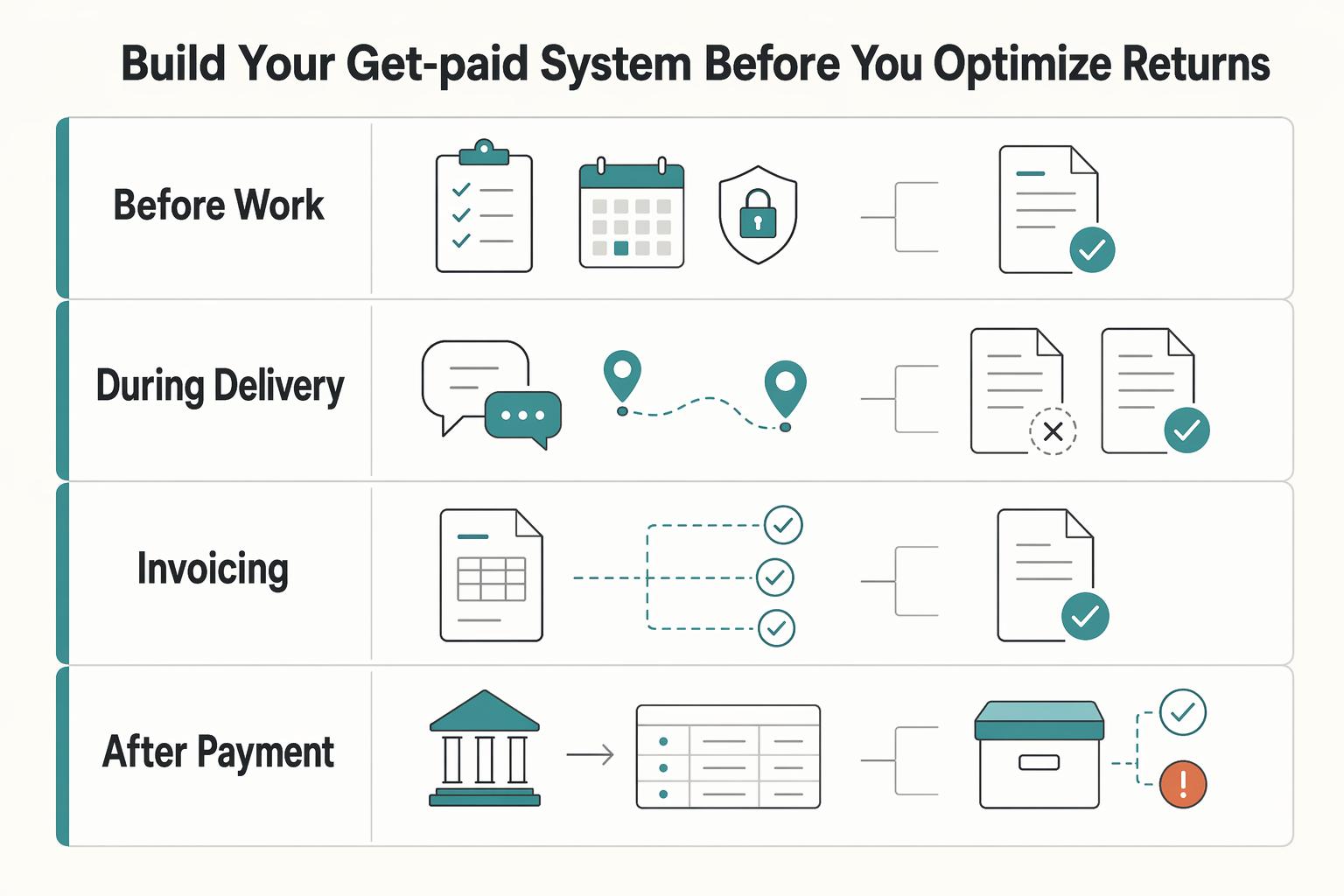
Build your get-paid system before you optimize returns#
If collections are loose, pushing harder on investing is premature. Before you optimize returns, tighten how you set terms, bill, collect, and document each invoice.
| Stage | Main action | Record check |
|---|---|---|
| Before work starts | Lock the scope or contract version, rates, and timing | Confirm whether payment depends on deposits or milestones |
| During delivery | Keep acceptance or delivery proof for each billed milestone | Do it as the work happens |
| At invoicing | Use a unique invoice ID and explicit due date | Make sure the billed item matches the agreed scope version |
| After payment | Match the settlement to your journal and ledger trail | Confirm the supporting records are complete |
Set payment terms before work starts: scope, rates, payment timing, deposits or milestones, and late-fee language. A common failure mode is letting scope drift in messages while the invoice still points to an older version. If the work changes after it starts, update the version tied to the invoice instead of relying on memory or scattered messages. That reduces cashflow risk and makes follow-up clearer if payment slips.
Run each invoice through the same four stages:
- Before work starts: lock the scope or contract version, rates, timing, and whether payment depends on deposits or milestones.
- During delivery: keep acceptance or delivery proof for each billed milestone as the work happens.
- At invoicing: use a unique invoice ID and explicit due date, and make sure the billed item matches the agreed scope version.
- After payment: match the settlement to your journal and ledger trail, then confirm the supporting records are complete.
At each stage, you are trying to remove ambiguity before it turns into follow-up work. If the scope version, delivery proof, and invoice details line up, collection stays simpler. If they do not line up, both sides may end up rebuilding what was agreed and what was delivered before payment can move cleanly.
Choose payment rails by failure mode, not habit. Card disputes can turn into chargebacks that pull funds from your account. Bank transfers using virtual account numbers can improve reconciliation and help avoid exposing your real account details, where supported. The point is not to pick whatever sounds modern. It is to choose the rail whose risks you understand and whose records you can keep clean.
For cross-border work, evaluate a Merchant of Record when payment, tax, fraud, or dispute operations are slowing collections. An MoR acts as the seller of record and can take on those responsibilities, with the tradeoff of less direct control. That tradeoff should be deliberate. If back-office tasks are delaying cash, eating too much follow-up time, or creating repeated errors, handing off part of the process may solve an operating problem, not just an administrative one.
Treat every invoice as a dispute packet from day one. Keep:
- Signed scope or contract version tied to the invoice
- Unique invoice ID and explicit due date
- Acceptance or delivery proof for each billed milestone
- Communication timeline showing what was delivered and when
- Journal and ledger trail with matching supporting records
Before you mark an invoice fully closed, check that the contract or scope version, delivery proof, communication trail, and journal entry all tell the same story. If something is missing, fix it while the file is still fresh instead of leaving it for later cleanup.
This approach makes month-end cleaner because you are not rebuilding the story of an invoice after the money lands. A paid invoice with weak records can still turn into a problem later. A paid invoice with complete records is easier to defend, reconcile, and close.
Before moving funds to long-term accounts at month-end, sample recent paid invoices for evidence completeness and matching journal entries. If something is missing, fix that first, then transfer. This is an important checkpoint. Cash arriving in the account does not automatically mean the business work is finished. The invoice should be settled, documented, and traceable.
Keep this sampling step simple: confirm that money marked as paid is also supported well enough to be treated as finished business cash. If the sample keeps exposing the same missing proof or matching error, tighten the process upstream rather than accepting the cleanup as normal.
Also assign one clear owner per invoice for collection follow-ups. Even if that owner is you, make it explicit. Shared responsibility often turns into no responsibility, especially when several invoices are moving at once. Ownership also matters when a client says payment is coming soon. Without an owner, those updates can sit in messages until the month closes. With an owner, there is a next action, a checkpoint, and a record of whether the collection is actually moving. Once collections and records are tight, the monthly cash-routing order becomes much easier to follow.
Route every payment in a fixed monthly order#
A fixed routing routine turns discipline into something you can actually repeat. Pick one order for verifying, holding, and investing cash, then follow it every month.
| Condition | Transfer approach |
|---|---|
| Reserve is below target | Direct more cash there and reduce investing transfers |
| Reserve stays stable through a normal cycle | Increase automated investing in small steps |
| Collections slip and core costs tighten | Scale transfers down and reset next month |
Keep money in purpose-specific accounts, such as operating, tax, reserve, and investing, so short-term obligations are not confused with long-term money. The exact layout matters less than the separation. At a glance, you should be able to tell which money is available, which money is already spoken for, and which money is truly safe to invest.
In practice, you should not have to mentally subtract taxes, pending obligations, or reserve needs every time you look at a balance. The structure of the accounts should do part of that work for you. When the balances are separated clearly, the investing decision becomes a smaller final step instead of a constant judgment call.
The sequence can stay simple: verify that paid invoices and internal records agree, ring-fence money for near-term obligations, then send the remainder to long-term accounts. The exact percentages matter less than the order and the rules around it. Apply the same logic in both good months and thin ones.
Write the rules down and apply them consistently:
- If your reserve is below your target, direct more cash there and reduce investing transfers.
- If your reserve stays stable through a normal cycle, increase automated investing in small steps.
- If collections slip and core costs tighten, scale transfers down and reset next month.
Keep the handoff between steps explicit. Money is not extra just because it arrived. It becomes available for the next step only after the related invoice is verified and the near-term buckets are topped up according to your rules. That small discipline is what keeps a strong collections run from turning into a weak month-end.
This routine does more than improve the numbers. It removes a lot of emotional decision-making. In a strong month, it keeps you from treating temporary cash as permanently free. In a weaker month, it shows you exactly what to protect first instead of making every transfer feel negotiable.
Before moving money to long-term accounts, run a monthly check that paid invoices and internal records match. If records are incomplete, hold the transfer until the mismatch is fixed. It is much easier to delay one transfer than to unwind a decision later because the supporting records were still unclear.
If the check shows a mismatch, write down exactly what is missing before you move on. A vague note to fix records later is how small gaps turn into recurring exceptions. A clear note with owner, status, and next action keeps the delay contained.
That monthly order only works if recurring exceptions get caught early instead of being normalized. The next step is making sure the same preventable problem does not keep draining your reserve.
Prevent the failures that derail freelancer FIRE#
Most FIRE setbacks are not caused by one dramatic event. They come from the same operational miss repeating until your reserve and investing rhythm get reset.
As a freelancer, you are running a business, so treat recurring issues as risk, not noise. Keep a monthly log and escalate patterns that repeat:
- Client delays that keep slipping past agreed terms
- More disputes or chargebacks tied to similar work
- Contract exceptions made after work has started
Review the log for clusters, not just isolated notes. If the same client type, service type, or handoff point keeps appearing, the correction usually belongs in the process rather than in an isolated apology or reminder. The fix may be clearer scope wording, earlier follow-up, or stricter alignment between what was approved and what was billed.
The key question is not just whether something went wrong. It is whether the same kind of problem keeps showing up. One delayed payment may be a client event. Repeated delays can point to weak terms, poor follow-up, or clients whose payment behavior does not fit your current setup. One dispute may be isolated. Repeated disputes tied to similar work usually mean something in scope clarity, delivery proof, or milestone acceptance needs to be tightened.
When onboarding a payment provider or program, complete required checks early and keep your business details consistent across documents and accounts. If setup is still in progress, route important collections through channels that are already active. That reduces the chance that a key payment gets stuck in avoidable setup friction.
If you pay collaborators, run payouts through a controlled batch process with clear review and approval. Track each payout line, and if a payout fails, reconcile settled entries before retrying only the failed lines. That keeps settled and unsettled items separate and makes cleanup much easier when something does not go through as expected.
Use an internal same-day incident rule for unmatched deposits, held funds, or failed payouts:
- Log the issue the day it appears.
- Capture the core details (ID, amount, date, status, owner).
- Send a follow-up and set the next checkpoint.
The same-day part matters because details are easiest to confirm while the issue is fresh. If the same issue appears twice, treat it as a process problem and tighten the process until the pattern stops. That could mean revising a template, clarifying an approval step, or changing who owns a follow-up. You are not trying to create perfect operations. You are stopping the same preventable issue from draining cash again.
Keep the log useful after the immediate issue is resolved. Close the item only when the cash, records, and owner notes all agree on what happened. Otherwise the same mismatch can resurface at month-end, when it is harder to tell whether the problem was fixed or merely deferred.
The same discipline applies to tax and compliance records, which are much easier to manage as you go than to rebuild later. If residence and mobility rules are also part of your setup, read Japan Digital Nomad Visa 2026 Planning Runbook.
Build tax and compliance records as you go#
Year-end is too late to build a clean tax file. Treat tax and compliance records as an operating routine, not a cleanup project.
Set up tax-document intake at the start of each client file and store accepted copies with invoice records. If W-8 or W-9 details are requested in your process, collect them early and log where the final versions live. The practical point is simple: if a form matters to the file, its location should not depend on memory or an email search.
For U.S. citizens or resident aliens living abroad, keep FEIE tracking active all year. Worldwide income is still reported on a U.S. return, and the exclusion applies only to qualifying individuals with foreign earned income. Use Form 2555 for the FEIE calculation, and track eligibility evidence such as the physical presence path (330 full days in 12 consecutive months).
That tracking is much easier when income records and travel records stay connected. If you are relying on FEIE-related tracking, keep travel-day logs in the same yearly control record that holds income by country and period. That way, settlement dates, invoice IDs, and travel evidence sit in the same file instead of separate places that need to be reconciled later.
Use one dated checkpoint file per tax year. Include:
- Income by country and period, tied to invoice IDs and settlement dates
- Travel-day logs used for FEIE eligibility checks
- FEIE, FBAR, and 1099 items flagged as "confirm with a qualified advisor"
- W-8 or W-9 request dates and accepted-copy locations (when applicable)
- International B2B invoice records where VAT validation was requested, with stored proof
Think of this file as the place where timing questions get answered without guesswork. If you need to confirm when income settled, which country it relates to, whether a form was requested, or what proof was stored, you should be able to follow a clear trail instead of checking disconnected folders.
Use that file as a working control document, not just a storage folder. If an item is incomplete, uncertain, or waiting on confirmation, flag it there rather than making an assumption and forgetting about it. That applies to tax forms, invoice support, travel logs, and validation proof. A frozen assumption is much easier to track than an unspoken one.
Be careful with annual FEIE limits. IRS materials can show conflicting 2025 figures, while 2026 is listed as $132,900 per person; verify the current filing-year amount before filing. Also, Form 2555 cannot exclude or deduct more than your foreign earned income for that year.
If records are incomplete at month-end, freeze the related assumption, log the gap the same day, and assign follow-up with a due date. Update the checkpoint file when cash settles so fixes stay small and verifiable. This is especially useful when timing crosses months. The invoice may have been issued earlier, the cash may settle later, and the tax record still needs one clear place where the timeline is visible.
That habit prevents treating an estimate as final and forgetting why a number or status looked unusual later. A dated note that says what is known, what is missing, and who owns the follow-up is often enough to keep a small issue from turning into filing-season reconstruction.
Keep this lightweight, but keep it current. Small updates made as you go are easier to trust than a large reconstruction later. Once records, reserves, and cash buckets stay current, automating investing becomes much safer.
Automate investing only after operations are stable#
Automation helps only after the business side stops surprising you. If collections, reserves, or tax routines are still unstable, automated transfers can force reversals and wipe out the benefit.
Use broad-market, low-cost index funds or ETFs, and fund them only after reserve and tax buckets are current. That supports the larger goal of building enough assets to cover living expenses over time. The investing side should feel boring. If every transfer still depends on a last-minute check of whether taxes, reserves, or records were shorted, the setup is probably not ready for bigger automation.
Stable does not mean perfect. It means the same monthly order is working without frequent reversals, the reserve is doing its job, and routine record fixes are small rather than disruptive. When those conditions hold, automation saves effort. When they do not, automation can leave you unwinding multiple decisions at once.
Choose account wrappers intentionally. If you are eligible for an IRA, pre-set how recurring contributions are split between IRA and taxable accounts. If you receive paid, personalized guidance on IRA moves, ask whether the adviser is acting in an investment-advice fiduciary role. The practical value of deciding this early is that money has a destination before it moves, instead of sitting in a gray area while you decide later.
Keep contribution rules conservative to reduce whiplash. Size recurring transfers from recent baseline income, not a single strong payment, and scale down when reserve targets slip. If the recurring amount keeps feeling too large whenever one client pays late, that is useful information. It usually means the transfer is ahead of your operations, not that the whole plan is broken.
Review on a fixed cadence:
- Contribution consistency: did planned transfers settle?
- Reserve health: did your minimum buffer hold?
- Tax posture: were expected obligations ring-fenced?
- FIRE fit: does your plan still match real spending?
If the review keeps showing the same strain point, adjust there first. For some freelancers that means lowering the recurring transfer until late payments stop causing reversals. For others it means tightening collections before raising the transfer again. The investing system should follow operational reality rather than try to overpower it.
Treat automation settings as adjustable controls, not permanent promises. Keep the recurring amount small enough that one delayed payment does not force immediate unwinds. If one review line fails, adjust the transfer rather than pretending the setup is still working as designed. Stable automation should reduce friction, not create emergency cleanup.
That sequence resolves most of the practical issues. The questions below cover the points freelancers tend to second-guess most often.
Conclusion#
FIRE is a useful framework, not a guarantee. For freelancers, the version that lasts is the one built around cashflow reality, not a clean spreadsheet month.
Lean FIRE may fit lower expenses. Fat FIRE may buy more room later, but it asks for a larger target. Coast FIRE can reduce pressure later by asking more of you earlier. Whatever version you choose, it has to survive ordinary friction: uneven months, delayed payments, recordkeeping gaps, and changes in spending.
Use one monthly review before increasing contribution cadence:
- Confirm what you actually saved this month, not what you expected to save.
- Check whether your spending still matches the lifestyle your FIRE target assumes.
- Review progress toward your financial-independence number and note what changed.
- Reassess whether your plan still feels financially comfortable for you.
- Increase automated investing only if the first four checks pass.
If one area is weak, pause expansion and repair that link first. That might mean tightening invoice records, protecting your reserve, cleaning up tax tracking, or reducing a transfer that no longer fits the month you actually had. Over time, steady execution beats intensity.
Frequently Asked Questions
What is the FIRE movement for freelancers in one sentence?
For freelancers, FIRE (Financial Independence, Retire Early) is an approach centered on disciplined budgeting, saving, and investing to reach financial independence earlier than traditional retirement timelines. The core idea is not one perfect formula; it is personalized and sustained over time.
Can freelancers realistically pursue FIRE with irregular income?
Potentially, yes. FIRE is often described as flexible rather than one strict template, so freelancers may need to adapt the pace and structure to variable cash flow.
Which is better right now: Lean FIRE, Fat FIRE, or Coast FIRE?
There is no single best variant. FIRE is commonly presented as personalized: Fat FIRE is typically framed as pursuing earlier retirement with fewer lifestyle sacrifices but aggressive saving and investing, while one source describes Coast FIRE as very low spending (about $25,000 per year or less) with heavy investing. Lean FIRE definitions can vary by source.
What should come first for freelancers: a better payment setup or more investing?
This guide does not set a single order for freelancers. What they do emphasize is sustained budgeting, saving, and investing habits, so prioritize the sequence you can keep consistent.
How do payment terms and chargeback risk change a FIRE timeline?
Consistent budgeting, saving, and investing are central to FIRE progress.
What are the most common mistakes that delay FIRE for freelancers?
Treating FIRE as one rigid formula is a common mistake. Another is underestimating how much ongoing budgeting, saving, and investing discipline FIRE requires.
Try a related tool
Researched and edited by the Gruv editorial team. Gruv builds cross-border billing, payouts, and finance-operations software for global businesses.
Sources
Includes 1 external source outside the trusted-domain allowlist.
Educational content only. Not legal, tax, or financial advice.
Related Posts

Japan Digital Nomad Visa 2026: Six-Month Planning Runbook
Treat this as your operating model: identify the right mission first, commit to one route, and keep dated records before you make irreversible plans. That is what keeps the rest of your timeline, paperwork, and decisions coherent.
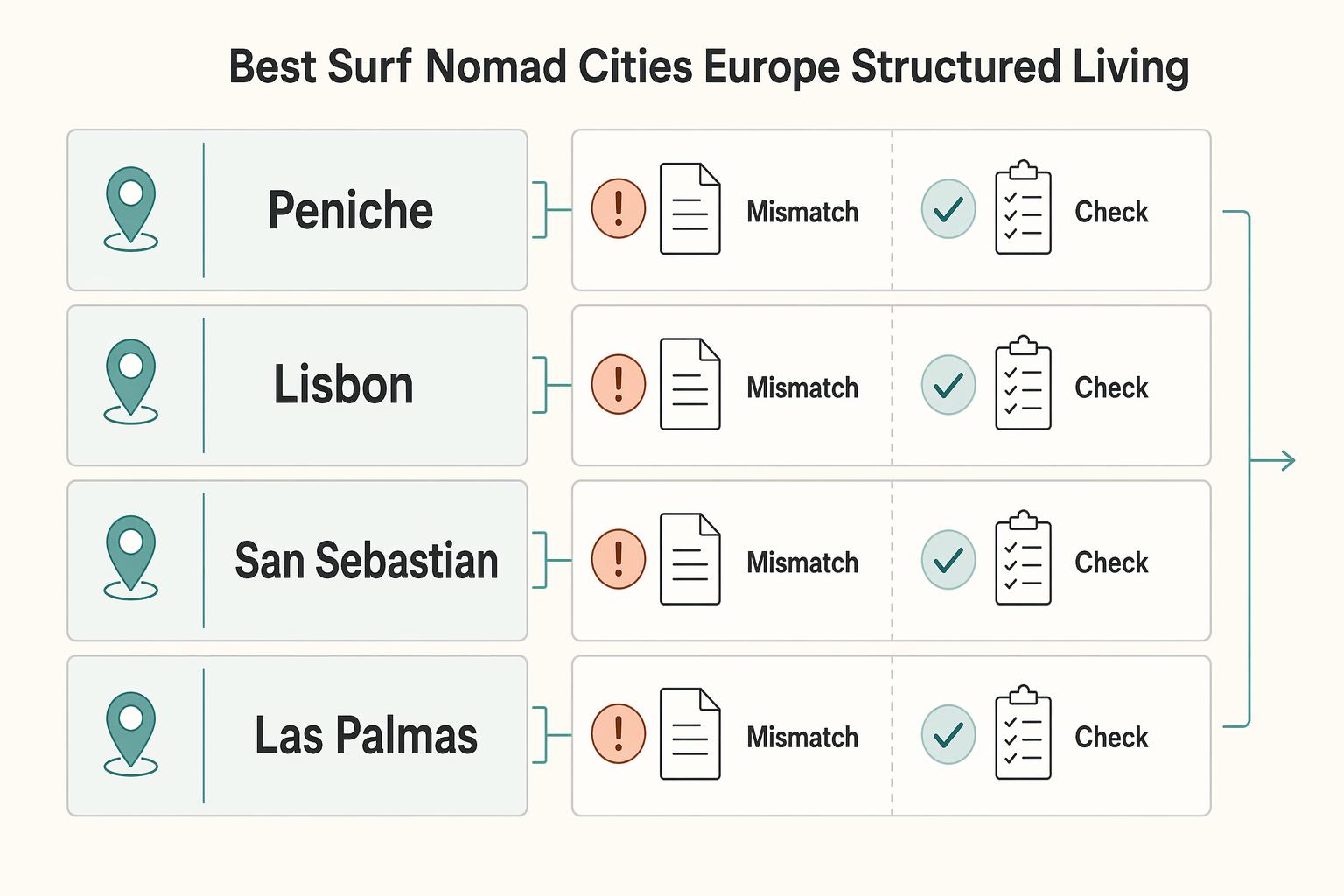
Best Nomad Cities for Surfing You Can Actually Work From
Most roundups of the best nomad cities for surfing blur two different choices: where to take a great surf trip and where to sustain a stable month of work. If your income depends on steady output, make the work-and-life call first and the destination call second.

The Freelance Payment Penalty: A Modeled Audit of Platform Fees, FX Spreads, and Payout Delays
The money rarely disappears through a single, easy-to-spot fee. The real loss is stacked. A marketplace takes its commission, a processor adds a charge for international cards, a bank or payment company converts the currency at a spread, a platform holds the funds before release, and a wire sheds a little to intermediaries on the way in. Each layer looks defensible on its own, but the worker feels the combined result as a smaller deposit and a later payday.