
Quick Answer
Build W-9 collection at scale as a control system, not a reminder process. Route payees into the correct tax lane first, collect a completed Form W-9 with the required certification, run TIN and status checks, and then decide payout state with documented ownership. Keep exception categories explicit and require approval artifacts for any conditional release. You should be able to reconstruct one payee record from onboarding through Form 1099 treatment without stitching data across disconnected tools.
Why W-9 Collection Gets Hard at Scale#
High-volume contractor payout programs can break on control gaps, not because they lack another tool. W-9 collection is easier to defend when you can show three things clearly: who was routed into the U.S. onboarding path, what tax data they submitted, and why payment was allowed or held.
The goal is not to build a heavy process for its own sake. It is to reduce downstream tax reporting risk, avoid preventable tax-handling problems, and keep onboarding fast enough that growth does not turn into a year-end cleanup project. In practice, that means treating tax-form collection as an operational control, not a document you chase after the first payout.
A useful checkpoint is simple. Before payout enablement, confirm the payee is in the right tax lane and that the submission record is complete enough to support follow-up if something later fails.
Scope matters as much as speed. This U.S. contractor workflow assumes the payee is a U.S. person. If that status is uncertain, pause the W-9 route and send the case for review of the appropriate documentation, including the applicable Form W-8 where relevant.
For operators, the recommendation is straightforward. Draw the line between your U.S. Form W-9 path and your non-U.S. review path early, and keep evidence of that decision. A common failure mode is letting onboarding, tax classification, and payout release sit in one queue with no clear checkpoint or owner. That may feel efficient for a week, but it can create missing records, late exception handling, and filing-season surprises that are hard to defend later.
Related: Payee Verification at Scale: How Platforms Validate Bank Accounts Before Sending Mass Payouts covers the bank-account verification side of contractor onboarding.
Define the minimum control system and scope#
Before you automate anything, lock down the minimum controls as internal policy. For W-9 collection at scale, treat tax-data intake, review, and payout release as connected controls rather than cleanup after first payout.
| Control domain | What it covers |
|---|---|
| Intake | who collects required tax data and certifications |
| Validation | who reviews data consistency and exceptions |
| Storage | where records are retained and which version is authoritative |
| Access | who can view or update tax data |
| Reporting and escalation | who decides whether exceptions affect payout or downstream Form 1099 handling |
Define routing boundaries early. Keep one documented path for U.S.-person cases and a separate review path for foreign payees. State who decides the tax-document route, what evidence supports it, and when a payout is held for review.
From there, define five control domains and assign a named owner for each:
- Intake: who collects required tax data and certifications
- Validation: who reviews data consistency and exceptions
- Storage: where records are retained and which version is authoritative
- Access: who can view or update tax data
- Reporting and escalation: who decides whether exceptions affect payout or downstream Form 1099 handling
The biggest scope mistake is applying U.S. payee rules to non-U.S. cohorts. Publication 515 covers withholding and documentation for foreign persons; route those cases to the appropriate tax review instead of forcing a W-9.
Set ownership and escalation before you automate#
Set named ownership first, then automate. For W-9 collection at scale, you need clear accountability for three decisions: onboarding completion, tax exception clearance for Form 1099 reporting, and payout release.
Name an owner for each decision and record each handoff. If no one is accountable for clearing an exception, the payout team cannot tell which tax record governed the release.
| Decision area | Primary owner | Consulted | Payment effect |
|---|---|---|---|
| Vendor onboarding completion | Payments Ops | Compliance | Do not move to payable status when tax intake is incomplete |
| Tax information reporting exception review | Finance or Tax lead | Compliance, Legal (edge cases) | Keep open exceptions visible through reporting season |
| Payout approval for exceptions | Finance or designated approver | Payments Ops, Compliance | Release only after documented approval, or hold |
Define escalation triggers before launch so operators do not improvise. Common triggers are missing electronic signature, conflicting TIN data, and unresolved U.S.-status signals that may require a Form W-8 path. Treat these as internal stop conditions for tax/legal review before payment release, not as assumptions to clean up later.
Make escalation evidence mandatory: case notes, decision timestamp, approver identity, and a linked audit-trail artifact. Add a RACI-style handoff checkpoint between onboarding completion and Form 1099 prep so unresolved exceptions are explicitly accepted, owned, and traceable.
For a broader finance operations view, Finance Automation and Accounts Payable Growth: How Platforms Scale AP Without Scaling Headcount covers how teams scale payment workflows without adding the same amount of manual work.
Decide when to block payouts and when to allow conditional pay#
Use one payout decision standard for U.S. payees: default to block when a Form W-9 is missing, unsigned, or materially inconsistent, and do not rely on reminders or manual follow-up alone.
The three payout states below are an internal control design. They do not replace the backup withholding rules for reportable payments; resolve those rules before approving any release.
| Payout state | Form W-9 status | TIN status | Risk classification | Required action |
|---|---|---|---|---|
block | Missing, unsigned, or materially inconsistent | Failed, conflicting, or not yet verified where policy requires | Elevated or unresolved | Stop payout, open exception, assign owner, collect corrected record before release |
conditional | Substantially complete with a defined open issue | Pending review or limited mismatch allowed by policy | Known, bounded, approved exception | Resolve any statutory withholding obligation before release; document a narrowly approved exception for remaining policy issues |
clear | Complete and accepted | Passed or otherwise resolved per policy | Standard | Enable payout and retain validation evidence with the payee record |
Keep the conditional lane narrow#
Treat conditional as an exception lane, not a pressure-release valve. Limit it to written policy cases, require a named approver and expiration, and define the next action to cure the record or reroute the case.
If a submitted record conflicts with what you already hold, route it to review. A policy exception cannot waive backup withholding where the law requires it. Before any permitted release, resolve withholding treatment and keep the submitted W-9 version, validation result, approver, timestamp, and exception rationale together.
Align payout controls across existing gates#
Avoid split decisions across separate queues. If your platform already uses payout gates for other controls, align statuses so one owner-facing decision determines whether funds can move.
At final pre-release review, confirm accepted W-9 status, TIN validation status, and payout risk state together. If those fields sit in different tools, require a single approval artifact or status snapshot so a hold in one lane cannot be missed in another.
Design the intake and validation sequence for Form W-9#
Use a strict intake order if you want fewer downstream tax exceptions: collect the electronic Form W-9, capture the electronic signature on that version, then run TIN and U.S.-status checks before payout enablement. The IRS does not prescribe one exact onboarding sequence, so this order is an internal control choice designed to keep evidence and decisions defensible.
You are not only collecting a form. You are deciding whether a submitted record is complete enough to support payout release and later tax information reporting.
Put the signed record before validation#
Validate only after you have a signed submission artifact. Publication 1099 (2026) includes "Electronic submission of Forms W-9," which supports digital intake, but it does not define your internal step order.
In practice, prevent payees from reaching payout-ready status from typed profile fields alone. Capture the electronic Form W-9, bind the electronic signature to that version, store the timestamp, and then run validation and routing checks. If your record cannot reproduce the exact signed version later, your audit trail is weak.
Keep logs thin and the source record controlled#
Treat masking, role-based access, and encrypted retention as control design choices, not IRS-prescribed architecture in this context. IRS materials here support electronic submission and recipient-statement workflows, not a specific storage model.
Keep logs limited to what operators need to resolve cases. Show masked values and status fields broadly, and restrict unmasked records to the smaller group handling tax exceptions. Maintain one controlled source record so teams are not resolving conflicts across multiple exports.
Make retries idempotent and status checkpoints explicit#
Make retries idempotent so dropped sessions, duplicate calls, or timeouts do not create duplicate tax profiles or conflicting statuses. Reuse the same submission key unless a new signed W-9 version is intentionally created.
| Checkpoint | Required record |
|---|---|
| Submission received | signed electronic Form W-9 artifact stored, timestamped, and linked to the payee |
| Validation passed or failed | results attached to that specific submission version |
| Exception opened or closed | owner, reason, and resolution timestamp recorded against that same record |
| Handoff ready for tax information reporting | accepted record marked usable for Form 1099 preparation, with validation evidence retrievable for your filing channel, including IRIS if you use it |
Track explicit checkpoints:
- Submission received: signed electronic Form W-9 artifact stored, timestamped, and linked to the payee.
- Validation passed or failed: results attached to that specific submission version.
- Exception opened or closed: owner, reason, and resolution timestamp recorded against that same record.
- Handoff ready for tax information reporting: accepted record marked usable for Form 1099 preparation, with validation evidence retrievable for your filing channel, including IRIS if you use it.
The tradeoff is straightforward: tighter sequencing adds onboarding friction, but loose sequencing creates year-end ambiguity about which W-9, which validation result, and which payout decision actually governed the payee.
Keep the approved tax status and payout decision linked so a later correction can be traced to the payment it affected.
Handle the exception cases competitors usually skip#
Define exception states up front and tie each case to the exact signed Form W-9 version reviewed, or your queue becomes inconsistent and hard to trust.
| Exception state | Definition |
|---|---|
| Missing W-9 | No signed Form W-9 artifact is on file for a payee in your U.S.-person path. |
| Invalid TIN | The submitted TIN did not pass your validation step; keep that result attached to that submission version. |
| Conflicting legal name | The name on the tax submission conflicts with prior identity, contract, or existing payee data. |
| Stale certification | The certification no longer matches the currently payable profile or entity and should be re-collected under your policy. |
| U.S.-status mismatch (W-8 review needed) | Intake started as W-9, but the profile should be routed to Form W-8 review; freeze the W-9 path and reroute. |
- Missing W-9
No signed Form W-9 artifact is on file for a payee in your U.S.-person path.
- Invalid TIN
The submitted TIN did not pass your validation step; keep that result attached to that submission version.
- Conflicting legal name
The name on the tax submission conflicts with prior identity, contract, or existing payee data.
- Stale certification
The certification no longer matches the currently payable profile or entity and should be re-collected under your policy.
- U.S.-status mismatch (W-8 review needed)
Intake started as W-9, but the profile should be routed to Form W-8 review; freeze the W-9 path and reroute.
When profile data conflicts with prior identity records, escalate for enhanced review: use KYB for entity context and KYC for individual context as your internal risk control.
Set internal SLA and aging rules for open exceptions so unresolved cases automatically change queue priority and payout permissions instead of relying on manual follow-up.
Before closing an exception, record the form version reviewed, the review date and owner, and the submission artifact that supports the decision.
Track repeat exception patterns by onboarding source. Faster closure helps operations, but recurrence by source is what shows whether your intake controls are actually improving.
Keep evidence audit-ready from onboarding through filing#
Your process is only audit-ready if you can trace one payee record from onboarding to payout to Form 1099 output without gaps. Treat evidence capture as part of each control, not as year-end cleanup.
The IRS permits electronic Form W-9 systems when they meet its requirements for information capture and any required electronic signature. Keep the submitted version, review result, and payout decision linked so the record can be reconstructed later.
| Control point | Evidence to retain | Audit check |
|---|---|---|
| W-9 submission | Signed submission artifact for the reviewed version, with timestamp and payee link | The accepted artifact is the one tied to the active payee record |
| TIN validation | Validation outcome linked to that same submission version | The status history is preserved across retries and updates |
| Role-based access | Access history for viewing or changing tax data | Access behavior aligns with your internal role model |
| Exception resolution | Decision log, change history, and approval record | Closure rationale and approver trail are clear and retrievable |
A common failure is broken linkage between systems: intake evidence in one tool, validation in another, approvals somewhere else. When that linkage breaks, teams struggle to prove that the approved tax record is the one that drove payout and Form 1099 treatment.
Limit access to submitted tax records, preserve the version used for each decision, and test whether reviewers can retrieve the evidence without exposing TINs in general-purpose logs.
Test evidence retrieval quarterly as an internal operating discipline so failures surface before filing season.
Choose tooling with decision criteria not feature slogans#
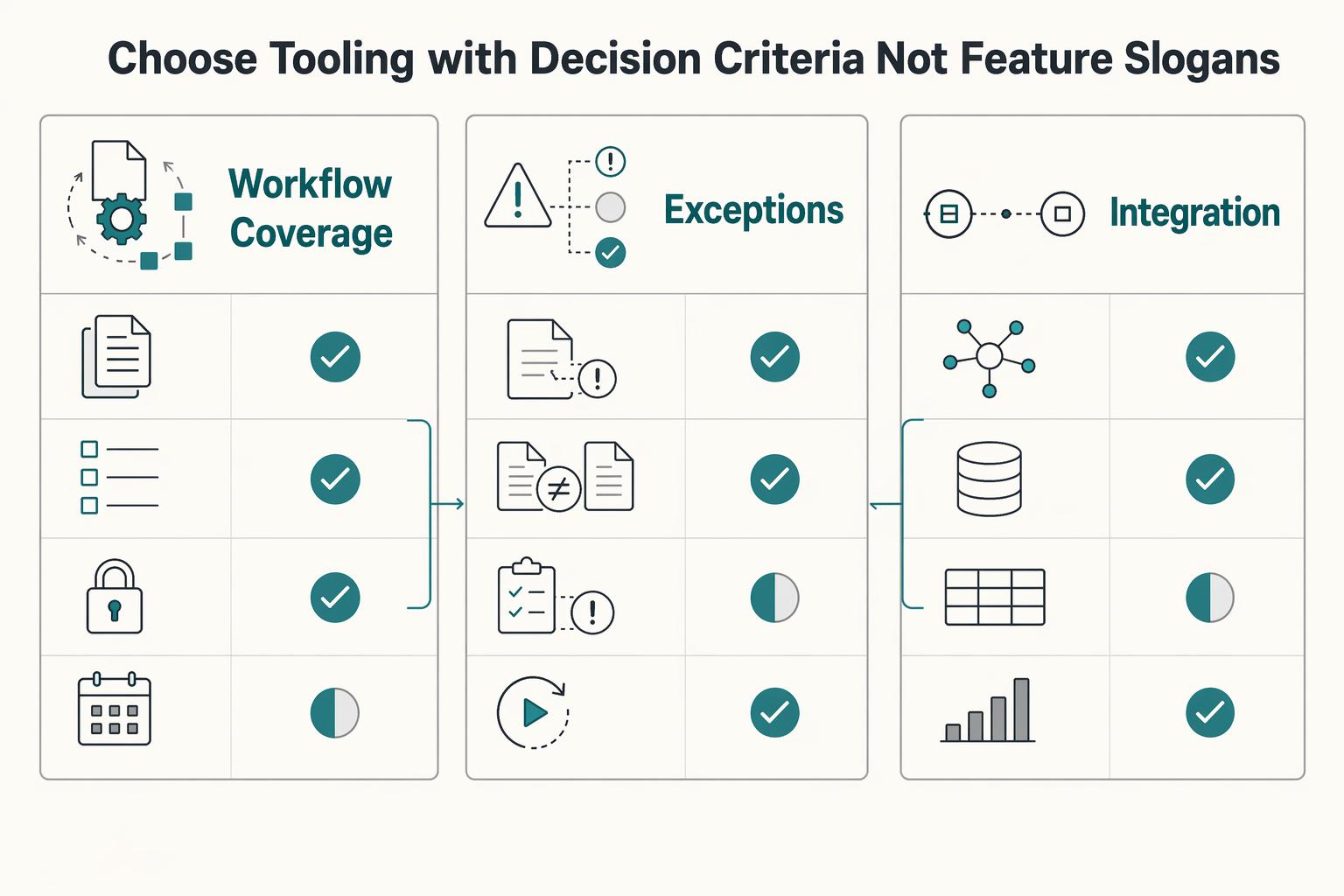
Choose the tool that supports your full Form W-9 control workflow, not just Form 1099 output. Businesses use W-9 data to complete Forms 1099-NEC and 1099-MISC, so a strong filing screen does not reduce risk if intake, validation, exceptions, and payout gating are disconnected.
Use a criteria matrix (for example, a Pugh-style scorecard) so options are judged against explicit requirements, not demo polish.
| Evaluation area | What to verify in the demo or sandbox | Red flag |
|---|---|---|
| W-9 workflow coverage | Can one payee record stay linked from W-9 submission through validation, approval, and 1099 reporting? | The flow starts at 1099 output and cannot show upstream control history |
| Audit trail and exception handling | Can you retrieve reviewer actions, timestamps, case status, and closure rationale for a single payee record? | Evidence is split across screens or cannot be exported as one record |
| Integrations and policy gating | Do API/webhook status changes feed payout controls and exception queues in your operating flow? | Tax status changes do not drive payout or exception decisions |
Ask vendors to walk through awkward scenarios, not just happy paths: mixed Form W-8/Form W-9 operations, resubmissions, and multi-entity reporting. Also treat unknowns as selection signals, especially implementation effort, edge-case handling, and reporting limits after go-live.
A useful demo ends with one exported payee record, including the signed form version, review history, exception decision, and reporting status.
Conclusion#
The durable win here is not faster chasers or prettier intake screens. It is a control set you can defend when someone asks what you collected, what you checked, what you decided, and why money was or was not allowed to move.
The IRS 2026 General Instructions for Certain Information Returns cover recipient names and TINs, backup withholding, and penalties alongside Form 1099 filing. Those controls start before the year-end return is prepared.
The practical test is evidence. Do not assume a specific W-9 decision table or audit-trail design is required, but recipient/TIN handling, backup withholding, and penalties do sit in the same compliance scope. If a control cannot clearly show what was submitted, what was checked, what exceptions were raised, and the resulting Form 1099 handling, treat that control as incomplete. A fast operation that cannot reconstruct one payee record without stitching together inboxes, screenshots, and memory is fragile, even if it feels efficient in normal weeks.
Your next move should be sequence, not shopping. First define your decision states for your program. Then define exception categories so materially different issues do not all collapse into a generic "needs review" bucket. After that, build the evidence checklist that proves each decision. Tooling matters, but it should conform to those choices rather than quietly making them for you.
Tie each reporting rule to the exact payment type, form, and tax year. Do not borrow a threshold from another Form 1099 workflow and apply it to every contractor payout.
If you want a simple operator rule to leave with, use this one: when a payee file cannot show complete intake, a supportable check on tax data, and a documented resolution of any exception, do not call the process finished. Build the decision logic, evidence retrieval, and review path first. Then tune integrations, reminders, and filing tools around that foundation.
Frequently Asked Questions
What are the minimum controls required for W-9 collection at scale?
At minimum, you need a reliable way to collect Form W-9 (officially, the Request for Taxpayer Identification Number and Certification), retain the submitted record, and validate key tax data. You also need to track exceptions and connect finalized records to Form 1099 reporting when required.
When should we block payouts for missing or invalid Form W-9 data?
A payout hold is an internal policy choice. If backup withholding applies to a reportable payment because a required TIN or certification is missing or an IRS notice requires it, approval cannot waive that duty. Resolve the tax treatment before releasing a policy exception.
What records should we retain to be audit-ready for IRS review?
Keep the submitted W-9 record, when it was received, and any validation or correction history tied to downstream Form 1099 reporting. A practical checkpoint is whether you can produce one clear payee record from collection through reporting status. Also remember that the completed W-9 is provided to the requester and is not filed with the IRS by the person completing it.
How is workflow automation different from basic e-file tooling?
Basic e-file tooling mainly helps with Form 1099 output. Automation covers earlier control points too: routing U.S. persons to W-9, routing other payees to Form W-8, collecting Form W-9 electronically, and handling validation or correction workflows before filing season.
How do we avoid year-end Form 1099 scrambles?
Collect the appropriate tax form during onboarding. If your payer is eligible for IRS TIN Matching, check name and TIN combinations early and resolve mismatches before filing season.
How should we handle contractors who may belong on Form W-8 instead of Form W-9?
Use the routing rule supported here: requesters collect W-9 forms from U.S. persons and W-8 forms from other payees. If the profile shows mixed signals, pause automated routing and send it to tax or legal review before enabling payouts.
What should we verify before selecting a W-9 automation vendor?
Confirm the product can capture an electronic W-9 with any required certification and signature, route foreign payees to the appropriate documentation review, and export records for Form 1099 preparation. Test correction and access controls with a sample payee case.
Try a related tool
Researched and edited by the Gruv editorial team. Gruv builds cross-border billing, payouts, and finance-operations software for global businesses.
Sources
- irs.gov/instructions/iw9trusted
- irs.gov/publications/p1099trusted
Educational content only. Not legal, tax, or financial advice.
Related Posts

How Platform Teams Scale AP Volume Without Adding Headcount
Use this as a decision list for operators scaling Accounts Payable, not a generic AP automation explainer. In these case-study examples, invoice volume can grow faster than AP headcount when the platform fit is right, but vendor claims still need hard validation.
How Platforms Validate Bank Accounts Before Mass Payouts
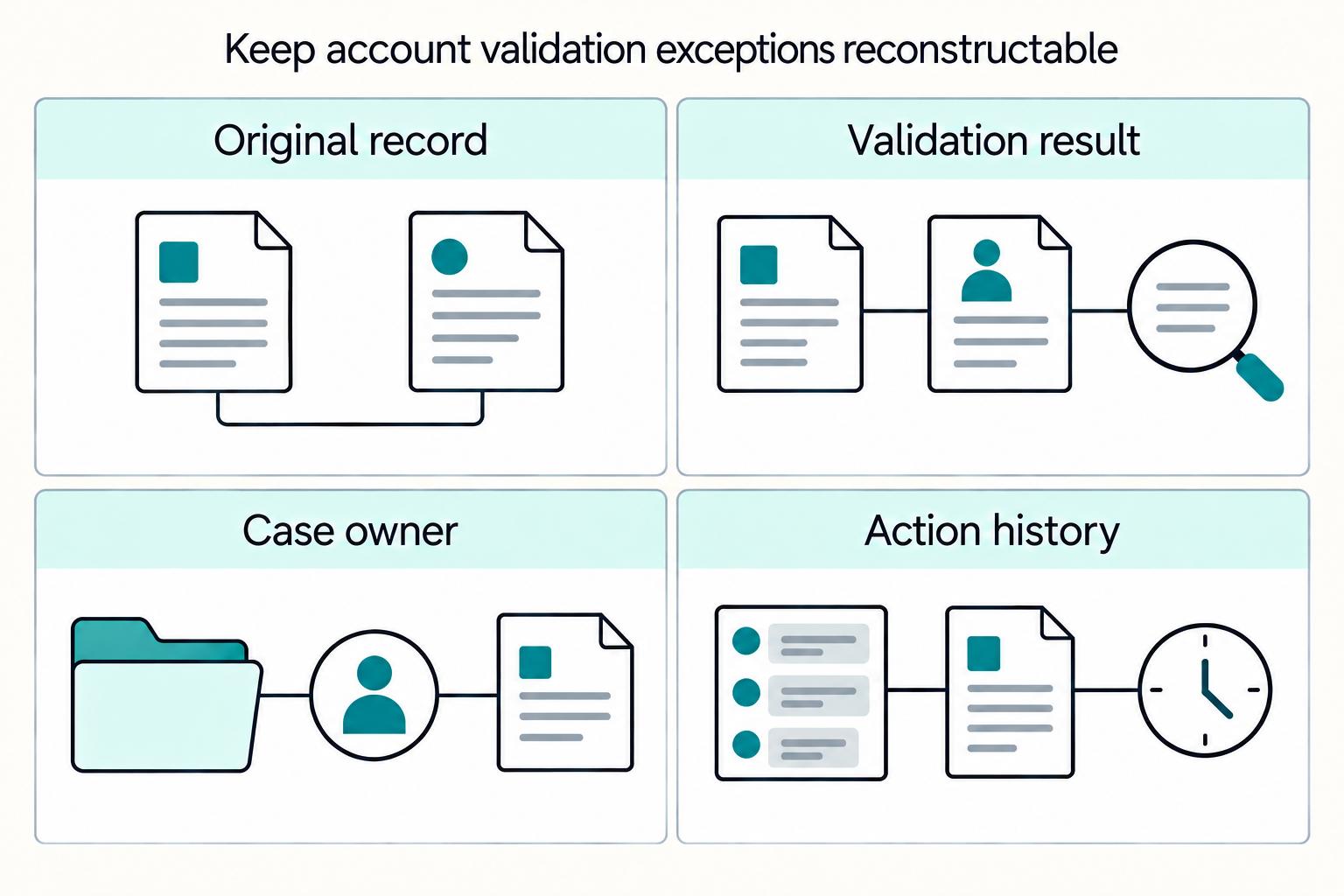
For mass payouts, the real question is not whether to verify payees. It is how much verification you require before release, who can override it, and what evidence you can produce later. If you cannot show that evidence on demand, your release rule is weaker than it looks.

The Freelance Payment Penalty: A Modeled Audit of Platform Fees, FX Spreads, and Payout Delays
The money rarely disappears through a single, easy-to-spot fee. The real loss is stacked. A marketplace takes its commission, a processor adds a charge for international cards, a bank or payment company converts the currency at a spread, a platform holds the funds before release, and a wire sheds a little to intermediaries on the way in. Each layer looks defensible on its own, but the worker feels the combined result as a smaller deposit and a later payday.