
Quick Answer
Pick your destination by the outcome you need most: creative contrast, decompression, perspective, or a low-friction reset. For practical planning, pair one primary stop with one fallback, then verify access rules before leaving Berlin. Use Sanssouci only if you can work with a fixed entry window through the sanssouci+ Combined Ticket, and treat Wannsee as the easiest flexible option because of S-Bahn access points like Wannsee, Schlachtensee, and Grunewald.
The Strategic Day Trip Matrix: An ROI-Based Guide to Berlin for Professionals#
Start with the outcome you want tomorrow, not the destination you can name today. If you are choosing among the best day trips from Berlin, the useful filters are simple: your energy level, how much planning effort you can tolerate, how much emotional weight you want to carry, and the kind of work waiting for you the next day. This matrix is built for same-day returns from Berlin only. Longer or overnight escapes are out of scope.
| Place | Pre-commit check | Article note |
|---|---|---|
| Potsdam | Whether the sanssouci+ Combined Ticket requires a fixed entry time | Treat it as a higher-effort day |
| Sachsenhausen Memorial and Museum | Seasonal hours and the Visitor Information Center window | Admission is free; Visitor Information Center: 8:30 am to 5:00 pm |
| Wannsee | Which S-Bahn stop best fits your route | You can jump on or off at Wannsee, Schlachtensee, or Grunewald |
If you want a visually rich change of perspective, Potsdam is a strong fit. The UNESCO-listed Palaces and Parks of Potsdam and Berlin span 500 ha and 150 buildings built between 1730 and 1916. If you want a slower nature reset, Spreewald is the cleaner fit, with more than 276 km of navigable channels and a trip style built around punting boats or canoeing.
The sections below flesh out each category with close substitutes. The right answer is often less about the headline destination and more about the kind of day you can actually carry through well.
How to use the matrix
- Pick the next-day outcome you need most.
- Match it to one trip type only.
- Do one booking and access check before you commit.
- Stop comparing and lock the plan.
That third step matters. Potsdam can require a fixed entry time through the sanssouci+ Combined Ticket, so treat it as a higher-effort day. Sachsenhausen Memorial and Museum has free admission, but you should still verify seasonal hours and the Visitor Information Center window of 8:30 am to 5:00 pm. For the lowest-friction option, Wannsee is forgiving because you can jump on or off the S-Bahn at Wannsee, Schlachtensee, or Grunewald.
Related: The Best Digital Nomad Cities in Eastern Europe.
Thesis I: For a Creative Infusion#
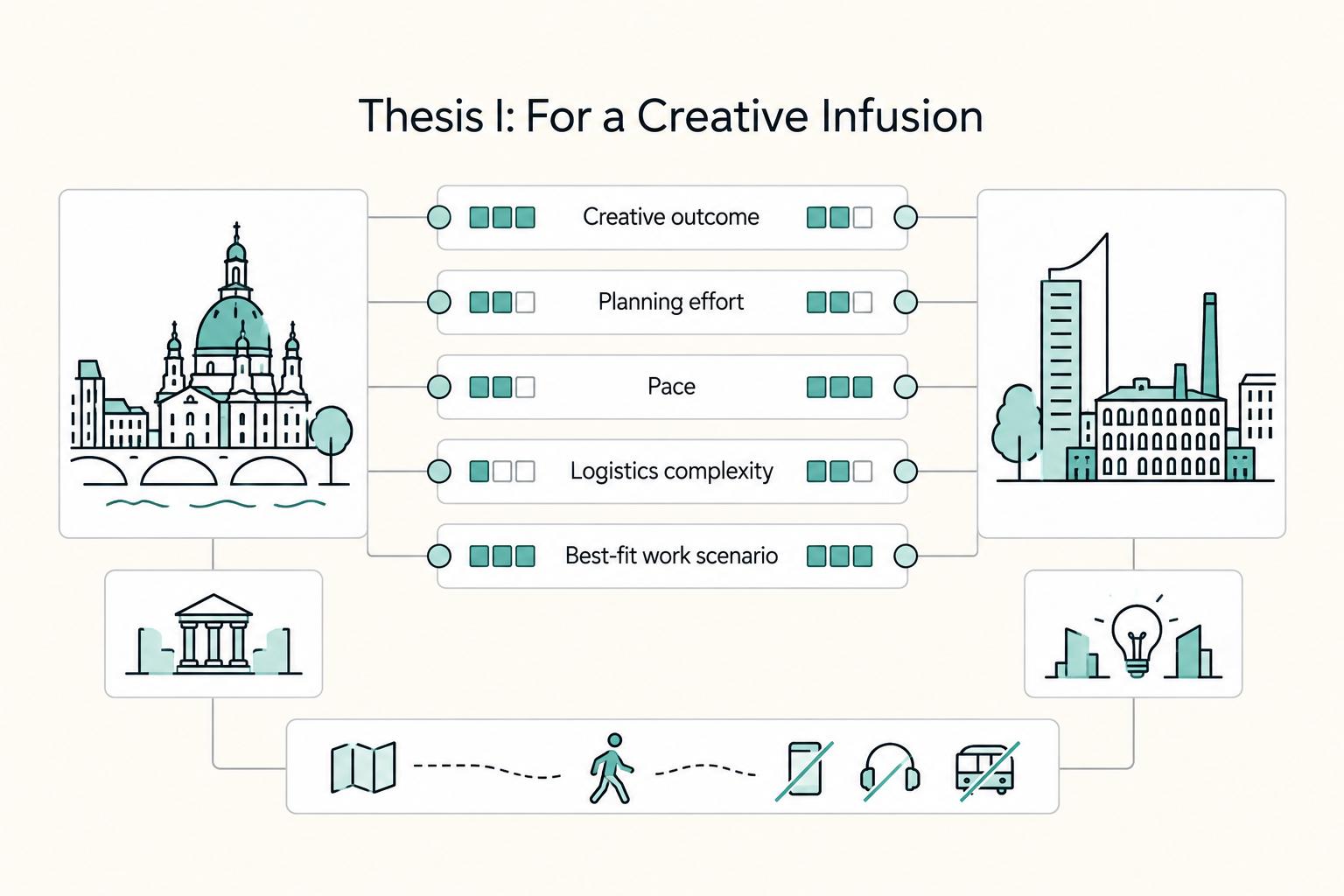
Choose Dresden when you need structure-driven inspiration. Choose Leipzig when you need disruption-driven inspiration. In both cases, keep the plan narrow and walk as much as possible: walking gives you more environmental input, while constant phone checks, headphones, and enclosed transport can narrow what you actually notice.
Before you compare stops, set your exact trip date first (Start date/End date), then build a two-stop day around one creative question.
| Criteria | Dresden (structure-first) | Leipzig (disruption-first) |
|---|---|---|
| Creative outcome | Use when you want clearer form, sequence, and editing judgment | Use when you want contrast, reframing, and new angles |
| Planning effort | Medium: one anchor stop + one nearby second stop | Medium: one anchor stop + one nearby backup |
| Pace | Slower, detail-focused | Looser, pattern-seeking |
| Logistics complexity | Verify current rail window; keep stops in one walkable zone | Verify current rail window; avoid cross-city zigzagging |
| Best-fit work scenario | Best when your work feels noisy and needs structure | Best when your work feels stuck and needs interruption |
Dresden#
Before you go, pick one anchor stop and one walkable second stop, save your route offline, and keep a simple fallback if access is blocked. Once you arrive, walk to the anchor first, keep your first block for observation rather than documentation, and delay your check-in window until after that block. If queues, closures, or routing friction appear, switch immediately to an exterior walk plus one indoor backup where you can capture notes. The main risk is not missing one venue; it is losing time to reactive rerouting and repeated app switching.
Leipzig#
Before you go, define one contemporary anchor and one indoor backup on a route you can cover on foot. Once you arrive, protect one uninterrupted focus block before any messages, then run a short, operational-only check-in window later in the day. If transit or access friction hits, keep moving on foot in the same zone instead of rebuilding the whole plan midstream. Before you return to Berlin, capture a short handoff note (key image, key phrase, one work problem, one next action) so the day converts into usable output instead of context-switch overload.
You might also find this useful: The Best Digital Nomad Cities for History Buffs.
Thesis II: For Deep Decompression#
If your mind feels overloaded and you want a lower-effort reset, choose Spreewald. If your thoughts keep looping and you need movement to reset, choose Saxon Switzerland. Decide based on your current mental state and effort tolerance, then keep the day simple.
| Option | Decompression style | Sensory load | Planning complexity | Connectivity expectation | Best-fit workweek context |
|---|---|---|---|---|---|
| Spreewald | Quiet, low-intensity decompression | Low to moderate | Medium | Assume delayed replies unless you verify current coverage | Better after a call-heavy or screen-heavy week |
| Saxon Switzerland | Movement-based decompression | Moderate to high | Medium to high | Assume partial offline periods unless you verify current conditions | Better when stress feels physical and restlessness is high |
| Transit window | Verify current rail window | Verify current route load | Verify current disruption risk | Verify current network assumptions | Verify your return buffer before committing |
Spreewald#
Choose Spreewald when your priority is less input and fewer decisions. The goal is a quieter pace, not a packed itinerary.
Pre-trip setup: set a communication boundary before departure, prepare offline maps and key trip details, and keep one calmer backup stop ready if your first choice feels crowded.
On-ground flow: commit to one low-choice plan first, then stay with it long enough to settle. Avoid turning the day into constant route changes, app checks, and micro-decisions.
Fallback plan: if weather, crowding, or transport friction changes the day, shorten the plan and preserve the reset. Protect a post-trip buffer before returning to work so decompression is not lost in immediate context switching.
Saxon Switzerland#
Choose Saxon Switzerland when movement is more likely to reset you than stillness. This option works best when you can handle more physical effort and keep scope tight.
Pre-trip setup: set your communication boundary before departure, check current route and conditions, and prepare offline navigation plus essentials so you are not dependent on live connectivity.
On-ground flow: keep one anchor route or viewpoint as the main objective. Leave margin for slower pace and changing conditions rather than stacking multiple goals.
Fallback plan: if conditions worsen or transport starts consuming the day, reduce scope and prioritize a safe, clean return. Keep a post-trip buffer so the decompression benefit is not diluted by immediate work re-entry.
If you want a deeper dive, read Can Digital Nomads Claim the Home Office Deduction?.
Thesis III: For a Necessary Perspective Shift#
When you need perspective more than another optimization tactic, use this day to reset your frame. Choose Potsdam when you want historical and political context with emotional distance. Choose Sachsenhausen Memorial when you want moral-historical reflection and can protect recovery time afterward.
| Option | Emotional intensity | Cognitive load | Planning requirements | Workday compatibility | Ideal reader intent |
|---|---|---|---|---|---|
| Potsdam | Moderate | Moderate | Verify current transit, site access, and any timed-entry rules before departure | Usually workable if your next day is lighter | You want clearer context without a heavy emotional load |
| Sachsenhausen Memorial | High | Moderate to high | Verify current visitor guidance, transit, and whether guided or audio formats are currently available | Not a strong fit before a demanding evening or next-day crunch | You want intentional moral reflection, not casual sightseeing |
| Transit check | Transit window must be verified from current transit and source records before use | Route complexity must be verified from current transit and source records before use | Some regional-train guides frame these trips around 0-1 changes and roughly 0.5-4 hours, but re-check for 2026 | Reconfirm fare assumptions before relying on older Deutschlandticket or 49 Euro ticket guidance | You want fewer same-day surprises |
Potsdam#
Pick Potsdam when you need perspective with enough distance to think clearly. Keep the day simple: center it on Sanssouci Palace and Park, then the Dutch Quarter. Add Cecilienhof as your final stop only if time and energy still hold.
| Stop | How it fits | If the day compresses |
|---|---|---|
| Sanssouci Palace and Park | Center the day on it | Keep in the core plan |
| Dutch Quarter | Visit after Sanssouci | Keep in the core plan |
| Cecilienhof | Final stop | Add only if time and energy still hold |
| Chinese Teahouse | Secondary stop | Deprioritize before cutting the core plan |
| Orangerie Palace | Secondary stop | Deprioritize before cutting the core plan |
Before you leave Berlin, verify current access and booking requirements for Sanssouci and Cecilienhof, then save screenshots of anything you reserve. If the day compresses, deprioritize secondary stops like the Chinese Teahouse or Orangerie Palace before cutting your core plan. The usual mistake is overloading palace-adjacent stops and turning reflection into logistics.
Sachsenhausen Memorial#
Pick Sachsenhausen Memorial when you are ready for a heavier perspective reset. Treat it as a reflective visit, not a box to tick.
| Phase | Primary focus | Article note |
|---|---|---|
| Before | Keep your evening clear | Avoid stacking social plans; decide whether you want guided or audio context if currently available |
| During | Move slowly | Take breaks; avoid forcing full coverage for completeness |
| After | Keep the return quiet | Protect a low-demand buffer instead of scheduling calls or heavy cognitive work |
| If time gets compressed | Keep the memorial itself | Cut extra wandering in Oranienburg |
Use a simple emotional risk and recovery structure:
- Before: keep your evening clear, avoid stacking social plans, and decide whether you want guided or audio context if currently available.
- During: move slowly, take breaks, and avoid forcing full coverage for completeness.
- After: keep your return quiet and protect a low-demand buffer instead of scheduling calls or heavy cognitive work.
If time gets compressed, keep the memorial itself and cut extra wandering in Oranienburg.
For a step-by-step walkthrough, see The Best Road Trips for Digital Nomads in the US.
Thesis IV: For a Low-Friction Reset#
When your planning energy is low, choose Wannsee and keep Pfaueninsel optional. This fits when you want minimal logistics, predictable access checks, and a short reset loop before you return to work.
| Option | Effort level | Flexibility | Connectivity expectation | Ideal use case |
|---|---|---|---|---|
| Wannsee lakeside only | Low | High; you can stop as soon as you feel reset | Stay reachable for urgent messages only; do not plan deep work | You want the easiest possible reset with few moving parts |
| Wannsee + Pfaueninsel extension | Low to moderate | Moderate; add only if access is straightforward on the day | Fine for light check-ins, not for important calls | You want a bit more structure without a full itinerary |
| Transit window | Transit window must be verified from current transit and source records before use | Keep return timing loose | Do not rely on uninterrupted connectivity | You want fewer surprises before and during the trip |
Use a simple sequence to keep the day low-friction: check current transit and island access before departure, go straight to the lakeside first, add Pfaueninsel only if energy and access still line up, then head back once you feel the reset. Do not force completion.
For remote-work reality, stay reachable while you are in transit and near station areas, then silence non-urgent notifications once you settle by the water. If weather or crowding reduces the reset value, skip the extension, take a short shoreline loop, and return early.
We covered this in detail in Best Nomad Cities for Surfing You Can Actually Work From.
Conclusion: Your Day Off is a Strategic Tool#
Once you narrow the field, the decision gets simpler: choose the trip that matches the outcome you need, not the one that sounds most impressive. That is the difference between a day that actually helps and a day that adds more coordination, more rushing, and a vague sense that you should have stayed home.
Here is the quickest way to make that call before you book anything:
| If you think like this | Decide like this instead |
|---|---|
| "I just need to get away." | Name the job first: low-friction reset, deeper decompression, perspective shift, or creative change. |
| "I'll figure it out on the way." | Pick one primary stop or route before departure so the day does not become a chain of small decisions. |
| "More sights means better value." | Match scope to energy. A lighter day fits one nearby stop, not a stacked itinerary. |
| "The posted time should be fine." | Treat travel times and hours as estimates, then add buffer for return legs, queues, and last-entry cutoffs. |
The main tradeoff is usually not money or ambition. It is friction. A simple trip that happens cleanly is often more useful than a bigger one that depends on perfect timing, extra transfers, and late decisions. The failure mode is predictable: one missed connection, one changed opening hour, or one long queue turns a reset into a scramble.
Your verification step should be just as practical. Pick your date first, then check the official website for the place you care about most before you leave. If your day depends on a timed stop, keep the confirmation on your phone, note any last-entry cutoff, and save your return options in advance. If you are driving, treat quoted route times the same way. For example, a planner can show a direct Berlin-to-Quedlinburg drive as 148 mi (238 km) in 2 hrs 9 mins, but that estimate is explicitly tied to normal traffic, not every real departure condition.
How to use this now#
- Pick the outcome you want most today.
- Match it to the destination type, not the most famous option.
- Confirm hours, entry details, and your return route before you head out.
That is the simplest way to make a Berlin day trip work for you instead of against your day off.
This pairs well with our guide on The best tools for migrating from Evernote to Notion.
Frequently Asked Questions
Which trip should you choose when your energy is low?
Choose the option with the least coordination for you, not the one with the biggest checklist. If you are considering Spreewald, plan around the roughly one-hour S-Bahn leg toward Lübbenau and keep the rest of the day simple.
What if you want perspective, not just fresh air?
Pick based on structure: unstructured reset time versus a more scheduled day with fixed stops. If your energy is limited, reduce the number of stops and map them first so the day stays geographically realistic.
Is Dresden worth doing in a single day?
Yes, if you can treat it as a full-day commitment. A commercial private listing shows 8h 45m and from €248 per person, which is useful as a convenience/time benchmark, not proof of the default or cheapest way to go.
What should you do if you only have half a day?
Stay close and keep the scope narrow. Map stops first and avoid stacking too much into one block. Also avoid pairing a rushed day trip with a large Museum Island museum visit, since one museum can take 3 to 5 hours and peak-season lines can be long.
Should you pay for a private day trip?
Use a private option when reducing coordination matters more to you than keeping the day flexible. For example, Berlin to Sachsenhausen appears in commercial listings at 4h 45m and from €124 per person, while Berlin to Dresden appears at 8h 45m and from €248 per person. Those numbers tell you the convenience premium and the total time block, but they should not be read as public transport costs or automatic best value.
What is the one logistics check that prevents the most avoidable failures?
Check each attraction's official website before you leave, even if you think you know the hours. Seasonal hours can change, some places stop entry 30 or 45 minutes before closing, and visitors may be moved out of even outdoor display areas shortly before the official close. If your day has more than one stop, map the route first so you know what is geographically feasible.
When should you reserve something in advance?
Reserve when the venue's official rules require it or when your plan depends on a specific time slot. This matters most when one delay can derail the day. If a site has a last-entry cutoff, aim to arrive comfortably before it rather than near closing.
Try a related tool
Researched and edited by the Gruv editorial team. Gruv builds cross-border billing, payouts, and finance-operations software for global businesses.
Sources
- bis.gov/news-updatestrusted
- exeter.edu/app/uploads/2025/07/PEA-COI-25-26-Web-7.28.2...trusted
- files.eric.ed.gov/fulltext/ED620640.pdftrusted
- govinfo.gov/content/pkg/CZIC-gc1025-e97-1966/html/CZIC-g...trusted
- ncd.gov/report/equality-of-opportunity-the-making-of...trusted
- ntrs.nasa.gov/api/citations/19700004979/downloads/19700004...trusted
- pmc.ncbi.nlm.nih.gov/articles/PMC12182830trusted
- pmc.ncbi.nlm.nih.gov/articles/PMC4338658trusted
Educational content only. Not legal, tax, or financial advice.
Related Posts

Can Digital Nomads Claim the Home Office Deduction?
Claim the deduction only when your facts and records can carry it. With the home office deduction for digital nomads, the real decision is usually a three-way call: claim it, do not claim it, or pause and get help because your file is not ready.

The Best Digital Nomad Cities in Eastern Europe
If you are choosing among the **best digital nomad cities eastern europe** can offer, make the call in this order: legal path first, city second, spending last. That sequence helps you avoid the most expensive relocation mistake: paying deposits based on assumptions you have not verified.
Best Nomad Cities for History Buffs Who Plan Long Stays
Treat this as a base-selection decision, not a travel mood board. Pick one city you can actually move to and work from, then keep a backup ready if your first choice stalls. That is how you avoid losing weeks to inspiring but unusable shortlists.