
Quick Answer
Pick a city only after it passes your work test, then choose the better surf fit from that shortlist. Start with two finalists such as Las Palmas and Canggu, verify call quality, upload stability, written housing terms, and at least one backup work location, then run a real trial workweek before paying for a long stay. Keep a metro fallback like Sydney or Cape Town ready in case a smaller base creates repeated work disruptions.
Start Here If You Want Waves and a Move You Can Actually Execute#
Most roundups of the best nomad cities for surfing blur two different choices: where to take a great surf trip and where to sustain a stable month of work. If your income depends on steady output, make the work-and-life call first and the destination call second.
The simplest way to stay honest is to use the same filter on every option before you compare vibes, photos, or social buzz. That stops one standout session from hiding the details that can break an ordinary workweek.
- Surf consistency: Match access and conditions to your real calendar, not your ideal one.
A base only works if you can surf around meetings and still recover enough to do your job well most weeks.
- Remote work reliability: Confirm call quality and upload stability before any long-stay payment.
If live calls drive revenue, weak internet is not a minor annoyance. It is a direct business risk.
- Relocation friction: Score visa-path clarity, housing terms, and admin steps you can confirm in writing.
If key requirements stay vague, expect delays, extra cost, and avoidable stress.
- Day-to-day livability: Rate commute time, groceries, healthcare access, and social fit against your normal routine.
A slightly weaker wave profile can still be the better long-stay choice when everyday life is easier to sustain.
A practical way to do this is to score each factor from 1 to 5 and write one sentence explaining the score. If the sentence sounds vague, treat the score as unproven and do not rank that city highly yet. This small discipline forces you to separate evidence from optimism.
A common red flag in roundup content is when very different places get presented as roughly equal without any side-by-side relocation reality. Connectivity advice also goes stale quickly, so check your exact setup before arrival instead of trusting generic claims.
Before you compare regions, write one line with your non-negotiables. That single line speeds up every later decision and cuts second-guessing when the choice starts to feel emotional instead of practical.
Who This List Is For and How to Choose Fast#
This list is for people who need reliable remote work and regular surf in the same month. If your only priority is peak wave quality and you do not care about Wi-Fi, coworking access, or long-stay logistics, a surf-only guide will serve you better.
Fast decisions come from choosing your tradeoffs early, not from opening more tabs. The goal is not to find a perfect place on paper. It is to get to a shortlist you can actually test and book, without turning the move into a research hobby.
Use this 10-minute filter to narrow the field:
- Role fit: Write your work mode in one sentence.
Meeting-heavy, async, or mixed is enough. If calls pay the bills, work reliability should outrank wave variety in your scoring.
- Region shortlist: Pick two regions, then two cities in each.
This prevents endless scrolling and forces direct comparisons between real options.
- City type match: Mark each option as a surf city or a smaller base.
Surf cities usually offer more backup work options near the water. Smaller bases can feel better day to day if your schedule is more flexible.
- Proof check: Keep a city only if you can confirm one practical item right now.
Useful proof includes clear housing terms, a coworking day-pass listing, or recent host-provided internet details.
Use one rule across the board: if stable calls are non-negotiable, test internet quality and backup work spots first, then compare surf quality within that smaller list. This removes false positives quickly and protects your workweek from avoidable surprises.
When two cities look close, break the tie with recovery cost. Choose the option that is easier to exit, easier to rebook, and easier to support with backups if week one goes poorly. In practice, that matters more than small differences in reputation.
If you want to sharpen how you present your experience while planning your move, read How to Write Compelling Case Studies for Your Portfolio. If you are ready to execute, Browse Gruv tools.
Quick Comparison Table of the Top Surf Nomad Bases#
Use this as a sorting table, not a fixed ranking. A base belongs near the top only after it passes your own checks for call stability, housing terms, and fallback work options. The point here is to speed up sorting, not to pretend every reader has the same risk tolerance.
| Base | Best for | Surf profile | Work setup confidence | Lifestyle pace | Key downside | Who should avoid it | Reality check |
|---|---|---|---|---|---|---|---|
| Peniche | Cost-aware planners who verify details early | Surf-focused base with fit tied to level and timing | Low until current internet and backups are confirmed | Variable | Easy to overrate from highlight-driven content | Anyone who cannot absorb setup risk | Community threads often skip workday constraints, so verify current conditions yourself |
| Las Palmas | People who want a balanced surf and work tradeoff | Urban-adjacent surf option | Medium after proof checks | Medium | Balanced still fails with weak housing or workspace choices | People expecting zero friction | Many recommendations sound plug-and-play, but they are only starting points |
| Canggu | People comfortable making active tradeoffs | Surf and lifestyle mix | Low to medium after verification | Fast | Hype can hide practical gaps | Meeting-heavy workers without backups | Community optimism can flatten tradeoffs, so validate your exact setup |
| Puerto Escondido | Surf-priority operators who can adapt work setup | Common in surfer-nomad roundups | Low until verified | Variable | Often selected for surf first and work second | Anyone needing predictable call reliability from day one | Online takes can over-index on surf appeal, so run the same proof checks |
| Taghazout | Budget-flexible planners who validate first | Surf-first positioning | Low until verified | Slower-feeling base for many nomads | Small planning misses can create outsized friction | People who need multiple redundant work options immediately | Community takes can understate operating tradeoffs, so confirm current realities |
| Sydney | Big-city fallback seekers | Metro surf-city model | Medium after verification | Fast | Big-city tradeoffs can reduce the surf-first feel | People who want a small-town surf rhythm | Big city does not guarantee smooth remote work, so still test your setup |
| Cape Town | Big-city fallback with surf access | Metro surf-city model | Medium after verification | Fast | Can feel less simple than summaries suggest | People who want minimal logistics complexity | Community summaries can make tradeoffs look cleaner than they are |
Recommendation split: Most balanced: Las Palmas | Most budget-flexible: Peniche or Taghazout | Best big-city fallback: Sydney or Cape Town
Use the table in two passes. First, remove any base with low confidence that you cannot independently confirm this week. Second, compare only the survivors against your work style and risk tolerance, not against a generic nomad persona. That keeps the shortlist tied to your calendar, income model, and appetite for setup friction.
If two finalists still look close, decide by downside tolerance rather than upside fantasy. Ask which problem you can absorb more easily: weaker surf windows, slower admin, or less redundancy on workdays. That question usually clears up the choice faster than another hour of browsing.
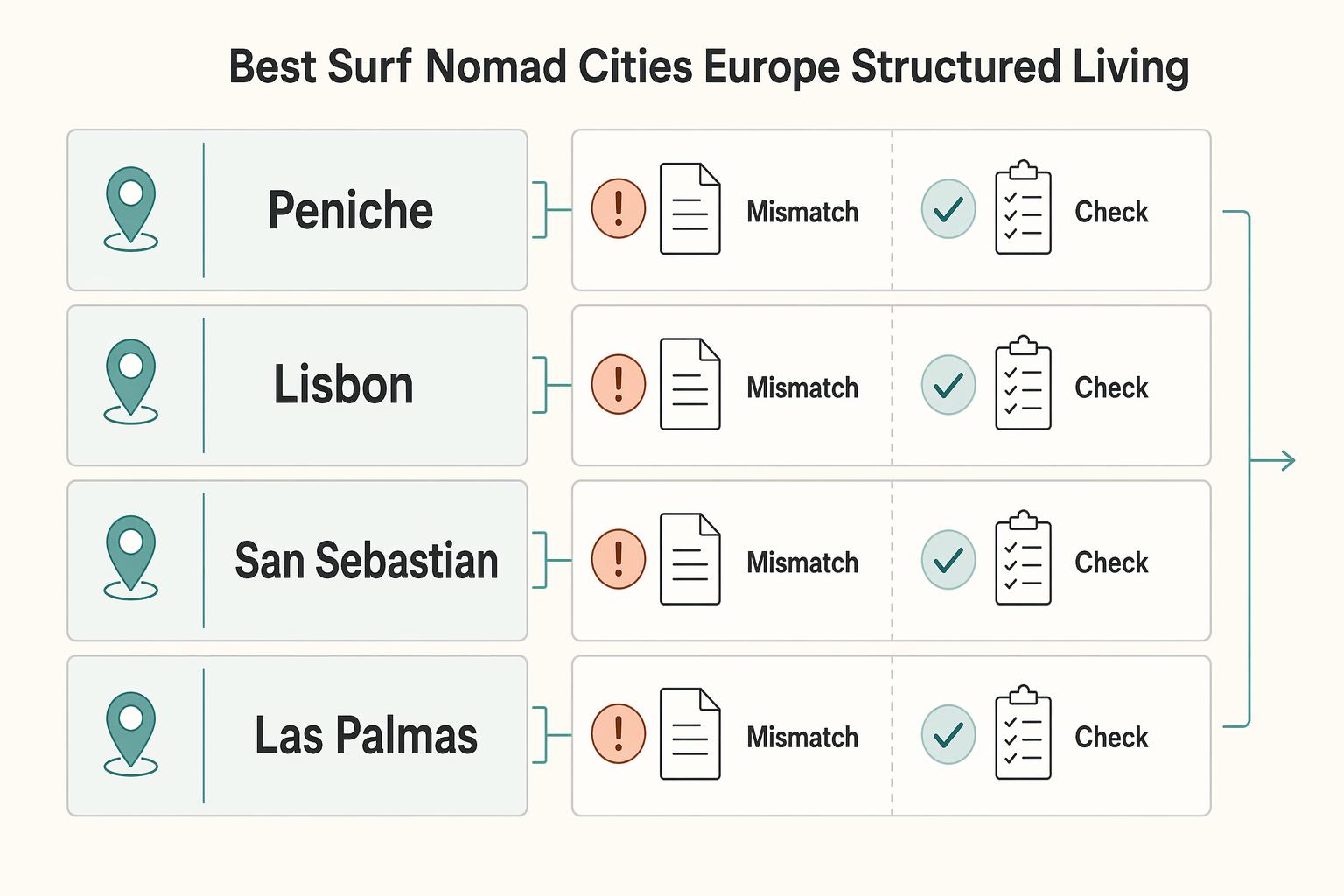
Best Surf Nomad Cities in Europe for Structured Living#
In Europe, the high-impact difference in this group is legal and administrative, not lifestyle branding. The better move is to choose the VAT path that matches your cross-border activity, then run local checks city by city.
| City | Evidence note | Compliance detail |
|---|---|---|
| Peniche | Verify Peniche-specific surf and remote-work conditions locally | Cross-border SME scheme may be the simpler compliance route if Union turnover in the current and previous calendar year does not exceed EUR 100,000 |
| Lisbon | No Lisbon-specific city performance claim is supported here | OSS can centralize registration in one Member State if you handle cross-border B2C e-commerce above the EUR 10,000 EU-wide threshold |
| San Sebastian | No city-specific surf or work reliability claim is supported here | A VAT Cross-border Ruling can provide advance clarification if VAT treatment is unclear in a complex cross-border setup |
| Las Palmas (Gran Canaria) | No location-specific family-lifestyle claim is supported here | For planning timelines, the cross-border SME registration process is expected not to take longer than 35 working days after prior notification |
That may feel less exciting than comparing waves, but it keeps you from optimizing the wrong layer first. If the compliance lane is wrong, a strong housing pick or fun social scene will not save the move.
Use this section as a decision sequence:
- Peniche
Verify Peniche-specific surf and remote-work conditions locally. If your Union turnover in the current and previous calendar year does not exceed EUR 100,000, the cross-border SME scheme may be the simpler compliance route.
- Lisbon
No Lisbon-specific city performance claim is supported here. If you handle cross-border B2C e-commerce above the EUR 10,000 EU-wide threshold, OSS can centralize registration in one Member State.
- San Sebastian
No city-specific surf or work reliability claim is supported here. If VAT treatment is unclear in a complex cross-border setup, a VAT Cross-border Ruling can provide advance clarification through a participating country where you are VAT-registered.
- Las Palmas (Gran Canaria)
No location-specific family-lifestyle claim is supported here. For planning timelines, the cross-border SME registration process is expected not to take longer than 35 working days after prior notification.
If your practical choice is Peniche versus Lisbon, keep the split clean. Use local confirmation for surf fit and network fit, and use this section for the compliance lane: SME-scheme profile versus OSS profile. Mixing those layers too early makes the decision harder than it needs to be.
It also helps to keep compliance notes and lifestyle notes in separate parts of the same city file. When you review the finalists later, that structure makes tradeoffs easier to see and keeps one strong surf preference from burying a legal risk you still need to resolve.
Decide your legal lane first. Once that is clear, test housing and internet in the city that fits it. That sequence gives you a cleaner move and fewer rewrites after arrival.
Best Surf Nomad Cities in Latin America for Cost and Community#
In Latin America, the first month usually determines whether a stay works. A city can win on surf reputation and still create a rough landing if social onboarding, housing setup, or work basics are unstable. If you need momentum quickly, prioritize places where you can confirm active nomad channels and practical setup details before you optimize for wave quality alone.
| Base | Fit | Supported signal | Tradeoff |
|---|---|---|---|
| Puerto Escondido (Mexico) | Async-heavy freelancers who can tolerate some setup ambiguity at the start | Appears in at least one surfers and nomad destination roundup | City-level reliability and admin details still need direct confirmation before longer commitments |
| Salina Cruz (Mexico) | People with trusted local contacts who can pre-check essentials | Can stay on your shortlist when you already have reliable on-the-ground guidance | This section has no grounded Salina Cruz-specific facts for cost, internet, or relocation friction |
| Nicaragua bases | Budget-aware async workers who prefer lower-commitment trials | One surf-camp source reports stable Wi-Fi and weekly or monthly stay discounts | These are property-level claims, not countrywide guarantees |
| El Salvador (El Tunco) | Solo workers who value quick community entry | One guide describes affordable living, decent internet access, and a tight-knit community in a very small town | That same small scale can limit fallback options when your primary setup fails |
The evidence quality is mixed across these locations, so use this section as a decision aid, not a hard ranking. The useful question is not which place sounds best. It is which one gives you the cleanest chance of a stable first month.
- Puerto Escondido (Mexico): strong surf draw, verify operations early
Best for async-heavy freelancers who can tolerate some setup ambiguity at the start. Supported signal: it appears in at least one surfers and nomad destination roundup. Tradeoff: city-level reliability and admin details still need direct confirmation before you make a longer commitment.
- Salina Cruz (Mexico): keep as a secondary option unless you have local inputs
Best for people with trusted local contacts who can pre-check essentials. Supported signal: it can stay on your shortlist when you already have reliable on-the-ground guidance. Tradeoff: this section has no grounded Salina Cruz-specific facts for cost, internet, or relocation friction.
- Nicaragua bases: useful for test-then-extend planning
Best for budget-aware async workers who prefer lower-commitment trials. Supported signal: one surf-camp source reports stable Wi-Fi and weekly or monthly stay discounts, which supports staged decision-making. Tradeoff: these are property-level claims, not countrywide guarantees.
- El Salvador (El Tunco): social momentum can be fast, redundancy can be thin
Best for solo workers who value quick community entry. Supported signal: one guide describes affordable living, decent internet access, and a tight-knit community in a very small town. Tradeoff: that same small scale can limit fallback options when your primary setup fails.
A practical way to use this section is to plan a first-month pilot. Pick one base for a short test, keep one backup ready, and delay long prepayment until your workweek runs cleanly. That approach keeps the upside of the region without forcing you into a long commitment before the basics are proven.
If Mexico is in your final two-city plan, handle tax decisions early with Taxes in Mexico for Foreign Residents before a short trial quietly becomes a longer stay by default.
A common failure mode here is simple: people choose by surf reputation, settle quickly, and only then discover that reliability was property-specific. Keep commitments short until your own week confirms what online summaries only suggest.
Best Asia and Island Picks for Warm Water and Flexible Lifestyles#
Warm water and easy routines lose their appeal fast when your workday keeps breaking. In this group, reliability should come before reputation. Many people start with social-feed appeal, then spend week one troubleshooting basics during core call windows.
Indonesia alone spans over 17,000 islands, so nearby options can still produce very different work conditions. That matters because a short hop on the map can still mean a very different setup once meetings start. In this evidence pack, Canggu has the clearest remote-work signal. The other picks may still suit the right person, but they need stronger direct confirmation before you extend beyond an initial trial.
Use this split when narrowing your shortlist:
- Bali (Canggu): strongest fit when call reliability is your top constraint
Best when your income depends on dependable meeting windows and you want the clearest remote-work context in this group. Tradeoff: busier environments can add distraction and decision load.
- Bali (Medewi): slower pace, higher confirmation burden
Best when lower social density matters more than convenience. Tradeoff: verify Medewi-specific work infrastructure before committing, so treat it as a verify-first option.
- Sri Lanka: trial candidate for flexible workers
Best for people comfortable with staged commitments. Tradeoff: verify Sri Lanka-specific reliability conditions before committing.
- Nusa Lembongan: smaller-island rhythm by design
Best if you intentionally want a smaller pace. Tradeoff: this pack has no location-specific work metrics, so direct testing is mandatory.
- Pulau Weh: only for high-uncertainty tolerance
Best for remote workers who can absorb setup variability. Tradeoff: verify Pulau Weh-specific work infrastructure locally before committing.
The decision rule is straightforward. Choose Canggu when work reliability is the first priority. Choose Medewi or Nusa Lembongan when pace is the first priority and you are prepared to confirm more yourself. The right answer depends less on taste than on how much uncertainty your schedule can absorb.
Island moves often look simple on a map and still add practical friction once work hours are fixed. Build extra margin into your first two weeks so setup tasks do not collide with client-facing obligations.
Before you extend any island stay, lock in a minimum viable setup and test it under real conditions:
- required internet standard
- one backup connection
- one backup work location
- successful real-work test days before extension
That short checklist protects your budget and keeps your surf choice aligned with your actual week, not your best-case scenario. If those basics never settle, a bigger city is usually a better answer than a longer troubleshooting cycle.
Major Surf Metros When You Need Big-City Reliability#
When a smaller surf town fails your work test, pivot quickly instead of trying to rescue it for weeks. The main value of a surf metro is redundancy. Multiple workspace options, backup housing, and nearby waves can protect your income when one part of the setup breaks.
These are reliability-first choices, not pure surf plays. You give up some of the surf-first feel in exchange for more ways to keep the week on track.
- Sydney
Best for professionals with heavy meeting loads or periodic in-person commitments. Use it as a fallback when missed calls or downtime create direct business risk.
- Gold Coast
Best for people who want beach access with city-level backup options. Use it when you want a primary stay plus pre-checked alternatives for work.
- Los Angeles
Best for client-facing roles with short-notice changes. Use it when you need multiple same-day options if one setup fails.
- Honolulu
Best for people who want island living without depending on a single property setup. Use it when continuity matters more than squeezing every lifestyle upside.
- Cape Town
Best for independent professionals balancing calls, deep work, and surf windows. Use it when weekly flexibility across locations is part of your plan.
The tradeoff is clear: metros are usually the reliability move, not the quietest or lowest-cost surf experience. Smaller hubs like Taghazout or Peniche can still win for lifestyle-first priorities if your work setup stays stable.
Treat the metro option as insurance built through planning, not as a rushed reaction. If your small-base plan slips, your fallback is already researched and ready. That protects momentum and reduces the stress that comes from making a rushed decision after something has already failed.
Before committing to a long stay in a smaller destination, keep one metro pre-qualified. Maintain a simple proof file with one refundable short stay, at least two backup work locations, and a real-work test plan for week one. That fallback only helps if you build it before you need it.
Your 90-Day Move Timeline and Paperwork Checklist#
Sequence matters more than destination hype. Use this 90-day plan as an execution order, not a legal stay guarantee: legal fit first, housing terms second, work reliability third, surf optimization last. That order keeps the fragile pieces from turning into expensive afterthoughts.
- Days 1-30: shortlist and evidence gathering
Build one proof file per finalist city. Capture visa-path notes, legal requirement notes, and the exact official government page you verified with a date stamp. Treat visa-country details as time-bound context, not fixed truth.
At this stage, the goal is clarity, not commitment. If a requirement cannot be confirmed in writing, log it as unresolved and lower that city in your ranking until you close the gap. This keeps uncertainty visible and prevents soft assumptions from turning into hard costs later.
- Days 31-60: booking and housing
Book flexible housing before you commit to longer terms. Confirm your entry status matches your intended stay length. Do not assume tourist entry supports an extended remote-work plan.
Record cancellation terms, deposit terms, and extension options before any large upfront payment. Keep screenshots or written confirmations where possible so you are not negotiating from memory when plans change. The objective here is optionality, not a perfect apartment on day one.
- Days 61-90: arrival setup and first-month validation
Run a real trial workweek before locking in a longer stay. Stress-test internet and call stability during actual meeting windows, not just off-hours speed checks. Verify the commute-to-break rhythm on real weekdays, then decide from observed patterns instead of weekend impressions.
By the end of this stage, you should know whether the city supports your actual schedule. If it does, extend. If it does not, pivot without delay.
Keep each city proof file lean and decision-focused:
- visa-path notes and official-source checks
- income-threshold items to verify directly
- work-permit risk notes
- housing terms
- coworking backups when useful
- local transport assumptions
Set hard pivot triggers so you do not drift inside a weak setup:
- recurring work disruptions in week one, especially repeated call failures during core hours
- housing terms that change after arrival or remain unclear in writing
- clear mismatch between expected and actual surf access once your real work schedule is running
- unresolved legal ambiguity around business-activity permissions or work-permit status
If one city fails two checks, move to your pre-qualified fallback immediately. Fast pivots usually cost less than trying to rescue a poor base after momentum drops. Keep your notes in one place and update them after each check so comparisons stay clean and repeat due diligence stays minimal.
How to Pick One City and Commit This Week#
Make the decision in this order: work reliability, then housing clarity, then surf fit. The right choice is the city where your setup stays dependable, your costs remain manageable, and you can still surf most weeks without constant replanning.
Keep the final round tight. Use two finalists and close the loop this week.
- Choose two finalists from broad nomad shortlists, then confirm both directly.
- Build a one-page proof file for each city with internet reliability by area, one backup work spot, accommodation workspace fit, lease terms, and travel time to your normal break.
- If Mexico is one option, match your timeline to the visa path:
6-Month Tourist Visafor shorter stays orTemporary Resident Visafor longer stays with financial proof. - Add a tourist-season buffer to your budget since costs can spike in popular areas.
- Drop any city that fails your core work checks.
To keep momentum high, set a decision deadline and stick to it once your required checks are complete. Extending research without new evidence usually adds stress, not quality. When both options are viable, pick the lower-friction one and protect your first month with flexibility.
The common failure mode is unchanged: committing to surf reputation before testing work reality. Use this sequence instead: book short first, validate under real work pressure, then extend only after your checklist is green. That one discipline keeps a weak first setup from turning into an expensive long stay.
If you want more execution depth before signing cross-border agreements, read Are You an Employee or a Contractor? A Self-Assessment Checklist, and review Taxes in Mexico for Foreign Residents if Mexico is your final pick. If you need support on country-specific program choices, Talk to Gruv.
Frequently Asked Questions
Which cities are best for remote work and surfing, not just surf trips?
Choose destinations that pass a work test, not just a surf ranking. Treat 2026 surf-focused digital nomad rankings as a shortlist, then verify internet quality, backup work spots, and housing terms yourself.
How do I compare surf quality against coworking and internet reliability?
Score workability and surf separately, then combine them using your real priorities. In some Central American surf spots, even basic cellphone reception has been reported as hard to get, and in places like Imsouane formal coworking can be limited, so reliability needs direct testing.
What should I verify before committing to a long stay?
Run full workdays from the exact place and hours you plan to use. Confirm upload stability, meeting quality, and travel time between your stay and your usual break.
Which destinations are better for families versus solo nomads?
Families often need lower friction: predictable transport, stable connectivity windows, and fewer daily surprises. Solo travelers can absorb more variability if they keep a backup stay ready and avoid long prepaid commitments.
How should beginners and intermediate surfers choose different bases?
Beginners often do better with consistency and short travel to easier sessions. Intermediates can accept more variance for stronger surf windows, but only if work reliability stays intact.
Is a surf city always better than a smaller surf destination for long stays?
No. Smaller spots can work when your schedule is flexible and your setup is already validated. Surf cities can be easier when unstable connectivity creates immediate professional cost.
Try a related tool
Researched and edited by the Gruv editorial team. Gruv builds cross-border billing, payouts, and finance-operations software for global businesses.
Sources
Educational content only. Not legal, tax, or financial advice.
Related Posts
Are You an Employee or a Contractor? A Self-Assessment Checklist
Forget the label. Classification turns on the relationship you actually run, not the title you typed into the contract. It is also much easier to fix before you sign.
How to Write Compelling Case Studies for Your Portfolio
Treat your case study as buyer decision evidence, not as a polished recap of work you enjoyed doing. To build trust, give the reader enough real context and proof to answer one question: should they trust your judgment on a project like theirs?

Taxes in Mexico for Expats Without Guesswork
Use a conservative sequence: decide residency first, map income second, then file from records that support your position. For freelancers and consultants, that order keeps the process workable.