
Quick Answer
Set payment-record retention by legal entity, record class and applicable rule. Covered US BSA records generally have a five-year period under 31 CFR 1010.430(d); Regulation E compliance evidence has a two-year minimum where that regulation applies. Add the clock start, deletion event, owner and legal-hold process to each row. Privacy storage limits and card-data controls still apply alongside these duties.
Start With Record Classification and Jurisdiction#
Payment data retention is not a single global number. It is a jurisdiction- and regime-specific control decision tied to record type and legal context.
Different regimes use different retention logic. For covered US BSA records, 31 CFR 1010.430(d) sets a five-year retention period. Regulation E requires covered evidence of compliance to be kept for at least two years under 12 CFR 1005.13. Neither period is a global rule for every payment record.
UK GDPR storage limitation also requires you not to keep personal data longer than needed, and to erase or anonymise it when the purpose ends. Taken together, those rules mean retention has to be defined record by record, with a clear reason for continued storage.
For payment data retention work across jurisdictions, a practical sequence is:
- classify the record
- map the legal entity and market
- identify the governing rule
- define the retention trigger
- define the deletion trigger
A workable structure usually starts with four buckets:
- payment transaction and customer account records
- BSA filing and compliance records
- dispute records
- personal data that should be deleted or anonymised once its purpose ends
These buckets matter because obligations can differ by record class. BSA/AML duties add a layer, and they do not replace other legal duties. Dispute evidence can also follow separate logic. Regulation Z recordkeeping references amounts subject to a billing dispute under § 1026.13, so dispute files may need a different timer than ordinary transaction archives.
The control test is simple. For each record class, you should be able to show the system of record, the basis for retention, the event that starts the clock, and the event that ends it. If one of those is missing, the retention position is hard to defend.
This article lays out a practical way to decide what to keep, how long to keep it, and when uncertainty should be escalated rather than buried. One caution before the mechanics: regulatory summaries are useful for orientation, but they are not a substitute for reviewing the applicable statute or regulation.
Define payment data retention in operational terms#
Treat the policy as an operating rule for each record class, not a legal memo. For each class, state how long it is kept, where it is stored, what starts the retention clock, and what triggers deletion or anonymisation.
Regulators generally expect written policies with documented periods, not informal practice. UK GDPR storage-limitation guidance is explicit that you should set standard retention periods where possible and erase or anonymise personal data when you no longer need it. If you cannot point to a current legal or operational purpose, do not keep data "just in case."
Use the same field set for every line item:
- record name
- legal basis
- system of record
- retention trigger
- deletion trigger
If any field is blank, the rule is not ready. In practice, watch for duplicated exports, debug logs, and warehouse copies kept without a stated purpose or destruction event.
Use legal anchors only where they fit. ECOA and Regulation B are credit-law anchors, not universal payment rules. Under 12 CFR § 1002.12, some credit-application records have a 25-month baseline, or 12 months for business credit in certain cases. That can matter when your payment product includes credit activity, but it does not automatically govern payouts, merchant settlement, or cross-border payment records. CFPB also states Regulation B generally does not apply to lending activities outside the United States.
When a team cites ECOA or Regulation B, require three answers before adopting the rule: which record is credit-related, which legal entity handles it, and whether the market is in U.S. scope. If those answers are unclear, the citation is incomplete and should be escalated.
Classify records before you set any retention period#
Do not set a timer until the record has a clear class. A common retention failure is applying one period to records that serve different legal and operational purposes. Use a basic taxonomy before you debate timelines:
- payment transaction records
- cardholder data
- dispute records
- KYC/AML compliance artifacts
| Record class | Why it must be separate | Anchor in this section | Tag before setting retention |
|---|---|---|---|
| Payment transaction records | Core payment activity is not the same as credit-application or compliance files | No single rule covers all payment contexts | System of record, legal basis, deletion event |
| Cardholder data | Card data is treated separately from general records | PCI treats cardholder data distinctly; PAN must be unreadable when stored | System of record, PAN presence, deletion event |
| Dispute records | Error/dispute handling has separate compliance evidence duties | 12 CFR § 1005.11 and 12 CFR § 1005.13 | System of record, legal basis, dispute-close or other deletion event |
| KYC/AML artifacts | Identity and AML records are not ordinary transaction history | 31 CFR § 1020.220 and 31 CFR § 1010.430 | System of record, legal basis, account-close or other deletion event |
Tag the record, not just the database#
The control that matters here is record-level tagging. Before you set any period, use three operational fields for each class: system of record, legal basis, and deletion event. This helps prevent one blanket rule from silently breaking another obligation.
Keep credit-application files out of the payment bucket#
Credit-application records should be classified separately from general payment records. Under 12 CFR § 1002.12, Regulation B retention is tied to applications and information used to evaluate credit, and use of retained prohibited information is constrained by 12 CFR § 1002.6. The 25-month baseline, or 12 months for business credit in certain cases, is a credit-application rule, not a catch-all for payment transactions, disputes, cardholder data, or AML artifacts.
Misclassification failures to catch early#
A few mistakes are worth stopping early because they create downstream problems. Do not archive dispute files on the same schedule as base transaction history. Regulation E defines errors in 12 CFR § 1005.11 and requires evidence of compliance retention for not less than 2 years under 12 CFR § 1005.13.
Do not treat cardholder data as ordinary analytics data. PCI distinguishes cardholder data from other records. PAN must be unreadable when stored, and cardholder elements stored, processed, or transmitted with PAN, or otherwise in the CDE, still require protection.
If a team cannot name the exact record class, pause the retention decision until classification is complete.
Map legal entities and jurisdictions before writing policy text#
Start with scope mapping, not timeline drafting. A retention rule is hard to defend unless you can show which legal entity owns the record, which market is in scope, and which authority supports that row.
Use the prior taxonomy here. A line like "dispute records, keep X years" is incomplete unless it also identifies who contracts, processes, or stores those records, and which authority applies in that lane.
Build the matrix before the policy#
Market lanes help operations, but each row should still be keyed to the actual legal entity. "APAC" is a routing label, not a legal authority.
| Market lane | What to identify first | Known authority | Still unverified | Owner | Review date |
|---|---|---|---|---|---|
| United States | Which U.S. entity is involved, and whether the record is part of a credit transaction or another payment activity | CFPB Regulation B (12 CFR Part 1002); Supplement I to Part 1002 for interpretation; 2025 federal retention guide as quick reference only | Whether the record is actually in Regulation B scope; whether investigation or enforcement extends retention; any non-CFPB rule that also applies | Named compliance or legal owner | Dated review point |
| European Union | Which EU establishment or processing activity creates GDPR nexus | GDPR Article 3 (territorial scope); Article 5(1)(e) (storage limitation) | Member-state rules, sector rules, and the exact purpose that supports continued storage | Named privacy or legal owner | Dated review point |
| United Kingdom | Which UK entity or UK-facing activity is in scope | UK GDPR storage-limitation principle; ICO guidance as working reference | Effect of guidance changes and any sector-specific UK obligations | Named privacy or legal owner | Dated review point |
| APAC | Exact country and legal entity, not just region | Country-level primary law only after country/entity are identified | All timing assumptions until country and authority are confirmed | Named regional counsel or compliance owner | Dated review point |
Treat Known authority and Still unverified as mandatory fields. They stop half-validated assumptions from being treated as settled law.
Use U.S. authorities carefully, and only for U.S. scope#
For U.S. credit-related records, CFPB materials are a useful starting point. Regulation B is a credit rule, not a global default for payment retention, and Supplement I is the official interpretation for reading Regulation B text.
The 2025 federal retention reference guide is useful as a quick overview, but it does not replace the underlying statute or regulation, and edge cases should be escalated to your primary regulator.
If a U.S. row uses Regulation B, document the credit-transaction link first. If you note 25 months (consumer) or 12 months (commercial) from the guide, treat those as secondary reference points and flag that retention may be extended for investigations or enforcement.
Treat GDPR, PCI, and SOX as routing signals first#
Use GDPR to establish scope and purpose before discussing duration. Confirm Article 3 applicability, then test whether Article 5(1)(e) supports continued identifiable storage.
Apply the same discipline to PCI and SOX. PCI DSS is a security baseline for card-data environments, and compliance or validation expectations depend on external program owners, for example brands or acquirers. It is not, by itself, a universal legal-retention rule across all payment and compliance records.
For SOX-linked scope, the grounded rule here is SEC Rule 2-06: seven years after an accountant concludes an audit or review of an issuer's financial statements. That is issuer- and audit-specific scope, not a blanket payment-policy duration.
Before sign-off, verify:
- every lane has a primary authority, not just a summary source
- every open item in
Still unverifiedhas an owner and deadline - every lane has a real review date; for UK rows, keep this tight because ICO storage-limitation guidance was noted as under review on 19 June 2025
False certainty is the core failure mode. If one row is a U.S. credit rule, one is a GDPR principle without local-law confirmation, one is a PCI control, and APAC is still only a region label, pause and escalate before drafting retention periods.
Resolve rule conflicts with explicit decision logic#
When retention and minimization duties conflict, legal or compliance should document the applicable duties and approve a lawful interim treatment. Restrict access while a supported preservation duty is being assessed, and set a decision date. Restricted access alone does not create a legal basis to retain the data.
The goal is not to apply the longest period everywhere. The goal is to show, row by row, why the data is kept, what pushes deletion, and who approves exceptions.
Build the conflict table#
Keep the table simple: governing rule, required retention direction, deletion pressure, risk if retained too long, risk if deleted too early, and escalation owner. Some rows have explicit timelines. Others need purpose-based review checkpoints.
| Governing rule | Required retention direction | Deletion pressure | Risk if retained too long | Risk if deleted too early | Escalation owner |
|---|---|---|---|---|---|
| 12 CFR § 1002.12, if the record is part of a credit transaction | Keep covered records for 25 months, or 12 months for business credit in stated cases | Minimization and access limits; retained information may be used only as § 1002.6 permits | Over-retention of applicant data and misuse in later credit evaluation outside permitted scope | Inability to evidence ECOA and Regulation B compliance | U.S. product counsel plus compliance owner |
| 12 CFR 1005.13, for covered Regulation E compliance evidence | Retain evidence of compliance for not less than two years from the required disclosure or action; certain proceedings can extend retention | Purpose-based minimization after the applicable period and any preservation duty | Unjustified continued storage or access after the purpose ends | Loss of evidence of required disclosures, investigations or actions | Consumer-finance counsel and records owner |
| 31 CFR 1010.410(e), for covered nonbank transmittals of $3,000 or more, with 1010.430(d) | Keep the required records for five years, subject to the applicable scope and exceptions | Review other lawful purposes and privacy duties when the required period ends | Unjustified storage after required retention and other lawful purposes end | BSA recordkeeping failure | BSA/AML officer and privacy counsel |
| UK GDPR and GDPR storage-limitation principles | Keep personal data only as long as needed; set erasure or periodic-review time limits and justify duration | U.S. credit, AML, audit, or consumer-finance rules may still require preservation for specific records | Storage-limitation breach from indefinite or unjustified retention | Loss of records still needed for another applicable legal obligation or dispute defense | Privacy counsel or DPO |
Verify the scope trigger before using a duration. Regulation B concerns covered credit records. The $3,000 transmittal rule for nonbank financial institutions is in 31 CFR 1010.410(e); paragraph (d) instead concerns Secretary-issued orders. Use 1010.430(d) for the general five-year retention period, and check the exclusions applicable to the transaction.
Put the exception in writing#
If one rule says keep and another says delete when no longer needed, legal or compliance should decide, and the exception should be written down. Engineering implements controls. It should not resolve legal conflicts on its own.
Keep the exception record short but complete: record class, legal entity, governing rule, conflicting rule, temporary disposition, access restrictions, owner, approval date, and checkpoint date. If data is retained pending decision, document who can access it and why. While it is retained, controls still need to protect security, confidentiality, and integrity.
For an unresolved row, record the lawful interim handling, decision owner and deadline. A supported legal hold can pause deletion; uncertainty by itself cannot justify keeping data indefinitely. If no retention purpose remains, apply the approved deletion or anonymisation process.
Check effective dates as well as rule text. The CFPB’s current personal financial data rights resource states that the court stayed the rule’s compliance dates on October 29, 2025. Section 1033.441 contains a three-year recordkeeping floor tied to consumer authorization, but it should not be copied into the matrix as a currently due obligation without confirming the rule’s status and your scope.
Use U.S. examples carefully#
U.S. examples are useful because they show how much scope matters. 12 CFR § 1002.12 provides a concrete baseline of 25 months, or 12 months for business credit in stated cases. But it applies to covered credit records and points retained-use limits back to § 1002.6. It does not answer all retention questions outside credit scope.
On the privacy side, UK GDPR storage limitation does not set one fixed period for all payment records. It requires that retention be justified and not longer than needed, and ICO guidance is noted as under review as of 19 June 2025. In practice, the quality of your documented justification and review cadence matters as much as the duration itself.
The common failure mode is the unresolved "keep until legal confirms" state with no checkpoint date. Make unresolved rows expire into a decision, not into indefinite storage.
Assign ownership and sign-off gates#
Set ownership before publication. One compliance owner should be accountable for the policy, with legal, finance ops, and security signing off on the parts that sit with them when applicable. Without that gate, retention decisions are harder to defend when markets, rails, or data classes change.
Put one name on the policy#
Assign one accountable compliance owner, not a committee. That owner coordinates publication and changes, tracks open legal questions, and should have authority to hold release if required approvals are missing.
Keep co-signer scope clear:
- Legal: confirm jurisdiction scope and unresolved conflicts.
- Finance ops: confirm which records exist across reconciliation, payout exports, and dispute operations.
- Security: confirm access controls, deletion controls, and logging controls.
Approval evidence should stay short and specific: policy version, legal entity, market, covered record classes, named approvers, approval date, and checkpoint date for unresolved items. For UK GDPR accountability, keep evidence of compliance steps, not just final policy text.
Make market and rail changes trigger re-approval#
New markets, new payout rails, and new KYC/AML-related data classes should trigger re-approval. U.S. examiner guidance ties AML risk governance to changes in products, services, customers, and geographies, and FATF emphasizes jurisdiction-specific implementation rather than a single global template.
| Trigger | Condition | Action |
|---|---|---|
| Market launch | Retention mapping for an affected data class is unsigned | Block rollout for that class until sign-off is complete |
| New rail or provider | It creates new KYC or AML evidence and no one can identify system of record, retention trigger, and deletion event | Stop ingestion after testing |
| Regulation B timing applied as a default | It is applied to non-credit payment records | Escalate to legal for scope review |
For U.S. MSB programs, 31 CFR § 1022.210 requires a written AML program available to Treasury on request, including controls for creating and retaining records and responding to law-enforcement requests. If a new rail creates new KYC or AML evidence, treat it as a new governed record class.
Use those same release rules as internal controls during rollout.
Define escalation triggers in advance#
Define escalation triggers before testing the policy in production: jurisdiction ambiguity, conflicting duties, a regulator inquiry or failed deletion controls. Freeze the proposed policy change, assign an owner and deadline, and obtain lawful interim handling for the affected records. Restrict access when preservation is justified; do not use a pending decision as an automatic retention permission.
For U.S. work, use the Consumer Compliance Outlook retention guide as orientation only. It says the chart is not a substitute for underlying law and that specific questions should go to the primary regulator. If your team cannot tie a decision to governing text, treat it as an escalation case.
At sign-off, require control evidence: a sampled deletion result, an access review result, and the current exception log reference. If evidence is missing, treat it as a control failure, not a documentation issue.
Implement controls in systems, not only in policy docs#
A retention policy only works if production systems enforce it. The real control point is not the document itself, but the systems that create, store, copy, and delete records.
Turn each record class into an implemented control set. For payment transaction records, dispute records, and cardholder data, define the storage location, retention timer, event that starts the timer, post-retention action, and deletion-process owner. Keep that in a retention schedule with documented post-retention actions and named process ownership.
Make the timer and the owner explicit#
Do not leave retention behavior implicit in code. For each record class, keep one control record that answers:
- Where the data lives.
- Who can access it.
- What rule sets the timer.
- What pauses deletion, if your process uses holds.
- Who investigates and closes deletion failures.
Map timers to governing rules where they apply. If a U.S. record is covered by 31 CFR 1010.430, use the five years requirement. If it is evidence of compliance under 12 CFR 1005.13, keep it for not less than two years. Engineers should not have to infer duration from policy prose.
Preserve traceability across the payment path#
Treat traceability as an operational control, not only a reporting convenience. Payment data can move from request events into ledgers, provider callbacks, payout files, exports, and support tooling. Retention and deletion tags should survive that movement.
For payment transaction records and dispute records, use a stable internal identifier across ledgers, case tools, and exports. In testing, sample one transaction and one dispute case and verify the retention tag and deletion trigger across each intentional copy. Unmanaged CSV or warehouse exports can become a gap.
Treat broad access as a control failure#
Restrict access to retained sensitive data to the roles that need it. Minimize stored cardholder data and mask displayed PAN. PCI DSS Requirement 3.4.1 permits no more than the BIN and last four digits unless a role has a documented legitimate business need for more. Showing only the last four can be sufficient for routine support; display masking does not replace protection of stored PAN.
Apply the same discipline to compliance records with customer information. Permit access only to authorized users who need the data for their duties, and monitor and log authorized-user activity so access reviews and investigations are evidence-based.
Put release checks in front of new integrations#
New integrations can be a break point. A new processor, dispute tool, or payout provider can introduce copies with no retention tag, no deletion trigger, and no owner.
Add release gates that block go-live when retention metadata is missing for new record flows. Where you run automated data processing, including MSB contexts, integrate compliance procedures into those systems so retention timing is tagged and action is prompted when due. For disposal, require controls that protect against unauthorized access during destruction, not just a successful deletion status. For the broader policy framework, see How to Create a Document Retention Policy.
Build the audit evidence pack regulators and auditors actually ask for#
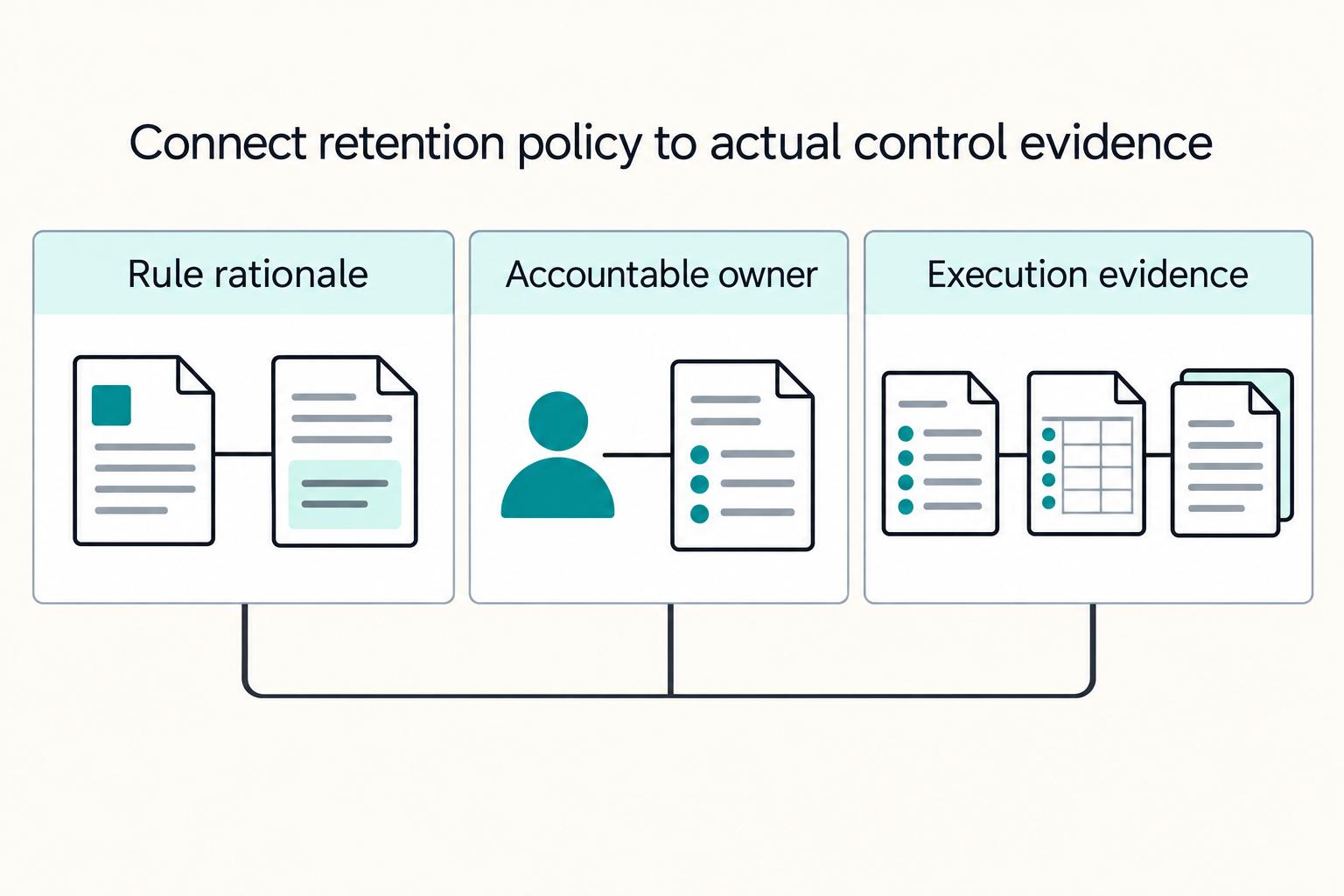
A defensible evidence pack should show three things for sampled records: the governing authority, accountable ownership, and proof that the control actually ran. If any one of those is missing, treat it as an open control gap.
Keep the pack live rather than building it once and forgetting it. Maintain a jurisdiction matrix, retention rationale, exception log, deletion test results, and access-control review records as products, markets, and processors change. This aligns with UK GDPR Article 30 expectations to maintain written records, including electronic form, and, where possible, document erasure timelines by data category. ICO guidance also expects records to stay current.
Use reference guides as routing tools, not legal endpoints. The Record Retention Reference Guide for Federal Consumer Financial Laws and Regulations is useful for finding requirements, but it does not replace the underlying statute or regulation. In your authority field, record the exact source you relied on. That might be CFPB materials, Regulation E, Regulation Z, Regulation B under 12 CFR § 1002.12 for applicable application or adverse-action records, UK GDPR Article 30, or FinCEN rules where FFIEC Appendix P points to them. Also note that FFIEC Appendix P is a summary and BSA retention duties are additive to other legal obligations.
Keep the pack compact. At minimum, it should cover:
| Evidence item | What it proves | Operator check |
|---|---|---|
| Jurisdiction matrix | Which legal entity, market, record class, and rule apply | Verify review date, owner, and unresolved items |
| Retention rationale | Why a period or deletion trigger was chosen | Link each rule to the exact authority used, not only internal policy text |
| Exception log | Where the standard rule was paused, extended, or escalated | Confirm reason, approver, and expiry or review date |
| Deletion test results | That deletion or archival actions actually execute | Sample one transaction and one dispute record, then trace post-retention action across intended copies |
| Access-control reviews | That retained sensitive data is still restricted appropriately | Check reviewer sign-off, remediation tickets, and closure evidence |
Store execution evidence, not just policy text. CFPB examination procedures describe requests for operational records, for example reports and ledgers, and Regulation Z requires evidence that required actions and disclosures were performed. Keep artifacts such as job logs, approval tickets, legal sign-offs, and sampled deletion confirmations as supporting proof when they map to the applicable rule and control. Where rules require holds during investigations or enforcement matters, retain records tied to that matter until final disposition and keep related pause-and-release evidence.
A common failure is a policy that cannot be traced to execution. A deletion job shows "success," but no sample confirms downstream copies were handled. An exception is approved without an expiry and turns into indefinite retention. A team cites a guide but cannot produce the underlying rule. If rollout needs to be phased, prioritize evidence sampling and collection for the highest-risk record classes first.
Catch common failure modes before they become incidents#
Most retention incidents do not start with obscure law. They start with repeat mistakes: copied cross-border timelines, PCI-only reasoning, ownerless exceptions, and dispute records mixed into standard archives.
| Failure mode | Why it matters | Action |
|---|---|---|
| One retention period copied across the United States, European Union, and United Kingdom | U.S. consumer-finance obligations are regulation-specific; EU GDPR supports time limits for erasure or periodic review; ICO guidance requires you to justify how long personal data is kept | Treat one repeated number across entities and record classes as unverified |
| PCI used as the full retention answer | PCI controls protect account data and prohibit certain post-authorization authentication-data storage; they do not set one duration for all transaction, dispute and compliance records | If the authority field says only "PCI," treat it as a policy gap |
| Temporary exceptions left open with no owner | Exceptions without a named owner, expiry, or review date can become indefinite retention | Review the exception log for blanks and overdue reviews, then escalate and close or renew with clear criteria |
| Dispute records deleted with standard transaction archives | Card-network dispute processes can require specific documents and have filing windows that change, and active enforcement or investigation records should be kept until final disposition | Keep dispute files on a separate retention track |
Card-data security duties are distinct from legal retention periods. Merchants and ordinary payment processors must not store sensitive authentication data after authorization, even encrypted or without PAN. Keep full track data, card verification codes and PIN/PIN blocks out of the retention schedule. An issuer or issuing-support service needs a separately verified legitimate issuing scope for the standard’s exception.
Keep dispute records on a separate track. The filing window depends on the network, reason code and transaction context, and it does not automatically set the evidence-retention period. Preserve records needed for an open dispute, investigation or applicable legal hold, then apply the approved disposition rule.
Use a 30-day rollout checklist for existing payment stacks#
A 30-day rollout can get you from intent to an auditable, versioned retention policy without pretending unresolved legal points are settled. The goal is to classify what you hold, map governing authorities by jurisdiction and record class, test one real control path, and publish with open questions, owners, and deadlines.
| Week | Focus | Key actions |
|---|---|---|
| Week 1 | Taxonomy and jurisdiction mapping | Map payment transaction records, cardholder data, dispute records, and KYC or customer due diligence artifacts to the legal entity, market, system of record, and governing authority, or flag the legal unknown |
| Week 2 | Draft the retention matrix | For each record class, define the authority, retention period or review rule, deletion event, owner, and exception path |
| Week 3 | Test a production-like path | Test one payout and one dispute scenario end to end: record classification, storage location, retention logic, ownership, and retrievability |
| Week 4 | Sign-off and publish | Confirm policy version, matrix rows, owners, control test results, and open exceptions with legal, finance ops, compliance, and security |
This is also where common failure modes surface. Teams that jump straight to one retention number can miss scope, ownership, and deletion events.
Week 1. Start with taxonomy and jurisdiction mapping#
Start with taxonomy and jurisdiction mapping before drafting policy text. At minimum, map payment transaction records, cardholder data, dispute records, and KYC or customer due diligence artifacts to the legal entity, market, system of record, and governing authority, or flag the legal unknown.
Treat summary guides as routing aids, not final authority. If a U.S. row only says "CFPB guide," it is incomplete. Link the row to the underlying rule where relevant. That might be Regulation B, 25 months or 12 months for business credit in the quoted clause, or Regulation E, retain evidence of compliance for not less than two years.
Week 2. Draft the retention matrix after the map is stable#
Draft the retention matrix only after the map is stable enough to support decisions. For each record class, define the authority, retention period or review rule, deletion event, owner, and exception path.
Keep similar-looking data in separate rows when their clocks differ. For covered UK AML records, Regulation 40 generally sets five years from the end of the business relationship or completion of the occasional transaction. Transaction records within a continuing relationship need the regulation’s specific treatment, including its ten-year limit on the records described in paragraph (3)(b)(i). These are AML scope rules, not a timer for all UK payment data. For stored account data, document the allowed elements, business justification and secure deletion controls.
A row without a deletion event is incomplete. "Keep for five years" is not operational by itself.
Week 3. Prove the controls work in a production-like path#
Use this week to prove the controls work in a production-like path. Test one payout and one dispute scenario end to end: record classification, storage location, retention logic, ownership, and retrievability.
For stored account data, test deletion evidence, not only storage behavior. PCI requires a process to verify, at least once every three months, that data past its retention period has been securely deleted. Confirm roles are documented and assigned for Requirement 3 activities, and capture at least one sample verification result.
Week 4. Run sign-off, publish, and formalize follow-up#
Run sign-off, publish, and formalize follow-up. Confirm policy version, matrix rows, owners, control test results, and open exceptions with legal, finance ops, compliance, and security.
Approve only the matrix rows whose scope and handling are resolved. For other rows, document a lawful interim treatment, owner and deadline before enabling that data flow. A quarterly governance review can follow up, but it does not replace a decision required for launch.
Verify policy quality quarterly and after every market change#
Publishing the matrix is not the finish line. Set a recurring review cadence, with quarterly as a practical baseline, and re-test after any new payout corridor, provider, or program so retention controls do not drift.
Start with execution, not wording. After entering APAC or any new jurisdiction, test at least one changed record class in the live path. Confirm that it is:
- classified correctly
- stored in the expected location
- retrievable as compliance evidence
- mapped to the correct deletion event
If you expand into Hong Kong, do not assume the existing AML row still fits. HKMA points authorized institutions to AML/CFT legislation that sets customer due diligence and record-keeping requirements, so your jurisdiction map may need a different authority, owner, or exception path.
Then verify that your legal references are still current. Retention schedules should be reviewed and updated when needed, and storage-limitation logic still requires not keeping personal data longer than necessary. For U.S. credit-linked rows, confirm your Regulation B citation still matches scope under 12 CFR § 1002.12, including the 25 months or 12 months for business credit split. If a row only says "SOX" or cites an outdated PCI version, treat it as a gap; PCI DSS v4.0 was retired on 31 December 2024.
Review exceptions with the same rigor. Every exception should have an expiry date, named owner, reason, and next decision point. If the same exception is renewed repeatedly, treat it as design debt and escalate it with evidence, then either remediate the control or rewrite the row with counsel.
Conclusion#
A defensible retention approach is a control system, not a single timer for all payment data. You need a documented schedule that classifies records, maps each class to its jurisdictional and legal basis, assigns ownership, and shows that retention and deletion controls actually run.
In practice, obligations can pull in different directions. Storage-limitation principles require that personal data not be kept longer than needed, while other laws can require fixed retention periods for specific records. The workable path is to document what is confirmed, flag what is unverified, and escalate real conflicts with clear owners and periodic review checkpoints.
The U.S. Regulation B example shows why jurisdiction-specific mapping matters. Under 12 CFR § 1002.12, it includes explicit timelines of 25 months, or 12 months for business credit in the specified context. Those timelines apply only where that credit scope applies. They are not a default for other payment record classes or jurisdictions. Quick-reference guides can help you start, but they are not a substitute for reviewing the applicable statute or regulation.
For cross-border payments, avoid assumption-driven retention. Cross-border payment data sits across multiple data frameworks, and regulators have noted uncertainty in balancing obligations across them. Keep a live matrix of confirmed rules, open gaps, responsible owners, and next review dates. Then test the control with sample records to verify the rule used, authority, retention status, and logged disposition. If your retention model spans multiple entities and jurisdictions, confirm market coverage and control design assumptions by contacting Gruv.
Frequently Asked Questions
What is a payment data retention policy by jurisdiction, in one sentence?
It is a documented retention schedule that classifies records and assigns retention periods based on the legal and business requirements that apply in each jurisdiction. It is reliable only when each row is mapped to a specific record class and legal basis.
How do we set one policy across multiple countries without over-retaining data?
Use one shared taxonomy and matrix, then set jurisdiction-specific retention rows instead of one global timer. Privacy rules such as storage limitation require you not to keep personal data longer than needed, while other laws can require fixed periods. That means your baseline policy should support local exceptions, not flatten them.
Which comes first for implementation, legal minimum retention or internal policy preference?
Legal requirements come first. If a law requires a fixed period, that period overrides a shorter internal preference. Internal policy choices apply only after mandatory retention is met and purpose-based deletion limits are checked.
When should compliance escalate a retention decision to legal counsel?
Escalate when scope is unclear, when one rule points to preservation and another points to deletion, or when the record class is not confidently identified. Do the same for cross-border launches or repeated exceptions that remain unresolved.
Can we use U.S. Regulation B rules as a global default?
No. Regulation B applies to creditors and credit activity, and § 1002.12 timelines, 25 months or 12 months for business credit, are specific to that scope. It should not be used as a default for non-credit payment records in other legal contexts.
What records are most often misclassified in payment environments?
Watch for credit-application records being placed in a general payment bucket, dispute files sharing a routine deletion timer, and customer due diligence records being mixed with transaction evidence. These classes can have different scope and clock-start events, so classify them before setting a duration.
What evidence should we keep to prove retention and deletion controls actually run?
Keep execution evidence, not just policy text: the retention matrix, written procedures, exception records, and logs that show retention, access testing, and disposal actions. For consumer-authorized data access, record authorization and revocation events and check the current status and scope of the Section 1033 rule before treating its recordkeeping period as due. For sampled records, you should be able to show why the record was retained, whether it remained retrievable, and how disposition was handled when due.
Try a related tool
Researched and edited by the Gruv editorial team. Gruv builds cross-border billing, payouts, and finance-operations software for global businesses.
Sources
Includes 2 external sources outside the trusted-domain allowlist.
- bsaaml.ffiec.gov/manual/Appendices/17trusted
- consumerfinance.gov/rules-policy/regulations/1033/441trusted
- consumerfinance.gov/rules-policy/regulations/1026/25trusted
- ecfr.gov/current/title-12/chapter-X/part-1002/subpart...trusted
- ecfr.gov/current/title-31/subtitle-B/chapter-X/part-1...trusted
- legislation.gov.uk/uksi/2017/692/regulation/40trusted
- gov.uk/hmrc-internal-manuals/economic-crime-supervi...external
- ico.org.uk/for-organisations/uk-gdpr-guidance-and-resou...external
Educational content only. Not legal, tax, or financial advice.
Related Posts

The Freelance Payment Penalty: A Modeled Audit of Platform Fees, FX Spreads, and Payout Delays
The money rarely disappears through a single, easy-to-spot fee. The real loss is stacked. A marketplace takes its commission, a processor adds a charge for international cards, a bank or payment company converts the currency at a spread, a platform holds the funds before release, and a wire sheds a little to intermediaries on the way in. Each layer looks defensible on its own, but the worker feels the combined result as a smaller deposit and a later payday.

How to Respond to a Subpoena for Business Records
Move fast, but do not produce records on instinct. If you need to **respond to a subpoena for business records**, your immediate job is to control deadlines, preserve records, and make any later production defensible.

A US Expat's Guide to Investing in UCITS ETFs to Avoid PFIC Issues
The real problem is a two-system conflict. U.S. tax treatment can punish the wrong fund choice, while local product-access constraints can block the funds you want to buy in the first place. For **us expat ucits etfs**, the practical question is not "Which product is best?" It is "What can I access, report, and keep doing every year without guessing?" Use this four-part filter before any trade: