
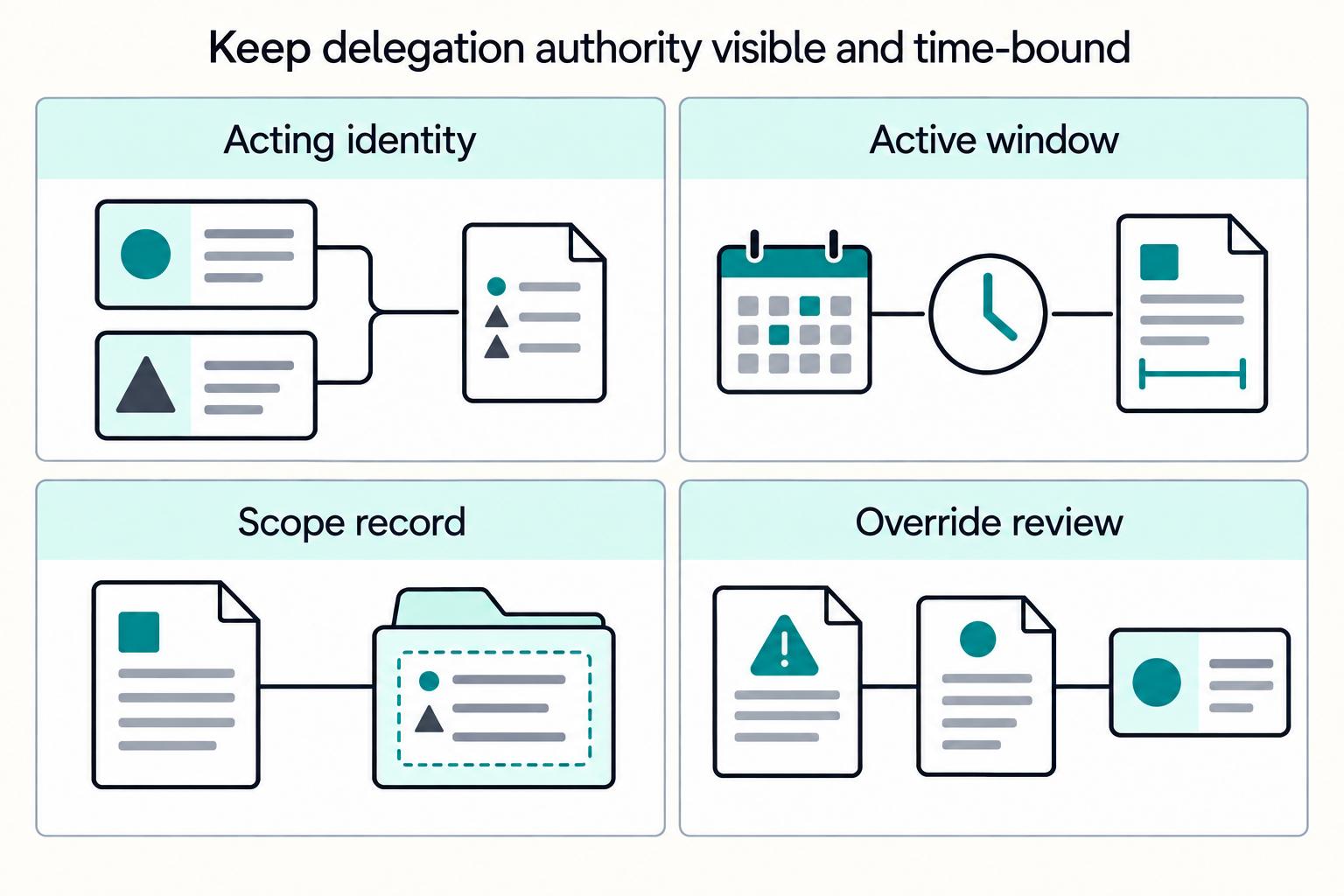
Quick Answer
A payment approval workflow should turn Delegation of Authority into system-defined routing rules that assign the right approver, block self-approval, and create an audit trail before funds are released. Set scope by money-moving action and failure cost, express thresholds and authority levels in a decision table, constrain delegation, and test states, escalations, and idempotent retries before rollout.
Build a payment approval system finance and engineering can both enforce#
A payment approval flow works only when policy becomes system behavior. The job is to translate Delegation of Authority into routing rules that send each request to the right approver, block conflicts, and leave an audit trail finance can verify later.
Convert policy language into enforceable controls#
A payment approval flow defines how payments are authorized and executed before funds are released. A DOA policy defines who can approve which financial decisions. To make that enforceable, map each rule to a product role, a routing rule, and a record field.
Use one checkpoint for every rule: can the system route it automatically, and does the record show who acted and what they did? If not, you have policy prose, not an enforceable control.
Balance speed and control without blurring roles#
You need speed and control at the same time. Bottlenecks slow payouts, but weak controls create errors and fraud risk. In practice, delays often come from unavailable approvers or reviews that stall, while manual handling raises the risk of both error and fraud. Set role boundaries explicitly. Segregation of duties should be built in, and self-approval should be blocked.
Define scope before debating limits#
Start by deciding which money-moving actions are in scope. The control question stays the same across those flows: who can approve, under what threshold, and with what evidence?
Complexity shows up early in multi-entity operations. A design that works for one entity can break once you add entities, channels, or currencies. Verify that routing and authority rules still hold across product flows and finance systems.
Set expectations for implementation, not policy alone#
This guide focuses on decision checkpoints, implementation order, and recovery steps, because policy text alone does not help if users can bypass routing limits.
Keep routing system-defined and non-bypassable. Build records that let you reconstruct events later: who acted, what action was taken, and when it happened. If your records cannot answer those questions, treat that as a design gap before rollout.
If you want a deeper dive, read How to Build an Invoice Approval Workflow for Your Platform: Roles Limits and Escalation.
Define approval scope and failure cost before setting limits#
Set scope by action and failure cost before you argue about dollar bands. Amount is a weak first filter because some low-value decisions are still hard to reverse once processed on high-finality rails.
List every action that can change money movement#
Start with action types, not job titles. At minimum, list payment initiation events, template create/update events, refund-versus-cancel paths, and FX conversion or settlement actions. In practice, approval criteria are often event-based, not just amount-based.
Score each action with a simple failure-cost rubric#
For each action, assign a quick risk profile across four lenses: financial loss, compliance exposure, customer impact, and reversibility. Keep this lightweight so teams can apply it consistently before they start debating threshold numbers.
Route by finality and settlement risk, not amount alone#
If an action can be irreversible once processed on a high-finality rail, route it through stricter authority levels even when the amount is small. Apply the same stricter path to FX-related actions where settlement risk is material, and keep lower-friction paths for actions that are easier to unwind.
Publish a one-page scope map with clear ownership#
Before you tune limits, publish one page that links each action type to the request owner and the active approver. That gives finance and engineering one reference for routing, accountability, and auditability.
Gather the evidence pack before you configure anything#
Before you configure roles or limits, get finance, ops, and engineering aligned on one current evidence pack. If you configure first, you can bake policy, routing, and ownership mismatches into the build.
Assemble the prerequisite documents and verify they agree#
Start with four controlled artifacts: the current Delegation of Authority policy, the existing approval flow diagram, a role roster, and escalation contacts. For each one, confirm an owner, a version or last-approved date, and one canonical location.
| Artifact | What to verify before config | Red flag |
|---|---|---|
| Delegation of Authority policy | Current authority levels, named owners, latest approved version | Amount bands in policy do not match actual approval practice |
| Approval flow diagram | Actual decision path for each money-moving action | Diagram shows a path no one can enforce in product |
| Role roster | Named requester, approver, backup, and any separation-of-duty conflicts | Shared logins, stale managers, or missing backups |
| Escalation contacts | Primary and secondary contacts, contact method, coverage hours | Escalation goes to a queue with no accountable person |
Standardize terms before configuration. If policy, diagrams, and engineering labels use different names for the same action, you already have a control gap.
Baseline the approval path you have today#
Capture baseline metrics from the current process before rollout. At minimum, track approval cycle time and exception volume. Add failed approvals by team or after-hours approvals where they are operationally relevant.
Define approval cycle time, exception volume and execution failures consistently for your own process. If a program originates ACH debits, monitor the applicable debit return rules separately; generic supplier-credit payouts do not inherit those thresholds.
Manual handoffs can create coverage gaps and stale decisions. Measure where requests stall and which approvals need rework instead of relying on an unidentified testimonial.
Define the minimum evidence required for every decision#
Set the minimum approval record before rollout so each decision is reconstructable. Define the fields your team will always capture, plus the core audit-trail fields. A practical minimum set includes:
- request ID and action type
- requester identity and business context
- decision outcome
- actor identity
- timestamp
- acting-as or delegation context
- policy version used at decision time
- attachment or reference to supporting evidence
- approved request version/fingerprint, legal entity, amount/currency, beneficiary/destination and policy version
Avoid free-text-only justification. It is easy to launch and hard to audit, investigate, or reconcile later.
Set a hard pre-production gate on one shared source of truth#
Use one shared source-of-truth document as the production gate, and make finance, ops, and engineering sign the same version. This is a governance control, not a universal legal requirement, and it reduces drift across docs, tickets, and code.
Include the policy reference, flow diagram, role roster, escalation ownership, metric definitions, and minimum audit-trail spec in that sign-off pack. If implementation tickets, review notes, and launch approvals point to different document versions, pause rollout.
Related: Gateway Routing for Platforms: How to Use Multiple Payment Gateways to Maximize Approval Rates.
Set approval thresholds and authority levels in a decision table#
Once the evidence pack is settled, turn it into a decision table before configuration. If a rule cannot be expressed as clear conditions, authority, and evidence in one row, it is not ready for production.
Build the table with enforceable fields#
Use one row per payment decision. Keep these columns: payment type, risk tier, Approval thresholds, required Authority levels, delegation allowed, and required evidence.
| Payment type | Risk tier | Approval thresholds | Required Authority levels | Delegation allowed | Required evidence |
|---|---|---|---|---|---|
| Recurring payout to approved beneficiary on a standard rail | Low | Below your approved low-risk threshold, with no payee change and no exception flag | Structured permission tier with one authorized approver | Yes, if delegate has the same approval role and is not the requester | Request ID, beneficiary match, business context, timestamp, policy version |
| Standard non-exception payment with finance review | Medium | Your approved amount/currency threshold plus business-unit/cost-center and risk rules; illustrative values are not vendor-mandated limits | Finance approval group or equivalent authority tier | Yes, if Separation of Duty still holds | Amount, payment type, requester identity, business unit or cost center, supporting document, decision record |
| Exception path (wire release, manual override, held-funds release, beneficiary change) | High | Often any amount when the action is irreversible, externally settled, or outside normal policy | Two distinct authorized approvers with tighter Separation of Duty between initiator and approvers, or another documented compensating control where full segregation is not feasible | Restricted unless policy explicitly allows delegation with equivalent authority and SoD controls | Exception reason, attachments, requester context, approver identities, timestamps, acting-as context if delegated |
Use signed policy values where available. The important pattern is not just amount bands. Rules may also route by business unit, cost center, and exception type.
Write the conflict rule directly into the table#
Do not leave conflict handling to judgment calls. Define which rule wins when amount-threshold logic and risk logic conflict. For many teams, that means routing to the stricter path in policy so low-dollar but high-risk actions, such as beneficiary changes or manual overrides, do not slip past stronger controls.
Low-risk recurring payouts can use structured permission tiers. High-risk exceptions can use a two-person rule with tighter Separation of Duty so one user cannot complete the full action alone.
Map each row to system logic and test it#
Bind the decision to the request version, legal entity, amount/currency, action, rail, beneficiary/destination, supporting evidence and policy version. Define aggregate exposure and FX conversion rules for thresholds. Material changes invalidate approval and require reapproval; labels such as urgent do not authorize bypass.
For every row in staging, run one matching case and one non-matching case. Confirm routing, approver set, evidence requirements, and SoD enforcement. For high-risk rows, confirm that the same user cannot initiate and approve the same request.
Close timing and jurisdiction unknowns before sign-off#
A decision table with open timing or jurisdiction issues is not ready for sign-off. Resolve these before final approval:
| Area | Open point | Details |
|---|---|---|
| SLA timing | Escalation timers by risk tier | Include owner and post-escalation delegation handling |
| Rail and provider constraints | Limits that affect routing | Actual route amount limits, eligibility, submission windows and provider-specific lower caps |
| Operating/legal checkpoints | Entity/route-specific review | Confirm operator/provider windows and the actual contract/legal requirements before enabling execution |
If a row still shows TBD for escalation owner, timing, or jurisdiction handling, keep it out of production.
Use your decision table as a build spec, then map each threshold and role rule to enforceable system behavior. See the docs.
Assign roles with separation of duties and conflict controls#
Once the decision table is stable, lock role boundaries so no one can request, approve, and benefit from the same payment action. Exceptions should route to an independent reviewer.
Name the role matrix#
Define five operating roles in your design: requester, approver, delegator, delegatee, and oversight reviewer for policy exceptions. These are control labels, not mandated job titles, so each role should map to a real person or group in your access model and DOA policy.
| Role | Control note | Audit focus |
|---|---|---|
| Requester | Requests the payment action | Show who requested |
| Approver | Approves the request | Show who approved |
| Delegator | Assigns approval handling to one delegatee for a defined period | Capture start, end, and reason |
| Delegatee | Acts on behalf of the original approver during the active delegation window | Record actual actor and acting-as context |
| Oversight reviewer | Reviews policy exceptions | Show who reviewed exceptions |
For each role, record who can hold it, what actions it can take, whether delegation is allowed, and what evidence must be captured. Your audit trail should answer four questions without interpretation: who requested, who approved, whether anyone acted on behalf of someone else, and who reviewed exceptions.
If you cannot assign a named oversight reviewer for exception paths, do not move those rows to production.
Enforce separation of duties in product logic#
Separation of duties has to live in system logic, not only in policy text. The same user cannot initiate and approve the same request. In dual-control terms, the initiator cannot approve their own work.
Check identity directly by comparing initiator ID, approver ID, and any acting-as identity used by a delegatee. If an approval resolves to the initiator, reject it and log the attempt. Where your product separates actions, also separate authorization from processing or recording and review.
In staging, verify at least:
- A user with both requester and approver permissions is still blocked from self-approval.
- A payment that meets your approval threshold routes to an additional independent approver, and no approver is the initiator.
Add conflict checks and recusal rules#
Self-approval is only one conflict type. If a person is tied to the transaction outcome, such as self-benefit or related-party context, remove them from the decision path. Route the request to the oversight reviewer, and record the disclosure and recusal.
For manager-reporting-line conflicts, set and document your own company rule. The baseline control here is disclosure plus recusal when conflicts exist, then independent review when needed.
Capture the conflict reason, disclosed facts, recusal action, reviewer identity, and timestamps. If that record is missing, treat the approval as incomplete.
Split ownership cleanly between finance and engineering#
Unclear ownership leads to control drift. Set an explicit operating rule: finance owns risk policy, including authority levels, exception criteria, and conflict decisions; engineering owns enforcement, including control logic, identity checks, and logs.
This is a control-design choice, not a universal legal standard. Use it to keep policy and production aligned, and require both teams to sign the same role matrix before launch.
Design delegation rules that survive vacations and emergencies#
Delegation only holds up when it is narrow, time-bound, and easy to audit. A practical baseline is one active delegation at a time, one level only, and no re-delegation by a Delegatee.
Constrain who can act and how delegation can branch#
Use a simple baseline in your DOA policy: a Delegator assigns approval handling to one Delegatee for a defined period, with one active delegation at a time for that delegator. Treat this as a practical operating pattern, not a universal product rule.
Keep delegation to one level. If User B is Delegatee for User A, User B cannot delegate onward to User C. In your logs and approval trail, always record acting-as context so reviewers can see who acted and under whose authority.
If you later enable multi-user delegation, make it an explicit exception with clear decision rules and visible audit records, not the default path.
Make every delegation temporary, reasoned, and approved before activation#
A delegation without dates is open-ended access. Require start and end timestamps, and capture a reason for the delegation. For payment approvals, you can also add role-based pre-activation approval in your own control design, for example by finance ops, a manager, or another authority owner. This is a policy choice you define to tighten access changes, not a universal platform behavior.
Capture delegator, delegatee, scope, start/end, reason and required authorization. Test both activation and expiry. At execution, recheck current authority, conflicts and revocation against the approved request version; a valid decision yesterday does not prove authorization for changed details today.
Separate planned delegation from emergency override#
Planned delegation and emergency override should use separate paths. Use planned delegation for known absences, and a separate emergency override path for unexpected unavailability.
For emergency override, require clear records: who granted it, who received it, why normal delegation was unavailable, exact start and end, and scope. Make the override time-bound with automatic expiry, then run a post-event review.
Block abuse patterns and test failure scenarios before rollout#
Delegation should never reopen the door to self-approval. Prevent a Delegatee from approving their own requests, and review approvals where acting-as identity resolves to the original initiator.
Add monitoring for unusual delegation changes and route those patterns for review. Then stage absence scenarios and confirm your records still capture acting-as identity, timestamps, and expiry cleanly.
Build approval request states and notifications across product and finance#
Explicit request states keep approvals operable. Operational failures often show up when handoffs, stalls, or denials happen without a clear state, owner, and trace across finance and product.
Define a state model your teams will actually use#
Define an internal state map for your approval request object, even if underlying tools use different labels. A practical starting point is: submitted, pending approval, approved, denied, delegated, escalated, expired, and change requested or returned.
Cover post-rejection handling, not just the happy path. In Dynamics 365 Finance, a rejection can create a new work item for the originator, so decide whether denied requests are revised and resubmitted or closed.
In your flow diagram, mark terminal versus recoverable states. Approved, denied, and expired are often terminal. Delegated and escalated are handoff states.
Map each transition to notifications and in-product status#
For each state change, define who is notified, where they see it, and what action is expected next. Dynamics 365 Finance supports notification events such as approved, rejected, delegated, escalated, and change requested. Power Automate approvals use in-product pending queues and email delivery.
Use a simple operating rule:
- Send email when action is required or a final decision is communicated.
- Keep current status in-product for shared operational visibility across finance ops, support, and requesters.
That keeps action prompts and system truth aligned.
Show acting-as context in the flow diagram and history#
Delegation is only reliable when records show both who acted and whose authority they used. Oracle documents delegation as acting on behalf of the original approver and supports displaying that relationship in the interface.
When a delegate approves or denies, record and display:
- actual actor
- delegator
- action taken
- timestamp
- reason or comment when policy requires it
Without acting-as visibility, audit reconstruction is weaker.
Configure timeouts and make escalation ownership explicit#
Timeouts are not enough on their own. You also need clear ownership after escalation. Dynamics supports escalation when the assigned user does not act within the configured time window. Your policy should also state who owns the request after that point, whether the prior approver can still act, and which team is accountable.
If you route escalations to higher authority levels, document that routing explicitly in both policy and flow diagrams.
Run a trace test before rollout#
Run one end-to-end trace in staging from request creation to final state. Submit, delegate, exercise timeout and escalation if configured, and complete with approval or denial.
Then verify that workflow history or tracking shows request progression with key transitions, timestamps, and actors, including acting-as context where your platform exposes it. Use built-in test and history features where available. The pass condition is simple: a reviewer can reconstruct the full path from system records alone.
Add audit trail and reconciliation checkpoints finance can sign off#
Finance sign-off depends on evidence, not status labels. If a control cannot produce exportable records showing who acted, when, what happened, and how the outcome ties to your books, treat that control as not ready.
Make the approval record complete#
Make every approval event auditable, not just the final decision. A practical minimum is actor identity, event type, timestamp, and success or failure outcome. For your control design, consider capturing delegated-authority context, policy version, and attachment references when your policy requires them.
If delegated authority is allowed, capture both the person who acted and the authority relationship they used so reviewers can explain why the action was permitted.
Preserve prior values and the approved fingerprint in history. Changing material payment details invalidates approval and reroutes the request; preserving old history alone does not authorize the changed action.
Link approval outcomes to ledger and reconciliation checkpoints#
Link approval decisions to the relevant request, payout/attempt, execution and reconciliation references. An approval alone is not cash movement or necessarily a journal event. Retain required accruals/liabilities and executed effects under accounting policy even when payment release remains unapproved.
In practice, this turns the approval flow into a finance control map. Decision, posting, and reconciliation should be traceable end to end from system records alone. That traceability supports reliable financial reporting.
Require exception logs, not just happy-path history#
Exception paths need the same rigor as successful approvals. Log manual overrides, rejections, and invalid-access or bypass-like attempts as explicit exception events, not just final states.
Capture enough exception context for review, including actor, timestamp, reason, and follow-up outcome where applicable. Incomplete exception records are weak audit evidence even when standard approvals look clean.
Set retention and export rules by record class#
Retention and exportability should be defined by record class, not by one blanket rule. Separate approval events, evidence attachments, exception logs, and reconciliation artifacts, then assign retention based on the underlying record requirements.
Assign retention and export rules from the laws, contracts and policies that actually apply to your entity and record class. Bank, broker-dealer or regulated electronic-record examples are not blanket platform requirements. Preserve readable records, prior values and the decision evidence needed for your retention period.
Before rollout, run an export test for finance or compliance review. If exports omit prior values or other policy-required context, fix that before sign-off.
Implement integration rules for idempotency webhooks and status surfaces#
Handle repeated approval requests and provider callbacks safely. Approval, execution and financial effects have separate identities. Recheck the approved fingerprint and current authority atomically before creating one durable release intent; a race between approvers must not release funds twice.
Add idempotency to every side effect#
Persist request identity, fingerprint, decision and recoverable execution intent before external release. A repeated internal action should return its recorded outcome; external provider idempotency follows that provider’s supported semantics. Resolve unknown original outcomes before new release attempts rather than assuming every 500 is safe to replay.
| Surface | Key limit | Validity note |
|---|---|---|
| Internal action identity | Stable financial-action key and approved request fingerprint | Retain durable uniqueness/recovery beyond provider windows |
| Stripe | Supported request key up to 255 characters | Can be pruned after at least 24 hours |
| Adyen | Supported key up to 64 characters; company-account scope | Valid 7–14 days; cross-regional endpoints need separate duplicate controls |
For transport retries of one external action, reuse its supported provider identity. Stripe keys can be pruned after at least 24 hours; Adyen company-account keys are valid 7–14 days with cross-regional checks excluded. Keep internal financial-action uniqueness and recovery beyond those windows; key length alone is not duplicate protection.
Make webhook consumers dedupe first and apply state second#
Verify and durably persist event intake before acknowledgement. Delivery IDs deduplicate intake, while financial-action keys and recoverable intent guard side effects. Do not mark work completed merely because its event was stored; completion requires the execution outcome to be known.
Acknowledge durably accepted intake promptly and process through a recoverable worker. Use the actual provider timeout/redelivery contract rather than treating an acknowledgement as proof that a payout or ledger effect completed.
Keep one canonical state model across product and finance#
Use one source-of-truth state model for the approval request, then project that state into product and finance statuses so they stay aligned. Apply your existing authority logic for approval decisions, and use provider events to update execution state.
Retain event-time facts and reconcile the current operational projection separately. Guard stale status overwrites without discarding valid late capture, return, refund or reversal effects. Provider timestamps/current lookup cannot replace historical financial evidence.
Simulate retries and replay before go live#
Test concurrent approvals, expired/revoked delegation, changed beneficiary/amount, repeated release requests and delayed provider events. Confirm only one authorized release intent for the approved version, preserved late financial effects and consistent product/finance views.
Drill durable intake and missed-event recovery against the actual provider/mode. Stripe live automatic webhook retries last up to three days; internal recovery must remain possible beyond provider delivery/key windows using retained evidence and supported lookup.
Common failure modes and how to recover quickly#
In approval workflows, recovery usually comes down to rule clarity, delegation controls, and audit evidence quality. The fastest path is to remove ambiguity in approval logic and treat incomplete records as recovery work.
Collapse threshold sprawl into one approved table#
When finance, ops, and product maintain different threshold logic, routing drifts. Move approval thresholds and authority levels into one approved decision table, and make UI, API, and notification paths read from that table.
Use amount routing as one input, not the whole rule. For example, you might require pre-approval over $1000.00 and auto-act only where low-value conditions are explicitly configured, such as below USD 100. Validate requests just below, at, and just above each breakpoint, and confirm the same approver path appears everywhere.
Tighten delegation and log acting-as context#
Delegation and reassignment are not the same, and treating them as interchangeable creates control gaps. Use bounded delegation windows with start and end dates, and record when a user acted as delegate for another user.
Keep Separation of Duty safeguards active during delegation, not only during standard approvals. When a two-person approval rule applies, the second approver should still be a different authorized user. Also test out-of-office coverage end to end so delegated approvals and notifications actually reach the delegate.
Treat missing audit fields as recovery work#
If you need audit-ready approvals, records with missing context are recovery work, not finished outcomes. Capture at least what happened, when, where, and who was associated with the event, including acting-as context where delegation is involved.
Use a review cadence you can sustain. A red flag is any approval record that shows only final status without clear actor context or delegation trace.
Add backup coverage and explicit escalation ownership#
Slow approvals can be a coverage problem, not only a threshold problem. Assign backup active approver coverage for each authority level, and set clear escalation ownership for inaction within the allotted time.
Then test vacation and inactivity scenarios. You should see escalation and notifications route to the right owner while preserving the same audit history.
Launch in phases and prove control before full rollout#
Roll out in phases, and force a real go or no-go decision before each expansion. Start with the payment paths where failure would cost the most, then expand only after pilot evidence shows the controls are holding.
Phase by risk tier (and payment type where useful)#
Prioritize the first phase by risk exposure rather than defaulting to org chart boundaries. If higher-risk activity spans multiple teams, keep that scope intact so you can validate approvals, escalation behavior, and delegation controls where failure matters most.
Use your approved Approval thresholds and Authority levels decision table as the launch map. For the first slice, confirm that requests follow the same routing, evidence requirements, and acting-as logging, including checks around threshold breakpoints.
Avoid pilot scopes that mix low-risk routine payouts with high-risk exceptions. Mixed-risk pilots make it harder to tell whether stricter controls actually work.
Run a small pilot with fixed measures#
Treat phase one as a canary: partial, time-limited, and evaluated before broader rollout. Define measurement rules before the first request enters the queue so results are interpretable.
Track at least:
- approval turnaround
- exception rate
- policy violations
- reconciliation defects
Keep definitions explicit. Log exceptions with request ID, payment type, violated rule, approver identity, and delegation context where applicable.
If the pilot moves cash, retain traceable reconciliation evidence and investigate differences on the approved close cadence. Use the deadlines applicable to your entity and accounts instead of copying a universal 30-day rule.
Set phase gates before you need them#
Write exit criteria before the phase starts. Expansion should happen only when required deliverables exist and exit criteria are met, not because the date arrived.
A practical gate pack includes:
- current decision table for
Approval thresholdsandAuthority levels - active exception log and incident summary
- sample audit evidence for approved, rejected, escalated, and delegated requests
- reconciliation review outcome for the pilot period
- documented sign-off from designated control owners and affected teams
Missing evidence is a no-go.
Publish a review cycle and name one owner#
After launch, run a regular review cycle to tune rules based on real incidents and ongoing monitoring. Use it to adjust approval permissions, delegation constraints, backup approver coverage, and any mismatch between policy and production behavior. Assign one named owner for policy updates and control effectiveness. Without clear ownership, rule drift can undermine enforcement.
Related reading: How to Build a Contractor Payment System for a Nursing or Allied Health Staffing Agency.
Turn this into your first enforceable version this quarter#
Use one hard rule: if a policy rule cannot be enforced in system behavior and shown in audit evidence, it is not live yet. Your first enforceable version should be narrow, testable, and tied to documented control activities.
-
Define scope and risk first. Start with the highest-risk payment path, not the most common one. Produce a single source-of-truth approval spec that names the action type, requester, active approver, risk factors, and required approval evidence.
-
Publish a threshold decision table that can be coded. For each payment type, document risk tier, threshold logic, required authority level, delegation allowance, and required evidence fields. Every row should map to an enforceable application or payment-service rule. If amount logic and risk logic conflict, resolve it using your documented risk assessment.
-
Assign roles and separation controls before granting access. Formally assign roles such as requester, approver, delegator, delegatee, and exception reviewer. Apply least privilege so access matches assigned tasks. Do not allow one user to both initiate and approve the same request; add two-person routing for high-risk cases where needed.
-
Treat delegation as a constrained exception. Define when delegation is active, why it is granted, and who approved it before it becomes active. Log actor identity and acting-as context so delegated actions are traceable. Review delegation-change logs as part of control monitoring.
-
Verify states, notifications, and retries in sandbox before go-live. Test the full path from submitted through approved, denied, expired, and escalated. Confirm notifications track each state change for finance and operations. For webhook-driven states, handle retries and ignore already-processed events; for payment actions, use idempotency so retries do not create duplicate effects.
-
Run a pilot with explicit go or no-go criteria. Limit scope, for example to one payment type and one finance owner, and define measures before launch. Keep audit-field requirements in place during the pilot so behavior matches production expectations.
-
Set periodic review ownership and date. Review incidents, exceptions, delegation usage, stale approvals, and evidence gaps on a recurring schedule. Keep ownership explicit across finance and engineering for policy and enforcement.
Next step: align finance and engineering on one approval spec, then implement the highest-risk payment path first. For a step-by-step walkthrough, see How to Build a Payment Sandbox for Testing Before Going Live.
After you align finance and engineering on the spec, validate your highest-risk payout path with real escalation scenarios before scaling. Talk with Gruv.
Frequently Asked Questions
What is a payment approval workflow with delegation of authority in practical terms?
A payment approval workflow is the defined sequence your team follows to authorize and execute a payment, from intake through funds leaving the account. In formal delegation frameworks, approval rights are assigned by role or position and authority type rather than by person name alone. In practice, that delegation should be explicit and traceable in workflow history.
How should approval thresholds map to authority levels without slowing operations?
Map thresholds to explicit authority levels, then assign those levels by role title or position. Keep routing rules unambiguous so routine items move cleanly and higher-risk exceptions escalate without ad hoc decisions. A practical check is that each threshold row maps to an enforceable workflow rule.
Who should be allowed to delegate approval authority and for how long?
Delegation should be limited to users who already have approval privileges for that workflow item type. Set delegation with a clear start date and end date, including temporary windows such as planned leave. If your policy is unclear on delegation chains, define it explicitly because source frameworks differ on whether re-delegation is allowed.
What controls prevent self-approval and delegation abuse?
Use segregation of duties so one person does not initiate, authorize, record, and reconcile the same transaction. Turn off self-approval where your system allows it, and enforce the same principle in delegation paths. Record delegation changes and delegated actions so unusual delegation patterns can be reviewed.
What must be logged in the audit trail for audit-ready approvals?
At minimum, log what happened, when it happened, where it happened, the event source, and the outcome. Include identity details for the person or entity tied to the event, not only status changes. For delegated approvals, keep enough context in the record to show who performed the action and that the action was delegated.
When should finance override amount-based thresholds with risk-based approval rules?
Override amount-only routing when risk indicates stricter control is needed. Control design should follow risk tolerance, not amount alone. Set a clear precedence rule so risk-based routing can take priority when the two approaches conflict.
Researched and edited by the Gruv editorial team. Gruv builds cross-border billing, payouts, and finance-operations software for global businesses.
Sources
Includes 1 external source outside the trusted-domain allowlist.
Educational content only. Not legal, tax, or financial advice.
Related Posts

The Freelance Payment Penalty: A Modeled Audit of Platform Fees, FX Spreads, and Payout Delays
The money rarely disappears through a single, easy-to-spot fee. The real loss is stacked. A marketplace takes its commission, a processor adds a charge for international cards, a bank or payment company converts the currency at a spread, a platform holds the funds before release, and a wire sheds a little to intermediaries on the way in. Each layer looks defensible on its own, but the worker feels the combined result as a smaller deposit and a later payday.

How to Respond to a Subpoena for Business Records
Move fast, but do not produce records on instinct. If you need to **respond to a subpoena for business records**, your immediate job is to control deadlines, preserve records, and make any later production defensible.
A US Expat's Guide to Investing in UCITS ETFs to Avoid PFIC Issues
The real problem is a two-system conflict. U.S. tax treatment can punish the wrong fund choice, while local product-access constraints can block the funds you want to buy in the first place. For **us expat ucits etfs**, the practical question is not "Which product is best?" It is "What can I access, report, and keep doing every year without guessing?" Use this four-part filter before any trade: