
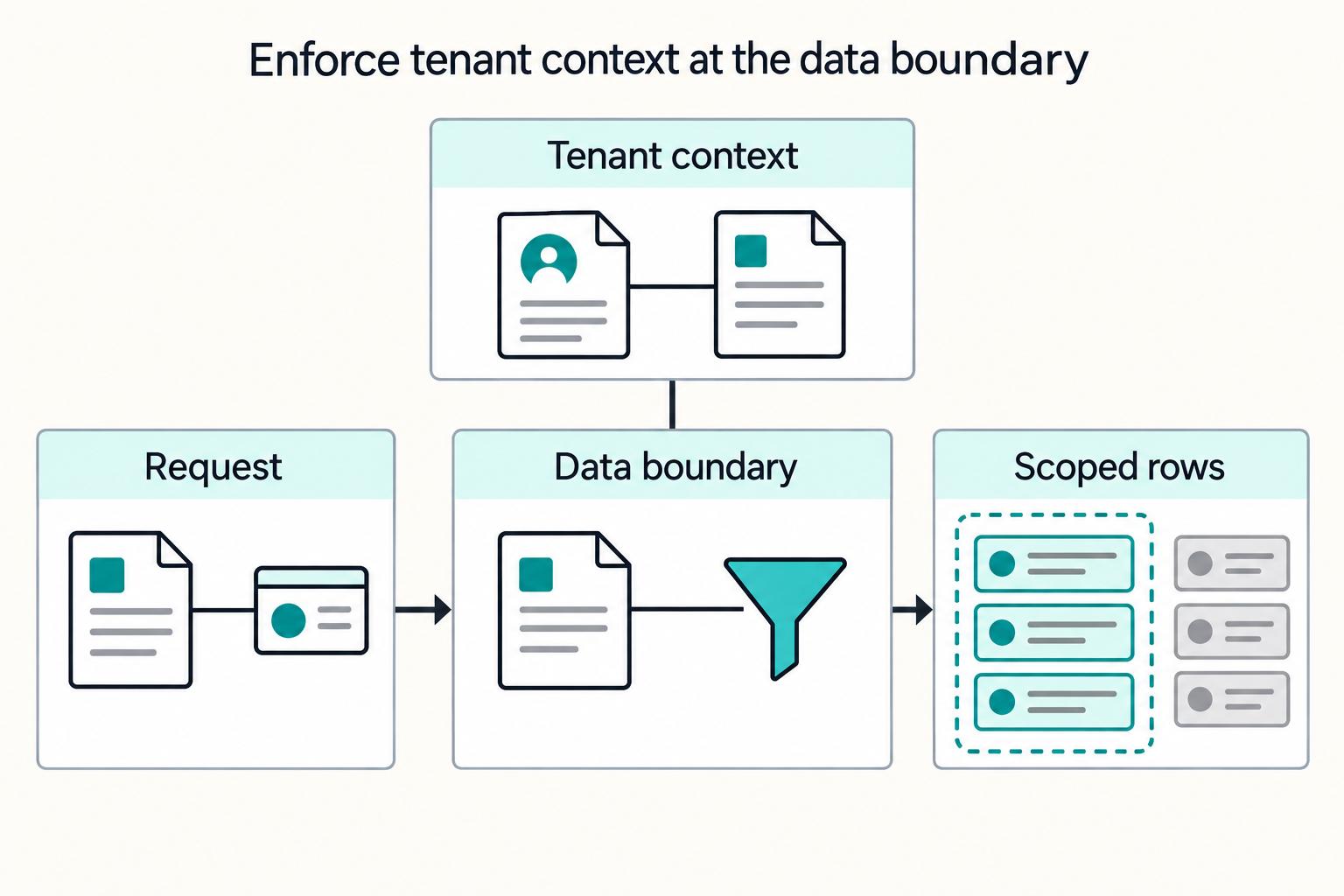
Start by selecting an isolation tier and writing the exact events that force a move to a stricter model. In a shared setup, `TenantId` is only a partitioning signal; tenant context must be bound to authenticated sessions and enforced with `Row-level security` so missing filters do not leak records. Add checkpoints for webhook replay behavior, export and restore overhead, and boundary near-misses. When those signals rise, migrate affected cohorts to `Schema-per-tenant` or `Database-per-tenant` instead of waiting for a full redesign.
Make isolation decisions explicit at the start. A shared multi-tenant model is efficient, but when controls are weak, a single vulnerability or misconfiguration can expose data across tenants. In a multi-tenant application, customers share infrastructure, code, and often databases. That efficiency is real, and so is the blast-radius risk if tenant boundaries fail.
Treat TenantId as one control, not the boundary itself. A shared database with a TenantId column can provide logical separation, but it does not automatically create a strong security boundary. The OWASP Multi-Tenant Security Cheat Sheet makes the same distinction. Isolation sits on a spectrum, from heavily shared to much stricter models. Each point on that spectrum brings different cost, scalability, and operational tradeoffs.
The practical baseline is disciplined tenant context. Establish tenant context early in the request lifecycle, tie it to authenticated sessions, and propagate it through the layers that read or write tenant data. Never trust client-supplied tenant IDs without validation. A Zero Trust Architecture model is useful here because it treats context propagation and policy enforcement as explicit control paths, not assumptions.
This article follows a simple decision sequence: choose an isolation tier deliberately, set a minimum control baseline for that tier, and define clear triggers for when shared patterns stop being enough. The goal is to help you ship now without backing into a rushed redesign later.
Separate two decisions up front: how tenant data is organized and how cross-tenant access is prevented. When teams blur those together, architecture debates drag on and isolation risk gets hidden behind storage labels.
In a multi-tenant architecture, one logical application serves multiple customers, while each tenant is still expected to remain isolated. That means data layout choices are implementation details, not proof of isolation by themselves.
Pattern names are useful because they describe what is shared and what is separated. By themselves, they do not determine the security outcome.
Frame the choice around explicit tradeoffs in resources, scalability, and operational complexity. Azure's multitenant storage guidance also calls out both multitenancy patterns and antipatterns, so the useful question is not just which pattern you use, but which failure modes you are designing against.
Set a concrete checkpoint early: review your tenant count and stored data volume, then decide what would trigger a reassessment. Even if you have "five or fewer" tenants today, write down what growth or risk changes would force a fresh isolation review.
Ask whether a failure in an identity path could turn a single-tenant problem into a wider incident. Identity isolation mistakes can carry a larger blast radius.
If you want a deeper dive, read Gateway Routing for Platforms: How to Use Multiple Payment Gateways to Maximize Approval Rates.
Choose the model whose failure mode you can live with, not the one with the strongest label. A shared model can be a sensible start when strict segregation commitments are not yet required. If you already support higher-risk enterprise accounts or contractual segregation requirements, consider starting those tenants on Schema-per-tenant or Database-per-tenant.
A Shared database with TenantId gives you logical separation, but layout is not isolation by itself. Data partitioning and access-boundary enforcement are different controls, and partitioned systems can still leak through implementation bugs, such as tenant #51 data showing up in tenant #50 views. Put the tradeoffs into one decision matrix.
| Model | Security boundary strength | Blast radius | Noisy-neighbor risk | Backup/restore granularity | Migration burden | Cost-to-serve per tenant |
|---|---|---|---|---|---|---|
Shared database + Shared schema | Logical separation via TenantId, but isolation still depends on enforcement in app and data paths | Shared privileged-path failures can expose many tenants | Explicit criterion: heavy tenant workloads can degrade others | Per-tenant backup, export, and maintenance must be designed explicitly | Context-dependent; validate against platform constraints | Context-dependent; avoid assuming a fixed ranking |
Schema-per-tenant | Different partitioning layout; isolation outcomes still depend on enforcement and privileged paths | Depends on which admin and infrastructure paths remain shared | Still an explicit criterion wherever resources are shared | Per-tenant operations still require explicit design and verification | Context-dependent; validate against schema lifecycle and rollout complexity | Context-dependent; avoid assuming a fixed ranking |
Database-per-tenant | Different partitioning layout with a separate database per tenant; isolation outcomes still depend on enforcement and privileged paths | Depends on which control planes, credentials, and services remain shared | Still an explicit criterion wherever upstream resources are shared | Per-tenant operations still require explicit design and verification | Context-dependent; validate for provisioning and fleet operations | Context-dependent; avoid assuming a fixed ranking |
These are tendencies, not guarantees. Real outcomes still depend on identity, privileged access, policy enforcement, and operational discipline.
A shared model is a reasonable starting point when you do not yet need strict segregation commitments. If you go this route, treat TenantId as one signal in a broader control chain. Verify tenant scope propagation end to end, from API entrypoints through jobs and storage queries.
Red flags include tenant scope passed ad hoc, internal tools that bypass guardrails, or batch and reporting paths that drop tenant filters. Authentication and authorization alone are not enough to claim isolation.
Move to Schema-per-tenant or Database-per-tenant before you onboard accounts that need stricter segregation. A stronger layout boundary does not replace good identity and policy controls, but it can reduce shared-fate exposure when implemented well and support safer tenant-scoped operations.
A simple rule works well here: if you cannot clearly demonstrate the required isolation posture in a fully shared model, do not onboard that account on shared architecture and call it temporary debt.
For adjacent operational issues, see Payment Decline Reason Codes for Platform Engineers. Use this decision point to translate isolation tier choices into concrete API, webhook, and ledger controls in one implementation plan: review the integration docs.
In a Shared database and Shared schema, a TenantId column is not a sufficient security baseline on its own. The baseline is tenant context set in session state and enforced at the database boundary. Isolation should not depend on every query author remembering to add tenant filters.
That distinction matters because logical partitioning is not the same as isolation. In shared-schema systems, all tenants can live in the same tables, and one missing tenant filter can expose another tenant's data. Shared models also carry shared-trust risk, where privileged-path mistakes can affect multiple tenants at once.
Treat TenantId as enforcement input, not proof that enforcement exists. Set tenant identity in session context, such as current_tenant, and apply that context in database security rules.
Row-level security at the database boundary#Row-level security enforces tenant isolation in the database by filtering rows from tenant or user context, often through predicates that act like automated WHERE clauses. This directly reduces the common shared-schema failure mode where a query hits the right table with the wrong tenant scope.
A practical implementation checkpoint is to index tenant IDs and keep RLS predicates simple, so isolation stays enforceable with minimal impact on query speed.
Multitenant architecture involves a tradeoff between stronger isolation and lower cost per tenant, and those priorities can conflict.
For a step-by-step walkthrough, see How to Set Up a Multi-Entity Payment Structure for Global Platform Operations.
Once Row-level security is in place, ask the next question: if storage or a privileged path fails, could that still expose plaintext across tenants? Use Application-Level Encryption when you need cryptographic tenant separation, and make key ownership part of that boundary.
TenantId and database policies help prevent accidental cross-tenant reads, but they do not remove shared-trust risk. A single app-layer flaw, over-broad admin path, or compromised privileged credential can still become a multi-tenant incident. Encryption only changes that outcome when key scope and key control match the tenant boundary you actually need.
| Situation | ALE stance | Key scope implication |
|---|---|---|
| Shared database and shared schema with an accepted shared-risk posture | Can be optional for lower-sensitivity data classes | A shared platform-managed key can improve baseline protection, but it does not provide tenant-level cryptographic isolation |
| Shared model with higher-sensitivity tenant data | Strongly recommended for affected data classes | Use tenant or tenant-cohort key scope so exposed storage does not automatically reveal all tenant plaintext |
| Tenants with stronger segregation or compliance expectations | Often necessary for those tenants if you remain on a shared model | Keep key ownership and access separable per tenant, not just per table or environment |
The real decision is not just whether data is encrypted. It is who controls the keys, and whether one key decrypts one tenant, a cohort, or the whole platform. A shared key can improve baseline data-at-rest protection, but it still keeps tenants in the same fate set if one broad decryption path is compromised.
For high-sensitivity tenants, consider scoping keys per tenant to reduce the failure domain under Zero-trust architecture assumptions. A clear warning sign is tenant-specific ciphertext combined with one service identity that can decrypt everything. That can add complexity without materially reducing exposure.
Microsoft Fabric's April 3, 2026 BYOK/CMK update is a useful control-mapping example because different keys protect different layers. The transferable point is simple: align key scope to the isolation boundary you need, rather than copying product boundaries directly.
Encryption boundaries have to survive live payment operations, not just a design review. Rotation, revocation, and recovery can affect payout and reporting paths. Validate these checkpoints in non-production:
If one test breaks unrelated tenants, your key boundary is wider than intended. If recovery depends on a manual bypass of tenant scoping, treat that path as high risk and constrain it tightly.
Encryption is not a standalone checkbox. In shared systems, identity failures can carry more blast radius than most application bugs. Decryption paths should use narrowly scoped service identities, tenant-aware authorization checks, and logs that preserve tenant context without exposing plaintext in routine traces.
If you cannot prove which identity can decrypt which tenant data, you do not yet have a reliable encryption boundary. For a related controls discussion, see DAC7 for Platform Operators: Scope, Seller Data, and Controls for EU and Non-EU Platforms.
A practical way to review isolation is surface by surface, using the same three layers every time: data, configuration, and access control. Do not treat payments as one undifferentiated blob, and do not assume one universal control matrix will fit every platform. Use one internal table so you review each lifecycle stage through the same lens; the exact stage-to-control mapping is still system-specific.
| Lifecycle stage | Example surface to map | What to document at minimum | Escalation path to record |
|---|---|---|---|
| Onboarding (if applicable) | Tenant onboarding flow | Where tenant-specific data and config live, how separation is enforced, and which access paths can change it | Whether the shared model still meets isolation needs |
| Collection (if applicable) | Collection data and configuration paths | Whether data is shared and tenant-partitioned, plus the access controls that enforce tenant scope | Whether stronger segregation is needed |
| Walleting (if applicable) | Wallet-related data and config paths | Data boundary, config boundary, and access-control boundary for create, update, and read paths | Whether the current model remains manageable |
| Conversion (if applicable) | Conversion-related data and config paths | Which parts are tenant-scoped versus shared, and where cross-tenant access is blocked | Whether shared boundaries are still clear |
| Payouts (if applicable) | Payout-related records and workflows | How records are partitioned, what controls enforce visibility boundaries, and where monitoring is applied | Whether stronger segregation is needed |
| Reporting (if applicable) | Tenant-facing reports and exports | Tenant data scope, authorization boundary, and monitoring boundary | Whether reporting needs require a stronger isolation model |
TenantId partitioning in shared tables is not isolation by itself. In row-level models, rigorous access controls still have to do the real work, so each surface needs a clear answer for data separation, configuration separation, and access-control enforcement.
If you have asynchronous paths, give them their own row instead of inheriting assumptions from synchronous paths.
For shared services, include an explicit checkpoint that upgrades, monitoring, and security controls are applied centrally.
For shared models, baseline controls are the ones that make row-level partitioning safe and operable. Escalation options are Schema-per-tenant, which balances isolation and manageability, and Database-per-tenant, which can simplify isolation and compliance at higher operational cost.
This pairs well with our guide on How to Maximize Your Xero Investment as a Payment Platform: Integrations and Automation Tips.
If you want to avoid expensive rework later, sequence the implementation from the start. "We'll harden later" tends to become "we are redesigning under pressure" once tenant count, data volume, and support load increase.
Phase 1. Make a shared model survivable with explicit tenant checkpoints. For subscription-based multitenant onboarding, define and verify a dedicated consumer subaccount in the provider global account, an explicit subscription step (cockpit, CLI, or REST API), and a dedicated tenant URL.
Call Phase 1 complete only when you can show failure containment, not just happy-path success. At minimum, confirm tenant boundaries still hold under error conditions and that onboarding checkpoints are observable and repeatable.
Phase 2. Reduce operational blast radius as the fleet gets denser. Add operational controls and incident detection that can distinguish isolated tenant issues from broader boundary failures.
Configuration containment matters here. Microsoft's Azure Front Door incident write-up shows how incompatible configurations can propagate broadly and quickly in shared fleets. It also shows how a manual cleanup action can bypass protection layers and let incompatible metadata move beyond canary containment. Roll out tenant-affecting config changes to a small containment scope first, and treat manual bypasses as exceptional actions with explicit approval and logging.
Phase 3. Graduate targeted cohorts instead of rewriting the whole platform. Move only the cohorts that need stronger separation to higher-isolation patterns, and keep lower-risk cohorts on shared paths while your baseline controls remain defensible.
If distributed storage is likely, capture the hard-to-change choices early. In Citus, shard count is harder to change after cluster creation. Multitenant guidance is typically 32 - 128 shards, with 32 as a possible start for smaller workloads under <100GB and 64 or 128 for larger ones. More shards increase flexibility, but they also increase query planning overhead and connection pressure as concurrent queries scale with shard count.
Use the Azure Well-Architected Framework as a quality lens, then validate service-specific patterns in the Microsoft Azure Architecture Center for the services you actually run. That review helps pressure-test your choices. It is not proof that the implementation is complete.
Keep a migration backlog for every deferred hardening item with an explicit owner, trigger, prerequisite, dependency, target cohort, rollback note, and closure evidence. If an item has no owner or trigger, it is not deferred work. It is accumulating debt.
Audit evidence is strongest when you can trace a tenant-scoped event end to end and explain it under review. Define that trace before launch, then test it in both directions, from an external event to internal records and from internal records back to origin, so reconciliation does not depend on guesswork.
Set one authoritative chain per tenant and document it explicitly. The material here does not establish required provider-reference schemas, ledger-event structures, payout-status models, or export formats, so treat those as implementation decisions you need to define up front.
A simple readiness check works well: for a sampled transaction, you can reconstruct what happened, who changed it, and when. If manual interventions exist, keep them attributable and visible so corrections stay reviewable.
Treat compliance records as a separate class, not as generic attachments. For W-8, W-9, 1099, and FBAR, the material here does not provide specific storage, masking, or retention rules, so do not infer those controls from this section.
For FEIE, the checkpoints are more concrete: the exclusion applies only to qualifying individuals with foreign earned income who file a U.S. return reporting that income, and the claim artifact is Form 2555 or Form 2555-EZ. For the physical presence test, the rule is 330 full days in 12 consecutive months, with a full day defined as 24 consecutive hours from midnight to midnight. Missing that period is not excused by illness, family issues, vacation, or employer orders, and time in a foreign country in violation of U.S. law does not count.
Do not assume one compliance pattern applies everywhere. FEIE minimum time requirements can be waived in some war, civil unrest, or similar adverse-condition cases, and the IRS publishes a yearly Revenue Procedure listing countries where waivers may apply.
| Process area | Concrete checkpoint from this grounding | Must be defined by your compliance program |
|---|---|---|
| FEIE | Form 2555 or Form 2555-EZ; 330 full days in 12 consecutive months; max exclusion $130,000 (2025) and $132,900 (2026); housing limit generally 30% (including $39,000 for 2025 and $39,870 for 2026) | How you collect, review, and retain supporting evidence |
| W-8 / W-9 / 1099 | No concrete checkpoint established in this grounding | Exact masking, storage, retention, and workflow controls |
| FBAR | No concrete checkpoint established in this grounding | Trigger logic, stored fields, and evidence requirements |
One implementation caution: the IRS Practice Unit that references Form 2555 / 2555-EZ is not an official pronouncement of law.
Related: Payments Orchestration: What It Is and Why Every Platform Needs a Multi-Gateway Strategy.
In a multi-tenant SaaS system, async recovery should protect tenant boundaries first and speed second. An async processing mistake can become a tenant-isolation incident, which raises both trust risk and regulatory risk.
Use background jobs for work that does not require user interaction or UI blocking. If a task requires the user or UI to wait, it is usually a poor fit for background execution and should be redesigned.
For async flows, document what is confirmed behavior and what is only assumed, then define what your application will accept before it updates tenant-scoped data.
Define failure modes and decisions explicitly, then make those decisions reconstructable in operations. For each sampled job or event, you should be able to show the input received, how tenant context was resolved, and the action taken. If your team cannot reconstruct that chain after the fact, recovery turns into guesswork.
When tenant context is ambiguous, force an explicit handling path instead of normal processing. The material here does not prescribe one universal policy, so define the one that fits your architecture and controls. Apply that gate before tenant-scoped updates so tenant resolution is confirmed before downstream state changes.
Before you enable auto-retry, verify in testing that repeated processing reaches the intended final state for your architecture. The provided material does not define payment-specific replay rules, so document your own acceptance criteria and operator checks.
A compact evidence pack is enough: first run, replay run, resulting state, and any operator intervention. Azure's background-job reliability checklist is a practical final check before you automate.
You might also find this useful: Adaptive Payments for Platforms: How to Split a Single Transaction Across Multiple Payees.
Define graduation triggers now, not in the middle of an architecture debate. Changing tenancy models later can be costly, and a cross-tenant boundary break can be a severe business event.
Keep the rule set explicit and tied to evidence, not opinion:
Keep the review operational. Architecture, security, and payments ops should inspect the same evidence each cycle: new contract clauses, key-ownership requests, boundary near-miss postmortems, export and restore tickets, and the manual effort required. If you have 50 tenants or more, storage and data architecture should already be under scale-focused scrutiny.
Set a recurring checkpoint, but treat cadence as a team choice, not a vendor mandate. AWS emphasizes continual review, and Azure gives every four months as an example. When a trigger fires, schedule the migration path for the affected tenants.
Need the full breakdown? Read Intacct vs. NetSuite for Payment Platforms: Which ERP Handles Multi-Currency and High-Volume AP Better.
The strongest pattern is not maximum isolation everywhere. It is choosing the isolation tier that fits your risk, then proving the boundary holds under failure conditions.
A strict shared model can be a valid starting point, but TenantId alone is only logical separation inside a shared-fate design. If you stay shared, enforce tenant boundaries at the data layer with controls like Row-Level Security, carry tenant identity through session context such as current_tenant, and verify those checks run on every query path.
The tradeoff is straightforward: fully isolated models increase separation by giving each tenant separate resources, databases, and network infrastructure, while a shared database plus TenantId remains a shared-fate design. The failure mode is just as straightforward here. Compromised privileged credentials or malicious admin access can turn into a catastrophic multi-tenant breach. When that risk profile is no longer acceptable, move the affected tenants to more isolated placement instead of waiting for a full-platform rewrite.
Keep the decision operational, not theoretical. Test negative cases such as cross-tenant read and write attempts. Confirm that row-level predicates behave like automatic tenant-scoped filters, and confirm that database session context matches the tenant your application is actually serving.
Document the choice before debt hardens. Capture:
Row-Level Security plus session context, or separate placementIsolation work is easy to postpone, but identity and tenant-boundary mistakes carry unusually high blast radius and cost. Keep your decisions defensible by stating what is still shared, where requirements vary, and what operational evidence supports the architecture.
If you want a quick architecture check on tenant isolation boundaries, payout flows, and market-specific compliance gates, talk with Gruv.
A practical baseline in these excerpts is a boundary that keeps each tenant's information separate, even in a shared system. Organizing data by tenant is part of that, but by itself it may fall short if one vulnerability or privileged compromise can expose multiple tenants at once.
Not on its own. A shared database with a TenantId column provides logical separation and can prevent some application-level cross-tenant leakage. The same source also says this model can become insufficient as security and regulatory demands rise.
There is no single grounded threshold in these excerpts, so treat this as a risk-and-scale decision, not a fixed rule. Isolation sits on a spectrum from fully shared to fully isolated, and you should reassess your position as security or segregation demands rise. The visible Azure excerpt also calls out tenant count and stored data volume as key inputs, and notes that "five or fewer" tenants with small data can be a different planning case.
Per-tenant Application-Level Encryption can cryptographically silo data by tenant. In practice, that means a storage-layer compromise does not automatically produce readable data for every tenant.
Use the distinction the source material makes explicit in the isolation spectrum: databases/data, resources, and network infrastructure can each be shared or isolated to different degrees. Data isolation focuses on separating tenant data. Resource and network isolation focus on separating the underlying infrastructure surfaces.
The excerpts here do not define webhook-, payout-, or reconciliation-specific verification steps. Beyond that, define verification steps from your own architecture and threat model.
Avery writes for operators who care about clean books: reconciliation habits, payout workflows, and the systems that prevent month-end chaos when money crosses borders.
Includes 5 external sources outside the trusted-domain allowlist.
Educational content only. Not legal, tax, or financial advice.

**Start with the business decision, not the feature.** For a contractor platform, the real question is whether embedded insurance removes onboarding friction, proof-of-insurance chasing, and claims confusion, or simply adds more support, finance, and exception handling. Insurance is truly embedded only when quote, bind, document delivery, and servicing happen inside workflows your team already owns.
Treat Italy as a lane choice, not a generic freelancer signup market. If you cannot separate **Regime Forfettario** eligibility, VAT treatment, and payout controls, delay launch.

**Freelance contract templates are useful only when you treat them as a control, not a file you download and forget.** A template gives you reusable language. The real protection comes from how you use it: who approves it, what has to be defined before work starts, which clauses can change, and what record you keep when the Hiring Party and Freelance Worker sign.


