
Quick Answer
Define ownership first, then move data: a safe subscription billing migration starts by setting one cutover rule so only one system can generate charges, validating a cohort through a live cycle, and expanding only after finance and product both sign off. The article stresses Billing Cutover Date discipline, record-level traceability from source to expected invoice, and explicit rollback triggers. It also warns that fee-model changes can quietly alter economics even when imports look successful.
What a No-Downtime Migration Requires#
A successful subscription billing migration should be boring to customers and calm for finance. You are not just moving records out of a legacy system. You are changing who can create charges, where invoice truth lives, and how finance will trust the first close. Done well, the move is largely invisible to customers, designed to avoid duplicate charging, and uneventful for the teams who have to run it.
Treat the move as a control problem first#
Start by treating the move as a control problem, not a UI swap. Answer a few questions before data quality even matters. Who can create charges on the Billing Cutover Date? Which team owns invoice truth during the transition? How does reconciliation get approved? What condition gives someone authority to stop or reverse the launch? If those controls are vague, clean data will not save you.
The target platform changes economics as well as operations. Compare your actual processing, billing and payout fees before cutover. A migration can preserve gross invoices while changing net collections and margins.
Keep fee ownership explicit. Stripe Connect distinguishes Stripe-billed connected users from a platform that handles user pricing. Its U.S. platform-priced schedule lists $2 per monthly active account and 0.25% + 25¢ per payout. Those marketplace fees apply only when that Connect setup is part of your migration; ordinary subscription billing does not automatically incur them.
Set scope before anyone touches data#
Set scope early so leaders and operators are solving the same problem. For leaders, that means naming ownership boundaries across product, finance, and engineering for cutover approval, reconciliation sign off, and rollback authority. For operators, it means deciding what must be accurate before launch: subscriber identity, plan and price state, payment status, billing cycle anchor, and the source of record once the switch happens.
This guide is intentionally cross-vendor. It uses examples from multiple billing platforms to explain decision logic, but it is not a setup tutorial for any one product. Before you go deeper, write down your current billing volume, payment method mix, payout pattern, and effective fee stack. Then compare that against the target platform and any add on pricing layers. If that comparison is still informal, you are evaluating software, not managing a controlled migration.
For Shopify-specific cutover considerations, see Shopify Subscription Integration: Adding Recurring Billing to Ecommerce Without Migration Pain.
Start with the seven decisions that determine migration risk#
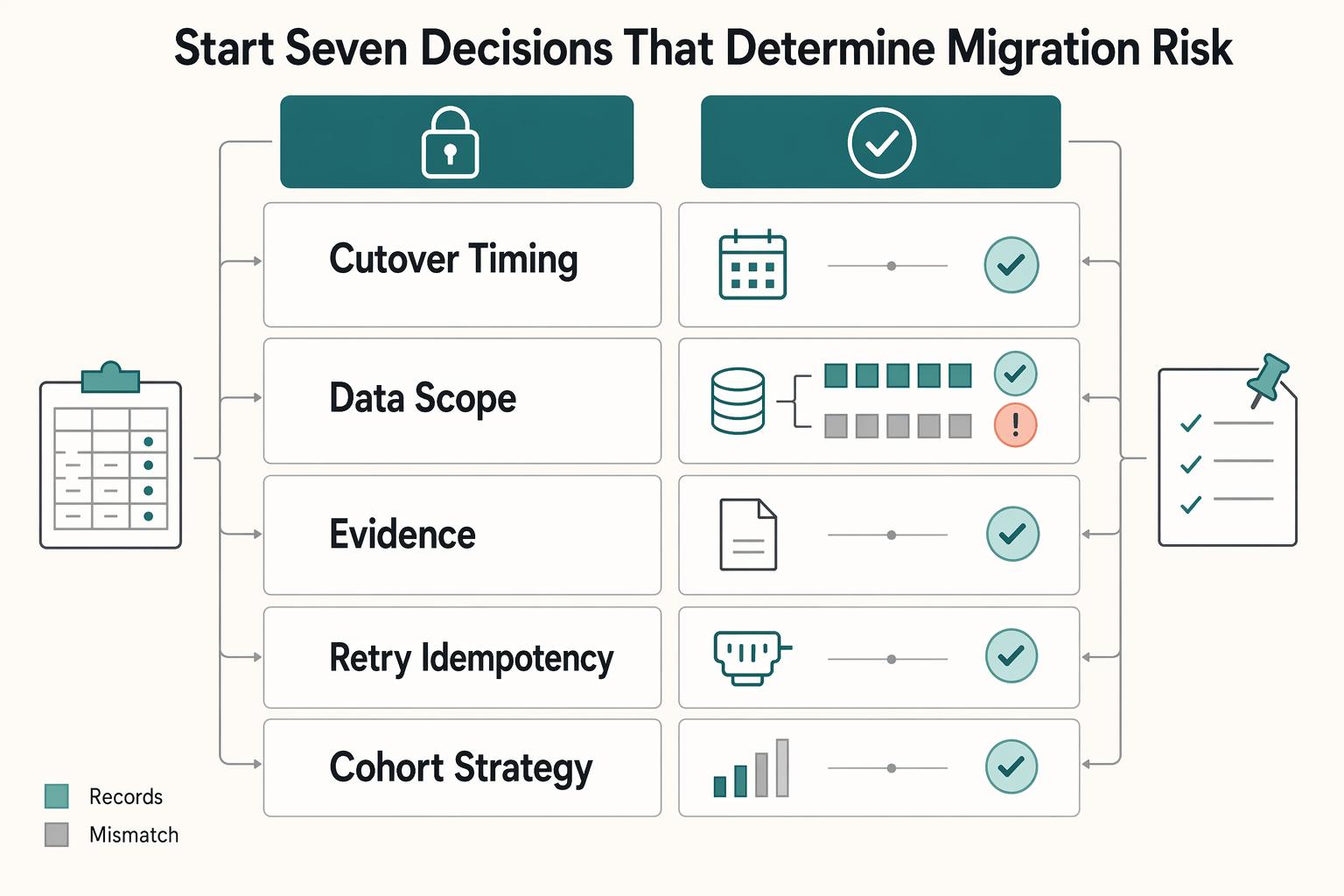
Lock these seven decisions in writing before implementation starts, because unclear ownership is the fastest path to double billing.
| Decision | What to lock |
|---|---|
| Cutover timing | Billing cutover date and timezone |
| Data scope | Which subscribers, plans, invoice history, and payment states move now versus later |
| System-of-record ownership | Which platform can create charges, invoices, and subscription changes after cutover |
| Retry and idempotency behavior | How replays, retries, and duplicate events are handled |
| Cohort strategy | Who moves first and who is held back |
| Reconciliation standard | What must match before finance signs off |
| Rollback trigger | What condition gives authority to stop expansion or reverse launch |
Use a short decision record that names:
- Cutover timing: billing cutover date and timezone
- Data scope: which subscribers, plans, invoice history, and payment states move now versus later
- System-of-record ownership: which platform can create charges, invoices, and subscription changes after cutover
- Retry and idempotency behavior: how replays, retries, and duplicate events are handled
- Cohort strategy: who moves first and who is held back
- Reconciliation standard: what must match before finance signs off
- Rollback trigger: what condition gives authority to stop expansion or reverse launch
Run one checkpoint before go-live: product, finance, and engineering should give the same answer to, "After cutover, which system can bill this customer?" If answers differ, delay the date. Billing migrations often fail when treated like a system swap instead of an operational change, and risk rises when connected dependencies are unclear or undocumented.
Do not leave revenue recognition implied. Decide whether you will restate, bridge, or dual-track it during transition, and record who signs off. Name one accountable owner each from product, finance, and engineering for cutover approval and rollback authority, and require all three names on the decision record before implementation.
Choose the migration method based on control requirements, not vendor marketing#
Choose the method that lets you prove billing behavior before go-live, not the one with the best demo. If your plans, billing-cycle rules, or dunning logic are non-standard, default to an API-led migration with explicit validation.
Score each option on three axes before moving data: speed to first cohort, customization depth, and observability of each migrated record.
| Migration path | Typical fit | What must be true before go-live |
|---|---|---|
| Toolkit/no-code import | Founder-led, lean team, simpler catalog | You can trace source record -> transformed record -> created subscription -> expected first invoice, with row-level error visibility. |
| API-led migration | Multi-entity finance org or non-standard billing logic | You can enforce and verify billing-cycle anchors, retry behavior, payment state, and reconciliation checks in code. |
| Enterprise platform import (for example, Microsoft Dynamics 365 or SAP Subscription Billing) | Teams using enterprise billing stacks | Apply the same proof standard as above; UI convenience is not enough without record-level validation evidence. |
For a Stripe migration, assess the Billing import toolkit’s supported fields and validation reports against your data contract. Choose an API-led path when required behavior is not represented by the toolkit. Payment-processing and Connect pricing choices are separate decisions from the subscription import method.
Related: The Best Tools for Managing Subscription Billing.
Build a migration data contract that finance and product both approve#
Treat the data contract as a go/no-go gate: if finance and product do not approve the same mapping and billing behavior, pause the migration.
Start by locking the entities and decisions that control the first post-cutover invoice.
| Entity | Decision to lock | What to verify |
|---|---|---|
| Subscriber identity | Durable source key to carry forward | One source customer maps to one target customer |
| Plan and price history | Preserve lifecycle history or flatten to current state | Upgrade and downgrade samples produce expected next charges |
| Billing cycle anchor | Renewal date/rule that survives cutover | First post-cutover invoice timing matches expectation |
| Adjustment period rules | How partial periods are handled | Proration/catch-up behavior is defined before import |
| Payment state | Meaning of active, past due, paused, failed renewal | Collections/dunning state is preserved, not reset |
| Payment method and mandate | Which credentials and consents can transfer through the processor’s supported migration route | Token remapping, off-session authorization and any required customer action are confirmed before first charge |
Preserve amendment history according to the billing outcome it controls. If the source groups schedules across upgrades or downgrades, document how the target represents the same renewal and adjustment rules. A different object model is acceptable when the expected invoices still reconcile.
Then document billing behavior primitives as business rules, not assumptions: rating logic assumptions, internal due-date logic, and expected behavior for backdated subscriptions. The key distinction is that a record can import successfully and still be commercially wrong.
Align quoting, contracts, billing, payments and revenue-recognition owners on those rules. A billing change can affect both product access and finance outcomes.
Before cutover, assemble a pre-migration evidence pack both teams can review asynchronously:
- Source sample records from the legacy system
- Transformed target records
- Expected invoice outcomes after import
- Edge-case samples (pauses, upgrades, downgrades, failed renewals, and other known complexity such as usage-based or multi-currency cases where relevant)
For each sample, include the source ID, transformed record, intended anchor, payment state, and expected first invoice result. If the team cannot trace source -> transformed record -> expected invoice outcome, the contract is not ready.
Finally, validate behavior, not only fields:
- Field parity on IDs, anchors, prices, and payment state
- Event ordering for pauses, resumes, changes, and renewals
- Edge-case outcomes for non-happy-path records
- Expected versus actual first-invoice behavior before expanding cohorts
This level of control matters more as pricing tiers, usage fees, amendments, and multi-currency operations increase, because disconnected or manual handling can create billing errors, revenue leakage, and delayed closes.
For a step-by-step walkthrough, see Building Subscription Revenue on a Marketplace Without Billing Gaps.
Set cutover governance so only one system can charge at a time#
Set one hard rule: after the Billing Cutover Date, only one system is allowed to generate charges. In SAP Subscription Billing, that date defines when charges are billed in SAP and not in the legacy system, and if the legacy system still charges in the in-between window, the risk is double billing.
| Step | Control | What to confirm |
|---|---|---|
| 1. Lock cutover policy | Document the Billing Cutover Date with exact timezone, freeze window, and irreversible actions | Per cohort, state whether the first SAP-billed point is the start date of the billing period or the date of the next adjustment period |
| 2. Tie timing to due-date behavior | Validate internal due date and first-invoice behavior before launch | Keep advance charges due at the start of the billing cycle and arrears charges due at the next billing cycle start explicit |
| 3. Lock adjustment-period control | Define adjustment periods in the Manage Business Configuration app under Billing Profiles and freeze those settings through cutover unless an authorized change is approved | If the legacy system emits charges after cutover, block new billing generation in one system immediately |
| 4. Rehearse with production-like timing | Run a dry cutover at the same day pattern and roughly the same hour as live | Confirm the planned cutover date, expected first SAP billing point, and proof that only one platform can create the next charge |
Step 1. Lock a cutover policy that removes timing ambiguity. Document the Billing Cutover Date with exact timezone, freeze window, and irreversible actions. SAP allows the cutover date to be today, in the past, or in the future, so your policy needs to state the operating details, not just a calendar date. Also state, per cohort, whether the first SAP-billed point is the start date of the billing period or the date of the next adjustment period.
Step 2. Tie cutover timing to due-date behavior before go-live. SAP calculates an internal due date for each charge, and that due date controls when the charge is included in a bill. For subscriptions with past start dates, SAP rates from the start date until now, so validate first-invoice behavior before launch. Keep the advance-vs-arrears distinction explicit: advance charges are due at the start of the billing cycle, while arrears charges are due at the next billing cycle start.
Step 3. Lock adjustment-period control and stop overlap immediately. Define adjustment periods in the Manage Business Configuration app under Billing Profiles, and freeze those settings through cutover unless an authorized change is approved. If the legacy system emits charges after cutover, block new billing generation in one system immediately. Do not rely on later reconciliation to solve overlap risk.
Step 4. Rehearse with production-like timing and use explicit go/no-go. Run a dry cutover at the same day pattern and roughly the same hour as live. In the rehearsal evidence, confirm the planned cutover date, expected first SAP billing point, and proof that only one platform can create the next charge. Check forecast behavior too: forecasts start at the billing-cycle start that contains the cutover date, and if Valid From or cutover is more than two years ago, only up to two years of past billing cycles are considered.
Reconcile finance logic before launch day#
Before launch, reconcile your finance assumptions to the fee model you are actually migrating to. Charging can work while margin, forecasting, and cohort reporting still drift if fee ownership and additive fees are modeled incorrectly.
Map fee ownership before finance expectations#
Document who pays processing, billing, account and payout charges under the selected configuration. Use the fee schedule for your account’s market and contract.
| Fee component | What to record | Validation before cutover |
|---|---|---|
| Processing | Method, market, percentage/fixed fees and refund treatment | Recalculate a sample of expected net collections |
| Subscription billing | Billing-service fee basis and enabled features | Confirm which invoice or transaction amounts incur the fee |
| Connect where applicable | Whether Stripe or the platform bills users; account/payout fees under the selected model | Keep platform and connected-account expenses separate |
| Other enabled products | Only fees for products actually used | Avoid stacking unrelated product prices into the forecast |
Use a quick checkpoint: recalculate expected net cash after fees for a small sample across cohorts using the actual pricing model, not one blended assumption.
Pressure test forecast integrity with fee variability#
Model fee variation by payment method, customer geography, currency conversion and refund behavior. Use the actual account schedule; a domestic-card headline price does not cover every cohort.
For each cohort, keep a short evidence pack: expected gross billings, fee assumptions, expected net collections, and why that cohort belongs in that fee bucket.
Validate reporting by cohort, not only in aggregate#
Validate reporting at cohort level before launch. If different cohorts run on different fee models or payment paths, aggregate reporting can hide where economics shift first.
Check that your reporting definitions can separate at least fee model, geography, and payment path. If those dimensions are missing, early variance will be harder to isolate.
List known unknowns before go live#
Record unresolved account terms, method-specific fees and reporting outputs with an owner and resolution date. Resolve any item that changes first-invoice behavior or net collections before expanding cohorts.
For SAP Subscription Billing or Dynamics 365 Finance, test the accounting and report outputs enabled in your configuration against the finance mapping. Save expected and actual results with the cohort sign-off.
For plan and dunning setup, see Subscription Billing Platforms for Plans, Add-Ons, Coupons, and Dunning.
Execute the migration in cohorts with hard stop checks#
Execute in cohorts, not all at once. Start with a low-risk group, run a real live-cycle check, and expand only when your first wave is traceable across billing, payment state, and customer access.
Start with the lowest-risk cohort and lock the evidence you need#
Pick a first wave that is easy to reason about: straightforward plans, predictable billing dates, and fewer exception paths. Keep high-value subscribers and unusual edge cases out of wave one so you can learn under controlled exposure.
Cohorting is mostly an organizational discipline problem, not just a tooling problem. Teams usually struggle when pressure rises and they stop honoring the original boundaries, so define those boundaries before launch and hold them.
Before import, create a wave checklist with cohort name, subscriber scope, legacy IDs, target mapping, expected billing outcome, expected entitlement outcome, and rollback owner. If your platform supports audit setup, enable it before billing starts. Treat auditability as a launch control, not cleanup.
Verify one live cycle before you expand#
Do not treat a completed import as acceptance. Let the first cohort pass through a live renewal or billing event, then validate customer outcome, billing outcome, and finance outcome together.
Use a simple cutover checklist to trace sampled subscribers end to end: legacy record, transformed target record, produced billing event, and downstream entitlement/provisioning result. If you cannot trace and explain exceptions clearly, pause expansion.
Define replay and recovery controls before go-live#
Assume imports will be rerun and events may be replayed. Before launch, make sure engineering and operations agree on exactly how reruns and reprocessing are handled so recovery work does not create new billing confusion.
A practical test is to simulate duplicate operational inputs and confirm the result matches your intended control behavior. If the plan is manual cleanup after the fact, treat the wave as not ready for wider rollout.
Enforce hard stops before high-value cohorts move#
Write stop rules before wave one and hold them during execution. Expansion should stop when reconciliation gaps are unexplained, exception handling trends worsen, dunning-path failures remain unresolved, or payment and entitlement states conflict in live cases.
This path is slower than an all-at-once launch, but it limits blast radius while you still have options. If wave one produces exceptions you cannot trace and resolve, fix the cause first, then move to higher-value cohorts.
For failed-payment recovery, see A Guide to Dunning Management for Failed Payments.
Handle the failure modes competitors skip#
The failure modes to plan for are the ones that create silent customer harm and finance variance after migration appears successful. Define recovery actions before go-live, and do not restart a cohort until you can prove containment and reconciliation.
| Failure mode | Immediate action | Validation before restart |
|---|---|---|
| Duplicate charging at the Billing Cutover Date | Stop one charging path immediately and reverse only confirmed duplicates after matching customer, amount, payment method, and charge window | Compile an evidence pack with the legacy billing record, new-platform invoice or charge record, payment processor ID, and reversal or credit action, then re-run reconciliation |
| Partial imports from Stripe APIs or a Subscriptions API path | Quarantine the cohort, diff expected legacy subscription IDs against created records, and rehydrate missing records before replay | Require count parity and field parity on customer ID, plan or price mapping, billing cycle anchor, and payment state; replay with idempotency keys |
| Wrong billing cycle anchors | Fix the anchor at subscription level before the next invoice cycle | Validate against the legacy next-bill date and review whether adjustment-period logic changed invoice timing, proration, or first post-cutover billing |
| Legacy revenue recognition assumptions no longer hold | Reset forecast baselines and re-approve finance definitions before close | Restart only when charges, fees, and reporting definitions reconcile together |
Stop duplicate charging at the Billing Cutover Date#
If both platforms can still charge at cutover, treat it as an incident and stop one charging path immediately. Reverse only confirmed duplicates after matching customer, amount, payment method, and charge window.
Before restart, reconcile the legacy invoice, target invoice, processor transaction and any reversal or credit. Confirm duplicates before reversing them, and include fees or refund costs in the financial correction record.
Quarantine partial imports from Stripe APIs or a Subscriptions API path#
A partial import is a stop signal because it can look successful while leaving missing records. Quarantine the cohort, diff expected legacy subscription IDs against created records, and rehydrate missing records before replay.
For validation, require count parity and field parity on the affected set: customer ID, plan or price mapping, billing cycle anchor, and payment state. Replay with idempotency keys so retries do not create new subscriptions for records that already landed. Treat "counts match but payment methods or renewal dates do not" as unresolved.
Correct wrong billing cycle anchors before the next invoice#
Wrong billing cycle anchors should be corrected before the next invoice cycle, not after customer impact. Fix the anchor at subscription level, then review whether adjustment-period logic changed invoice timing, proration, or first post-cutover billing.
Validate against the legacy next-bill date, not only created-at timestamps in the target system. If corrected anchors change charge timing, communicate that before renewal.
Reset finance baselines when legacy revenue recognition assumptions no longer hold#
If old revenue recognition logic, fee assumptions, or reporting definitions no longer match the new setup, reset forecast baselines and re-approve finance definitions before close. "Charges look right" is not an acceptance criterion if fee and reporting assumptions drifted.
Reconcile charges, fees and recognition schedules as separate records. Approve any changed accounting treatment before the first close; changing a processing fee assumption alone does not establish the correct revenue-recognition policy.
Conclusion#
A successful subscription billing migration usually comes down to cutover governance, reconciliation discipline, and named ownership, not tooling alone. The platform can help, but it will not save you from a vague Billing Cutover Date, weak field mapping, or unclear rollback authority.
Step 1. Rehearse one cohort before you touch scale. Pick a low-risk cohort and run a production-like cutover rehearsal with the exact Billing Cutover Date, timezone, and charging rule you plan to use live. Your pass condition is not "records imported." It is evidence that one billing path creates charges, billing cycle anchors match the source records, and finance can tie expected invoice outcomes to the migrated data contract. This matters even more if you are aligning configurations and entity mappings across modules such as Dynamics 365 Finance and subscription billing, because cross-module mismatch can hide silent errors.
Step 2. Require finance and product sign-off on outcomes, not effort. Do not expand because engineering finished the import or because a toolkit completed without hard errors. Ask finance to sign off on invoice timing, payment state, and reporting logic for the cohort. Ask product to sign off on entitlement behavior, renewal timing, and customer-visible changes. If either team cannot explain a variance, stop there. Unplanned migrations can create duplication, reporting errors, and downtime, and those are much cheaper to fix in one cohort than across the full base.
Step 3. Scale only after you document the failure response. A phased migration plan works because it gives you milestones and risk controls, not because it feels slower. Before cohort 2, write down the rollback triggers, who can invoke them, and who gets paged if duplication or reporting drift appears. Keep an evidence pack for each wave: legacy sample records, transformed records, expected invoice results, and post-cutover reconciliation output. That pack is what lets you decide quickly whether you have a real defect or just an unfamiliar billing pattern.
Copy and paste this into your launch note:
- Define the Billing Cutover Date, timezone, freeze window, and single charging rule.
- Choose your migration path based on required customization and record-level validation controls.
- Approve the migration data contract across finance, product, and engineering.
- Rehearse cutover with one cohort, including rollback triggers and owner escalation paths.
- Launch cohort 1, validate outcomes, then expand in controlled waves.
- After go live, keep validating, training the team, and supporting edge cases until the new billing motion is boring.
If you keep one rule, make it this: no cohort expansion until finance and product both sign off in writing.
Frequently Asked Questions
What causes double billing during subscription billing migration?
The usual cause is simple: both the legacy platform and the new platform can still create charges around the Billing Cutover Date. SAP is explicit that if the cutover is set before actual go live, and the legacy system still bills in that window, the result can be double billing. The real check is not whether the import finished. It is proof that only one charging path is active, plus a record set that ties each invoice or charge to the system that owned billing at that moment.
How should we choose a Billing Cutover Date without disrupting renewals?
Pick the Billing Cutover Date as the first time the subscription should be billed in SAP Subscription Billing, not as a generic project milestone. SAP allows the date to be in the past, present, or future, but the practical rule is stricter: do not set it earlier than the point where the legacy system has truly stopped billing that cohort. If subscriptions started in the past, also verify how the rating process behaves, because SAP can rate the entire period from the start date until now.
When should we use a Billing migration toolkit instead of Stripe APIs or another Subscriptions API path?
Use a toolkit when its supported fields, row-level validation and scheduling controls cover the migration contract. Use APIs for behavior the toolkit cannot represent, with explicit replay protection and expected first-invoice tests. Import method and payment-fee ownership are separate choices.
What must be reconciled before and after go-live date to avoid finance-close surprises?
Reconcile invoice dates, anchors, payment state, credits, tax and revenue-recognition schedules before the first close. Separately reconcile actual processing, billing and payout fees to expected net collections, using the account’s market and contract terms.
What are the minimum no-downtime acceptance checks for each migration cohort?
No single checklist guarantees zero downtime, so use acceptance checks to reduce risk before expansion. At minimum, confirm no duplicate invoices, no missed renewals, no broken entitlement updates, and no unresolved payment-status drift. Also check count parity and field parity for the cohort: customer ID, plan or price mapping, billing cycle anchor, and attached payment method. If you must replay imports or events, use idempotency keys so the retry cannot create fresh subscriptions or charges.
How do we phase migration when we cannot tolerate risk on high-value subscribers?
Start with a low-risk cohort, pass reconciliation, then expand in controlled waves. Keep high-value subscribers for later cohorts unless you can isolate a very small representative slice and watch it through a full renewal. If any cohort shows duplicate charging, anchor errors, or finance variance you cannot explain, stop expansion and fix that class of defect before moving the next group.
Try a related tool
Researched and edited by the Gruv editorial team. Gruv builds cross-border billing, payouts, and finance-operations software for global businesses.
Sources
Includes 3 external sources outside the trusted-domain allowlist.
- docs.stripe.com/billing/subscriptions/import-subscriptions-t...trusted
- docs.stripe.com/implementation-guides/core-payments/migrationtrusted
- stripe.com/connect/pricingtrusted
- help.sap.com/docs/subscription-billing/setup-administrati...external
- help.sap.com/doc/fc3a4887022f486fb4f3af198687dc5d/2026-03...external
- learn.microsoft.com/en-us/dynamics365/guidance/techtalks/finance...external
Educational content only. Not legal, tax, or financial advice.
Related Posts
Shopify Subscription Integration for Recurring Billing Without Migration Pain
Separate customer product subscriptions from merchant app charges before writing code. A shopper subscribing to monthly coffee deliveries and a merchant paying for your app need different billing records, approval flows and recovery steps.

Seven Subscription Billing Tools: Features and Pricing
The best subscription billing tool depends on what you sell, how you charge and who acts as seller to the customer. Start with those choices, then compare recovery, finance exports, implementation effort and price. A recurring invoice engine, a payment processor and a merchant of record perform different jobs; their headline fees cover different costs.

A Guide to Dunning Management for Failed Payments
If you run recurring invoices, failed payments are not back-office noise. They create cashflow gaps, force extra follow-up work, and increase **Involuntary Churn** when good clients lose access after payment friction.