
Quick Answer
Start by treating the cloud migration SOW as a project control document: define what sits in the MSA, what belongs in the SOW, and what belongs in any SLA, then lock workload boundaries across AWS, GCP, and Azure. Price by phase, require plain-language Change Order triggers, and set phase-based readiness authorization before cutover and acceptance evidence after it. Keep legal risk terms explicit, including Termination, Limitation of Liability, Indemnification, Governing Law, Jurisdiction, and Dispute Resolution.
Why a cloud migration SOW needs locked scope and honest uncertainty pricing, not generic procurement language#
A strong sow for cloud migration is not a generic procurement attachment. It is the client-facing document that fixes scope, commercial boundaries, and delivery assumptions. That keeps you from underwriting a messy move across multiple cloud platforms with your own time and margin.
That matters because cloud migration sounds simple in a sales call and gets slippery in delivery. "Move these workloads to the cloud" can mean assessment only, execution for specific applications or services, or even the cloud resources themselves. Public cloud migration templates used by government buyers make that distinction explicit. One GSA Statement of Objectives sample says migration scope can cover labor hours and the cloud resources themselves, including IaaS and PaaS. A Texas sample says the Statement of Work is "unique and distinct for each engagement." That is the right mindset for private consulting too.
The core tension is speed versus protection. If you keep the document vague to get the signature faster, you usually absorb the risk later through undefined app dependencies, disputed deliverables, and client assumptions that re-platforming or data cleanup were somehow included. If you make it too rigid too early, the deal can stall because the client has not finished discovery and cannot honestly approve hard commitments yet. The answer is not more legal language. It is sharper project language.
For a multi-cloud engagement, start with one basic check. Confirm what is actually being migrated and in what form. Is the commitment limited to named applications or services? Does scope include only labor, or also provisioning and managing cloud resources? Are you targeting IaaS, PaaS, or a cloud broker model for any part of the estate? If those points are still fuzzy when drafting starts, the SOW can read cleanly and still fail in execution.
A common failure mode is mixing business intent with delivery promises. Clients may be chasing lower infrastructure cost, faster processing, better data sharing, or help with internal skill gaps. Those goals matter, but they are not scope boundaries. Your document has to translate them into concrete commitments, assumptions, exclusions, and acceptance points. Otherwise, "modernize during migration" slips in without anyone approving the extra cost or risk.
This guide helps you write a consultant-safe Statement of Work that works with your MSA instead of fighting it later. The structure is practical: define the contract stack, lock boundaries, price uncertainty honestly, assign security duties clearly, and require evidence before acceptance. Do that well, and you cut late surprises without turning the sales process into a legal obstacle course.
For related delivery boundaries, see A DevOps Engineer’s Statement of Work That Prevents Scope Creep, or use the SOW generator to draft your project sections.
Define the contract stack before you draft scope#
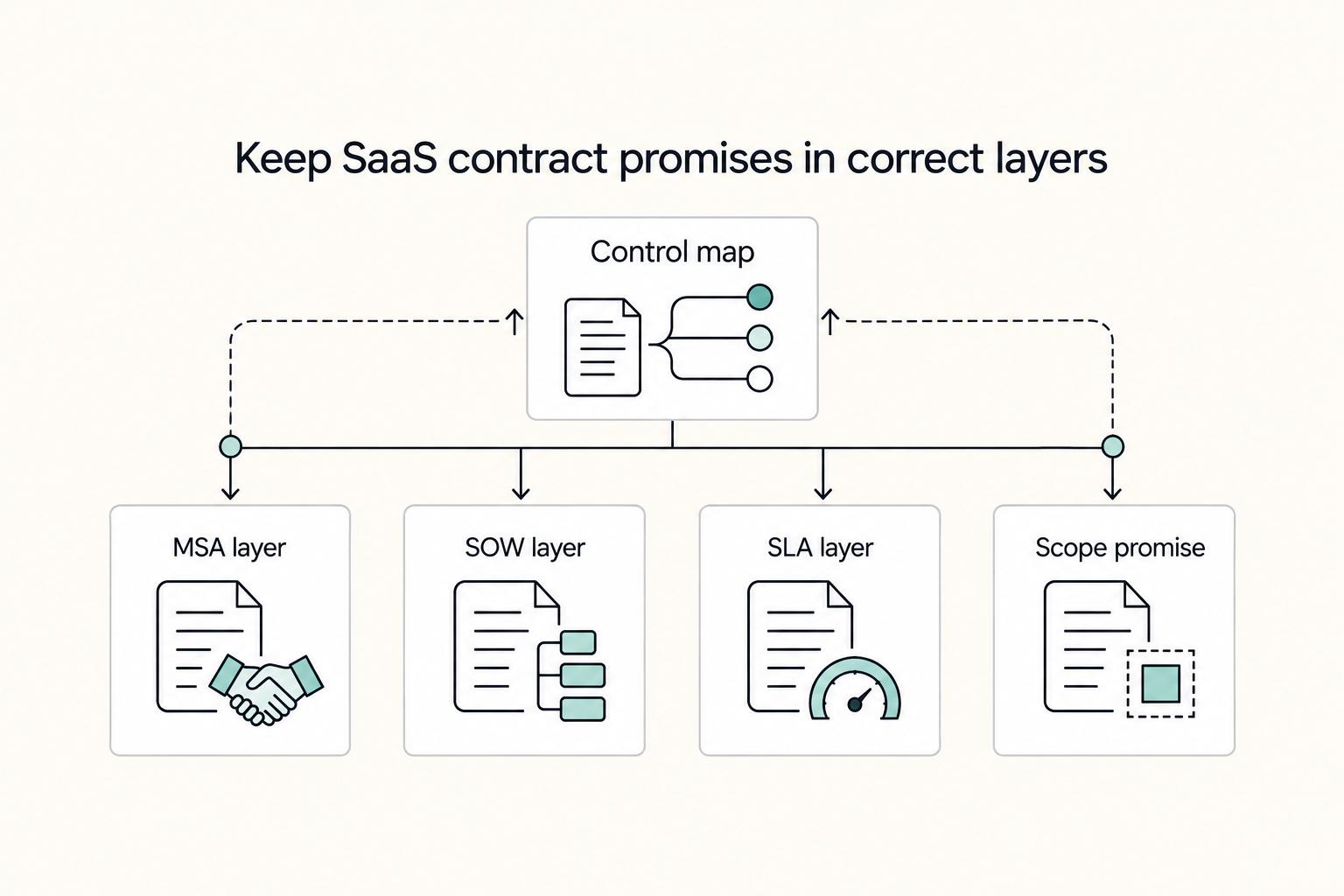
Set your contract stack first, then draft scope. Use the SOW for project-specific commitments, keep stable legal terms in the MSA, and use an SLA only for service-performance commitments you are actually making. That separation prevents scope fights later.
| Document | Use for | Keep here |
|---|---|---|
| SOW | Project-specific commitments | Terms likely to change by project |
| MSA | Stable general legal terms | Terms that should remain stable across projects |
| SLA | Service-performance commitments you are actually making | True service commitments kept separate from general project scope |
Use the U.S. General Services Administration sample Performance Work Statement as a structure reference, not copy-ready language. The GSA cloud migration PWS is explicitly a sample that should be tailored, and BUY.GSA frames these documents as curated templates and samples to support requirement drafting. In private work, borrow the structure for work definition, responsibilities, and verification points, then tailor the wording to your deal.
Apply one rule consistently: if a term is likely to change by project, keep it in the SOW; if it should remain stable across projects, keep it in the MSA. Keep SLA terms separate when they are true service commitments, and avoid mixing them into general project scope.
Review the MSA, SOW and SLA together and specify an agreed order of precedence for actual conflicts. Document any project-specific override and required approval rather than assuming document labels resolve contradictions. Related: How to Write a Scope of Work for a Web Development Project.
Lock scope boundaries and the multi-cloud target state#
Lock boundaries first, or the project will absorb unpriced work. In multi-cloud SOWs, the fastest way to lose control is leaving "what is being migrated" too vague.
Start with a boundary table that names the in-scope workloads, environments, and phases for each provider. A workload is a collection of components, for example VMs, applications, code, data, and cloud services, so avoid labels that are too broad to execute.
| Scope dimension | AWS | GCP | Microsoft Azure |
|---|---|---|---|
| In-scope workloads/apps | List named workloads with key components and known dependencies | List named workloads with key components and known dependencies | List named workloads with key components and known dependencies |
| In-scope environments | State exactly which environments are included, for example dev, test, prod | State exactly which environments are included, for example dev, test, prod | State exactly which environments are included, for example dev, test, prod |
| Project phases | Name the phases used in this engagement, for example discovery, migration, stabilization | Name the phases used in this engagement, for example discovery, migration, stabilization | Name the phases used in this engagement, for example discovery, migration, stabilization |
Then follow the same planning order in the draft: catalog workloads, map dependencies, and choose migration paths such as rehost, replatform, refactor, re-architect, replace, or retire. If cataloging and dependency mapping are still incomplete, do not commit to early execution dates.
For larger estates, plan in migration waves rather than one block. Wave planning keeps groups manageable, and high-confidence dependency data is key when deciding what moves first.
Define the target state with explicit service models, not slogans. If the target is IaaS, state that compute, storage, and network resources are provisioned while the client still runs and manages what they deploy on top. If the target is PaaS, state that underlying infrastructure is provider-managed while your team focuses on deployed applications. If a Cloud Broker is part of delivery, name that assumption because it changes who manages service use, delivery, and provider relationships.
Add an out-of-scope block for common expansion areas, but only for items you are actually excluding in this deal, for example re-platforming, data cleanup, app rewrites, or third-party license renegotiation. If one may be needed after discovery, route it through Change Order language instead of letting it enter silently.
Document the portability-versus-speed tradeoff explicitly. If portability is the goal, prioritize design choices that preserve freedom to move later; if speed is the goal, note that heavier managed-service use can increase lock-in and record the client's decision.
Before build starts, run a verification checkpoint on the current-state inventory, dependency assumptions, and future-state assumptions. Most scope failures start with missing inventory detail, not legal wording.
This pairs well with our guide on How to Write a Scope of Work for a Mobile App Development Project.
Price and change terms that survive real migration surprises#
Price terms hold up when they match what is known now and what is still uncertain. In your SOW, define the commercial model by phase, name the exact outputs for each phase, and state which assumptions the price depends on.
Keep the draft plain: if assumptions change, scope, timeline, and cost may need a written reset before affected work continues. That protects both sides from treating early estimates as fixed commitments after the facts have changed.
Write Change Order terms in plain language#
Your Change Order process should be easy for delivery teams to follow under pressure. Define project-specific triggers in plain language, then require a short written notice that covers:
| Written notice item | What it should cover |
|---|---|
| Changed assumption | What changed from the signed assumptions |
| Affected scope | What part of scope is affected |
| Impact | Impact on dates, cost, and deliverables |
| Approval status | Whether affected work pauses until written approval |
If this process is optional in practice, margin and schedule control usually fail first.
Define "done" before invoicing#
Avoid vague billing language. For each billed deliverable, state what review evidence or approval shows it is done, who approves it, and how exceptions are recorded.
Keep invoicing records aligned to the SOW line by line so disputes are handled when the change happens, not at month end.
Related reading: How to structure an 'SOW' for a retainer-based consulting engagement.
Write security and delivery obligations as testable controls#
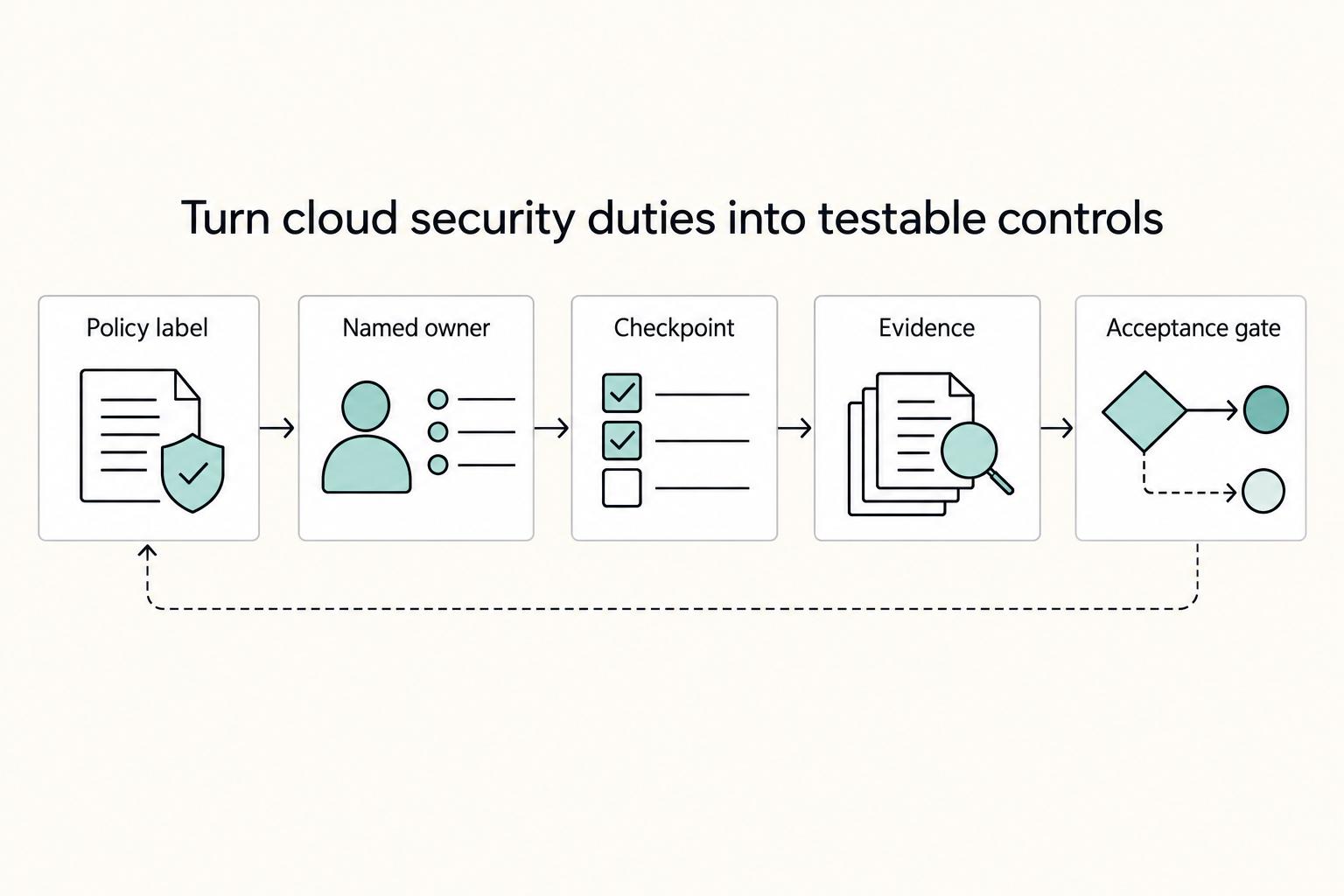
Write this section so each policy label becomes a named obligation with an owner, a checkpoint, and evidence. In a migration SOW, terms like "security is shared," "Zero Trust," "SSO," or "Cloud First" only protect you when the SOW maps who does what and how completion is verified.
Translate each policy into party-owned actions. For example, if SSO is in scope, specify who prepares identity configuration inputs, who maps roles, who runs access tests, who approves production federation, and who owns break-glass access. If Cloud First is in scope, define where managed services are preferred and where portability requirements override that preference. Put this in the SOW, not in meeting notes.
| Control area or policy | Consultant responsibility | Client responsibility | Verification checkpoint |
|---|---|---|---|
| Policy control in scope | Implement the agreed scoped tasks | Provide required inputs and approvals | Written evidence that agreed checks passed |
| Access and identity control in scope | Configure and document agreed setup steps | Provide identity source access and role decisions | Test results and release approval record |
| Architecture preference in scope | Document options and tradeoffs in scope | Approve selected tradeoff path | Approved architecture decision record |
Define delivery method as obligations, not labels#
Use the same approach for DevSecOps, CI/CD, and Agile commitments. State who owns backlog priority, who accepts sprint goals, which release gates apply, and who can approve production release. If CI/CD is included, specify who owns pipeline build, policy checks, and deployment scripts.
A simple rule: every release gate needs a named approver role. If approval authority is unclear, disputes and delays usually follow.
Define the evidence pack up front#
If the client requires continuous compliance-style delivery, define the evidence expected at each gate before work starts. Keep it practical: approval records, test outputs, exception logs, remediation tracking, and pipeline run records tied to each deliverable or release gate. Put the evidence list in an appendix so acceptance and invoicing can reference it directly.
The failure mode to prevent is broad shared-responsibility language with no role mapping. Before signature, map each in-scope control family to an owner, reviewer, evidence, and escalation path. If a control has no owner, it is uncovered.
For a step-by-step walkthrough, see How to Structure a 'Change Control' Process in an SOW for an Agile Development Project.
Set acceptance, evidence packs, and handoff gates#
Separate permission to begin production cutover from acceptance of completed migration. Require a pre-cutover readiness package and written authorization, then collect production test and stabilization evidence for the post-cutover acceptance milestone. Tie invoicing to the specific agreed milestone.
Avoid vague acceptance like "migration completed." Set phase-based Acceptance Criteria so both sides know what must be done before the next gate starts, and so unresolved issues are clearly handled through normal scope or change-order paths.
| Gate | What to define in the SOW | Evidence pack to require |
|---|---|---|
| Migration readiness | Environment readiness, required access, agreed test approach, documented rollback approach | Environment checks, approved test plan, rollback document, access validation for named roles |
| Cutover authorization and completion | Authorize cutover after readiness; verify production results afterward | Pre-cutover approval, executed checklist, production test results, rollback and exception records |
| Stabilization and handoff | Post-cutover issue handling, support transition, documentation transfer, handoff milestone | Issue/defect log, training record, handoff artifacts, support ownership record, final acceptance record |
Make evidence specific: attach test results with failure and retest status rather than writing only testing completed. Define how those records meet the negotiated acceptance criteria. Evidence improves verifiability; enforceability still depends on the contract and applicable law. Include access and emergency-access tests.
If your Service Order attaches the SOW under a master agreement, keep these gates in the SOW itself. Structure them to match the work sections you already define, such as Data Migration and Integration, Application Security Management, Testing Services, and Training Services, so each area has a clear owner and sign-off point.
Be just as exact on handoff as on cutover: define training delivery, documentation transfer, and the receiving support role. If a gate package is incomplete at cutover time, pause the release decision and route schedule or scope changes through a Change Order instead of accepting a verbal "go ahead."
Negotiate Termination, Limitation of Liability, and Indemnification without stalling the deal#
Treat these clauses as pricing and risk controls, not boilerplate. Decide in writing who pays, when, and where the limit sits before delivery friction starts.
Split termination into two real scenarios#
Use separate language for termination for convenience and termination for cause so each path has clear payment and delivery rules. For convenience, state what is due for accepted work and committed non-cancelable costs. For cause, define cure process, what happens to in-progress deliverables, and how access and handoff artifacts are handled.
Keep "material breach" clear enough to avoid later relitigation of routine delivery disputes. Tie any payment dispute back to written acceptance records from earlier gates.
Put the cap where everyone can see it#
Negotiate an explicit liability cap and its basis, exclusions and applicable period. Assess the amount against fees, insurable risks and exposure rather than copying a number from an unrelated public agreement.
Keep document roles clean: core liability terms in the main agreement, project execution detail in the SOW, and service-level detail in any SLA exhibit. Also confirm the signing entity before signature, since contracts are formed with the named offeror entity.
Assess the liability cap alongside exclusions, insurance, price and each party’s exposure. Acceptance timing and change control should remain clear at any cap; they do not automatically compensate for a different liability allocation.
Narrow indemnity to risks you can actually control#
Scope indemnity to risks tied to your own deliverables or conduct, and avoid broad language that shifts third-party platform risk onto you by default. The SOW assumptions and approval records should show which decisions were client-directed versus consultant-led.
State how long the offer remains valid and when pricing or schedules must be refreshed. If redlines extend beyond that period, obtain written agreement to the revised commercial terms before signature.
Before signature, escalate these red flags to counsel:
- One-sided indemnity with no meaningful reciprocal protection
- Broad consequential-damages exposure tied to ordinary delivery disputes
- Undefined "material breach"
- No clear payment language for completed work and committed non-cancelable costs on termination
- Liability terms that conflict across MSA, SOW, and SLA exhibits
If any of these appear, treat it as a commercial risk decision, not a minor legal cleanup.
Choose Governing Law, Jurisdiction, and Dispute Resolution for cross-border work#
In cross-border work, set governing law, jurisdiction, and the dispute path explicitly in the MSA, then have the SOW and any SLA follow that same rule.
| Step | Contract detail |
|---|---|
| Executive escalation | Between named decision-makers |
| Mediation | A defined mediation window |
| Arbitration or court | As the contract states |
Use Order of Precedence as a fast consistency check so conflicting documents do not create avoidable ambiguity. If the MSA points to one forum but the SOW says something looser, you increase dispute risk. Also verify the legal clauses match the signature details, including the named contracting entity and registered address.
Keep the dispute path short and explicit:
- executive escalation between named decision-makers
- a defined mediation window
- arbitration or court, as the contract states
If you use that structure, define who attends, how notice is given, and when the matter can move to the next step so discussions do not stall.
Also cover legal-response operations in the MSA. Cloud projects can trigger requests for logs, configurations, tickets, and security records, so include clear treatment for Requirements for Information in Legal Proceedings and Compliance with Laws, rather than burying those duties in an SLA.
If the parties are in different countries, confirm enforceability and collection practicality before signing, and validate final wording with qualified local counsel because rules vary by country and program. You might also find this useful: A Guide to the Statement of Work (SOW) for a SaaS Development Project.
Conclusion#
A strong sow for cloud migration is not impressive because it is long. It is stronger when it is explicit about boundaries, decision rights, evidence, and how risk is divided when the work gets messy. That matters even more in multi-cloud work, where portability, compatibility, and the risk of vendor or technological lock-in can affect choices long after the migration is done.
If you tighten only three things, tighten these. First, draw hard scope boundaries around workloads, environments, phases, and target outcomes. Second, make Change Order triggers plain enough that nobody can pretend a redesign, compliance add-on, or access delay is just a minor tweak. Third, define acceptance evidence early, so sign-off depends on proof, not optimism.
Those three areas provide most of the practical protection. Scope boundaries can limit silent expansion. Change control can protect margin when the facts change, which they often do because cloud migration has a substantial learning curve and requires knowledgeable staff. Acceptance evidence gives you a cleaner handoff point and reduces the usual argument at the end of the job, when the client feels "almost done" should count as done.
A useful drafting pattern is to organize delivery in phases. One cited example uses a three (3) phase methodology: Design, Deployment, and Enablement. If your deal does not follow that exact structure, the lesson still holds. Tie deliverables and approvals to named phases, and require a checkpoint before build work starts so the client confirms the current-state inventory and future-state assumptions in writing.
Do not treat sample procurement language as finished contract text. A Performance Work Statement can give you structure, but even the GSA sample says it is a sample document that should be tailored. The same goes for security language. If you promise outcomes tied to automated security controls, enforcement, and evidence-based verification, especially in a continuous authority to operate process, map who provides what evidence and when. Otherwise, "shared responsibility" turns into shared confusion.
If the document clearly states what is being migrated, what counts as accepted, and what reopens price or time, you have done the hard part right.
Want to talk it through? Talk to Gruv.
Frequently Asked Questions
What is an SOW for cloud migration, and how is it different from an MSA and an SLA?
The SOW defines project scope, assumptions, deliverables, responsibilities, pricing and acceptance. The MSA ordinarily carries general legal terms across engagements, while an SLA defines agreed service-performance commitments where relevant. These are drafting roles, not universal legal definitions; the signed contract and precedence clause control.
What must be in scope for a multi-cloud migration SOW to be enforceable and practical?
Name workloads, environments, dependencies, target services, exclusions and client inputs. Define phase deliverables, security responsibilities, acceptance tests and approvals. User/data volumes can affect price, but they are not the only scope drivers. Enforceability depends on the signed terms and applicable law, so do not equate a complete checklist with a legal guarantee.
Should cloud migration be fixed-price or time-and-materials?
Use fixed-price phases where scope, dependencies and acceptance are sufficiently known. Use time-and-materials or a separately priced discovery phase where uncertainty is high, with agreed reporting and budget controls. A phased combination can fit larger migrations; record the assumptions that reopen price or dates.
Which events should automatically trigger a Change Order?
Agree triggers such as additional workloads, changed data volume, missing access, new compliance duties, redesign or remediation beyond the assumptions. A trigger starts written impact assessment and approval; it need not automatically authorize new work. State whether affected work pauses and who can approve the change.
How do I reduce vendor lock-in risk when migrating across AWS, GCP, and Azure?
Make portability an explicit design goal instead of an informal preference. Public cloud migration PWS language points to interoperability, portability, and compatibility to lessen vendor or technological lock-in.
What acceptance evidence should a client require before sign-off?
Before cutover, require readiness checks, test and rollback plans, access validation and written authorization. After cutover, require production test results, defect/retest evidence and stabilization/handoff records before the agreed final acceptance. Tie evidence to each milestone, with owners and an exception process.
How should Termination, Limitation of Liability, and Indemnification be balanced for consultant-led projects?
Separate convenience and cause termination, payment for agreed work and non-cancelable costs, cure and handoff duties. Negotiate the liability cap and exclusions, then scope indemnities to risks each party controls. Align MSA/SOW/SLA terms and assess the combined commercial risk before signature.
Try a related tool
Researched and edited by the Gruv editorial team. Gruv builds cross-border billing, payouts, and finance-operations software for global businesses.
Sources
Educational content only. Not legal, tax, or financial advice.
Related Posts
Writing a Web Development Scope of Work That Prevents Scope Drift
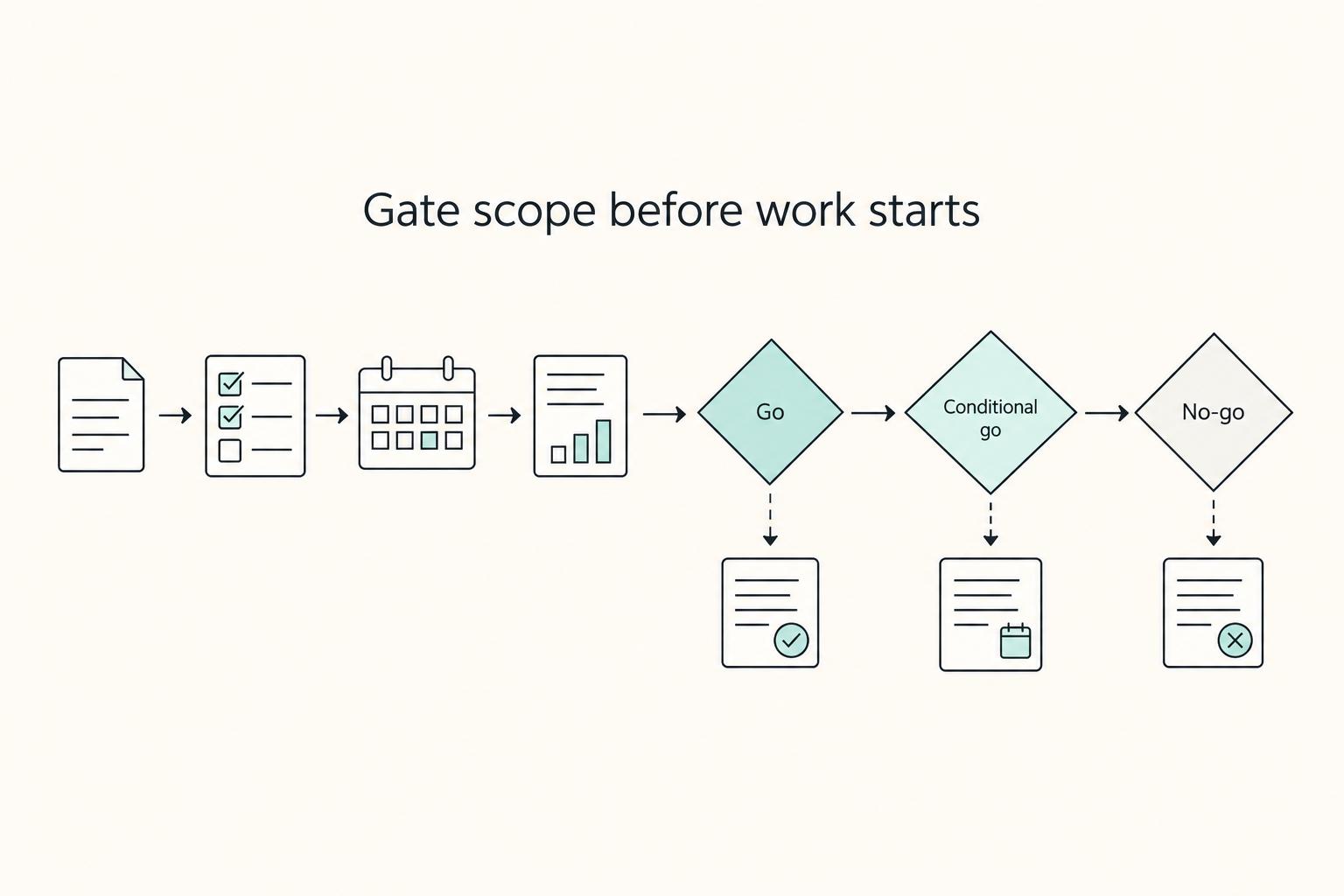
Use your SOW as a pre-work control document, not a project diary. Before work starts, make sure the key project documents describe the same deliverables, responsibilities, and timing.
A Guide to the Statement of Work (SOW) for a SaaS Development Project
Before coding starts, agree what the client will receive, how it will be tested and when you can invoice. Those decisions protect delivery time and cash flow more directly than a broad promise to implement the platform.

The Freelance Payment Penalty: A Modeled Audit of Platform Fees, FX Spreads, and Payout Delays
The money rarely disappears through a single, easy-to-spot fee. The real loss is stacked. A marketplace takes its commission, a processor adds a charge for international cards, a bank or payment company converts the currency at a spread, a platform holds the funds before release, and a wire sheds a little to intermediaries on the way in. Each layer looks defensible on its own, but the worker feels the combined result as a smaller deposit and a later payday.