
Quick Answer
Yes, a supported marketplace payment flow can allocate platform commission before seller payout. Specify the commission basis and earning event, who bears processing costs and any reserve, then record seller proceeds and validate release eligibility before sending funds. A transfer to a seller’s provider balance and a payout to their bank are separate events; refunds must also address seller recovery and commission treatment.
How Deduct-Before-Payout Flows Work#
Yes, a platform can deduct Platform commission before Seller payout. The hard part is not the math. It gets harder when product promises one fee story, finance books another, and engineering implements a third. The practical win is to lock one operating model early so every order follows the same gross-to-net payout logic from completed sale through payout release.
A commission revenue model means the marketplace operator earns a percentage or flat fee from each seller transaction. That model is common in multi-vendor marketplaces where the platform sits between independent sellers and customers. At launch, the headline take rate matters less than the exact earning point, the payout timing, and whether any extra charges are disclosed consistently everywhere sellers will see them.
Before you start#
Step 1. Freeze the fee event and basis. Define when the agreement earns commission and distinguish that from authorization, capture and seller bank payout. Walmart publishes category referral fees based on total sales price, including shipping, handling and other specified charges; its basis is an example, not a universal marketplace formula.
Step 2. Write one fee policy that everyone uses. Your internal spec and seller-facing terms should name the same things: commission rate or flat fee, payout timeline, and any additional charges. This is where teams drift fast. If finance keeps a spreadsheet with exceptions that never made it into product copy or API rules, you can get seller disputes, support tickets, and reconciliation breaks early.
Step 3. Trace one test order before launch. Reconcile the promised seller proceeds to the journaled obligation, released payout, reserve and supported adjustments. For $90 owed with a $5 reserve, $85 may be queued while $5 remains owed. An unexplained difference is a defect; a documented reserve is not.
A common early failure is mismatched definitions, not just a wrong percentage. One team excludes a charge from commission, another includes it, and your first refund or payout exception can expose the gap. Keep a small evidence pack for each rule version, including the fee policy, seller disclosure text, and at least one traced example transaction.
This guide focuses on an implementation you can test, audit, and explain without guesswork. You might also find this useful: MoR vs. PayFac vs. Marketplace Model for Platform Teams.
For each category, keep a hand-calculable sale and refund beside the implemented fee rule so finance and support can explain the seller statement.
Choose who pays and lock one fee logic#
Compare seller-paid, buyer-paid and shared fees against your own conversion, supply and support data. Choose the arrangement your terms and payment flow support, and keep mandatory buyer charges visible at the appropriate point. Fee incidence and splitting a payment among recipients are separate design choices.
Compare fee models against the pain you can actually afford#
A marketplace fee flow is usually simple: buyer pays, platform takes commission, seller receives the rest. Your real choice is where the commission is felt, because that drives conversion impact, seller churn risk, and support load.
| Fee model | Conversion hypothesis to test | Seller-response hypothesis to test | Possible support tradeoff | When it fits |
|---|---|---|---|---|
| Seller fee model | Usually lower buyer friction because checkout pricing stays cleaner | Higher if take rate feels opaque or too high to sellers | Moderate, mostly seller-side statement and payout questions | Strong starting point when buyers are price sensitive |
| Buyer fee model | Higher checkout friction because buyers see an added charge | Lower seller pushback because sellers keep more of the sale | High, because buyers dispute visible fees at payment | Use only when buyer demand is strong and fee visibility is defensible |
| Split-fee model | Medium friction if both sides see part of the charge | Medium, since neither side absorbs all of it | Questions may come from both sides; measure actual support load | Use when seller acquisition is the main constraint |
Model the actual provider quote by country, method, order size, recipient count and payout cadence. Include fixed charges, refunds, disputes and FX where applicable. A headline percentage cannot establish total marketplace cost or support a universal 2–5% GMV estimate.
Hypothetical seller-fee sale with no tax or shipping: the buyer pays $100, a 10% commission is $10 and the seller is owed $90. If the platform bears an assumed $3 processing cost, $97 reaches the provider balance: $90 seller proceeds and $7 remaining platform cash. The $10 commission is not $10 profit. A $5 seller reserve would leave $85 immediately releasable and $5 still owed, not increase commission to $15.
Standardize one Commission revenue model per category#
After you choose who pays, lock one Commission revenue model per category. The goal is predictable Gross-to-net payout math: define the commission basis, payout timing, and reversal rule once, then mirror that language across seller terms, pricing UI, and internal calculations.
Categories and sellers can have different disclosed agreements. Version each rule and its effective date so an approved seller-specific rate is reproducible; do not apply a later fee increase retrospectively to an earlier order. Define currency minor-unit rounding and whether the percentage applies per line or to the whole order.
Before launch, run one sample order per category and confirm four fields match across product, finance, and engineering records: buyer charge, platform commission, seller net, and payout amount. If those values change by screen or export, you do not have one fee logic yet.
Require launch sign-off before scope is approved#
Do not approve launch scope until product, finance, and engineering sign off together on:
- Fee visibility: where each charge appears and how it is labeled
- Payout timing: when seller payout is created relative to completed sale status
- Reversal policy: what happens to commission on refunds, partial refunds, and disputes
Use a small evidence pack: seller-facing fee copy, buyer-facing fee disclosure (if any), one worked transaction, and one reversal example. This keeps fee behavior transparent and easier to defend in support and reconciliation workflows.
Test the fee model on comparable buyer and seller cohorts before repricing. Record the policy and effective date on the order so exceptions cannot silently change the promised proceeds.
Lock prerequisites and integration boundaries before coding#
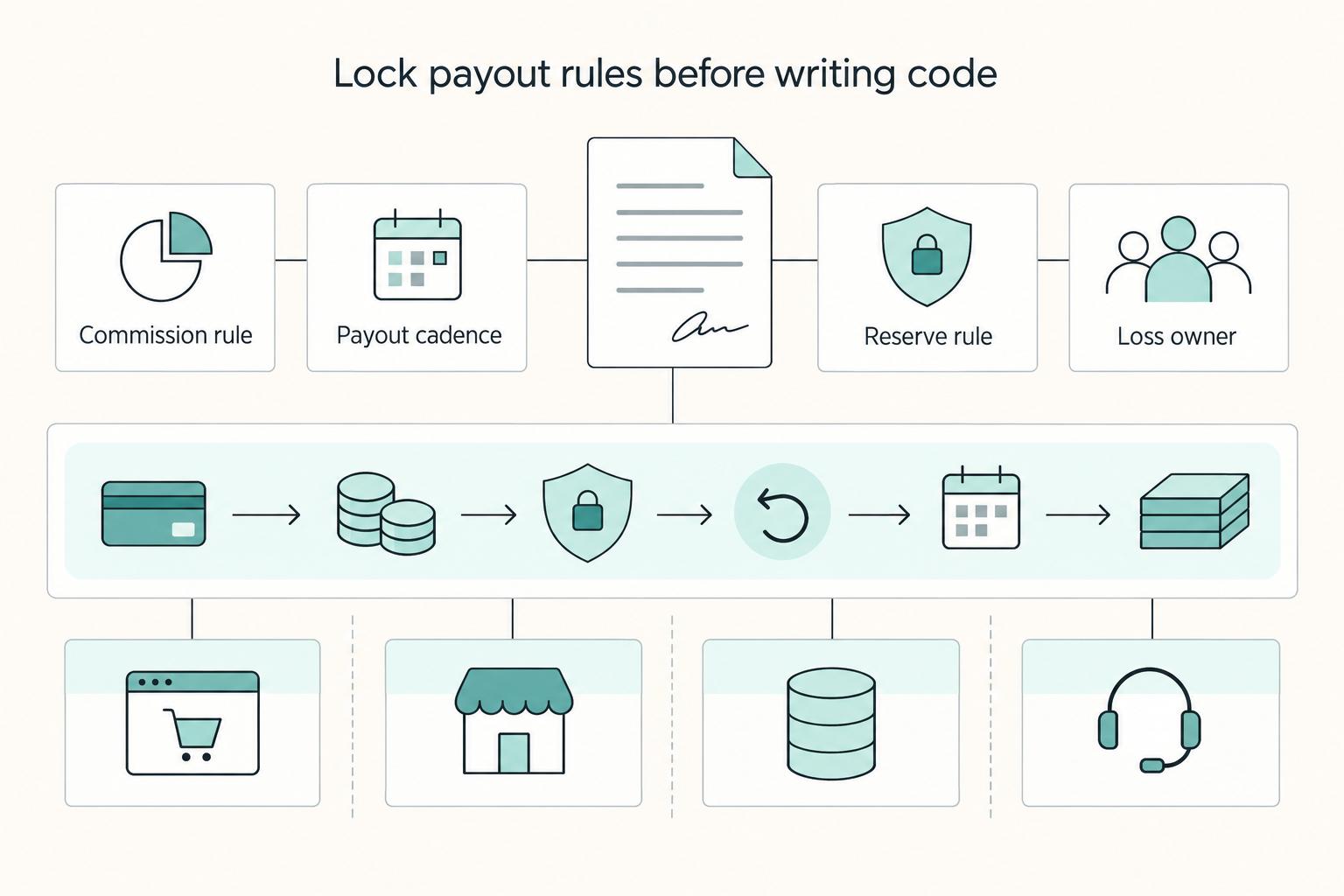
Before you write payout code, lock the operating rules in writing; otherwise, engineering assumptions will become finance and support issues later.
Step 1. Finalize policy inputs in one signed spec. Define the commission rule, payout cadence, reserve/hold rule, and who owns loss on refunds, disputes, and chargebacks. Make it concrete enough to hand-calculate one order from gross charge to seller payout, including timing.
Use a quick pre-scope check with three scenarios: normal sale, refunded sale, and disputed sale. Confirm product, finance, and engineering all see the same fields: buyer charge, platform commission, reserve held, seller net, payout release date, and dispute owner.
Step 2. Choose the provider flow and distinguish transfer from payout. Stripe destination charges can use application_fee_amount and transfer funds to a connected account’s pending balance at capture. That transfer is not the connected account’s bank payout. If your policy requires delaying seller allocation, confirm the flow and controls before selecting a charge type.
For separate charges and transfers, commission can be represented by the amount retained after seller transfers and processor costs; do not assume every flow has the same application-fee object. Confirm the provider’s permitted regions, recipient capabilities, refund behavior and loss allocation. A PayPal Payouts or gateway fee page alone does not prove marketplace split-settlement support.
Step 3. Define event ownership before payout states are treated as final. For each Webhook or API event that can change payout state, record event owner, allowed state change, dedupe/idempotency rule, conflict source of truth, and retry/escalation owner.
In the planned staging check, deliver the same provider event twice and confirm one intended business action. Use a durable event inbox or equivalent recovery record so deduplication does not discard an action that failed after the event was marked received.
Step 4. Draw the Merchant of Record boundary explicitly. Identify who sells to the buyer and who is responsible for applicable sales tax, refunds and customer obligations. The provider’s settlement-merchant setting does not by itself decide every legal or accounting role. MoR treatment does not automatically resolve the platform’s seller payout or AML responsibilities.
The FTC’s Rule on Unfair or Deceptive Fees took effect May 12, 2025 for live-event tickets and short-term lodging, including covered third-party platforms. It requires upfront total-price presentation with specified exclusions and later final-payment disclosures; it does not ban particular fee amounts. Do not treat the old 2023 proposal as current law or extend this specific rule automatically to all marketplace categories.
For a step-by-step walkthrough, see How Freelancers Can Implement and Enforce a Late Fee Clause.
Map money movement and states end to end#
Map one canonical payout state sequence before you automate anything. If finance and engineering use different state definitions, you will not be able to explain gross-to-net outcomes consistently.
Step 1. Define one end-to-end state sequence tied to gross-to-net outputs. Start at capture or funds receipt, then map fee deduction, hold/reserve treatment, payout eligibility, payout release, and exception states (refund, dispute, payout failure). For each state, require the same core outputs: gross amount, platform commission, reserve held, seller net, release date, and the internal record ID used to derive that result.
Step 2. Keep reconstructable accounting and operational records. Store the commission rule, seller obligation, processor costs and adjustments, and reconcile them against provider statements and bank activity. An internal ledger is useful but can also contain errors. Capturing cash or allocating a fee does not by itself establish its revenue-recognition treatment; use the appropriate earned or deferred treatment for the agreement.
Step 3. Use common reporting fields with rail-specific states. Card authorization, capture, asynchronous payment completion, bank-transfer receipt, connected-account transfer and bank payout are different events. Map them to clear internal states without collapsing them into one paid flag. One seller statement can show the same fee and proceeds fields while retaining those distinctions.
Step 4. Preserve uncertain execution after timeouts. Use one stable payment-obligation ID and the provider’s supported idempotency key. Stripe may prune keys after at least 24 hours; a reused pruned key can create a new request. Reconcile the original instruction before another execution, and do not treat an absent lookup result as proof of non-execution. An alternative rail requires confirmed non-execution or a completed return.
For deeper payout math patterns, see Gross-to-Net Payout Calculation: How Platforms Deduct Fees Taxes and Withholding Before Disbursing. This also pairs with Payoneer Review: Is It the Best Platform for Marketplace Freelancers?.
Implement deduct-before-payout in strict order#
Use a controlled sequence: calculate and record the allocation, check eligibility and available funding, reserve the releasable amount, then submit the external instruction. An internal draft instruction may exist earlier, but submission must not precede required release checks. Keep commission earning, seller balance availability and bank receipt distinct.
Step 1. Calculate under the stored rule version. When the relevant payment and fee events occur, record gross amount, commission basis, commission, processing-cost owner, seller proceeds and reserve. Allocate amounts before release, while applying the proper accounting recognition rather than assuming every capture earns revenue.
Step 2. Post fee and net entries to the Ledger journal before payout creation. Write commission and seller-net entries to the Ledger journal first, using the same internal transaction ID across states. Treat payout instructions as execution of posted amounts, not the place where fee math is decided.
Step 3. Validate release and submit the instruction. Confirm current required eligibility checks, available funds and the amount not already reserved for another execution. Submit only that releasable amount with stable internal and provider references. Batches must preserve each seller and order allocation, rather than changing their accounting.
Step 4. Reconcile completion and resolve holds. Keep incomplete required checks pending before submission. A hold does not erase seller proceeds or turn a reserve into commission. After submission, reconcile provider states and bank evidence; a paid provider status can later fail and is not independent confirmation of bank receipt.
Verification checkpoint. Trace the allocation and release. Match payment event, fee calculation, seller obligation, eligibility decision, provider instruction and reference. Reconcile seller proceeds to the released amount plus the remaining reserve and supported adjustments, then track bank receipt separately.
We covered this in detail in How to Choose a Merchant of Record Partner for Platform Teams.
Handle refunds, reversals, and disputes without breaking fee math#
Use separate rules for each exception type so your fee math stays explainable. A single generic "reverse transaction" path will break down because refunds, amendments, and Chargebacks affect different points in the payout and reconciliation flow, and batched marketplace payouts are not one sale to one deposit.
Step 1. Split reversal logic by event type#
Define event-specific accounting and payout behavior before support or ops can trigger actions:
| Event type | What changes | Commission decision to predefine | Payout effect |
|---|---|---|---|
| Full refund | Entire buyer amount is reversed | Reverse all, some, or none of Platform commission per policy | Reduce seller net fully if unpaid, or create recovery if already paid |
| Partial refund | Part of the order is reversed | Apply a proportional or explicit fee rule | Reduce only the related portion of seller net |
| Amendment | Order value or scope changes without a classic refund | Recalculate on the amendment delta, not the original gross | Post an adjustment entry, not a blanket reversal |
| Post-payout Chargeback | Dispute lands after Seller payout | Decide whether commission is clawed back, partly retained, or waived | Create seller debit, reserve draw, or future offset |
Hypothetical $40 partial refund on the $100 sale above: if commission is refunded proportionally, $4 of commission reverses and the seller’s share falls by $36, from $90 to $54. The remaining commission is $6. If the original $3 processing cost is not refunded, the platform has $3 remaining before other costs. If the seller already received $90, recover $36 separately; the buyer refund alone does not prove that recovery happened.
Step 2. Set a dispute-fee policy and mirror it in seller terms#
Choose one dispute policy for Platform commission and keep it consistent everywhere: claw back, partial retain, or waive. Then mirror that same rule in product behavior, support playbooks, ledger handling, and seller terms.
Use a simple check: pick one disputed order and confirm the case note, terms language, journal entries, and payout adjustment all reflect the same commission treatment.
Step 3. Add negative-balance and offset controls for paid-out sellers#
For already-paid sellers, create an explicit recovery balance tied to the original transaction. Apply reserves, future offsets or account debits only where the agreement, law and provider capability permit them. A receivable or negative balance is not collected cash; retain failed recovery and platform loss exposure instead of marking the case reconciled.
Stripe permits transfer reversals subject to flow-specific limits and balance availability. A customer refund, a seller transfer reversal and an application-fee refund are distinct operations; reconcile each outcome and its identifier. Record the refund amount, commission treatment, prior payout, recovery target, completed recovery and any amount still uncollected.
Build the finance evidence pack for reconciliation, tax, and audits#
Your evidence pack should let finance trace gross to fee to Seller payout every day from a single source of truth. If that chain is incomplete, reconciliation, tax support, and audit review get fragile even when payout logic is correct.
Step 1. Build one daily recon file from the Ledger journal#
Use journal-driven data, not reconstructed exports. Each row should connect gross amount, platform fee, seller net, currency, order/charge ID, internal journal entry IDs, payout instruction ID, seller payout reference, and the external reference from each Payment gateway.
The control standard is simple: every money-moving event carries both an internal ID and a provider ID, and that mapping survives retries, reversals, and batched payouts. Validate this daily on a settled order by confirming gross, fee, and net match both posted journals and provider-side references.
Step 2. Run exception queues in parallel with recon#
Create queues for unmatched records, stale statuses, and failed Webhook deliveries per Payment gateway. Do not defer these until month-end.
Define queue fields so ops can act fast: owner, age, retry count, and last event timestamp. If teams cannot sort by gateway and age, quiet failures accumulate and drift appears in close.
Step 3. Store tax and compliance outputs as structured evidence#
Collect tax and identity documentation according to the actual seller, income and jurisdiction. Store applicable W-8 or W-9 status and reporting records with date, version and reference. A 1099-K gross-payment amount is not necessarily net seller cash after commission, refunds or other adjustments; preserve gross and adjustment fields separately.
| Output | Store | Notes |
|---|---|---|
| W-8 | status; entity; collection date; version/revision label when available; document reference | Track as a retrievable record |
| W-9 | status; entity; collection date; version/revision label when available; document reference | Track as a retrievable record |
| 1099 | status; entity; collection date; version/revision label when available; document reference | Track as a retrievable record |
| VAT validation | jurisdiction; check status; evidence reference | Store as structured evidence |
Related: Accounts Receivable Management for Platforms: How to Collect from Buyers While Paying Sellers Fast.
Run go-live checks and a 30-day control window#
Do not go live until you can prove one clean gross-to-net path in both single payouts and batched payouts.
Step 1. Run pre-launch tests on live-like flows#
Run pre-launch tests on live-like flows, not just happy paths. Include correct fee computation, delayed payout release, full and partial reversals, and a dispute that arrives after a Seller payout is initiated, across both single payouts and Payout batches.
Checkpoint: for one test order, confirm provider event history, payout reference, and Ledger journal entries match on gross, fee, and seller net. If batch and single paths diverge on references, statuses, or timing, treat it as a launch blocker.
Step 2. Track payout failure rate and reconciliation breaks daily#
For the first 30 days, track failures, returns and pending instructions for defined initiation cohorts and observation cutoffs. Keep unknowns in the denominator and report unresolved amounts separately. Compare provider balances and references with ledger and bank records; queue closure alone is not reconciliation.
If breaks cluster by gateway or payout cadence, pause expansion until you isolate whether the issue is timing, mapping, or release gating.
Step 3. Alert on operational failures that distort payout accuracy#
Alert on operational failures that can quietly distort payout accuracy. Delayed Webhook processing can leave payout status out of sync, AML holds can block release after fee deduction posts, and unresolved seller exceptions can create promises operations cannot fulfill.
Step 4. Judge fee-model performance from live cohorts with enough volume#
Compare actual cost and support load across cohorts with enough observations for your decision. Include basket structure, seller count, payout cadence, refunds and disputes. Keep seller-specific fees versioned and disclose prospective changes rather than repricing past orders.
Compare public referral fees only when category, geography, commission basis and refund treatment are comparable. A take rate from another marketplace does not establish your viable margin.
Conclusion#
If you are ready to launch, pick the commission setup your team can operate on a messy day, not just the one that looks clean in product mocks. Split payments hold up only when the money flow is predictable, the reversal rules are frozen, and finance can tie every gross amount to the seller payout without guessing.
Copy and paste launch checklist#
Step 1. Lock the fee model and ownership. Choose one commission revenue model per use case and write down who owns exceptions. If your fee is a percentage, say so plainly, for example 10% per sale, and if it is a flat fee, document that too. A common red flag is agreeing on the headline take rate but not on who approves seller-specific overrides, extra charges, or payout timing changes.
Step 2. Freeze gross-to-net rules before code changes continue. Your team should be able to answer one basic test case without debate: gross order value, platform fee, seller net, and what changes on a full refund or partial refund. If that answer still depends on Slack history or tribal knowledge, you are not ready. The failure mode is not bad math once. It is different teams applying different math later.
Step 3. Validate release controls before submission. Authorization is not captured money and a provider balance is not automatically escrow. Use only the holding and release capabilities the contracted service supports. Confirm that event processing cannot submit an external payment before required eligibility and funding checks pass.
Step 4. Prove transaction traceability from capture to payout. Before go-live, replay one real transaction end to end and confirm the fee and seller net are recorded before payout instructions are created. Then match that record to the payment gateway reference and the final payout status. If those records do not agree, scaling will only make reconciliation slower.
Step 5. Turn on monitoring for event and payout failures. Manual collect-then-pay-later methods do not scale well and are linked with delays, reconciliation errors, compliance risk, and seller frustration. You need alerts for failed event handling and stale payout states. That is the difference between a contained exception queue and a month-end cleanup project.
Step 6. Scale from one controlled cohort only after clean reconciliation. Start with a small seller group, close the loop on payout timing, and verify that transparent policies match what sellers actually see in statements and support replies. Expand only after you can reconcile fast under pressure and handle at least one real exception path correctly. If you want a deeper template for the math layer, use this gross-to-net payout guide.
Frequently Asked Questions
What is marketplace fee splitting in practical terms?
It is the money movement pattern where one customer payment is divided between parties instead of being treated as one simple merchant sale. In a common marketplace flow, a buyer pays $100, the platform keeps its commission, and the seller receives the remainder. In split settlements, that division is part of the payment orchestration, not a manual afterthought.
Can a platform deduct commission before paying sellers?
Yes. Many marketplace flows are built that way operationally. The key check is whether your processor path and settlement model support routing the platform share and seller proceeds cleanly, with records that can be reconciled. Do not assume the timing is universal across every jurisdiction or provider just because the product design wants it.
When should platform commission be deducted in the transaction lifecycle?
Allocate commission at the event specified by the agreement and supported payment flow, before the seller’s bank payout where that is the chosen model. Capture, fee earning, transfer to a connected balance and bank payout are separate events. Validate release eligibility before submitting an external transfer or payout instruction.
How do seller-fee, buyer-fee, and split-fee models differ in real operations?
A seller fee reduces seller proceeds; a buyer fee increases the buyer’s payable amount; a shared-fee arrangement charges both. These describe who bears the fee. Split settlement instead describes allocating one payment among recipients, and can implement any of those fee models. State both the fee basis and final buyer amount clearly.
What should happen to commission when a refund or chargeback occurs?
Specify whether commission reverses fully, proportionally or under another disclosed lawful rule. A $40 refund on a $100 sale with 10% proportional commission reverses $4 commission and $36 seller proceeds. If already paid, the $36 needs a separate recovery action; the customer refund does not automatically reverse every transfer or application fee.
What records are required to reconcile gross order value to net seller payout?
Link order amount, fee basis, commission, processing charges, seller proceeds, reserves and adjustments to ledger and provider references. For a batch, retain each contributing order and seller allocation. Track transfer, bank payout and bank receipt separately, with unresolved and failed recovery visible instead of assuming one deposit equals one order.
What must finance, product, and engineering approve before go-live?
Approve the fee basis and earning event, cost and loss ownership, release timing, onboarding requirements and refund/recovery rules. Define how tax, shipping and discounts enter the calculation for your own agreement; another marketplace’s Total Price definition is not universal. Check seller and buyer disclosures against the implemented rule.
Try a related tool
Researched and edited by the Gruv editorial team. Gruv builds cross-border billing, payouts, and finance-operations software for global businesses.
Sources
Includes 1 external source outside the trusted-domain allowlist.
Educational content only. Not legal, tax, or financial advice.
Related Posts
Choosing a Gross-to-Net Payout Model for Platform Disbursements
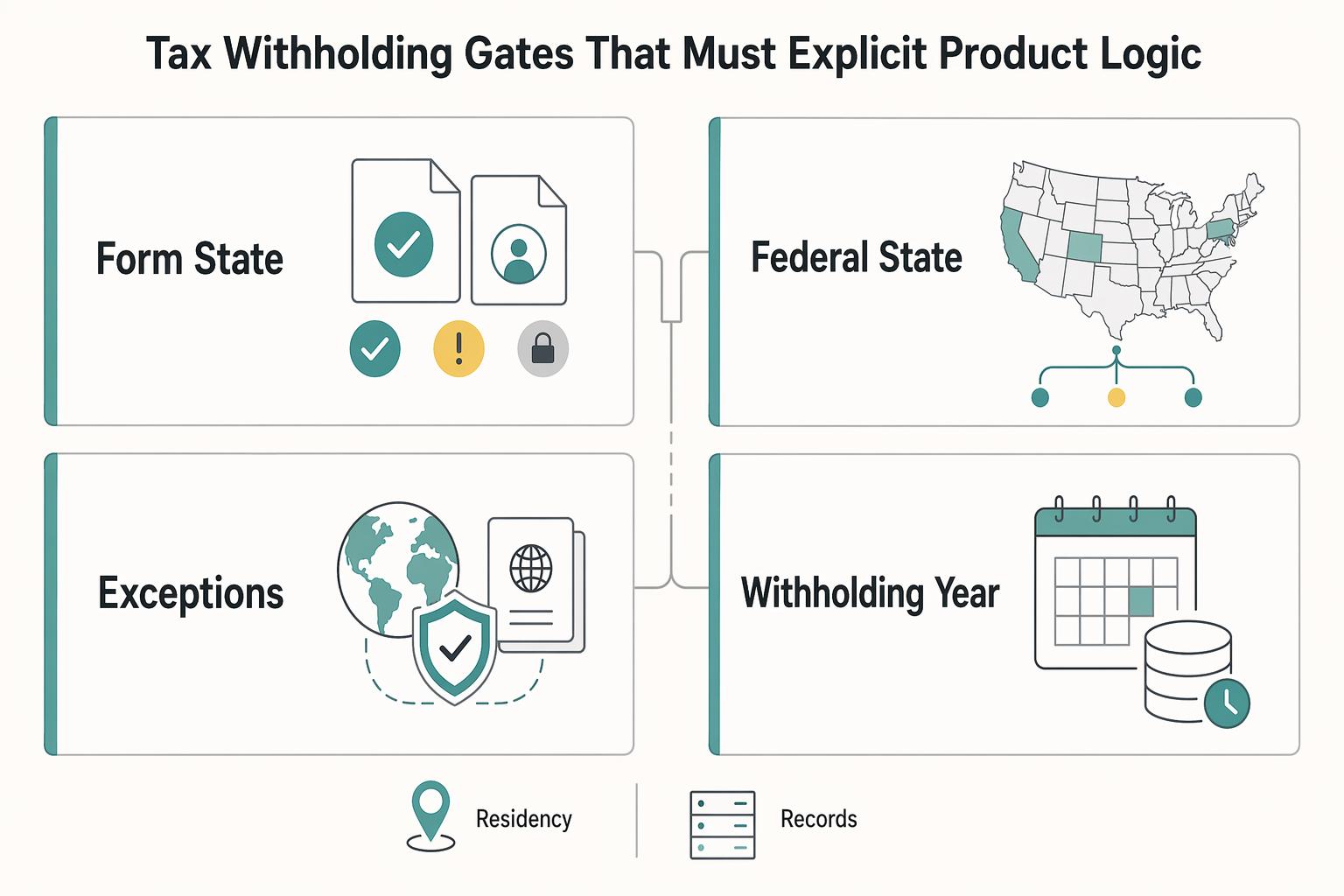
Payroll tax references matter, but they are not a payout architecture. Teams often collect withholding rules, filing-status details, and tax-form requirements before they have defined who owns each deduction line. That guidance still matters for withholding logic. [IRS guidance on the Additional Medicare Tax](https://www.irs.gov/businesses/small-businesses-self-employed/questions-and-answers-for-the-additional-medicare-tax) can be useful context for tax review, but it does not define deduction sequencing, ledger mapping, release gates, or recipient-facing payout explanations.

How Marketplace Platforms Pay Third-Party Sellers Compliantly
Generic marketplace payout advice usually skips the part that breaks in production. Paying many sellers is not just moving money out. It is deciding who gets paid, when they become eligible, what happens when a buyer disputes a payment, and how finance proves every release later. If you are working on **ecommerce reseller payouts marketplace platforms pay third-party sellers**, this guide is for the marketplace operator, not for solo freelancer banking tips.
Accounts Receivable Management for Platforms: How to Collect from Buyers While Paying Sellers Fast
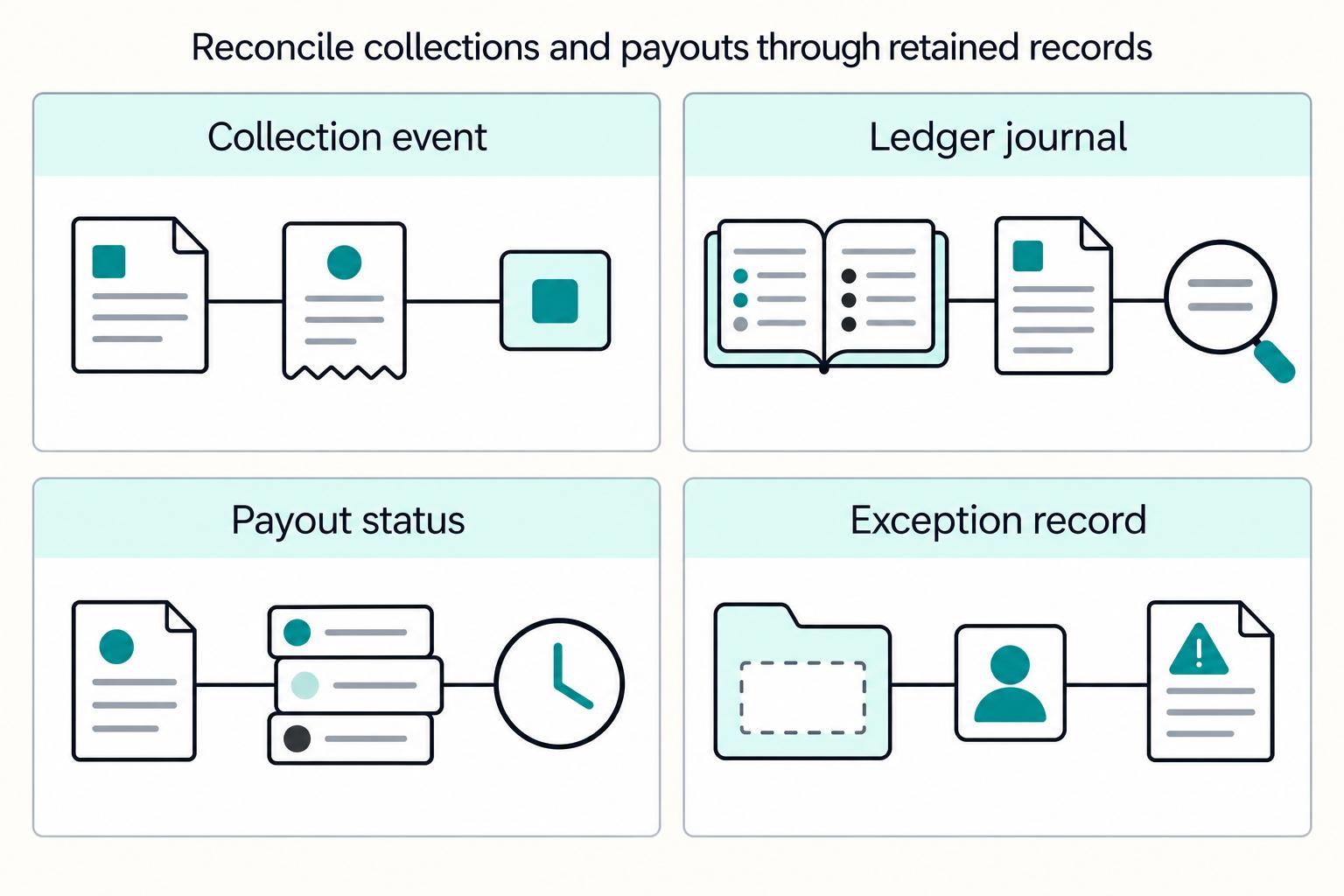
**Treat AR for a platform as a payout control problem, not just a collections task.** If you separate buyer collections from seller payouts, you risk releasing funds based on a status your ledger cannot actually support.