

Quick Answer
Confirm the invoice is due and reconcile deposits, credits and partial payments. Send a dated request with the invoice ID, balance and requested payment date or specific dispute. Decline uncommitted new work; suspend existing duties only under contractual notice and cure conditions. Save evidence and calendar deadlines, then choose a demand, settlement or available recovery route by likely net recovery.
Treat nonpayment as a collections process#
When a client misses an invoice deadline, first establish what is unpaid and why. Match the agreement, delivery record, invoice and received payments, then send a dated request for payment. Keep one owner and a next action date so reminders lead to a resolution rather than an indefinite chase.
Before you start#
Use these terms consistently. Overdue means unpaid when due. Collections status is your internal stage label for where the case sits, such as pre-filing, filing, hearing, or post-trial. A clean record is an orderly file of supporting documents, especially invoice and payment records, kept in date order. That record is not admin busywork. If this ends up in court, you may need to prove both liability and damages, and documentary evidence can be central to that burden.
Prevent trouble before delivery#
Lock terms, define acceptance points, make invoicing easy to process, and build your record while the work is active. Decision gate: if your terms are unclear or your records are disorganized, fix that before you keep delivering. Do not assume bad faith after the first missed payment. Start with fact-finding, but be careful about increasing unpaid exposure just because the tone stays friendly.
Escalate after default with a written trail#
Once an invoice is overdue, move from routine project management to collections status. Next gate: did the client cure after a written request for payment? In some courts, that request step is required before filing, so your record should show what was owed, when it was due, and what notice you gave.
Keep delivery and collections separate. Assign one owner for payment communication, and keep all payment notices in one written channel. If a client calls or drops payment excuses into a delivery thread, send a short written recap in the collections channel and keep the project thread focused on scope and delivery.
Use your contract, platform notice and court rules to set the response and escalation dates. A friendly reminder does not extend a filing or dispute deadline. Record those deadlines at the first missed payment and preserve the available route while you investigate. If you already have a judgment, the next task is enforcement: A Freelancer’s Guide to Collecting on a Judgment.
Lock payment terms before the project starts#
Payment disputes are often set up at kickoff, not in collections. Your best control is a contract, invoice, and kickoff recap that match before any work starts. Draft those three documents together. If the wording, triggers, or milestone labels differ across them, fix that before delivery begins.
Write the five payment terms so nobody has to guess#
Write the core payment terms in plain language inside the agreement so a third party can tell exactly when payment is due and what happens if it is not made. Define these five points clearly:
- Payment terms: the conditions that govern when an invoice must be paid, including the due date and what event starts the clock.
- Deposit: money placed before work starts. On fixed-price platforms, this can mean milestone funding in place before work begins.
- Acceptance criteria: the quality and quantity requirements your deliverable must meet for acceptance.
- Change order: a written, signed change to the original scope, price, or timeline.
- Pause trigger: the contract-defined event that allows suspension, including any notice or cure period before it takes effect.
If a third party cannot tell when payment is due, who accepts the work, and when work pauses, your terms are still too vague.
Tie payment to acceptance and funding events#
Each milestone should state the deliverable, acceptance criteria, acceptance owner, invoice amount, due event, and pause trigger. Assign acceptance ownership to a named person or role, because payment can stall when approval and payables sit with different people.
For Upwork fixed-price milestones, check funding before starting and submit completed work through the contract’s Submit work flow. Sending a file only in Messages does not start the 14-day review period. Funding and proper submission support the platform’s protection process; they do not guarantee recovery in every case. Freelancer’s dispute service concerns existing Milestone Payments, so confirm the funded amount and milestone before delivery.
- Proceed: client confirms approval path, invoice routing, and payment owner in writing.
- Reduce scope exposure: client agrees in principle but stays vague on approvers, funding, or routing.
- Decline: client resists written payment clarity or wants work to start before funding or ownership is clear.
Mirror the agreement on every invoice#
Your invoice should put the agreement into practice, not introduce new terms. Include the core fields every time: contractor identity, invoice date and number, line-level description, quantity, unit, unit price, extended price, payment destination, and a contact for invoice defects. That reduces avoidable processing disputes and speeds correction if an invoice is rejected.
Operationally, payment timing can hinge on both a proper invoice and acceptance or performance completion. Keep milestone names, amounts, acceptance events, and payee details identical between contract and invoice.
Use the kickoff recap as a go or no-go control#
Send one written kickoff recap and ask the payment or approval owner to confirm in the same thread. Restate scope, milestone names, acceptance owner, invoice route, due events, and pause triggers.
If you work with EU businesses or public authorities, verify whether local payment rules affect your terms before work starts. Do not assume your preferred term controls without that check.
Close admin readiness before any work starts#
Before kickoff, run a short readiness check:
| Check | Confirm | Why it matters |
|---|---|---|
| Payables contact | Exact AP inbox or portal and backup contact | Prevents invoice routing failures |
| Required routing fields | The client's mandatory invoice fields | Missing fields can block processing |
| Approver ownership | Who accepts work and who releases payment | Avoids approval-to-payment handoff gaps |
| Payment destination | Bank or platform destination shown on invoice | Reduces avoidable payment defects |
| Funding status | Deposit received or milestone funded pre-work | Preserves recovery position in disputes |
Keep one record of the agreed work, payment event, invoice route and suspension conditions. For an existing overdue invoice, preserve those original terms rather than rewriting them after default. For future projects, use International Freelance Contract Clauses for Payment and Dispute Control to make the triggers explicit.
Make paying easy so excuses are harder#
Once terms are locked, the next control is operational. Remove avoidable payment friction before the invoice goes out. Late payment often starts as process failure, not bad faith, so your billing cycle should still work when inboxes, references, or approvers are messy.
Define what "invoice-ready" and "paid" mean#
Use one internal definition set across clients:
- Invoice-ready state: the billing event in the agreement has occurred, such as a deposit due, milestone delivery or a time-based billing date; attach acceptance evidence where that event requires it.
- Complete billing packet: invoice, contract or order authorization reference, milestone or billing-period label, acceptance or delivery proof, payment instructions, and a defect-resolution contact.
- Payment received: funds are received by the rule for that rail, not when someone says payment was "sent."
Keep the rail and invoice states separate. Fedwire settlement is between banks, RTP return requests are a distinct message process, and ACH return rules depend on the account and return reason:
- ACH: can complete quickly, but can also take days and can be returned for nonpayment.
- Fedwire: settlement between participating banks is final and irrevocable when the receiving bank is credited or receives the credit advice, whichever happens first. Confirm the credit to your own account separately.
- RTP: settlement is final and irrevocable, though institutions can still send return requests through network messaging.
- Card: distinguish successful capture, processor settlement and payout to your bank; match each to the invoice and retain evidence for possible disputes.
Pick payment rails by client profile, then keep the right proof#
Offer multiple rails, but choose them on purpose based on client market, urgency, and dispute exposure.
| Rail | Best fit market | Settlement pattern | Dispute exposure | Admin effort | Fee check |
|---|---|---|---|---|---|
| Card processor | Domestic or cross-border clients who expect click-to-pay | Fast to initiate; confirm processor settlement status before marking paid | Formal billing-dispute process with timing rules | Moderate. Keep processor record, invoice ID, delivery proof, and acceptance proof aligned | Verify current processor fee details |
| ACH bank transfer | Domestic US clients who prefer bank transfer | Variable. May take days and may be returned | Not final at submission; returns are possible | Moderate. Verify account details, remittance reference, and cleared-funds policy | Verify current bank or processor fee details |
| Fedwire | High-value, urgent domestic payments where finality matters | Final settlement between participating banks; recipient account posting still needs confirmation | Reversal risk is lower after processing | Higher. Instructions must be exact and confirmed | Verify current bank fee details |
| FedNow or RTP | Domestic instant-payment cases where institutions support the rail | Near real-time for supported participants; confirm availability by institution | Document exceptions and return or return-request handling where available | Moderate. Confirm availability and exact payee details before sending | Verify current bank fee details |
| Platform milestone release | Platform-managed projects, for example Freelancer milestones | Platform release event | Depends on platform process and evidence timing. Release can serve as acceptance evidence | Track funded, released, held and withdrawn balances separately, with timely evidence | Verify current platform fee details |
Use this decision rule:
- For a US domestic client using bank transfer, distinguish ACH from supported instant rails and confirm receipt using bank records rather than a sender screenshot.
- If the payment is high value and time-critical, prioritize Fedwire finality over convenience.
- If the client pays by card, keep a tight record: invoice, delivery proof, acceptance proof, and matching invoice ID in processor records.
For a missing cross-border payment, ask the sender or payment provider for a trace reference, amount, currency and status immediately. Do not treat a consumer remittance cancellation rule as your invoice collection deadline: the 30-minute cancellation right applies to qualifying transfers requested by a US consumer primarily for personal, family or household purposes, with conditions including that funds have not been deposited or collected. Business-purpose transfers are outside that sender definition. On Freelancer, calendar the case’s response and evidence deadlines; its policy closes new evidence submission after Stage 3.
Run a pre-send check every cycle#
Before you send an invoice, run one checklist:
| Check area | What to confirm |
|---|---|
| Entity and contact | Correct legal entity, AP inbox or portal, backup contact, and named defect-resolution contact. |
| References and linkage | Invoice number, contract or order reference, PO if required, and exact milestone or billing-period match. |
| Approval state | The agreed billing event occurred; attach delivery or acceptance evidence where the agreement requires it. |
| Payment path | Primary rail plus backup, correct currency, and tested payment link. |
| Reminder ownership | Follow-up dates, owner per stage, and escalation trigger if there is no response. |
Ask AP to identify missing references or routing defects promptly. For US federal procurement, FAR 32.905 generally requires the billing office to return an improper invoice within seven days, with shorter periods for certain goods. That is a federal procurement rule, not a private-client deadline. For private work, record the actual defect, correction date and contractual due date instead of letting an unspecified “processing issue” reset the clock.
Send reminders by stage so tone stays consistent#
Standardize the intent of each reminder stage so teammates send consistent, enforceable messages:
- Courtesy follow-up: assume oversight, restate invoice number, amount, due date, and payment link, and ask whether AP needs corrections.
- Firm follow-up: state that the invoice is overdue, resend the full billing packet, and request a specific payment date or written defect notice.
- Escalation notice: state the outstanding balance, prior reminder dates, and the next step if payment is not received by the stated deadline.
Once the packet is complete, the follow-up can ask for a payment date or a specific dispute rather than another general update. If payment is said to be sent, reconcile the receipt before escalating; see The Best Way for a German Agency to Pay a US-Based Freelancer for cross-border payment setup.
Build your evidence pack before anything goes wrong#
Build your evidence pack while the work is moving, not after payment stalls. The file should show entitlement, delivery, overdue status, and notice sequence without relying on memory.
Capture records as you go#
Use one source of truth from day one: one matter folder, project space, or client record where payment-related documents are saved when they are created.
For each milestone or billing period, you should be able to trace what was agreed, what changed, what was delivered, what was accepted, and what was invoiced from that one place.
Keep complete records by category#
Prioritize primary records and platform or processor records you can export. Keep screenshots as backup context, not as the core record.
| Record category | What to keep |
|---|---|
| Contract terms | Signed agreement, scope, deliverables, rates, deadlines, milestones, payment terms, and late-fee terms if used. |
| Scope and changes | Emails, messages, and call notes showing approvals, change requests, and confirmations. |
| Delivery proof | Final files, upload receipts, handoff messages, and delivery confirmations. |
| Acceptance proof | Approval messages, revision sign-off, milestone release, or other satisfactory-performance proof. |
| Invoicing ledger | Numbered invoices, due dates, amounts, and credits or partial payments. |
| Payment-state artifacts | Bank, processor, or platform records and failed, bounced, or reversed payment evidence. |
| Notice history | Reminders, resent invoices, firm follow-ups, and formal notices, including registered or certified delivery where used. |
If the work ran through a platform, export milestone history as well, since completion and dispute mechanics can be platform-specific.
Maintain chain-of-custody structure#
A clean file should be easy for someone else to review. Use a consistent naming pattern, for example, YYYY-MM-DD_Client_Invoice-104_Milestone-2_DeliveryProof.pdf, and keep a chronological index.
In that index, link each invoice ID to its milestone label, delivery proof, acceptance record, payment-state artifact, and notice entries. This structure is not a legal requirement, but it makes third-party review faster.
Trigger escalation prep at first stall signals#
Do not wait for a full breakdown before you prepare the file for escalation. Start when delivery is done and payment communication stalls. Also prepare the file when you need to resend an invoice, when payment is said to be sent but does not clear, or when platform status changes in a way that affects completion.
Verify your delivery and agreed revision obligations before sending stronger notices, then export the records without altering the originals. An illustrative operating schedule is a courtesy reminder on Day 1–3 after the due date, a firm follow-up if unresolved, and a demand around Day 7–14. These are chosen business intervals, not legal waiting periods. Shorter platform deadlines, contractual cure periods and approaching filing limits take priority.
Readiness check: can another person trace the agreement, delivery, due amount and notices? For Invoice 104, an assumed $2,400 charge less a $600 deposit and $300 later payment leaves $1,500 principal. Attach both payment records and demand $1,500, not the original gross invoice. Show any permitted interest separately with its basis and calculation.
Set hard stop rules for work and delivery#
When the agreed suspension trigger occurs, follow the contract’s notice and cure requirements before stopping affected work. Do not assume every overdue invoice permits immediate suspension, withholding client-owned files or revoking access. Decline new, uncommitted scope while you resolve payment, and get advice before interrupting already owed services if the suspension right is unclear.
Define your control terms before anything stalls#
Use these terms the same way every time:
- Payment trigger: a contract-defined event that must occur before duties continue or restart, for example payment received and cleared.
- Pause: suspension of specified work after the contractual notice or cure process, rather than cancellation of all duties.
- Collections status: a formal recovery stage that can come before court filing.
- Release condition: the exact condition that changes duties again and allows work to resume.
Keep release language specific, not vague. Use "Work resumes after Invoice 104 is paid in full and funds clear," not "once payment is sorted."
Use one trigger-to-action table and follow it consistently#
| Trigger condition | Immediate action | What you stop | What communication you send | What evidence you log |
|---|---|---|---|---|
| Invoice is past due and payment has not cleared | Check suspension rights; send required notice and honor any cure period | Affected work only when suspension is permitted; decline uncommitted additions | Notice with invoice ID, balance, clause, cure deadline and suspension date | Invoice, due date, payment state, notice and cure deadline |
| Client requests delivery outside agreed payment order | Check agreed release obligations; propose revised terms for genuinely new work | Only deliverables whose release is conditioned on payment; preserve client-owned materials and continuing access/data duties | Written reply that current terms remain in force unless revised terms are confirmed in writing | Client request, your reply, governing payment term |
| Reminder sequence gets no response | Move account to collections status | New scope discussions and courtesy extras | Formal notice that the account is now in recovery handling | Notice history, non-response log, status change record |
| Prior milestone is unpaid and next phase is scheduled | Apply the agreed funding or suspension condition before starting the phase | Kickoff, booked production, subcontractor start instructions | Written hold notice tied to overdue balance and release condition | Project schedule, staffing hold note, overdue summary |
Control check: after any trigger, your file should show the trigger event, the notice sent, and exactly what was paused.
Allow exceptions only with revised written terms and a release condition#
For an early release request, distinguish client-owned materials and already owed deliverables from new work or a payment-conditioned release. Record an agreed exception in an exportable amendment using the approval process your contract requires. State:
- What you are releasing now.
- What payment or other condition must be satisfied next.
- What remains paused until release is approved.
Assign ownership so delivery cannot restart informally#
An agency can assign a notice owner and a release approver; a solo freelancer can log both decisions. This example assumes a valid suspension clause and an expired cure period. Use the agreement’s actual fields and dates:
Subject: Invoice 104 — suspension under clause [number]
Invoice 104 has $1,500 principal outstanding after recorded payments. It was due [date], and the contractual cure deadline in our notice of [date] expired on [date].
Under clause [number], we are suspending [specified work] from [date]. Existing client-owned materials and continuing obligations will be handled under the agreement.
The affected next milestone is [name]. Please confirm payment to [verified destination] or identify specific disputed charges and supporting records.
We will confirm resumption when the agreed payment condition is met, or after both parties approve revised terms in writing.
If an account is in collections status, restart only after written release approval.
Use a clear escalation timeline#
Use a documented sequence with review dates. A written dispute can lead to an evidence review or settlement; silence can lead to a demand. Do not wait for every reminder stage to finish if a platform or filing deadline would expire.
Define stage labels your team will use every time#
Use these as internal operating labels, not universal legal definitions. This section does not establish legal notice requirements or mandatory delivery rules.
- Invoice reminder: first post-invoice follow-up when payment is due or past due and funds have not cleared. Entry trigger: due date passes, or payment is still unconfirmed after your normal post-invoice check.
- Final reminder: firm follow-up after the reminder stage ends without payment, written dispute, or confirmed payment date. Entry trigger: reminder stage closes with no documented resolution.
- Formal demand: structured written demand stating what is owed, what was already sent, and the deadline before your next recovery step. Entry trigger: final reminder stage closes unpaid.
- Legal-action notice: written notice naming the formal step you are prepared to take next, for example court action or a collections agency. Entry trigger: formal demand deadline passes unpaid.
A contract sets expectations, but payment may still require formal enforcement. Before escalating to court or collections, reassess whether likely recovery is worth the expected time, stress, and cost.
Send notices only when the trigger is met#
| Stage | Send trigger | Required message elements | Documented channel (example) | What you log |
|---|---|---|---|---|
| Invoice reminder | Payment due or past due and not cleared | Invoice ID, amount due, due date, payment-status request, current pause status | Written, timestamped channel you consistently use, such as email or an invoicing platform | Send time, thread link, invoice status, reply status, next review date |
| Final reminder | No payment, no written dispute, no confirmed payment date after reminder | Balance, prior reminder date, any permitted suspension status, request for payment confirmation and next step | Same written thread, plus saved copy | Notice history, non-response note, any promised date, owner of next action |
| Formal demand | Final reminder stage closes without resolution | Total owed, invoice IDs, prior notices by date, demand deadline, next recovery step if unpaid | Durable written channel with delivery record | Demand copy, delivery proof, deadline logged, file completeness check |
| Legal-action notice | Demand deadline passes unpaid | Unpaid amount, reference to demand date, named next formal step, planned proceed date, settlement contact point | Durable written channel with delivery record | Notice copy, delivery proof, internal approval, selected recovery path |
After every notice, your file should show the trigger, exact message, delivery channel, and next action date.
Allow extensions only with written terms#
For an extension, record a payment date, installment amounts and what happens on a missed payment. Preserve the original debt and specify when concessions or a release take effect. An extension does not necessarily suspend statutory or platform deadlines. Keep a permitted suspension in place unless you approve a separate resumption condition.
Use one checklist so every notice is consistent#
Use one internal template set for all four stages. Before sending, confirm:
- invoice ID and amount are correct
- prior notice dates are listed
- current stage label is correct
- delivery channel is documented
- promised payment date, if any, is captured
- next escalation trigger is stated
- message copy or export is saved
Use the same balance calculation and invoice IDs in each notice. Create an itemized invoice with the Free Invoice Generator, retain its original copy and record later credits separately.
Write demand documents that move decisions#
At formal demand, the document should force a decision: pay, dispute specific line items, or decline and accept escalation. Write for proof and action, not persuasion. State what is owed, why it is owed, the deadline, and the next step you are actually prepared to take.
Use the right document for the right trigger#
A demand letter states the debt, its basis and requested resolution. California small-claims guidance generally requires asking the other side to pay before filing, unless there is a good reason you cannot. The request may be in person, by phone or in writing. A letter documents it, but certified or registered mail is not universally required.
A notice of action is a practical label, not a universal legal form. It is typically used after a demand deadline expires unpaid. It should state a final payment date and one specific action you are prepared to take next. Do not threaten steps you have not verified for your forum, claim type, and amount.
Use these triggers and limits:
- Demand letter - Send when: prior payment requests close unpaid. Evidence pack: signed agreement or accepted proposal, invoice or invoices, approval or delivery record, payment history, prior notice dates, amount calculation. Allowed next step: wait through any required local pre-suit period, or move to the next supported recovery step.
- Notice of action - Send when: the demand deadline passes with no payment or written resolution. Evidence pack: everything above, plus proof the demand was sent and the deadline expired. Allowed next step: only the specific action you name and are ready to take.
Notice periods depend on the claim. Massachusetts’s 30-day demand concerns consumer-protection claims under Chapter 93A §9; it is not a general unpaid-business-invoice rule, and B2B §11 claims do not have that demand prerequisite. In NYC commercial claims, a qualifying commercial claimant suing over a consumer transaction must mail the demand, original debt instrument and payment accounting 10–180 days before filing and certify compliance. Ordinary B2B commercial claims are a different category. California’s ask-for-payment step does not adopt those waiting periods.
Verify every field before you send#
Short demand documents usually work best, but every line has to match the file.
| Required field | Why it matters | Verification check |
|---|---|---|
| Exact balance due | Prevents easy accuracy challenges | Match invoice totals, credits, deposits, and partial payments |
| Why the amount is owed | Grounds your claim in agreed work | Match contract, proposal, or approval record to billed scope |
| Invoice IDs and due dates | Shows the debt is specific and due | Confirm IDs and dates against invoice PDF and ledger |
| Amount calculation | Pre-suit rules may require clear math | Show principal, authorized contractual or statutory charges, and payments made separately |
| Prior notice history | Supports your escalation timeline | Confirm prior notice dates and response deadlines |
| Response deadline | Creates a clear decision point | State one deadline and log it on your calendar |
| Delivery record | Lets you prove notice was sent | Save email thread, platform export, or mailing proof |
Reconcile the demand, invoices and ledger. An example demand: “Invoice 104 for [delivered milestone] was due [date]. After a $600 deposit and $300 payment, $1,500 remains. The agreement, delivery record and payment ledger are attached. Please pay by [date] or identify disputed charges and supporting records. If unresolved, I intend to [verified recovery step].” Set the response date under your actual notice requirements. A demand is not service of court proceedings.
Choose the next step by economics, not emotion#
Before you name court, settlement, or outside help, compare options on these factors:
- Expected net recovery: likely recovery after filing, service, advisor, or agency costs, using verified local costs.
- Time burden: your time to prepare, file, attend, and follow up.
- Relationship impact: whether this likely ends the relationship or still allows settlement.
- Enforceability: whether collection is realistic, since winning does not mean the court collects for you.
- Counterclaim risk: whether the client could file a money counterclaim in your court.
If the file is weak or net recovery is marginal, offer a tight settlement option first. If you are ready to file, confirm route fit, then review A Freelancer's Guide to Small Claims Court.
Run a line-item dispute protocol#
If the client disputes only part of the invoice, keep the dispute line-item specific. Require a written response that identifies each disputed line, the reason, and the supporting record.
Ask the client to identify each disputed charge, reason and supporting record. Separately request payment of amounts they acknowledge are due. Whether a partial dispute permits withholding other amounts depends on the agreement and law; a vague response calls for clarification, not an automatic finding of bad faith.
In your reply, restate each disputed line, confirm the undisputed amounts due now, and attach the matching records. That keeps the file audit-ready if you escalate. Related: How to Implement and Enforce Late Fee Clauses in Your Contracts.
Choose the right recovery path for claim size and risk#
After the demand deadline expires, choose the narrowest path your contract, evidence, and economics can support. If any gate fails, route to settlement or apply your stop-loss rule instead of escalating by habit.
Define your decision terms before you choose a path#
Use the same terms every time so the decision stays consistent:
- Net recovery: your working estimate of what you expect to keep after direct costs and the value of your time.
- Direct costs: out-of-pocket costs such as filing fees, service fees, mailing, arbitration administrative fees, and paid legal help.
- Opportunity cost: the value of the work or business activity you give up while pursuing the claim.
- Stop-loss rule: your pre-set exit point where you continue, narrow, settle, or stop.
- Forum selection clause: the court or location chosen for disputes.
- Governing law: the law that applies to the dispute.
Confirm route fit in your contract before formal escalation.
Run the decision gates in order#
Run the gates in sequence, because each one can knock out the next path.
| Gate | What to confirm | Section detail |
|---|---|---|
| Confirm forum first | Read the arbitration clause, scope, provider, notice process and any small-claims exception. | FAA §2 supports covered written agreements, subject to contract defenses and statutory exceptions; not every clause controls every claim. |
| Confirm evidence and procedural readiness | Legal party identity, service details, agreement or proposal, invoices, delivery and approval records, and a stable amount calculation. | Confirm filing and service requirements for the selected court or arbitration process. |
| Confirm business viability after cost and time impact | Small-claims limits, startup cost, and your stop-loss threshold. | California: up to $12,500 for a natural person, including a sole proprietor, or $6,250 for a business entity. Standard filing fees are $30/$50/$75 by amount, or $100 for frequent filers. NYC commercial claims allow qualifying corporations, partnerships or associations up to $10,000. Hearing schedules and extra costs vary. |
Check forum, filing and service readiness, then economics. A sole proprietor is not automatically a separate business entity for California’s lower cap. Confirm legal identity, repeat-filing limits and venue. Do not abandon part of a larger debt to fit a cap without checking the consequences. California fee guidance and NYC commercial-claims eligibility supply the specific rules; check the claimant’s principal office and monthly action limit as well. Covered arbitration agreements are addressed in FAA §2.
Match the path to the file#
| Path | When to use | Prerequisites | Downside risk | Exit trigger |
|---|---|---|---|---|
| Settlement | A gate is weak, but a negotiated payment is still realistic | Clear balance, written terms, defined amount and deadline | Lower total recovery than face value | Missed settlement deadline or refusal to sign terms |
| Small claims | Claim fits local cap and dispute is straightforward | Correct forum, amount under cap, complete file | Time burden. Winning may still leave collection work to you | Amount exceeds cap, service problems, or dispute complexity expands |
| Arbitration | Contract clause requires it or clearly directs it | Enforceable clause, filing readiness, fee check | Up-front filing cost. Arbitrator compensation may be separate from admin fees | Clause uncertainty, poor net outcome, or settlement becomes better |
| Collection agency | You want external follow-up and accept reduced net | Clean debt packet, verified debtor identity, placement authority | Reduced net recovery and less process control | Agency cannot validate debt or dispute shifts to scope or quality issues |
| Attorney-led action | Claim value or complexity justifies a higher-cost process | Strong file, route fit, budget for formal process | Costs and scope can expand quickly | Updated costs or weaker facts push net below your threshold |
Re-evaluate at a fixed checkpoint#
Set one checkpoint before you spend more money, then run it again when new facts appear. Document four items each time:
- What changed
- Did claim strength drop
- Did costs or time rise
- Decision now: continue, narrow, settle, or stop
Include filing fees and arbitrator compensation in the budget. For an award covered by FAA §9, where the agreement permits entry of judgment, the statute provides an application to confirm within one year after the award. That is not a universal deadline for every domestic or international award. Confirm the applicable court, service and enforcement regime promptly.
Handle platform and cross-border edge cases#
When payment runs through a platform or across borders, process accuracy usually matters first. Before you escalate, identify which problem you actually have: true nonpayment, a hold in the payout flow, or a payment-to-record mismatch.
A three-party payout flow means the client pays the platform, the platform holds funds, and you are paid after milestone or delivery conditions are met. Reconciliation is matching incoming payments to the correct invoice, project, and payout record.
Before any escalation, check three things:
- Did the client fail to fund or send payment?
- Are funds present but held because milestone, delivery, or payout status is incomplete?
- Did payment arrive but fail to map to the correct invoice or milestone because the reference changed?
Compare case type before you escalate#
Start by classifying the case correctly. Platform cases and cross-border payment cases can break in different places, so they need different first moves.
| Case type | First action | Required evidence | Escalation path after verification | Common failure points |
|---|---|---|---|---|
| Platform case | Open the platform dispute channel and restate amount, milestone, and status in one thread | Invoice or milestone ID, project status, acceptance proof, payment reference, current balance snapshot | Preserve the dispute deadline with accurate available evidence; continue matching funds and status in the case | Stripped or abbreviated references, incomplete milestone status, misallocated funds, conflicting support versus client updates |
| Cross-border payment case | Verify payment method records, received amount, and remaining balance before escalation | Invoice or milestone ID, payment method record, amount received, fee deductions, and balance calculation | Escalate only after the verified amount and allocation are clear | Fee-heavy payment methods, reference gaps, misallocated funds, unclear balance tracking |
For example, a €15,000 transfer covering five €3,000 invoices may already satisfy them even if its reference is abbreviated. Obtain remittance advice and allocate €3,000 to each once confirmed. Do not demand €15,000 again because matching failed. If fees leave €14,950 credited, separate the €50 fee from nonpayment and check the agreement’s fee allocation before claiming a remaining debt.
Run reconciliation before each escalation#
Before every escalation step, standardize the same checks:
- Confirm exact invoice or milestone ID.
- Map billed amount, amount received, fees, and remaining balance.
- Attach acceptance or delivery approval proof.
- Send one written confirmation request asking where payment was applied and whether the shown balance is final.
Keep one case index linking client messages, platform tickets and internal notes; they need not share one communication channel. Preserve each source’s date and reference. Repair unclear allocation while protecting deadlines. Submit a required dispute or response on time with accurate available evidence rather than waiting indefinitely for perfect reconciliation.
Set a stop-loss decision gate for limbo balances#
Set a review date from the actual transfer or case status, not an assumed 60–180-day limbo period. Ask the provider what is held, why, who must act and by when. Fees or compliance holds can affect available cash without proving the client still owes the full invoice.
Set a checkpoint using a verified window that matches the payment route. At that point, choose one outcome: resolve, narrow to the verified amount, or exit. If reconciliation is still unclear, narrow to the verified amount and verified record. If route fit or costs keep degrading, stop instead of escalating by habit.
Protect cashflow while collections are active#
Protect operations first: run day-to-day decisions from available cash, and treat overdue invoices as uncertain receivables until funds clear.
Define your controls before you chase money#
Use the same terms every time so your decisions stay consistent:
- Available cash: cash capacity for near-term obligations. This is a liquidity control, not your total revenue.
- Uncertain receivables: invoices where collection is not fully certain, so they are not spendable funds.
- Concentration risk: dependence on one client or group for receipts. Set an exposure threshold from available cash and near-term obligations; a banking benchmark is not a freelancer safety limit.
- Movement potential: likelihood an account can still move to payment, settlement, or a narrowed collectible claim. Age matters, but it is not the only signal.
- Stop-loss review: the point where you test whether expected recovery still justifies time, fees, and operational distraction.
Triage accounts into lanes#
Assign every open receivable to a lane, one owner, and one review date. Keep documentation complete and invoices routine so each file is practical, not memory-based.
| Account status | Movement signal | Next action | Owner | Review date |
|---|---|---|---|---|
| Low-touch lane: overdue, responsive client, clean acceptance record, no amount dispute | Recent replies, promised pay date, reminders still get answers | Keep reminders automated, avoid renegotiating yet, confirm exact balance in writing | You or admin support | Next scheduled reminder |
| High-attention lane: overdue, no meaningful response, active project, or growing exposure with same client | Silence, shifting excuses, disputed facts, rising concentration | Pause new scope, send direct follow-up, prepare formal notice pack | You | Verified checkpoint date |
| Settlement review lane: partial dispute or partial payment offer | Client engages only on narrowed amount or timing | Recalculate verified amount, document concessions, get settlement terms in writing before more delivery | You | Decision date before next notice |
| Stop/close lane: weak recovery economics or no realistic payment ability | No present or prospective ability to pay a significant amount, or collection cost likely exceeds recovery | Close file, document why, preserve the full record | You | Final file review date |
Decide by expected net impact, not invoice age alone#
For an illustrative cash check, assume $2,000 available, $2,600 of bills due before the next reliable receipt and a $3,000 overdue invoice. The immediate shortfall is $600 despite a healthy-looking receivables ledger. Reduce discretionary spending or arrange funding around that shortfall; the overdue $3,000 is not available cash. Decline uncommitted new scope and use any valid suspension process to limit further exposure.
Compare options with stated assumptions. On a $1,500 claim, an assumed 60% chance of collecting the full amount gives $900 expected gross recovery. Subtract $100 direct costs and six hours at $50 ($300) for $500 expected net value. A $1,100 settlement costing $100 of time gives $1,000 net if paid. These are estimates, not guaranteed recovery or a legal merits assessment. Adjust for payment risk and specify the payment condition before releasing the claim.
Run recurring review gates and a mandatory integrity check#
At each review point, choose one output:
- Advance: clear debt basis and amount, complete correspondence trail, and positive expected net value.
- Hold discretionary escalation: repair incomplete allocation, service or acceptance records while protecting mandatory response and filing deadlines.
- Settle: narrowed claim gives better expected net recovery than full pursuit.
- Stop: stop-loss review fails and additional effort is unlikely to pay back.
Before any escalation, run a mandatory integrity gate. Contract terms, invoice data, and acceptance evidence should align. Prior notices should state the same debt basis and amount. Replies should be preserved in the file, and key documents should be dated. If the record is inconsistent, fix it before you escalate. For a related workflow, see How to Protect Yourself from Chargebacks as a Freelancer.
Sanity checks before you escalate#
Before you send a formal notice, run one final go or no-go check. Your contract, invoice, delivery record, and reminder trail should tell the same story.
Use these terms as practical checks, not legal definitions:
- Billing integrity: your invoice dates, amounts, client name, and payment trigger match the written agreement and your prior reminders.
- Scope ambiguity: it is still unclear what was included, what changed, or whether extra work is being treated as a condition of payment.
- Notice compliance: if your agreement includes a notice path, you can follow it and prove what you sent and when.
- Net recovery: what you are likely to keep after time, outside cost, and operational distraction, not just the invoice total.
| Gate | What to confirm | Evidence that should exist | If it fails |
|---|---|---|---|
| Billing integrity | Contract terms and invoice math match | Written agreement, invoice, and one consistent balance across reminders | Correct amounts, dates, or party details before escalation |
| Scope clarity | The billed work matches what was promised | Scope terms, delivery files, change history, and acceptance or use evidence | Separate scope dispute from non-payment and tighten the file first |
| Notice route | If your agreement includes a notice path, you are using it | Notice clause if present, dated send plan, and proof of sending | Re-send using the agreed route and update your escalation date |
| Net recovery | Escalation effort still makes financial sense | Amount due, expected effort, and likely outside cost | Reduce effort, pursue settlement, or hold |
Proceed only if all four gates pass in one dated timeline. That timeline should show the contract terms, invoice due date, for example after 30 days if that is your term, delivery proof, reminders, and any unanswered emails or calls.
Then run a final contradiction check across invoices, reminders, and your demand draft. If totals, dates, milestone names, party names, or the reject-versus-use narrative do not match, resolve the mismatch before you escalate. After the file is clean, How to Send a Demand Letter for an Unpaid Invoice is a useful execution guide, not a substitute for record quality.
Choose and Record the Next Collections Action#
Treat collections as a repeatable control process, not a one-off reaction. Set terms early, bill against verifiable checkpoints, and escalate only through the route your contract, platform terms, and jurisdiction support.
-
Step 1. Define terms before work starts. Put scope, compensation, due dates, acceptance points, and pause triggers in writing before delivery begins. Your test is simple: a third party should be able to see what was promised, what triggers payment, and what happens if payment stalls.
-
Step 2. Run billing at checkpoints you can prove. Invoice on milestone or fixed-date checkpoints, and confirm invoice ID, amount, due date, and delivery channel every time. Do not rely on verbal approvals or scattered messages if you may need to prove what became payable and when.
-
Step 3. Escalate in documented stages. Move from reminder to firm follow-up and demand while protecting shorter deadlines. For California small claims, document the request for payment; do not assume a formal letter or certified mail is always required.
-
Step 4. Maintain one chronological evidence file. Keep the signed agreement, scope changes, approvals, delivery records, invoice trail, reminder trail, and proof of key notice delivery in date order. That file supports every next decision: monitor, pause, escalate, settle, or stop.
-
Step 5. Tie account status to one next action.
Current: monitor. Watchlist: verify the next payment date. Past due: investigate, decline uncommitted additions and apply any permitted suspension process. Collections: preserve evidence and use the available route. Settled: record installments, payment and the release condition. Closed: retain the record and reason; an internal write-off does not itself settle the debt.
Assign each open balance an owner, verified amount, deadline and next action. For a settlement, record the parties, amount, payment dates, method, missed-payment consequence and when any release takes effect. Close after the agreed payment condition or a deliberate stop-loss decision is documented.
For invoice and payout tracking alongside the case file, see Gruv for Freelancers. Retain court notices, amendments and settlement confirmations with your records as well.
Frequently Asked Questions
What should I do first when a client will not pay my invoice?
Verify the due date, balance, legal client identity and payment status, then send a dated request naming the invoice and asking for a payment date or specific dispute. Decline uncommitted additions and suspend existing duties only under contractual notice and cure conditions. Save evidence, calendar platform and filing deadlines, and move to a demand or available recovery route if follow-up stalls.
How many invoice reminders should I send before a demand letter?
Do not use a fixed reminder count. Switch based on whether the client is giving concrete, verifiable movement. Keep reminders going only when you get specifics like a payment date, an accounts-payable blocker, or a narrow issue you can validate. A formal demand is the next step when normal follow-up stalls. Before threatening court or arbitration, verify the controlling route in your contract, platform terms, or local rules, then verify any filing prerequisite before you say you will file.
When should I pause work if a milestone payment is late?
Follow the contract’s suspension trigger, notice and cure period. A late milestone does not automatically permit withholding already owed files or cutting client access. Decline new uncommitted work while resolving payment; check unclear suspension rights before stopping existing duties. Resume under the agreed payment condition or amendment, and protect platform deadlines throughout.
Can I charge a late fee if my contract is silent?
A silent contract does not automatically permit a newly invented fee. A statutory entitlement may still apply: qualifying UK B2B debts can attract interest at 8% plus the Bank of England base rate, subject to the rules on contractual interest. Identify the applicable law and calculation date before adding charges. Show principal, authorized fees and statutory interest separately.
Which comes first for freelancers, demand letter or small claims court?
Ask for payment before filing where required. California generally requires that request unless there is a good reason you cannot ask; it can be oral or written, and a mailed letter is not universally mandatory. A written demand is a useful record. Follow additional contract notice, claim-specific waiting periods or arbitration provisions for your route.
What proof should I gather before arbitration or legal filing?
Keep a chronological file of the agreement, scope changes, delivery, acceptance or use, invoices, payments and notices. Identify the correct defendant, address and service route. Distinguish sending a demand from court service and proof of receipt. Check filing deadlines and net recovery before spending; notices and support conversations do not necessarily extend deadlines.
What changes when the client is in another country or on Upwork or Fiverr?
Follow the platform case procedure alongside the ledger. Upwork fixed-price refund requests give the freelancer seven calendar days to dispute; after submission, the client has five calendar days to respond. Active contracts with unreleased funds have a support-assisted route. Fiverr normally auto-completes three days after delivery, or 14 for shipping gigs, but completion is not bank payout. PayPal US buyer disputes can affect money already paid: Item Not Received has a 180-day opening window; Significantly Not as Described uses the earlier of 30 days from delivery/fulfillment and 180 days from payment. The buyer must also escalate an unresolved dispute to a claim within 20 days of opening it. These buyer-remedy windows are not a seller’s collection remedy for an unpaid invoice. For litigation abroad, confirm jurisdiction, service and practical enforcement. The Hague Service Convention may apply when judicial documents must be transmitted abroad between contracting states; country declarations and the actual service route matter.
Watch
Client Won’t Pay? How Freelancers Can Get Paid
Try a related tool
Researched and edited by the Gruv editorial team. Gruv builds cross-border billing, payouts, and finance-operations software for global businesses.
Sources
- acquisition.gov/far/32.905trusted
- consumerfinance.gov/rules-policy/regulations/1005/34trusted
- consumerfinance.gov/rules-policy/regulations/1005/30trusted
- govinfo.gov/content/pkg/USCODE-2024-title9/pdf/USCODE-20...trusted
- govinfo.gov/content/pkg/USCODE-2024-title9/pdf/USCODE-20...trusted
- kings.courts.ca.gov/system/files/forms-and-filings/small-claims-...trusted
- mass.gov/info-details/30-day-demand-lettertrusted
- mass.gov/info-details/re04rc12-mgl-c-93a-consumer-pro...trusted
Educational content only. Not legal, tax, or financial advice.
Related Posts

International Freelance Contract Clauses for Payment and Dispute Control
Send a written contract before any work starts. In cross-border freelance work, this is one of the simplest ways to reduce misunderstandings and protect the terms that matter most.

How Freelancers Can Implement and Enforce a Late Fee Clause
Set contractual late-fee terms before delivery. Match the signed agreement, invoice and client routing, and check the applicable legal limits before charging. This workflow is for agreed contractual fees; statutory rights, such as eligible UK B2B late-payment interest, may apply even without a fee clause and need a separate eligibility check. Lock these four terms in plain language:
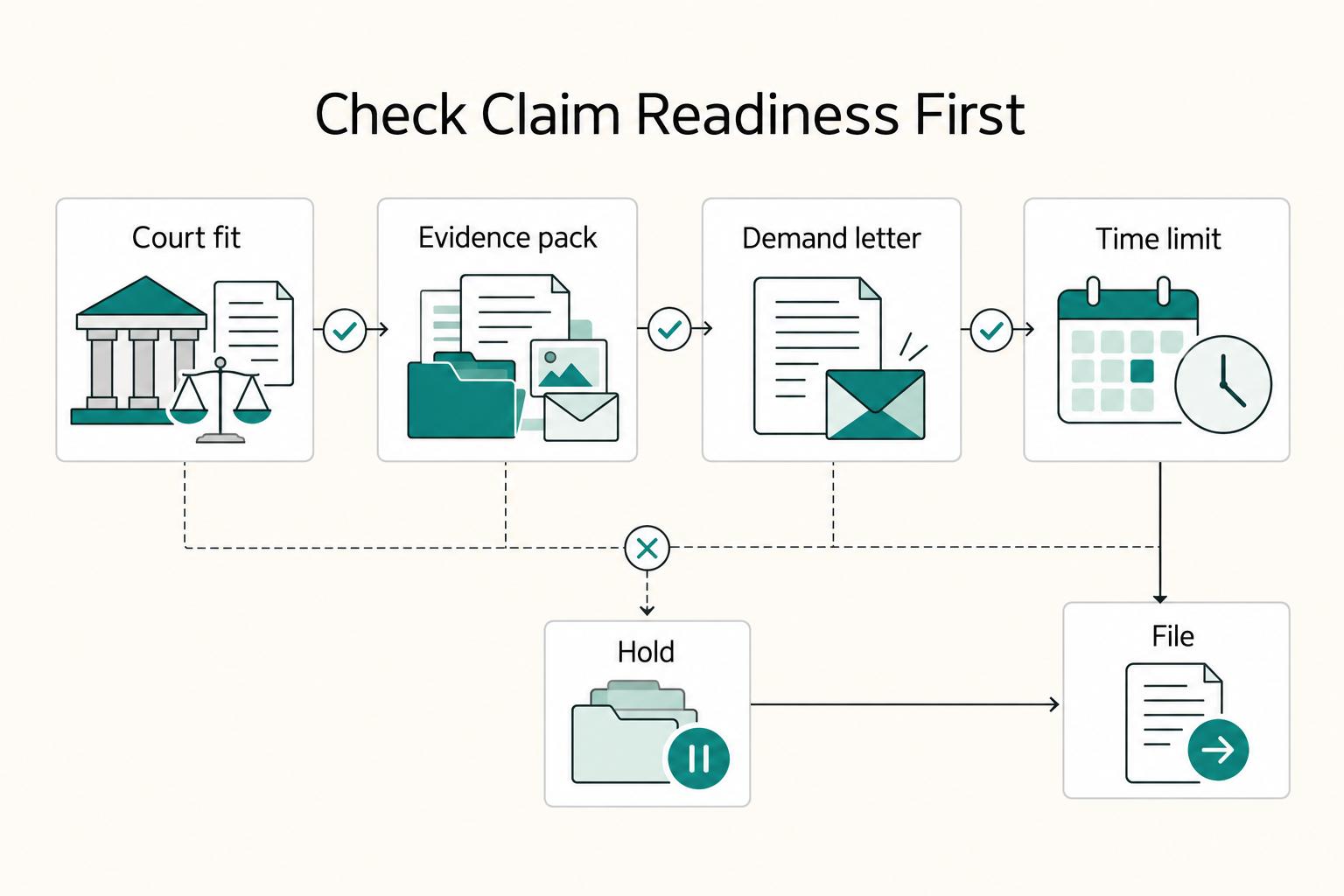
Small Claims Court for Freelancers With Unpaid Invoices
An unpaid invoice can justify a court claim when you can identify the debtor, explain the amount and prove the agreement and work. This guide focuses on **UK money claims**, with detailed procedural examples for **England and Wales** and distinct routes for Scotland and Northern Ireland. A claim can be worth pursuing without a signed formal contract, but emails, agreed scope and other evidence must still establish the obligation.