
Quick Answer
Start by treating legal marketplace payouts as a controlled release workflow rather than standard seller disbursements. Define who contracts with the acquirer, who can authorize movement, and which record proves each state from holding through provider transfer. Keep referral-fee eligibility logic separate from execution events, then block movement until evidence-backed KYC, KYB, and AML outcomes are cleared. Where trust-account boundaries are still unresolved in a market, keep release manual or paused.
Why Legal Marketplace Payouts Need Tighter Controls#
Marketplace payouts in legal services are an operating-model decision before they are a product feature. In multi-seller environments, payout flows involve regulatory, operational, and technical complexity. Your payout design affects who contracts with the acquirer, who receives settlement proceeds, and who handles receipts, refunds, and disputes.
At a basic level, a marketplace is a digital platform that connects buyers and third-party sellers. In a multi-seller setup, payments and settlement proceeds on behalf of sellers become a core function. In legal marketplaces, that same flow can become an operational control question, not just a funds-movement task.
A practical starting point is merchant of record. In the model described by Fire, the platform contracts with the acquirer and acts as merchant of record rather than leaving that role to individual sellers, including in transactions with multiple sellers. Treat that as a useful model, not an automatic default for legal services in every jurisdiction.
The legal market is split too. The October 2024 California legal market report describes a structural divide between PeopleLaw (individual clients) and organizational clients. It also notes organizational work shifting to ALSPs. For operators, that suggests one payout design may not fit every client segment or provider mix.
This article is meant to help you make those design calls before major build and GTM spend, without guessing at jurisdiction-specific legal outcomes. The checkpoints are:
- merchant-of-record structure
- who receives settlement proceeds on behalf of sellers
- payout handling for refunds and disputes in multi-seller transactions
- segment fit across PeopleLaw and organizational-client operating models
Legal marketplace payouts and what makes them different#
These are often release decisions, not just routine seller disbursements. In many implementations, they are transfers from your platform to legal service providers after fee logic, checks, and status rules are applied.
The baseline marketplace model is a useful starting point, but it is not enough on its own. Platforms may process payments and receive settlement proceeds on behalf of sellers. In a merchant-of-record setup, the platform contracts with the acquirer rather than individual sellers, issues receipts, and handles refunds and disputes, including multi-seller transactions. That foundation still leaves legal-specific questions open, especially around attorney referral fees and trust accounting. Keep those questions visible in your release logic.
Provider mix matters too. Legal service delivery is not limited to traditional firms, and ALSP usage is already reported across more than one-third of companies and more than 50 percent of law firms. For payout design, a single path can break down when provider roles and engagement structures differ.
Before you set payout rules, confirm these control points for each provider path:
- who contracts with the acquirer
- who is designated to receive funds
- who owns refunds and disputes
- what record shows the payout met release conditions
One failure mode is copying generic third-party transaction logic and labeling every provider as a standard seller. That may look clean at launch, but it can become brittle when refunds, disputes, or release decisions need to be defended. That is why the first real build task is not API wiring. It is locking the money flow.
The money-flow model you must lock before launch#
Lock one end-to-end flow before launch. If the release path is not explicit, treat expansion as not launch-ready. Use one shared diagram and one reference table that finance, legal, ops, and product can all use.
As an internal launch checklist, map client payment, holding state, fee allocation, payout approval, provider transfer, and reconciliation in one sequence. If trust accounting or dispute-resolution states can pause release in your model, show those pause points in the same sequence.
Draw the sequence as a release chain#
For each step, answer three questions: where funds sit, who can move them, and what record proves the step completed. Keep control points explicit, especially where status can change from received to releasable.
Separate money moved from money may move. A conflict-of-interest discussion in another market, payment for order flow, shows why control design matters. Compensation structure can conflict with execution duties when decision rights are unclear.
Assign owner, responsibility, and schedule dependency#
Keep step names identical across the diagram, incident notes, and payout statuses. Use this as a working matrix, then adapt it to your policy and operating model.
| Step | Primary owner | Responsibility to define | Dependency on payout schedules |
|---|---|---|---|
| Client payment | Payments or finance ops | Receipt record and intake controls | Low at intake, affects downstream timing |
| Holding state | Finance with legal review | Hold criteria and release preconditions | High when release is date/batch driven |
| Fee allocation | Finance or revenue ops | Provisional vs final allocation state | Medium to high before transfer |
| Payout approval | Ops with policy approver | Release authority and exception path | High when schedules open approval windows |
| Provider transfer | Payments ops | Evidence of initiated and completed transfer | High because batches move cash |
| Reconciliation | Finance or accounting | Source-of-truth record for mismatches | Indirect but critical for schedule breaks |
Decide refund behavior in advance#
Define refund handling before payouts run, especially when timing overlaps with allocation and approval states. You want deterministic outcomes. The same timing and status inputs should produce the same hold, offset, or release result.
Verify evidence, not just process design#
Define the proof artifact for each step, then verify the status of your legal-research source before you rely on it. For example, FederalRegister.gov XML is informational and not official legal notice. Legal research should be checked against an official Federal Register edition, and each posted document includes a link to the official PDF on govinfo.gov.
Treat source status as part of launch readiness. The OCC item posted on 03/02/2026 is labeled a Proposed Rule, with a comment period shown through 05/01/2026. Any process assumptions tied to that text should remain explicitly provisional.
If you are mapping state licensing exposure alongside payout design, see State Money Transmitter Licenses: Which US States Require a License for Marketplace Payouts.
Choosing control model by market and risk appetite#
Choose your control model before launch, and treat it as a go or no-go decision. If market ambiguity is high, default to tighter control and stronger policy enforcement, even when that increases onboarding friction.
Make risk appetite explicit. Do not let launch pressure make the decision for you. Governance is not one-size-fits-all, and policy approval is a formal checkpoint, so the decision is incomplete until you can point to the approved policy, named owner, and meeting record.
How the models trade control for speed and support load#
A merchant-of-record model and a payment facilitator/acquirer model can be configured with different control boundaries, ownership splits, and evidence requirements. Treat any speed or support assumptions as hypotheses to validate in policy, contracts, and operating runbooks before launch.
The core tradeoff is coordination risk versus centralized control design. Release authority, return handling, ledger authority, and support ownership all need to stay explicit across parties.
Use this as a scoring lens, not a universal rule:
- Merchant of record
- Liability concentration: define explicitly in policy and contracts * Launch speed: estimate based on required controls and approvals * Support burden: estimate based on exception ownership and evidence handling
- Payment facilitator plus acquirer
- Liability concentration: define explicitly across all parties * Launch speed: estimate based on provider readiness and contract scope * Support burden: estimate based on cross-party exception handling
Keep controls proportionate to the risk in each market. Also watch known framework failure modes such as siloed knowledge, disputed accountabilities, and duplicated reviews.
Use a country scorecard before you pick the model#
Use a country-by-country scorecard before approval, then decide with legal, payments, and ops together.
| Market profile | Legal clarity | Provider coverage | MOR operating cost | PayFac/acquirer operating cost | Recommended stance |
|---|---|---|---|---|---|
| Core market with counsel-confirmed funds-flow assumptions | High | Strong | Validate with your operating design | Validate with your operating design | Choose based on who must enforce holds and release policy |
| Expansion market with open questions on release or recipient rules | Medium | Mixed | Validate with counsel and provider terms | Validate with counsel and provider terms | Prefer tighter control until open questions close |
| High-ambiguity market with uneven provider support | Low | Thin or uncertain | Validate before commitment | Validate before commitment | No-go until legal position and operational ownership are explicit |
Pressure-test your preferred model against the least clear market in scope. If it fails there, narrow the rollout or change the model now.
Pressure-test multi-currency and local compliance before approval#
Multi-currency and local compliance can expose weak ownership quickly, so pressure-test those control points before approval. Confirm who owns conversion timing, which record proves payout values before and after conversion, and who handles mismatches, returns, and local review queues.
Use the 3 Lines Model as a practical check: first-line execution ownership, second-line policy interpretation and oversight, and third-line assurance evidence. If adding currencies creates duplicated reviews or conflicting ownership, redesign before launch.
Finalize with documented governance artifacts: a risk-register entry for model choice by market, the approved structure, rejected alternatives, rationale, and required payout-release evidence, plus meeting minutes that record the decision. If ownership, policy approval, or cross-currency controls remain unclear, do not launch.
If your go or no-go hinges on who controls fund release and legal responsibility, compare the operating tradeoffs of a merchant of record setup.
Referral fees and trust accounting where teams get exposed#
This is where otherwise workable payout designs often break. Teams get exposed when referral-fee eligibility and payout execution are treated as one opaque calculation. Keep them separate so legal, finance, and product can validate each part independently.
Split entitlement from disbursement#
Treat referral fees as an entitlement decision first, and money movement second. One record should answer whether a fee is allowed in that jurisdiction and which signed documents govern it. A separate record should track whether the approved amount was released, held, returned, or corrected.
| Item | Category |
|---|---|
| Written agreement between participating lawyers | Written checkpoint |
| Written client consent with full disclosure | Written checkpoint |
| Proportional division or joint responsibility | Written checkpoint |
| Reasonable total fees | Written checkpoint |
| Fee formulas | Operational term to write and store |
| Payment timing | Operational term to write and store |
| Dispute-resolution procedures | Operational term to write and store |
The written checkpoints are specific: written agreement between participating lawyers, written client consent with full disclosure, proportional division or joint responsibility, and reasonable total fees. Operational terms should also be written and stored, including fee formulas, payment timing, and dispute-resolution procedures. If those fields are missing before payout instruction, review and QA become guesswork.
Draw the boundary before you configure payout schedules#
Set payout schedules only after you have a written position, confirmed by local counsel, on how funds are classified in that market. Trust-account handling can vary by jurisdiction, so do not hard-code one assumption across markets. If local counsel has not confirmed the boundary, keep release manual or disabled for that market.
This helps avoid a coordination failure: finance standardizes a batch schedule while legal is still defining funds classification. Use a hard gate. No schedule goes live until legal has approved the classification and finance can show that classification in reconciliation outputs.
Edge cases need written decision rules#
Mixed matters, multi-party splits, and late corrections need explicit rules, not ad hoc analyst decisions.
- Mixed matters: if a matter spans multiple practice areas or jurisdictions, route it to legal review before automated splitting.
- Multi-party splits: require named participants, stored percentages or formulas, responsibility allocation, payment timing, and a dispute path before release.
- Late fee corrections: do not overwrite original payout records. Post linked adjustments tied to the matter and agreement version, with legal and finance review before make-good or clawback actions.
Without a proper written agreement, disputes are harder to resolve. The source example of expecting 30% and receiving 10% is exactly the kind of variance your records should be able to explain from documents and ledger history.
Sign-off should depend on reconciliation, not memo comfort#
A legal memo helps, but it is not release evidence. Sign-off should require reconciliation that ties each matter to agreement version, client-consent status, approved formula, gross funds received, held amount, released amount, and open exceptions.
If reconciliation shows unexplained variance, missing consent status, or payee mismatch, do not clear the batch. That aligns with formal payment risk-management expectations for policies, internal controls, governance reporting, and internal audit. Related: Late Fee Automation for Marketplace Invoices: Legal Requirements by Country.
Policy gates that should block payout release#
Payout release should stop by default until KYC, KYB, and AML gates are each cleared with reviewable evidence. Design the process so funds do not move while key checks are still unresolved in email threads or analyst notes.
Make each gate explicit and evidence-backed#
Use separate gates for KYC, KYB, and AML, not one blended compliance_passed outcome. Each gate should carry its own evidence record, decision owner, review timestamp, and outcome so finance and ops can explain why funds were blocked, released, or returned.
| Gate | Minimum record to release decision |
|---|---|
| KYC | Evidence that individual payee identity review was completed, plus the source record used |
| KYB | Evidence that business entity review was completed, including the exact entity record used |
| AML | Evidence that screening or review was completed, plus the outcome code |
No required KYC, KYB, or AML checklist is defined here, so do not hard-code one as if it were mandated. Define evidence classes, storage location, and release behavior when evidence is missing, expired, or under review.
Queue behavior and exceptions need written rules#
Blocked payouts need traceable hold logic, not a generic pending bucket. For each queued payout, store the hold reason, triggering gate, evidence record ID, and the team authorized to clear it.
| Record element | Applies to | Requirement |
|---|---|---|
| Hold reason | Queued payout | Store the hold reason |
| Triggering gate | Queued payout | Store the triggering gate |
| Evidence record ID | Queued payout | Store the evidence record ID |
| Team authorized to clear it | Queued payout | Store the team authorized to clear it |
| Market | Allowed exception | Require a written record of market |
| Provider | Allowed exception | Require a written record of provider |
| Affected payout IDs | Allowed exception | Require a written record of affected payout IDs |
| Legal or policy basis | Allowed exception | Require a written record of the legal or policy basis; verify against an official edition before release when it depends on regulatory text |
If exceptions are allowed, require a written record of market, provider, affected payout IDs, and the legal or policy basis. When that basis depends on regulatory text, verify it against an official edition before release. FederalRegister.gov states that its displayed version is not an official legal edition and should be verified against an official edition for legal reliance.
Do not treat a Proposed Rule entry, including 88 FR 14672, as settled authority, and do not release funds based only on unofficial page or XML data. The same source warns that this does not provide legal notice or judicial notice.
Use stricter defaults where markets are still being validated#
When a market is still being validated, default to the stricter outcome. Use statuses such as blocked_local_validation or manual_review_required instead of inheriting another market's approved path.
This matters most where trust treatment may affect payout handling. The California State Bar's 2024 client trust accounting handbook states that New Jersey trust accounting rules differ from California's, even though basic accounting principles are shared. Do not assume one market's approval logic is portable to another.
Statuses should reconcile cleanly#
Use machine-readable status transitions so finance and ops can reconcile outcomes consistently. A simple model like pending, blocked, exception_requested, exception_approved, released, and returned is enough if each status has one definition and one owner.
A useful pattern is discrete lifecycle states rather than vague progress labels. Legislative workflows, for example, expose stages such as Introduced and Signed by Governor. For payouts, blocked, released, and returned should be explicit transitions tied to evidence records, not reconstructed later from comments.
Designing payout timing without breaking operations#
Payout timing is an operating control, not a marketing promise. Once a payout is approved, when it moves should reflect dispute handling, cash forecasting needs, and provider expectations, not competitor cadence. If you optimize only for speed, you can release payouts that later turn into refunds or disputes. If you optimize only for float, you can create provider friction and one-off exceptions.
Use timing tiers, not one global release rule#
A single cadence across all matters is usually too blunt. Use timing tiers so higher-dispute work follows a more cautious path, while lower-risk recurring work can be considered for a faster path only when controls are stable and explainable to finance, ops, and compliance.
| Matter profile | Timing posture | Extra release condition |
|---|---|---|
| High-dispute or complaint-prone matters | Cautious release path | No active refund, dispute, or unresolved hold before batch inclusion |
| Standard one-off matters | Standard cycle | Policy gates cleared before release |
| Low-risk recurring work | Potentially faster cycle with guardrails | Limited to provider/matter groups with stable reconciliation |
Use this as an internal control tool, not a legal artifact.
Pressure-test against refunds and disputes#
A payout schedule is only real if it holds up under exceptions. Refunds and reimbursements are explicit payout API payment types, so test timing rules against those paths before rollout.
At minimum, dry-run reconciliation for:
- approved payout released
- approved payout held for dispute
- approved payout reversed into a refund-adjusted balance
If those outcomes still require spreadsheet fixes or analyst notes, your cadence may be too aggressive for current operations. Also account for procedural differences in dispute handling. Some intermediaries are federally required to provide procedural minimums, such as timely notice and reasonable investigation, while platforms may have broader discretion.
Make the schedule operationally real#
Document schedule logic with clear ownership, eligibility rules, release blocks, and refund handling. If schedule logic stays informal, teams will recreate it case by case and lose auditability.
Treat manual weekly CSV uploads as a warning sign. Manual uploads are error-prone, can create inconsistent payments, and weaken cash forecasting. If you are moving to automated bulk payout requests, re-test timing logic during that change and involve developers, finance, and compliance in integration planning.
Revisit timing whenever payout scope or integration design changes, because exception handling and reconciliation can shift even when policy gates stay the same. Related reading: Building a Virtual Assistant Marketplace with Operable Payout and Tax Controls.
API and ledger design for traceable payout operations#
Once timing rules are set, traceability is what keeps them usable. A payout API can coordinate outbound disbursements, but an accepted API call alone is not the same as settled funds or closed reconciliation.
Model payouts as an event chain#
A payout is not a single event. It sits in a settlement flow that can include capture, split, payout, and possible reversal, and longer or more branched flows increase reconciliation complexity. Record state changes as they happen instead of collapsing them into one final status.
For retries or delayed updates, treat idempotency and replay handling as rollout checkpoints, not assumptions. Define how repeated payout intents and out-of-order events should be recorded so the ledger stays consistent and teams are not forced back into manual reconciliation.
Keep one normalized core contract, isolate transport differences#
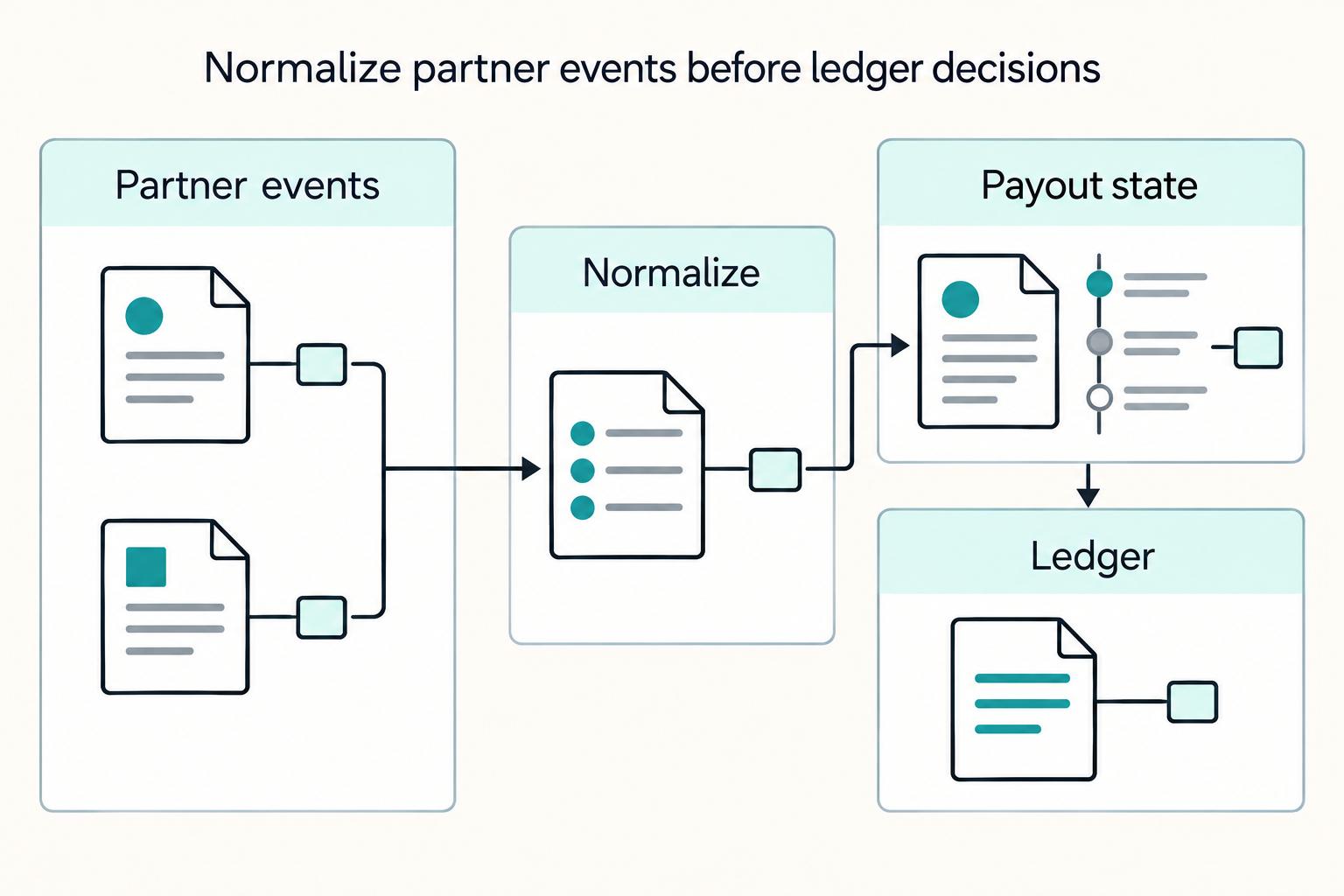
If you need to support multiple partner interfaces, keep transport-specific shapes at the edge and normalize records before they reach core payout state and ledger logic. That helps reduce fragmented data and keeps reconciliation records consistent across partners.
It also keeps the platform aligned with payout orchestration as an outbound process, rather than inheriting inbound transaction assumptions from other payment flows.
Persist the references needed for investigations#
When data is scattered or visibility is delayed, exception handling slows down quickly. Persist the identifiers and event history your teams will actually use to investigate payout issues, including trace IDs where available.
Common records to keep include:
- internal payout ID and external trace/reference IDs used for investigations
- settlement-flow events with timestamp and source, such as capture, split, payout, and reversal
- compliance checkpoints on the same timeline, including KYC and AML screening outcomes
Put policy and money movement in one operational history. If compliance checks affect payout handling, that context should be visible next to the payout attempt itself.
Align technical statuses with finance meaning before launch#
Before rollout, review status labels jointly across engineering, finance, and ops so each label has one operational meaning.
| Example label | Engineering meaning | Finance meaning to confirm |
|---|---|---|
accepted | Request passed API validation | Not yet paid |
processing | Partner is handling the payout | Open, not settled |
completed | Final success event received | Eligible for closed reconciliation |
returned | Transfer reversed after initiation | Exception handling and balance correction required |
Without this mapping, teams can misread open payouts as settled and create avoidable cleanup work during reconciliation.
Failure modes in disputes, refunds, and reversals#
Once payout batches execute, disputes, refunds, and reversals need explicit ownership and rules or they become reconciliation risk. Assign one first-response owner before launch. Define that owner's checklist for freezing follow-on actions, opening the case record, and coordinating legal, finance, and provider communication on one timeline.
Assign first response like a formal process#
Handle first response as a formal process, not an inbox habit. A practical process reference is the Federal IDR process shape: initiation, offer handling, decision output, and recordkeeping, with defined consequence paths when required steps are missed. Use that shape as an operational template, not as a legal rule set for marketplace payouts. Once dispute resolution starts, your team should already know who logs the case, who decides whether payouts pause, and what missed response triggers escalation.
Make post-payout refund rules deterministic#
Post-payout refunds should follow written policy, not case-by-case judgment. Decide in advance how your platform handles refunds and downstream balance corrections after payout, then apply that rule set consistently by matter type and control model.
Treat policy states like fraud holds as explicit controls when determining refund eligibility. Also avoid assuming payment failure automatically unwinds earlier commitments. Reversal outcomes can leave upstream commitments in place even after a dispute or failed payment.
Record reversals as structured outcomes#
Record reversals as structured data, not free-text comments, so reconciliation and escalation stay reliable.
| Reversal field | What to record |
|---|---|
| Identifiers | Original payout ID, provider reference, and linked dispute or refund case ID |
| Decision details | Reversal reason, owner, decision state, and final outcome |
| Accounting effect | Balance correction or open recovery amount |
If reversal patterns repeat by provider group, corridor, or matter type, treat that as an operational risk signal. Repeated refund or reversal behavior may justify tighter payout timing, added holds, or account controls.
Country rollout sequence and go or no-go checkpoints#
Use a phased rollout and sequence countries by readiness against clear goals, scope, and success metrics, with accountability checkpoints at each stage. Leading with payout-rail convenience alone can create avoidable risk and blind spots.
Before enabling live payouts in any market, confirm that ownership, checkpoint evidence, and pass or fail criteria are clearly defined. If any required checkpoint is unclear, that market is not launch-ready.
Cross-border scaling raises operational burden as you add local acquiring banks and payment providers in each market. Expanding payment methods and settlement partners can increase complexity and cost. Treat rail convenience as a later filter for that reason, not the entry gate.
Use a formal launch checklist with named owners, evidence, and pass or fail outcomes for each checkpoint. Validate risk tiers against actual business needs and compliance requirements rather than documentation alone.
Freeze launch when any required gate is unclear. Unresolved ambiguity is a no-go condition until the owner resolves it and updates the evidence pack.
For a step-by-step walkthrough, see Legal Marketplace Payouts: Trust Accounts and ABA Compliance.
Evidence pack founders should require before approving launch#
Approval should rely on one dated, versioned evidence pack per market, not scattered notes. The pack should make your launch decision defensible later by showing both the operating model and proof that controls behaved as expected before launch.
| Artifact | What it should show | What to check before sign-off |
|---|---|---|
| Model decision notes | The chosen flow, release authority, and treatment of edge cases are explicit | Notes match the product behavior and current market assumptions |
| Policy gates design | Key control gates are defined with outcomes | Each gate has an owner, exception handling, and visible status outcomes |
| Sample reconciliation outputs | Core flows and exceptions can be traced end to end | Samples include both successful and blocked or exception paths |
| Test artifacts | Status changes and exception paths were exercised before launch | Evidence includes inputs, expected results, actual results, and timestamps |
| Red-team scenarios | Stress cases were tested intentionally | Include high-impact edge cases relevant to your operating model |
Use one shared artifact set for product, legal, and finance sign-off. That does not make sign-off legally mandated, but it does prevent teams from approving different assumptions based on different documents.
Do not rely on a green dashboard alone. The pack should show concrete gate outcomes and exception handling in a way ops and finance can verify through reconciliation.
Document quality is part of launch quality. Where legal reliance matters, verify informational legal text against official editions or PDFs, and keep each market pack dated and versioned so assumption changes are traceable.
FedRAMP is a useful discipline example, not a rulebook for this vertical. It separates package artifacts, for example SSP, SAP, SAR, and POA&M, and supports reuse of a single package across multiple reviews. Apply that same hygiene here: one package, explicit evidence, clear gaps, and market-specific version history.
Conclusion#
Treat these payouts as a market-entry decision, not a checkout feature. If control, release rules, and exception handling are still being defined after launch, you are revising a sensitive part of the model while real money and reporting are already live.
Payment infrastructure is the full chain, not just processor pricing. In marketplace payments, settlement flow connects capture, split, payout, and possible reversal, and longer or more branched flows increase working-capital pressure and reconciliation complexity.
Use reconciliation readiness as the go or no-go test. Your team should be able to explain one consistent flow across product, legal, finance, and ops: how release is triggered, where policy gates block movement, and what happens when refunds or reversals arrive after payout. If those answers are fragmented, the design is not launch-ready.
Model costs as a full stack before making expansion decisions. In marketplace contexts, rough processor pricing of 2-3.5% per transaction plus a fixed fee can land closer to 2-5% of GMV after payout and gateway costs. Those are not legal-market benchmarks, but they are a practical warning that payment-layer costs can outgrow assumptions based on visible 5%, 10%, or 15% commissions.
If you need a hard launch rule, use this:
- Lock the control model before market launch.
- Make policy gates explicit before payout release.
- Prove reconciliation on normal, blocked, returned, and reversal paths before volume.
If your flow cannot show fee handling, fund-flow boundaries, and payout exceptions end to end, scaling will amplify confusion faster than revenue.
Before committing rollout resources, walk your team through policy gates, payout states, and reconciliation checkpoints in the Gruv docs.
Frequently Asked Questions
What are legal marketplace payouts, and how are they different from standard marketplace payouts?
This guide does not set a single legal definition of "legal marketplace payouts." For planning purposes, treat them as payout flows where release timing, controls, and reconciliation are explicitly documented before launch.
Can a legal marketplace pay attorneys directly in every jurisdiction?
You should not assume a universal yes or no. This guide does not establish a jurisdiction-wide rule on direct attorney payouts. Treat this as a market-by-market legal question tied to your exact product flow, and keep that analysis dated and versioned.
How do attorney referral fees change payout design decisions?
This guide does not define legal-marketplace referral-fee rules. As an internal design choice, keep referral-fee calculations separate from payout execution so legal and finance can review them without tracing transfer code.
Who should control funds release when trust accounting obligations apply?
This section cannot name one legally correct release controller. The practical requirement is to make release authority explicit in your money-flow design, assign ownership, and expose approval states in reconciliation outputs. If release control is still implicit, automation is premature.
Which KYC, KYB, and AML policy gates should block payout release?
This guide does not give legal-marketplace-specific KYC, KYB, or AML release rules. Use your policy framework explicitly, and do not present a generic checklist as jurisdictional law. Operationally, your system should clearly distinguish blocked, released, and returned outcomes so finance and ops can verify behavior.
How should payout schedules be set when disputes and refunds are common?
This guide does not set a legal-marketplace dispute window or refund-timing standard. Set payout timing to match your dispute and refund behavior, and use a slower cycle if holds, returns, and reversals are not fully traceable end to end.
When should a platform choose merchant of record over a lighter payment facilitator model?
This guide does not support a legal-liability ranking between these models for legal marketplaces. Use market-specific analysis of control, reporting, and exception handling needs instead of broad claims.
Can we rely on general agency FAQs or staff bulletins when making payout decisions?
Only after confirming source type, scope, and applicability. SEC Staff Legal Bulletin No. 9 states that it has no legal force or effect, so it should not be treated as binding law. The cited CMS Medicare/Marketplace FAQ is also scoped and excludes some populations, which is a reminder that official guidance can be limited.
Try a related tool
Researched and edited by the Gruv editorial team. Gruv builds cross-border billing, payouts, and finance-operations software for global businesses.
Sources
- arcadiaca.gov/Document%20Center/Government/City%20Clerk/Ag...trusted
- calbar.ca.gov/Portals/0/documents/accessJustice/2024-Legal...trusted
- calbar.ca.gov/Portals/0/documents/ethics/Publications/Port...trusted
- cms.gov/medicare/eligibility-and-enrollment/medicare...trusted
- cms.gov/files/document/federal-idr-guidance-idr-enti...trusted
- congress.gov/event/112th-congress/senate-event/LC2556/texttrusted
- ecf.vid.uscourts.gov/vidapps/Materials_for_Legal_Ethics_in_the_Ag...trusted
- federalregister.gov/documents/2026/03/02/2026-04089/implementing...trusted
Educational content only. Not legal, tax, or financial advice.
Related Posts

The Freelance Payment Penalty: A Modeled Audit of Platform Fees, FX Spreads, and Payout Delays
The money rarely disappears through a single, easy-to-spot fee. The real loss is stacked. A marketplace takes its commission, a processor adds a charge for international cards, a bank or payment company converts the currency at a spread, a platform holds the funds before release, and a wire sheds a little to intermediaries on the way in. Each layer looks defensible on its own, but the worker feels the combined result as a smaller deposit and a later payday.

How to Respond to a Subpoena for Business Records
Move fast, but do not produce records on instinct. If you need to **respond to a subpoena for business records**, your immediate job is to control deadlines, preserve records, and make any later production defensible.

A US Expat's Guide to Investing in UCITS ETFs to Avoid PFIC Issues
The real problem is a two-system conflict. U.S. tax treatment can punish the wrong fund choice, while local product-access constraints can block the funds you want to buy in the first place. For **us expat ucits etfs**, the practical question is not "Which product is best?" It is "What can I access, report, and keep doing every year without guessing?" Use this four-part filter before any trade: