
Quick Answer
A marketplace does not automatically need its own MTL in every state. Analyze who accepts and transmits funds, which state laws apply, and whether the entity is licensed, exempt, an authorized agent or outside scope. Provider API access and FinCEN registration do not establish nationwide state coverage.
How to Assess State Licensing for Marketplace Payouts#
Marketplace payout licensing depends on the legal entity and the actual flow of funds. Receiving buyer money for onward payment can create state money-transmission exposure; a provider API or federal MSB registration does not decide that question for every state.
At the federal level, 31 CFR 1010.100(ff)(5) defines money transmission and its fact-dependent exclusions. If your entity is an MSB required to register, FinCEN’s registration guidance explains the separate filing obligation. Neither classification nor registration is a state license.
Map who receives buyer funds, who owes the seller after receipt, who controls refunds and release, and where payers and payees are located. Then test the entity’s role against each relevant state’s statute, exemptions and agency relationship. The same product label can hide materially different legal flows.
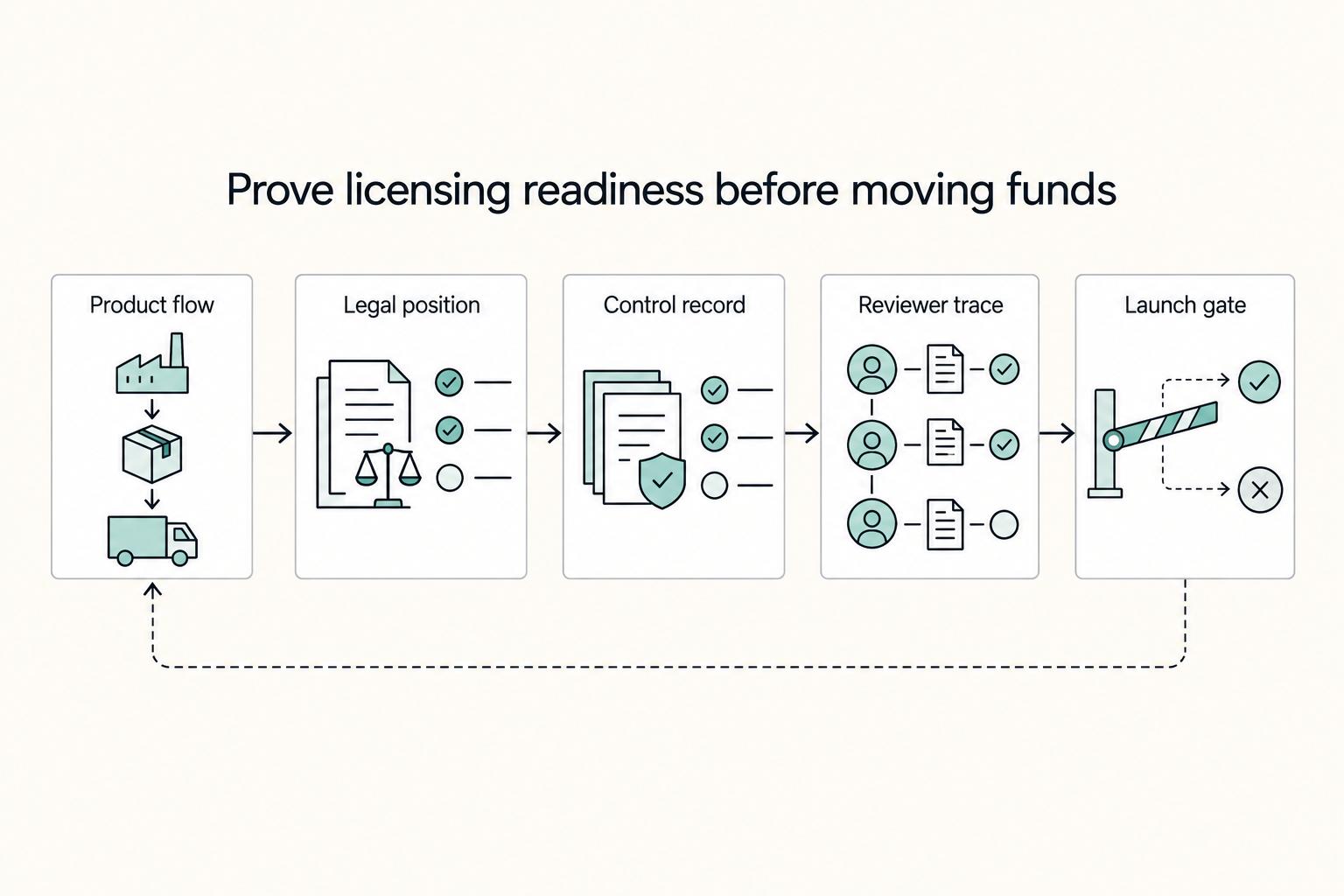
Before launch, or before changing payout flows, force three checkpoints and document them in writing:
- Confirm the actual fund flow: who receives money first, who can hold or pause it, and who triggers disbursement.
- Verify the legal posture you are relying on: your own analysis, a partner's licensed program, or an unresolved question that needs counsel.
- Map the state footprint touched by the product as designed, not as marketed.
Keep the evidence simple and durable. Save a current fund flow diagram, copies of provider agreements and terms, internal sign-off from Legal and Compliance, and a short memo explaining why you think a partner's coverage does or does not apply. One useful verification step is to compare product behavior to contract language every time payout timing, beneficiary onboarding, or release conditions change. If those no longer match, your earlier conclusion may not hold.
For the rest of this article, use a simple rule. Separate federal MSB obligations from state Money Transmitter License analysis, document the facts before relying on a partner, and treat unresolved edge cases as escalation items rather than launch assumptions. That is a reliable way to keep Compliance, Legal, Finance, and Payments Ops working from the same set of facts.
Start with the terms that drive licensing scope#
Start with this baseline: an MTL is state licensing, and MSB is a federal category that can apply in parallel. Treating one as a substitute for the other is where marketplace payout decisions break down.
The state answer is not simply “all 50.” Montana’s banking division says it does not regulate money transmitters, while noting that adjacent activities can require other licenses. In states with money-transmission licensing laws, your entity may need its own license, qualify for an exemption, operate as an authorized agent, or perform a role outside the statutory definition. Record which route applies rather than treating every marketplace as a license applicant.
Set tight internal meanings for recurring terms. "Marketplace payouts" should mean the actual movement of funds from payer to payee in your product, not a feature label. "Agent-of-payee treatment" should be handled as a state-specific legal position you may rely on, with written validation where it matters.
Anchor conclusions to legal sources, not provider commentary. If your position depends on a state Money Transmitters Act or similar statute, start there, then confirm with regulator materials, and retain the exact statute or regulator page, access date, and matching contract clauses tied to your fund flow.
Maintain a dated legal-source register for the states you support. CSBS’s September 2026 MTMA update reports uneven adoption and interpretation despite common standards. Adoption of the model law does not create a single national license. Related: Money Transmission Modernization Act and State Licensing Decisions.
Decide when partner licenses are enough and when they are not#
Using a licensed provider is different from being its authorized agent. Identify the contracting licensed entity, the states and activity covered, and any formal appointment or agent reporting required. If the provider performs the regulated activity while you supply software, document the boundary; if your platform also receives or transmits money independently, analyze that activity separately.
Use this checkpoint table before you rely on partner-license coverage:
| Checkpoint | Evidence supporting the documented route | Change requiring review |
|---|---|---|
| Custody of funds | Funds flow stays within the licensed provider's program terms | Your platform can hold, route, or otherwise control funds outside that scope |
| Control of payout timing | Release timing is governed by the provider program as contracted | Release authority expands beyond the documented provider or agent program |
| Control of recipient onboarding | Onboarding follows the provider's governed flow for the program | Onboarding duties or decision authority change beyond the documented program |
| License relationship in force | The live product, contracts, and operations match the same licensed relationship | Contract posture and live operations diverge, or coverage assumptions are unclear |
Treat custody, payout instructions and release controls as facts to analyze, not automatic legal conclusions. A platform can have operational controls within a lawful provider program; conversely, outsourcing execution does not necessarily remove the platform’s own regulated activity. Match the complete flow and agreement to the relevant legal route.
For example, California Financial Code section 2030 as explained by DFPI distinguishes licensed, exempt and agent activity. Its agent-of-payee exemption requires a preexisting written contract and receipt by the agent to satisfy the buyer’s obligation for the goods or services. A clause calling the platform an agent is insufficient if the buyer remains liable until the seller receives the payout.
Example: when has the buyer’s obligation been discharged?#
Suppose a buyer owes a seller $100 for a service. Under a reviewed California agent-of-payee arrangement, the seller appoints the platform in a written agreement, and payment of $100 to that agent satisfies the buyer’s obligation. The platform may still owe the seller settlement, but the buyer cannot be required to pay the same service charge again merely because the agent fails to remit. If your terms instead make the buyer responsible until the seller’s bank receives the money, that discharge condition is not met. Test the checkout terms, receipt and failure-handling workflow together.
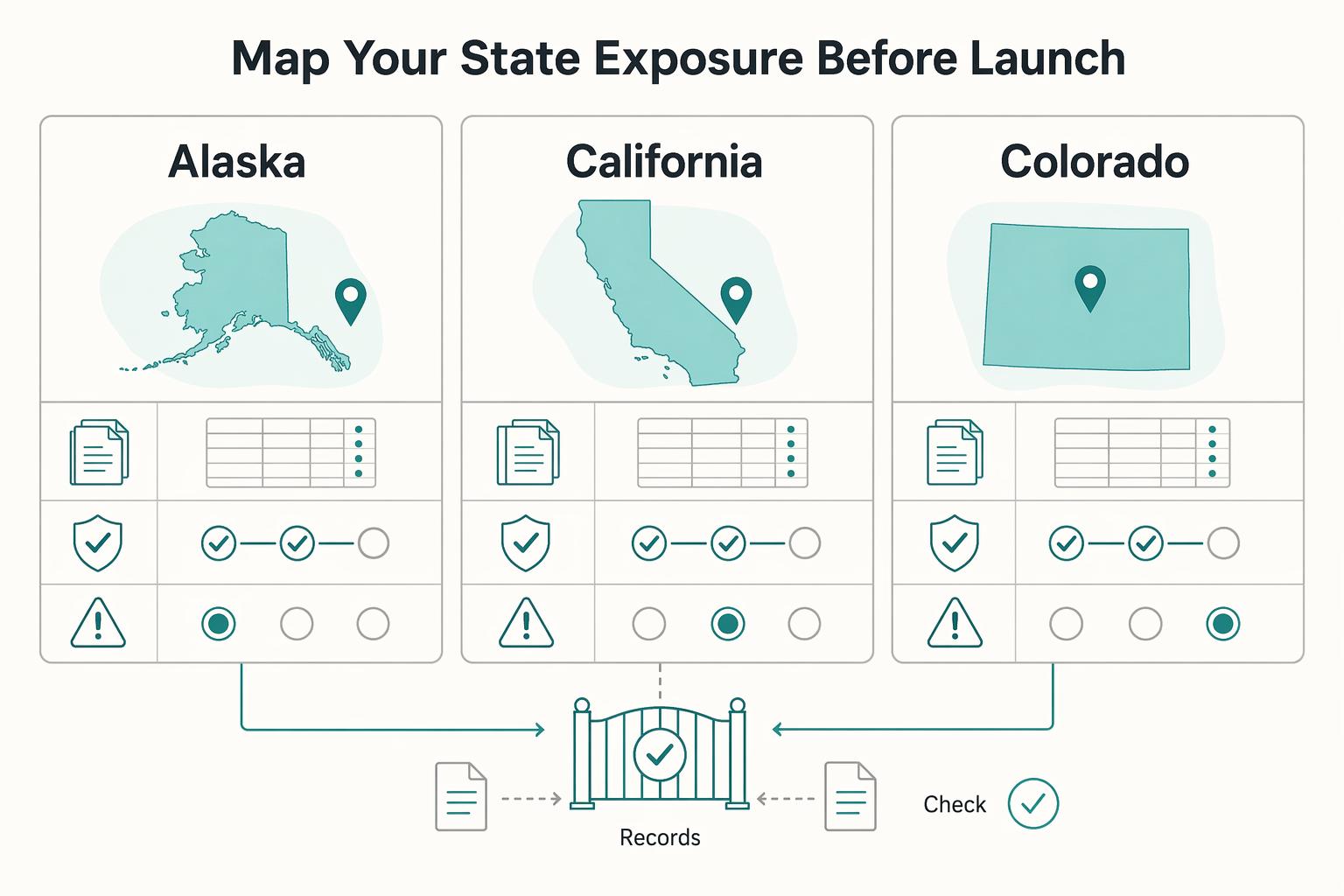
Map your state exposure before launch#
Build a state inventory before launch, and treat Legal sign-off as a gate: no new-state launch until Legal confirms that state's exposure classification and licensing or exemption posture.
Build rows for the jurisdictions your actual flow reaches, including relevant payer and payee locations. The three states below illustrate the worksheet rather than an exhaustive national determination. Add the exact activity, entity, statute, exception conditions and approval basis for every supported state.
For each state, log the launch sequence, payer/payee geography, fund-flow control points, regulator steps, complaint-channel status, and the evidence behind your current view.
| State | Regulator step to log | Complaint channel status | Known evidence attached | Unknowns blocking launch |
|---|---|---|---|---|
| Alaska | State of Alaska Division of Banking & Securities | Verify current intake path on regulator site | Launch sequence, payer/payee geography, fund-flow diagram, provider contract terms | Exposure classification, licensing/exemption posture, Legal sign-off |
| California | Department of Financial Protection and Innovation (DFPI): Money Transmission Act and current guidance | Verify current intake path on regulator site | Same evidence set, plus any California-specific memo/provider analysis | Which licensed, exempt or authorized-agent route covers this entity and flow |
| Colorado | Colorado Division of Banking; MTMA enacted by HB25-1201, effective 6 August 2025 | Verify current intake path on regulator site | Same evidence set, with owner for regulator outreach | Applicable statutory route and current agent-of-payee conditions |
Colorado illustrates why older state tables need updating: HB25-1201, effective 6 August 2025, replaced its earlier act with a partial MTMA adoption and codified an agent-to-payee exemption. Read the operative exemption conditions for the proposed flow; the existence of that exemption is not approval of every marketplace payout.
Give each row an outcome such as own license, authorized agent, exemption, outside scope or unresolved. Mark the statutory conditions and supporting contract clauses as verified separately: an agreement supplies facts, but cannot itself exempt conduct from state law. Keep pending applications separate from issued licenses, and use nonfinancial simulations while launch authorization is unresolved.
Use a separate federal row. FinCEN’s payment-processor ruling describes four conditions: goods/services or bill-payment facilitation, clearance and settlement through systems admitting only BSA-regulated financial institutions, a formal agreement, and an agreement at least with the seller or creditor receiving the funds. That federal exclusion and a state agent-of-payee exemption are distinct tests.
Date-stamp each regulator page and complaint channel, store the snapshot you relied on, and record who verified it. If your memo depends on older agency materials, re-verify current complaint and supervisory paths before launch.
Build the evidence pack regulators and auditors will ask for#
After you map state exposure, make the file reviewable: a regulator or auditor should be able to see who controlled each payout decision and why.
| Artifact | Include |
|---|---|
| Control narrative | Who initiates the transfer request; who can pause or release payouts; where KYC/KYB, OFAC screening, and other policy checks run; which provider or internal service executes the payment |
| Customer and payee terms | Version dates and clauses on payout authority, holds, reversals, and complaints |
| Partner contracts and program terms | In-force contracts, program terms, and any addenda that change onboarding, payout timing, or funds release |
| Complaint logs | Intake date, state, allegation, owner, resolution, and any regulator contact |
Your audit trail should let a reviewer pick one payout and reconstruct the path end to end: onboarding status, KYC/KYB result, OFAC outcome, exception approval (if any), provider response, ledger posting, and reconciliation output. The main risk is not missing a payout record; it is being unable to show which control approved release, who overrode a hold, or whether the outcome matched your own policy.
When evidence conflicts, treat it as a launch stop signal. If contract language, control settings, and observed payout behavior do not match, reopen the state analysis before launch.
Add a regulatory-duty schedule to the evidence pack for the actual license or exemption route: required reports, notice events, permitted-investment or safeguarding obligations, complaint handling and record retention. Apply the obligations of the relevant entity and jurisdiction rather than importing a bank supervisory checklist as the law for every marketplace.
Run ongoing obligations as an operating calendar#
Run licensing as a live operating calendar, because drift after launch is usually the bigger risk than initial filing. Treat annual license renewal, state examination readiness, and regulator correspondence as recurring operations, not one-time documentation.
Keep state and federal obligations on one calendar with separate owners and due dates. For each state license, track renewals, reports, assessments, material-change notices and correspondence required by that jurisdiction. For an MSB required to register, track the FinCEN filing and renewal cycle separately. An agent-only federal registration exception does not automatically remove state agent duties. If your MSB must maintain an agent list, assign its annual update and required retention to a named owner. That principal duty is separate from the registration exception for an entity acting solely as another MSB’s agent.
Build one calendar teams can run#
A usable calendar should show, for each item:
- The obligation
- The legal entity and product in scope
- The jurisdiction
- The filing or notice owner
- The completion evidence retained
Attach each filed form, submission confirmation, regulator acknowledgment and relevant configuration version to its calendar entry. Save the source and effective date that established the deadline so a change can update future tasks without erasing prior completion evidence.
Review the signals that change your risk profile#
As an internal review cadence, inspect complaint trends, failed payouts, manual exceptions and out-of-policy releases monthly. Link each complaint to its transaction, jurisdiction, owner, response deadline and outcome. Use the deadline applicable to that complaint channel; a general response statistic is not a state filing rule.
If exceptions become routine, treat your licensing analysis as potentially stale even when filing dates are current.
Make product change review mandatory before release#
Require compliance impact review before deployment whenever fund flow, payout timing, onboarding control, or disbursement authority changes. This includes provider migrations, routing logic changes, and new hold or reserve features. If control of disbursement changes, reopen the state analysis before release.
For New York-specific questions, Choosing Between a New York Money Transmitter License and BitLicense explains where those regimes diverge.
Set escalation triggers for Legal and outside counsel#
Escalate immediately when the facts behind your last licensing view change. That includes entering a new state, adding a new payout rail, or changing who can pause, release, or sequence disbursements.
Escalate before launch if your terms rely on agent-of-payee treatment and you do not have explicit state-by-state validation for each target state and product variant. If your support is only a provider explainer or an old deal memo, treat that as a gap.
Reopen federal and state classifications separately when the facts change. A state exemption does not automatically satisfy the federal payment-processor exclusion, and federal registration does not authorize state-regulated activity.
Include changes in the underlying transaction, not only new payout rails. An agent-of-payee flow for goods or services may not cover a new peer-to-peer transfer or unrelated wallet feature. Record the new flow and contract obligations before assuming the earlier analysis applies.
For a step-by-step walkthrough, see A Deep Dive into Florida's Money Transmitter License Rules.
Align product and engineering controls to compliance decisions#
Make compliance decisions enforceable in the product, and treat compliance sign-off as a release gate for payout-flow changes.
Licensing conclusions hold only if your runtime behavior matches them. If your documented position says your team cannot control disbursement timing, but an internal tool can still release funds, your facts and implementation are out of sync, and that can create problems in a state examination.
Your minimum control set should cover:
- Policy gates on payout initiation so payouts start only when required checks pass for that product variant and recipient state
- Tamper-evident event logging for decision path, actor, timestamp, and policy result on every payout and exception
- Role-based approvals for overrides so support or ops cannot bypass holds, sequencing rules, or release restrictions without proper authority
Use stable identifiers for each logical payout operation and provider idempotency keys where supported. A retry after an uncertain response should first recover the original provider result; an expired key does not establish that nothing moved. Keep the request, authorization, provider reference, ledger effect and reconciliation outcome linked. These are operational controls that enforce the approved flow, not a standalone licensing exemption.
Use a simple verification checkpoint: walk one completed payout and one failed payout end to end. You should be able to show who initiated the action, which rule allowed or blocked it, the provider response or error code, and the resulting ledger entry.
Keep licensing records separate from adjacent tax-reporting work. A payout-control audit trail demonstrates what your platform did; it does not independently establish that an entity has the required license or qualifies for an exemption.
If a release changes payout routing, release authority, exception handling, or ledger timing, do not ship until Compliance signs off on both the updated facts and the controls enforcing them.
Conclusion and next actions#
The practical win is a decision-led model, not a broad theory about whether Money Transmitter License (MTL) rules apply to marketplace payouts. Start with your actual role in the money movement, verify that role state by state, and do not scale until Legal has signed off on the documented facts. That is the cleanest way to reduce surprise licensing work, bad partner assumptions, and launch rework.
Keep the federal classification and each state outcome visible in the launch decision. An exemption for one flow does not establish the answer for every product variant. Reopen the affected rows when custody, transaction purpose, customer geography or agent relationships change.
Treat the approved legal flow as a maintained product boundary. A new manual hold, wallet transfer or alternate payee can change the underlying facts. Make the release checklist compare the proposed behavior with the current state decision, then update the affected controls and evidence before activating that variant.
Your next actions should be concrete and sequenced:
- Build the state exposure table first. Include target state, payer and payee geography, product variant, whose licensed program you rely on if any, known versus unknown legal coverage, and the approval owner.
- Define escalation triggers before launch. At minimum, trigger review when you add a new state, a new payout rail, a new manual exception path, or any change in who controls disbursement timing.
- Map controls and evidence to that baseline. Tie the exposure table to fund flow diagrams, partner contracts, customer terms, complaint handling, event logs, and the calendar for renewals, notices, and internal reviews.
One verification checkpoint is worth adopting immediately. Pick one completed payout and one failed payout each month and confirm you can show initiation, policy decision, provider response, ledger effect, and any manual approval without hunting across tools. If you cannot do that quickly, your control story is weaker than your legal memo suggests.
If you want a simple rule to carry forward, use this one: when the facts change, the answer may change. That is the right posture for state money transmitter licensing in U.S. marketplace payouts, and it is the difference between a launch that is merely fast and one that is defensible.
For budgeting and sequencing, How to Get a Money Transmitter License: A State-by-State Timeline and Cost Guide outlines typical timelines and cost drivers.
Frequently Asked Questions
Do marketplace payouts require an MTL in every US state?
Not every marketplace needs its own MTL in every state. The answer depends on the state definition, the entity’s activity, applicable exemptions and any authorized-agent relationship. Montana does not regulate money transmitters, although other licenses may apply. Assess every relevant state for the actual flow rather than treating a provider relationship as nationwide clearance.
Can we rely on a provider like PayPal or Stripe instead of getting our own license?
A provider can perform the regulated activity, or appoint an agent where the relevant law and program permit it, but using its API is not automatically the same as either arrangement. Verify the contracting entity, state coverage, actual fund flow and any formal agent duties before relying on the relationship.
What is the difference between MSB status and state MTL obligations?
MSB status and registration are federal BSA concepts; an MTL is a state license. FinCEN registration generally must be filed within 180 days of establishment and renewed every two calendar years for entities required to register. An entity that is an MSB solely as another MSB’s agent is not required to register, but independent activity can change that result. State agent and licensing requirements still need their own analysis.
What ongoing duties continue after licensing approval?
Track the state-specific renewals, reports, assessments, material-change notices, examinations and complaint duties that apply to your entity. If federal MSB registration is required, maintain that separate calendar too. Approval is not permission to add a new activity or change custody and release authority without reviewing the conditions on which the approval relied. For an MSB required to maintain an agent list, include its annual update and retention.
Which internal team should own the state complaint process and regulator responses?
Assign one accountable complaints owner, with Legal and Compliance handling regulatory questions and Operations supplying transaction evidence. Record intake, jurisdiction, deadline, action and response. The internal owner model should support the requirements of the specific complaint channel.
What evidence should we keep to prepare for a state examination?
Keep the applicable license or exemption analysis, dated fund-flow diagram, contracts, agent appointments where relevant, policy settings, complaints and transaction-level release and reconciliation evidence. Match retention and examination requirements to the relevant jurisdiction and entity; a general evidence checklist does not replace those rules.
Try a related tool
Researched and edited by the Gruv editorial team. Gruv builds cross-border billing, payouts, and finance-operations software for global businesses.
Sources
- commerce.alaska.gov/web/portals/3/pub/MoneyServicesStatutesRev09...trusted
- connectmt.mt.gov/BFIDtrusted
- dfpi.ca.gov/regulated-industries/money-transmitterstrusted
- dfpi.ca.gov/rules-enforcement/laws-and-regulations/opini...trusted
- ecfr.gov/current/title-31/subtitle-B/chapter-X/part-1...trusted
- fincen.gov/resources/money-services-business-msb-regist...trusted
- fincen.gov/fact-sheet-msb-registration-ruletrusted
- leg.colorado.gov/bills/hb25-1201trusted
Educational content only. Not legal, tax, or financial advice.
Related Posts

US Money Transmitter Licensing: State Fees, Capital and Timeline
A US money transmitter license program needs a state-by-state activity assessment and budget. Federal MSB registration does not supply national state-license authority, and a license in one state does not itself authorize the same business everywhere else. Begin with the intended customers, money flow and launch jurisdictions, then price the requirements that apply to that activity.
Money Transmission Modernization Act and State Licensing Decisions
If your business receives money for another party, issues stored value or controls a payment before passing it on, review the applicable licensing rules before launch. Receiving payment for your own design or consulting invoice is a different fact pattern from collecting customer money for onward payment. A billing label alone does not decide the result.

California Money Transmitter License Requirements for First-Time Filers
A California money transmitter license may be required when a business sells or issues payment instruments or stored value to a person in California, or receives money for transmission from that person. Map the actual flow before choosing a licensing or exemption position. Receiving funds for onward payment matters even if the product never issues a wallet or money order.