
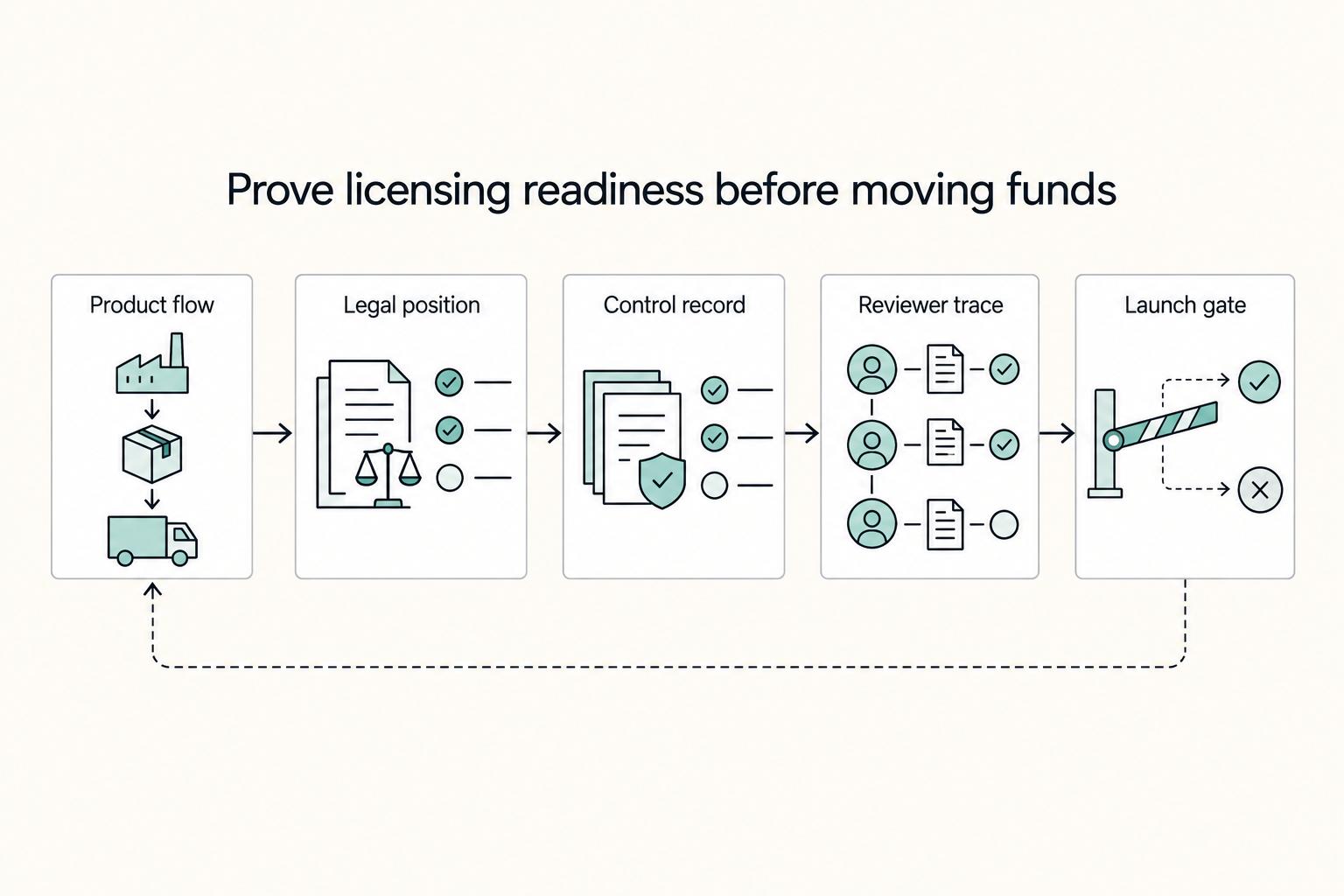
Quick Answer
Map who receives, controls and owes money at each step, then test the operative state definition and exemption conditions. MTMA adoption is not a national license. Record state licensing, federal MSB/BSA and any partner or authorized-delegate arrangement separately, with a dated decision for each flow and jurisdiction.
Map the funds flow before a licensing decision#
If your business receives money for another party, issues stored value or controls a payment before passing it on, review the applicable licensing rules before launch. Receiving payment for your own design or consulting invoice is a different fact pattern from collecting customer money for onward payment. A billing label alone does not decide the result.
For a fintech or payment operator, start with the actual contracts, accounts and instructions. Identify who owes the sender and who must make the recipient whole when a payment fails.
MTMA is a model for state legislation. It aims to align licensing, supervision and financial safeguards, but adoption is not one nationwide approval. The enacted state text and applicable guidance determine each flow’s treatment.
Before you touch funds, run a simple pre-launch pressure test. Ask whether someone new could read one packet and explain who controls funds at each step, which states are in scope, and why each state status is cleared, pending, or blocked. If not, you have a documentation gap that can slow expansion and increase review risk.
Before you touch client funds, keep a compact working file:
- A clear flow map that shows who sends funds, who receives them, and who controls funds in between.
- A state list for each flow you plan to run.
- A written exemption view for each flow, including any agent-of-a-payee analysis where relevant.
- A decision log showing what changed after legal or regulator review.
Keep that file live. Update it when a contract term changes, when payout timing shifts, when a new partner is added, or when a state status moves from proposal to enacted text. A common failure mode is relying on a past review that no longer matches the live flow.
Use this operational guide to prepare a fact-specific licensing review. A flow map, current contracts and dated jurisdiction decisions are useful inputs; a marketing label or provider logo is not launch clearance.
What MTMA is and what it is not#
MTMA is model legislation that states can adopt, not a single national license.
The Money Transmission Modernization Act (MTMA) is model legislation created by state regulators and industry experts and approved for state adoption by the Conference of State Bank Supervisors (CSBS) Board of Directors. CSBS describes it as a single set of nationwide standards and a shared prudential framework for state modernization efforts.
Think of it as common drafting language that can reduce some state-to-state friction, not as a final answer you can apply without local confirmation. It does not remove the need to match your exact flow against each state's operative text and current guidance.
What MTMA does not do matters just as much. It is not a federal statute, and it does not grant one nationwide money transmitter license. Your obligations still come from each state statute and regulator guidance for the specific flow you run.
The CSBS page, dated September 3, 2026 and checked October 5, reports 31 states adopting MTMA in full or part. That count does not establish identical text or an exemption for your product. Use it as dated context and check each actual jurisdiction.
When you capture adoption status, keep a short evidence note in your decision log with three fields: source used, date checked, and how that status affected your product-flow conclusion. This keeps future updates clean because the next reviewer can see what changed and what stayed constant.
Use this checkpoint before entering any new state:
- Record whether adoption is full, partial, or selective.
- Map that status to the exact product flow, not the company in general.
- Confirm current regulator guidance before relying on an exemption or definition.
Carry that lens through the rest of the article: MTMA can improve consistency, but compliance decisions stay state-specific.
Where harmonization helps and where it still breaks#
Harmonization helps you organize multistate review, but it does not replace jurisdiction-by-jurisdiction legal verification.
Use model text as your internal baseline, not as launch clearance. A position that works in one jurisdiction can fail in another once local law and regulator guidance are applied to the same flow.
A common miss is treating summaries and trackers as if they were controlling text. Summaries are useful for triage and planning. They are not the final authority for launch approval. Your approval logic should always tie back to current operative language and any applicable regulator materials.
For each row, separate the statute, effective date, regulation and any interpretation. A model provision or bill summary is not controlling enacted law. Store the exact section and record whether a later amendment changes the conclusion.
Federal money-services-business analysis runs alongside state licensing. A federal exclusion or FinCEN registration does not automatically satisfy or remove state requirements. FinCEN’s registration guidance addresses a federal reporting regime, rather than a nationwide money-transmission license.
Use three checks before marking a state row as cleared:
- Confirm the controlling text you relied on is operative for your question.
- Confirm the legislative stage and latest action date are current in your notes.
- Confirm any regulator interpretation you are relying on matches your actual flow facts.
For planning purposes, if these jurisdictions are in scope, keep separate review rows for Montana, the District of Columbia, Puerto Rico, Guam, and the US Virgin Islands. Do not infer treatment from nearby jurisdictions. Confirm each jurisdiction's controlling text and current regulator guidance before launch.
Does your business activity likely trigger money transmission#
Use this as a triage gate: if your activity is close to regulated money movement, escalate for licensing review before launch.
As a concrete state example, Iowa Code 533C defines covered activities and has separate licensing and exemption sections. Compare the actual activity with the definition first, then test an exemption’s conditions; do not start by assuming that every invoice receipt is money transmission.
Start each product-flow review with a short intake sheet:
- Are you receiving funds from one party to pass value to another?
- Does the flow involve moving value between parties on behalf of someone else?
- Is an exemption position being considered, and what exact facts support it?
- Which statute sections and regulator materials support the current conclusion?
Then move through a fixed decision sequence so the result is easier to audit later:
- Write the flow in plain language, step by step, including temporary holds.
- Match each step to relevant statute and guidance excerpts already in your packet.
- Record the current preliminary view, including what is still unknown.
- Escalate if fund-control or timing facts are incomplete or disputed.
- Lock the conclusion only after counsel or regulator checks are logged.
A hypothetical platform collects $10,000 from a buyer, keeps its agreed $500 fee and owes a supplier $9,500. Its ledger must identify the supplier obligation, where the money is held, who can redirect or refund it, and what happens if payout fails. The platform fee does not by itself turn the remaining receipt into payment solely for the platform’s own service. This example raises review questions, not a licensing conclusion.
A frequent failure mode is label-first analysis. Teams call a product a billing tool, marketplace feature, or payroll add-on, then assume classification follows the label. It does not. Classification should follow a documented, fact-specific reading of the applicable statute and guidance in your packet.
Before launch, apply one escalation rule: if key facts about how funds move or who controls them are incomplete, treat the flow as elevated licensing risk until state review confirms your position. This is an escalation standard, not a claim that licensing is always required.
For an Iowa agent-of-payee position under 533C.103(17), check the written payee appointment, public representation that the agent accepts payment for the payee, and discharge of the buyer’s obligation when the agent receives funds. The goods/services must be something other than transmission itself. A clause leaving the buyer liable if the agent fails to remit does not match that discharge condition. Check other states separately.
Licensing exposure triage before you scale to more states#
Before expansion, document both applicable state licensing and federal MSB/BSA analysis. Identify whether your own entity, a licensed partner, an authorized-delegate arrangement or an exemption covers each specific role; none follows automatically from having a bank partner.
Use the same sequence each time:
- Map where customers are located today and where you plan to serve next.
- Map transaction types by flow: who funds, who receives, where funds are held, and whether value is passed through or stored.
- Map where each current and planned flow could touch regulated activity, then label each state entry as cleared, pending review, or blocked.
Consider capturing this in a jurisdiction matrix shared by legal and product teams. For each product-flow/state row, log the activity summary, current license view, exemption hypothesis, reviewer, last review date, and re-review trigger.
To keep matrix entries usable under pressure, write each row so a new reviewer can answer four questions quickly. They should be able to see what changed, why the current status is what it is, who approved it, and what event reopens it. If those answers are not visible in one row, the row is too thin.
A practical row format can include:
- Flow identifier and version date.
- State or jurisdiction.
- Status: cleared, pending review, or blocked.
- Basis summary tied to statute and guidance already logged.
- Owner and backup.
- Re-review trigger and target review date.
Do not treat remote operations as an automatic pass. State licensing questions should be validated against your exact flow facts before launch.
A useful go or no-go rule is to delay new-state launches until counsel or regulator checks are logged and the matrix is updated for affected flows. If a product change alters fund movement, reopen prior state entries before release.
Add a contract-chain diagram to the matrix showing the customer, your entity, licensed provider, bank and final payee, with responsibility for each failed or returned payment.
Prudential requirements you must evidence not just understand#
Financial safeguards serve different purposes. Tangible net worth supports the licensee’s capital position; a surety bond provides defined claim protection; permissible investments back outstanding transmission obligations under the applicable rules. Keep current calculations and proof where required. They are not interchangeable and do not establish that every customer balance is federally deposit-insured.
| Prudential area | Evidence to keep |
|---|---|
| Tangible net worth | Dated tangible-capital calculation using applicable adjustments, approval and change record |
| Surety bond | Executed bond, required amount/beneficiaries, coverage, renewal and cancellation notice |
| Permissible investments | Eligible assets, valuation, outstanding transmission obligations and reconciled coverage exceptions |
Build each item into your prudential register with a primary owner, a backup owner, and a scheduled review date.
For a hypothetical control check, a ledger shows $200,000 in outstanding transmission obligations while an investment schedule identifies $190,000 as eligible under the reviewed rule. The $10,000 gap needs investigation and remediation; an additional surety bond or expected future revenue is not automatically an eligible investment. Apply the actual jurisdiction’s valuation, permissible-asset and coverage rules rather than this simplified example as a formula.
Set ownership rules that survive normal turnover. Each control file should have a primary owner, a backup owner, and a scheduled review date. The review should confirm not only that documents exist, but that they match current product behavior and current jurisdiction coverage.
The common failure mode is maintenance drift after launch. When ownership and cadence are unclear, controls go stale at different times and expansion work slows while documentation is backfilled.
A short recurring checklist keeps this manageable:
- Confirm file completeness against your required evidence list.
- Confirm dates are current and approvals are traceable.
- Confirm exceptions were resolved or escalated.
- Confirm no product or partner change has made the last review obsolete.
Use a practical gate: run a recurring prudential control review and a pre-expansion prudential review before entering any new jurisdiction.
Check virtual-currency and payroll treatment separately#
MTMA includes provisions states may adopt differently. Fiat, virtual currency, payroll processing and stored value need their own flow and exemption analysis. A digital-asset tax reporting rule does not decide state licensing.
Iowa 533C.103(21) gives a conditional payroll agent-of-payor exemption. It requires a written appointment and holding the agent out to employees/payees, while the employer’s obligation remains if the agent fails to remit. That differs from the agent-of-payee discharge condition: using the same clause for both can reverse the intended allocation.
Federal payment-processor exclusions also have conditions. FinCEN FIN-2014-R009 addresses a specific payment-processing arrangement, including formal agreement and eligible clearing/settlement systems. Do not import its outcome into a wallet, custody or person-to-person transfer without testing the actual facts and current rules.
Mixed-rail, conversion, custody, and fund-control questions should be treated as issues for jurisdiction-specific legal review.
A simple contrast helps set review depth. A fiat-only leg with no custody can still require careful analysis. A mixed-rail leg with conversion and temporary holds may need earlier legal escalation and tighter evidence notes. The point is not to force one outcome. It is to match your review depth to real fund movement.
Apply this gate before go-live:
- Map each flow leg as fiat-only, digital-asset-only, or mixed rails.
- Mark exactly where conversion or custody occurs, including temporary holds.
- If any leg touches conversion, custody, or mixed rails, escalate to state-by-state legal review before launch.
- Keep launch blocked until counsel notes are logged and the jurisdiction matrix is updated.
- Reopen review when payout timing, wallet design, or partner responsibilities change.
Keep matrix language narrow and specific. Avoid blanket entries such as covered under MTMA. Record what flow was reviewed, in which state, on what date, and what change triggers re-review.
Use Wisconsin, Indiana and Massachusetts as separate state files#
Treat Wisconsin, Indiana, and Massachusetts as separate decision files, not one model-law shortcut. Local drafting and enactment choices can change what the same flow requires, so each state needs its own documented read.
State definitions can expand beyond an older licensing regime or differ from optional model provisions. Compare the operative definition, exemptions, transition rules and guidance, rather than assuming a prior consumer-only or foreign-transfer analysis remains adequate.
Use these three files as a repeatable comparison method.
| State file | What to verify directly | Why it matters |
|---|---|---|
| Wisconsin Chapter 217 /2023 Act 267 | DFI states effective January 1, 2025; check current money-transmitter and virtual-currency kiosk guidance | Old seller-of-checks analysis may not cover the new scope |
| Indiana SEA 458 and current code | DFI 2023 report records January 1, 2024 commencement and business-purpose coverage; verify current amendments | Consumer-only assumptions and optional model provisions may differ |
| Massachusetts Chapter 169B /2024 Act 312 | Current section 4 states January 1, 2026 effective date; review licensing exceptions and transition status | Old foreign-transfer-only or bill-stage notes can be stale |
Run the same question set across all three files so differences are easier to spot:
- What exact activity language matters for this flow.
- Whether the item is proposed, enacted, or otherwise not yet operative for your decision.
- Which implementation materials affect timing or submission readiness.
- Which unresolved point keeps a state blocked.
For Massachusetts, the current chapter 169B licensing provision covers engaging in, advertising or holding out money transmission, with specified delegate and exemption exceptions. It uses NMLS for coordination but does not make an accepted application equivalent to approval. The linked legislative section states a January 1, 2026 effective date. Review applicable transition rules rather than carrying forward the old H4840 bill label.
Use one launch gate when scope is ambiguous. Keep that state blocked until counsel resolves it, then update the matrix row with reviewed materials, conclusion date, owner, and re-review trigger.
Build the evidence pack before you touch client funds#
Do not move client funds until your evidence pack shows product flow, legal position, and control posture in one pass. If a reviewer cannot trace a transaction from initiation to payout against current legal materials, launch readiness is incomplete.
Core documents to assemble#
Keep one versioned folder per product flow and include:
| Document | Include |
|---|---|
| Business model memo | Who sends funds, who receives funds, when control changes, and where custody starts and ends |
| Transaction-flow maps | Step-by-step flow for each rail, including failed payouts, reversals, and delayed settlement |
| Legal-basis analysis | Jurisdiction-by-jurisdiction record of the basis tested, your reasoning, and legal review status |
| Control documents | Current records for financial and operational safeguards tied to each launch jurisdiction |
| Jurisdiction matrix | One row per launch jurisdiction with status, owner, last review date, open questions, and launch decision |
Depth matters as much as presence. A one-page memo can be enough if it is specific, current, and connected to the same flow version used in your legal review. A large folder can still fail if dates, flow versions, and conclusions do not match.
Use consistent naming and version discipline so your team can retrieve the latest material without debate. Keep prior versions available, but make current versions obvious and date-stamped.
Use a source hierarchy so your evidence stays stable: primary legal text first, official agency or legislative status pages second, then internal summaries. Track bill movement separately from enacted requirements.
Verification checkpoints#
Use three checkpoints as launch gates:
- Pre-launch review: legal and compliance confirm each jurisdiction row has current primary text, no unresolved scope issue, and an explicit go or no-go.
- Post-launch control test: test live transactions against your documented flow and confirm controls and exception handling work as written.
- Change triggers: rerun review before new products, new rails, or new jurisdictions, and when legislative status changes.
When a checkpoint fails, do not leave it as an informal note. Record the blocker, assign an owner, set a target date, and keep the related jurisdiction rows blocked until evidence is updated and rechecked.
For a proposed amendment, record introduction, passage, enactment and effective date as separate fields. An enacted act can contain delayed or transitional provisions. Assign an evidence owner and backup, and reopen affected matrix rows when operative requirements change.
For the next review, choose one actual payment and compare the contracts, ledger entries and bank instructions with the documented flow version.
Operating controls after licensing that reduce unpleasant surprises#
Licensing is a starting point, not a one-time answer. Keep activity mapping and control records current so product, rail, corridor, and rule changes are reviewed before launch decisions.
Keep a cadence that drives decisions#
Use a repeatable review rhythm tied to go or no-go decisions.
- Re-test your activity map against current state money transmission laws on a fixed schedule.
- Trigger an immediate review before new features, new rails, new partners, or new state entry.
- If scope, exemption, or definition analysis changes, pause launch work for that state until the matrix is updated and approved.
Treat this cadence as a decision input, not calendar theater. If a review uncovers a mismatch between documented flow and production behavior, stop expansion for affected states until the mismatch is closed.
Tie controls to day-to-day execution#
Controls reduce surprises only when they are part of delivery execution.
- Require compliance approval before enabling a new flow.
- Keep immutable audit trails for rule and policy changes.
- Reconcile transaction, ledger, and bank records on a defined cadence.
- Track exceptions with clear ownership, disposition, and impact on your licensing conclusion.
- As volume grows, revalidate licensing assumptions alongside prudential controls and incident response.
Also define the handoffs between product, compliance, and operations so no change reaches production without an explicit licensing-impact check. Silent handoffs are where stale assumptions survive.
Keep licensing, registration and other reporting decisions distinct#
Use a separate record for each regulatory conclusion. State licensing concerns the entity, activity and jurisdiction; federal MSB registration and BSA duties use their own definitions and exceptions. Other tax or account-reporting obligations may apply independently and do not establish permission to transmit money.
| Review record | Keep distinct |
|---|---|
| State activity/licensing | Definition, entity, jurisdictions, exemptions and effective dates |
| Federal MSB/BSA | Registration status or exemption and applicable ongoing duties |
| Licensed partner/delegate | Entity coverage, written authority, permissible functions and failure responsibility |
| Other reporting | Tax and account-reporting tests with their own owners and deadlines |
A partner’s license covers only the activities and entity arrangements the applicable law and contract allow. Record the licensed entity, jurisdiction, authorized role, receipt/disclosure obligations and who bears the unpaid transmission obligation. A commercial sponsorship agreement alone is not evidence that your entity is an authorized delegate.
Cross-link these records by flow version while keeping their conclusions separate. Do not mark state licensing cleared merely because a federal registration number or another filing confirmation exists.
Frequent mistakes that trigger avoidable compliance risk#
Avoidable risk usually starts when teams reuse old conclusions while products and customer experience keep changing.
- Reusing prior compliance conclusions for new states, rails, or customer segments without a fresh review and dated decision record.
- Copying another company's legal rationale instead of validating your own contract chain, custody timing, and payout flow.
- Applying one policy set across different customer contexts and assuming disclosures, fee presentation, settlement expectations, and dispute handling still align.
- Treating ongoing control obligations as periodic paperwork instead of live controls tied to current activity and exception handling.
- Expanding into new flows before documenting what changed, why it changed, and who approved the updated conclusion.
One practical correction is to add a mandatory change note for each product release that can affect movement of funds. The note should state whether your regulatory analysis changed, who reviewed it, and which matrix rows were updated. This turns compliance drift into a visible release check rather than a delayed audit surprise.
Check the customer-facing statement against the real flow: who provides transmission, who holds money, what timing is promised and what happens on failure. A licensed partner’s name in copy does not replace the applicable receipt and disclosure duties.
Keep dated approvals, operating records and changes retrievable. If production differs from the licensed, exempt or delegated arrangement, escalate the actual mismatch and determine the lawful corrective action; stopping expansion alone may not resolve existing affected activity.
Conclusion and your next move#
Treat every licensing conclusion as provisional until you can show the current legal stage and dated evidence for each jurisdiction.
Keep model text, proposed amendments and operative statutes visibly separate in the file. The next action is a reviewed flow-state decision, not a generic statement that the business is covered by MTMA.
Use this short checklist and keep each step auditable:
- Map your real activity flow in plain language.
- Test each requirement against your exact contracts and transaction paths.
- Build an evidence pack that records source text, regulatory stage, latest action date, decision owner, and next review date.
- Confirm treatment in each target jurisdiction before launch or expansion.
- Assign a primary owner and a backup for ongoing control updates.
If you need a first move this week, choose one product flow and bring its packet to full clarity: flow map, jurisdiction list, open questions, and dated status rows. Then run the same structure for the next flow. Repetition with clean records beats one large cleanup after expansion has already started.
Keep a stage-drift gate in your process: do not treat proposal text as final obligations. Recheck conclusions at public milestones, including proposal comment and reply windows, and again when final text is published.
When licensing logic and controls are documented, dated, and auditable, expansion decisions get faster and less risky.
Frequently Asked Questions
What is the money transmission modernization act in plain English?
The money transmission modernization act is a model law, not a national license. It was approved by the CSBS Board of Directors to create a shared baseline of standards that states can adopt and adapt.
Is MTMA a federal law or a model law adopted by states?
MTMA is a state-adopted model, not federal legislation. Indiana’s SEA 458 took effect January 1, 2024 according to DFI’s 2023 annual report; state-specific licensing still applies. Federal MSB registration is a separate analysis.
If many states adopted MTMA, why are requirements still not fully uniform?
States can adopt only parts of the model and apply different definitions, exemptions, timing or interpretation. The September 3, 2026 CSBS page expressly recognizes uneven adoption and interpretation; similarity is a review starting point, not a uniform outcome.
Which requirements appear most consistently across MTMA-style state updates?
A common baseline includes safety-and-soundness requirements, including net worth, bonding, and permissible investments. Standardized licensing exemptions also appear as a recurring goal. Treat these as common baseline themes, then verify each state's current rules and keep a separate evidence row for each prudential area.
How do I tell whether my activity is money transmission or likely exempt?
Describe the actual sender, payee, fund control and failure obligations; match the state activity definition, then test each relevant exemption or licensed/delegate arrangement. For example, Iowa’s agent-of-payee exemption includes debt discharge on agent receipt, while its payroll agent exemption keeps the employer liable if the agent fails to remit.
Why do virtual currency and payroll processing services create extra uncertainty?
The same label can conceal different obligations. Payroll may involve agent-of-payor conditions; virtual-currency custody, exchange and kiosk activity may have separate state rules. Check each state’s enacted provisions and current guidance, plus federal requirements independently.
What is still unknown even after reading current MTMA summaries?
Summaries cannot predict how every regulator will apply rules to your exact facts over time. You still need current statute text, regulator guidance, and a dated decision record for each jurisdiction where you operate. Changes in your product or transaction flow can reopen prior conclusions.
Researched and edited by the Gruv editorial team. Gruv builds cross-border billing, payouts, and finance-operations software for global businesses.
Sources
Includes 1 external source outside the trusted-domain allowlist.
- dfi.wi.gov/Pages/FinancialServices/LicensedFinancial/Mo...trusted
- fincen.gov/resources/money-services-business-msb-regist...trusted
- fincen.gov/resources/statutes-regulations/administrativ...trusted
- in.gov/dfi/files/DFI-Annual-Report-2023.pdftrusted
- legis.iowa.gov/docs/code/2026/533C.102.pdftrusted
- legis.iowa.gov/docs/code/2026/533C.103.pdftrusted
- malegislature.gov/Laws/GeneralLaws/PartI/TitleXXII/Chapter169B...trusted
- csbs.org/csbs-money-transmission-modernization-act-mtmaexternal
Educational content only. Not legal, tax, or financial advice.
Related Posts
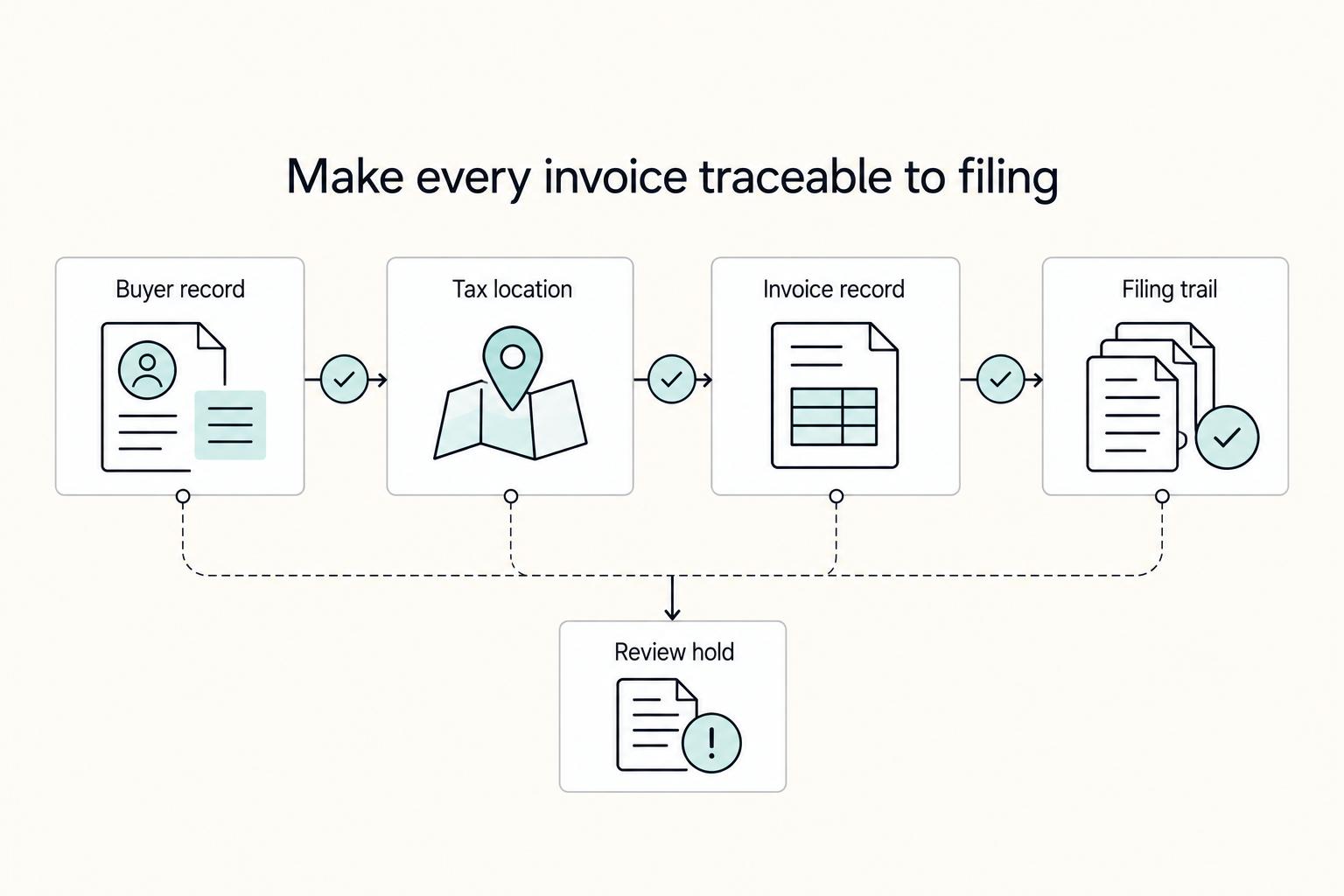
Taxes in Germany for Freelancers and Expats
Low-stress compliance in Germany comes from decision order, not tax tricks. Use this sequence: confirm core facts, apply conservative temporary assumptions, verify the few points that can break invoices or filings, and keep one evidence file that explains each decision.
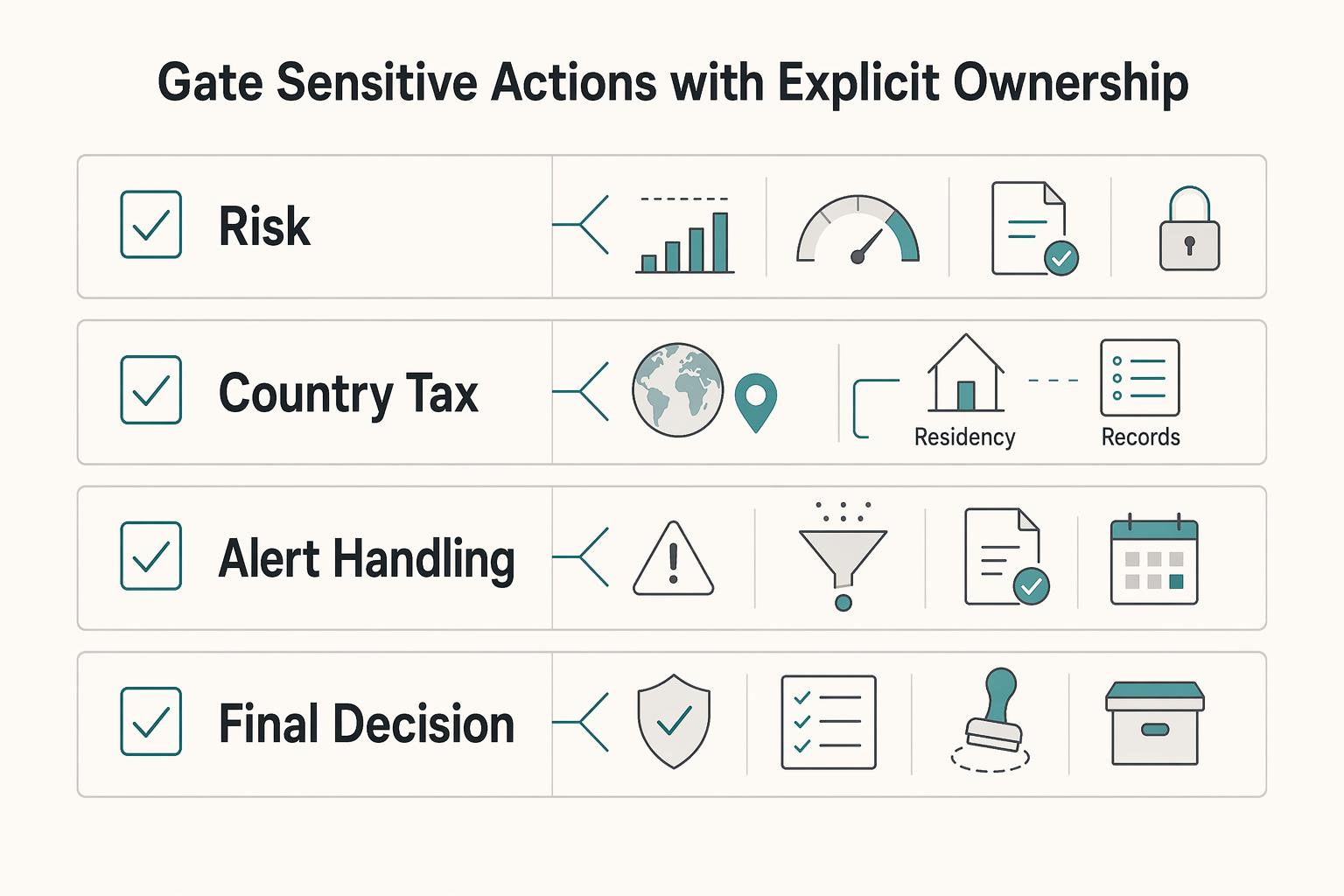
Running a Durable Business-of-One in the Solopreneur Economy
A business of one puts delivery, sales, administration, and cash decisions in the same person’s hands. A durable setup makes those responsibilities manageable as client work rises.
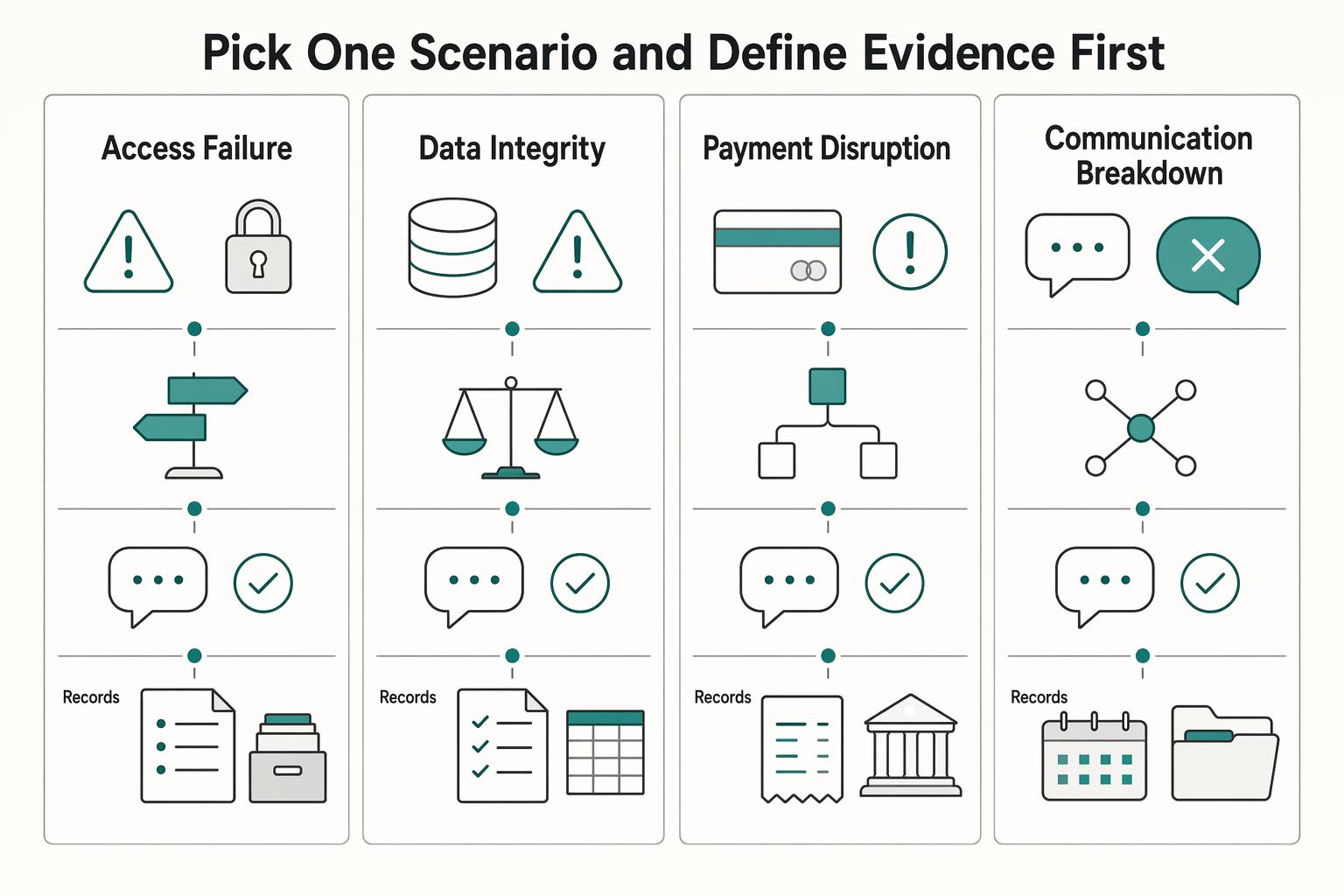
How to Create a Disaster Recovery Plan for Your Freelance Business
Build this as a baseline to create a freelance disaster recovery plan you can run under pressure: clear recovery targets, a restore order, client-ready messages, and one restore proof record. This helps reduce improvisation during an outage.