
Quick Answer
Structure the clause by defining exactly what work is restricted, who is off-limits, where the restriction applies, and when it ends, then tie that limit to clear compensation and written carve-outs. In a freelance agreement, keep exclusivity narrow, time-limited, supported by clear payment terms, and paired with termination, renewal, and verification rules so you do not block future work on vague language.
Start with the deal reality behind an exclusivity clause#
Treat exclusivity as a business restriction#
Treat exclusivity as a business restriction, not a trust signal. In contract terms, it limits whether you can do business with others, usually for the client's commercial benefit. Your starting position in a freelance agreement should be simple: keep it narrow, clearly time-limited, and tied to a clear economic tradeoff.
This is not harmless boilerplate. An exclusivity conflict can force you to stop pursuing live work. One documented example required a party to exit an RFP and confirm that withdrawal in writing, with more than $150 million at risk. The number is unusual, but it shows how high the opportunity cost can get. Once you sign, you may have to turn down work you were otherwise ready to take.
Use a simple acceptance rule#
Use a clear acceptance rule before you touch draft language: accept exclusivity only if the restriction is specific, ends clearly, and comes with an economic tradeoff. That is a negotiation position, not a legal entitlement, but it helps protect current revenue without quietly blocking future growth.
If a client asks for broad exclusivity and offers no tradeoff, default to "narrow it" or "no." In independent contractor agreements, broad control-like restrictions can also raise misclassification risk. As a practical check, search the draft for exclusive, sole, will not provide, and competing, then test that language against your current clients, open proposals, and likely inbound leads.
Name the tension before you negotiate#
Name the tension before you negotiate. The client wants protection, and you need enough freedom to keep building your business. Those goals can coexist only when the clause is precise about what is actually off-limits.
The rest of this guide walks through the drafting sequence, the redline priorities, and a sign-or-no-sign checklist. Final reality check: one source describes exclusive contract clauses as generally enforceable under federal law and most state laws. Treat this as a real commercial trade, not a courtesy line item.
Define exclusivity so you do not sign the wrong restriction#
Define the restriction before you negotiate wording. A common failure pattern is a single broad sentence that bundles exclusivity, non-compete, and non-solicitation duties without saying clearly what is actually blocked.
Separate exclusive from non-exclusive#
Treat exclusive and non-exclusive as business limits, not style choices. In practice, exclusive language gives one side protected space that can limit overlapping work. Non-exclusive language usually leaves that space open unless another clause adds a restriction.
Use one test question: "Exclusive as to what?" If the draft does not clearly state the blocked activity, the covered party, and the time period, it is too vague.
Identify what the restriction targets#
Next, separate the target of the restriction, because each one creates a different risk profile. A clause can restrict work with direct competitors, similar offerings, solicitation behavior, or activity in a defined territory, and those are not interchangeable.
- Client access: limits on working with certain clients, competitor groups, or direct competitors.
- Scope of services: limits on offering similar services or products.
- Territory: limits tied to a defined geographic area.
Push for the narrowest version tied to the client's actual concern. Broad wording around scope is where misunderstandings, unpaid extra work, and disputes can start.
Unstack bundled restrictions#
Watch for stacked obligations in one paragraph. An Exclusivity clause usually limits who you can work with during the agreement term. A Non-compete clause can restrict competitive work and may continue after termination. A Non-solicitation clause focuses on soliciting the other party's clients or employees.
| Clause | Main restriction |
|---|---|
| Exclusivity clause | Limits who you can work with during the agreement term |
| Non-compete clause | Can restrict competitive work and may continue after termination |
| Non-solicitation clause | Focuses on soliciting the other party's clients or employees |
These can show up together in one "Exclusivity and Non-Competition" provision. Sometimes the limits are tied to a Territory, and some sample language extends for five years after termination. If you see terms like "compete," "solicit," "clients," "employees," or "Territory" in the same paragraph, stop and clarify each point before signing. Related: A Guide to Non-Solicitation and Non-Compete Clauses.
Decide if exclusivity is worth it before you draft anything#
Make the business call before the drafting call. If the payment side is unclear, decline exclusivity or narrow it before you negotiate wording.
Screen payment and scope first#
Start with a basic payment-and-scope screen. In a business-to-business agreement, the contract should say what each side owes the other, so exclusivity should not sit on vague promises.
Before you move forward, verify two basics in writing: the total package price and, if there are multiple deliverables, an itemized list of what is being paid for. If those are missing, the deal is not clear enough to justify giving up future capacity.
Check concentration risk#
Then run a concentration-risk check: how much future pipeline could this restriction block? If the answer is material, pause and tighten terms before you continue.
That risk is often sharper in freelance work because many employee-style protections do not apply in the same way. A bad clause can leave you constrained after signing, so treat broad language as a warning sign, not a drafting detail.
Choose the narrowest workable structure#
Once the economics are clear enough to compare options, choose the narrowest structure that fits the client's concern.
| Option | What it blocks | When to use it | What to verify first |
|---|---|---|---|
| Broad exclusivity | Can block overlapping work across a client group, service line, or sector, depending on wording | Only when the commercial terms are very clear in writing | Clear paid deliverables, total package price, itemized list |
| Named-competitor exclusivity | Work for competitors named in the contract | When the client concern is specific and can be narrowly framed | Competitors are named, blocked work is specific, term is clearly stated |
| Non-exclusive contract fallback | No exclusivity lockout in this clause | When scope or expected work is still uncertain | Scope, deliverables, and payment terms are clear and signed |
Make your fallback explicit#
Make your fallback explicit. If the client will not put clear economics and scope in writing, do not accept a broad lockout. Narrow the Scope of services and term, or use a Non-exclusive contract.
Keep the paper trail aligned. Draft terms, pricing summary, and any MOU should match the final contract. That signature checkpoint clears misunderstandings before work starts.
For a step-by-step walkthrough, see How to Write an Arbitration Clause for a Freelance Contract. Use this section's sign/no-sign test to set your baseline, then draft from a clean template with the freelance contract generator.
Gather prerequisites before redlining the contract#
Good redlines start with a clean record. Exclusivity is a real restriction on who you can work with, and weak prep can turn into broader language than you intended.
Collect the current deal record#
Collect the current deal record in one place before the call: the latest Freelance contract draft and the written deal terms you plan to rely on.
Start with the draft opening and definitions. Confirm both parties are named, the Effective Date is explicit, and core terms like Services are defined. Also check whether scope limits are concrete, such as monthly hour caps, or left open-ended. If your notes and the draft conflict, resolve that before redlining.
Build a one-page evidence pack#
Build a one-page evidence pack for negotiation decisions. The point is not volume. It is to document the contract checkpoints you need to protect:
| Checkpoint | What to capture |
|---|---|
| Named parties and Effective Date | The named parties and Effective Date |
| Definitions | The definitions that control interpretation, especially Services |
| Scope approval | Who approves scope and any fallback authority if that person is unavailable |
| Workload limits | Any workload limits written into the contract text |
| Exclusivity language | What the exclusivity language restricts in outside commercial relationships |
If you cannot explain each checkpoint clearly on one page, narrow it before the call.
Confirm who has authority#
Confirm authority before redlining. You need to know who can sign, who can approve scope, and who decides edge cases.
Verify the scope-approval role in the contract text. In the sample agreement model, "Services" are mutually agreed by the "Company Officer" and contractor, with a named fallback if the CEO is unavailable. Use that same checkpoint logic in your draft.
Write your non-negotiables before the call#
Write your non-negotiables before the call: what outside work must remain allowed, how scope approvals happen, and which workload limits need to be explicit. Keep these limits specific enough for fast yes-or-no decisions in live negotiation. If exclusivity language is too restrictive, assess the consequences before committing.
Draft the scope matrix that prevents overreach#
If you want exclusivity to be manageable, write it like an operating rule. A scope matrix can make the restriction reviewable by defining what is blocked, what is allowed, and what proof resolves a dispute. If the draft says broad terms like "all consulting" or "related services," replace that wording instead of relying on verbal clarification.
Define services in concrete terms#
Define the Scope of services in concrete terms, not umbrella labels. "Marketing consulting" is broad. A scoped description like specific campaign strategy and account management work is harder to overread.
A practical approach is to use all three dimensions together:
- deliverables, meaning what you produce
- channels, meaning where the work happens
- service lines, meaning which service category is covered
If one dimension is missing, scope can be stretched through interpretation. The drafting goal is precision on the scope of rights granted or restricted, because poorly worded clauses create ambiguity that can favor one side.
Separate geography from industry#
Set separate boundaries for Geographic scope and Industry vertical restriction. Do not blend them into one vague sentence.
For geography, use verifiable territory language, such as named countries or regions, not open-ended phrasing. For verticals, use specific industries or customer types rather than broad categories. If the conflict risk is competitor-specific, naming competitors can reduce future argument over what the restriction actually covers.
Build the scope matrix#
Once the dimensions are clear, build the matrix and define proof expectations under the Exclusivity clause.
| Work category | Allowed work | Blocked work | Proof needed if challenged |
|---|---|---|---|
| Paid media services | Organic social strategy for unrelated brands | Managing paid search or paid social for named competitors in the defined territory | Signed statement of work, client legal name, campaign channel list |
| Strategy and advisory | General GTM advisory outside the restricted vertical | Advisory for companies in the defined vertical where advice covers the restricted service line | Proposal, meeting notes, scope summary showing topic and vertical |
| Training and workshops | One-off team training using standard materials | Custom workshop delivering the same restricted service you agreed not to provide | Training agenda, deck title, attendee company, invoice description |
| Existing business | Work for clients listed before the Effective Date | Expansion work entering the blocked service line and territory unless carved out | Existing client schedule, prior invoices, pre-signature email record |
This keeps negotiation tied to concrete scenarios and gives you an evidence trail you can actually maintain.
Pair every restriction with a carve-out#
Match each restriction with a Carve-out clause. Do not leave exceptions implied.
If you need to preserve current accounts, pre-existing prospects, passive inbound work, teaching, open workshops, or productized templates, state that in the contract text or an incorporated schedule. A useful rule is that every "no" in the matrix should have an explicit "unless" where your business reality requires it.
Add verification checkpoints#
Write verification checkpoints before finalizing the draft. As an operating baseline, state who approves edge cases, expected response timing, and what written record can modify scope.
Name the approving role for borderline work and clarify that unauthorized roles cannot expand restrictions. Then lock modification evidence to named written methods, such as a signed amendment or signed statement of work. If scope depends on an external legal or regulatory document, verify it against an official edition. Where available on FederalRegister.gov, use the link to the corresponding official PDF on govinfo.gov rather than relying on an unofficial rendering.
Related reading: A Deep Dive into the 'Assignment' Clause in a Freelance Contract.
Set Termination and renewal rules before work starts#
Once scope is narrow enough to evaluate, lock the timeline and exit rules in writing. Exclusivity can be easier to enforce, and easier to unwind, when the term, renewal, and termination mechanics are explicit before work begins.
Fix the term and renewal method#
Set a fixed start date, fixed end date, and consider a renewal method that requires active written confirmation. In the Freelance agreement, name the Effective Date, end date, and exact renewal action.
Use renewal and extension intentionally. Renewal is typically a new agreement, which can reopen pay and term negotiation. Extension usually continues the same commercial terms, with less room to renegotiate. Quick check: if the clause can roll forward without your written confirmation, redline it.
Spell out termination triggers#
Define each Termination trigger separately instead of relying on a generic "material breach" line. If nonpayment, scope or exclusivity breaches, or convenience termination matter to your deal, write each trigger in plain language. Then tie it to a written record.
Useful records can include unpaid invoices, approval-request threads, project timelines, and signed scope documents. Termination clauses work best as part of a broader risk-control set with performance and dispute terms, not as a standalone fix.
If California is in scope, keep payment terms especially clear. In the SB 988 context described, qualifying freelance work at $250 or more for a single project, or within a calendar year by the same client, requires a written contract with a payment due date, or a method to determine it. If no date is stated, payment is described as due within 30 days after finishing work.
State what happens after termination#
State post-termination effects with the same precision as scope so neither side has to guess.
| Contract element | After termination |
|---|---|
| Exclusivity restriction | State whether it ends immediately or survives for a defined written period |
| Ongoing statements of work | State whether they end, continue to completion, or require a separate written election |
| Payment and accrued rights | State whether completed work, approved milestones, and undisputed invoices remain payable |
Negotiate payment-linked exit protection#
If you want payment-linked exit protection, negotiate it directly into the contract. Do not assume any automatic repeat-failure rule exists by default.
Write the trigger, the remedy, such as termination or conversion to non-exclusive, and the evidence required to invoke it. If the client rejects any payment-linked exit mechanism, treat that as a commercial risk and adjust term length or deal structure before signing.
This pairs well with our guide on How to structure a 'payment on termination' clause in a freelance contract.
Price exclusivity so the restriction is actually funded#
If exclusivity removes real options from your pipeline, it should be paid like a real commercial commitment. A practical default is to avoid broad lockouts without guaranteed economics.
The last section covered exit mechanics. Here, the question is whether the live deal is economically defensible. If the client is taking market access off your table, the payment model needs to carry that cost.
Match breadth to compensation#
Set the tradeoff first: broader restrictions usually warrant stronger guarantees. If a client wants wider Geographic scope or a broader vertical lockout, ask for more payment certainty, not softer promises.
Use a fill-in table during negotiation so both sides define what is restricted and how it is funded.
| Restriction breadth | Expected opportunity cost to you | Compensation method to consider |
|---|---|---|
| Named competitors only, limited service line | Deals you would likely turn down: ______ | Monthly Retainer or narrow Minimum spend commitment |
| One industry vertical in one market | Pipeline or outreach you must pause: ______ | Minimum spend commitment or Guaranteed volume commitment |
| Multi-country, broad category, or affiliate-wide restriction | Revenue channels materially blocked: ______ | Strong guaranteed economics, or narrow the restriction before signing |
Do not widen scope and weaken guarantees at the same time.
Choose the right compensation structure#
Pick the compensation structure based on how work will arrive, then tie that structure directly to exclusivity in the contract.
| Compensation model | Best fit | If the commitment is missed |
|---|---|---|
| Monthly Retainer | Priority access to your time with variable month-to-month workload | Consider reducing or ending the restriction per contract terms |
| Minimum spend commitment | Uneven work volume but a promised commercial floor over a defined period | Consider reducing or ending the restriction per contract terms |
| Guaranteed volume commitment | Measurable output, such as hours, deliverables, campaigns, or repeatable units | Consider reducing or ending the restriction per contract terms |
Write this linkage directly in the Freelance contract. Otherwise, payment and exclusivity can drift apart, and you can be contractually blocked even when the economics that justified the restriction are not being met.
Add invoice and proof checkpoints#
Make invoice and proof checkpoints explicit so enforcement does not depend on memory. In the Freelance contract, state invoice timing, payment due windows, cure periods for missed payment or missed commitment, and when you can suspend exclusivity or convert to non-exclusive.
Keep a lightweight verification pack: signed agreement, invoices, payment confirmations, timesheets or accepted deliverables tied to the commitment, and a short monthly committed-versus-actual reconciliation. If there is a dispute, those records can help resolve it faster.
Budget for legal review#
Budget legal review as part of the exclusivity economics. If terms are mostly settled and you need issue-spotting, review may be enough. If you are rebuilding restrictions, triggers, carve-outs, or affiliate coverage, drafting support can be the better fit.
As a budgeting checkpoint, ContractsCounsel lists average flat fees of $350.00 to review an exclusivity agreement and $700.00 to draft one. The page shows $610.00 for all exclusivity agreement projects and states these are averages across U.S. states, with a last update of 7 March, 2025. Treat that as a planning reference, not a full-market rule.
If a client wants meaningful exclusivity but the deal cannot support even basic review, that is a practical warning that the restriction is probably underpriced.
Add carve-outs that keep your business alive#
Exclusivity should be narrow enough that your existing business can still function. If core carve-outs cannot be agreed in the contract, that can be a deal-risk signal.
Carve out existing clients clearly#
Use an Existing client carve-out as a clear exemption inside the exclusivity language. A carve-out is an exception to a broader rule, so define which current work sits outside the restriction from the start.
Put it in the signed Freelance contract, not in informal side discussions. There is no single mandatory drafting formula for existing-client carve-outs, so keep the wording explicit and tied to the engagement.
Protect reusable assets#
If reusable assets are important to your business, address them directly in the contract rather than leaving assumptions unstated.
Contract terms vary by industry, so tune this language to the engagement instead of dropping in a generic clause unchanged.
Keep portfolio rights usable#
Keep Portfolio rights and confidentiality language aligned, but do not assume there is one universal boundary that applies across contracts. Treat this as agreement-specific drafting.
Address subcontracting directly#
If you may use support, address it directly with a Subcontracting clause instead of assuming it is allowed. Set the boundaries in the Freelance agreement so the client understands when help is permitted and how confidentiality and quality are handled.
Keep this operational. Know who can access client material, and keep the related paperwork organized. Also keep a drafting hygiene check for high-stakes language: if you borrow legal wording from public guidance, verify it against an official Federal Register edition, for example the linked govinfo PDF, because the FederalRegister.gov XML/prototype view is an unofficial informational resource.
Pair exclusivity with Limitation of Liability and Indemnification#
Do not pair a broad exclusivity restriction with undefined risk. If the scope is wide and your agreement includes Limitation of Liability or Indemnification language, those terms should be just as explicit in the signed Freelance agreement.
Use the same definitions across risk clauses#
Match your liability review to the same definitions used in exclusivity. If the draft defines Territory, Exclusivity Period, customer segment, or Competing Products, check risk language against those exact terms instead of leaving liability broad or implied.
Use a simple test: what does a breach look like under this scope, and what risk are you actually assuming if it happens? If those boundaries are unclear, tighten the wording before signing.
Define indemnity scope first#
If indemnity is included, define its scope before you polish phrasing. Confirm who indemnifies whom, which claims are in scope, and what is excluded.
Keep risk language tied to named deal terms already in the contract. If schedules or covered offerings can change only by written agreement, apply that same discipline to risk terms instead of relying on informal assurances.
Cross-check related clauses#
Cross-check risk language with related clauses, such as Intellectual property clause and confidentiality terms, where present, so one event is not described three different ways. Because exclusivity is often granted "subject to the terms of this Agreement," related clauses can change how broad the restriction is in practice.
Mark where business scope is defined, then verify that the risk clauses point back to the same concepts. If definitions drift across sections, clean that up before execution.
Keep one hard walk-away checkpoint#
Keep one hard checkpoint: if exclusivity is broad and liability boundaries are unclear, narrow scope or walk. Treat that as a structural risk decision, not a wording debate.
Typical narrowing levers are to reduce Territory, shorten the Exclusivity Period, and tighten which services or products are covered. If scope stays broad and risk terms stay open-ended, treat the deal as high risk.
We covered this in detail in Limitation of Liability Clause for Freelance Software Developers.
Lock Governing Law Jurisdiction and Dispute Resolution for cross-border deals#
Lock these terms before signing. If they are vague, you can end up arguing about which law applies before you ever reach the real dispute.
State the governing law clearly#
State the Governing law clause clearly in the contract text. Governing law is the legal system that interprets the contract in a dispute, so it sets the rulebook for how contract terms and available remedies are assessed.
In cross-border deals, that matters because different legal systems can treat the same issue differently. Use one clear governing-law statement and avoid conflicting wording elsewhere in the agreement package.
Draft jurisdiction separately#
Draft Jurisdiction separately from governing law. They are related, but they are not the same.
If these clauses are unclear, you increase the risk of early fights about which law applies, higher legal spend, and weaker negotiating leverage before the merits are even addressed.
Choose one dispute path#
Choose one Dispute resolution clause path and write it so it is easy to follow under pressure. The practical test is simple: if a dispute started tomorrow, could you identify the next step from the contract without guessing?
Keep the sequence consistent anywhere dispute language appears so the process does not conflict across documents.
Match forum choices to practical reality#
Match the forum choices to the practical reality of the deal. Before signing, get legal advice for your specific situation. A focused review can check whether governing law, jurisdiction, and dispute language work together for your contract.
Negotiate the clause in writing without slowing the deal#
The clause is negotiable. The final wording should be in the signed agreement before work begins.
Redline the biggest risks first#
Redline the highest-risk points first: Scope of services, the defined Exclusivity Period, and the compensation link in the exclusivity clause.
Keep edits short and specific. Define exactly which services, channels, or deliverables are covered, and state how many revisions are included before extra fees apply. Without those boundaries, scope can drift from a clear brief into repeated extra requests without added pay.
For timing, replace open-ended language with a clearly defined Exclusivity Period. For scope and coverage, add written language for how covered items can be updated in the agreement or an attached schedule.
Use practical fallbacks#
If broad exclusivity stalls, narrow the covered scope or Territory and keep negotiations moving one concrete redline at a time.
If your day-to-day contact is unsure on contract terms, confirm who actually has authority to approve legal language.
Put every accepted change in the final contract#
Put every accepted change in the Freelance agreement itself, or in an attached updated schedule the agreement expressly references.
Email confirmations can help align details, but for core terms like scope, Territory, timing, and compensation, verify that one final signed draft captures all agreed edits. Your leverage usually drops once work starts.
Need the full breakdown? Read How to Write a Limitation of Liability Clause.
Common mistakes and recovery moves after signature#
After signature, treat this as a document-control task. Start with what is written, dated, and executed in the agreement.
Check the controlling text#
Check the controlling text first. Compare the signed agreement, schedules, and signature packet to confirm that one consistent clause set governs the transaction terms and conditions. If key points are unclear or split across sections, flag the gap and resolve it in writing.
Clarify ambiguity in writing#
If the parties decide to clarify ambiguous language, document it in a formal written amendment or addendum tied to the signed agreement. Keep it specific, include an effective date, and state that it is subject to the agreement's terms and conditions. Make sure the same final version is fully executed and stored with the contract record.
Verify authority and capacity#
Verify party capacity language and approvals. If a representative is signing or acting only in an agency capacity, make sure that role is stated clearly in the documents you rely on. If capacity or authority language is unclear, resolve it in writing before treating later approvals as settled.
Confirm execution conditions#
Confirm that execution conditions were met. If the transaction depends on signed consents or counterparts at execution, verify that those documents are present and linked to the agreement file. If something required at signing is missing, close that gap in writing.
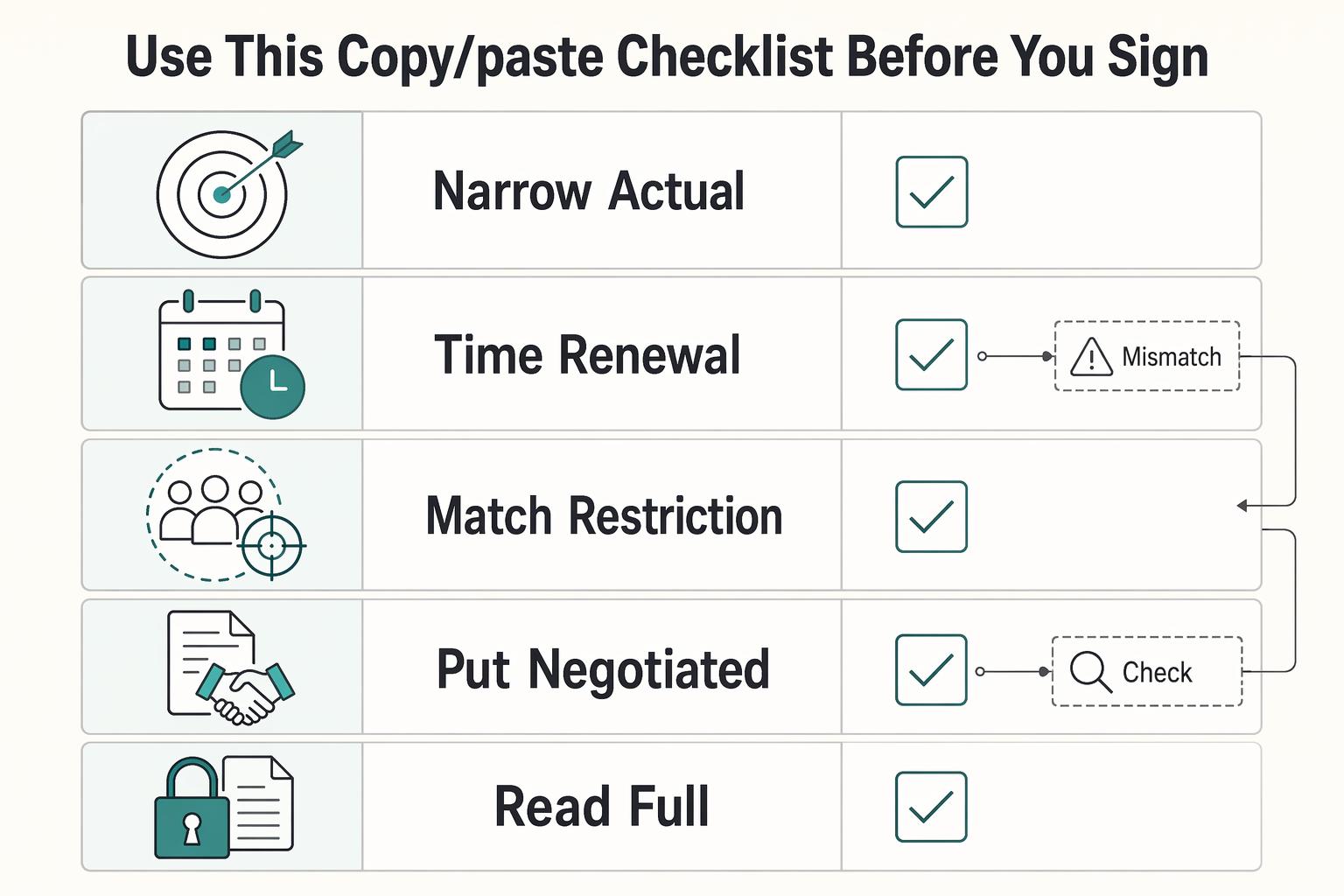
Use this copy/paste checklist before you sign#
Before you sign, confirm that the restriction is narrow, written clearly, and aligned with payment terms. A signed contract creates binding obligations, so unclear language is risk you can still fix now.
- Narrow the actual restriction.
Verify the Scope of services, Geographic scope, and Customer segment restriction are concrete and specific. Replace vague wording with clear tasks, deliverables, and objectives. If the draft uses a defined term like Territory, make sure it precisely states the geography or customer segment.
- Check time and renewal mechanics.
Read the Term and renewal clause line by line for start date, end date, renewal terms, and end-of-term behavior, including auto-renewal. If you cannot tell when exclusivity ends, do not sign yet.
- Match restriction breadth to compensation and payment mechanics.
If exclusivity is meaningful, make sure compensation terms are explicit in writing. Also confirm invoice timing and payment due dates, and scan for hidden charges.
- Put negotiated carve-outs in writing.
If you negotiated carve-outs, for example existing clients, portfolio use, or subcontracting, make sure they are explicit in the contract text. If a carve-out is only discussed verbally or in loose email language, it is still exposed.
- Read the full contract as one system.
Flag unclear or conflicting language and get it clarified in writing before signing.
- Ensure negotiated edits are in the final signature set.
Use revised contract text or an updated attached schedule for scope or exclusion changes. Before signing, compare the final redline to the signature version and confirm every negotiated item is present.
If any check fails, treat it as open risk and pause until the text is fixed.
If your final clause depends on cross-border payment timing and compliance gates, confirm your implementation path with Gruv.
Frequently Asked Questions
What is an exclusivity clause in a freelance agreement?
An exclusivity clause is a contract restriction on who you can work with outside that client relationship. It can block work with named competitors or broadly defined competing companies during the agreement. If the scope does not clearly define the work, companies, or market, it can become too broad to price or manage safely.
Should freelancers accept exclusivity clauses at all?
Sometimes, but usually only when the restriction is narrow, time-limited, and paid for. The main risk is income concentration because full exclusivity can leave one client controlling your entire income. If the scope stays broad and compensation stays weak, decline it or move to a non-exclusive setup with priority service.
What should be included in a fair exclusivity clause?
Define the restricted work clearly and tie it to the deliverables the client is paying for. State who is off-limits, when the restriction starts and ends, what happens at termination, and how exclusivity is compensated. If there are multiple deliverables, keep payment terms clear and itemized.
How long should a freelance exclusivity term last?
There is no universal correct term length. Use a clear, limited term and end exclusivity at completion or termination unless you are paid to remain restricted after that. Post-termination exclusivity without ongoing compensation is a red flag.
Can exclusivity apply only to named competitors or one industry vertical?
Yes. Named-competitor language usually creates a clearer boundary than broad wording like 'could potentially compete.' If the restriction is based on an industry vertical, define that vertical precisely in the contract text.
Do exclusivity clauses require a retainer or guaranteed minimum spend?
Not as a universal legal rule. But if the restriction is meaningful, ask for clear extra compensation, such as a premium rate or another defined compensation mechanism. Pressure-test the economics against the opportunity cost.
How do Governing Law, Jurisdiction, and Dispute Resolution affect cross-border enforceability?
This guide does not support a country-specific enforceability outcome for these clauses. In cross-border deals, keep Governing Law, Jurisdiction, and Dispute Resolution aligned in one clear path. Get local counsel review before signing a high-value exclusive contract.
Researched and edited by the Gruv editorial team. Gruv builds cross-border billing, payouts, and finance-operations software for global businesses.
Sources
- courts.wa.gov/content/petitions/101304-3%20Petition%20for%...trusted
- das.nebraska.gov/materiel/purchasing/5749/5749%20Z1%20Firespr...trusted
- digitalcommons.unl.edu/cgi/viewcontent.cgitrusted
- digitalcommons.unl.edu/cgi/viewcontent.cgitrusted
- dol.gov/sites/dolgov/files/WHD/flsa/IC_NPRM_092220.pdftrusted
- federalregister.gov/documents/2021/01/07/2020-29274/independent-...trusted
- federalregister.gov/documents/2020/09/25/2020-21018/independent-...trusted
- govinfo.gov/content/pkg/CFR-2023-title16-vol1/html/CFR-2...trusted
Educational content only. Not legal, tax, or financial advice.
Related Posts

Germany Freelance Visa Application Path for Freiberufler and Gewerbe
Choose your track before you collect documents. That first decision determines what your file needs to prove and which label should appear everywhere: `Freiberufler` for liberal-profession services, or `Selbständiger/Gewerbetreibender` for business and trade activity.

Non-Solicitation vs Non-Compete for Freelancers and Consultants
Choose the narrowest restrictive covenant that protects a real risk and still lets you keep earning. For freelancers and consultants with multiple engagements, broad restrictions can cut off pipeline long before any dispute starts.
Best Nomad Cities for Women Planning a Long Stay
Treat this as a safety-first relocation guide, not a popularity contest. If you are looking for the best nomad cities for women, use rankings and roundup posts as an opening filter. The real work starts when you test each option against paperwork, housing, and how safe your everyday routine is likely to feel.