
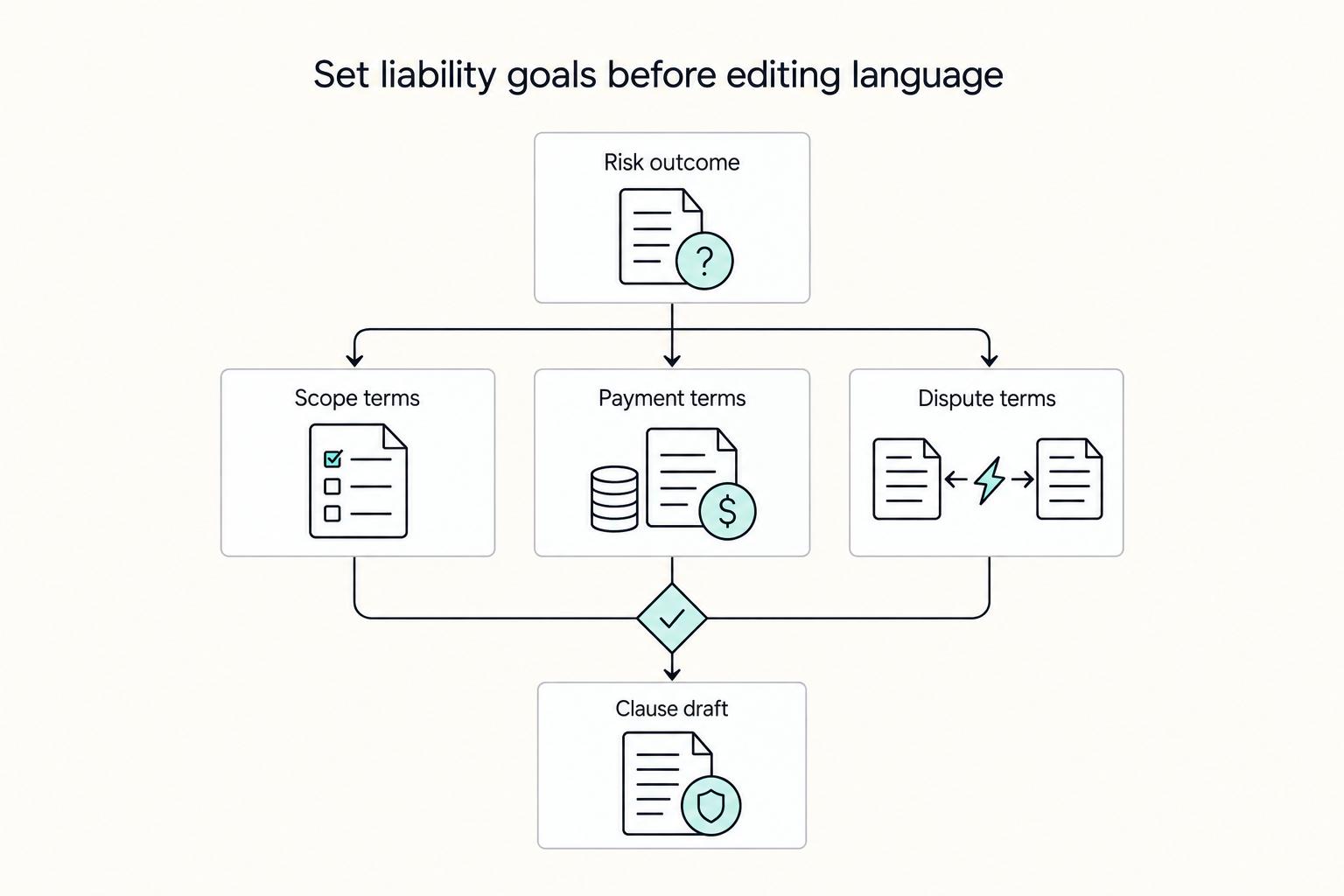
Quick Answer
Define the cap’s fee base, time anchor and aggregate scope; state the damages excluded and the precise effect of each exception. Preserve payment obligations and liabilities the law does not allow you to limit. Test the result with a realistic claim and align it with indemnity, scope, termination and dispute terms before signing.
Start here if you want protection without killing the deal#
A strong limitation-of-liability clause should first put a clear ceiling on your downside without making the deal unworkable for either side. A practical starting point is a liability cap tied to the project fee instead of open-ended exposure.
Step 1 Set the goal before you touch the wording#
Start with the risk outcome, not the template language. You want both sides to understand how risk is allocated if something goes wrong. Before you edit the clause, read it next to the scope, payment terms, and dispute-resolution language. If the agreement is vague about what was promised or how payment works, a polished liability paragraph may not fix that later.
Step 2 Keep the scope practical and honest#
These drafting choices are for a negotiated business-to-business services agreement. The governing law can prohibit or constrain a limitation even when both parties signed it; consumer work and regulated activities need a different review.
Treat this as a clause audit, not a copy-paste exercise. A short checkpoint review usually works well. Confirm the contract clearly addresses both the liability cap and dispute resolution, then make sure those terms do not conflict with the rest of the draft.
Step 3 Know what you should leave with#
Leave the drafting process with four defined choices: the cap calculation, the recoverable losses, exceptions to either limit, and a usable claim procedure. The examples below show how each choice changes exposure.
Use this quick verification test:
- What is the cap based on?
- Which claims or damages are excluded?
- Which obligations, if any, sit outside the cap?
If you cannot answer those questions in plain English from the draft, pause before signing.
Gather your inputs before you draft#
Start with the contract set you actually have, not an isolated clause. That keeps you focused on real risk instead of guessed risk.
Step 1 Pull the current contract set#
Review the latest services agreement, scope or statement of work, payment schedule and termination terms together. A filed agreement from another business can illustrate structure, but it does not establish the right terms for your engagement.
First, make sure you are editing the live version. Check whether a newer draft supersedes or fully restates an earlier one, and review file dates and redline history. A clean clause in an outdated draft still leaves you exposed.
Step 2 List exposure by deliverable#
Map risk to deliverables, not broad labels. Tie each potential loss or breach scenario to the specific work item involved. If you cannot connect a risk to a deliverable, do not draft around it yet. Clarify the risk first.
Step 3 Mark overlap with related clauses#
Before you draft the cap, flag overlap with related clauses, including indemnification, confidentiality, and dispute-resolution language where those sections exist. This is where expectation gaps often start. Different sections may describe related conduct in different ways, and that mismatch can drive disputes.
Step 4 Write your downside in one sentence#
State your worst-case exposure in one plain sentence before you draft. Use that sentence as a checkpoint, not a legal standard. If you cannot explain the downside clearly, pause and define the risk first. Then draft the clause to cap the damages one party can claim from the other.
Set your Liability Cap using project type and exposure#
A fee-based cap is a negotiation starting point, not a rule that project fees are always an adequate or enforceable limit. Compare the price with likely replacement costs, reliance on your work and liabilities the law does not allow you to exclude.
Step 1 Classify the deal before picking the cap#
Start with the project model, not an abstract idea of what is "reasonable."
| Project model | Starting cap logic | When to move above contract fees | Possible review point |
|---|---|---|---|
| One-off project | Cap at total paid or payable under the contract | If the outputs are higher-stakes and both sides agree fee-only is too low, use a bounded fixed-dollar cap | Material scope change before delivery |
| Retainer | Cap tied to fees paid or payable under the retainer term or current statement of work | If work expands into higher-risk advisory or operational support, use a higher fixed cap or category-specific cap | Renewal or major scope expansion |
| Multi-phase delivery | Cap tied to fees paid or payable for the phase, or the full contract if phases are tightly linked | If later phases carry more risk, use category-specific caps or a higher phase-specific cap | New phase or major change order |
This keeps the cap anchored to commercial value instead of a generic template.
Step 2 Use fee-based cap as default, then justify any increase#
Define the fee base before choosing the multiple: paid fees, paid or payable fees, one SOW, the full agreement or a specified rolling period. State whether taxes and pass-through expenses count. If the base is only fees already paid, a claim before the first payment can produce a zero cap; decide whether that outcome is intended and legally workable.
Without a cap, claimed losses can exceed the contract value and create outsized personal exposure. If broader exposure is real, do not jump straight to unlimited liability. Keep it bounded with one of these structures:
- cap at total paid or payable fees
- fixed-dollar cap different from contract value
- category-specific caps for different liability buckets
For an illustrative $5,000 SOW with $1,000 paid, a cap of all agreed fees is $5,000; a paid-only cap is $1,000 at that point. If two recoverable ordinary claims are $3,000 and $4,000, a single aggregate $5,000 ceiling limits their combined capped recovery to $5,000, whereas a $5,000 cap per claim could allow $7,000. Exceptions, exclusions and legal limits still apply. A rolling retainer cap also needs an anchor date, such as the event giving rise to the claim, and a rule for related claims; otherwise its value can change with the filing date.
Step 3 Prevent claim labels from expanding exposure#
The clause should say clearly what the cap applies to. If you want the limit to cover claims arising from the services relationship, say that directly and decide whether it includes claims framed as Tort, Negligence, or Strict Liability.
A clean structure is:
- Define what losses remain recoverable.
- Set the maximum amount for those claims.
That is usually clearer than one long sentence trying to capture every theory of liability and every damage category at once.
Step 4 Re-check cap fit when the deal changes#
A cap that fit the original deal can stop fitting once scope or value changes. Renewals, major scope expansions, and new phases are useful checkpoints to compare the current cap against current fees and deliverables.
You do not need to change the cap every time, but you should confirm it still matches the deal before more work goes forward.
Step 5 If you adapt SaaS cap language, rewrite it for services#
SaaS language can assume recurring subscription charges, system availability and a rolling fee window. Replace those concepts with your actual services, SOW fees and delivery responsibilities. Specify whether linked phases share one cap or have genuinely separate limits.
For the claim procedure, define the arbitration venue, rules and cost allocation using the freelance arbitration guide.
Decide which damages to exclude and why#
Once the cap is set, exclusions do the next job: they decide what can be recovered at all. The cap sets the ceiling; exclusions decide which losses are even in play. Without a limitation clause, potential damages can exceed a business's profits or assets.
Separate direct correction or replacement costs from downstream business losses. Lost profit can be a direct loss in some contracts and a consequential loss in others; the label alone does not settle the result. If you intend to exclude a particular loss regardless of classification, name that loss expressly and check whether the governing law permits the exclusion. In Biotronik v Conor, New York’s Court of Appeals treated lost profits under that distribution agreement as general damages despite its consequential-loss exclusion.
| Damage category status | Practical effect |
|---|---|
| Explicitly excluded in the clause | Generally not recoverable under the clause, subject to the rest of the agreement |
| Not excluded in the clause | May still be claimed, subject to the rest of the agreement and the cap |
This clause is commonly negotiated, so clarity matters more than assumptions. Exclusions do not mean no liability. A client can still pursue claims and damage types the contract leaves available, subject to your cap and the rest of the agreement.
Use breadth as a risk decision, not a reflex. Broader exclusions reduce exposure. Narrower exclusions can be easier to negotiate in some deals. If you hit resistance, keep a clear baseline and consider narrow, case-by-case exceptions tied to a concrete scenario.
Before you sign, test one realistic dispute and confirm:
- What amount could still be claimed.
- Which listed categories would be excluded.
- Whether that result matches your risk tolerance for the deal.
A consequential-damages exclusion should explain what happens to downstream losses without obscuring the direct remedies that remain available.
Define negotiated exceptions and preserve mandatory liabilities#
Carve-outs should be narrow, named exceptions that work with the rest of the agreement. When they are vague, they can override the cap by accident.
Step 1. Name carve-outs and state their exact effect#
First separate liabilities the law forbids you to limit from commercial exceptions you can negotiate. Fraud, intentional injury or gross negligence can face public-policy restrictions, depending on the jurisdiction. Do not describe every exception as optional simply because the contract has a carve-out heading.
For each carve-out, define three things in one place:
- The trigger.
- The liability treatment, whether uncapped, differently capped, or under the general cap.
- Whether damages exclusions still apply.
That avoids clauses that sound strong but leave open whether the carve-out overrides only the cap or also overrides exclusions such as Indirect Damages and Consequential Damages.
Step 2. Align carve-outs with indemnity and confidentiality#
If your indemnity covers third-party IP claims, state whether defense costs, settlement payments and judgments count toward the general cap or a separate cap. A duty to defend can create costs before liability is decided. Align written notice, defense control, cooperation and settlement consent with the agreed limits.
Do the same for Confidentiality Obligation terms. If confidentiality has a separate cap, write that clearly. If it stays under the general cap, write that clearly too.
Category-specific caps can be a clean compromise. Keep the general cap tied to amounts paid or payable under the contract, then apply different treatment only where there is a defined risk, such as a narrow confidentiality or IP issue.
For example, UCTA sections 2 and 11 in England, Wales and Northern Ireland prohibit limiting death or personal injury caused by negligence and subject other negligence limits to reasonableness where applicable. The Consumer Rights Act deals separately with consumer services: section 57 prevents specified statutory service protections from being excluded or limited below the contract price. Do not apply its consumer rules to every B2B engagement.
Step 3. Decide where warranty and IP claims sit#
There is no universal rule that Breach of Warranty or IP claims must sit inside or outside the cap. Make a commercial choice, then draft it clearly.
| Category | Treatment bucket | Drafting note |
|---|---|---|
| Gross negligence | Check mandatory law before a negotiated exception | In New York, Goldstein v Carnell discusses public-policy limits on insulating grossly negligent conduct; ordinary negligence is distinct. |
| Fraud or willful misconduct | Mandatory limits can override the draft | California Civil Code1668 bars contractual exemption for one’s own fraud, willful injury or violation of law; do not assume a cap solves every case. |
| Ordinary negligence | General cap if the draft and law allow | Name its treatment explicitly; reasonableness or other legal constraints may apply. |
| Breach of Warranty | Case by case | No universal inside/outside-cap rule |
| Specific IP infringement tied to your deliverables | Case by case | Consider a separate cap or narrow carve-out |
| Confidentiality breach | Case by case | Can be handled with a higher cap instead of fully uncapped liability |
| Broad contractual indemnity | Case by case | Condition carefully so it does not bypass the cap |
Avoid broad language like "any IP breach is uncapped." Define the exact breach and scope so you do not expand risk more than intended.
Step 4. Pressure-test the wording before signature#
Before you sign, run one realistic scenario, such as confidentiality, IP, or warranty, and confirm you can answer two questions in two sentences:
- Which clause governs.
- Whether the claim is capped.
Then make sure your records support the clause in practice: acceptance records, written change orders, invoices, payment history, and retained documents that show fee base, scope, and acceptance.
If a buyer requests a $1 million insurance-linked cap on a $5,000 engagement, compare that proposed exposure with your actual policy. A certificate showing a $1 million limit does not prove this claim is covered or that the full limit remains available. Check the deductible, exclusions, claim/notice conditions and whether defense costs erode the limit. Agree the contract cap independently, then check cover for the obligations you accept.
Related reading: What is a 'Force Majeure' Clause and Do You Need One?.
Align liability terms with scope, payment, and Termination#
A liability cap is easier to apply when it uses the same commercial terms as scope and payment. If those sections use different definitions, the contract gets harder to apply when something goes wrong.
Step 1 Match the cap to the payment definition#
Use the payment language your agreement already relies on, then carry that same defined label into the Liability Cap. If invoices and payment terms use a defined label such as "Fees" or milestone payments, use that same label in the cap. Do not introduce new undefined terms.
Quick check before signature:
- Payment clause
- Invoice wording
- Liability Cap wording
If those three do not describe the same commercial base, align them.
Step 2 Confirm scope and acceptance as you finalize liability wording#
The Scope of Work defines what you were hired to do, so keep scope and acceptance criteria clear as you finalize liability language. Unclear terms can create confusion and make later disputes harder to resolve.
This matters in milestone projects too. If deliverables or acceptance are vague, small disagreements can grow into larger liability disputes.
Step 3 Pressure-test the termination scenario#
If Termination can happen before full completion, check whether scope, payment, and cap wording still fit together after the contract ends. The practical goal is consistency: the contract language and your records should tell the same story.
Use a simple file check: signed scope, approved changes, invoices, payment history, and the termination notice.
Step 4 Keep survival language explicit#
When you draft post-termination survival, name the surviving clauses instead of relying on implication. Confirm that survival wording still reads consistently with the liability terms.
Final check: after termination, can you point to each surviving obligation by clause name without guessing?
Lock Governing Law, Jurisdiction, and Dispute Resolution early#
These terms need to be usable in real life, not just present on paper. A strong Limitation of Liability Clause loses value quickly if the chosen law, forum, or process is too impractical to use.
| Item | What to confirm | Note |
|---|---|---|
| Governing Law and Jurisdiction | Choose them so you can clearly explain where a dispute would go and why that forum works for both sides | Do not leave them as boilerplate |
| Notice before filing | Whether notice is required before filing | Part of the Dispute Resolution sequence |
| Business-negotiation step | Whether there is a business-negotiation step and who joins it | Make escalation predictable |
| Next forum | What forum comes next if that step fails | Name the venue and the Dispute Resolution sequence together |
| Mandatory legal limits | Check statutes and decisions for the actual law and contract type | Use primary legal material; unrelated contractor-classification rules do not establish liability-cap enforceability. |
| Client-proposed jurisdiction | Confirm the named forum and whether it is exclusive | If the practical impact is unclear, pause and escalate to counsel before signing |
Step 1 Choose a forum you could realistically use#
Do not leave Governing Law and Jurisdiction as boilerplate. Choose them so you can clearly explain where a dispute would go and why that forum works for both sides. If you cannot do that, the clause is not finished.
Step 2 Pair venue with a clear escalation path#
Name the venue and the Dispute Resolution sequence together so escalation is predictable. At minimum, make these points explicit:
- Whether notice is required before filing
- Whether there is a business-negotiation step and who joins it
- What forum comes next if that step fails
Step 3 Verify legal text before relying on it#
Check the legal rule that actually affects the draft. For example, the New York Goldstein decision distinguishes ordinary from gross negligence in an inspection dispute; California Civil Code1668 identifies prohibited exemptions. These are jurisdiction-specific illustrations, not permission to use one clause worldwide. Keep the signed draft, redlines and the applicable primary text.
Step 4 Treat jurisdiction-specific requests as a counsel flag#
If a client proposes a specific jurisdiction, do not treat that as automatic. Confirm the named forum and whether it is exclusive. If the practical impact is unclear, pause and escalate to counsel before signing.
Choose clause language for the risk and bargaining position#
Choose a starting version that matches the delivery risk and bargaining position. A unilateral freelancer cap and a mutual cap allocate risk differently; describe that difference honestly before sending the redline.
Once the core terms are workable, this becomes a negotiation choice. The version that gets signed should reflect the project's risk profile and keep exposure clear.
Step 1 Classify the deal before you pick language#
Start with four filters: client size, procurement rigidity, project criticality, and replacement cost of your services.
Use those filters to frame the pushback you are likely to get and the downside if the project fails. If the work is high impact or hard to replace, you may need tighter limits. If procurement is rigid, expect pressure for broader exposure and decide your tradeoffs before redlines start.
Step 2 Choose a starting version, not a final position#
These are original illustrative clauses for negotiated B2B services, not official model clauses or guaranteed protections. Each preserves payment obligations and non-limitable liability. Define Fees in the payment schedule and review any exceptions elsewhere; the wording below assumes no additional commercial carve-outs. If you add a separate indemnity or confidentiality cap, say whether it replaces the general cap for that category or stacks on top of it.
| Version | Sample starting language to adapt | Might fit when |
|---|---|---|
| Broader fee base, freelancer cap | “Subject to the exceptions below, Freelancer’s total aggregate liability for all claims arising from this Agreement, whether in contract, negligence or another legal theory, shall not exceed the total Fees paid or payable under this Agreement. Neither party shall be liable to the other for indirect or consequential losses. These limits do not restrict agreed payment obligations or liability that the applicable law does not permit the parties to limit.” | A total-contract fee base can exceed paid-only or single-deliverable limits. The cap protects the freelancer; it is not mutual. |
| Mutual cap with defined SOW base | “Subject to the exceptions below, each party’s total aggregate liability for all claims arising from a Statement of Work, whether in contract, negligence or another legal theory, shall not exceed the total Fees paid or payable under that Statement of Work. Neither party shall be liable to the other for indirect or consequential losses. These limits do not restrict agreed payment obligations or liability that the applicable law does not permit the parties to limit.” | A separate ceiling per SOW means claims under several SOWs may exceed any one SOW’s fee value; define related and cross-SOW claims. |
| Paid-only freelancer cap | “Subject to the exceptions below, Freelancer’s total aggregate liability for all claims arising from a Statement of Work, whether in contract, negligence or another legal theory, shall not exceed the Fees actually paid under that Statement of Work as of the event giving rise to the claim. Freelancer shall not be liable to Client for indirect or consequential losses. These limits do not restrict agreed payment obligations or liability that the applicable law does not permit the parties to limit.” | A smaller paid-only base favors the freelancer but can be zero before payment. Check enforceability and consider an agreed floor. This cap and exclusion are one-sided. |
The indirect/consequential exclusion in these examples does not automatically exclude all lost profit, data loss or replacement work. Decide which direct remedies should survive and which named losses, if any, to exclude separately. Payment terms can be another commercial lever: propose an advance or 14–30-day terms instead of 60–90 days, but faster payment does not itself make an excessive liability promise affordable.
Step 3 Run the comparison check before you send redlines#
Before you send any version, confirm the clause sets a clear cap and does not leave uncapped one-sided liability by accident.
Check these three points:
- Does the clause clearly state the maximum liability cap?
- Is either party left with uncapped liability exposure?
- Are scope and acceptance criteria clear enough to reduce avoidable disputes, delays, and costs?
Final checkpoint: read the liability language next to scope and acceptance criteria. If those sections together do not make the post-failure path clear, the draft is not ready.
For a step-by-step walkthrough, see How to Structure a 'Limitation of Liability' Clause when using OpenAI's API in a Client Project.
Handle redlines with scripts that protect value#
Redlines should protect the economics, not just the words. Your job is to keep exposure bounded, keep indemnity aligned with the cap, and stop vague additions from quietly expanding risk.
Step 1 Ask for the claim scenario before accepting broad asks#
When a client proposes broader liability language, ask what claim scenario they are trying to cover before you negotiate wording. That quickly shows whether the concern is a third-party claim that belongs in the Indemnification Clause or another risk that should be handled elsewhere in the contract.
Use a script like: "I understand the concern. Can you walk me through the claim scenario you want this to address? If this is a specific third-party risk, let's handle it with a clear indemnity procedure. For the rest, I need a defined cap and clear scope."
Before you accept edits, make sure you can point to the exact sentence creating each obligation. If language adds attorneys' fees, settlements, judgments, or a duty to defend without written notice, defense control, and settlement consent, downside can grow quickly.
Step 2 Treat deletion of the Limitation of Liability Clause as a commercial reset#
If the client deletes the Limitation of Liability Clause, do not leave silence in its place. An uncapped position changes risk allocation and should trigger a commercial recheck.
Use a script like: "I can't accept an uncapped position on this scope and fee level. If the cap is removed, we should revisit pricing, scope, or risk allocation."
Then recheck scope and survival language. If indemnity sits outside the cap, the risk is higher.
Step 3 Ask for reciprocity when claim categories can run both ways#
If claim categories could be brought by either side, ask for mutual treatment unless both parties agree on a specific carve-out.
Use a script like: "If these claim types can be asserted by either party, liability allocation should be mutual unless we both agree on a specific carve-out."
Classify the redline as ACCEPT, NARROW, or REJECT based on scope, procedure control, and cap alignment. If a term is one-sided, procedurally loose, and outside the cap, narrow it or reject it.
Common drafting mistakes and how to recover fast#
Bad outcomes often come from clauses that do not fit together, not just the headline cap number. Before signing, run a short check on carve-outs, indemnity conflicts, dispute terms, and copied language that does not fit services work.
| Drafting issue | Fast fix | Quick check |
|---|---|---|
| Vague carve-outs | Use tight, named triggers instead of open phrases | Could a routine delivery dispute be relabeled as a carve-out? |
| Indemnification conflicts | Fix ambiguity if one section excludes losses that another section appears to require | Run one claim scenario through both clauses |
| Unclear dispute terms | Review Governing Law, Jurisdiction, and Dispute Resolution as one package | State where a claim would be brought, what law applies, and what process would be used |
| Copied template language | Rebase the clause to your statement of work, deliverables, acceptance points, payment terms, and termination language | Make sure the cap points to the same fee base used elsewhere in the agreement |
Step 1 Narrow carve-outs before they swallow the cap#
Vague carve-outs can gut the cap. When you carve out Gross Negligence or Willful Misconduct, use tight, named triggers instead of open phrases.
List only the exceptions you need. Confidentiality or third-party IP indemnity can have a higher bounded cap, while legally non-limitable liabilities must remain available. If a $10,000 category cap replaces a $5,000 general cap for that category, say so; if separate claims can use both buckets, the combined exposure can be $15,000. Do not call the higher bucket a universal overall ceiling.
Quick test: could a routine delivery dispute be relabeled as a carve-out? If the answer is yes, narrow it. Keep the cap applying across contract, warranty, tort, and strict liability theories, then state only the exceptions you actually agreed.
Step 2 Resolve conflicts with the Indemnification Clause#
Conflicts between damages limits and the Indemnification Clause can create dispute risk. If one section excludes losses that another section appears to require, fix that ambiguity before signing.
Because indemnity obligations are often handled as explicit carve-outs, check that your indemnity language and limitation language still point to the same intended scope.
Then run one claim scenario through both clauses. If you still cannot tell quickly whether that claim is inside or outside the cap, the drafting is too loose.
Step 3 Recheck Governing Law, Jurisdiction, and Dispute Resolution together#
A liability cap can still be hard to rely on if dispute terms are unclear. Review Governing Law, Jurisdiction, and Dispute Resolution as one package, especially in cross-border freelance contracts.
Your check is practical. State in one sentence where a claim would be brought, what law applies, and what process would be used. If that answer is unclear, fix the procedure language before relying on the cap.
A clear clause can still fail a mandatory-law or public-policy test. Identify whether the client contracts as a business or consumer and where the services and claim are connected; choosing a governing law does not automatically remove mandatory protections elsewhere.
Step 4 Rebase copied template language to your services scope#
Copy-pasted limitation language is risky when it comes from a different deal type. These clauses appear across many contract types, so template fit matters in freelance services work.
Rebase the clause to your actual service documents: statement of work, deliverables, acceptance points, payment terms, and termination language. Make sure the cap points to the same fee base used elsewhere in the agreement.
Before signature, calculate the maximum recoverable exposure under each category and identify any uncapped obligations. Check the indemnity procedure alongside those limits so defense costs and settlements follow the same allocation.
Copy-paste pre-sign checklist#
Before signing, make sure the cap, excluded damages, and carve-outs match the agreement and SOW, not just the limitation clause in isolation.
Step 1 Tie the cap to a defined fee base#
Match the Liability Cap to the defined payment terms in the base agreement and SOW.
- Use a fee base already defined in the contract, such as total consultant compensation value.
- If the clause uses a formula, such as the greater of compensation value or recoverable insurance, confirm both terms are defined in the signed documents.
- Quick test: you should be able to calculate the cap from the contract without guessing what counts as "fees."
Step 2 Check excluded damages line by line#
Treat Indirect Damages and Consequential Damages as negotiated terms, not boilerplate.
- Confirm both parties understand whether categories like lost profits or revenues, loss or interruption of use, and lost or damaged data are excluded.
- Run one concrete scenario and confirm both sides reach the same answer on recoverable damages.
- If answers differ, resolve the exclusions before signing.
Step 3 Reconcile carve-outs across the whole contract#
Carve-outs only work when the cap, indemnity, and confidentiality language stay consistent.
- Compare the cap section with the Indemnification Clause and Confidentiality Obligation.
- Verify carve-outs for Gross Negligence and Willful Misconduct are explicit and aligned with related clauses.
- Test one third-party claim through both sections to catch opposite outcomes.
Step 4 Confirm the agreement and SOW are aligned#
Read the core contract terms together before signature so expectations do not conflict.
- Check that scope, timing, payment mechanics, and responsibilities are consistent between the base agreement and SOW.
- If the SOW is vague or the base agreement is missing core protections, fix that before relying on limitation language.
- If you cannot explain how one scenario is handled from start to finish, pause and resolve the mismatch.
Use the Freelance Contract Generator as a drafting aid, then review the actual fee definitions, exceptions and governing-law requirements. A generated draft does not validate enforceability.
The takeaway to use in your next contract#
Treat liability terms as a business risk and pricing decision, not a template task. The goal is a Limitation of Liability Clause that matches the fee, scope, and dispute path so both sides can sign with clear exposure boundaries.
Step 1 Price the downside before editing wording#
Start with the loss you can absorb and the legal limits that apply. Some liabilities cannot be excluded even by a signed agreement; other cap and exclusion choices are commercial terms to negotiate.
Then tie the cap to a clearly defined fee base in the contract. If the work sits under an MSA plus a Statement of Work, say whether the cap applies across the full agreement or only the relevant SOW. If you use a formula like 150% of charges paid or payable in the prior 12 months, also say whether it is a single aggregate cap across claims. That changes the real exposure.
Step 2 Align the cap with clauses that can expand exposure#
A reasonable cap can fail if surrounding clauses are broader or inconsistent. Read the Limitation of Liability Clause together with related risk-allocation terms, then test a realistic breach scenario end to end. What is capped, what is excluded, and what survives termination?
For example, after a missed milestone and termination, a client might claim replacement work plus downstream losses. Check that the cap uses the agreed surviving fee base and that the exclusion addresses each loss correctly. Termination does not automatically erase the cap or every payment obligation.
Step 3 Verify the enforcement path before signature#
The clause only helps if the enforcement path is usable. Read Governing Law, Jurisdiction, and Dispute Resolution together and ask: if the likely claim size happened tomorrow, would you actually use this path?
Use this pre-sign check each time:
- Confirm the Liability Cap uses the same fee definition used in payment terms, invoices, and any Statement of Work.
- Confirm the contract states whether the cap is a single aggregate cap or a separate-cap structure.
- Confirm the Limitation of Liability language and related risk-allocation terms work together without conflict.
- Confirm whether the limits are mutual or one-sided, keep payment obligations available, and preserve liabilities that law does not permit you to limit.
If a client pushes back, ask which loss scenario they want covered, then counter with a bounded number, a narrower carve-out, or clearer wording. Final test: can a neutral reader find the cap, exceptions, and enforcement route in a few minutes? If not, tighten the draft before signing.
Related: A Deep Dive into the 'Limitation of Liability' Clause for Freelance Software Developers.
Once your risk language is set, align how you invoice and get paid cross-border with Merchant of Record for freelancers.
Frequently Asked Questions
What is a Limitation of Liability Clause in a freelance contract, in plain English?
A limitation of liability clause sets a boundary on what one side may owe the other if something goes wrong. It is often drafted as a monetary cap, exclusions for specific damage types, or both. A quick check is whether the clause clearly states the cap amount or formula and the excluded damage categories.
What should freelancers include first: the Liability Cap or the damages exclusions?
There is no single required drafting order here. Start with whichever point is easier to price and explain, then finalize the cap and exclusions together so the risk allocation holds together. Even a reasonable cap can be undermined by vague exclusions, which can create ambiguity and disputes.
What carve-outs should not be capped in most service contracts?
There is no worldwide list. Some liabilities cannot be limited under the applicable law; negotiated confidentiality or IP exceptions are a separate choice. For each exception, state whether it changes the cap, the damages exclusion or both, and whether it uses a replacement category cap or adds another bucket. Preserve legally mandatory liability even if it is not expressly named.
Can a client require liability above project fees, and how should you respond?
A client can ask because limitation terms are commonly negotiated. Ask what scenario they are trying to cover, then counter with a bounded number, narrower damage categories, or tighter carve-out wording instead of open-ended exposure. If they will not move, decide whether to reprice, narrow scope, or walk away.
What is the difference between a Limitation of Liability Clause and an Indemnification Clause?
A limitation clause restricts the amount or types of recovery. An indemnity creates a defined obligation to cover specified losses or claims, often a third-party claim, and can include defense costs or settlement duties. An indemnity does not automatically limit your exposure: state its procedure and whether its costs sit inside the general cap, a separate cap or an uncapped exception.
Are one-sided limitation clauses usually enforceable between sophisticated parties?
A one-sided clause is not automatically invalid or enforceable. Clear agreement, bargaining context, contract type and applicable law matter. New York’s Goldstein decision illustrates a permitted ordinary-negligence limit with a gross-negligence boundary; UK reasonableness and consumer rules can impose different constraints. Reciprocity is a negotiation goal rather than proof of legal validity.
How should cross-border freelancers choose Governing Law, Jurisdiction, and Dispute Resolution?
Select the substantive law, court or arbitration forum, and procedure separately. Compare likely claim value with filing, representation, travel and enforcement costs. State valid notice and negotiation deadlines, preserve legal filing deadlines, and check whether a judgment or award can be enforced where assets are held. A convenient forum on paper may be unusable for a small cross-border claim.
Researched and edited by the Gruv editorial team. Gruv builds cross-border billing, payouts, and finance-operations software for global businesses.
Sources
Educational content only. Not legal, tax, or financial advice.
Related Posts

Limitation of Liability Clause for Freelance Software Developers
A liability clause sets which losses can be recovered and how much can be claimed. For a freelance developer, the useful starting point is the project risk: a failed acceptance test, an IP complaint, a data incident, or an unpaid invoice. Agree which risks the contract covers before choosing a cap number.

The Freelance Payment Penalty: A Modeled Audit of Platform Fees, FX Spreads, and Payout Delays
The money rarely disappears through a single, easy-to-spot fee. The real loss is stacked. A marketplace takes its commission, a processor adds a charge for international cards, a bank or payment company converts the currency at a spread, a platform holds the funds before release, and a wire sheds a little to intermediaries on the way in. Each layer looks defensible on its own, but the worker feels the combined result as a smaller deposit and a later payday.

How to Respond to a Subpoena for Business Records
Move fast, but do not produce records on instinct. If you need to **respond to a subpoena for business records**, your immediate job is to control deadlines, preserve records, and make any later production defensible.