
Quick Answer
Negotiate the assignment clause as an operating control point, not boilerplate. Define that the client receives rights in final accepted deliverables after payment, while you retain background IP and a narrow right to show finished public work in your portfolio. Keep agreement transfer and duty delegation subject to consent, and state when novation is required for full replacement. Before signing, confirm the executed version matches approved redlines and that SOW and payment terms do not conflict.
The assignment clause is often treated like a block of legalese to skim and accept. That is a mistake. For most independent professionals, it is one of the clearest control points in the contract.
If you understand this clause, it stops being just a defensive concern and starts doing real work for you. It protects your assets, gives you room to scale, and makes it easier to preserve business value later. In practice, it often marks the difference between taking one-off work and building something durable.
Pillar 1: The Asset Shield - Fortifying Your IP and Autonomy#
In a freelance contract's assignment clause, negotiate three protections up front. Keep limited portfolio-use rights, prevent duty transfers without your consent, and carve out your pre-existing IP. Those three moves protect your ability to market your work, keep control of reusable assets, and avoid getting pushed into a new counterparty relationship you never priced.
Use these terms precisely in redlines, especially in MSA plus SOW structures:
- Final deliverable IP: the final accepted deliverables defined in the contract.
- Background IP: pre-existing code, templates, methods, processes, and tools you bring to the work.
- Assignment: transfer of rights or benefits.
- License: permission to use IP while ownership stays with the owner.
- Delegation of duties: another party performs obligations, but the original party is typically not automatically released from liability.
- Confirm local rule before signing: assignment and license formalities can vary by jurisdiction.
| Issue | Client-default assignment wording | Freelancer-protective wording |
|---|---|---|
| Portfolio use | "Contractor assigns all right, title, and interest in the work product to Client." | "Upon payment, Contractor assigns rights in Final Deliverables to Client, with a non-exclusive right to display finished public work for portfolio and self-promotional use, excluding confidential information." |
| Assignment of obligations | "Client may assign this Agreement freely." | "Neither party may assign this Agreement or delegate material duties without prior written consent, except as expressly stated. Any permitted delegate does not by itself release the original party from liability absent a signed novation." |
| Pre-existing materials | "All materials, inventions, know how, and work product created or used in connection with services belong to Client." | "Contractor retains all rights in Background IP and pre-existing materials. Client receives only rights in Final Deliverables and a limited license to embedded Background IP needed to use them." |
1. Keep portfolio rights#
This should be explicit. If you assign everything without a carveout, you may not have clear rights to display the work publicly later. Ownership of a deliverable and permission to showcase it are not the same thing.
Preferred clause intent: client owns final accepted deliverables after payment; you keep a narrow license-back to show finished public work, excluding confidential content. Fallback if resisted: limit use to client name, project description, and approved excerpts after public release. Negotiation script: "You will own the final deliverables. I need a narrow right to show the finished public work in my portfolio, with no confidential material."
2. Block unwanted successor risk#
Depending on the clause and local law, broad assignment language can let the other side move your contract to an affiliate, buyer, or successor without asking you. This often shows up in procurement redlines and change-of-control situations.
Preferred clause intent: no assignment of the agreement and no delegation of material duties without your written consent. Fallback if resisted: require advance notice plus a termination option for change-of-control scenarios that materially change risk. Negotiation script: "I agreed to this entity and team. If the agreement is transferred, I need consent rights or a termination option."
3. Separate rights transfer from duty transfer#
Do not let one sentence do two different jobs. Assignment language can transfer rights and delegate duties unless the contract clearly separates them.
Preferred clause intent: transfer IP rights only for final custom deliverables; keep agreement assignment and performance delegation subject to consent. Fallback if resisted: allow limited administrative delegation, but keep the original party liable unless there is a signed novation. Negotiation script: "I can transfer rights in final deliverables, but contract performance obligations should not move without consent."
4. Carve out background IP#
This is one of the most important protections in the whole clause. Without a clear carveout, broad ownership language can swallow your templates, libraries, methods, and internal tools.
Preferred clause intent: client owns only final custom deliverables; you retain background IP, with a limited license for embedded elements needed to use the deliverable. Fallback if resisted: attach a short schedule listing key pre-existing materials. Negotiation script: "You need ownership of the custom output, not my underlying toolkit. I can license embedded background IP so the deliverable works as intended."
If you want a deeper dive, read Germany Freelance Visa: A Step-by-Step Application Guide.
Pillar 2: The Growth Engine - Enabling Scale and Collaboration#
If you want room to grow, your contract has to support it. The goal is straightforward: preserve your ability to bring in help or change structure without weakening delivery accountability, confidentiality, or client trust.
Subcontracting without losing control#
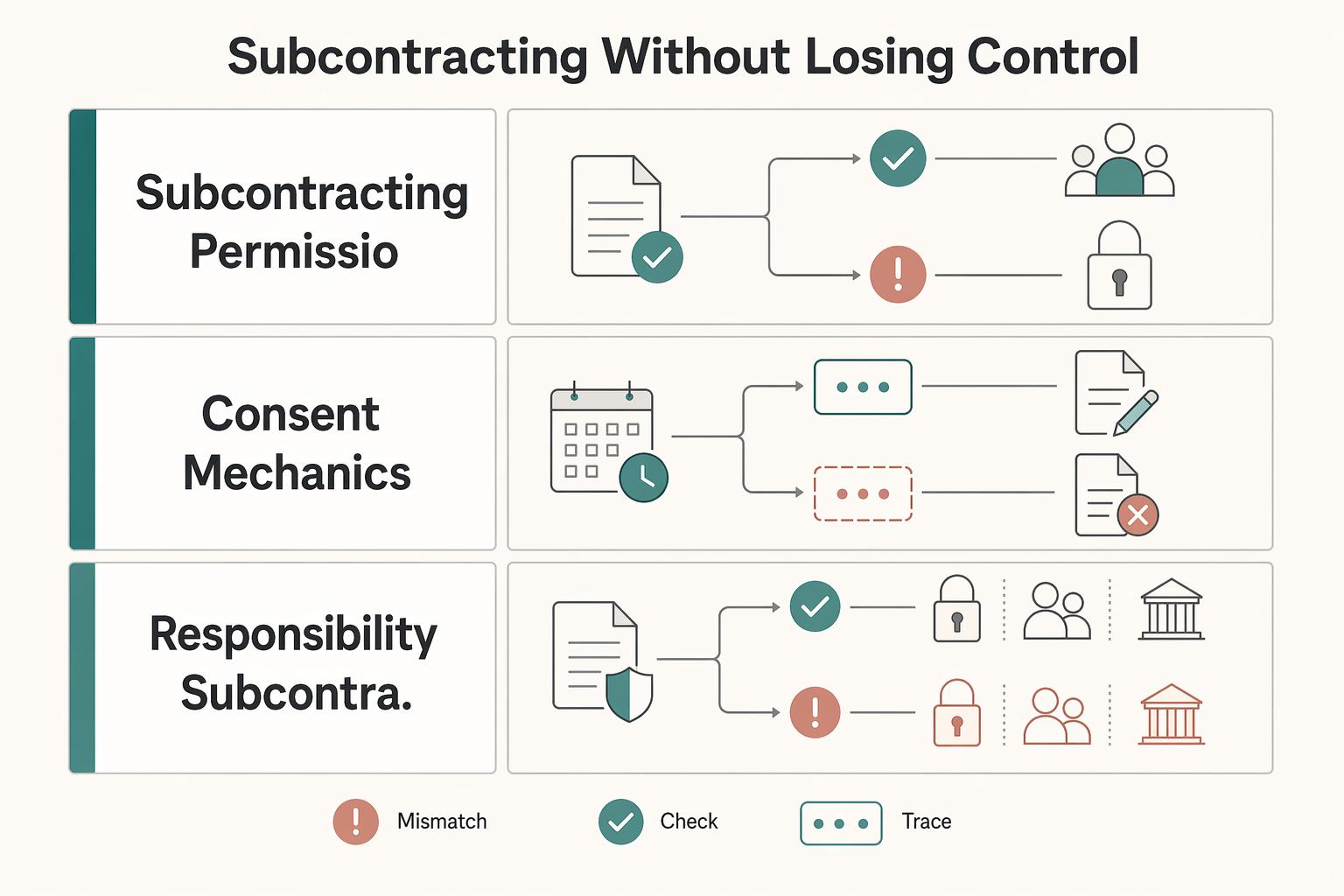
Contract silence creates ambiguity. If you expect to need support, ask for subcontracting terms that let you collaborate while keeping responsibility clearly with you. Use a simple decision flow:
- Define permission in the contract. State whether you may use subcontractors for defined parts of the services and whether written approval is required.
- Keep accountability clear. State that you remain responsible for delivery, timelines, confidentiality, and subcontractor performance.
- Use a defined approval process. Submit a short approval pack with name, role, access level, confidentiality commitment, and your review owner so decisions are traceable.
| Growth term | Example restrictive language | Example scalable language |
|---|---|---|
| Subcontracting permission | "Contractor may not subcontract any services." | "Contractor may use approved subcontractors for portions of the services." |
| Consent mechanics | "Client may approve or reject in its sole discretion." | "Approval must be given or denied in writing under the contract's stated review process." |
| Responsibility for subcontractor performance | Silent or unclear | "Contractor remains responsible for subcontractor work, confidentiality, and compliance with this agreement." |
If a client wants approval rights, ask for written decisions through the stated process and request reasons tied to stated risks, such as confidentiality, conflicts, or compliance.
Permitted assignees and business changes#
Do not treat business changes as a single catch-all scenario. Moving from sole proprietor to your own company, internal restructuring, and a sale or acquisition can create different contract and operational needs.
For each scenario, document the agreed process for notice, consent, or both. After an approved change, confirm the operational record in writing: legal entity name, authorized signatory, invoicing details, and payment instructions.
Pick the collaboration model first#
Choose the collaboration model before you draft assignment language, because that choice shapes what transfer, delegation, and approval terms you may need.
| Model | Client relationship | Description |
|---|---|---|
| Prime contractor | You hold the client relationship | Manage specialists behind the scenes |
| Specialist subcontractor | Another provider holds the client relationship | Your scope is narrower |
| Joint delivery | Responsibilities are explicitly split | Use when scope boundaries, approvals, confidentiality duties, and invoicing responsibilities are explicitly split |
One final verification point matters if you reuse clause wording from public materials. Confirm that the source text is official. FederalRegister.gov states its prototype is not an official legal edition, and its XML text does not provide legal notice or judicial notice. For legal research, verify against an official Federal Register edition and use the linked official PDF on govinfo.gov. For federal regulations, confirm against the CFR, which is presented as official codification and prima facie evidence under 44 U.S.C. 1507 and 44 U.S.C. 1510.
For related clause strategy, see A Guide to Non-Solicitation and Non-Compete Clauses. If you are deciding how to word assignment and subcontracting permissions, draft a clean first version with the Freelance Contract Generator and then tailor it to your deal.
Pillar 3: The Exit Strategy - Securing Your Business's Future Value#
If you want contracts to survive a sale, merger, or internal succession, transfer rights are usually easier to build in before any deal starts. Revenue tied too tightly to you personally is much harder to move.
The practical rule is simple: keep enough subcontracting flexibility to operate, but do not let assignment or personal-services language pull the agreement back into a founder-only commitment.
Build transfer rights into the contract now#
This work is usually easier during drafting than during diligence. When you review transfer terms, check the whole agreement and define the scenarios you actually need. Use this checklist:
| Review point | What to check | Article note |
|---|---|---|
| Related clauses | Assignment or transfer, change-of-control, key-personnel, subcontracting, and personal-services language | Cross-check so the terms do not conflict |
| Transfer scenarios | Assignment to your controlled entity, internal restructuring, merger, asset sale, and successor entity | State the scenarios you actually need |
| Consent mechanics | Written notice, a review contact, and risk-based reasons for refusal | Use reasons such as confidentiality, conflicts, security, or continuity instead of open-ended discretion |
| Personal-performance terms | "Must personally perform" and "personal services/non-assignable" language | Treat as high risk unless it is truly required |
| Liability language | Whether assignment moves rights and whether duties may be delegated unless excluded | Delegation does not automatically release the original party from duty or breach liability |
- Check all related clauses, not just one heading. Start in the assignment or transfer clause, then cross-check change-of-control, key-personnel, subcontracting, and personal-services language so the terms do not conflict.
- State the transfer scenarios you actually need. Cover assignment to your controlled entity, internal restructuring, merger, asset sale, and successor entity.
- Define consent mechanics if consent is required. Use written notice, a review contact, and risk-based reasons for refusal, such as confidentiality, conflicts, security, or continuity, instead of open-ended discretion.
- Avoid unnecessary personal-performance lock-in. Highly personal or rare-skill obligations may be non-assignable, so treat "must personally perform" and "personal services/non-assignable" language as high risk unless it is truly required.
- Keep liability language realistic. Assignment can move rights and often includes duty delegation unless the contract says otherwise, but delegation does not automatically release the original party from duty or breach liability.
A practical drafting standard is to define business continuity first, then limit objections to concrete, documentable risks.
Choose assignment or novation deliberately#
This is a real decision point, not a wording tweak. Use assignment when transferability is the priority. Use novation when you need a clean release.
| Decision point | Assignment | Novation |
|---|---|---|
| Best fit | Internal succession or transfer to a successor while the original contract framework continues | Final replacement where the successor fully takes your place |
| Approval | Depends on contract terms and applicable law; consent may be needed, especially if transfer materially changes duty, burden, or risk | Requires agreement by the original contracting parties |
| What moves | Rights or benefits transfer; duties may be delegated unless excluded | A new obligation replaces the old one |
| Exposure after transfer | Original party may still remain liable if assignee fails | Old obligation is extinguished and replaced |
Under deal pressure, focus on exposure. Assignment may still leave you on the hook. Novation is the cleaner release tool when full substitution is required.
Negotiate continuity, not convenience#
A practical way to frame transfer language is around client continuity, not your future exit plans. That usually makes the request easier to justify.
Use a script like this: "I want this agreement to preserve continuity if my business structure changes or if the practice is acquired. Any successor will remain bound by the same confidentiality, service, and payment terms. If approval is required, let's tie it to objective risk checks and a written review process so service is not disrupted."
Support that with a short approval pack. Include successor entity details, a control or ownership summary, the effective date, the continuity plan, the day-to-day lead, invoicing updates, and confirmation that confidentiality and data-handling duties remain in force.
Run a pre-exit audit before you have a buyer#
A light audit now can prevent avoidable problems later. This is where you find blockers before a buyer, investor, or diligence team does.
| Audit task | What to record | Examples |
|---|---|---|
| Classify active agreements | Mark each agreement as freely assignable, consent required, silent or unclear, or expressly prohibited | Include amendments, SOWs, and procurement terms |
| Flag consent bottlenecks | Watch for terms that can slow or block a transfer | Named-individual performance terms, personal-services language, sole-discretion approvals, and merger or ownership-trigger clauses |
| Route legal review early | Escalate unfamiliar governing law, public-sector clients, or transfers that could materially change burden or risk | For U.S. federal contracts, review FAR Subpart 42.12 and FAR 42.1204 |
- Classify each active agreement. Mark as freely assignable, consent required, silent or unclear, or expressly prohibited; include amendments, SOWs, and procurement terms.
- Flag consent bottlenecks. Watch for named-individual performance terms, personal-services language, sole-discretion approvals, and merger or ownership-trigger clauses.
- Route legal review early where risk is higher. Escalate unfamiliar governing law, public-sector clients, or transfers that could materially change burden or risk. For U.S. federal contracts, review FAR Subpart 42.12 and FAR 42.1204: federal transfer limits apply, recognition of a successor in interest requires a written request to the contracting officer, and the process includes a 30-day objection or comment window.
Bottom line: make your standard contracts transferable where appropriate, and expect some counterparties to require novation or a tailored consent package for a clean exit.
You might also find this useful: When a Severability Clause Helps or Hurts a Freelance Contract.
Your Contract, Your Control#
Treat this clause as a control check, not boilerplate. Before you sign, confirm that the contract clearly states what each side owes. It should also state what work output is being assigned and set clear authority limits on who can make commitments on behalf of the company.
For cross-border work, do not rely on assumptions about ownership. If IP is meant to transfer, the contract should say so explicitly. If you have multiple deliverables, itemize payment terms to match them and tie payment to specific, verifiable triggers so milestone disputes are less likely.
Also protect the process, not just the wording. Get signatures before work starts. Confirm the signed version matches the last approved redline, and make sure the SOW and payment section say the same thing. Many contract problems come from workflow drift, not just clause text, so treat version control and an audit trail as part of your risk control.
Quick decision aid#
- Accept: obligations are clear, IP assignment is explicit, payment triggers are verifiable, authority limits are defined, and the signed copy matches negotiated terms.
- Negotiate: key points are vague or silent, such as assignment scope, payment triggers, authority limits, or terms that conflict across sections.
- Walk away: the final signature copy still leaves material ambiguity or process risk you cannot operate under.
Reviewing the assignment clause this way helps you keep practical control over your work, your client commitments, and your future business options.
For a step-by-step walkthrough, see How to Write a Termination Clause That Protects You.
Before you sign your next agreement, run one final clause-by-clause pass with Gruv's Contract Tools so your assignment terms match how you actually operate.
Frequently Asked Questions
Can a client use the assignment clause to prevent me from subcontracting?
Possibly, but this guide does not provide a definitive legal rule on assignment vs subcontracting. Treat delegation/subcontracting as something that must be stated explicitly in the signed contract, and avoid assumptions based on template language alone. A practical checkpoint is workflow: confirm the legal-approved version is the one actually signed.
How do you assign IP rights but keep portfolio rights?
Keep these points separate in writing. Use an explicit IP assignment clause, especially for cross-border work where relying on "work for hire" can fail. Portfolio display rights are not automatic, so treat portfolio use as requiring explicit permission in the contract.
What happens to your contract if your client’s company is sold?
This guide does not establish a standard change-of-control outcome. Do not assume automatic continuation or termination; make transfer/successor handling explicit in the agreement and get legal review for cross-border scenarios.
If you already work through an LLC or company, do you still need to worry about assignment?
Yes. This guide does not establish any automatic right to transfer the agreement to a future LLC or successor entity. Treat transfer rights as explicit contract language that may require consent.
What is the practical difference between assignment and novation?
The practical distinction between assignment and novation requires legal review. Avoid assuming rights, duties, or liability move automatically without explicit contract language.
What should a short freelancer-friendly drafting template look like?
Use this as a drafting checklist, not plug-and-play legal advice: Define scope clearly. Tie payment to specific, verifiable triggers. State IP ownership explicitly; for cross-border work, use explicit IP assignment rather than relying only on "work for hire". Include confidentiality and termination terms.
If you manage many contractor templates, the risk is often workflow failure, not just clause drafting. Compare the final signed copy against the approved version, and use version control plus an audit trail as contractor volume scales (for example, from about 20 to 150).
Try a related tool
Researched and edited by the Gruv editorial team. Gruv builds cross-border billing, payouts, and finance-operations software for global businesses.
Sources
- acquisition.gov/far/subpart-42.12trusted
- acquisition.gov/far/42.1204trusted
- clame.nyu.edu/Resources/E03G5B/311607/Intercompany%20Servi...trusted
- copyright.gov/circs/circ30.pdftrusted
- copyright.gov/title17/92chap2.htmltrusted
- courts.delaware.gov/Opinions/Download.aspxtrusted
- federalregister.gov/documents/2024/01/10/2024-00067/employee-or-...trusted
- federalregister.gov/documents/2021/01/07/2020-29274/independent-...trusted
Educational content only. Not legal, tax, or financial advice.
Related Posts

Germany Freelance Visa Application Path for Freiberufler and Gewerbe
Choose your track before you collect documents. That first decision determines what your file needs to prove and which label should appear everywhere: `Freiberufler` for liberal-profession services, or `Selbständiger/Gewerbetreibender` for business and trade activity.

Non-Solicitation vs Non-Compete for Freelancers and Consultants
Choose the narrowest restrictive covenant that protects a real risk and still lets you keep earning. For freelancers and consultants with multiple engagements, broad restrictions can cut off pipeline long before any dispute starts.

The Freelance Payment Penalty: A Modeled Audit of Platform Fees, FX Spreads, and Payout Delays
The money rarely disappears through a single, easy-to-spot fee. The real loss is stacked. A marketplace takes its commission, a processor adds a charge for international cards, a bank or payment company converts the currency at a spread, a platform holds the funds before release, and a wire sheds a little to intermediaries on the way in. Each layer looks defensible on its own, but the worker feels the combined result as a smaller deposit and a later payday.