
Quick Answer
Structure the clause by separating accrued fees, notice mechanics, termination paths, and any compensatory exit amount. Define one cutoff date, state whether work continues during notice, tie payment to work performed and approved expenses, and keep convenience, cause, and immediate termination rules separate. Cross-reference the SOW, milestone schedule, pricing, and written change approvals so the final invoice can be calculated from records.
Your Termination Clause is a Client-Filtering Tool. It's Time You Used It That Way.#
Use your payment on termination clause as a pre-signature screening tool, not just cleanup language for later. If a client wants the right to end the deal for their own reasons, how they react to clear notice, payment, and change-control terms can tell you a lot. It can signal how they may behave when pressure hits, so define the terms before you negotiate:
- Payment on termination clause: what is payable if the contract ends early, using the agreed work cutoff and payment formula.
- Termination for convenience: a right to end the contract because it serves the terminating party's interest, not because the other side breached.
- Opportunity cost: the value of the best alternative work, time, or capacity you gave up to take this project.
That opportunity-cost point is practical, not theoretical. If you reserved capacity, turned down other work, or started ramp-up, early cancellation can still cause real loss even when the client says nothing went wrong.
Agree formal notice, an effective termination date, the payment cutoff and written scope-change approvals before signing. If work continues during notice, the cutoff can be the effective date; if it stops on notice, use the notice date. FAR examples concern US federal procurement and illustrate drafting mechanics rather than default rights under a private freelance contract.
The real checkpoint is whether the client can discuss those terms against an actual SOW, milestone plan, and records trail. Watch for vagueness: "we'll sort that out later," "we only pay accepted deliverables," or resistance to written change control. Written change control will not eliminate scope creep, but it does reduce drift risk and make payment disputes easier to document.
| Client reaction | Likely risk signal | Recommended action |
|---|---|---|
| Accepts written notice, effective date, and payment for completed work | Healthy commercial behavior | Proceed and tie the clause to your SOW and invoice schedule |
| Pushes for broad cancellation rights but no payment mechanics | Elevated payment-friction risk | Narrow the termination right or require clear payout language before signing |
| Resists written change approval | Higher scope-drift risk | Freeze scope, itemize deliverables, or walk away if they will not document changes |
| Wants a fixed cancellation charge with no clear logic | Penalty-risk drafting issue | Tie any pre-agreed charge to a reasonable loss estimate and keep supporting records |
Treat a negative response as a risk signal, not proof of bad faith. But if a client fights basic notice, payment, and documentation terms before work starts, expect the same friction when deadlines, scope, or invoices get harder. Related: How to Write a Termination Clause That Protects You.
The Terms a Termination Clause Needs#
This clause is easier to administer when you split it into four separate rules: accrued fees, notice or payment in lieu, termination path, and compensatory fee design. If you blend them together, you invite one combined dispute over acceptance, timing, breach, and money.
Before you start#
Draft this clause with your SOW, milestone schedule, pricing exhibit, and written change-approval method open beside you. If those documents do not show how value accrues, your termination language will be harder to apply when a real dispute shows up.
Step 1. Define accrued fees with one cutoff date and one measurement method#
Start here, because closeout fights often turn into measurement fights. State clearly whether accrued fees are owed regardless of why termination happens. Define them as services performed and deliverables submitted before the cutoff date, plus approved expenses. Pick one cutoff rule and keep it explicit:
- If work continues through notice, use the effective termination date.
- If work stops on notice, use the notice date.
Define work performed through the chosen cutoff using the SOW, time records, milestones and approved changes. Separate completed milestone fees from unbilled work on other tasks so the same work is not counted twice.
Step 2. State notice mechanics or payment in lieu#
Notice terms need to answer the operational questions up front. Define who may send notice, where it must be sent, when it is effective, whether work continues during the notice period, and what handoff duties apply.
If you want immediate stop rights, say so directly. Do not assume payment in lieu exists by default. Include it in the contract, or agree to it at termination. If access is cut the same day notice is sent, your fallback can require payment equal to the fees that would have accrued during the agreed notice period. A message like "we're done" should be easy to classify under your notice rule.
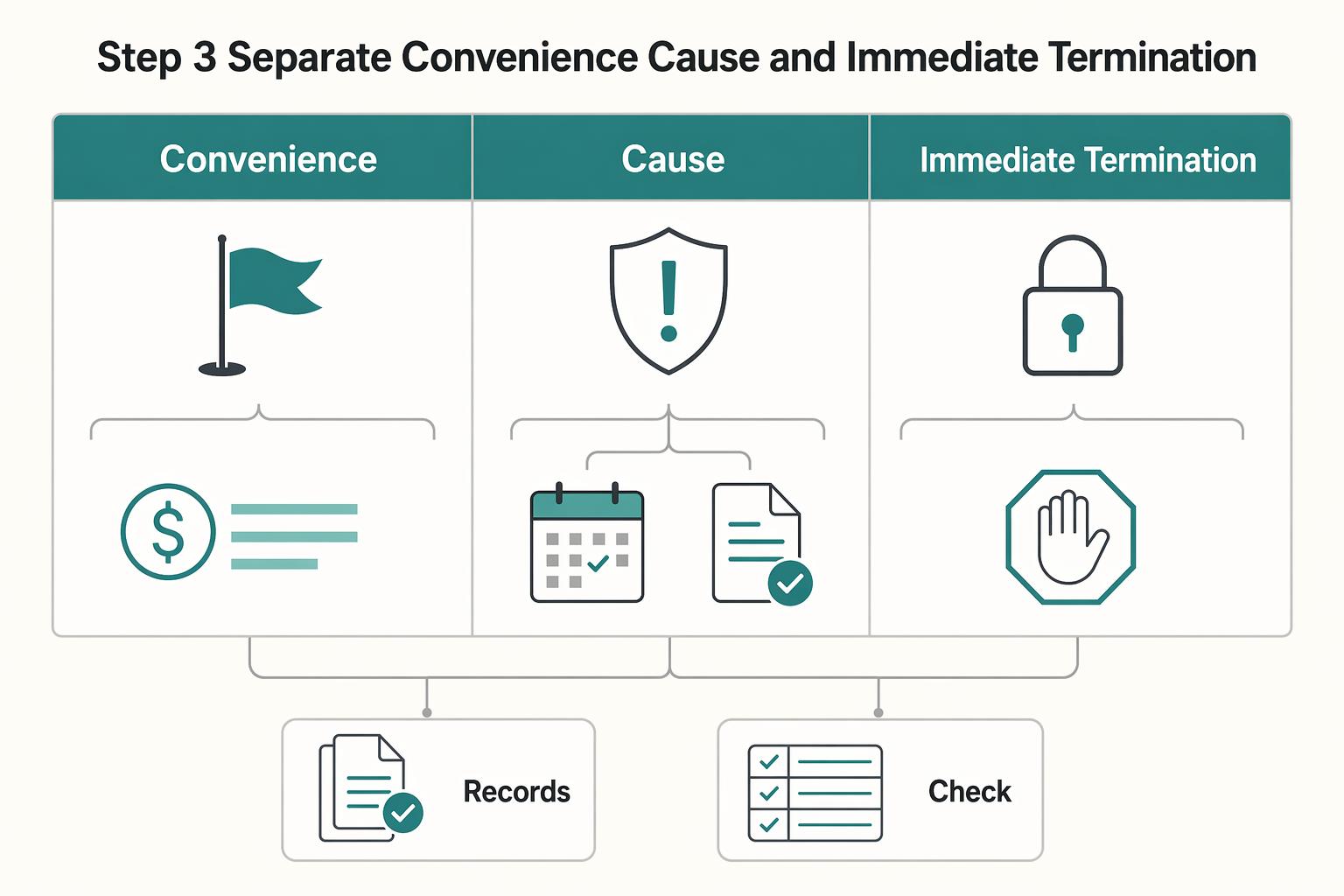
Step 3. Separate convenience, cause, and immediate termination#
This is where many clauses get muddy. Use separate trigger and payment language for each path so the rights and consequences do not blur together.
| Termination path | Trigger standard | Payment outcome | Documentation required |
|---|---|---|---|
| For convenience | Client elects to end without your breach | Accrued fees, approved expenses, notice pay if applicable, plus any separately stated compensatory exit amount | Written notice, effective date, SOW support, invoice support, capacity or wind-down support |
| For cause | Defined default or non-compliance, typically with cure opportunity if curable | As stated in the contract (for example, accrued fees up to cutoff date and no convenience fee unless expressly included) | Breach notice, cure notice, response record, milestone or non-compliance evidence |
| Immediate termination | Defined fundamental or material non-performance that is non-curable | As stated in the contract, with treatment of already-earned fees and future obligations stated explicitly | Immediate-termination language, written notice, evidence of serious breach |
For cause triggers, use objective language, for example failure to perform, failure to comply with contract terms, or failure to provide requested assurances of future performance. For curable defaults, add a written cure process. FAR 52.249-8 includes a 10-day cure example, but treat that as a model, not a default rule for private freelance contracts.
If the facts are disputed, add fallback wording: identify what remains undisputed and require both sides to follow the contract's dispute process while performing any stated transition obligations.
Step 4. Draft for compensation, not punishment#
Separate a negotiated price for convenience cancellation from damages payable for breach. They have different triggers, and the governing law determines whether a proposed amount is enforceable. Define the trigger, calculation and interaction with work-to-date payment before agreeing a figure:
- One defined cutoff date for accrued fees
- Written notice method and effective-date rule
- Express payment-in-lieu language, if you want that option
- Separate wording for convenience, cause, and immediate termination
- Objective cure triggers and cure timing for curable defaults
- Dispute fallback for contested facts and undisputed amounts
- Evidence list aligned to the SOW: timesheets, milestones, change approvals, expenses, and wind-down support
For a step-by-step walkthrough, see How to Write a Limitation of Liability Clause for a Freelance Contract.
Crafting and Positioning Your Clause#
Use a modular clause so you can negotiate details without giving up the payment protection that matters. That usually means separating notice, work-stop rules, payment in lieu, and any pre-agreed exit amount instead of bargaining over them as one block.
Before you start#
Read the contract, SOW, pricing exhibit and invoice terms together. Resolve conflicting acceptance, billing and change-approval provisions. Have the proposed termination amount and notice or cure rules reviewed under the governing law before use.
Step 1. Build the clause in modules#
The cleanest way to draft this is in short, separate parts. Write five modules and tie each one back to the SOW.
| Module | What to include |
|---|---|
| Accrued payment | Accrued fees and approved expenses are payable through one defined cutoff date. |
| Notice mechanics | Written notice only: who can send it, where, and when it becomes effective. |
| Work during notice | State whether work continues through notice or stops immediately. |
| Payment in lieu (optional) | If access is cut before notice ends, define the substitute payment rule. |
| Pre-agreed exit amount (optional) | If used, frame it as reasonable compensation tied to anticipated loss and wind-down, not punishment. |
Keep convenience and cause termination paths separate so triggers and payment outcomes stay clear. Two optional fallbacks are worth keeping in reserve:
- Curable default: define the breach, notice and cure period, with governing-law review where needed.
- Dispute step: contested items follow the contract dispute process, and state whether work continues during the dispute
A third party should be able to identify the trigger, cutoff date, and calculation method from the clause text alone.
Step 2. Cross-reference the SOW where disputes usually start#
To reduce termination invoice disputes, your clause should point to the SOW fields that control payment calculations:
- Work description
- Period of performance
- Deliverable schedule
- Performance standards
Then define four minimum calculation inputs:
- Deliverables in scope
- Acceptance criteria per deliverable
- Billing trigger per fee
- Termination calculation inputs, for example accepted work, proper invoicing, milestone status, percentage performed, time records, written change approvals, approved expenses
If acceptance is undefined, payment disputes are harder to resolve. You should be able to compute the final invoice from the SOW, invoice records, and written change approvals without relying on memory.
Step 3. Position it as mutual risk control#
How you explain the clause matters. Position it as a shared clarity tool, not as a threat response.
- Say this: "I include this so we both know what notice looks like, what work stops, and what gets paid if the project ends early."
Avoid this: "This is here in case you cancel and refuse to pay."
- Say this: "It ties the contract to the SOW so we are not debating later what counted as accepted or invoiceable."
Avoid this: "I need extra protection because clients disappear."
- Say this: "If you need more flexibility, we can narrow notice or refine acceptance criteria, but we should not leave early-termination payment undefined."
Avoid this: "Take it or leave it."
Step 4. Respond to pushback by signal, not tone#
What matters is not whether the client sounds polite. What matters is whether they resist the parts that make the payment outcome calculable.
| Client pushback | Risk signal | Response path |
|---|---|---|
| "Let's just pay for completed work." | No shared cutoff date or measurement method | Hold firm |
| "We do not want any cure language." | Broad cause-termination discretion | Narrow scope; escalate to counsel for larger engagements |
| "Can approvals happen in chat or email?" | Unclear approval authority or record retention | Allow the agreed written channels if they identify authorized approvers and preserve the change record. |
| "Set the termination amount high so cancellation never happens." | Penalty-risk framing that can weaken enforceability | Narrow scope, reframe as reasonable compensation, escalate to counsel if needed |
Rule of thumb: if a client resists clarity on acceptance, written changes, or calculation inputs, treat it as payment risk, not drafting style. You might also find this useful: How to Use a Kill Fee to Protect Your Time and Income.
After Termination: Acknowledge, Invoice From the Contract, and Follow Up#
Once termination happens, leverage comes from a clean record. You need a clear acknowledgment, a contract-based invoice, and follow-up that tracks the client's behavior.
Before you act, build your evidence pack#
Before you send anything, pull this together:
| Item | What to pull |
|---|---|
| Termination notice | Timestamp, whether by email or message |
| Contract file | Signed contract, controlling SOW version, and written change approvals |
| Delivery proof | Submission emails, file timestamps, meeting notes, and acceptance messages |
| Invoice trail | Prior invoices, payments, and approved expenses |
| Communication log | Notice, feedback, pauses, access removal, and stop-work requests |
If you cannot map performed work to the SOW and written changes, reconcile that first.
Step 1. Acknowledge and lock the record#
Reply in writing as soon as you can. The goal is to confirm facts and next steps, not to argue the merits in the first message. Use this framework so a third party can identify the termination date, governing clause, and billing next step from your message alone:
- Acknowledgment: confirm receipt and the stated termination date, or note that the date will be determined under the notice clause.
- Contract reference: identify the termination, notice, and payment clauses that control cutoff-date payment and any payment in lieu or pre-agreed exit amount.
- Next action: confirm that you will issue a final invoice with calculation support.
- Deadline: state when they will receive it and the payment due date under contract.
Step 2. Invoice from the contract, not memory#
Speed matters, but traceability matters more. Send the final invoice promptly, and make every line item track back to the signed documents.
| Line item | SOW reference | Acceptance status | Clause reference | Calculation note |
|---|---|---|---|---|
| Accepted deliverable or milestone | SOW section or milestone ID | Accepted on date (or deemed accepted if the contract says so) | Fees or billing clause | Fixed milestone amount |
| Work performed through cutoff date | SOW task or phase | Not yet accepted | Termination payment clause | Unbilled hours x rate or agreed % complete, excluding work already included in milestone fees |
| Approved expenses | SOW budget or approval email | Approved | Reimbursement clause | Receipt-backed amount |
| Pre-agreed termination amount / payment in lieu | Termination schedule or formula | Triggered per contract facts | Termination clause | Exact signed formula |
| Deposits, payments and credits | Invoice or receipt IDs | Already applied or payable credit | Payment and credit terms | Subtract once; reconcile any unapplied balance |
Illustrative closeout: the contract permits $2,000 for a completed milestone, $800 of unbilled work on a separate task, $100 of approved expenses and a non-overlapping $300 convenience cancellation payment. A $1,000 deposit has already been applied. The final balance is $2,000 + $800 + $100 + $300 − $1,000 = $2,200. Do not also charge a percentage-of-completion amount for the milestone already billed.
Before sending, check:
- Confirm cutoff date.
- Confirm acceptance status by deliverable.
- Attach time records or percentage support where allowed.
- Attach written change approvals.
- Include required invoice particulars, for example full VAT invoice details if applicable.
- Use contract payment terms. If you need a default term, verify it for the governing law before stating it.
Do not inflate, relabel, or round up charges. If your contract uses a pre-agreed amount, invoice the signed amount or formula exactly.
Step 3. Follow the path the client's behavior earns#
After the invoice goes out, let the client's response determine your next move. Use the path the facts support:
| Path | When to use it | Key actions |
|---|---|---|
| Routine reminder | No substantive dispute | Send a reminder and then an overdue notice. Apply charges only where the contract and governing law support them. |
| Dispute | Client challenges the amount | Request a line-by-line response, provide calculation evidence and seek payment of undisputed sums where supported. |
| Escalation | Unresolved overdue payment | Choose counsel, collection support or a formal claim process appropriate to the jurisdiction and amount. Check applicable pre-action steps, response periods and document requirements before proceedings. |
Use counsel early when contract meaning is disputed, counterclaims are threatened, or exposure is material. Use collection support when the debt is clear and documented, but the issue is non-response.
Before you send your termination invoice, standardize the format so payment terms, due date, and line items are unambiguous with the Free Invoice Generator.
Conclusion: From Contract to Partnership#
Your termination clause is a risk-allocation tool. It sets scope expectations, termination rights, notice mechanics, and payment terms before work starts. Use it to prevent disputes, not to win them later.
The thread through all of this is simple: draft clearly, document consistently, and invoice from the contract you actually signed. Payment outcomes are typically proved from documents. Your file should make it possible to calculate closeout from the signed contract, current SOW, written changes, termination notice, logs or timesheets, and invoice.
Partnership test before you sign#
- Proceed when notice, written scope, change approval and a clear payment formula through the agreed cutoff are settled, including deposits, credits and any non-overlapping exit compensation.
- Renegotiate when the client agrees in principle but leaves key placeholders unresolved, avoids defining the notice effective date, or pushes payment terms to "later."
- Decline when the client rejects written scope, insists on verbal changes, refuses termination-payment language, or pushes a punitive amount without a reasonable basis.
Apply this framework to your standard template now. Verify jurisdiction-specific wording where needed, keep any pre-agreed amount or formula reasonable, and state final-invoice timing in signed terms before work begins.
We covered this in detail in How to Handle a 'Liquidated Damages' Clause in a Contract.
Turn this clause framework into a usable first draft for your next engagement with the Freelance Contract Generator.
Frequently Asked Questions
What is termination for cause?
Termination for cause means the contract ends because of default, noncompliance, or another breach-based trigger defined in your agreement. In some rule sets, that termination is handled through written notice, and some breaches require a cure notice before termination. Keep the breach timeline, required notices, and proof of performance in your file before you stop work or dispute amounts due.
What is termination for convenience?
Termination for convenience means a party uses an at-will contract right to end some or all work for its own reasons, not because you breached. This can be the termination type where payment protection for canceled future work is defined, if your contract says so. If you allow convenience termination, tie it to a clear payment formula and trigger.
What counts as notice?
Notice is the communication required by the contract or governing law to make termination effective. Specify the permitted method, recipient, delivery rule and effective date. State whether work continues during notice and which date sets the payment cutoff.
What is a final invoice?
A final invoice records the closeout amount. Show each entitlement, its SOW or clause reference, evidence and calculation; deduct deposits, prior payments and credits. Use the agreed invoice deadline and payment due date, with any applicable legal requirements.
What is a kill fee?
A kill fee is a business label for an agreed cancellation payment. The clause must define the trigger, covered scope and calculation, including whether it overlaps with notice-period compensation or other exit payments. The label alone does not establish enforceability.
What are liquidated damages?
Liquidated damages are a pre-agreed amount or formula payable on breach. A convenience cancellation price has a different trigger: an agreed right to end the engagement without alleging breach. Review either provision under the governing law rather than treating a reasonable-looking amount as automatically enforceable.
How do termination types change what you can invoice?
Your invoice rights usually depend on the termination type, the contract trigger, and the quality of your documentation. Use this table before you bill:
What should the clause itself include?
Use a checklist so the payment outcome is calculable from documents, not assumptions. Include: who may terminate, cause grounds, cure-notice rule, notice method and effective date, payment for work through cutoff, approved-expense handling, any pre-agreed amount or formula, controlling documents such as the contract, SOW, and written changes, final-invoice timing, due date, and handling for disputed versus undisputed sums. Ask yourself: could a third party compute the closeout amount from this text and file set without asking what you meant?
How do you draft this without overpromising enforceability?
Define governing law, notice, the payment cutoff, invoice deadline and any cancellation formula before signing. Review legal enforceability separately from the commercial amount. If the trigger, proof and calculation cannot be explained clearly, revise the clause.
Try a related tool
Researched and edited by the Gruv editorial team. Gruv builds cross-border billing, payouts, and finance-operations software for global businesses.
Sources
Includes 1 external source outside the trusted-domain allowlist.
- acquisition.gov/far/52.212-4trusted
- acquisition.gov/far/12.403trusted
- ecfr.gov/current/title-48/chapter-1/subchapter-H/part...trusted
- ecfr.gov/current/title-48/chapter-1/subchapter-B/part...trusted
- eur-lex.europa.eu/EN/legal-content/summary/combating-late-paym...trusted
- selfhelp.courts.ca.gov/small-claims/trialtrusted
- single-market-economy.ec.europa.eu/smes/challenges-and-resilience/late-payment/...trusted
- gov.uk/late-commercial-payments-interest-debt-recov...external
Educational content only. Not legal, tax, or financial advice.
Related Posts

Germany Freelance Visa Application Path for Freiberufler and Gewerbe
Choose your track before you collect documents. That first decision determines what your file needs to prove and which label should appear everywhere: `Freiberufler` for liberal-profession services, or `Selbständiger/Gewerbetreibender` for business and trade activity.
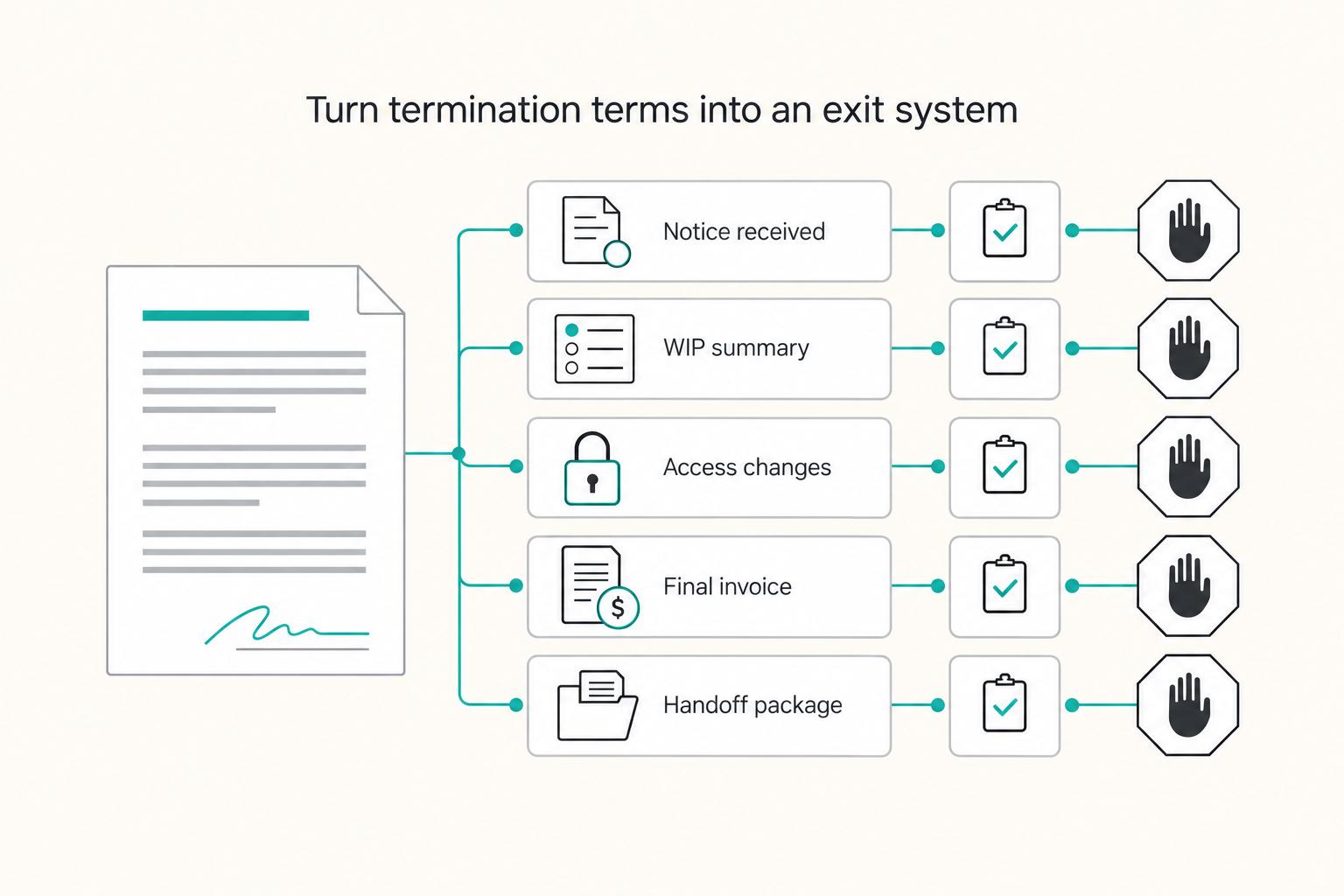
How to Write a Termination Clause That Protects You
**A freelance contract termination clause should explain how the engagement can end, what remains payable and what must be handed over.** Write the exit rules before the project starts so notice, unfinished work and final billing can be handled against agreed terms. A clause can reduce uncertainty; it cannot guarantee collection or make every unfinished task billable.

The Freelance Payment Penalty: A Modeled Audit of Platform Fees, FX Spreads, and Payout Delays
The money rarely disappears through a single, easy-to-spot fee. The real loss is stacked. A marketplace takes its commission, a processor adds a charge for international cards, a bank or payment company converts the currency at a spread, a platform holds the funds before release, and a wire sheds a little to intermediaries on the way in. Each layer looks defensible on its own, but the worker feels the combined result as a smaller deposit and a later payday.