
Quick Answer
Use a three-phase operating model: pre-peak readiness, in-peak intervention, and post-peak reconciliation. For Black Friday and Q4, map every payout from intent to provider response to ledger journal, then run one shared completion definition across finance, ops, and engineering. Set cohort-based rail rules with explicit fallback between FedNow, RTP, and scheduled batches. Keep KYC, KYB, AML, and tax release gates visible, and allow replay only for idempotent jobs.
How gig platforms should think about Black Friday and Q4 payout scaling#
For a gig platform, Black Friday and Q4 payout scaling can become a trust problem as much as a throughput problem. As payout demand rises, exception load and reconciliation pressure rise with it. One unclear status can quickly turn into a worker complaint, a support ticket, and a finance cleanup issue at the same time.
Step 1 Map the control path from payout intent to ledger post#
Start by treating a payout as a chain of controlled state changes, not a single button click. You need a clear view of payout intent creation, policy approval, provider acceptance, status propagation, and ledger posting. If any link in that chain is vague, peak volume is more likely to expose it quickly.
| Stage | Trace with | What to confirm |
|---|---|---|
| Payout intent creation | Internal payout ID | Intent exists for the payout |
| Policy approval | Approval record | Approval is recorded |
| Provider acceptance | Provider reference | Provider accepted the request |
| Status propagation | Status event | Status event that updated the internal surface |
| Ledger posting | Ledger journal | Ledger journal that reflects the outcome |
A practical check is simple. Pick one payout and trace it end to end using exact identifiers: the internal payout ID, the approval record, the provider reference, the status event that updated your internal surface, and the ledger journal that reflects the outcome. If finance, ops, and engineering need different tools or different interpretations to answer where that payout stands, you do not have a scaling problem yet. You have a visibility problem.
Your evidence pack for any disputed payout should already exist before peak week. At minimum, keep the payout intent, the approval outcome, the provider request and response, the latest internal status event, the ledger entry, and any manual hold or release note tied to the same payout ID. That gives support something concrete to use and gives finance a clean trail when your numbers do not match the provider file.
Step 2 Define one completion contract and assign owners#
Before you tune capacity, write one shared completion contract that finance, ops, and engineering all use. A common avoidable peak failure is not raw volume. It is different teams using the same word for different states.
Do not let "paid" mean "released" to one team, "accepted" to another, and "visible in the app" to a third. Pick one internal definition for completed, such as provider accepted, status reflected in the platform, and ledger journal posted. If your accounting policy needs a later settlement state, name that state separately instead of calling both of them complete.
| Decision area | Primary owner | What must be true |
|---|---|---|
| Release | Finance or payouts ops | Policy approval passed and release is authorized |
| Hold | Ops with risk or compliance input | Hold reason is recorded and visible to support |
| Retry | Engineering-owned logic, ops-approved manual action | The prior attempt state is confirmed before any resend |
| Incident decision | One named incident lead per shift | Teams use the same completion definition and escalation path |
The verification point here is agreement, not optimism. Ask each function to explain what happens when a payout is delayed, manually held, retried, or disputed. If those answers produce different owners or different status definitions, fix that before you add scale. This is also the right point to decide whether different rails require different operating rules, which is why the downstream rail choice matters in FedNow vs. RTP: What Real-Time Payment Rails Mean for Gig Platforms and Contractor Payouts.
Step 3 Separate useful lessons from weak analogies#
Outside examples can sharpen your thinking, but they should not be stretched into proof that your own payout path is ready. A useful example here is a participatory audit-style study of Uber's algorithmic pay and work allocation based on a longitudinal analysis of 1.5 million trips from 258 UK drivers. In that study context, reported outcomes after dynamic pricing included decreased pay, a higher platform cut, and less predictable job allocation and pay.
That is not Black Friday or Q4 payout execution evidence, and it should not be presented that way. What it does show is the operator lesson that matters: when pay logic becomes harder to predict, workers feel the downside immediately. The same paper also says drivers were still paid only for on-trip and en route to pickup time, creating a failure mode where more drivers can be left waiting without pay. The transferable lesson is not about copying ride-hail economics. It is about reducing ambiguity in waiting states, payout eligibility, and worker-facing explanations.
So use public stories for caution, not comfort. Keep the parts that transfer: traceability, exception triage, and ledger-first verification. Drop the parts that do not: sector-specific economics, legal assumptions, and anecdotal claims about peak behavior. If you want another concrete example of how payout complexity changes by operating model, read Shift-Based Pay for Gig Healthcare Workers: How Platforms Handle Variable Contractor Payouts.
If you want a deeper dive, read How Gig Platforms Can Use Earned Wage Access (EWA) as a Contractor Retention Tool.
Want a quick next step on peak-season payout volume for Black Friday and Q4? Try the free invoice generator.
Set the payout demand model before you touch architecture#
Forecast payout behavior first, then size architecture to the bottleneck you can prove. Reversing that order usually over-optimizes request capacity while failures show up in exceptions, status visibility, or finance close.
Step 1 Build one shared peak view#
Use one shared planning view for each peak window, with payout demand, exception pressure, support load, and finance-close dependencies in the same place. Keep windows distinct when expectations or review timing differ, instead of blending everything into one forecast.
Your readiness check is simple: finance, ops, and engineering should all be able to answer the same timing questions from the same data view. If that requires manual interpretation or stale exports, fix data integrity first. Trusted, governed data is a prerequisite to scaling, not a cleanup task for later.
Step 2 Split the traffic into three streams and mark handoffs#
Model traffic as three streams: payout creation, status polling, and webhook ingestion. Mark explicit handoffs in each stream so you can tell the difference between a true completion stall and a visibility delay.
| Stream | Mark | Signal |
|---|---|---|
| Payout creation | Creation accepted into processing | Creation succeeds but no downstream state changes |
| Status polling | Same payout ID and provider reference | Helps tell the difference between a true completion stall and a visibility delay |
| Webhook ingestion | Webhook receipt to status update | Polling moves but webhook ingestion lags |
Trace sample payouts end to end with the same payout ID and provider reference. If polling moves but webhook ingestion lags, treat it as a data-latency issue; if creation succeeds but no downstream state changes, investigate release flow, provider acceptance, or rail path next. That is why rail strategy is a direct follow-on decision in FedNow vs. RTP: What Real-Time Payment Rails Mean for Gig Platforms and Contractor Payouts.
Step 3 Choose posture from forecast confidence#
Set your operating posture from forecast confidence. When confidence is low, prioritize graceful degradation: protect completion rates, watch drop-off points, and keep exception handling and reconciliation readable under stress. When confidence is high and handoff data is clean, focus on throughput tuning.
Write shared measurement definitions before peak starts. Finance, ops, and engineering should use the same start and stop points for states like created, in progress, and complete. A common failure mode is carrying over outdated QA habits and calling a run ready without proving shared measurement and handoff visibility under peak conditions. If tax-document flow is part of your release path, align that with this model in Gig Worker Tax Compliance at Scale: How Platforms Handle 1099s W-8s and DAC7 for 50000+ Contractors.
You might also find this useful: ERP Integration for Payment Platforms: How to Connect NetSuite, SAP, and Microsoft Dynamics 365 to Your Payout System.
Prepare the prerequisites teams and evidence need before peak week#
Set one pre-peak readiness standard before volume rises: one evidence pack, one decision chain, and one escalation path every team can execute without ad hoc lookup.
Step 1 Build one pre-peak evidence pack and test decision speed#
Make one shared pack your operating source of truth for who can act, what they can approve, and how escalation works. If release pauses, batch-size changes, provider escalation, or cohort deferral still depend on memory, readiness is incomplete.
Keep the pack practical and fast to use: primary and backup owners for payout release, reconciliation signoff, incident command, provider contact, and support communication; the provider account or merchant reference to quote; the support portal or phone path; the incident room; and explicit approval rights for pause, manual review, and deferral decisions. Your check is simple: can a new shift lead find the next decision-maker and recording path in under five minutes?
Run a short simulation before peak week. Pick one likely failure pattern and test cross-team handoff clarity. The pass condition is aligned answers on next decision, approver, and escalation route, not a perfect drill.
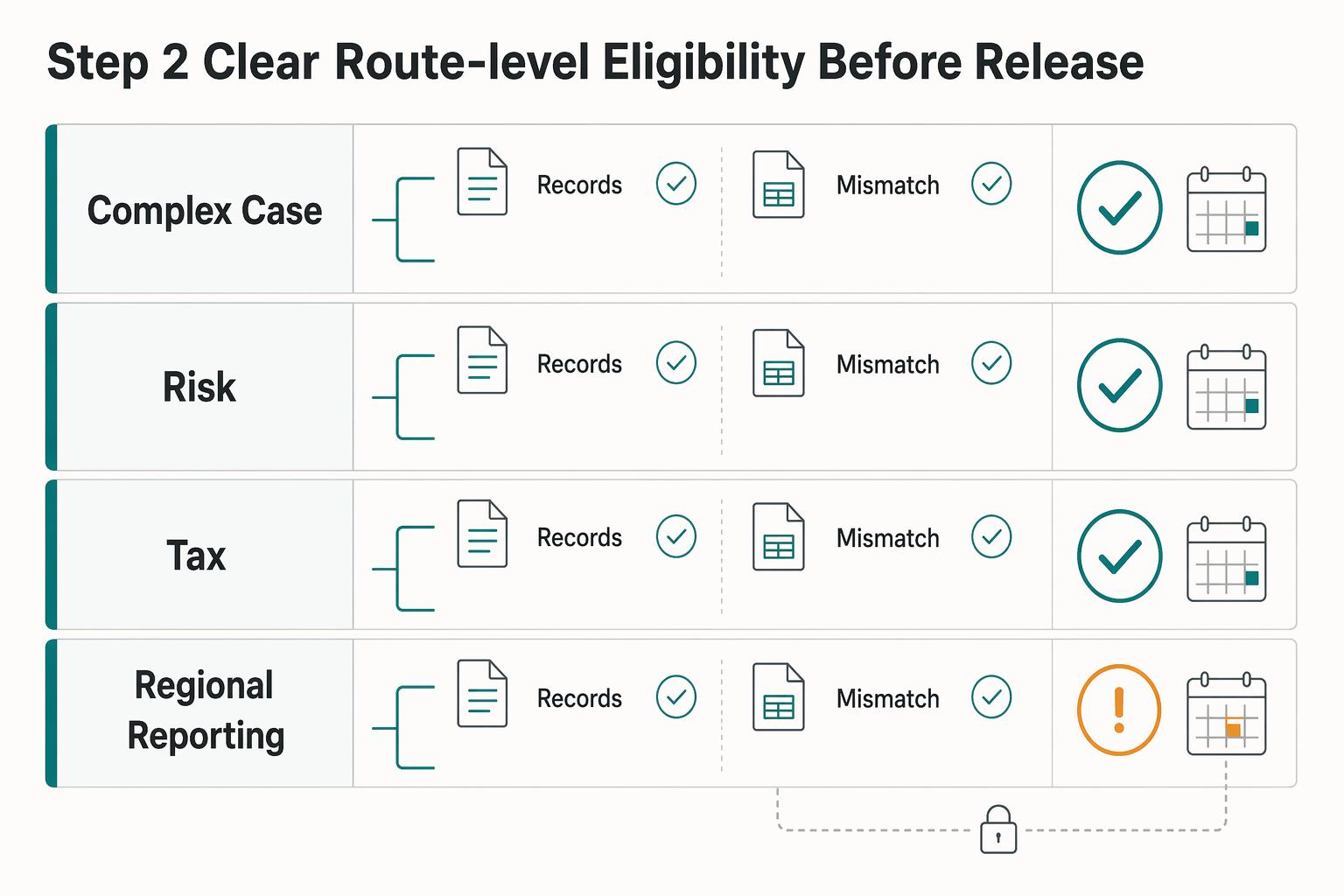
Step 2 Clear route-level eligibility before release#
Organize readiness by payout route, not by department. A route should enter release only when required records are complete, visible, and reviewable for that route.
| Requirement area | What should be complete before release eligibility | Evidence to retain | Action if missing |
|---|---|---|---|
| Identity | Required payee identity records are present and approved for that route | Verification status, review timestamp, exception notes | Block and remediate |
| Entity | Legal entity details align to the releasing party; owner data is present where your onboarding program requires it | Entity profile, approval log, owner records (if collected) | Block until aligned |
| AML and risk | Screening or internal risk review is current; unresolved alerts are dispositioned | Alert IDs, reviewer notes, decision outcome | Block high-risk cases or defer cohort |
| Tax | Required tax documentation/status for the route is present | Document status, classification field, review history | Defer until complete |
| Regional reporting | Required destination/payee reporting markers are set | Region code, reporting flag, exception note | Defer affected cohort |
Use a binary rule to reduce peak-week ambiguity: incomplete route-level requirements do not enter the main release queue.
For documentation workflows, keep this reference in the operator path: Gig Worker Tax Compliance at Scale: How Platforms Handle 1099s W-8s and DAC7 for 50000+ Contractors. If your onboarding program includes owner identification, keep that rule explicit and traceable to your governing requirement for beneficial-owner identification.
Step 3 Reconcile onboarding, payout profile, and ledger-linked identity records#
Treat record integrity as a release gate: reconcile onboarding identity, payout profile details, and the ledger-linked identity record used by release decisions. Mismatches here create avoidable delay and exception churn under load.
Sample recent held, returned, or manually reviewed payouts and compare the same payee across all three records. Keep one explicit action path: block when identity or ownership is unclear, remediate when the fix is straightforward and timely, or defer the cohort when cleanup cannot be completed safely before the window.
Close this step with a mismatch report and named signoff. Ops confirms blocked or deferred cohorts, and finance confirms expected cash and support impact. If profile updates do not propagate to the record used at release time, stop patching downstream and fix the upstream mapping path before peak week.
For related operational context, see Gig Worker Financial Wellness: How Platforms Can Offer Savings and Insurance as Benefits.
Choose payout rails and settlement timing with explicit tradeoffs#
Rail choice is a cohort service decision, not a default architecture choice. Pick the rail by balancing speed promise, risk posture, geographic coverage, and the operations load your team can actually run during peak week.
Step 1 Compare rail classes against cohort needs#
Real-time payments move funds in seconds rather than days, but that only helps when the cohort is already eligible and operations can absorb fast exception handling. Before assigning any real-time path, confirm corridor and product availability, because not all products and services are available in all geographical areas.
| Rail class | Best fit by cohort | Eligibility complexity tolerance | Exception tolerance during peak | Reconciliation workload |
|---|---|---|---|---|
| FedNow | Cohorts where faster access is part of the payout promise | Low; route records that are already clean and approved | Low; unresolved exceptions create immediate support pressure | Higher live monitoring and faster finance confirmation |
| RTP | Similar fit to other real-time paths where provider and geography support it | Low; avoid review-heavy cases | Low; failures need fast operator decisions | Higher live monitoring and faster finance confirmation |
| Scheduled payout batches | Cohorts where review depth and release control matter more than instant delivery | Higher; easier to hold, review, and release in windows | Higher; easier to defer or rerun in controlled windows | More cutoff management, but easier structured reconciliation |
If a cohort still creates recurring eligibility exceptions, keep that cohort on scheduled release until the exception pattern is stable.
Step 2 Define primary rail, fallback rail, and switch conditions per cohort#
For each cohort, document three fields in your evidence pack: primary rail, fallback rail, and the exact trigger to switch. Keep the rule simple enough that a shift lead can apply it without escalation debate.
Use a practical default. If speed is part of the product promise and eligibility is complete, set a real-time primary rail with a batch fallback. If the cohort still needs heavier review, set scheduled batch as primary and reserve real-time paths for approved exceptions. Switch to fallback when coverage is unavailable, routing is impaired, unresolved exceptions accumulate, or finance cannot reconcile outcomes fast enough to release confidently.
Step 3 Keep control points aligned with rail choice#
Before go-live, align four controls to the selected rail: cutoff logic, idempotent retries, status visibility, and finance reconciliation checkpoints. If you switch a cohort from real-time to batch under stress without updating those controls, you increase the risk of duplicate attempts, confusing status signals, and reconciliation drift.
Run one trace test per cohort from release decision to provider response to ledger journal. Then use FedNow vs. RTP: What Real-Time Payment Rails Mean for Gig Platforms and Contractor Payouts for the deeper rail-level comparison, and keep How HR Platforms Scale Employee Recognition Payout Disbursements as a supporting operational reference.
Build the payout engine for retries without duplicates#
Once primary and fallback rails are set, keep one reliability standard: retries must preserve business intent, keep state accurate, and leave an audit trail support and finance can trust under peak load.
Step 1 Enforce idempotency separately for requests and events#
Treat payout requests and inbound payout events as separate duplicate-control layers. Use one request idempotency key per business intent, not per attempt, and document its lifecycle only after the value is verified. Until then, label it Request-key retention window pending engineering verification.
For events, keep a separate dedupe record keyed to the event identifier you actually receive, with its own replay window verified before release. Until then, label it Event replay window pending engineering verification. Keeping these layers separate helps you catch mismatches instead of hiding them.
Step 2 Control queues so failures stay local#
Use a queue policy that is bounded, observable, and explicit during peak periods: define when intake is slowed, when work is deferred, and when failing items are isolated for review instead of replayed repeatedly. Document those triggers and actions with verified environment values, not assumptions.
Classify retries before replay, and keep an isolation path for unresolved items so one bad flow does not create broad replay noise. If rail switching is part of your back-pressure playbook, align it with your rail policy in FedNow vs. RTP: What Real-Time Payment Rails Mean for Gig Platforms and Contractor Payouts.
Step 3 Keep ledger-confirmed status authoritative#
Define explicit internal payout states and make it clear which state is authoritative for customer messaging and finance close. In practice, provider responses can be useful signals, but they should not replace ledger-confirmed outcomes in your final status logic.
For threshold-gated or scheduled release programs, keep eligibility and payout status tied to your internal records. Convocore's Affiliate Dashboard separates payout history, pending earnings, and "Total Money Payout Amount" (eligible amount), and notes payouts are monthly once the minimum payout threshold is met. For adjacent release-gate dependencies, see Gig Worker Tax Compliance at Scale: How Platforms Handle 1099s W-8s and DAC7 for 50000+ Contractors.
The EU reporting obligation lands on the platform rather than on the people it pays, which makes it a product and data question as much as a tax one. DAC7 and DPI reporting for platforms covers what has to be collected, when it is due, and which fields become mandatory only in certain conditions. Running an export through the DAC7 seller data checker shows how far the current record is from that.
Step 4 Use an operator traceability checklist to close incidents#
For each payout, keep one trace that links: internal payout ID, request key, batch or release ID (if used), provider reference, inbound event IDs, ledger journal ID, and final user-visible status.
Add a formal escalation path when records disagree. A structured "Submit a request" route is more reliable than ad hoc chat escalation because it preserves the evidence needed to resolve mismatches.
Related: Payment Scheduling for Platforms: How to Build Flexible Payout Calendars for Contractors.
Add compliance and tax gates that reduce risk without freezing volume#
Step 1 Separate the release paths in plain language#
Use two paths: payouts with required controls resolved stay on the auto-release path, and payouts with unresolved required controls stay on the hold-and-review path. Keep optional or later-stage checks out of that first release decision so clean payouts do not stall behind exceptions. If a rule depends on a threshold, label the unresolved value as Current threshold pending risk-policy verification until the policy value is verified.
Step 2 Define layered gates before peak week#
Use layered gates so each decision is visible, auditable, and easy to route.
| Gate layer | What it checks | When it triggers | Follow-up owner |
|---|---|---|---|
| Required release gate | Whether all required controls are complete enough to allow release | Before release, and any time a required control changes | Confirm the case owner with operations; record release or hold decision |
| Monitoring gate | Whether a released payout shows later signals that need follow-up | During and after release activity | Confirm the case owner with operations; keep status active until resolved |
| Documentation and reporting gate | Whether evidence records are complete for reconciliation and reporting review | At onboarding, before release when relevant, and before reporting cycles | Confirm the case owner with operations; attach evidence link and current status |
A practical queue check is to require one trigger reason, one evidence link, and one latest action per held payout. If any of those are missing, exceptions become hard to clear and volume slows.
Step 3 Route holds with a short decision flow#
Run holds through a simple flow: capture trigger reason, assign the case owner, set review priority, then close with a clear outcome. Outcomes should be explicit: release, request more evidence, or escalate when records conflict. Keep this operating flow aligned with payout design choices in Shift-Based Pay for Gig Healthcare Workers: How Platforms Handle Variable Contractor Payouts, reporting workflows in Gig Worker Tax Compliance at Scale: How Platforms Handle 1099s W-8s and DAC7 for 50000+ Contractors, and adjacent architecture decisions in How EdTech Platforms Pay Tutors: Tax and Payout Architecture.
Run a three-phase operating sequence from pre-peak to post-peak#
Run peak operations as three phases, not one long incident window, so each team has a clear objective, trigger, and handoff artifact.
A simple contact matrix helps: named ownership keeps handoffs stable when pressure rises.
| Phase | Objective | Trigger to act | Owner lane | Artifact to produce | Handoff output |
|---|---|---|---|---|---|
| Pre-peak | Reduce avoidable change risk and prove continuity | Freeze window opens before peak traffic and payout demand | engineering | Approved freeze record plus dry-run results | Go/no-go decision sent to ops and finance/compliance |
| During peak | Intervene early without blocking healthy flow | Shift review interval begins | ops | Shift dashboard with incident owner and current disposition | Watch, reroute, or escalate decision |
| Post-peak | Reconcile outcomes before closing exceptions | Peak window ends or incident is stabilized | finance/compliance | Reconciliation file and evidence pack | Cleared ledger differences, prioritized exception queue, root-cause record |
Step 1 Freeze risky changes and prove the path#
Freeze code and config changes that affect payout creation, queue handling, webhook processing, ledger posting, or provider routing unless the change removes a live known risk. Keep continuity explicit so an unfinished replacement does not force a last-minute scramble.
Before freeze begins, run a failover drill and a reconciliation dry run on sample payout batches. Use a short go/no-go checklist:
- payout creation succeeds end to end on the primary path and fallback path
- webhook health is current and shows pass/fail status, not stale status
- routing lands on the expected provider or rail for the test cohort
- each sample traces cleanly from request to provider reference to ledger entry
If any item is unresolved, call no-go and keep the issue visible into the next review.
Step 2 Monitor intervention rules, not just metrics#
Assign one incident owner per shift and publish that roster to engineering, ops, and finance/compliance. Treat signals as decision rules:
| Rule | Trigger |
|---|---|
| Watch | Throughput holds but completion softens, webhook delay grows, or queue depth rises without a clear failure cluster |
| Reroute | Failures cluster on one route, provider, or processing path and an approved alternative is available |
| Escalate | Failure codes conflict with expected routing, exception queues keep growing across review intervals, or affected exposure crosses a threshold still pending risk-policy verification |
Use the table as the shift rubric. If rerouting means switching rails, use FedNow vs. RTP: What Real-Time Payment Rails Mean for Gig Platforms and Contractor Payouts to frame the tradeoffs.
Step 3 Reconcile first, then clear exceptions, then save proof#
After peak, reconcile ledger journals against provider reports before clearing tickets. That sequence separates true failures from lagged but valid postings.
Then work the remaining exception queue in priority order and save one evidence pack per incident or batch: report exports, queue snapshots, incident timeline, owner decisions, and root-cause notes. For document-driven holds or reporting mismatches, route cleanup through the same exception logic used in Gig Worker Tax Compliance at Scale: How Platforms Handle 1099s W-8s and DAC7 for 50000+ Contractors.
Handle the failure modes competitors skip#
State integrity should be your first failure check in peak windows, because wrong-action retries can create duplicates or false exceptions faster than a full outage. The operator goal is to detect drift early, classify it consistently, and only intervene after verification.
Step 1 Detect drift before you retry anything#
Treat status accuracy as its own incident surface. If webhook ingestion lags, provider confirmations arrive late, or an internal status view is stale, pending may mean "not yet updated," not "not processed." Verify with record sampling first: trace the same payout from creation request to provider reference to ledger entry.
Use one shared working label set so ops and support classify incidents the same way before acting:
| Bucket | Short definition | First verification check | Wrong action to avoid |
|---|---|---|---|
| Intake delay | Request is still in your creation or queue path | Check queue age and request acceptance into processing | Re-sending before confirming idempotent handling |
| Update delay | Outcome exists, but status update is late | Check webhook backlog, polling lag, and update processor health | Declaring provider failure when the update is delayed |
| Counterparty response lag | External request is accepted but final disposition is pending | Confirm provider reference and in-flight state | Replaying work that may already be progressing externally |
| Internal view drift | Ledger, provider state, and team-facing status disagree | Compare all three records for the same payout sample | Acting from dashboard status alone |
Step 2 Recover in a fixed order with clear gates#
Use the same sequence each time so teams do not jump from suspicion to replay:
- Pause broad retries and noncritical changes when affected exposure, exception growth, or unresolved samples cross a threshold still pending risk-policy verification.
- Isolate the failing rail, route, cohort, or status pipeline when issues cluster in one path.
- Replay only idempotent jobs you can trace from original request through provider reference and ledger posting.
- Reopen in small waves after fresh samples show provider outcome and internal state alignment.
Between each step, re-sample live records. If a migration fallback path is active, verify old and new paths write compatible identifiers and reconcile to the same ledger outcome before reopening.
Step 3 Inspect rule volatility, then close with proof#
When manual overrides spike, review recent rule or policy changes before assuming volume is the only driver. Routing updates, hold logic changes, tax-document gates, or support-side status edits can all increase exception pressure.
If the stuck cohort is tied to destination-account issues or recent bank-detail edits, run it through How Platforms Verify Bank Details Before Payout Release before reopening traffic. For rail-switch decisions and tax-gate cleanup during incident handling, use the same operating tradeoff lens as FedNow vs. RTP: What Real-Time Payment Rails Mean for Gig Platforms and Contractor Payouts and Gig Worker Tax Compliance at Scale: How Platforms Handle 1099s W-8s and DAC7 for 50000+ Contractors.
Close the incident only after affected cohorts show provider outcome and ledger match. Save one evidence pack with replay list, exception export, queue snapshots, provider report, ledger diff, incident timeline, and the decision log for pause, isolate, replay, and reopen.
Copy this Q4 payout checklist and decide your next move#
Use this as a go/no-go check for your October to December peak window. If any row fails, close that control gap before throughput tuning, batch-size changes, or faster payout promises.
| Step | Pass or fail test | Required artifact | Brief action note |
|---|---|---|---|
| Step 1. Assign owners | Pass if finance, ops, engineering, and incident ownership are current, named, and accepted, including who can pause traffic, approve replays, contact providers, and sign off on recovery. Fail if any role is assumed, split, or only known in chat. | Owner map | If ownership is unclear during Black Friday or Cyber Monday, incident decisions slow down first. Update the owner map first. |
| Step 2. Expose exceptions | Pass if held payouts are visible in one exception-queue view with a reason, current status, and named owner. Fail if exceptions are spread across inboxes, tickets, or provider dashboards. Trigger: confirm the queue-growth or aging threshold with operations. | Exception-queue view | Hidden holds look like payout outages to support and finance. Fix visibility before tuning throughput. |
| Step 3. Prove replay behavior | Pass if a recent peak-like test shows retries and replays resolve cleanly without conflicting outcomes. Fail if retry outcomes are unclear or require manual guesswork to close. Trigger: confirm the unresolved-replay threshold with engineering. | Replay test log | Keep proof of request, retry, and final state. |
| Step 4. Trace payout state end to end | Pass if sampled payouts can be followed from internal request to provider reference to ledger journal without broken links. Fail if one state is missing or disagrees for the same payout. | Traceability sample | Use this to surface state mismatches before reconciliation and reporting. |
| Step 5. Write rail fallback decisions | Pass if each payout cohort has a primary route, fallback route, escalation contact, and pause/reopen rule. Fail if fallback depends on tribal knowledge or waiting for a provider reply during an incident. Trigger: confirm the rail-delay or cost-exception threshold with operations. | Rail fallback playbook | Write the decision path before peak pressure starts. |
Mark each row pass or fail, attach the artifact, and date it. Treat stale evidence as a fail. This checklist is for known sales periods such as Black Friday, Cyber Monday, and the Christmas period.
When evidence is weak, tighten the artifacts that change incident decision speed first: owner map, exception-queue view, and rail fallback playbook.
If the blocker is document or tax holds rather than processing pressure, read Gig Worker Tax Compliance at Scale: How Platforms Handle 1099s W-8s and DAC7 for 50000+ Contractors. If routing is still the open question, related reading: FedNow vs. RTP: What Real-Time Payment Rails Mean for Gig Platforms and Contractor Payouts. For a broader payout-controls walkthrough, see How EdTech Platforms Pay Instructors Globally: Compensation Models, Payout Controls, and Reconciliation.
Next move: validate every control with current artifacts, then decide. If any row fails, close that gap before throughput tuning. If all five pass, proceed with volume tuning using current, verified thresholds. Want a second review before peak week? Talk to Gruv.
Frequently Asked Questions
How do gig platforms scale payouts for Black Friday and Q4 without overbuilding year-round capacity?
Model Q4 as demand windows, not a permanent baseline. Work backward from your campaign calendar, budget, and timing so capacity can rise before key dates and taper after the surge. Define budget floors and ceilings for operations decisions so you know when to add review coverage, extend support hours, or pause noncritical changes.
What usually breaks first in peak payout volume: rails, webhooks, or internal queues?
There is no single layer that always breaks first. Start by sampling records across request creation, provider reference, webhook receipt, and ledger posting, then isolate where state diverges. If queue age rises while provider references are still present, investigate update or visibility gaps before assuming a rail-throughput issue.
When should a platform choose FedNow or RTP versus scheduled payout batches?
Choose by cohort policy, not just speed. Use faster rails where immediate access is the priority, and keep scheduled batches where holds, checks, or finance controls are required. Write routing and fallback rules per cohort, then test those rules against failure-handling paths. For rail tradeoffs, see FedNow vs. RTP: What Real-Time Payment Rails Mean for Gig Platforms and Contractor Payouts.
How can finance, ops, and engineering split ownership before Cyber Monday?
Set a clear ownership split before the surge: finance for reconciliation decisions, ops for queue and exception handling, engineering for processing and status integrity. Assign one incident owner per shift so retry, pause, and reopen calls stay coordinated. Validate the split with a short tabletop on one delayed cohort.
How do you reduce payout failures while still enforcing KYC, KYB, and AML gates?
Move review-heavy checks earlier, before peak windows, whenever possible, and keep only truly blocking gates inline during the surge. A common risk is letting a verification backlog look like a payout incident. Define what can clear earlier and keep an exception path for records that still need manual review. For document-heavy obligations, see Gig Worker Tax Compliance at Scale: How Platforms Handle 1099s W-8s and DAC7 for 50000+ Contractors.
What should be reconciled first after Giving Tuesday to avoid downstream tax and reporting errors?
Start with the cohort most likely to have drift between provider outcome, internal status, and ledger state. If those views do not align, reporting errors can propagate downstream. Pull one evidence pack first (provider report, ledger diff, replay list, and exception export), then close only after sampled records align.
Try a related tool
Where Gruv fits
Researched and edited by the Gruv editorial team. Gruv builds cross-border billing, payouts, and finance-operations software for global businesses.
Sources
- assets.stevens.edu/mviowpldu823/4F1JEFA6VJSD9xV8p5phZ3/61203ee4...trusted
- dlg.usg.edu/record/dlg_zlgb_gb0222trusted
- doh.wa.gov/sites/default/files/2022-02/EvalCN21-56.pdftrusted
- doh.wa.gov/sites/default/files/2022-02/EvalCN21-46.pdftrusted
- federalreserve.gov/publications/files/2024-annual-report.pdftrusted
- gpo.gov/docs/default-source/contract-pricing/washing...trusted
- lacoe.edu/content/dam/lacoeedu/documents/board/board-a...trusted
- michigan.gov/-/media/Project/Websites/dtmb/Procurement/Co...trusted
Educational content only. Not legal, tax, or financial advice.
Related Posts

Shift-Based Pay for Gig Healthcare Workers and Variable Contractor Payouts
The headline story around **shift-based pay for gig healthcare workers** is usually built on snapshots: a surge-priced shift, a fast fill, a worker who likes the flexibility. That is not enough to make an operating decision. The real question is whether your payout model still works when rates move with demand, work is booked shift by shift, and facilities change or cancel needs with very little notice.

Gig Worker Tax Compliance at Scale: How Platforms Handle 1099s W-8s and DAC7 for 50000+ Contractors
At scale, the hard part is not the acronyms. It is deciding sequence, ownership, and evidence when Form 1099-K, Form 1099-NEC, Form W-8BEN/W-8BEN-E, and DAC7 do not line up cleanly. If you run a high-volume marketplace, put controls in the right order and define clear stop points where legal or tax takes over.

FedNow vs RTP for Gig Platform Contractor Payouts
You are not choosing a payments theory memo. You are choosing the institution-backed rail path your bank and provider can actually run for contractor payouts now: FedNow, RTP, or one first and the other after validation.