
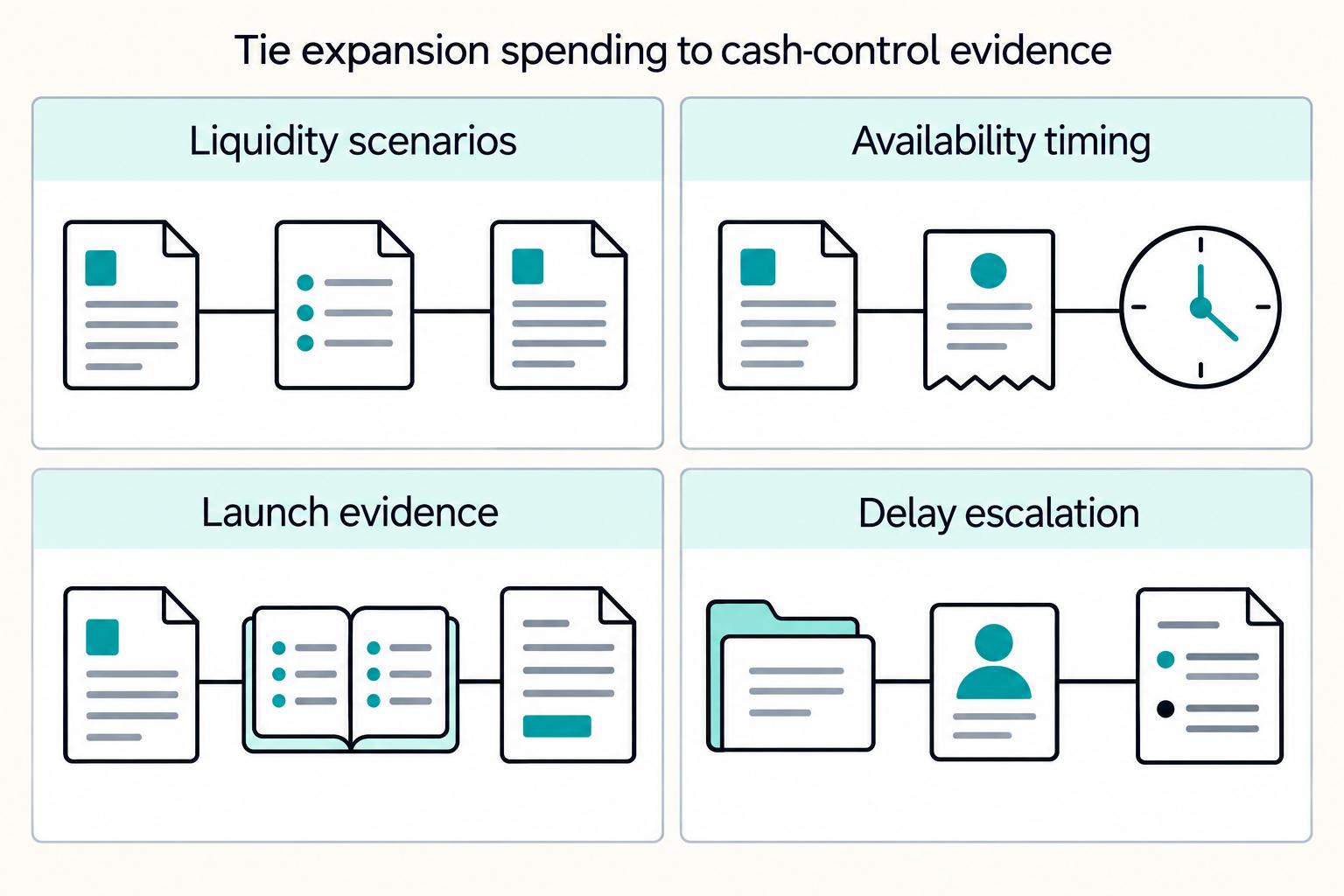
Quick Answer
Use an operations-first gate before expansion: approve only markets that can prove compliance handling, tax-document ownership, and end-to-end money traceability. In practice, that means a launch memo with clear go/no-go status, validated KYC/KYB/AML and VAT routes, defined W-8/W-9/1099 workflows where applicable, and one tested chain from API request through provider reference, webhook status, ledger posting, and finance export.
How Platform CFOs Expand Carefully in a Downturn#
If you are expanding in a weaker cycle, start with operational resilience, not demand. Choose markets your finance, compliance, and payments teams can support without creating cash blind spots or avoidable risk.
The IMF's July 2026 World Economic Outlook update projects global growth of 3.0% in 2026 and 3.4% in 2027, with uneven effects across economies. A global forecast does not establish that your platform or target market is in recession. Use this playbook when your own collections, margins or funding capacity weaken: approve expansion only when its cash demands and control workload fit the downside case.
Use this lens before you start#
- Anchor the decision in resilience, not just pipeline.
Resilience does not mean freezing growth. It means being selective about where new complexity enters the business. A market can look strong commercially and still be a poor fit if it adds payment delays, unclear compliance obligations, or weak reconciliation visibility. Ask first: if volumes ramp faster than expected, will this market strengthen operations or force manual exception handling?
- Treat compliance feasibility as an entry condition.
The FATF Recommendations are the global AML/CFT baseline, and the cornerstone is a risk-based approach. Expansion planning should reflect the real compliance burden of each market and user profile, not a one-size-fits-all launch path. If you cannot explain how verification will run, how higher-risk cases will be reviewed, and who owns those queues, the market is not launch-ready.
- Pressure-test money movement before trusting the revenue model.
Cross-border costs and timing depend on the actual corridor, amount, payment method and bank chain. The World Bank's Remittance Prices Worldwide homepage reports a 6.36% average based on consumer-remittance observations, not a commercial platform-payout quote. For each proposed market, obtain the contractual charges and measured timing your finance model will use, including FX spread, intermediary deductions and beneficiary crediting.
Rank markets using operational readiness, compliance feasibility and money-movement evidence before committing resources.
For the operating metrics behind these decisions, see Real-Time Reporting Metrics Platform Finance Teams Can Actually Control.
Set the decision objective before you rank markets#
Set the decision objective in writing before you score markets, or your ranking can be detailed but still hard to use.
Write the decision as one sentence#
Write the cycle decision as a single sentence and keep it narrow enough for clear evaluation criteria. "Where do we launch next?" and "Which current market do we pause?" are both valid, but they require different evidence and tradeoffs. Tie the decision to your written risk appetite statement so it guides strategy, not just compliance documentation.
Define guardrails before analysis#
Define guardrails before analysis starts, using qualitative boundaries and measurable limits. For KYC and AML, define what exposure fits your risk appetite, who owns review and escalation, and whether identity can be verified with reliable, independent information. Apply similar visibility expectations to reconciliation and risk reporting. If data is not accurate, complete, timely, and adaptable enough for oversight, treat that as a risk issue.
Separate strategy from rollout scope#
Keep strategy and rollout scope separate. "Enter this market" is the strategy decision. Rollout scope is a separate decision and may need to be narrower. If compliance looks workable but visibility is weak, start with the narrower scope and expand only after operations prove out.
Write disqualifiers early#
Write disqualifiers before expansion pressure rises. If ownership is unclear, a workable KYC path is missing, or the reconciliation outputs your controls depend on are unavailable, document that as a stop condition. This helps keep exceptions explicit and governed, and reduces the chance of standards drifting under delivery pressure.
Prepare the evidence pack before committing product or GTM resources#
Do not commit product or GTM budget until each target market has a written evidence pack with named unknowns. If you cannot show how identity, tax, payout eligibility, and reconciliation work in practice, treat that market as unready.
Build a market-by-market compliance file#
Build a minimum compliance file for each market, not one global summary. Capture KYC, Know Your Business (KYB), AML constraints, VAT treatment, and payout-eligibility assumptions for that country and currency.
Map obligations to the actual regulated entity and service. U.S. bank Customer Identification Program requirements and FinCEN's legal-entity beneficial-owner rule do not automatically apply directly to every software platform. Covered institutions may use February 2026 relief to verify beneficial owners at the first account, when earlier information becomes unreliable and when risk-based procedures require updates. Record which checks the bank/provider performs and which data, escalation and monitoring duties belong to your platform.
Use a simple checkpoint: can someone outside the project team read the file and answer who must be verified, which documents are likely needed, and what blocks activation?
Prove tax treatment and payout assumptions#
Document tax treatment and payout assumptions as hypotheses that must be proven before launch. For EU activity, record VAT as a consumption tax baseline, then write the unresolved question for that market, such as supplier-of-record treatment or required tax evidence.
Handle payouts the same way. Country and currency support is not universal, so validate availability before launch and record constraints by method or program. If local payouts require a different setup than planned, mark the market as conditional rather than ready.
Add finance-operability artifacts before engineering#
Add finance-operability artifacts before engineering starts. The evidence pack should show what finance will receive once funds start moving. Include at least:
| Artifact | What to include | Why it matters |
|---|---|---|
| Reconciliation outputs | Expected outputs by payout mode | Automatic-payout and manual-payout flows can require different reports |
| Audit-trail fields | Internal transaction ID, provider reference, timestamp, status, amount, currency, and ledger posting reference | Needed to reconstruct event sequence |
| Webhook coverage | Status tracking across key lifecycle events | Supports tracking across key lifecycle events |
| Retry and idempotency | Handling so retries do not create duplicate processing | Prevents duplicate processing |
Run a paper trace test and map one payment or payout from API request to provider event to ledger entry to reconciliation output.
Confirm tax-document workflows before launch#
Confirm tax-document workflows and user-guidance boundaries before opening the market. Assign ownership for W-9 collection where payees must provide TIN data for IRS information returns, and for W-8 collection where foreign beneficial-owner documentation is required.
| Workflow | Basis to establish | Launch ownership |
|---|---|---|
| W-9 | U.S. payee status and applicable information-reporting/withholding workflow | Tax owner sets collection, validation and correction rules |
| W-8 series | Foreign payee, beneficial owner/entity type and relevant income/payment facts | Tax owner selects W-8BEN, W-8BEN-E or other appropriate form |
| 1099-NEC | Applicable nonemployee compensation; 2026 threshold US$2,000, with exceptions and payment-method exclusions | Finance aggregates payee totals for the correct year and filing role |
| Foreign-payee withholding/reporting | Income source, character, beneficial owner and applicable exceptions/treaty treatment | Tax determines whether withholding and Form 1042-S apply |
For payments made in 2026, the ordinary nonemployee-compensation reporting threshold is US$2,000, replacing US$600 for earlier years. Inflation indexing begins after 2026. The threshold does not settle whether your platform is the reporting payer: confirm payee status, payment method and exceptions, including payment-card and qualifying third-party-network reporting paths. Keep the rule version with the year in the tax configuration.
Keep individual tax questions separate from platform launch gates. The evidence pack should identify the legal payer, reporting role, source of income, tax documentation and any applicable withholding obligation. Missing optional paperwork is not authority to withhold all money indefinitely; implement the lawful hold or withholding treatment for that specific payment.
Rank countries and verticals with an operations-first scorecard#
Once the evidence pack is complete, rank country-vertical pairs by operability, not demand. If compliance friction is high and payout reliability is uncertain, move that pair down even when commercial signals are strong.
Score each country-vertical pair separately#
Score each country-vertical pair as its own row, because operability can differ by vertical within the same country. Keep one shared scale across all rows, for example 1 to 5 where 5 is strongest readiness, so comparisons stay fair and reproducible from the evidence pack. Use this baseline criteria set:
| Criterion | What to inspect | Score down when |
|---|---|---|
| Compliance complexity | KYC, KYB, AML review depth, unresolved legal questions, country risk signals | Key handling steps are still assumptions or unclear |
| Payout reliability | Corridor speed, cost, reversals, fallback options, proof from provider or prior operations | Timing is inconsistent, costs are unclear, or support is unproven |
| Reconciliation burden | Match quality, audit trail completeness, manual intervention points | Finance cannot trace request to event to ledger cleanly |
| Implementation effort | API clarity, testability, engineering lift, support setup | API/docs are thin, event models are incomplete, or edge cases are unclear |
| Product fit | Merchant of Record (MoR) and Virtual Accounts availability where supported | A required module is unavailable or only conditionally usable |
Score compliance and payout risk before revenue#
Use the latest FATF publications and your provider's actual country-risk policy. The June 19, 2026 increased-monitoring list identifies jurisdictions working on remediation; FATF does not call for blanket enhanced due diligence solely because a jurisdiction is on that list. Distinguish it from high-risk jurisdictions subject to a call for action and from binding EU or local lists. A country-risk score is a screening input, not proof that your particular payout route is lawful or operable.
The G20/FSB end-2027 targets provide an ambition to compare against: retail cross-border average cost at or below 1%, no corridor above 3%, and 75% providing recipient funds within one hour, with the remainder within one business day. They are not your provider's SLA. Rank the market using its quoted fees, observed completion times and failure/return handling, and record which of those measurements remain unproven.
Treat product fit as a hard gate#
Treat product fit as a hard gate. If your launch design depends on MoR, Virtual Accounts, or another required payout module, score whether each module is actually available and usable for that geography and model. Then label each as ready, conditional, or unavailable.
Distinguish legal role from payment technology. A Merchant of Record is the seller of record for the covered transaction and assumes the contracted customer-sale responsibilities, including the relevant refund, dispute and indirect-tax work. A processor can move payments without being that seller. Virtual-account identifiers help allocate receipts to an underlying account or ledger; the label alone does not establish bank-account ownership, deposit protection or access to funds.
Score integration readiness with compliance#
Score integration readiness with the same weight as compliance. Favor markets where the API surface is understandable, the event model is operationally complete, and exception handling is manageable.
Use OpenAPI presence as a practical readiness signal, then validate webhook operability: delivery-state visibility, retry behavior, and handling procedures for failed or delayed events. In at least one documented pattern, retries can continue for up to 3 days. Reflect that in idempotency and manual-review design.
Run two checks: trace one transaction from API call to provider reference to webhook event to ledger entry to reconciliation output, and run one replay scenario for delayed or repeated delivery.
Apply one ranking rule at the end#
Apply an explicit ranking rule at the end: if compliance friction is high and payout reliability is uncertain, deprioritize the market despite demand pressure.
That keeps the ranking usable and gives you a clean next gate. Top markets should show workable module fit, operable API and webhook flows, and reconciliation that finance can run without exceptional manual effort.
Related: How Modern CFOs Make Payment Platform Expansion a Strategic Driver.
Gate every candidate market with compliance and tax feasibility checks#
Run a strict pass or fail gate before build work starts. If KYC, KYB, AML handling, or VAT and tax-document paths are unclear, treat the market as no-go until the evidence pack is complete.
Verify KYC, KYB, and AML operability#
This gate is about operational proof, not policy intent. Identity checks, legal-entity checks, and post-onboarding monitoring must run for your target market and user mix.
| Gate area | What must be operationally clear | Fail the market when |
|---|---|---|
| KYC | Identity checks required for the actual institution, service and customer mix, including applicable provider requirements | The team cannot show what data is collected, how identity is verified, or who handles exceptions |
| KYB | Legal entity and beneficial ownership/control checks required by applicable law and provider policy | Business onboarding depends on manual guesswork, or beneficial-owner review is undefined |
| AML | What happens when activity needs review, including monitoring and suspicious-activity escalation after onboarding | You can onboard users, but no one owns monitoring, review decisions, or reporting escalation |
Use one consumer path and one business path, from signup to payout eligibility. If you cannot point to the exact review step, required document set, and exception owner, the process is not launch-ready.
Do not confuse onboarding readiness with AML readiness. Passing KYC at onboarding does not answer what happens when activity requires review later, so your memo should name monitoring ownership, escalation, and the evidence finance receives when activity is escalated.
Validate VAT and tax-document paths for your actual payer/payee mix#
Use the correct VAT route: VIES for applicable EU VAT checks, the UK checker for GB VAT numbers, and the appropriate XI/VIES treatment for qualifying Northern Ireland goods activity. VAT-number validity does not alone decide the supplier's tax role, place of supply or reverse-charge treatment; keep that determination and the supporting customer facts beside the validation record.
Run one live VAT-validation test from the target flow and save the output format in the evidence pack. If you cannot show how VAT numbers are validated in the right tool, fail the market.
Map U.S. documents and reporting only where the platform's role and payment facts require them. Form W-9 generally documents U.S. status; W-8BEN covers foreign individuals and W-8BEN-E foreign entities where appropriate, with other forms for other situations. Establish income source and withholding/reporting basis before assigning Form 1099-NEC or Form 1042-S. A foreign payee does not automatically trigger a 1042-S workflow for every payment.
Use clear ownership:
- Compliance and onboarding: W-8 and W-9 collection completeness
- Tax and finance ops: review rules, exceptions, and Form 1099 scope decisions
- Product: form logic and payout-path blocking rules
If any of these queues lacks a named owner, fail the gate.
Write market caveats into the launch memo#
State caveats directly, including "coverage varies by market/program" and "when enabled." Payout and product availability can vary by country and program configuration. Unqualified availability claims create avoidable sales, support, and finance exceptions.
Hold rollout when legal or tax unknowns remain#
Use a no-exceptions rule: unknown legal or tax obligations are rollout blockers, not backlog items.
Apply one final check. Could the CFO, compliance lead, and finance ops owner explain the KYC/KYB basis, AML monitoring and escalation process, VAT-validation path, and W-8/W-9/1099 handling to an auditor using only the evidence pack? If not, pause build, announcement, and GTM spend.
Design the money movement path you can actually operate#
After a market clears initial legal review, choose the narrowest money path your team can trace and operate reliably. If finance cannot follow a payment or payout from API request to reconciliation output, that rail is not launch-ready.
Choose the module mix you can operate#
Start with the rail mix your team can monitor, reconcile, and explain when exceptions happen. Use a simple rule: choose the first mix you can operate end to end, not the broadest future-state design.
| Module mix | When it fits | Main operational gain | Common failure point |
|---|---|---|---|
| MoR-first | A seller-of-record arrangement fits the actual customer sale and provider contract | Assigns covered customer-sale duties to the named seller of record | Assuming the MoR contract covers every payout, regulated activity or seller obligation |
| Virtual Accounts-first | Your main pain is attributing inbound funds across customers, markets, or balances | Stronger attribution and reconciliation because each virtual account has a unique identifier | Teams treat virtual accounts like funding accounts, even though they are identifiers linked to a physical account and do not hold funds directly |
| Direct Payout Batches-first | You mainly need outbound disbursements and can run asynchronous processing | Fast path to high-volume payouts with per-item results and webhooks | Batch-level success can hide item-level failures, and weak batch references can cause duplicate retries |
At minimum, produce one real sample flow with the exact fields operations will use.
Map the event chain into reconciliation output#
Define one explicit trace for each flow:
- Client API request with your internal payment or payout ID
- Provider request reference, for example
Request-Idwhere supported - Provider object or batch reference
- Webhook event ID and status transition
- Internal ledger posting ID
- Export-ready reconciliation row used by finance
Store the permanent internal payment or payout ID, attempt ID and provider object references together. An API request reference identifies a call and may differ across retries; it is not a substitute for the provider's payment object. Provider idempotency keys have limited retention windows, so preserve your own durable history and query an uncertain prior attempt before creating another transfer.
For payout batches, design traceability at both batch and item level. Nium documents up to 1,000 payouts per request in its preview batch API; confirm production availability and limits for your contract before relying on it. That documented API provides batch execution with asynchronous processing, per-item results, and webhooks. PayPal supports up to 15,000 payments per call. In both models, finance still needs row-level outcomes.
Confirm that one sample transaction can be traced from API request through provider reference, webhook, ledger posting, and reconciliation artifact. If you depend on provider reconciliation reports, confirm availability, timing, and field coverage before launch.
Define stale, duplicate, and conflicting event behavior#
Assume duplicate delivery and potentially out-of-order events. Stripe can resend undelivered webhook events for up to three days, and PayPal retries non-2xx webhook deliveries up to 25 times over three days.
| Case | Article detail | Control response |
|---|---|---|
| Stripe webhook resend | Undelivered webhook events can be resent for up to three days | Deduplicate webhooks by event ID |
| PayPal webhook retry | Non-2xx webhook deliveries are retried up to 25 times over three days | Design duplicate-event handling |
| Stripe missed-event recovery | Missed events can be recovered in chronological created order | Maintain a replay path for missed events |
| PayPal sender_batch_id | Duplicate rejection applies within 30 days | Retry logic must respect provider dedupe behavior |
Set these rules before launch:
- Authenticate webhook signatures before financial processing.
- Deduplicate delivery IDs and protect each financial operation against duplicate posting.
- Preserve payout and attempt identity beyond provider deduplication windows.
- Query uncertain prior attempts; process later returns according to actual lifecycle evidence.
A later return can legitimately change a previously paid payout; a status ranking that treats paid as permanently final would hide it. Retain delayed-event evidence, query the current provider object when statuses conflict, and post each actual payment, fee, return or reversal once using its own financial identity. Replay updates existing operations; it must not silently create fresh transfers.
If creation times out, the result is unknown until provider evidence resolves it. Retry only within the provider's documented rules using the same request identity; otherwise query the existing operation or escalate it. Stripe can prune API idempotency keys after at least 24 hours; PayPal rejects duplicate sender_batch_id values within 30 days. Neither window is a permanent business duplicate-payment guard.
Write one market tradeoff and commit to it#
State one clear tradeoff per market: faster launch with narrower rails, or broader rails with longer setup for legal-entity, technology, and resource readiness. If you cannot state that tradeoff in one sentence, the design is still optimism-driven rather than operations-ready.
Build the recession cash-control cadence for cross-border operations#
Once your money path is traceable, run cash control against payment reality, not launch-plan optimism.
Tie liquidity reviews to expansion spend#
Choose cash horizons that match your operation: daily funding needs, the next 30 days, a 90-day expansion case and longer commitments. Refresh the downside case when collections, funding availability or rail timing changes; review it with finance owners at a regular cadence. Monthly stress refreshes and quarterly executive review can be useful internal choices, but daily cash decisions still need current data.
Use those horizons as operating discipline, not as a blanket legal requirement for non-bank platforms. Short horizons surface immediate payout-funding gaps. Longer horizons show receivables drag, payables pressure, and whether expansion costs still fit tolerance.
For a hypothetical weekly test, start with US$120,000 of unrestricted corporate cash, US$40,000 of expected receipts and US$110,000 of obligations including the proposed launch spend. The base-case headroom is US$50,000; if receipts slip one week, it falls to US$10,000. If the internally approved minimum is US$20,000, delay at least US$10,000 of discretionary spend or secure committed funding before release. Customer/safeguarded funds are excluded from the opening cash and cannot fund this corporate expansion.
Map timing by rail before you trust the forecast#
Separate payment acceptance, settlement availability, scheduled payout creation and beneficiary crediting. A payout schedule determines sending cadence, while pending-funds availability depends on the method and account. Model weekend, holiday, cutoff and bank-posting effects for the specific route, rather than adding a universal two- or three-day delay.
For Virtual Accounts flows, record at least initiated, provider-received, funds-available, and treasury-approved timestamps by market and payment method. Settlement timing varies by country and method, so "received" is not the same as "usable."
Track the batch and every item from eligibility through submission, provider processing, beneficiary crediting and any later return. A batch acknowledgement is not evidence all recipients were paid. Use measured route distributions and the age/value of pending or unknown items in the forecast; do not use a wholesale-network average as a promise for your contractor payouts.
A common failure mode is finance treating batch release as cleared cash while delayed items or beneficiary-bank lag still constrain liquidity.
Gate GTM spend with finance checkpoints#
No incremental GTM spend until both checkpoints pass: the compliance gate and the reconciliation test. If compliance passes but reconciliation fails, you scale volume you cannot explain. If reconciliation passes but AML or sanctions handling is unresolved, you scale risk you cannot contain.
Write this gate rule into each market launch memo with owner, pass date, and evidence. Minimum evidence is a compliance pass record plus one successful reconciliation trace from request to ledger to an export-ready row. Finance should be able to point to the exact memo entry that unlocked spend.
Document escalation paths for holds and delays#
Predefine escalation by cash impact, then route by root cause. Use a risk-based AML/CFT lens, but do not assume every delay is AML. Beneficiary-bank processing, cutoffs, and batch timing can break the same liquidity assumption. Document triggers in advance:
- AML or sanctions review stops release of a high-value payout or market-critical batch
- Payout delays push expected customer crediting beyond the forecast window
- Virtual Account receipts are visible but not yet available for use
- A rejected transaction that would violate OFAC rules may trigger reporting obligations
For each trigger, name finance, compliance, and payments owners. Also record CFO notification timing and required evidence: affected amount, market, batch or payment reference, age of delay, expected versus actual cash date, and whether the blocker is compliance or bank posting.
Sequence rollout in waves and define kill criteria early#
Once you have a spend gate, avoid opening too many markets at once. Run rollout like a canary: start with limited exposure, verify controls under real conditions, then expand only after the first wave proves reliable.
Limit wave one to markets you can verify now#
Start with markets where onboarding requirements and payout behavior are least ambiguous, not just where demand looks strongest. KYC requirements vary by country and enabled capabilities, and payout availability also varies by country and operating context.
For finance, the question is operational proof, not market narrative. Before GTM spend, each wave-one market should be able to answer without guesswork what clears identity-verification requirements, which event trail proves money-movement status, and which reconciliation output finance will review at close. A practical minimum is one successful end-to-end trace from request to provider reference to webhook confirmation to ledger row.
Define stop rules before launch pressure#
Write kill criteria into the launch memo and assign owners before go-live. If you wait, launch pressure can reframe recurring issues as temporary. Use explicit stop criteria such as:
- Unresolved webhook visibility gaps. Stripe live automatic delivery retries run for up to three days, and its Retrieve Event API accesses events for up to 30 days. Record each provider and environment's own delivery/retrieval windows and alternative reconciliation path.
- Repeated reconciliation breaks between provider event, internal ledger entry, and export-ready output.
- Compliance exceptions beyond your stated tolerance in that market.
Keep recurrence visible with an incident log that records market, payment or batch reference, mismatch or missing-event type, owner, and resolution deadline.
Freeze after two failed checkpoints and reallocate#
Use a clear house rule: if a market fails two consecutive checkpoints, freeze expansion there and move budget and implementation effort to the next ranked market. This is an internal escalation rule, not a universal standard.
After two failed checkpoints, freeze discretionary expansion under this house rule and investigate the affected control. Existing legitimate payment obligations still need lawful servicing. Reallocate budget only after finance distinguishes committed costs, customer funds, unrestricted cash and the actions required to restore the current market.
Assign owners and a weekly operating rhythm#
When markets start pausing or reallocating, clear ownership and a repeatable review rhythm help prevent control drift. If you run this on a weekly cadence, keep ownership explicit and the pack consistent.
Name accountable owners by control area#
Assign a compliance owner for the laws and provider obligations actually applicable to this business. Name a technical owner for authenticated event handling, duplicate protection and recovery, and a finance owner for reconciliation and cash availability. The existence of a platform does not alone establish that it is a U.S. BSA-regulated institution.
Keep leadership accountability explicit. Named owners support execution, but board and senior management still own internal-control oversight. Record the owner map in launch materials and management reporting.
Standardize the weekly review pack#
Use the same short pack each week: standardized reports with policy exceptions, key operational issues, and open tax-document gaps for Form W-8BEN, Form W-9, and Form 1099 work, as applicable. Add one verification checkpoint per owner so reviews stay operational, not narrative.
Integration owners should reconcile delivery exceptions with authenticated events and financial-operation records. Tax owners should use the correct year and filing calendar: Form 1099-NEC is generally due January 31, adjusted when it falls on a weekend or legal holiday. Routine duplicate delivery should be safely handled without becoming a false launch incident.
Couple scope decisions with control readiness#
Treat expansion as a joint operating decision, not a product-only milestone. If support queues are rising or reconciliation still needs manual repair, consider holding scope until product, finance, and control owners document readiness.
Keep a decision log#
Log every material tradeoff: what changed, who approved it, what risk was accepted, and when it will be revisited. This keeps board, incident, and audit discussions traceable when launch decisions are questioned later.
Plan for common failure modes and recovery paths#
When a control fails, pause new exposure on the affected path while servicing existing obligations lawfully. Restore status visibility through provider queries and reconciliation. A fallback is available only when it is authorized for the same customer, currency and purpose and no prior transfer remains unresolved; switching rails cannot bypass a sanctions hold or an unknown payment.
Rebuild missing status signals from webhooks#
Treat webhook gaps as a finance-control issue, not only an engineering issue, because they create payout and ledger blind spots. Two constraints should shape your recovery approach: duplicate webhook delivery can happen, and automatic retries for undelivered events are finite, up to three days. Use replay plus idempotent reprocessing with stored processed event IDs so duplicates do not create double postings.
Do not treat webhook success as proof of final money-movement status. Reconcile internal ledger state against provider reconciliation artifacts, including payout reconciliation reports. For manual payouts, reconciliation ownership remains with the platform, so unresolved webhook status is not a valid end state.
Verification checkpoint: each exception resolves to posted and matched, blocked and escalated, or still in active replay/reconciliation. If there is no webhook confirmation and no provider-side match, hold downstream release decisions.
Tighten KYC and AML intake before payouts back up#
Verification delays can affect payout eligibility, but there is no universal KYC review SLA. Separately, the UK payment-delay rules allow qualifying payer PSPs to delay specified payment orders when the statutory third-party fraud/dishonesty conditions are met, potentially until the end of the fourth business day following receipt. This is not a generic four-day AML or identity-review allowance.
The practical fix is earlier data quality. Tighten onboarding pre-checks, require the right documents before payout eligibility, and run a short exception-triage SLA by reason code. If resubmissions keep rising, narrow launch scope instead of letting pending payouts accumulate.
Verification checkpoint: track weekly aging of compliance exceptions by payout value, not just ticket count, and update intake rules when the same missing-document patterns repeat.
Block tax and VAT mismatches when rules require it#
For applicable reportable U.S. payments, missing or incorrect TIN data can trigger backup withholding, currently 24%, under the relevant threshold and rule. Determine the reporting payer, payment method and statutory trigger before applying it. Other foreign-payee withholding rules use different documentation and income-source tests.
Define the lawful payment response to each tax exception: collect or correct documentation, apply required withholding, or hold only where the legal/provider rule permits or requires it. Do not turn every reporting gap into an indefinite full-payment block. An invalid VIES result can reflect registration or activation issues and is not proof of fraud; investigate the customer's actual status and applicable VAT treatment.
Verification checkpoint: no unresolved tax-document or VAT exception should be left unowned as Form 1099 work approaches, especially ahead of January 31.
Revert to narrower rails when coverage assumptions break#
Coverage must be checked for the exact product and legal arrangement. Stripe Financial Accounts for platforms has U.S. platform/connected-account constraints; other Stripe financial-account variants and stablecoin products have different availability. Record the specific version, eligibility and approved use rather than borrowing its coverage from another product or a broad MoR country count.
If an assumed product is unavailable, redesign the future flow around an approved route and re-score the market. Resolve outstanding attempts before moving the same obligation to a replacement rail; the redesign does not release blocked funds or erase existing payment exposure.
Verification checkpoint: the launch memo should name the exact product variant, country coverage, and any caveats such as where supported or when enabled.
Verify readiness before releasing full GTM budget#
For a governed rollout, do not release full GTM budget until a formal go or no-go check is complete. At this point, additional spend is a control decision tied to launch readiness, not just a GTM decision.
Require a pass/fail launch memo#
Use a short launch readiness memo as your stage-gate artifact. Mark pass or fail for four core items: compliance, payout reliability, reconciliation integrity, and support load. Treat any item still marked "in progress" as fail until required reviews, deliverables, and exit criteria are complete. This keeps product, finance, and GTM aligned on one definition of ready before further resource commitments.
Validate the reporting finance will rely on#
Before approval, validate finance outputs, not just product behavior. Confirm audit-ready traces, reconciliation completeness for period-end tie-outs, and evidence that reconciliations are timely with stale items actively researched.
Red flag: a dashboard that looks complete but cannot prove posting and exception completeness for the target market. If finance cannot support that standard, hold spend and fix reporting first.
Confirm market caveats and assign remediation owners#
Match external messaging to actual product, country, currency and beneficiary support. If local payout is unavailable, cross-border transfer requires separate eligibility, pricing and authorization; it is not an automatic fallback.
Separate mandatory gates from residual operational risks in the remediation tracker. A named owner and date cannot waive a licensing requirement, sanctions restriction or unresolved lawful payment basis. The authorized decision-maker may accept only residual risks within policy after mandatory gates pass.
Before final sign-off, map your pass or fail gates to concrete API, webhook, and reconciliation checks so finance and ops review the same evidence: Read Gruv docs.
Conclusion#
Approve the next market only when it clears explicit gates, not because demand looks strong. If a gate is still framed as "should work" or "when enabled," keep spend on hold.
Confirm compliance and tax feasibility#
Start with pass or fail questions: can your team operate required compliance reviews, including beneficial-owner verification where required, AML controls, and VAT handling in this market with named owners, documented checks, and a clear exception path? Requirements differ by jurisdiction and institution type. A risk-based approach is only workable when obligations and day-to-day ownership are explicit.
Your launch memo should name the market compliance owner, document beneficial-owner verification requirements where relevant to your institution type, and confirm country-specific VAT treatment instead of assuming a regional default. For EU markets, VAT implementation varies by member state, even though the EU minimum standard VAT rate is 15%; reduced and zero-rate treatments may apply to eligible supplies. If tax handling still depends on unresolved interpretation, do not approve the market.
Also confirm whether U.S. tax-document flows apply to your users. If they do, define handling for Form W-9, Form W-8BEN, and Form 1099-NEC before launch.
Validate the exact money-movement path#
Name the seller of record for each covered customer sale and the parties responsible for tax, refunds and disputes under that contract. For virtual accounts, document the underlying account, custody/access conditions and receipt allocation. For batches, retain both batch and item identities and reconcile actual movements, including fees and returns. These are different roles and controls within the same money path.
Use evidence, not confidence: run a test flow and trace it from API request through webhook handling and reconciliation output. If one link is missing, the flow is not launch-ready.
Define kill criteria and weekly reviews before budget#
Set ownership and kill criteria before GTM spend moves. Name one accountable owner for compliance, one for integration integrity, and one for finance controls so accountability stays clear when exceptions appear.
Define pause criteria for unresolved payment-state gaps, repeated reconciliation breaks and compliance exceptions outside policy. Test authenticated duplicate/out-of-order delivery, timeout queries, replay isolation and later returns before launch. Stripe live automatic webhook retries run for up to three days; provider-specific recovery windows are finite and do not justify fresh payments while a previous attempt is unknown.
Match launch messaging to real coverage and release spend in waves#
Align launch messaging with actual market coverage before budget release. Payment-method and settlement support can vary by country and currency, even on platforms that support over 135 currencies, so avoid global claims that overstate coverage.
Review final market-facing language, keep caveats where coverage varies, and release spend in waves. Fund the first wave only after compliance, event traceability, and reconciliation checks pass. Expand only after weekly reviews show controls holding under live volume.
If your next expansion wave depends on market-specific payout and compliance constraints, pressure-test assumptions before budget release: Talk to Gruv about coverage.
Frequently Asked Questions
What should a recession-proof platform finance plan include before expansion starts?
Start with an evidence pack, not a revenue target. Document compliance handling, payout-path eligibility, reconciliation outputs, audit-trail fields, and tax-document ownership for Form W-9, Form W-8BEN for individuals, and Form W-8BEN-E for entities. A practical check is whether finance can trace one payment from API request to provider reference, webhook confirmation, ledger posting, and month-end export without manual guesswork.
How do you prioritize countries when compliance differs by market?
Prioritize the actual lawful, operable route using current FATF guidance, binding jurisdictional lists and provider policy. Increased monitoring is distinct from a high-risk call for action; EU listed-country duties apply to covered entities under the applicable rules. Record the customer's and transaction's risk rather than treating a country label as an automatic blanket ban or clearance.
Which cash-flow controls matter most for cross-border platforms handling payouts at scale?
Keep a rolling liquidity view tied to unrestricted cash, actual availability and beneficiary-credit timing. Track value and age of holds, unknown payments and unreconciled movements. Authenticate and deduplicate event deliveries; Stripe live automatic retries can run for up to three days, while other providers and sandboxes have different windows.
How do you balance growth speed against compliance and reconciliation risk during a downturn?
Use the narrowest launch path you can operate cleanly, then expand rails later. If compliance clears but reconciliation still fails at close, hold GTM spend and fix finance outputs first. Do not trade control gaps for speed.
What signals show a country is rollout-ready versus only marketable on paper?
A rollout-ready country shows confirmed support for the exact payout flow, tested webhook behavior, complete ledger mapping, and explicit caveats that match customer messaging. It also has named owners and dates for unresolved exceptions. A market is still paper-ready if the language stays at "where supported" or "when enabled" while finance cannot prove posting completeness before close.
When should a team use Merchant of Record (MoR) versus Virtual Accounts and direct payout rails?
Use a MoR arrangement when a seller-of-record contract fits the customer sale and explicitly assigns the covered sale responsibilities. Use virtual-account identifiers when receipt attribution is the problem, after confirming the underlying account and fund-access model. Direct payout rails address outbound execution and require their own eligibility, exception and reconciliation controls. These functions can coexist; one does not eliminate the duties of the others.
What are the first warning signs that a market launch should be paused?
Pause new launch exposure when the lawful payout, tax or provider basis is unresolved, or when unknown payments and unreconciled movements cannot be contained. Apply required withholding to applicable reportable payments under the correct threshold and rule, rather than blocking every payee with incomplete paperwork. Investigate contradictory events and duplicate financial effects; routine authenticated webhook redelivery should be handled normally.
Try a related tool
Researched and edited by the Gruv editorial team. Gruv builds cross-border billing, payouts, and finance-operations software for global businesses.
Sources
- developer.paypal.com/sdk/payoutstrusted
- developer.paypal.com/api/rest/webhooks/resttrusted
- docs.stripe.com/webhookstrusted
- docs.stripe.com/api/idempotent_requeststrusted
- finance.ec.europa.eu/news/commission-updates-list-high-risk-count...trusted
- fincen.gov/resources/statutes-and-regulations/cdd-rule-...trusted
- imf.org/en/publications/weo/issues/2026/07/08/world-...trusted
- irs.gov/individuals/international-taxpayers/forms-fo...trusted
Educational content only. Not legal, tax, or financial advice.
Related Posts
How to Make the Case for AP Automation to Your CFO: A Platform Finance Team Playbook
Manual AP can become a problem before it becomes a budget item. What stalls the work is often not the backlog itself, but the case you bring to the CFO and Controller. If the proposal reads like a feature list instead of a control and execution plan, approval often stops there.
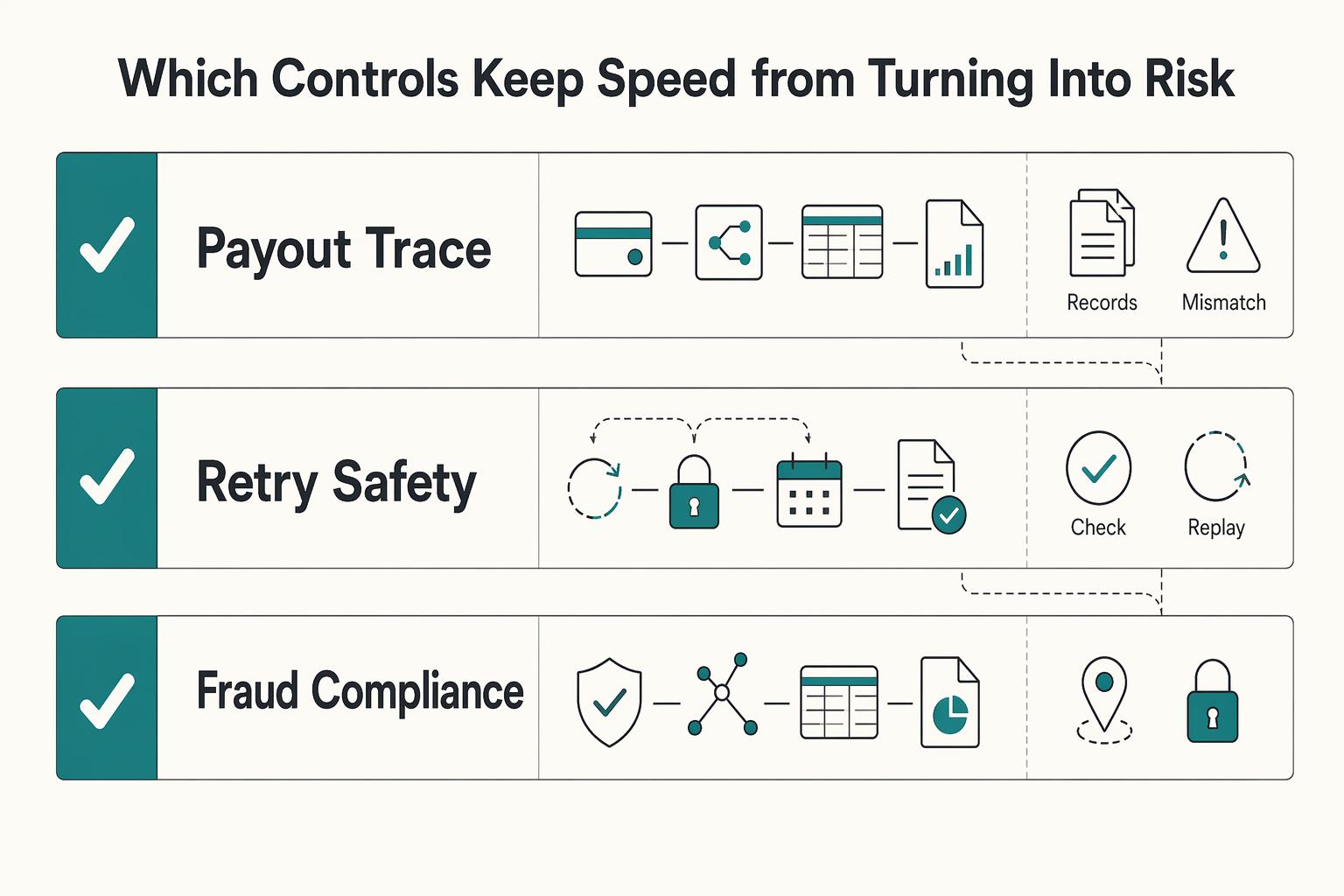
How Modern CFOs Make Payment Platform Expansion a Strategic Driver
A payment platform should choose its next market based on operational readiness, not volume forecasts alone. The real question is whether you can run that market safely and clearly without creating finance debt that later shows up as payment, reconciliation, or compliance failures. If you cannot explain that operating path cleanly, your forecast should not carry the decision.

Choosing Embedded Finance for Freelance Platforms With an Operations-First Scorecard
Trend headlines are not a selection method. If you are evaluating embedded finance for freelancers, start with an operations-first scorecard that tests day-to-day execution before you reward product polish.