

Quick Answer
First decide whether the seller needs faster access to an eligible balance or funding against future cash flow. For instant payouts, verify account and destination eligibility and disclose the speed fee. For financing, identify the finance provider, agreement, underwriting, total cost, and repayment terms. Keep legal holds active, and trace unknown payment outcomes before fallback.
Decide which cash-flow problem you are solving#
A seller asking for money sooner may need faster access to a payment balance, or money to buy inventory before the next sale. Those are different products. An instant payout accelerates eligible funds; financing supplies funds under a separate agreement and creates a repayment or receivables obligation.
Define the funding source and legal arrangement before adding a “get paid now” button. The distinction determines eligibility, costs, provider responsibilities, disclosures, accounting, and what support should do when something goes wrong.
| Product | Source of funds | Seller obligation | Core decision |
|---|---|---|---|
| Standard payout | Funds eligible under the payment arrangement | No new financing agreement solely from receiving the payout | Schedule, available balance, destination, and cost |
| Instant payout | Balance eligible for the provider’s instant-payout product | A disclosed speed fee where charged | Instant eligibility, destination, provider cost, and exceptions |
| Loan | Funds advanced under a loan agreement | Repay principal and applicable costs under the agreement | Lender, underwriting, disclosures, repayment, and servicing |
| Receivables purchase or other advance | Funds supplied under the specific financing contract | Deliver purchased receivables or perform the agreement’s obligations | Legal character, recourse, payment mechanism, cost, and risk allocation |
The exact legal character depends on the agreement and jurisdiction. Paying out an eligible balance sooner is not automatically lending. Advancing funds before the business has the relevant eligible balance is not merely a faster payment rail.
Instant payouts: verify the eligible amount and destination#
Stripe Connect Instant Payouts is one concrete provider example. It requires supported platform and connected-account locations, local payout currency, and an eligible external account. Stripe describes funds as typically arriving within 30 minutes, with possible bank delays. That is a qualified estimate, not a universal delivery guarantee.
Read the balance for the chosen account, currency, and destination immediately before creating the instruction. The Balance object distinguishes available, pending, and instant-available amounts. When monetising Connect Instant Payouts with application fees, use the applicable destination-specific net-available amount as documented, rather than treating a gross balance as the seller’s net payout limit.
Some provider products make completed card-charge funds eligible for instant payout before ordinary settlement timing; bank-debit eligibility can differ. Follow the provider’s Instant Payouts guidance and current account result. Do not assume “charge succeeded” means every payment source can be paid out instantly.
Keep the seller’s entitlement and applicable reserves or restrictions separate from technical eligibility. A positive provider balance does not permit spending another seller’s funds or releasing money subject to a legal hold. Have the account owner and authorisation model documented.
Financing: establish the provider and agreement#
Stripe Capital for platforms is a separate example of financing embedded through a Connect integration. Stripe and its financial partners describe managing eligibility, underwriting, pricing, funding, servicing, and collections. Availability, offer type, and terms differ by country and account; an account is not guaranteed an offer.
The Capital product explanation distinguishes loans from purchases of future receivables. A loan can have minimum payment requirements and debits to cover a shortfall; a receivables-purchase agreement can use a different obligation structure. Do not describe every product as a loan, interest-free cash, or repayment that always falls to zero when sales stop.
| Question | Evidence before launch |
|---|---|
| Who supplies the funds? | Named finance provider and country-specific agreement |
| What does the seller sign? | Loan, receivables purchase, or other actual financing contract |
| What is the cost? | Amount received, total amount due or purchased, fees, and required cost disclosures |
| How is payment collected? | Sales withholding, minimums, fixed payments, bank debits, and authority for each |
| Who bears losses? | Contractual allocation of default, fraud, recourse, guarantees, and servicing duties |
| What does the platform retain? | Marketing, referral, data, complaint, recordkeeping, and regulatory obligations |
Partner underwriting does not mean the platform has no obligations. Follow applicable law and the provider’s regulatory guidance for marketing, disclosures, complaints, and records. Identify the seller’s actual country and business type before offering a product; do not copy the terms of one country into every checkout.
Model seller cost and platform contribution separately#
Hypothetical instant-payout economics#
Assume the seller chooses a USD 1,000 payout, the platform charges a USD 20 speed fee, and its provider and operational costs are USD 15 and USD 3 respectively. On that stated fee basis, platform contribution is USD 2. If the fee is deducted from the seller’s balance, show the resulting proceeds before confirmation. These are hypothetical figures, not current provider prices.
At 500 similar payouts, the model yields USD 1,000 contribution before overhead and any additional losses. If average operational cost rises from USD 3 to USD 6, contribution becomes negative USD 1 per event, or negative USD 500 across that cohort. Track the observed support, return, and reconciliation work rather than assuming speed revenue is pure margin.
Hypothetical short-term advance cost#
Suppose a separate financing offer delivers USD 10,000 and requires USD 10,200 after 30 days, with no other payments or costs in this simplified example. The USD 200 cost is 2% of the amount advanced. Multiplying 2% by 365/30 gives about 24.3% as a simple annualised comparison. That calculation is not a legally prescribed APR and does not account for instalments, compounding, or other charges.
Use the actual payment dates and amounts to assess a real offer. If the fee is deducted upfront, the seller receives less cash and the comparison changes. If payments are withheld from sales during the period, the cash-flow timing also changes. Provide all required disclosures using the appropriate legal methodology; a flat fee alone does not describe the financing burden.
Keep platform referral or servicing revenue separate from payout fees and from any financing risk the platform assumes. An increase in seller adoption does not establish improved retention or profitable financing without evidence from the relevant cohort.
Use different rules for ineligibility, holds, and uncertainty#
| Condition | Appropriate action |
|---|---|
| Destination does not support instant payout | Before submission, offer an eligible standard route if the seller is otherwise cleared and agrees to its terms |
| Insufficient instant-eligible balance | Show the eligible amount or the standard schedule; do not manufacture an advance without its own approved agreement |
| Required verification or legal hold unresolved | Keep the applicable restriction active; changing rail does not clear it |
| Instant submission outcome unknown | Retrieve or trace the original instruction before creating any fallback |
| Transfer conclusively failed or returned | Use the approved recovery process, with evidence and any needed new authorisation |
| Financing offer unavailable or declined | Show that outcome accurately; do not present standard payout as approval for financing |
A standard payout can be a useful option when only the instant method is unavailable. It is not a safe fallback for every exception. Account restrictions and statutory holds apply independently of speed. A provider support case being closed does not establish permission to release funds.
Review the applicable Connect risk allocation, including responsibility for negative balances. Faster access can leave refunds, disputes, or losses to be covered later. Use documented limits and reserves within your authority rather than changing seller obligations without agreement.
Keep one durable instruction through recovery#
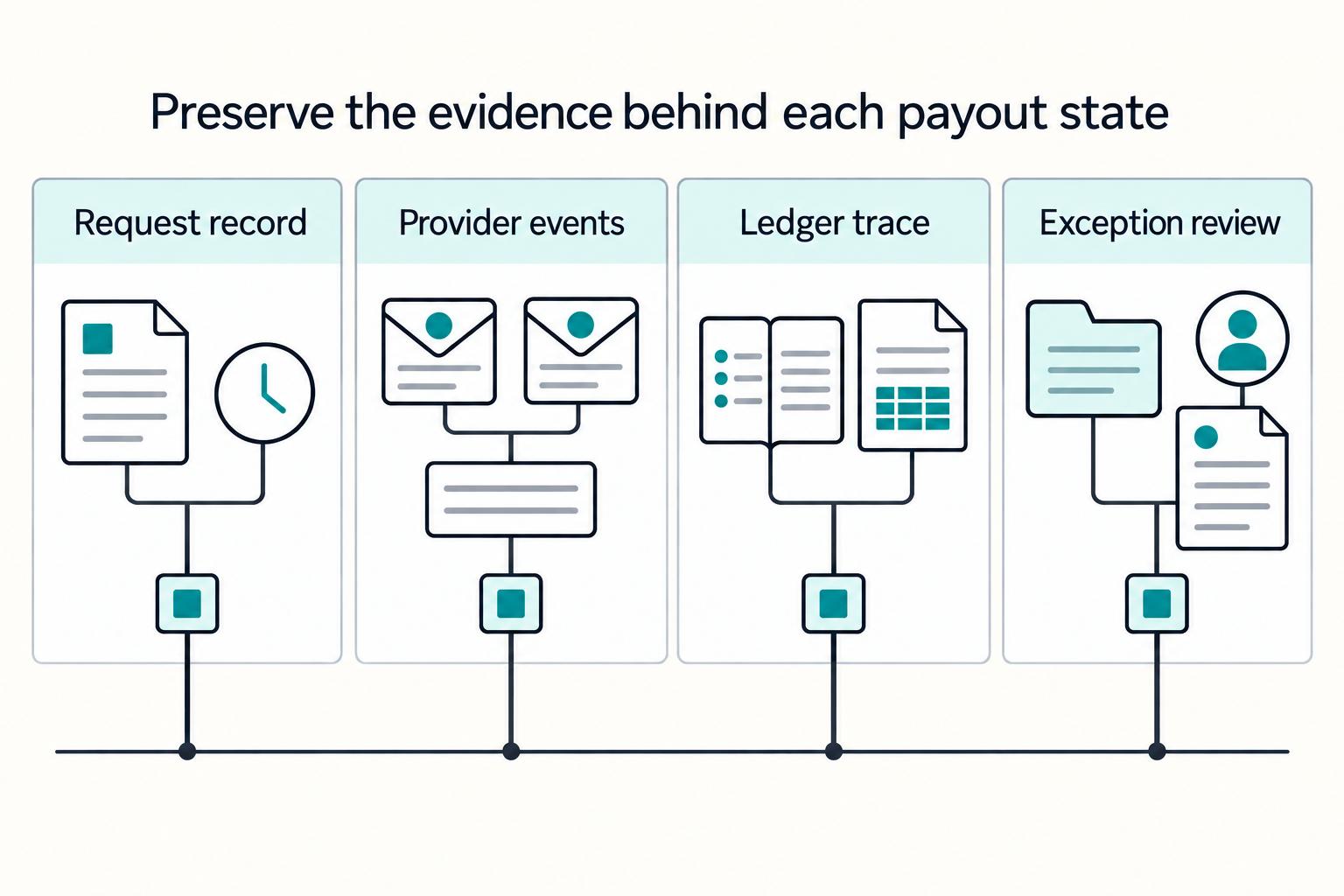
Before dispatch, persist one logical payout instruction keyed to the seller obligation, amount, currency, and approved beneficiary version. Record the request payload, provider duplicate-prevention key, and provider references against that instruction. A transport attempt is not a new seller obligation.
If a request times out, retrieve the remote result or replay the same instruction only within the provider’s supported procedure. Stripe idempotency helps with repeated API requests, but provider retention is not permanent. Keep your own durable operation record and recover old results before deciding whether a new request identity is safe.
Authenticate and durably store incoming webhook receipts before acknowledging them. Receipt is not the same as processing. Commit validated payment-state and accounting changes with the processed marker and any outbound intent in one local transaction, then dispatch outbound work after commit. A remote API call cannot be made atomic with your database transaction.
A duplicate or delayed event must not create a second payout. Use the provider’s object and event semantics to validate transitions, and retrieve authoritative state when necessary. The payout object documents statuses; an initially paid result can later fail. Keep returns and subsequent failures visible rather than closing the record permanently at the first apparent success.
Reconcile instant payouts and financing on separate paths#
Stripe’s payout reconciliation report automatically relates transactions to automatic payout batches. It does not identify the included transactions for an instant payout whose timing and amount you choose. For instant and manual payouts, reconcile against transaction history and an appropriate balance report, with your own allocation and payout records.
For each payout, retain opening balance, relevant credits and debits, holds or reserves, payout amount, fees, provider references, and closing balance. Preserve the rule that allocates the seller’s obligation to the paid amount. Do not pretend a provider supplied an automatic transaction-to-instant-payout mapping when it did not.
For financing, keep the accepted offer, funding reference, principal or purchased-receivables obligation, fees, repayment or collection events, adjustments, and remaining obligation in its own records. A financing disbursement is not marketplace trading revenue merely because it reached the same bank account.
Launch one clearly defined product at a time#
- Choose instant balance access or a specific financing product, and document its funding and legal scope.
- Define the eligible country, account type, currency, and destination or finance provider.
- Show proceeds, costs, timing qualifications, and obligations before consent.
- Assign owners for payment uncertainty, financing complaints, legal holds, and reconciliation.
- Review actual cohort cost and exceptions before expanding availability.
Assess the first cohort by received funds and resolved exceptions, seller cost, and platform contribution. Do not substitute same-day “paid” counts for a review of later failures, refunds, collections, and unresolved exposure.
Frequently Asked Questions
Are instant payouts a form of financing?
Faster transfer of an eligible balance is not automatically financing. A loan or advance against future cash flow requires its own funding arrangement, contract, and obligations. Determine the actual product before using either label.
Can we move a held seller to standard payout?
Only if the issue is method-specific and all applicable release conditions are satisfied. Required verification, legal restrictions, and unresolved transfer outcomes cannot be cleared by switching to a slower rail.
Can a flat financing fee be compared as a percentage?
You can calculate fee divided by amount received, but that alone is not a complete cost comparison or a prescribed APR. Include payment timing, instalments, deducted fees, and legally required disclosures for the actual agreement.
Does Stripe automatically map instant payouts to their underlying payments?
Stripe says it cannot identify which transactions are included in an instant payout whose amount and timing you control. Reconcile against transaction history and your internal allocation records rather than relying on automatic payout-batch mapping.
Can we resend an instant payout after a timeout?
Recover the original result first. A timeout does not establish failure. Use the saved instruction and the provider’s supported duplicate-prevention procedure before creating any replacement or fallback.
For payment approval and transfer tracking requirements, assess Gruv Payouts. A financing integration also needs an identified finance provider and the specific contractual and regulatory responsibilities described above.
Try a related tool
Researched and edited by the Gruv editorial team. Gruv builds cross-border billing, payouts, and finance-operations software for global businesses.
Sources
Educational content only. Not legal, tax, or financial advice.
Related Posts
How Supply and Demand Dynamics Should Set Your Marketplace Payout Strategy
In a two-sided marketplace, payout strategy is not back-office plumbing. It can shape whether sellers stay active, whether transactions complete reliably, and whether buyers can find supply that is ready to transact.

The Freelance Payment Penalty: A Modeled Audit of Platform Fees, FX Spreads, and Payout Delays
The money rarely disappears through a single, easy-to-spot fee. The real loss is stacked. A marketplace takes its commission, a processor adds a charge for international cards, a bank or payment company converts the currency at a spread, a platform holds the funds before release, and a wire sheds a little to intermediaries on the way in. Each layer looks defensible on its own, but the worker feels the combined result as a smaller deposit and a later payday.

How to Respond to a Subpoena for Business Records
Move fast, but do not produce records on instinct. If you need to **respond to a subpoena for business records**, your immediate job is to control deadlines, preserve records, and make any later production defensible.