
Quick Answer
Start by documenting one decision you repeatedly explain to prospects, then send that page before discovery calls. Thought Leadership functions as risk control: it improves lead quality, strengthens pricing conversations, and filters poor-fit buyers when your method, limits, and tradeoffs are visible early. Keep it lean with one main channel and a pillar piece you can repurpose, then check whether inbound messages mention your ideas rather than immediate rate shopping.
Thought Leadership as Your Ultimate Risk Mitigation System#
Treat thought leadership as risk control for your business, not just a visibility tactic. The real shift is from fast, reactive client chasing to slower, deliberate asset building. You publish to reduce risk before the next dry month, pricing call, or bad-fit project shows up.
| Risk | How it shows up | Effect of published thinking |
|---|---|---|
| Pipeline volatility | You only market when work is slow: send pitches, wait, repeat | A public body of insight creates inbound interest from people who already understand how you think and what you solve |
| Weak pricing power | Clients find you through a generic search and can price-shop | A sharp piece of insight starts you from authority instead of availability and helps you defend scope, process, and value |
| Poor client fit | Bad-fit projects show up as scope creep, late payments, and communication breakdowns | Published thinking attracts buyers who want your way of working and repels those looking for the cheapest or fastest pair of hands |
| Fragility | If your expertise only exists in sales calls and live delivery, it disappears the moment you stop billing | Codified expertise in articles, models, simple diagnostics, and other materials keeps working when you are busy, offline, or between projects |
Start with pipeline volatility. If you only market when work is slow, you stay stuck in the same loop: send pitches, wait, repeat. A public body of insight changes that by creating inbound interest from people who already understand how you think and what you solve.
That slower move protects you from rushed decisions later. A simple checkpoint: look at your last few inquiries. If prospects mention a specific article, method, or model, you are building attraction. If every lead starts with "what's your rate?" you are still depending on transactional discovery.
The next risk is weak pricing power. Discovery path shapes the negotiation before you ever speak. When a client finds you through a generic search, you are easy to compare and easy to price-shop. When they find a sharp piece of insight that helps them frame their problem, you start from authority instead of availability. That does not guarantee higher fees, but it puts you in a better position to defend scope, process, and value.
| Discovery path | What the client assumes | Negotiation leverage | Likely project quality |
|---|---|---|---|
| Generic search | You are one of many vendors | Client holds power and can price-shop | More transactional, comparison-driven |
| Unique insight | You may be the authority for this problem | You hold more power to set terms and approach | Better aligned to your method and strengths |
Poor client fit is the third risk, and this is where published thinking does real filtering. It attracts buyers who want your way of working and repels those looking for the cheapest or fastest pair of hands. That matters because bad-fit projects usually fail in familiar ways: scope creep, late payments, and communication breakdowns. If your ideas are so generic that they never turn anyone away, that is a red flag. You are broadcasting activity, not pre-qualifying demand.
The fourth risk is fragility. If your expertise only exists in sales calls and live delivery, it disappears the moment you stop billing. A durable asset is the codified version of your expertise: articles, models, simple diagnostics, and other materials that explain how you assess a problem and why you make certain recommendations.
Codifying those pieces improves consistency because you stop reinventing your explanation every time. It improves pre-qualification because clients can self-select before the call. It also improves resilience because those assets keep working when you are busy, offline, or between projects.
The tradeoff is real. This is slower than chasing the next lead. But slower is the point. You are replacing fast reactions with assets that lower risk across all four fronts at once.
If you want a deeper dive, read A Freelancer's Guide to A/B Testing Your Website and Emails.
Why Generic 'Content Marketing' Fails a Solo Business#
Generic content marketing fails a business-of-one when it optimizes output volume instead of market position. You stay busy, but you do not reliably change who you attract or how buyers perceive your work.
You can spot this in your own workflow: you draft, resize, and schedule content, then still handle proposals, follow-ups across time zones, and payment collection tasks with the same friction. The issue is not effort or even quality. It is direction.
A quick self-check is the language in your planning notes. If most of it is "What format should I use?" or "How many pieces can I publish this quarter?", you are likely in a tactical trap.
| Tactic choice | Time cost | Lead quality consequence | Pricing consequence | Delivery consequence |
|---|---|---|---|---|
| Publish on every major channel for visibility | High ongoing maintenance | Broad attention, weak qualification | You remain easy to compare | Frequent context switching from client work |
| Publish frequent assets without a clear point of view | High production/repackaging load | Activity rises, fit may not improve | Positioning stays generic | More non-billable admin around proposals/follow-ups |
| Publish fewer pieces anchored to a specific problem you want to be known for | Concentrated effort, lower maintenance burden | Narrower audience, clearer fit signals | Better differentiation in buyer perception | More protected focus for delivery |
The omnipresence trap#
You do not need to be everywhere. You need one or a few channels that match buyer behavior and that you can maintain without harming delivery.
| Filter | Question | If it fails |
|---|---|---|
| Channel fit | Are your actual buyers there in a professional context? | Cut the channel |
| Buyer intent | Does the channel support problem-aware reading and later recall? | Cut the channel |
| Maintenance burden | Can you run it consistently during heavy client weeks? | Cut the channel |
Run every channel through those three questions before you add it. If a channel fails, cut it.
Keep it tied to the P&L#
For a business-of-one, content must compete with proposal work, follow-up load, client-fit screening, and payment reliability work. Publishing multiple pieces each year is not enough if you still attract the same buyers with the same objections.
Use this mini-checklist before committing to any content activity:
- Will this help a prospect understand your method before a call?
- Will this reduce repeated explanation in proposals or follow-ups?
- Will this improve fit quality, not just raw attention?
- Can you maintain this without weakening delivery focus?
If the answer is mostly no, skip it. That is workload, not leverage. Related: A Freelancer's Guide to Angel Investing and Venture Capital.
The Lean Thought Leadership Framework: One Channel, One System, Maximum Leverage#
Use a fast-then-slow rhythm: move quickly on publishing and replies, but go slower on your core claim, proof, and positioning so the work stays credible.
1. Write down a point of view you can defend. Start with a claim, not a topic. Use this sequence before you draft anything: What is my claim? What is the strongest counterpoint? What proof source do I have? Why is this relevant to a client decision now? If one of those is weak, pause and tighten it. Keep your proof sources in one running evidence file - project notes, repeated proposal questions, anonymized client patterns - and do not publish pieces that cannot point back to it.
2. Pick one primary channel with a simple rubric. Choose one channel that helps buyers evaluate you, not just notice you. Score each option on buyer intent, conversation depth, and consistency burden.
| Rubric factor | Keep as primary channel when... | Deprioritize when... |
|---|---|---|
| Buyer intent | People arrive problem-aware and looking for practical guidance | Attention is broad but low-intent |
| Conversation depth | You can explain tradeoffs and get substantive follow-up questions | Interaction stays shallow and reactive |
| Consistency burden | You can maintain quality during delivery-heavy weeks | It forces rushed output or inconsistent quality |
Then watch for buying signals in real conversations: people reference your ideas, share them internally, or start applying them before contacting you.
3. Turn one pillar asset into a repeatable workflow. Build one strong pillar piece, then repurpose it into touchpoints that support evaluation across the buyer journey.
| Pillar asset | Repurposed output | Distribution touchpoint | Expected business outcome |
|---|---|---|---|
| One in-depth article or memo | Short post focused on one claim | Primary public channel | Clearer positioning before first contact |
| Same article or memo | Brief email with one practical takeaway | Newsletter or direct follow-up | Better trust with quiet evaluators |
| Same article or memo | Proposal snippet, FAQ response, or call-prep note | Sales calls and follow-ups | Less repeated explanation and stronger fit screening |
If repurposed pieces start sounding generic or recycled, go back to the claim and proof source, not the format.
4. Treat engagement as research, not applause collection. Meaningful engagement is decision-relevant feedback: serious follow-up questions, direct messages about specific problems, and objections that repeat in calls or threads. Capture recurring objections in one log, label them clearly, and feed them into your next content cycle. Move fast on short clarifications in public, then go slower on deeper assets that resolve the highest-friction objections. Over time, this improves lead fit: aligned buyers come in better prepared, and poor-fit buyers self-select out earlier.
You might also find this useful: A Freelancer's Guide to Content Licensing and Syndication.
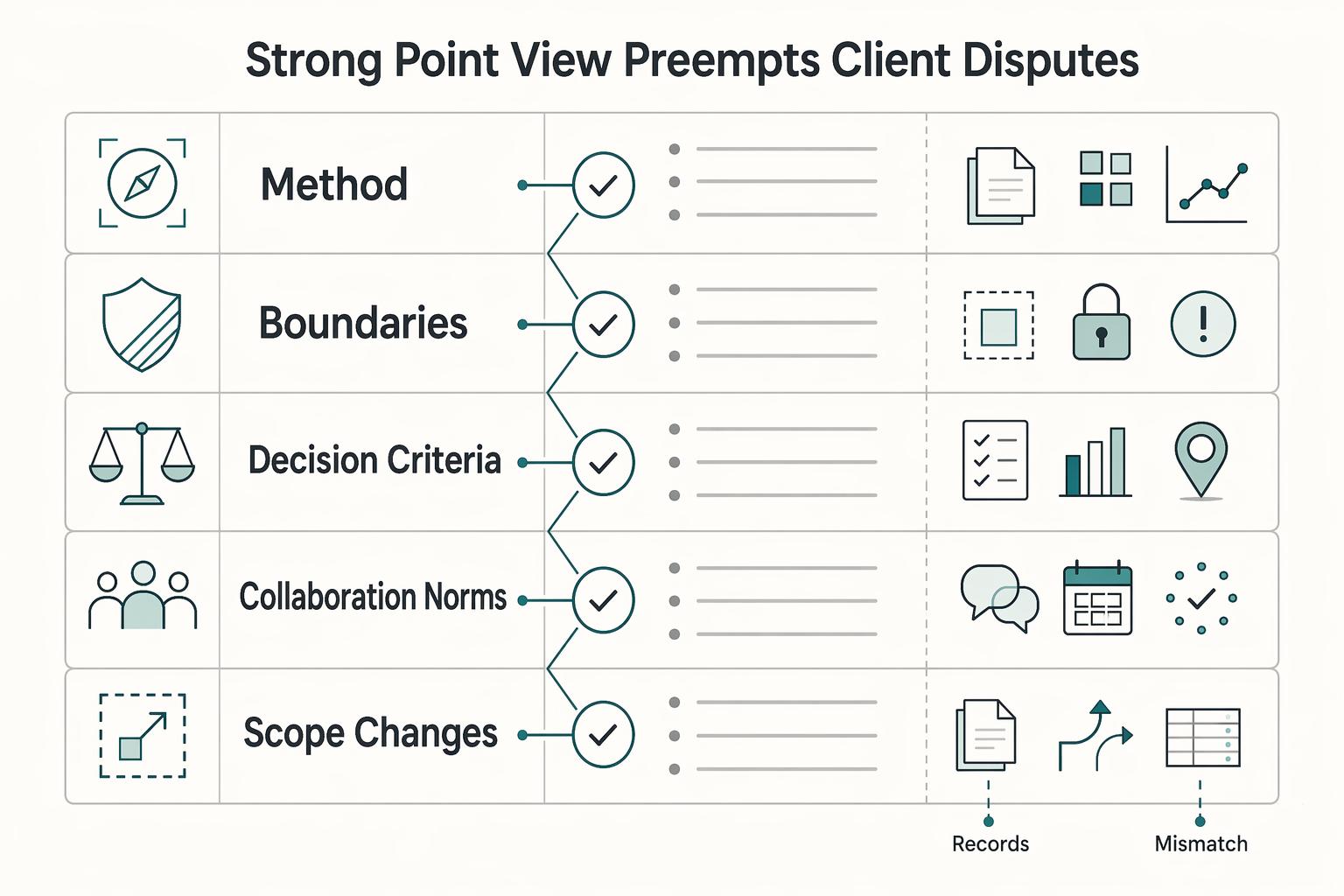
How a Strong Point of View Preempts Client Disputes#
Use your public point of view to set expectations before kickoff, so fewer conflicts start in proposal review, scope alignment, feedback cycles, and invoice acceptance. It is not a contract, and it does not guarantee a smooth engagement. It does make your method, limits, and collaboration rules visible early, so both sides start from clearer assumptions.
| Framework part | What to state publicly |
|---|---|
| Method | Explain your workflow steps in plain language |
| Boundaries | State what is in scope vs out of scope |
| Decision criteria | Show how you evaluate tradeoffs and approve changes |
| Collaboration norms | Define how feedback, updates, and approvals should happen |
Use authority bias as a practical lens: when buyers have already seen how you decide, they are less likely to renegotiate every step from zero. In practice, this shows up when you explain why discovery comes first, why extra rounds trigger re-scoping, why feedback should be consolidated, and why invoices follow the agreed process.
| Dispute-prone area | Unclear public stance | Clear point of view |
|---|---|---|
| Scope changes | "Can you just add this?" keeps expanding | Your published method states when changes require re-scoping |
| Revision pressure | Feedback grows without a stopping rule | Your decision criteria and review norms are already stated |
| Communication cadence | Client assumes always-on, ad hoc access | Your collaboration norms define update rhythm and response expectations |
| Payment friction | Invoice feels disconnected from delivery | Your public process connects milestones, decisions, and billable work |
In public content, make those four items explicit so a prospect can review them before the call.
For cross-border or procurement-minded buyers, map content assets to trust signals they can review quickly:
| Public asset | Trust signal it supports |
|---|---|
| Methods page | How work is performed and governed |
| Sample process note | How decisions and handoffs are documented |
| Versioned service terms | Change control across versions (Version List, authorship/history, clear change markers) |
| Client-requested document slot | Evidence you can produce the specific document a buyer requests |
Quick self-audit:
- Can a prospect see how you handle scope, revisions, and feedback before a call?
- Do your proposal language and public language match?
- Do key pages show current version status and change visibility?
- Does this content prevent misunderstandings, or only market expertise?
For a step-by-step walkthrough, see A Freelancer's Guide to Donating to Charity (and the Tax Benefits).
From Expert-for-Hire to Durable Asset: Your Next Step#
Your next step is simple: take one explanation you repeat in calls or email, and turn it into a reusable page you can send before the next conversation.
| Area | Keep it ad hoc | Build one reusable asset |
|---|---|---|
| Offer design | Rewrite your approach from scratch each time | Publish a short diagnostic note with your approach, limits, and out-of-scope items |
| Pipeline control | Start each conversation from zero context | Share one article, FAQ, or decision note before the first call |
| Pricing posture | Explain assumptions live while discussing price | Put assumptions, exclusions, and decision criteria in writing first |
| Asset ownership | Leave core reasoning in private threads | Keep your best reasoning in a page you can update and reuse |
| Client-fit filtering | Discover misfit late in back-and-forth | State boundaries and poor-fit cases publicly |
Use fast thinking for live delivery. Use slow thinking for repeat decisions: write down the recurring judgment, the conditions you use, and what would make you change your view.
Before you publish, verify the sources you rely on. If you cannot open and read the full text of a source, hold that claim until you can confirm it.
- Pick one repeated client or prospect question from recent conversations.
- Draft one page with your diagnosis, tradeoff, limits, and the information you need before quoting.
- Add a visible last-updated marker, then send that page before your next discovery call.
We covered this in detail in A Freelancer's Guide to Understanding Inflation and Interest Rates.
Frequently Asked Questions
What counts as Thought Leadership if definitions are all over the place?
Use a practical definition: you become a trusted, go-to opinion leader in a narrow area of expertise. That matters because vague positioning creates confusion. Pick one claim you want to be known for, then publish one short piece that explains what you believe, why, and where you draw limits.
What is the real ROI for a solo freelancer or small expert team?
Do not treat this as a guaranteed revenue jump. A practical way to assess return is to track whether your content is consistently answering recurring audience questions and improving the quality of your conversations over time. Focus on those signals rather than vanity metrics.
Should you optimize for audience growth or qualified pipeline?
There is no universal target for everyone. If you use growth targets, verify your benchmark first. Keep a simple lead log and tag inbound contacts by source and fit so you can see which content is bringing useful conversations.
How do you do this without a marketing team?
You do not need a content machine. You need consistency and one repeatable publishing rhythm. A common failure mode is stopping when the blinking cursor gets intimidating. Block one recurring session each week, answer one real client question, and keep a running topic list pulled from calls, email threads, proposal comments, and review notes.
What should you write about when you feel like you have nothing original to say?
Start with the work topics you would naturally discuss with peers, the barbecue version, not a formal industry performance. Your best material usually comes from recurring audience questions. Review your last ten client or prospect conversations and turn the repeated questions into a short FAQ, decision note, or tradeoff post.
How does this reduce risk if you work across borders or with compliance minded clients?
It can improve clarity by making your method, boundaries, and decision criteria visible before proposal review. It does not replace contracts, service terms, tax registration, or any client-required compliance document, and it should not be treated as legal or compliance risk reduction on its own. Keep an evidence pack behind your public content with versioned service terms, a last-updated marker on key pages, sample process notes, and any client-facing requirements you have verified.
Can you give one concrete example that applies beyond a single profession?
Yes. A software developer might publish "Why I chose one implementation path over another," showing tradeoffs, risks, and decision criteria rather than just code samples. The pattern transfers well to designers, writers, consultants, and operators: explain the decision, name the constraints, show the tradeoff, and state what evidence changed your mind. Draft one post using those four parts and remove any client identifiers before publishing.
How long does it take to see results?
Treat this as a practice that compounds over time, not a short campaign with a fixed payoff date. If you want to publish a timeline estimate, verify it first. Set a review point after a defined publishing cycle, compare inquiry quality before and after, and keep going if the questions you receive are getting sharper.
Try a related tool
Researched and edited by the Gruv editorial team. Gruv builds cross-border billing, payouts, and finance-operations software for global businesses.
Sources
Includes 5 external sources outside the trusted-domain allowlist.
- revisor.mn.gov/laws/2025/1/9trusted
- consideredcontent.com/blog/thought-leadership-beyond-the-content-a...external
- leveragewithmedia.com/types-of-thought-leadership-contentexternal
- orx.org/blog/unlocking-the-future-orx-scenarios-thou...external
- scribetribe.media/dear-thought-leader-2-frequently-asked-quest...external
- viewfinderpartners.com/blog/most-common-thought-leadership-question...external
Educational content only. Not legal, tax, or financial advice.
Related Posts

The Freelance Payment Penalty: A Modeled Audit of Platform Fees, FX Spreads, and Payout Delays
The money rarely disappears through a single, easy-to-spot fee. The real loss is stacked. A marketplace takes its commission, a processor adds a charge for international cards, a bank or payment company converts the currency at a spread, a platform holds the funds before release, and a wire sheds a little to intermediaries on the way in. Each layer looks defensible on its own, but the worker feels the combined result as a smaller deposit and a later payday.

How to Respond to a Subpoena for Business Records
Move fast, but do not produce records on instinct. If you need to **respond to a subpoena for business records**, your immediate job is to control deadlines, preserve records, and make any later production defensible.

A US Expat's Guide to Investing in UCITS ETFs to Avoid PFIC Issues
The real problem is a two-system conflict. U.S. tax treatment can punish the wrong fund choice, while local product-access constraints can block the funds you want to buy in the first place. For **us expat ucits etfs**, the practical question is not "Which product is best?" It is "What can I access, report, and keep doing every year without guessing?" Use this four-part filter before any trade: