
Quick Answer
Angel investing for freelancers should come after cashflow stability, not before. Use a repeatable decision system: protect operating capital, run a Go/No-Go gate, and allocate only true surplus into a capped Risk Capital bucket. Then do operator-grade due diligence with clear documentation and compliance checks. If reserves, taxes, or payment reliability are fragile, pass and fix the business first.
You don't need "more investing knowledge" - you need a cashflow-safe decision system#
Build a decision system that protects your operating cash first, then treat angel investing as an optional use of true surplus. If you are considering angel investing as part of broader wealth building, you need controls that keep "startup investing" from quietly raiding rent, taxes, or payroll. Knowledge feels productive, but constraints keep you solvent. As the CEO of a business-of-one, your job is to protect the operating cash that keeps the machine running.
If your income arrives in waves, timing risk is real. That reality can make angel investing and venture capital adjacent opportunities uniquely dangerous, not because they are "bad," but because they often involve illiquid investments with unclear timing and uncertain outcomes. Operators do not invest with money that still has a job.
To stay cashflow-safe, install a simple decision system before you even evaluate a deal.
Verify surplus, cap exposure, and write down what you reviewed#
| Tool | Purpose | What it prevents | When to run it |
|---|---|---|---|
| Cashflow check | Confirms you can invest without touching operating obligations | Cash crunch from investing money you need soon | Before you take a founder call seriously |
| Allocation cap | Sets a hard limit so one deal cannot dominate your risk | Over-concentration and reactive decision-making elsewhere | Before you say "yes" in principle |
| Diligence notes | Forces clear documentation, assumptions, and next steps | Memory-based decisions and messy records later | Before you wire funds |
A brief hypothetical: a founder offers you a "quick allocation" because the round closes soon. Your system says: first, verify the money comes from true surplus after obligations. Second, cap exposure so urgency cannot change your plan. Third, write down what you reviewed and what you did not. If you cannot do all three, you decline. Clean, professional, repeatable.
Jurisdiction-dependent items you must verify (no guessing)#
Legal, tax, and eligibility requirements can vary by jurisdiction and sometimes by offering structure. Treat those as verify-first items, not vocabulary words.
Default to this: ask the issuer what requirements apply, confirm your eligibility in writing, and get qualified legal or tax advice when anything looks unclear before you send funds. Want a quick next step? Try the free invoice generator.
Build the mental model first: what you're actually doing when you "angel invest"#
Angel investing is not client work, and you should not evaluate it like client work. Even among people who do it, expectations vary. For example, in a Quora thread, one respondent asserts that "angel investors will only invest when you have a product already produced and proven" (treat that as one person's view, not a universal rule).
I'll use angel investing as shorthand for putting your own money into a startup under written terms.
And I'll use angel investor to mean an individual deploying personal capital (not client funds). Treat that "not client funds" piece as a hard boundary. You protect your reputation and your operations by keeping investing activity downstream of your cashflow reserves and tax set-asides.
The 4 terms you will see (and what to do with them)#
You will hear founders use phrases like Equity Financing and Convertible Debt. The operator move is simple: do not fill in the blanks from social media or vibes. Ask for the documents and read what you actually sign.
| Term you'll hear | Your operator action |
|---|---|
| Angel Investing | Ask what the founder means by "angel" in this round and what, exactly, you're buying. Log the decision and documents. |
| Angel Investor | Clarify whether you're investing personally or via an entity, and keep strict separation from client money and operating cash. |
| Equity Financing | Request the signed term summary and the exact security you're being asked to purchase. |
| Convertible Debt | Request the note or agreement. Have counsel explain outcomes before you wire. |
Freelancer translation: stop calling it "income"#
Don't automatically treat startup investing like invoices. Plan for uncertainty, and plan for paperwork.
A quick hypothetical: a founder says, "It's basically equity." You respond, "Send the docs, tell me what I'm buying, and confirm whether any eligibility requirements apply." If they cannot produce clear documentation, you decline. That is not pessimism. That is professional capital allocation.
If you want a deeper dive, read the six-month Japan digital nomad visa runbook.
Should you angel invest before your cashflow is stable? Use this Go/No-Go gate#
No reserves plus invoice uncertainty equals no angel checks. If you understand angel investing as illiquid startup exposure (not a new revenue stream), you also need a gate that protects your runway before you touch any alternative investments. The operator default is "No-Go" until the business can absorb delays, taxes, and bad months without drama.
The 4 Go/No-Go gates (run them in order)#
Gate #1: Runway math (non-negotiable). If you do not have a Cashflow Reserve that covers a defined number of months and you routinely float expenses because invoices land late, you do not invest. Treat angel investing and venture capital style deals as optional. Your rent, contractors, tools, and tax obligations are not optional.
Gate #2: Payment risk reality check. If chargebacks, client non-payment, or payout holds show up often, fix collections first. Angel checks do not reduce uncertainty. They stack uncertainty on uncertainty. Your action: tighten payment terms, shorten time-to-cash, and stop the bleeding before you wire money to a startup.
Gate #3: Tax and compliance buffers (United States, U.S. taxpayers). If you are a U.S. taxpayer, protect tax reserves and reporting readiness before investing.
The IRS says you use Form 8938 to report specified foreign financial assets if their total value exceeds the appropriate reporting threshold, and you attach Form 8938 to your annual tax return. Under FATCA, certain U.S. taxpayers holding financial assets outside the U.S. must report them to the IRS generally using Form 8938. Failure to report may result in penalties starting at $10,000, and the IRS notes higher penalties can apply for continued failure after notification (up to $50,000). Do not invest money you might need to cover taxes, professional help, or compliance cleanup.
Gate #4: Concentration and timing. If one client represents a large percentage of revenue, treat your income as fragile. Adding startup investing exposure amplifies volatility, especially with Convertible Debt that does not repay on a predictable schedule. De-risk the base (client concentration) before you add illiquid bets.
Your decision rule (write it down)#
| If this is true | Default decision | What you do next |
|---|---|---|
| No Cashflow Reserve and late invoices force you to float expenses | No-Go | Build reserves, then revisit |
| Chargebacks, non-payment, or payout holds recur | No-Go | Fix collections and payout reliability |
| U.S. tax/compliance buffers not ready (FATCA, Form 8938 awareness) | No-Go | Set aside taxes, confirm reporting needs |
| Revenue concentrates in one client and timing feels fragile | No-Go | Reduce concentration before illiquid bets |
Hypothetical: a founder offers you "basically equity" via convertible debt. You run the gate, see recent payout holds plus a thin reserve, and you pass, even if you like the product. That is not fear. That is professional wealth building.
How much should a freelancer allocate to angel investing (without breaking payroll, taxes, or rent)?#
Allocate only from a defined Risk Capital bucket, after Operating Capital (reserves, taxes, and obligations) is fully protected. A Go/No-Go gate prevents thin-runway mistakes. Sizing prevents one "yes" from turning into a cashflow incident.
The two-bucket model (your default safety rail)#
Operating Capital is money with a job. Risk Capital is money without a job (yet), so it can take startup investing risk.
| Bucket | What belongs here | Non-negotiable rule |
|---|---|---|
| Operating Capital (protected) | Cashflow Reserve, tax set-asides, upcoming bills, contractor payroll, tools, any money you might need on short notice | Do not invest it. Ever. |
| Risk Capital (investable) | Surplus you can lock up without affecting obligations | Only this bucket funds Angel Investing and other high-uncertainty bets |
This separation is what keeps a good investment decision from becoming an operational mistake.
The "10-minute allocation framework" (repeat monthly)#
| Step | Action in the text | Rule |
|---|---|---|
| Lock the Cashflow Reserve | Pick a runway target in months and physically separate it from investing accounts; one guide recommends 12 to 18 months of runway and a 15 to 25% contingency buffer in a pre-seed budgeting context | Define runway, add buffer, then stop touching it |
| Cap total angel exposure | Cap exposure to a small slice of what you truly own free and clear | If you would feel forced to sell something else, miss a tax payment, or take bad client terms to make it back, you allocated too much |
| Set a per-deal maximum | One startup should not dominate your Risk Capital | Concentration turns one founder update into a personal finance emergency |
- Step 1: Lock the Cashflow Reserve. Pick a runway target in months and physically separate it from investing accounts. In a pre-seed budgeting context, one guide recommends targeting 12 to 18 months of runway and adding a 15 to 25% contingency buffer for surprises. Borrow the principle: define runway, add buffer, then stop touching it.
- Step 2: Cap total angel exposure to a small slice of what you truly own free and clear. Do not hunt for a magic percentage. Use a harder standard: assume illiquidity and uncertain timing. If you would feel forced to sell something else, miss a tax payment, or take bad client terms to "make it back," you allocated too much.
- Step 3: Set a per-deal maximum to avoid concentration. One startup should not dominate your Risk Capital. Concentration turns one founder update into a personal finance emergency.
Default staging plan (risk ramp): start with learn-sized checks until you can explain, in writing, how Venture Capital dynamics can change outcomes (priced rounds, dilution, down-rounds, and follow-on needs). Scale only after you build a repeatable process and a diversified posture.
Client shock test: assume your biggest client pauses payments for an extended period. If you cannot cover obligations without touching angel positions, reduce your Risk Capital allocation (or pause new checks).
Hypothetical: you want to invest after a great founder call, but the shock test shows you would dip into taxes if invoices slip. You pass. That is wealth building with operator discipline.
Where do freelancers actually find angel deals - and what access paths are realistic?#
Angel investing typically means putting your own money into an early-stage startup in exchange for equity, often before the company hits major milestones. It also means you can lose your entire investment if the startup fails, so the real work is staying intentional, not impulse-driven.
The right angel can bring more than cash, including industry connections, mentorship, and operational expertise. But fit matters: the process of finding the right investors (and being the right investor for a founder) can take longer and be more difficult than you expect, and the wrong match can waste time and hurt the business.
Realistic access paths (and what to expect)#
Treat "access" as optional, not guaranteed. Some providers market investor matching and visibility (often alongside guidance), which can increase exposure to opportunities. It does not replace careful evaluation of the company or the terms.
Keep your process simple (so you do not gamble with your attention)#
Do not "shop for hot deals." Keep a consistent diligence habit, write down why you said yes or no, and be willing to pass when the information you need is not available.
Hypothetical: a founder you like asks for a quick check on unclear terms. You ask for the missing details in writing. If they cannot provide them, you decline and preserve your capital for a deal that respects process.
The freelancer-grade due diligence checklist (audit-ready, reusable, and designed to prevent regret)#
Run due diligence with a real data room, a written risk memo, and evidence for every key assumption before wiring funds. Deal flow is worthless if you cannot evaluate consistently. This workflow keeps angel investing for freelancers in the "controlled decision" lane, not the "hope and pressure" lane.
1) Build your "data room" habit (and make it audit-ready)#
A startup should be able to share a data room. That means a collection of legal, financial, and operational documents prepared for due diligence in fundraising. Your job is to store what you receive, track versions, and write down what you concluded.
Use this safe-default structure:
| What you request | What you look for | What you store internally |
|---|---|---|
| Legal documents (including documents that govern the investment) | The exact instrument you're buying and anything that modifies it | Signed copies, plus a one-page summary of key terms in your own words |
| Financial documents | Evidence that numbers reconcile and match the story | The files, notes on inconsistencies, and follow-up answers |
| Operational documents | Proof the business runs the way the deck claims | A short list of verified strengths, open questions, and deal risks |
Risk memo (non-negotiable): keep a dated "why I said yes/no" note. Treat it as traceability. If you cannot explain the decision later without re-reading the entire deck, you did not finish your due diligence.
2) Pressure-test like an operator (not a tourist)#
You already know how to spot fragile revenue from client work. Apply the same lens:
| Check | Questions to ask | Risk lens |
|---|---|---|
| Revenue quality | How customers pay, why they stay, and what causes churn | Customer concentration risk |
| Burn and runway | Walk through cash burn and runway assumptions | Whether there are operational levers they can pull if funding slows |
| Cash management and counterparty risk | Where funds sit, who controls access, and what the company does to manage treasury operations | Basic operational risks |
- Revenue quality: Ask how customers pay, why they stay, and what causes churn. Then sanity-check customer concentration risk.
- Burn and runway: Make them walk you through cash burn and runway assumptions. Do not accept "we'll raise again" as a plan. You want operational levers they can pull if funding slows.
Add one more check many first-time angels skip: cash management and counterparty risk. Ask where funds sit, who controls access, and what the company does to manage treasury operations. Do not pretend basic operational risks cannot show up.
Hypothetical: a founder pushes for a fast close. You respond, "Happy to move quickly. Share the data room and I'll confirm within my process window." If they resist documentation, you pass.
Finally, set a recurring review rule. Portfolio risk management requires regular evaluation and adjustment. Re-read your risk memo before any follow-on check, and confirm the facts still hold.
Do you need to be an Accredited Investor - and how do you stay compliant across borders?#
Verify eligibility and cross-border compliance before you commit, sign, or wire funds. If your diligence is audit-ready, your eligibility and reporting posture should be too. This keeps angel investing for freelancers inside the controlled-decision lane and away from avoidable cleanup.
In the United States, private startup offerings can come with specific legal conditions, including who is allowed to participate. Do not guess, and do not let a founder's "everyone can invest" reassurance substitute for the actual offering terms. You need the company (or its counsel) to state the legal basis and any investor eligibility requirements clearly.
If you operate cross-border, add a second layer. Your residency, citizenship, and the issuer's location can all change what you can legally buy and what you must report. Do not treat "I live here, the company lives there" as trivia. Treat it as a requirement to confirm rules in writing.
Your pre-commit compliance script (safe default)#
Before you send funds, ask these questions and store the answers next to your risk memo:
| Ask for this | Why it matters | What you store |
|---|---|---|
| "What legal basis does this offering rely on?" | Eligibility and disclosure requirements can vary by structure. | The written answer plus the final signed docs. |
| "Are there any investor eligibility requirements I must meet to participate?" | You must confirm eligibility before you sign and wire. | The eligibility statement and any investor questionnaire you completed. |
| "Any restrictions for non-local or cross-border participants?" | Cross-border rules can change what's permitted and how you subscribe. | A short summary of restrictions and who confirmed them. |
Hypothetical: you live abroad, a U.S. startup asks for a quick wire, and the subscription flow asks you to make eligibility representations. You pause. You request the legal basis and a clear yes or no on whether you can participate under the deal's terms. If they cannot answer cleanly, you stop and get professional advice.
Reporting awareness (not tax advice): FBAR + FATCA/Form 8938#
If you hold foreign financial accounts or foreign assets, you may need to consider FBAR reporting (via FinCEN Form 114) and FATCA reporting via IRS Form 8938. The IRS states, "Under FATCA, certain U.S. taxpayers holding financial assets outside the United States must report those assets to the IRS generally using Form 8938," and Form 8938 must be attached to the taxpayer's annual tax return. The IRS also states that U.S. taxpayers who do not have to file an income tax return for the year do not have to file Form 8938, regardless of asset value.
| Item | Article detail | Reference |
|---|---|---|
| FBAR | If you hold foreign financial accounts or foreign assets, you may need to consider FBAR reporting | FinCEN Form 114 |
| FATCA reporting | Certain U.S. taxpayers holding financial assets outside the United States must report those assets to the IRS generally using Form 8938 | IRS Form 8938 |
| Form 8938 filing threshold | In general, the aggregate value of reportable assets must exceed $50,000 to be reportable, though in some cases the threshold may be higher | $50,000 in general |
| Form 8938 filing exception | U.S. taxpayers who do not have to file an income tax return for the year do not have to file Form 8938, regardless of asset value | No Form 8938 if no income tax return is required |
| Failure-to-report penalties | The IRS notes a $10,000 penalty for failure to report and up to $50,000 for continued failure after IRS notification | $10,000 to $50,000 |
On thresholds, the IRS notes that in general the aggregate value of reportable assets must exceed $50,000 to be reportable on Form 8938, but in some cases, the threshold may be higher. The IRS also notes you may face a $10,000 penalty for failure to report, and up to $50,000 for continued failure after IRS notification.
If you change residency or entity structure, connect the dots early with your setup and banking rails. Start here: How to Set Up a US LLC from Germany.
The Gruv-fit operations layer: keep investing downstream of a reliable "get paid" system#
Keep angel investing downstream of your "get paid" system so you reduce the odds it ever touches operating money. Even when compliance is correct, operator mistakes still happen. This layer is meant to make those mistakes less likely.
Core rule: your investing policy answers to your "get paid" system, not the other way around. If you are still dealing with late invoices, unpredictable payout timing, or disputes, you may not have investable slack yet. Treat angel investing (and other alternative investments) as wealth building that happens only after your business pays itself cleanly.
Separate money by purpose (and make it explainable later)#
You want two clean workflows: one for running the machine, one for placing bets. The idea is to protect your Cashflow Reserve from accidental investing caused by timing mismatches, holds, or optimism.
| Layer | What it's for | What you track | Safe default |
|---|---|---|---|
| Client Ops (Operating Capital) | Client receipts, taxes, tools, contractors, refunds | Invoices, payouts, fees, disputes, obligations | Many teams choose not to invest from here. |
| Investing Ops (Risk Capital) | Angel Investor checks, follow-ons, startup paperwork | Subscription docs, wires, decision memo, cap table notes | Some fund this only after close. |
If you ever need to explain a transfer (to yourself, an accountant, a partner), you can. That is the point.
Hypothetical: you invoice a client, see a payout pending, and a founder asks you to wire "today to get into the round." You might choose not to treat "pending" as cash. You might wait until your close process confirms what is truly available. Then you fund the investment from Risk Capital only.
Build a monthly close that updates "Risk Capital available" last#
Accounting and cash management routines vary by business and jurisdiction, so treat this as a practical operating pattern, not universal advice.
If you run a monthly close, one simple approach is to update "Risk Capital available" last:
- Reconcile what you believe you earned with what actually landed.
- Confirm obligations cleared (near-term bills, taxes you set aside, contractor payments you owe).
- Verify your Cashflow Reserve still sits intact in the operating layer.
- Update "Risk Capital available" last, and only if the above steps still hold true.
Practical next step: write a standing rule you can follow when you feel excited, and keep it consistent. The goal is a hard gate that matches your real cashflow reality, not your optimism.
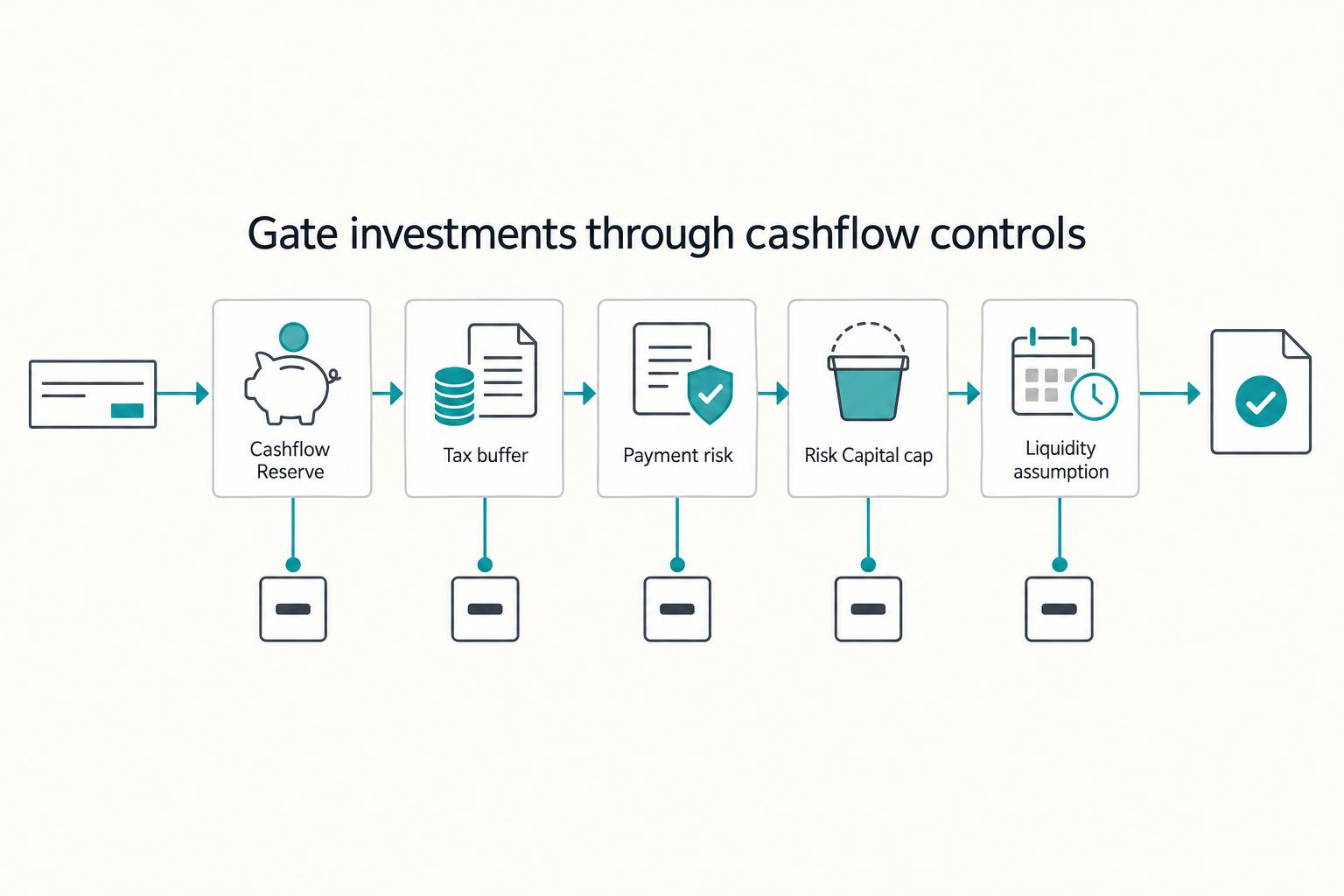
Run the cashflow gate before any check leaves your account#
Treat angel investing for freelancers as a controlled, cashflow-protected decision that only happens after you clear a written Go/No-Go gate. Here is the operator recap you can run each time a founder asks you to wire this week. The goal is simple: keep startup investing in the alternative investments lane, not in your rent, tax, or payroll lane.
Cashflow-protection Go/No-Go checklist (copy, paste, run monthly)#
Define the game: Angel Investing buys long-horizon, illiquid exposure through Equity Financing (you own shares) or Convertible Debt (a contract that can convert to equity later). It never replaces client revenue. If you need the money to stabilize invoicing, collections, or delivery, you are not investing. You are borrowing trouble.
Run this gate before any check leaves your account:
| Gate | Pass criteria | If you fail |
|---|---|---|
| Cashflow Reserve | Your Cashflow Reserve stays untouched after the investment. | No-Go. Rebuild reserves first. |
| Tax buffer | You set aside taxes and near-term obligations before investing. | No-Go. Do not invest from tax money. |
| Payment risk | You reduced recurring disputes and chargebacks (or platform payout holds). | No-Go. Fix collections and terms first. |
| Risk Capital cap | You invest only from a clearly labeled Risk Capital bucket. | No-Go. Separate accounts, then decide. |
| Liquidity assumption | You assume zero liquidity for years. | No-Go. Do not invest money you might need. |
Allocation with constraints (safe defaults):
- Cap exposure per deal so one startup cannot dominate your Risk Capital.
- Stage exposure (small learn-sized checks first) before you scale.
- Write one sentence that explains your rule. If you cannot, you do not have a rule.
Hypothetical: a founder offers a "friends and family" note right as two clients pay late. You pass. You failed the gate (cash timing risk), so you delay or decline.
Due diligence and compliance (don't skip the boring parts)#
Execute Due Diligence like an operator: keep a written log, store docs (terms, cap table summary, side letters), and document why you said yes. Also track counterparty and banking risk. Where the money sits matters.
For cross-border compliance, verify instead of guessing. The IRS states: "Under FATCA, certain U.S. taxpayers holding financial assets outside the United States must report those assets to the IRS generally using Form 8938." The IRS also says to use Form 8938 to report specified foreign financial assets if the total value is more than the appropriate reporting threshold, and that Form 8938 must be attached to the taxpayer's annual tax return. The IRS adds that U.S. taxpayers who do not have to file an income tax return for the year do not have to file Form 8938, regardless of asset value. The IRS also notes you may have to file FBAR (FinCEN Form 114). Failure to report foreign financial assets on Form 8938 can trigger a $10,000 penalty, and up to $50,000 for continued failure after notification.
Call to action: If you want angel investing and venture capital exposure to stay sane, lock reserves and tighten collections first. Then, and only then, invest from a defined Risk Capital bucket.
Frequently Asked Questions
Can freelancers be angel investors?
Often, yes, but eligibility depends on the offering and your jurisdiction. Treat it as personal Risk Capital, not business money. At its core, angel investment means backing an early-stage startup with your own capital in exchange for equity. Your operating rule stays the same: invest only from a separated Risk Capital bucket after your monthly close confirms taxes, obligations, and reserves stay intact.
Do you need to be accredited to angel invest?
Some private startup offerings restrict participation and may require specific investor qualifications. Do not guess based on what a founder says. Ask, in writing, what the offering relies on and whether any investor status requirements apply, then confirm with qualified counsel if anything feels unclear.
How much should a freelancer allocate to angel investing?
Use a policy, not a vibe. Allocate only what remains after you fund (1) your Cashflow Reserve, (2) tax set-asides, and (3) known near-term obligations. Then cap deal size so one startup cannot dominate your Risk Capital. If you cannot explain your allocation rule in one sentence, you do not have a rule yet.
Angel investing vs reinvesting in your freelance business: which should come first?
Reinvest in the freelance business first when it improves cash conversion, pricing power, or reduces payment risk. Angel investing for freelancers works best as a downstream wealth building lane after you run reliable invoicing, collections, and a clean close. Hypothetical: if a new tool or contractor makes delivery faster and invoices more predictable, fund that before a startup bet you cannot control.
What due diligence should a solo professional do before investing in a startup?
Start with documents, then pressure-test the business like an operator. Ask for the terms, a cap table summary, and enough context to understand how the round works. Then write a one-page decision memo for your records. If you want a more structured process, you can consider investing with a syndicate where a lead angel takes point on negotiating and coordinating the group.
Is angel investing liquid, how long is money locked up?
Angel investments do not behave like public stocks, and you should assume illiquidity. You may not be able to sell whenever you want, and outcomes (if any) depend on future company events. Operationally, invest only money you can leave untouched without touching your operating runway.
How do cross-border freelancers manage investing risk while staying compliant?
Treat cross-border investing as two tracks: banking rails (where the money moves) and reporting/compliance (what you must disclose). Before wiring, confirm the issuer jurisdiction, the offering basis, and what your residency and accounts trigger from a reporting standpoint, then coordinate with a tax professional who understands your countries. If you operate internationally, it can help to align your entity and residency setup before you add alternative investments like startup investing. A practical reference point: How to Set Up a US LLC from Germany.
Try a related tool
Researched and edited by the Gruv editorial team. Gruv builds cross-border billing, payouts, and finance-operations software for global businesses.
Sources
Educational content only. Not legal, tax, or financial advice.
Related Posts

Japan Digital Nomad Visa 2026: Six-Month Planning Runbook
Treat this as your operating model: identify the right mission first, commit to one route, and keep dated records before you make irreversible plans. That is what keeps the rest of your timeline, paperwork, and decisions coherent.

How to Set Up a US LLC from Germany
If you run a business of one, you need a repeatable system, not vibes.

The Freelance Payment Penalty: A Modeled Audit of Platform Fees, FX Spreads, and Payout Delays
The money rarely disappears through a single, easy-to-spot fee. The real loss is stacked. A marketplace takes its commission, a processor adds a charge for international cards, a bank or payment company converts the currency at a spread, a platform holds the funds before release, and a wire sheds a little to intermediaries on the way in. Each layer looks defensible on its own, but the worker feels the combined result as a smaller deposit and a later payday.