
Quick Answer
Yes, freelancers can potentially claim a charitable donations tax deduction, but the safe default is to treat it as an itemized Schedule A workflow that must be documented and verified. Confirm the tax year, recipient eligibility, contribution type, and limit exposure before assuming any benefit. If rules look new or unclear, forecast the benefit as zero until IRS guidance is confirmed, and escalate specialized cases early.
You want to give generously and stay audit-proof - here's the 10-minute system#
The safest move is to treat charitable giving like a repeatable compliance workflow, not a "tax optimization" trick. As a globally mobile freelancer, you already juggle moving parts like income timing, residency signals, and multiple accounts.
Your giving should make tax season easier, not create a new category of "hope this works." As a business-of-one, handle generosity with the same discipline you bring to billing and compliance.
The IRS gives you the operating manual. IRS Publication 526 covers "how much you can deduct, what records you must keep, and how to report charitable contributions," and it also tells you where to check for updates. The IRS directs readers to IRS.gov/Pub526 for "the latest information about developments" after the publication release. Build your system around that, not around social posts.
The 10-minute "Donation Deduction Pipeline" (run it in order)#
| Step | Your question | Output you store | Stop-sign (escalate) |
|---|---|---|---|
| Year gate | Which tax year's rules apply to this gift? | "Tax year" label on the donation log | You rely on "new law" rumors. Verify on IRS.gov/Pub526 first. |
| Benefit gate | Does this gift plausibly create a US federal income tax benefit for you this year? | A quick "benefit: yes/no/unknown" note | You cannot explain why you expect a benefit. |
| Donation classifier | What exactly did you give (cash, property, other)? | Donation type tag plus proof of value where relevant | Non-cash gifts or messy valuation. Bring a pro. |
| Limit awareness | Do IRS rules cap what you can claim this year? | "Limit risk: low/medium/high" note | You expect a cap to apply but cannot articulate the category. |
| Tracking note | If you can't claim what you expected this year, what do you track for filing? | A single tracking line item per gift | You span multiple years and cannot reconcile amounts cleanly. |
| Documentation pack | Can you prove the gift, timing, and amount quickly? | Receipt, payment proof, donation log | Missing records or unclear payment trail. Fix before filing. |
Hypothetical operator scenario: You have a strong income year and want to front-load giving. You run the pipeline first, realize one planned gift hits a specialized rule (not "normal cash giving"), and you pause. That pause alone can save you from claiming a deduction you cannot defend later.
Two "complexity triggers" you should recognize fast#
- Retirement account giving elections: Pub 526 describes a one-time election up to $54,000 from an IRA through certain charitable trust or annuity vehicles funded only by qualified charitable distributions. Treat this as pro territory unless you already run retirement distribution workflows.
- Entity-level conservation contributions: Pub 526 warns that certain conservation contribution deductions by partnerships and S corporations can get disallowed if the contribution exceeds 2.5 times the sum of each ultimate member's relevant basis (unless an exception applies). If you operate through an entity, do not freestyle here.
Run the system, save the proof, and when the facts get specialized, escalate early.
Known vs. Unclear (as of 2026-03-03): the only safe way to start#
Start with IRS-backed rules you can defend on Schedule A, and treat anything "new for 2026" as unverified until you confirm it on IRS.gov.
The pipeline above is your execution layer. This section is the judgment layer: separate what you know from what you're guessing.
Known (high confidence): anchor to IRS mechanics, not to what a quick search suggests.#
These are stable defaults because the IRS states them clearly:
- In general, the deduction runs through itemizing. The IRS says charitable contributions may be deductible if you itemize deductions on Schedule A (Form 1040). Schedule A exists to "figure your itemized deductions," and your tax bill is often lower when you take the larger of itemized deductions or the standard deduction.
- Eligibility is not vibes. The IRS directs you to use Tax Exempt Organization Search to check whether the organization qualifies for income tax deduction purposes. If you cannot confirm the recipient as a qualifying organization for deduction purposes, treat the deduction as zero until proven.
- AGI limits exist. The IRS states that, in most cases, deductible cash contributions get limited to a percentage (usually 60 percent) of your adjusted gross income (AGI). Other limits can apply depending on the facts, so classify the gift and the recipient before you try to "optimize" anything.
| What you're deciding | Known safe default | What you do next |
|---|---|---|
| Where the deduction shows up | Schedule A when you itemize | Run an itemize vs standard comparison before you plan |
| Whether the charity qualifies | Verify via Tax Exempt Organization Search | Screenshot or export proof into your Evidence Pack |
| Whether limits cap you | AGI-based limits apply (often 60% for cash in most cases) | Classify donation type and recipient, then confirm in current IRS guidance |
Unclear or commonly misreported: verify before you rely#
Search results love "returning deductions." Treat them as provisional. The IRS itself shows how time-bound these rules can be, for example the special provision for cash donations up to $300 made before December 31, 2020, deductible when filing 2021 taxes. That history is why outdated rules keep getting recycled as if they are current.
Operator scenario (hypothetical): You see a post claiming a 2026 non-itemizer charitable deduction tied to a proposed bill. You still log the gift and save the proof, but you forecast the tax benefit as zero until you confirm the final rule on IRS.gov.
If you live globally, your country stack changes outcomes. US federal tax deductions are one layer. Your host country may deny the deduction or treat it differently, so connect this to your broader residency plan: Digital Nomad Taxes in 2026 With a Defensible Filing Plan.
Build the mental model: the freelancer "Donation Deduction Pipeline"#
Run every gift through the same pipeline so your documentation stays consistent year to year. If you hold foreign financial assets, add a disclosure check (Form 8938 and possibly FBAR) to the same workflow.
Define the terms once, then push every gift through a fixed sequence of gates before you assume any tax benefit. That's what keeps you consistent when you move countries mid-year or when your filing gets more complex.
Key terms (plain English, no loopholes)#
Treat these as shared language for compliant giving:
| Term | Article definition |
|---|---|
| Charitable donations tax deduction | A potential reduction to taxable income you may be able to claim for qualifying gifts to an eligible charity; rules vary by jurisdiction and your filing situation. |
| Donation documentation | The proof trail: receipts, bank proof, written acknowledgments, and your own log that lets you substantiate what you claim. |
| Form 8938 | Used to report specified foreign financial assets when their total value exceeds the appropriate reporting threshold. |
| FATCA | The regime under which certain U.S. taxpayers holding financial assets outside the United States must generally report those assets to the IRS using Form 8938. |
| FinCEN Form 114 (FBAR) | A separate filing you may also have to file. |
The 10-minute pipeline (do this in order)#
Use this workflow as your default checklist. Do not change the order.
| Gate | Your question | Safe operator move |
|---|---|---|
| 1. Scope gate | What am I claiming this year, and what am I just tracking? | Decide what you will claim versus what you will simply document and carry forward as "record only." |
| 2. Recipient + gift-type gate | Is this gift the type that's potentially deductible where I'm filing? | Verify eligibility before you optimize anything. When unsure, treat it as "not yet proven." |
| 3. Documentation gate | Can I prove it quickly if asked? | Store receipts, bank proof, and a donation log in one folder per year. |
| 4. Form 8938 gate (if applicable) | Do I have specified foreign financial assets above the reporting threshold? | If yes, prepare Form 8938 and attach it to your annual tax return (where required). If you don't have to file an income tax return for the year, you don't have to file Form 8938. |
| 5. Penalty awareness gate | What happens if I skip foreign-asset reporting? | The IRS notes penalties for failing to report foreign financial assets on Form 8938, including a $10,000 penalty and up to $50,000 for continued failure after IRS notification. |
| 6. FBAR gate (separate track) | Do I also have an FBAR obligation? | You may also have to file FinCEN Form 114 (FBAR). Treat it as its own requirement, not a substitute for Form 8938. |
Globally mobile twist: Your return can include both charitable claims and foreign-asset disclosures. Build your "audit readiness" for the full stack, not just the donation side.
Talk to a pro inside the model: If you cannot confidently classify the gift or your filing obligations, especially cross-border disclosures, pause. Do not manufacture a tax position you cannot substantiate.
Do you have to itemize to claim charitable deductions in 2025 vs 2026?#
Use "must itemize on Schedule A" as your safe default unless the IRS explicitly confirms a non-itemizer allowance for your tax year.
This is the fork that determines whether the rest of your planning matters.
Safe default (most years)#
The IRS framing is straightforward: "Charitable contributions to qualified organizations may be deductible if you itemize deductions" on Schedule A. Schedule A (Form 1040) exists to "figure your itemized deductions."
| Year or rule | What the article says | Planning stance |
|---|---|---|
| Most years | Charitable contributions to qualified organizations may be deductible if you itemize deductions on Schedule A. | Use itemizing on Schedule A as the safe default. |
| Cash donations made before December 31, 2020 | The IRS described a special non-itemizer provision of up to $300, deductible when filing in 2021. | Do not generalize this exception into 2025 or 2026. |
| Calendar year 2020 qualified contributions | There was time-limited relief that allowed certain qualified contributions up to 100 percent of AGI. | Treat it as 2020 relief, not a standing rule. |
| 2026 online claims | Claims about a new non-itemizer charitable deduction are provisional until final IRS instructions. | If you cannot confirm it, plan as if it does not exist. |
If you are not itemizing, treat your charitable deduction as zero for planning until you verify otherwise in official IRS guidance.
One nuance worth keeping in your mental model: the IRS has described a special non-itemizer provision in the past (example: up to $300 for certain cash donations made before December 31, 2020, deductible when filing in 2021). Do not generalize that exception into 2025 or 2026.
When you do itemize, the IRS notes charitable cash contributions are generally limited to a percentage (usually 60 percent) of your AGI, and contributions over the allowed amount can carry over to the next tax year. There was also time-limited relief for calendar year 2020 that allowed certain qualified contributions up to 100 percent of AGI.
For 2026 specifically, you will see online claims about a new non-itemizer charitable deduction. Treat those claims as provisional and wait for final IRS instructions before you rely on them. If you cannot confirm the rule, plan as if it does not exist.
Operator workflow: run both scenarios, then set your giving cadence#
The IRS notes your federal income tax will often be less when you take the larger of your itemized deductions or the standard deduction. So run both scenarios every time:
| Scenario | What you do | What it tells you |
|---|---|---|
| Standard deduction | Assume no Schedule A benefit for gifts | Your giving still counts personally, but you should not bank on a federal deduction without verified special rules. |
| Itemized deduction | Add Schedule A charitable gifts to your other itemized categories | Whether charitable giving actually moves your taxable income this year. |
Practical move: build a two-tab worksheet labeled (1) "Standard deduction" and (2) "Itemized with Schedule A donations." Then set your cadence. If itemizing only wins when you bunch gifts, you might donate annually, or fund a donor-advised fund in a high-income year, instead of monthly.
What counts as a deductible charitable donation (and what doesn't)?#
A deductible donation starts with a qualified organization and correct contribution-type classification before you ever touch Schedule A.
Run the two gates every time: confirm the organization, then classify what you gave. "I donated" and "I deducted" diverge fast when you skip eligibility.
Run the two gates: organization, then contribution type#
Gate 1: Organization eligibility (non-negotiable). The IRS sets the baseline: charitable contributions to qualified organizations may be deductible if you itemize deductions on Schedule A (Form 1040). Your first move should stay boring and strict: confirm the recipient qualifies before you plan any tax benefit.
Confirm the recipient in the IRS Tax Exempt Organization Search. The IRS explicitly points you there to verify qualification. If you cannot verify the org as qualified, treat the deduction as zero until you confirm eligibility.
Gate 2: Donation type classification. Contribution type matters. Different gifts can be handled differently for deduction purposes, and some can trigger special handling and limitations under IRS rules.
Use this safe-default table to sort transactions:
| Scenario you see in your ledger | Safe default for planning | Your next action |
|---|---|---|
| Gift to an org you can verify as IRS-qualified | Potential Schedule A itemized deduction | Classify it and document it cleanly. Confirm any AGI limit later. |
| Gift to a cause you cannot verify in IRS tools | Deduction = zero | Pause and verify eligibility before you file. |
| Non-cash or "not clearly cash" contribution | Unknown until confirmed | Check IRS guidance for the specific category rules before you claim anything. |
| You "donated your time" or provided services | Deduction = unknown, do not assume | Don't claim it based on instinct. Confirm treatment under IRS guidance before you file. |
Complex giving situations (including cross-border giving): treat as stop-signs#
Some giving setups deserve extra friction because "charity" in plain English is not the same thing as "qualified organization" for U.S. federal income tax purposes. If the path from you to the recipient is indirect, or the recipient is not obviously a U.S. qualified organization, slow down and verify before you bank on a Schedule A benefit.
For globally mobile freelancers, apply the same discipline to cross-border gifts. A legitimate non-US charity can still fail the US "qualified organization" test. Verify eligibility under IRS rules before you bank on Schedule A benefits. If you want the broader context on how your country stack changes your risk, keep this nearby: the digital nomad tax guide.
Hypothetical operator reality: you donate while abroad, then build Schedule A months later from bank exports. If you cannot confirm the recipient as qualified, treat that line item as personal giving, not a tax deduction. That single decision prevents a sloppy filing posture.
AGI limits and self-employment tax: what the IRS actually states#
The only percentage anchor stated clearly in the cited IRS material is that deductible cash contributions are limited, in most cases, to a percentage, usually 60 percent, of AGI.
If you are looking for additional "bucket" percentages, verify them directly in current IRS guidance or with a pro. Do not fill in the rest from memory or from recycled search snippets.
Freelancers: keep the filing picture straight#
Keep the full filing picture in view. Self-employment tax on the IRS's self-employment tax page refers to Social Security and Medicare taxes only. You compute that piece using Schedule SE (Form 1040), which the IRS describes as the form you use to figure the tax due on net earnings from self-employment.
Schedule SE also matters beyond the current-year bill: the Social Security Administration uses the information from Schedule SE to figure your benefits under the social security program. And per the IRS, this tax applies no matter how old you are and even if you are already getting social security or Medicare benefits.
Planning note: if you are weighing charitable decisions alongside self-employment income, keep them as separate parts of the return. Do not assume a rule from one schedule automatically changes how the other works.
What happens if you donate above the limit? Carryover without chaos#
If your eligible giving may exceed what you can claim for the year, treat the remainder as a recordkeeping problem first, then confirm what, if anything, happens to the unused portion under IRS rules for your filing year.
The mess starts when continuity breaks from one year to the next. If your eligible giving may exceed your allowed ceiling for the year, do not assume it all belongs on this year's return. Capture the details, label any "unused" portion clearly, and then confirm the exact treatment under current IRS rules. That keeps your position defensible when you plan across multiple years.
Your Carryover Ledger (minimum viable system)#
You want a ledger you can update in five minutes, even from an airport lounge. Create one spreadsheet or one table in your notes app, then keep it sacred.
| Field | What you record | Why it matters on your return |
|---|---|---|
| Donation date | The actual gift date | Drives which tax year "owns" the gift |
| Charity legal name | Exact name as acknowledged | Prevents mismatches if the org rebrands |
| Proof link | Receipt plus payment proof | Lets you rebuild your audit pack fast |
| Amount | Amount you gave | Basis for what you attempt to claim |
| Donation type | Cash vs non-cash note | Flags complexity you must verify |
| Origin return year | The year you first tried to claim it | Keeps continuity across years |
| Limit note | Your classification note (per IRS rules) | Prevents misapplying next year's ceiling |
Operating cadence: update the ledger the same week you file, then review it during Q4 planning. If you set it and forget it, you will forget it.
Hypothetical: you bunch giving in a strong income year, but part of it does not fit under the year's limits. Your ledger tells you exactly what is still in play later, without re-litigating every receipt.
Global mobility: keep continuity across compliance surfaces#
If you change residency, entities, or filing status, continuity matters more, not less. Your return can include disclosures that demand the same level of rigor, like FATCA reporting on Form 8938. The IRS says you use Form 8938 to report specified foreign financial assets when their total value exceeds the applicable reporting threshold. You attach Form 8938 to your annual tax return. The IRS also notes: "You may also have to file FinCEN Form 114, Report of Foreign Bank and Financial Accounts (FBAR)."
Stop-sign: if your "unused" amount spans multiple years, or you include non-cash gifts, confirm the treatment before you file. If your life crosses borders, keep your full compliance picture in one place, starting with our guide to a defensible 2026 filing plan.
Your audit-ready documentation workflow (built for mobile freelancers)#
Build one "Year File" per tax year with donation confirmations, payment proof, and a simple log so you can explain your numbers quickly.
That one file keeps your story straight across records, accounts, and any cross-border disclosures without rebuilding it from memory. This is the part most people skip, then regret later.
The Donation Evidence Pack (one folder, one truth)#
Treat this like an operator artifact, not a pile of screenshots. Create a folder named Taxes/YYYY/Charitable Contributions/ and store the same three ingredients every time.
| Component | What you store | Operator standard (what "good" looks like) |
|---|---|---|
| Donation confirmation | PDF receipt plus the original email (including source headers when possible) | One file per gift, named with a consistent reference you can match back to your log |
| Proof of payment | Bank transfer confirmation, card statement line, or processor record | The pay proof clearly ties to the organization and date so you can reconcile without guesswork |
| Donation log | A simple log with donation type, notes, and classification | You use consistent categories and notes so your "cash vs non-cash vs other" decisions stay consistent year to year |
Hypothetical: you fund a donor-advised fund while moving countries, then later try to remember which account paid it and which receipt matched it. The Pack prevents that spiral. You open one folder and see the receipt, the payment trail, and your classification note in one place.
Mobile-first compliance: assume multiple surfaces#
If your banking footprint goes international, documentation quality stops being admin work and becomes compliance. The IRS explicitly says, "Use Form 8938 to report your specified foreign financial assets," and "The Form 8938 must be attached to the taxpayer's annual tax return." The IRS also notes, "You may also have to file FinCEN Form 114... (FBAR)."
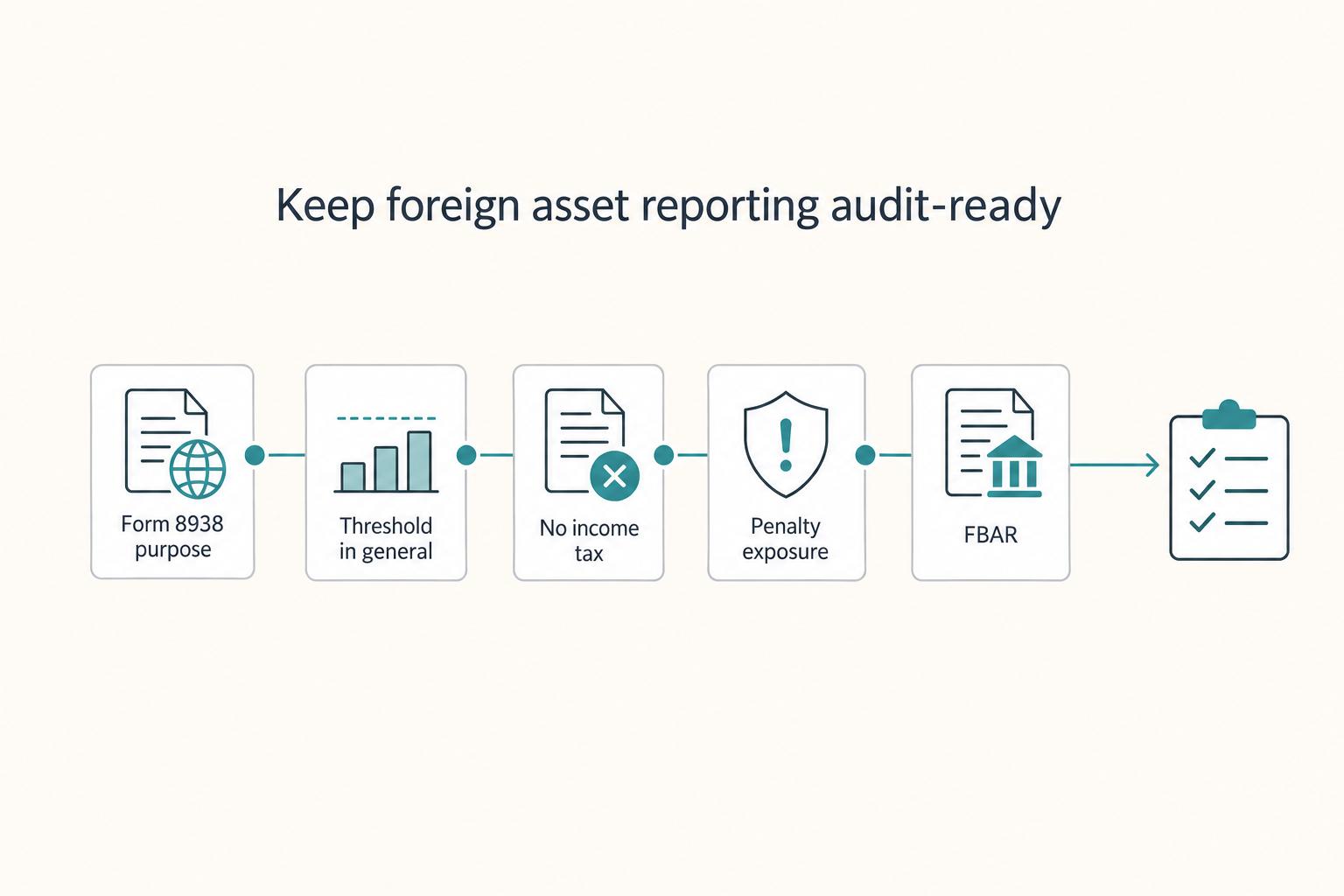
| Topic | Article says | Action |
|---|---|---|
| Form 8938 purpose | Use Form 8938 to report specified foreign financial assets, and attach it to the annual tax return. | Check whether the reporting threshold is met. |
| Threshold in general | The aggregate value of assets must exceed $50,000 to be reportable on Form 8938, but in some cases the threshold may be higher. | Confirm the applicable threshold for your case. |
| No income tax return filed | If you do not have to file an income tax return for the year, you do not have to file Form 8938, regardless of asset value. | Do not file Form 8938 solely because of asset value. |
| Penalty exposure | Failure to report foreign financial assets on Form 8938 may result in a $10,000 penalty, with up to $50,000 for continued failure after IRS notification. | Treat reporting as part of the year file. |
| FBAR | You may also have to file FinCEN Form 114 (FBAR). | Treat FBAR as its own requirement. |
In general, the IRS notes the aggregate value of assets must exceed $50,000 to be reportable on Form 8938, but in some cases the threshold may be higher. Also: if you do not have to file an income tax return for the year, you do not have to file Form 8938, regardless of asset value.
That matters because the same tax year can trigger multiple review paths. Failure to report foreign financial assets on Form 8938 "may result in a penalty of $10,000," with "a penalty up to $50,000 for continued failure after IRS notification." Even if your charitable giving stays straightforward, you still want a clean year file.
Gruv-style controls (no magic, just traceability):
- Prefer ledger-first records with exports you can reconcile, not isolated screenshots.
- Keep donation outflows separate from client inflows so your books do not blur business receipts with personal charitable giving.
- If you use bookkeeping software, create a dedicated "Charitable Contributions" category and attach source documents as you go. Use this: A Guide to QuickBooks Self-Employed for Freelancers.
Mini-checklist (printable):
- Confirm your filing posture for the year and what you plan to report, and where.
- Keep the organization name and any identifiers shown on the receipt consistent across your log and stored files.
- Classify donation type and add a short note explaining any judgment calls, so Future You does not have to guess.
- Store receipt or confirmation, payment proof, and log entry in the same tax-year folder.
Conclusion: Run the system, keep the proof, and use safe defaults when the law is moving#
Treat the deduction as a compliance workflow, not a tax hack. Run the same gates every year - itemize vs standard, eligibility, limits, and documentation - and you keep your giving generous while your return stays defensible.
If you remember one thing, make it this: the deduction starts with eligibility, runs through Schedule A and AGI limits, and ends with an audit-ready Evidence Pack. "I gave money to a good cause" and "I claimed a compliant deduction" are different statements.
Your safe default stack (operator rules)#
- If the year-specific rule feels new, verify it on IRS.gov (and Congress.gov, when relevant) before you rely on it. Do not plan your cash flow around unconfirmed changes. Use itemizing on Schedule A (Form 1040) as the safe default, with limited year-specific exceptions such as the special $300 rule tied to certain 2020 cash donations.
- If you cannot classify the organization fast, treat the deduction as unknown and escalate. Use the IRS Tax Exempt Organization Search to confirm the recipient qualifies.
- If you received a benefit (dinner, merch, tickets), deduct only what exceeds the fair market value of that benefit. Capture the charity's acknowledgment that breaks this out.
Here's the decision rule in one table:
| Situation | Safe default | Next action |
|---|---|---|
| Unsure you will itemize | Assume the deduction depends on itemizing on Schedule A | Run "standard vs Schedule A" scenario for your filing year |
| Unsure charity qualifies | Treat as non-deductible | Check IRS Tax Exempt Organization Search |
| Big gift relative to AGI | Assume limits apply (in most cases, cash on Schedule A is usually limited to 60% of AGI) | Verify which limit applies and track what you actually claim |
| Benefit received (goods/services) | Deduct only the amount over the benefit's fair market value | Save the acknowledgment and your valuation notes |
Practical next step (10 minutes today): build your Donation Evidence Pack#
Do this before your next donation, not during tax season:
- Create a folder:
Taxes > 2026 > Donations (Evidence Pack). - Add three subfolders:
Receipts,Payment Proof,Carryover Notes (if applicable). - Start a simple tracker (a sheet works): date, charity name, amount, cash vs other, filing year, link to receipt, link to payment proof.
Hypothetical scenario: you make a large gift during a high-income year, then you travel and forget the paperwork trail. Your future self only wins if you store the receipt and payment proof in one place today, and note how you planned to claim it.
Bring in professional help when you see any of these: non-cash gifts, giving that pushes up against your AGI ceiling, or anything that feels like it could trigger special limits or year-specific rules.
If you want the larger cross-border frame, connect charitable giving to your residency and filing posture in Digital Nomad Taxes in 2026 With a Defensible Filing Plan.
Frequently Asked Questions
Can I claim a charitable donations tax deduction if I take the standard deduction in 2026?
Do not plan on a deduction while taking the standard deduction unless you can confirm a specific rule for your filing year on IRS.gov (and you can trace it back to final legislative and IRS guidance). GiftLaw Pro reports that “starting in 2026, non-itemizers will get an above-the-line deduction for cash gifts to qualified nonprofits,” but treat that as provisional until it is confirmed by the IRS and reflected in final instructions.
Do I have to itemize to claim charitable deductions?
In the baseline workflow, yes. The IRS frames the core charitable deduction as something you take on Schedule A as an itemized deduction, so you run the “itemize vs standard” gate first. If you take the standard deduction, your donation still matters personally, but do not assume it reduces federal taxable income.
What is the AGI limit for charitable deductions?
Use this anchor: the IRS limits, “in most cases,” the amount of deductible cash contributions to a percentage (usually 60 percent) of your AGI. Other percentage limits can apply based on donation type and recipient organization, so confirm the applicable limit for your facts and filing year in current IRS guidance.
What happens if I donate above the limit, do I lose the deduction or can I carry it forward?
Do not assume you lose it, and do not assume carryover automatically saves you either. The IRS explicitly said for the calendar year 2020 temporary suspension that “contributions that exceed that amount can carry over to the next tax year.” Outside that 2020 relief context, confirm whether carryover applies for your situation and tax year in current IRS guidance, then track it so it does not disappear between filings.
Which charitable deduction rules are confirmed vs still unclear as of 2026?
Confirmed: charitable contributions may be deductible if you itemize on Schedule A, and the IRS applies AGI-based limits (with cash often limited to a percentage, usually 60 percent, in most cases). Unclear here: claims about 2026 changes circulating online. GiftLaw Pro describes changes “starting in 2026,” including “a new charitable floor on itemized deductions” and an above-the-line deduction for non-itemizers. Treat those as unverified until they are confirmed by final IRS and legislative guidance.
Can I deduct donations to a foreign charity if I’m living abroad?
Do not assume you can. Use the eligibility gate: confirm the organization qualifies under IRS rules before you treat it as deductible on Schedule A.
Are donor-advised funds deductible, and how do they change my documentation and timing?
Treat donor-advised funds as a separate decision point because they can change documentation and timing. GiftLaw Pro reports that a 2026 above-the-line deduction for non-itemizers would not apply to “contributions to a donor advised fund,” so do not count on that pathway if you plan to take the standard deduction. For the rest, follow the IRS rules and recordkeeping requirements that apply to your filing year and specific contribution.
Try a related tool
Researched and edited by the Gruv editorial team. Gruv builds cross-border billing, payouts, and finance-operations software for global businesses.
Sources
Educational content only. Not legal, tax, or financial advice.
Related Posts

Digital Nomad Taxes in 2026 With a Defensible Filing Plan
With digital nomad taxes, the first move is not optimization. It is figuring out where you may be taxable, where filings may be required, and what proof supports that position.

Do I Have to Pay State Taxes While Living Abroad as a Digital Nomad?
Living abroad does not end `state income tax` exposure by itself. The first decision is practical: choose a filing position your facts can support, then build records that support the same story all year.

A Guide to QuickBooks Self-Employed for Freelancers
**QuickBooks Self-Employed can support basic bookkeeping, but predictable cashflow comes from your payment controls, not invoicing alone.**