
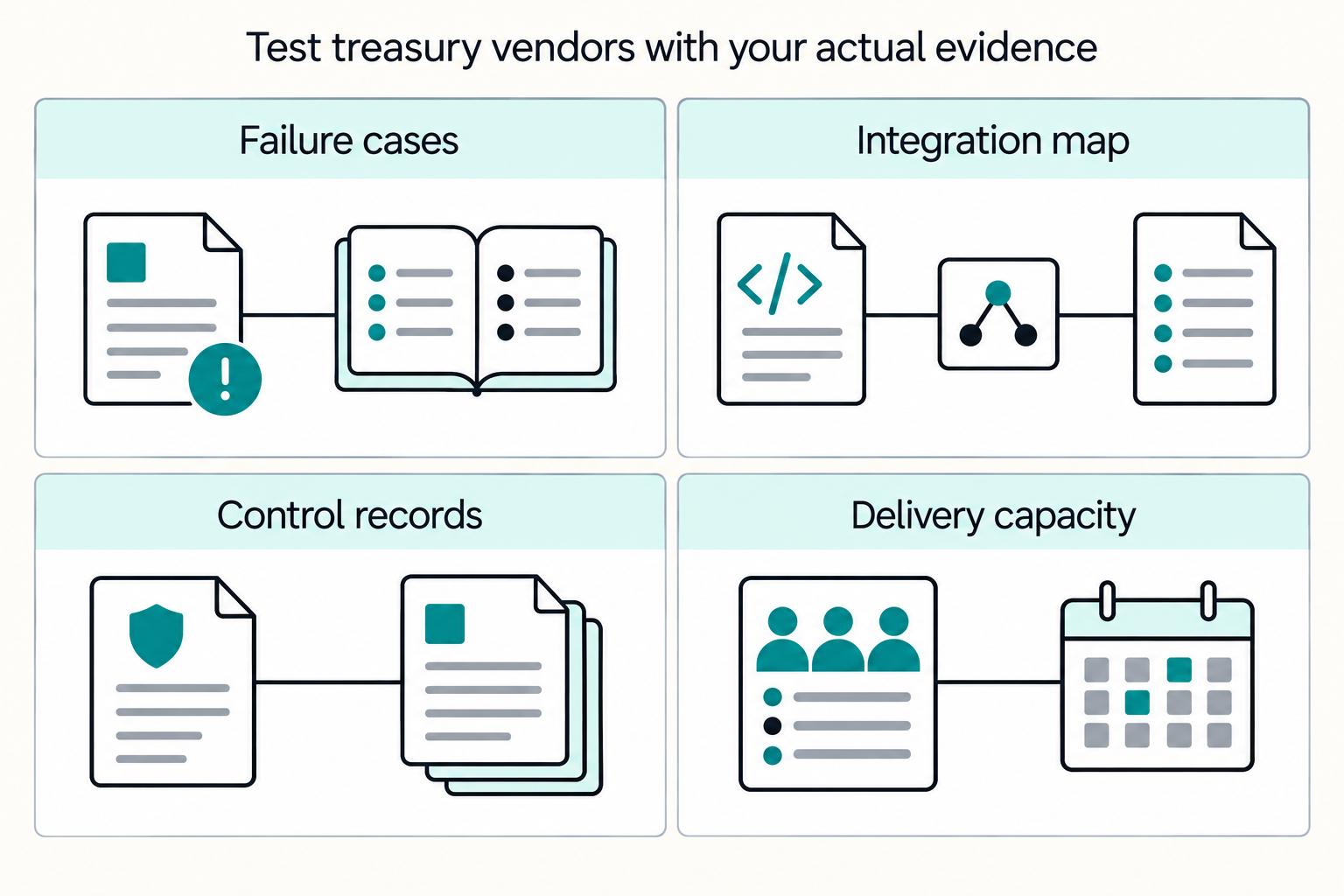
Choose a treasury management system by starting with your actual operating model, rails, reconciliation needs, and control requirements, then forcing vendors to prove fit with written evidence and real-flow tests. Prioritize API reliability, webhook handling, idempotency, ERP fit, and request-to-report traceability, and treat feature breadth as secondary to auditable control depth and implementation reality.
Start with your own operating evidence, not a vendor leaderboard. Some "best Treasury Management System" pages are promotional, so they are weak selection evidence for a payment platform even when the product itself may still be strong.
A treasury decision has to fit your payment risk, rail mix, controls, and operating capacity. OCC payment-systems guidance is institution-specific and organized by product area. Your ACH, wire, card, or real-time profile should shape the evaluation criteria instead of a generic "payments" score.
Use that filter in every vendor conversation. If a seller stays at category-level claims and cannot show behavior for your rails and control needs, you are not comparing viable options yet.
Use this guide as a structured process, not a universal rule. Finance, product, and engineering should bring evidence into procurement. By the end, you should have:
Tie each output back to operating evidence from your own environment. If a claim does not hold up against your control, exception, reconciliation, and audit requirements, it should not stay in the vendor score.
Ask candidates to answer control questions in writing. OCC risk-management checkpoints cover policies, internal controls, risk assessment, reporting, staffing, audit, and third-party risk management. The booklet also includes an Internal Control Questionnaire.
This matters even more as your dependencies scale. Treasury's January 2025 Financial Services Sector Risk Management Plan highlights cloud concentration and single-point-of-failure risk in critical utility functions. Broad feature coverage can still hide fragile operating reality.
Keep the scope tight from day one. Capabilities, controls, and compliance coverage vary by market, program, and implementation. The goal is not to reward the loudest category claim. The goal is to prove, with your own facts, that an option supports your flows without creating new blind spots.
Use this guide to build a decision record you can defend later: why an option fits your rails, controls, and operating load, and which tests would disqualify it early.
If you want a deeper dive, read Expired Card Management at Scale: How Platforms Automatically Refresh Payment Credentials.
Define your operating model first, then compare vendors against it. Vendor claims are only useful after you are clear on funds flow, reconciliation outcomes, and control ownership.
Start with the model you actually run: contractor payouts, creator payouts, marketplace settlement, or Merchant of Record (MoR). This choice changes how funds move and who is responsible. For example, direct charges send payments to a connected account, while indirect charges send payments to the platform first. In an MoR model, the MoR seller is the transacting seller.
Write a one-page money-flow map from payment collection to journal posting to payout, and name who holds funds at each step. If a demo is built on the wrong charge pattern, the gap can show up later in reconciliation or liability handling.
Set success criteria in operational terms, not visibility terms. Use measurable outcomes such as fewer reconciliation errors, faster cash reporting, and less duplicate data entry across your payment platform, accounting system, and ERP.
Make each metric testable. If a vendor claims strong reporting, ask which export, API response, or reference field lets your team tie a payment event to a journal entry and reporting output.
Set clear cross-functional ownership for the review, with roles such as finance ops, engineering, and payments ops. This supports segregation of duties and lowers the risk that API behavior, exception handling, or reporting controls get approved without the right scrutiny.
Require written pass or fail comments from each reviewer. Implementation risk often comes from coordination, migration, and compatibility gaps, not just missing features.
When your own data shows higher cross-border complexity, prioritize control depth over feature breadth. Cross-border flows involve multiple parties, infrastructures, jurisdictions, and intermediaries, so broad coverage alone does not prove operational resilience.
Ask vendors to show payout-failure handling, investigation flow, and how reporting feeds back into your records. Breadth is easy to present; stable exception handling is harder and can better protect your close process.
You might also find this useful: How to Set Up a Healthy PO System for a Platform: From Requisition to Payment in 5 Steps.
Use the demo to test your actual failure patterns, retry behavior, and document requirements, not a polished sample flow.
Start with artifacts from the flows you actually run: payout failures, ACH return reason codes with timing references, wire-flow evidence, including settlement finality characteristics for participating institutions, and month-end reconciliation breaks from your Journal. The goal is to show exactly where money movement and accounting traceability break today.
For each failed or delayed case, capture the transaction ID, rail, timestamp, provider reference if available, internal case notes, and final accounting impact. On ACH, reason codes help separate administrative and account-data issues from other failure types. If administrative errors are rising, treat that as a scaling risk. Nacha sets a 3.0 percent administrative return rate level for specified debit-entry administrative or account data errors.
Use one practical check: can finance ops trace a failed payout from payment event to a Journal break without engineering rebuilding history by hand? If not, the evidence pack is still too thin.
Document the integration surface as it exists today. Include your Enterprise Resource Planning (ERP), upstream and downstream API dependencies, webhook events, and retry behavior.
Be explicit about async handling. Webhooks are used for asynchronous events, and some providers resend undelivered events for up to three days. Ask vendors to show deduplication for resent events and how delayed notifications reconcile into your posting logic and reporting.
For request retries, include your idempotency behavior: same key, same result. If your current provider may prune keys after 24 hours, record that as a provider-specific constraint. If a demo cannot map to your real retry pattern, treat it as a product tour, not validation.
Compliance requirements shape onboarding, holds, releases, and reporting, so document them directly in the flow. Note where identity-verification and AML checks sit, and whether Customer Identification Program and beneficial-owner procedures apply to your customer types.
Do the same for tax and indirect-tax documentation. Some payees may require Form W-9 for IRS information-return workflows. Foreign-status withholding documentation may involve Form W-8BEN when requested by the payer or withholding agent. If you sell into EU contexts, VAT treatment can affect flow and reporting design. Your test is simple: can the vendor show where these documents are collected, stored, and tied to payout decisions or reporting outputs?
Write down your actual implementation capacity before you accept any sales timeline. List who will support the project across engineering, finance ops, compliance, and payments ops, and how much time each person can realistically commit.
Include constraints that often get skipped: ERP change windows, approval gates, and post-go-live ownership for webhook monitoring and reconciliation exceptions. If the plan assumes full-time coverage you do not have, the timeline is not aggressive. It is inaccurate.
For a step-by-step walkthrough, see How to Build a Finance Tech Stack for a Payment Platform: Accounts Payable, Billing, Treasury, and Reporting.
Map your real flow before you score any vendor. If you cannot show where money changes state, who owns exceptions, and what evidence proves each change, you are comparing feature lists instead of operating risk.
Use one successful transaction and a few failed cases from your own records. Build the sequence your teams already run, not a generic diagram, and include components like a journal, virtual accounts, payout batches, or downstream reporting only where they actually exist.
At each handoff, name the system of record and attach one artifact that proves the state changed. If a step can only be explained by reconstructing logs later, treat it as a control gap. Use the table below as a worksheet template, not a required order.
| Possible step in your flow (reorder as needed) | System of record | Evidence produced | Verification checkpoint |
|---|---|---|---|
| Funding or collection event (if used) | Your intake/provider/bank record | Reference, amount, timestamp, counterparty ID | Record matches the expected internal transaction |
| Accounting state update (if used) | Internal journal or posting system | Entry ID, posting time, account impact | Payment event and accounting impact reconcile |
| Balance/account state update (if used) | Account/balance system | Event ID, account ID, movement | Update ties back to originating event |
| Payout preparation (if used) | Ops or approval workflow | Batch/run ID, totals, approval artifact | Prepared totals match approved obligations |
| Payout execution state (if used) | Provider/bank execution record | Rail/reference, status, execution time | Execution ties to obligation and accounting impact |
| Reporting/export state (if used) | Reporting store or ERP output | Export artifact, snapshot, recon output | Reported totals tie back to journal and payment references |
Mark every point where state depends on asynchronous updates in your stack. For each event type, record the key you use, what internal object it may change, and how you check whether replays created a second business action.
Focus on patterns you can verify from your own history:
Put failure handling on the same map as the happy path. For each failure point, record the trigger, owner, recovery step, and retained evidence.
Include the failure modes that matter in your operation, such as unmatched deposits, AML-related holds, stale quote handling, or payout reroute conditions, and document how each is resolved in your environment. If money movement can change without a case record, approval artifact, or updated accounting trace, treat that as a selection risk during vendor evaluation.
We covered this in detail in How to Leverage Cloud Spend Management for a Global Payment Platform.
Set the hard gates now. If a vendor cannot prove reliable API behavior, observable webhook operations, replay-safe idempotency, and request-to-report traceability, it is not ready for money movement in your environment.
Start with controls that prevent duplicate money movement, missing state changes, or reporting you cannot prove. In this decision, treat availability in the plain NIST sense: timely, reliable access for authorized use. Do not accept marketing language as proof. Require evidence that your team can detect failures, retry safely, and reconcile outcomes.
These belong in the non-negotiable bucket:
| Requirement | What to require |
|---|---|
| API reliability | For the transaction types you actually run |
| Webhook observability | Include duplicate-event handling and failed-delivery monitoring |
| Idempotency controls | For create and update requests |
| Auditable traceability | From payment request to provider reference to journal entry to report or export |
If finance and engineering cannot reproduce one successful transaction and one failed transaction from source records without vendor support, treat that as a procurement blocker.
Write each non-negotiable as a proof requirement, not a feature label. For idempotency, require the vendor to show how unique retry keys are handled and what result is returned on repeated submission.
One benchmark is behavior where the first result is persisted for a key, and retries return that same result, including failures, with clear key constraints and retention windows. One example is up to 255 characters and removable after 24 hours.
For webhooks, require proof that duplicates are handled and failed deliveries are retried. Your checkpoint is test evidence showing that the same event is delivered more than once, but your downstream business action happens once. A failure pattern to test for is API-layer deduplication paired with duplicate internal actions from repeated webhook events.
Apply identity-verification, AML, and tax requirements only where your policy and jurisdiction require them, but treat them as mandatory when they apply. For U.S. programs, CIP is risk-based and should support a reasonable belief in true customer identity. AML minimums are broader than document collection and include internal controls plus independent testing.
If you onboard legal entities, require clear beneficial-ownership procedures at new-account opening and confirm current applicability to your institution or program before contracting. Do not assume one universal rule. A reported U.S. update effective Feb. 13, 2026 may affect repeat beneficial-owner checks for covered institutions, so legal or compliance confirmation is required.
For tax documents, define forms and trigger points explicitly. Form W-9 is used to provide a correct TIN for information returns, and Form W-8BEN is submitted when requested by the withholding agent or payer. Your evidence pack should cover capture, validation status, retention approach, and audit exportability.
Treat "AI assistant," "all-in-one," and similar claims as nice-to-have unless they remove a measured bottleneck such as reconciliation time, exception queue age, or support ticket volume. If the vendor cannot show before-and-after impact on your bottleneck, do not let the claim outweigh control depth.
If you run high-volume payout batches, tighten gates before expanding scope. Require demonstrable exception handling, replay safety, and a clear operator path for partial failures, retries, and batch-level reconciliation. A red flag is a platform that looks smooth on single payouts but cannot show behavior under duplicates, mixed failures, or late status updates.
This pairs well with our guide on How to Build a Payment Compliance Training Program for Your Platform Operations Team.
Once you have hard gates, compare vendors by integration evidence, not demo quality. At this stage, each option should pass or fail against explicit thresholds tied to your stack.
Use this as a desk-check screen to decide who earns deeper engineering review. Mark Pass only when the public documentation in your review set shows the exact capability in that row. Mark Fail when it does not.
Score the rows most likely to create downstream risk when they are vague. This table scores public evidence against thresholds. It is not a full product ranking.
| Criterion | Pass threshold | Stripe | FIS | Ripple Treasury | GTreasury | HighRadius | Trovata |
|---|---|---|---|---|---|---|---|
| ERP connectivity | Publicly documented ERP connector or ERP integration layer | Fail | Pass | Fail | Pass | Pass | Fail |
| API maturity | Public API docs or API-first treasury/payment capability | Pass | Pass | Fail | Pass | Pass | Pass |
| Webhook evidence | Public docs for asynchronous event callbacks in treasury/payment flows | Pass | Fail | Fail | Fail | Fail | Fail |
| ACH support | Publicly documented ACH support for fund movement/initiation | Pass | Fail | Fail | Fail | Fail | Pass |
| Wire transfer support | Publicly documented wire support for fund movement/initiation | Pass | Fail | Fail | Fail | Fail | Pass |
| Virtual accounts | Publicly documented virtual account support in supplied sources | Fail | Fail | Fail | Fail | Fail | Fail |
| Journal/export traceability | Public proof of traceability from transaction reference to output | Fail | Fail | Fail | Fail | Fail | Fail |
Stripe passes the API, webhook, and rail rows based on documented API-first financial accounts, webhook handling for asynchronous events, and ACH or domestic wire outbound transfer support. It also has a material compatibility constraint: Accounts v2 does not support Financial Accounts and Issuing workflows.
FIS, GTreasury, and HighRadius show clearer public ERP-integration evidence in the supplied sources. Trovata shows API plus publicly referenced ACH, wire, and RTP initiation via partner material, but webhook behavior and accounting traceability still need direct validation. Ripple Treasury should be treated as dependency-sensitive because it is presented as powered by GTreasury, not as automatic proof of equivalent integration behavior in your contract scope.
Prioritize shortlist time around your highest implementation risk. If your risk is embedded money movement controls, start deeper testing with options that already show rail and API evidence. If your risk is ERP-to-treasury operating flow, prioritize options with clear ERP integration posture.
Before solution design, require artifacts from each shortlisted vendor:
Do not treat API access as proof of low integration risk. Public bank guidance highlights recurring failure points in legacy compatibility, migration complexity, and operational coordination. If a vendor cannot show end-to-end alignment across payment records, events, and output files, keep it below final selection until it can reproduce one successful and one failed ACH or wire flow with full traceability in your environment.
After integration fit, make controllability the next hard gate. If a vendor cannot reproduce control evidence and transaction history on demand, do not pass procurement regardless of feature score.
Have each shortlisted vendor mark every in-scope control as native, configurable, or externalized. Cover KYC, KYB, AML, VAT, and tax-document workflows that matter for your payouts.
For each control, capture four fields: owner, trigger, decision artifact, and update path. If KYB is in scope, verify how beneficial owners for legal entities are identified at onboarding and, on a risk basis, updated later. If AML is in scope, verify who performs ongoing monitoring, who escalates suspicious activity, and what evidence is retained. For covered bank AML programs, minimum components include internal controls, independent testing, designated responsible individual(s), training, and risk-based due diligence procedures. If a partner owns the control, require clear handoff boundaries plus a sample case record.
Expected outcome: a control matrix compliance and finance ops can use as-is. Red flag: "partner-managed" with no retrievable review artifact.
Require a full trace from a single payment request to provider reference to Journal to export or report output. A usable audit trail must let you reconstruct the sequence of events, so screenshots alone are usually not enough.
Run two tests: one successful payout and one failed or retried payout. For API and webhook flows, verify the idempotency key, event IDs, retry outcome, and final accounting state. Duplicate events and delayed redelivery can occur, so confirm retries do not create duplicate payouts or duplicate journal entries.
Expected outcome: timestamps, identifiers, status transitions, and export rows align across every step. Red flag: provider references disappear before the journal or export, or retries and reversals are not distinguishable.
Do not accept "supports tax forms." Confirm exact capture fields, storage location, export format, and filing owner for every required workflow.
| Workflow | Field-level check | Threshold or note |
|---|---|---|
| W-9 | Confirm TIN capture and reporting output fields | Reporting output fields |
| W-8BEN | Confirm foreign-status and treaty or withholding fields | When requested by the withholding agent or payer |
| FBAR tracking (if relevant) | Confirm workflows flag the aggregate foreign-account threshold | $10,000 |
| FEIE tracking (if relevant) | Confirm annual limits are handled as reference data in reporting | $130,000 for 2025; $132,900 for 2026 |
| 1099 outputs | Validate threshold logic and ownership of filing or export workflow | $600; $2,000 for payments made after December 31, 2025 |
| VAT (where applicable) | Verify exported records are detailed enough for tax authority checks | OSS record-keeping and audit needs |
Require an evidence pack before commercial approval:
If you are choosing treasury tooling for a payment platform, this is the final filter: no reproducible evidence, no pass.
Related: Tail-End Spend Management: How Platforms Can Automate Long-Tail Contractor Payments.
Once a vendor clears the audit-evidence gate, the next question is operational: can your team launch it and run it without creating new reconciliation risk? Treat implementation effort and day-two ownership as a hard decision factor, not a post-signature detail.
Use a small set of rollout gates that fit your environment rather than one all-in launch plan. The goal is clear ownership, entry conditions, and pause or rollback expectations before money moves.
For implementation planning, define the critical touchpoints that must work in your stack and downstream finance process. For controls validation, confirm that normal cases and failure cases still produce a trace your team can review.
Keep early rollout scope intentionally narrow so you can judge outcomes quickly. Before broader cutover, document who can pause or reverse the rollout and what records must be preserved if you do.
Expected outcome: a written cutover document with phase owners, checkpoints, rollback authority, and required evidence at each gate. Red flag: one combined plan that treats testing, pilot, and go-live as calendar milestones instead of proof points.
Estimate effort across engineering, finance ops, and compliance from the start. If any one function is only "informed" and not staffed, your plan is probably under-scoped.
Ask each function for task-level commitments. Engineering can scope integration changes and operational safeguards. Finance ops can scope reconciliation and close-process impacts. Compliance can scope review requirements and evidence handling.
Use a dependency sheet that names upstream and downstream touchpoints. If ERP mapping, account codes, or payout-state logic are still unresolved, treat that as open implementation risk. If you need context on ERP dependencies, this guide on choosing an Enterprise Resource Planning system is relevant.
Expected outcome: a cross-functional task list with owners, dependencies, and signoff points. Failure mode: the integration works technically, but finance ops still relies on manual exports and side spreadsheets to close.
Define day-two ownership before go-live: exception handling, mismatches, delayed updates, duplicate events, returns, reversals, and payout-status disputes. If ownership and escalation paths are unclear, delay cutover.
Separate issue types by default owner. Different payment and accounting issues may look similar at intake, but they should not all route to the same person automatically. Document first-response ownership, investigation ownership, who can reissue or reverse, and when compliance or support must be involved.
Run a tabletop with one failed payout and one duplicate or delayed event. Confirm the team can identify the source record, compare it to system records, determine whether funds moved, and communicate status clearly. If this creates channel chaos or conflicting spreadsheet numbers, fix the operating model before launch.
Related reading: Digital Nomad Payment Infrastructure for Platform Teams: How to Build Traceable Cross-Border Payouts.
Do not let a high feature score override a failed control. Use weighted scoring only after each vendor passes hard gates for reconciliation, audit traceability, and day-two operations.
Use a scorecard that is simple to run and hard to game. Score five categories: capability fit, integration risk, control adequacy, implementation effort, and ongoing ops burden.
Require written evidence for every score. If a score is not backed by tested behavior or documented artifacts, treat it as opinion and leave it out.
| Category | What to judge | Evidence to attach |
|---|---|---|
| Capability fit | Match to your payout model, rails, and reporting needs | Demo notes tied to use cases, sample exports, operator walkthrough |
| Integration risk | Likelihood of implementation surprises in your stack | API test output, webhook handling results, ERP mapping review |
| Control adequacy | Whether controls are auditable and reproducible | Request-to-provider-reference trace, journal trace results, retained compliance artifacts |
| Implementation effort | Work required across engineering, finance ops, and compliance | Task list, owners, dependencies, rollback conditions |
| Ongoing ops burden | Exception and reconciliation load after launch | Pilot findings, queue ownership, month-end close checkpoints |
Expected outcome: one shared scorecard with evidence references behind each score. Red flag: scores based on demo memory without artifacts.
Set mandatory gates, such as idempotency tests, journal trace tests, and compliance evidence checks. If a vendor fails any gate, mark it no-go regardless of weighted total.
For idempotency, test duplicate and delayed-event retries and confirm your team can tell whether funds moved once, more than once, or not at all. For traceability, follow a transaction from request through provider reference into the journal and downstream export, including a failed or retried case. For compliance evidence, confirm required approvals or retained artifacts can be produced on demand.
Expected outcome: a pass or fail gate sheet attached to the scorecard. Verification point: each passed gate has a dated test record, screenshot, log extract, or exported artifact.
If two vendors score close, choose the one with lower operational risk and a clearer, verified path to a stable month-end close. Use pilot and reconciliation evidence, not sales timelines.
If broader capability still leaves finance ops doing manual settlement matching or spreadsheet-side fixes, treat that as higher risk. Prefer the option with cleaner traceability, clearer ownership, and fewer unresolved exception paths. Ask one tie-breaker question: which option is less likely to create unclear payment incidents on a bad Tuesday?
Capture the decision in a one-page executive memo as an internal governance practice: decision statement, vendors considered, gate results, score summary, top risks, mitigations, and final recommendation with named owners.
State the no-go condition explicitly so leadership is approving a decision rule, not a preference.
Expected outcome: an internal memo that records go, no-go, or go with named conditions. Failure mode: a recommendation that does not document what could still stop cutover.
Need the full breakdown? Read How to Build a Payment Reconciliation Dashboard for Your Subscription Platform.
Before locking procurement, pressure-test your must-pass gates against real integration behavior in the Gruv docs.
If a vendor is strong in demos but weak in logs, controls, or contract language, pause before signature. Third-party relationships do not all carry the same risk, and relying on vendors reduces your direct operational control.
Feature breadth is a screening signal, not an approval signal. If selection drifted into feature-only comparisons, rerun weighted scoring and reapply must-pass gates for reconciliation, audit traceability, and day-two operations.
Recovery rule: if a score is not backed by tested behavior or artifacts, treat it as no-go until evidence is produced. Verification point: each rescored item links to dated logs, exports, screenshots, or test output.
Webhook reliability is a go or no-go control, not a minor integration detail. Events can be duplicated, stale, partial, or out of order, and undelivered events may be resent for up to three days.
Recovery move: require replay evidence and idempotency proof in test logs. Ask for processed-event ID logs, duplicate-delivery tests, and retry cases that show one business outcome per request.
Close compliance and tax scope before signature, not after. Add evidence checks for AML program handling where your model is regulated, VAT treatment where relevant, and document paths for Form W-9 and Form W-8BEN when requested by a payer or withholding agent.
Verification point: confirm retained artifacts, ownership, and retrieval steps. Red flag: "handled externally" with no clear evidence your team can receive and store.
Do not accept generic onboarding promises without enforceable checkpoints. Tie milestones to completed integration tests, webhook replay and idempotency evidence, reconciliation traceability, and production-ready audit artifacts.
If those checkpoints are not attached to contract negotiation and ongoing monitoring, treat the plan as underspecified. Make payment and go-live approval contingent on passed checkpoints.
For teams targeting a month-long evaluation, run it as four gated steps with evidence at each gate, not as a loose demo cycle. If a vendor cannot produce the required evidence for that gate, pause progression.
| Step | Focus | Gate evidence |
|---|---|---|
| Define scope and lock the non-negotiables | Set objectives, assign resources, confirm budget, and separate must-haves from wants | Each non-negotiable maps to one artifact, one owner, and one pass or fail test |
| Run demos as tests, not presentations | Use structured demos plus proof-of-concept time with engineering present | Test idempotency, duplicate delivery, delayed retries, and out-of-order handling; processed event IDs map to one business outcome, including retries of up to 3 days |
| Finish scoring only after risk and control review | Confirm whether KYB, AML, and tax workflows are native, configurable, or external | Validate document collection and output paths; failure mode is "handled externally" with no retained evidence path |
| Write the memo, set milestones, and pilot with rollback ready | Close with a one-page decision memo and a canary pilot before broader exposure | Define rollback before the first live batch: trigger, owner, and the path back to the prior payout flow without breaking reconciliation |
Use kickoff to set objectives, assign resources across treasury or finance, IT or engineering, and any third-party support, and confirm budget. Then separate must-haves from wants at task level, and lock approval gates for API behavior, webhook handling, traceability, ERP handoff, and required compliance artifacts.
Build the evidence pack in the same week. Include your current failure and exception cases, current journal exports, and the tax documents your flow actually needs, for example, Form W-9 or W-8BEN-E. Verification point: each non-negotiable maps to one artifact, one owner, and one pass or fail test.
Use structured demos plus proof-of-concept time with engineering present. The goal is integration fit across your existing systems and data inputs, not UI polish.
Require API retry behavior that demonstrates idempotency, so repeated requests do not create duplicate operations. For webhooks, test duplicate delivery, delayed retries, and out-of-order handling, and confirm processed event IDs map to one business outcome, including retries of up to 3 days. Red flag: polished demos without logs, exports, or retry proof.
Finalize the scorecard only after a defined risk review. Confirm whether KYB, AML, and tax workflows are native, configurable, or external, and what evidence your team can retrieve on demand.
For legal entities, verify beneficial-owner identification and verification at account opening where required. For AML, check for concrete internal controls, testing, ownership, and training. For tax, validate document collection and output paths, including whether your process can support Form 1099-NEC reporting by January 31 when applicable. Failure mode: "handled externally" with no retained evidence path.
Close with a one-page decision memo: recommendation, key risks, mitigations, and why alternatives were rejected. Tie implementation milestones to tested checkpoints, not estimated dates.
Launch with a canary pilot, a partial, time-limited rollout, before broader exposure. Define rollback before the first live batch: trigger, owner, and the path back to the prior payout flow without breaking reconciliation. If that rollback plan is not clear in one paragraph, the pilot is not ready.
Pick the system that proves operational fit in your environment, not the one with the strongest demo. If a vendor cannot reproduce control evidence, handle duplicate and out-of-order webhooks, or trace a payout from API request through journal and reconciliation, it should not pass.
Set criteria before selection and use scores only after must-pass gates are met. Keep the side-by-side table and weighted scorecard, but require pass or fail proof for controls, traceability, and implementation feasibility first. Then document the business tradeoffs in the memo.
Do not accept "supported" without artifacts. Ask for the exact evidence pack you will need in production: output files, journal detail, failure states, retry behavior, and reconciliation support for close.
Treat due diligence as part of selection, not a cleanup step after selection. A third party may improve speed, but accountability for compliance and safe operations stays with your team.
If your payout flow depends on tax-document collection, verify whether Form W-9 and Form W-8BEN, when requested by the payer or withholding agent, are handled natively, configured through another tool, or left to you. Require a reproducible chain from API request to provider reference to journal entry to export, including failure and retry paths.
When scores are close, choose the lower-risk option. Favor faster verified time to stable reconciliation, clear exception ownership, and less ambiguity in API and webhook behavior.
Assume duplicate, outdated, and out-of-order webhook events can occur, and validate that both your handlers and the vendor model tolerate that. For idempotency, require test evidence that repeated identical requests produce one intended server effect, not duplicate payouts or journal postings.
Publish a short decision memo, then run a controlled pilot. Include selected and rejected options, top risks, owners, pilot scope, rollback trigger, and monitoring milestones so the decision stays usable after the meeting.
If ERP handoff is a dependency, name it and set a checkpoint before cutover. If needed, use this ERP guide as the companion read.
Use this copy/paste checklist before signature:
If one box is unchecked, pause. Waiting for proof is often cheaper than moving ahead with a hidden failure mode.
If you want a coverage check against your payout model, controls, and rollout constraints, talk with Gruv.
Start by locking scope, your payout model, and your non-negotiables. Evaluate integration fit and control fit first: API behavior, webhook handling, traceability, ERP connectivity, and required compliance-document flows. Treat due diligence before selection and contracting as mandatory.
Non-negotiables are the capabilities that protect money movement, reporting integrity, and auditability in your real workflow. That usually includes idempotent API behavior, webhook deduplication and replay handling, usable event logs, request-to-report traceability, retrievable control evidence, and required tax-document paths when they apply. Nice-to-haves are features that improve convenience but do not reduce core operational risk or remove a measured bottleneck.
Use a written scorecard with pass or fail criteria tied to your own flows, and run demos as tests instead of presentations. Compare feature fit together with lifecycle risk controls such as due diligence, contracting posture, monitoring, and termination readiness. Require proof artifacts so decisions are based on evidence, not vendor claims.
Go-live usually slips when teams find integration and control gaps late. Common blockers are unclear webhook retry behavior, missing duplicate-event handling, unproven idempotency under retries, weak log-management design, and unresolved ownership for exceptions. Delays also happen when teams assume provider delivery and redelivery behavior is uniform across vendors.
Run pre-signing tests in a mode that does not affect live money movement. Prove that repeated identical API requests produce one effective outcome, then test duplicate delivery, delayed retries, replay behavior, and clear deduplication for webhooks. Validate each vendor's retry and redelivery behavior directly because it is not standardized across providers.
Your current stack may be enough if it already supports your required payouts and liquidity workflows with reliable API and webhook behavior and auditable logs. It also needs to maintain the ERP and bank connectivity you depend on and provide retrievable control and compliance evidence without fragile manual workarounds. If those checks pass consistently, defer adding a new system until risk, complexity, or scale changes.
Yuki writes about banking setups, FX strategy, and payment rails for global freelancers—reducing fees while keeping compliance and cashflow predictable.
Educational content only. Not legal, tax, or financial advice.

**Start with the business decision, not the feature.** For a contractor platform, the real question is whether embedded insurance removes onboarding friction, proof-of-insurance chasing, and claims confusion, or simply adds more support, finance, and exception handling. Insurance is truly embedded only when quote, bind, document delivery, and servicing happen inside workflows your team already owns.
Treat Italy as a lane choice, not a generic freelancer signup market. If you cannot separate **Regime Forfettario** eligibility, VAT treatment, and payout controls, delay launch.

**Freelance contract templates are useful only when you treat them as a control, not a file you download and forget.** A template gives you reusable language. The real protection comes from how you use it: who approves it, what has to be defined before work starts, which clauses can change, and what record you keep when the Hiring Party and Freelance Worker sign.


