
Quick Answer
Choose embedded architecture for home services platform payments once a single charge may be divided across parties, payout release depends on approvals, or finance cannot explain exceptions from the source record. Keep invoicing-only while one entity collects and settles cleanly without side tracking. Before launch, lock a checkpoint chain: payment confirmation, ledger journal creation, and payout marked release or hold. Then test messy cases such as refunds, reversals, and delayed transfers before adding provider cohorts.
Where Childcare Launches Need a Different Payments Setup#
Start with one decision: can you run on basic invoicing, or do you already need embedded payments with downstream payouts?
For home services platform payments and childcare launches, checkout is not always the hard part. Complexity tends to show up when a single payment needs to be allocated across parties, payout timing changes, or release checks become part of daily operations. Childcare-specific or home-services-specific legal payout rules are not established, so treat those constraints as model-specific until your own workflow proves otherwise.
Stripe's embedded payments guide frames monetization as two options: customized pricing or revenue-sharing. It also says integrating payments into the product can reduce manual billing costs, delays, and non-payment risk, and that major platforms and marketplaces use Stripe Connect for this setup. That does not mean every launch needs full marketplace architecture on day one. It means invoicing can work while money movement stays simple enough that finance and ops can explain each transaction without side spreadsheets, manual reallocations, or payout workarounds.
Use three blunt checks early:
- Does one customer payment ever need to be divided across more than one party?
- Can provider payouts be delayed based on internal checks or approvals?
- Can finance reconcile collections, reversals, and payouts without a side ledger?
If any answer is yes, you are already moving toward embedded platform payments.
Before you commit, define one exact checkpoint between collection and payout release. Decide what confirms payment success, what confirms the ledger entry, and what confirms payout-ready versus held. If those checkpoints are fuzzy, disputes and provider support will expose that quickly.
The January 2025 FIU card procedures are not marketplace guidance, but they are a useful operations lens. They explicitly track credit card limits and billing-cycle controls, rejected transactions and declines, fraudulent or unauthorized transactions, and incomplete reconciliations. Those failure modes are a practical test of whether invoicing is enough or whether you need payout-aware design from day one.
Define the payment model before evaluating vendors#
Set the payment model before you compare vendors. That choice shapes onboarding, reconciliation, and support outcomes.
Start with payment responsibility#
If you may need Pay splits, treat them as money-movement rules, not pricing settings. A Point of Sale terminal or payment link can collect an invoice, but by itself it does not define how marketplace-style payouts are handled later.
Make the Merchant of Record call early. In the source material, the MoR is the legal entity authorized to accept online payments, assumes financial liability, and handles refund and tax or regulatory responsibility. The MoR name is also what appears on the customer card statement, so lock this down before contracting.
If you stay with a Payment Service Provider (PSP) model, assign responsibility for VAT or sales-tax calculation and dispute handling explicitly instead of assuming the PSP covers it.
Know whether you need PayFac-style onboarding#
If you are onboarding providers, confirm whether the vendor supports a Payment Facilitator structure. In that model, the PayFac owns the master MID and can board providers as sub-merchants.
The source material notes PayFac onboarding can start processing within hours, while traditional merchant-account approval may take days or even weeks. Before selection, get written confirmation of who owns the master MID, who is boarded as a sub-merchant, and how compliance and acquirer-facing due diligence are handled.
Keep implementation risk in scope#
Do not evaluate checkout in isolation if it may not be your only payment path. You do not need a final rail mix yet, but you should confirm the model will not force a migration once payout patterns become more complex.
Also ask shortlisted vendors about data conversion and testing resources before you choose. Migration execution often determines whether the model works in practice or creates avoidable operational drag.
Compare childcare and home services before committing one build path#
Use separate decision tracks unless childcare evidence checks pass first. The strongest grounded evidence here is for childcare, especially CCDF-linked workflows, and it does not validate equivalent assumptions for home services or home care agency.
| Model | Payer and billing evidence | Cadence, refunds, onboarding evidence | Verification and insurance evidence | What to do before you commit |
|---|---|---|---|---|
| Childcare | Payment flow can vary by program design: direct payments, reimbursements, or prepaid benefits cards. A childcare CRM is defined around family interactions from inquiry through enrollment and ongoing engagement. In CCDF-focused contexts, agency-through-platform payment support is a stated evaluation criterion. | Attendance-linked billing is evidenced through attendance-to-claim reconciliation. The sources do not validate one-off job frequency, refund pressure, or onboarding friction as broad childcare rules. | Audit-trail exports for state licensing officer review are supported. The sources do not establish bonding insurance requirements or payout timing gates. | Treat payer mix and documentation as first-order inputs. Validate attendance-to-claim linking and agency payment handling before choosing tooling. |
| Home services | Confirm payer structure and billing ownership with your platform and legal adviser. | Not established: whether work is mostly one-off, how high refund pressure is, or how difficult onboarding is. | No supported evidence here on bonding, contractor trust checks, or verification-driven payout timing. | Keep this as a separate discovery track; do not import childcare assumptions without operator evidence. |
| Home care agency | Confirm payer model with your platform and legal adviser. | The sources do not establish schedule pattern, refund behavior, or onboarding friction for this model. | No supported evidence here on verification intensity, insurance posture, or payout-release controls. | Collect real payment and exception samples from vendors or operators before grouping this with childcare or general home services. |
Where childcare is already different#
For licensed centers accepting CCDF subsidies, the cited evaluation lens is billing reconciliation, attendance documentation, audit trails, and agency-through-platform payments. That is a different operating standard than basic invoice and card collection.
Use one concrete pre-signature test: attendance records linked directly to billing claims so reconciliation discrepancies surface before submission. If this fails with your sample data, plan for recurring manual cleanup in finance and operations.
Also request the actual audit export. The supported artifact is audit-trail formatting for state licensing officer review, not just parent-facing summaries.
Why generic demos can mislead#
Generic demos are a weak decision signal when the operating model changes. The sources show a mismatch: a general childcare CRM description can highlight centralized billing and attendance, while a CCDF-focused comparison can still report manual subsidy workarounds and missing agency-direct payment support. Those are different operating conditions, not necessarily conflicting statements.
That is why a polished category demo can still mislead. A product can look complete for parent-facing billing and still fall short when agency payment, subsidy reconciliation, or state submission formats are required. One cited failure mode is unsupported state subsidy submission formats at launch.
Manual ratio tracking can be another warning sign because ratio updates may still require staff-maintained work.
Choose rails from payer design, not vertical labels#
Do not pick rails based on vertical shorthand. The evidence does not support a blanket rule that ACH fits recurring care and cards fit urgent jobs. What is supported is that childcare payment flows can differ by program design, including direct pay, reimbursement, and prepaid card.
Choose rails from payer structure and evidence requirements. Focus on who pays, how attendance or claims are proved, and whether agency-through-platform payment is required. In CCDF-like scenarios, agency-direct payment support is a high-signal selection test.
The excerpt also reports 225,204 CCDF provider participants as of 2022, down 53% from 2006, and attributes the decline to administrative burden. Treat that as context, not a universal rule. It still supports treating documentation-heavy payment operations as a core design risk.
If you want a deeper dive, read Payments for On-Demand Service Platforms: Delivery Rideshare and Home Services.
Decide when invoicing tools are enough and when they are not#
Basic invoicing is enough only while the full payment story stays inside the source record. If one business entity invoices, collects, and records payment cleanly, simple tooling can work in phase one. If reconciliation depends on manual side tracking, that is the point to move beyond it.
When simple invoicing is still a credible choice#
Simple invoicing remains credible when your team can reliably handle, track, and process invoices from receipt to payment. Treat basic invoicing tooling as a baseline for this simpler model, not as proof that more complex payment flows will hold.
The first checkpoint is centralized intake. Invoices can arrive by email, physical mail, or EDI, and without a central system, emailed invoices can be overlooked or misfiled. If you cannot quickly show where an invoice entered the queue and what status it is in, the process is already fragile.
Predictable service patterns matter too. Recurring, standardized services can fit subscription billing with monthly, quarterly, or annual cadence. Highly customized or irregular work can create more exceptions, even if you keep a basic invoicing setup.
The red flags that mean invoicing is no longer enough#
Move on from invoicing once manual repair becomes normal. If core invoice work relies on spreadsheet stitching, the invoicing layer is too thin for current operations.
Escalate again when invoice records are no longer self-explanatory. Manual invoice handling is linked to delays, data-entry errors, and lost invoices, and incomplete or inaccurate reporting can increase compliance and financial risk.
A practical test is month-end explainability. Sample messy cases, not clean ones, and confirm your team can reconstruct each outcome from the source record without side ledgers.
The document detail that usually gets missed#
What usually breaks first is the record chain. Keep intake channel, invoice ID, validation or approval status, payment reference, and any related credit note together. That is how you avoid a "paid but not explainable" finance state.
| Revenue scope | Phase start |
|---|---|
| Above RM100 million | August 2024 |
| Above RM25 million | January 2025 |
| Above RM1 million | July 2025 |
| All other taxpayers | January 2026 |
Jurisdiction can force stricter structure. In Malaysia, the cited e-invoicing model references PEPPOL and MyInvois with real-time validation. The phased starts listed are August 2024 for revenue above RM100 million, January 2025 for revenue above RM25 million, July 2025 for revenue above RM1 million, and January 2026 for all other taxpayers.
The rule is simple: basic invoicing is enough while invoice-to-payment records stay complete under normal exceptions. Once exceptions are resolved outside the source record, move to a more structured billing architecture.
If your decision points to multi-party distribution, review how Payouts aligns with your operational requirements.
Handle bonding insurance and payout controls as one risk system#
Treat bonding insurance and payout release as one risk system. If insurance evidence is checked only at onboarding while payouts run on separate logic, you create a control gap.
That gap is especially relevant in home care and other in-home access roles, where service risk can be higher because care involves vulnerable people, long-term relationships, and high emotional risk. Even without a legal payout gate, you can still use insurance status as an operational payout condition tied to trust and platform exposure.
Make insurance status a live payout gate#
Insurance status should be a release-time control, not a one-time upload check. Use a conditions-based payment model: verify required documentation and milestones before funds move.
In practice, keep provider payout eligibility dynamic. Your payout trail should clearly show why a payee was released, held, or returned for review.
Tie payout movement to KYC and AML#
Run insurance evidence alongside identity and compliance checks in the same release decision. A practical sequence is:
- Documentation verification
Confirm the insurance or COI record exists, is current under your policy, and maps to the onboarded provider identity.
- Milestone verification
Confirm the service event tied to payment is complete or otherwise approved.
- Funding decision
Release, hold, or return payout based on insurance status, KYC status, AML review state, and completion records.
If a payout is blocked, risk, compliance, finance, and operations should work from one shared status and reason code.
Red flags you should not automate past#
Keep high-risk payouts tighter than steady-state payouts. A practical control is to avoid auto-releasing payouts when insurance evidence is missing, stale under your internal policy, or mismatched to onboarding records.
Potential failure modes include entity mismatch and stale documents without active COI tracking. Keep an evidence pack for each hold: insurance or COI record, onboarding entity details, compliance status, completion record, and decision timestamp. This helps you show payouts were tied to agreed conditions, including in fraud or dispute review.
For a step-by-step walkthrough, see Accounting and Bookkeeping Platform Payments: How to Pay CPAs and Bookkeepers at Scale.
Design pay split logic that survives real operations#
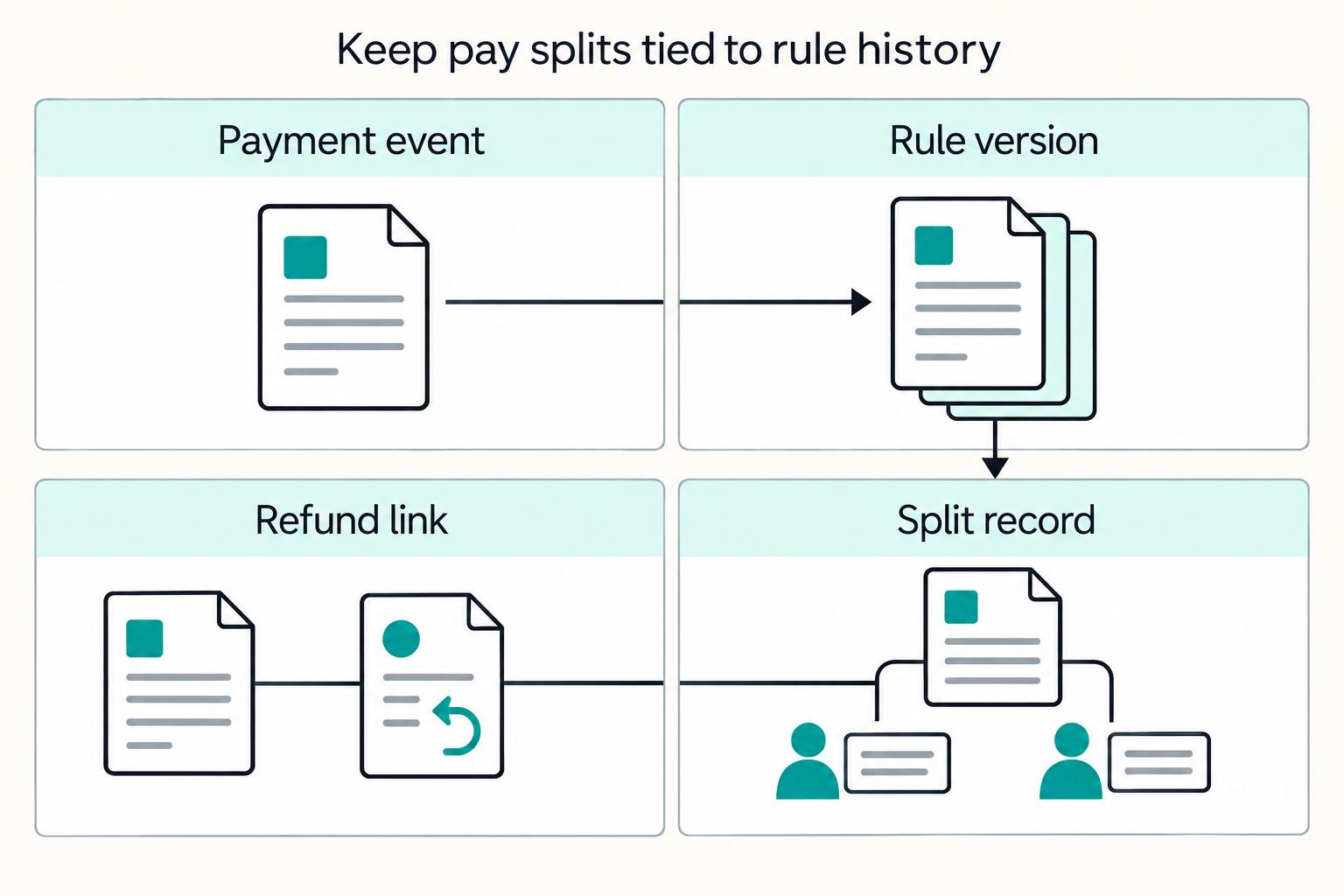
In on-demand platform payments, split math is a money-movement control, not just a pricing setting. Keep one server-side source of truth for split computation. Record which rule version was applied, and avoid relying on client-side math or ad hoc scripts once refunds, reversals, or payout timing changes appear.
Treat split rules as configurable policies. The exact mix is platform-specific, and you can model Pay splits and Marketplace payouts with patterns like these:
| Rule pattern | How it is applied | What to store with the transaction | Possible failure mode |
|---|---|---|---|
| Fixed fee | Platform keeps a set amount per order or booking | Fee amount, currency, rule version, effective date | Config updates not applied consistently across cohorts |
| Percentage | Platform keeps a percentage of the customer charge | Percentage, calculation base, rounding method, rule version | Refunds or discounts applied to a different base than the original split |
| Tiered commission | Rate changes by threshold, segment, or category | Tier definition, threshold snapshot, segment, rule version | Re-rating prior transactions after a tier change |
| Refund clawback handling | Prior payouts are adjusted after full or partial refunds | Original payout reference, refund amount, adjustment rule, clawback status | Partial refunds and payout timing create inconsistent provider net results |
One workable operating sequence is:
- Collect payment, based on your authorization, capture, and settlement policy.
- Record the payment event in your ledger system.
- Apply the split rule using the stored rule version.
- Run release checks defined by your payout-control policy.
- Release payout batches only after those records are linked.
Plan for amounts that are not final at payment time. Some transaction costs are calculated only after the payment request is received, and by default those costs can be deducted from the liable balance account. If product and finance assume different fee treatment, payout math will drift even when each charge appears valid.
This matters more in on-demand operations because booking flows span multiple steps, not one UI action. Availability, pricing, assignment, notifications, tracking, and cancellations can all change what should be paid out after initial collection.
Hold the line on one principle: keep split computation centralized and versioned on the server. Let clients show estimates and let finance review outputs, but keep payout math tied to one rule history and one ledger trail so holds, reductions, reversals, and clawbacks stay explainable.
Related: How Home Services Platforms Pay Contractors: Insurance Verification Background Checks and Payouts.
Set compliance and tax gates by market and program#
Set compliance and tax gates as payout-eligibility controls, then enable only the checks your provider, rail, and jurisdiction actually support. Start with payout controls by launch market, and add tax paths as scoped capabilities, not universal promises.
Start with payout eligibility, not feature menus#
Make payout-blocking checks explicit gates in your ops flow. If a gate can stop money movement, it needs a visible lifecycle status, owner, and timestamp.
| Gate area | What to set before launch | Verification detail | Common failure mode |
|---|---|---|---|
| Provider-supported identity checks | Individual or business onboarding path by market | Store the provider status that made the account payout-eligible, with timestamp | Provider appears approved in the app but is not actually eligible for payout |
| Tax reporting scope | Which payment flows are in your Form 1099-K reporting chain | Map direct card flows separately from payment app/marketplace flows | Teams apply one threshold to every channel |
| Recipient copy handling | Owner and workflow for recipient-copy delivery timing | Track annual delivery readiness and exception ownership ahead of January 31 | Delivery handling is treated as ad hoc and misses deadline risk |
| Tax and VAT capability | Tax-form and VAT features actually enabled by provider | Keep enabled capabilities and exceptions visible to ops | Teams assume vendor coverage is universal when capability is partial |
Treat Form 1099-K as the concrete tax checkpoint#
Use Form 1099-K as the clearest tax checkpoint here. The IRS describes Form 1099-K as a report of payments received for goods or services during the year. It says payment card companies, payment apps, and online marketplaces send this information to the IRS each year and send a recipient copy by January 31.
Do not apply one threshold across all payment channels. For direct card acceptance for goods or services, IRS language says a payee can receive Form 1099-K regardless of payment count or amount. For payment apps and online marketplaces, the provided IRS text states a trigger of over $20,000 and more than 200 transactions. It also notes platforms may issue Form 1099-K below that level, and the Form 1099-K page notes the dollar limit reverted to $20,000.
If your program sits in that reporting chain, assign ownership early for the evidence pack. That pack should cover annual gross payment totals, transaction-count logic where relevant, recipient-copy handling by January 31, and exception review when provider profiles change midyear.
Add tax-document and VAT paths only where enabled#
Do not present optional tax-document flows as default requirements everywhere. Treat them as readiness flows unless your tax team has confirmed requirements for that provider cohort and market. In product and ops docs, label these as supported document paths when enabled.
Apply the same qualifier to VAT. Vendor claims, including Merchant of Record claims about tax and VAT handling, should be treated as provider-specific capabilities, not universal marketplace coverage. Keep that explicit in copy: capabilities may be enabled per provider, rail, and jurisdiction.
Build the document pack before launch approval#
Before the first live payout, turn your market and tax gates into one approval packet for Marketplace payouts. The packet should let your team explain any release, hold, or return decision without reconstructing evidence across product, compliance, and finance.
Make the packet checklist-based#
Treat the checklist as the approval artifact, not admin overhead. Use a clear application-and-supporting-documents structure, and keep each required item explicitly tracked to completion.
Keep compliance evidence official and current#
When you reference regulatory material, keep the official record in the packet. FederalRegister.gov says its web display is informational and links to the official PDF on govinfo.gov, so retain that PDF for cited items such as the 09/04/2024 FinCEN entry at 89 FR 72156.
Track time-bounded authorizations as active controls, not static notes. OFAC states General Licenses can have different expiration dates and terms, so assign ownership and recurring expiry checks for any dates that affect your program, including April 29, 2026 and May 1, 2026 where relevant.
Add the operational pages teams will actually use#
Include a document checkpoint log that shows what was reviewed, when it was verified, and who approved it. Keep AML/CFT source controls explicit by storing the governing document version, the official-record document copy, and any blocked-person conditions or time-bound caveats that could change launch readiness.
Sequence integration so reconciliation works on day one#
For platform payments, design for reconciliation first and payout speed second. One workable sequence is payment collection, ledger journal posting, payment splits, payouts, then finance-close export.
Start with the journal, not the balance#
The first durable record after collection should be the journal entry. If payout logic runs before a journal entry exists, exceptions and corrections are much harder to trace.
Treat balance views as operational summaries, and keep journal history linked to supporting documentation such as the invoice, receipt, and payment confirmation so disputes and audits are explainable.
Use event-driven updates, but design for bad event timing#
Event-driven updates can improve matching, especially as reconciliation moves from end-of-day review to more frequent checks.
Do not assume updates will resolve themselves. Keep external payment or bank references on journal entries, and preserve original transfer references so corrections are easier to trace.
Make checkpoints explicit and auditable#
Use checkpoints operators can verify without reading code:
| Checkpoint | What to confirm |
|---|---|
| Invoice paid state | The invoice or charge is marked paid and includes a payment confirmation reference. |
| Ledger journal created | A journal entry exists for the collection event and is linked to the related records. |
| Payout status changed | Payout state transitions are recorded with timestamps and visible context. |
| Reconciliation export completed | Export transaction IDs and amounts match what is already in the ledger. |
Keep export last. It should reflect internal truth, not create it. If your process depends on manual rekeying between collection, splits, and payout release, tighten integration controls before increasing volume or channel complexity.
Related reading: Telehealth Platform Payments: How to Pay Physicians and Specialists Under Medicare Rules.
Plan for failure modes before market launch#
Define your exception policy before the first provider payout. When access is blocked, funds are delayed, or an account is placed under review, your team should already have a named action, a visible status, and customer-safe language.
These failures are not theoretical. Complaint narratives describe accounts blocked during review, requests for additional identity verification, support handoff gaps, and real business impact when funds stay stuck. In one case, an expected 7-10 business day timeline became 16 business days without resolution.
Put every failure into a state table#
Map each failure mode to a money state, an owner, and the next permitted action.
| Failure mode | Immediate platform action | Operator checkpoint | External status language |
|---|---|---|---|
| Account placed under review | Pause money movement on the affected account until review is complete | Confirm when the review started and who owns the next update | Account under review |
| Additional identity verification requested | Keep payouts on hold until required information is submitted and reviewed | Confirm what identity information was requested and what is still unresolved | Verification in progress |
| Support escalation handoff gap | Escalate to a named owner and stop silent handoffs | Confirm the last contact, current owner, and next response deadline | Case escalated |
| Funds remain inaccessible beyond expected timeline | Trigger manual follow-up and document customer impact | Confirm expected timeline, elapsed business days, and current hold status | Funds delayed |
| Case tracking fields are incomplete | Block closure until tracking data is complete | Confirm date received, date sent to company, response status, timely response status, and complaint or case ID | Update in progress |
Use this table to answer three questions quickly: can money move, what evidence is missing, and who owns the next step.
Make holds explicit and auditable#
For account holds and unresolved identity issues, use one shared hold state across product, support, and finance. "Account under review" is clearer than internal error text and keeps teams aligned.
Also define a simple escalation log for every hold or payout exception. At minimum, track date received, date sent to company, response status, timely response status, and complaint or case ID so handoffs are traceable and unresolved cases do not stall silently.
Run vendor due diligence on unknowns competitors skip#
Do not rely on pricing pages or polished demos alone. For home services platform payments, run scenario-based diligence that forces clarity on fee components, payout charging units, and contract terms when split math changes.
| Fee item | Stated fee | When it applies |
|---|---|---|
| Domestic cards | 2.9% + 30¢ | On Stripe's published pricing |
| Manually entered cards | +0.5% | Can combine depending on how payments are taken |
| International cards | +1.5% | Can combine depending on how payments are taken |
| Currency conversion | +1% | Can combine depending on how payments are taken |
| ACH Direct Debit | 0.8% | ACH Direct Debit with a $5.00 cap |
| Managed Payments | 3.5% per successful transaction | Charged in addition to standard processing fees |
| Monthly active account | $2 per monthly active account | Under Connect pricing where you handle pricing |
| Payout sent | 0.25% + 25¢ per payout sent | Under Connect pricing where you handle pricing |
Use the same Childcare and Home services scenarios with every provider, and require fee line items instead of a blended rate. On Stripe's published pricing, base fees and add-ons can combine depending on how payments are taken. That can include 2.9% + 30¢ for domestic cards, +0.5% for manually entered cards, +1.5% for international cards, +1% for currency conversion, and 0.8% ACH Direct Debit with a $5.00 cap. If Managed Payments is in scope, Stripe states a 3.5% fee per successful transaction, charged in addition to standard processing fees. It also notes that country pricing pages can supersede listed fees.
Treat payout modeling as a hard checkpoint. Stripe defines a payout as each transfer to a user's bank account or debit card. Under Connect pricing where you handle pricing, that can include $2 per monthly active account and 0.25% + 25¢ per payout sent. If Stripe bills connected accounts, Stripe states you do not incur additional account, payout volume, tax reporting, or per-payout fees.
Then run a narrow contract checklist:
- where Merchant of Record language appears and which entity is described as collecting funds
- who is assigned responsibility for payout errors, reversals, or re-releases
- how split recalculations are handled after refunds, disputes, or pricing corrections
- whether payout terms and exception handling are explicitly documented in order forms, schedules, or support attachments
Finally, test real flows on Stripe and other shortlisted rails, not just demos: one payment, one split change, one refund, and one payout release. Save fee outputs, webhook logs, ledger entries, payout status changes, and finance exports so you can verify how costs and responsibilities change when money moves more than once.
Execute a phased launch in the first 90 days#
Treat the first 90 days as a checkpoint window, not a full-scale rollout.
A phased plan works best when each phase has a clear go or no-go decision based on documented evidence, not momentum. In home services, one stated failure mode is over-reliance on paid ads and third-party platforms, which can increase acquisition costs and lead to inconsistent growth; treat that as directional because it comes from a distributed press release.
| Phase | Scope to allow | What to prove before advancing | No-go signal |
|---|---|---|---|
| 1 | One market and one core operating flow | Checkpoint status and control evidence are documented for the phase window | Required evidence is missing or controls are not yet reliable |
| 2 | Additional cohorts or operating paths | New scope is reviewed against the same checkpoint standard, with assumptions re-tested | Expansion relies on untested assumptions or repeated exceptions |
| 3 | Next market as a fresh launch configuration | Prior-phase evidence is complete, and the next market is treated as a new checkpoint | First-market assumptions are reused without re-validation |
Keep one go or no-go gate per phase#
Before each phase, define the evidence you need, review it on a fixed cadence, and pause expansion if control gaps remain.
Conclusion#
Teams may clear checkout setup and still fail in live operations, where post-checkout risk events and compliance gates collide. For home services platform payments, choose the architecture that still works after collection, not the one that only looks fastest in a demo.
Payment acceptance can influence trust, but checkout trust is not operational readiness. Readiness is whether you can trace status from onboarding through settlement and whether core setup is in place, including business registration and an EIN. If either breaks, expansion is ahead of your controls.
Failure modes are often ordinary. A missing invoice link can delay collection for days. The costlier version appears after funds are collected, when your team cannot clearly explain a payout decision or status change between onboarding and settlement. At that point, unclear decision logic and compliance review become operational risk, not feature checkboxes.
Do not carry assumptions across markets or models. There is no universal legal threshold for bonding insurance or fixed rule for when pay splits become mandatory established here. Treat both as market-specific design inputs to validate in your own provider and processor setup. If childcare and general home services differ in onboarding or payout handling, do not force one rollout pattern.
Use a simple go or no-go rule: if you cannot defend each movement of funds from collection to payout with audit-ready evidence, the launch may pass a pilot and fail under volume. If you can, you are positioned to expand by market, rail, or provider cohort without losing control of exceptions.
Before final launch approval, run a short implementation check against the Gruv docs to confirm idempotent webhooks, ledger-first tracing, and finance-close exports.
Frequently Asked Questions
What payment capabilities are truly table stakes for a home services platform in 2026?
For home services platform payments in 2026, the baseline is more than a checkout page. The grounded capabilities are card and ACH acceptance inside the product, flow coverage from onboarding through settlement, and clear exception handling. A practical evaluation question is whether the platform has a defined exception-management capability before launch.
How are platform payments different from field-service invoicing tools like Square or Housecall Pro?
The grounded distinction is the payment model, not a specific brand comparison. In a traditional model, the merchant contracts directly with a processor and software connects externally. In an embedded model, payments are integrated in-platform and the platform can control merchant onboarding. Embedded payments can provide more operational control, but they are also more complex than a checkout-only integration.
When do pay splits become mandatory instead of optional?
This guide does not establish a universal trigger point, so this should not be treated as a fixed rule. Treat pay splits as a product and operations decision tied to how your payment flow is designed. If your roadmap may require dividing one payment across parties, validate that capability early.
How does bonding insurance change payout timing and risk controls?
The evidence here does not establish legal thresholds or release mandates for bonding insurance. Treat insurance-linked payout controls as a market-specific operating decision that needs validation in your own legal and processor context. Do not rely on a universal timing rule here.
What should founders validate before entering childcare versus general home services?
Do not assume childcare and general home services can share one rollout template. Validate core operating assumptions for each, including onboarding flow, payment behavior, and settlement operations, before committing rollout scope. In the provided 2026 home-services evidence, one user expectation is smooth booking, fast fulfillment, and transparent pricing.
Which compliance gates should be live before the first marketplace payout?
The evidence here does not support a universal jurisdiction-wide checklist. Supported operational checkpoints include in-product card and ACH acceptance, flow continuity from onboarding through settlement, and exception handling readiness. A useful readiness test is whether you can trace the flow from onboarding through settlement without losing status continuity.
What are the most common unknowns in provider due diligence before contract signing?
The common unknowns are operational ownership and implementation depth, not headline feature claims. Clarify who controls merchant onboarding, whether card and ACH are both supported in-product, and how exceptions are handled in practice. If processor flexibility is important, confirm how agnostic architecture works in implementation, not just in positioning.
Try a related tool
Researched and edited by the Gruv editorial team. Gruv builds cross-border billing, payouts, and finance-operations software for global businesses.
Sources
- calpers.ca.gov/sites/default/files/spf/docs/board-agendas/2...trusted
- congress.gov/bill/119th-congress/house-bill/7148/texttrusted
- consumerfinance.gov/data-research/consumer-complaints/search/api/v1trusted
- dhcs.ca.gov/BHT/Documents/Behavioral-Health-Services-Act...trusted
- fdic.gov/resources/supervision-and-examinations/exami...trusted
- federalregister.gov/documents/2024/09/04/2024-19260/financial-cr...trusted
- files.consumerfinance.gov/f/documents/cfpb_buy-now-pay-later-market-tr...trusted
- fiscal.ca.gov/wp-content/uploads/8860-030.pdftrusted
Educational content only. Not legal, tax, or financial advice.
Related Posts

The Freelance Payment Penalty: A Modeled Audit of Platform Fees, FX Spreads, and Payout Delays
The money rarely disappears through a single, easy-to-spot fee. The real loss is stacked. A marketplace takes its commission, a processor adds a charge for international cards, a bank or payment company converts the currency at a spread, a platform holds the funds before release, and a wire sheds a little to intermediaries on the way in. Each layer looks defensible on its own, but the worker feels the combined result as a smaller deposit and a later payday.

How to Respond to a Subpoena for Business Records
Move fast, but do not produce records on instinct. If you need to **respond to a subpoena for business records**, your immediate job is to control deadlines, preserve records, and make any later production defensible.
A US Expat's Guide to Investing in UCITS ETFs to Avoid PFIC Issues
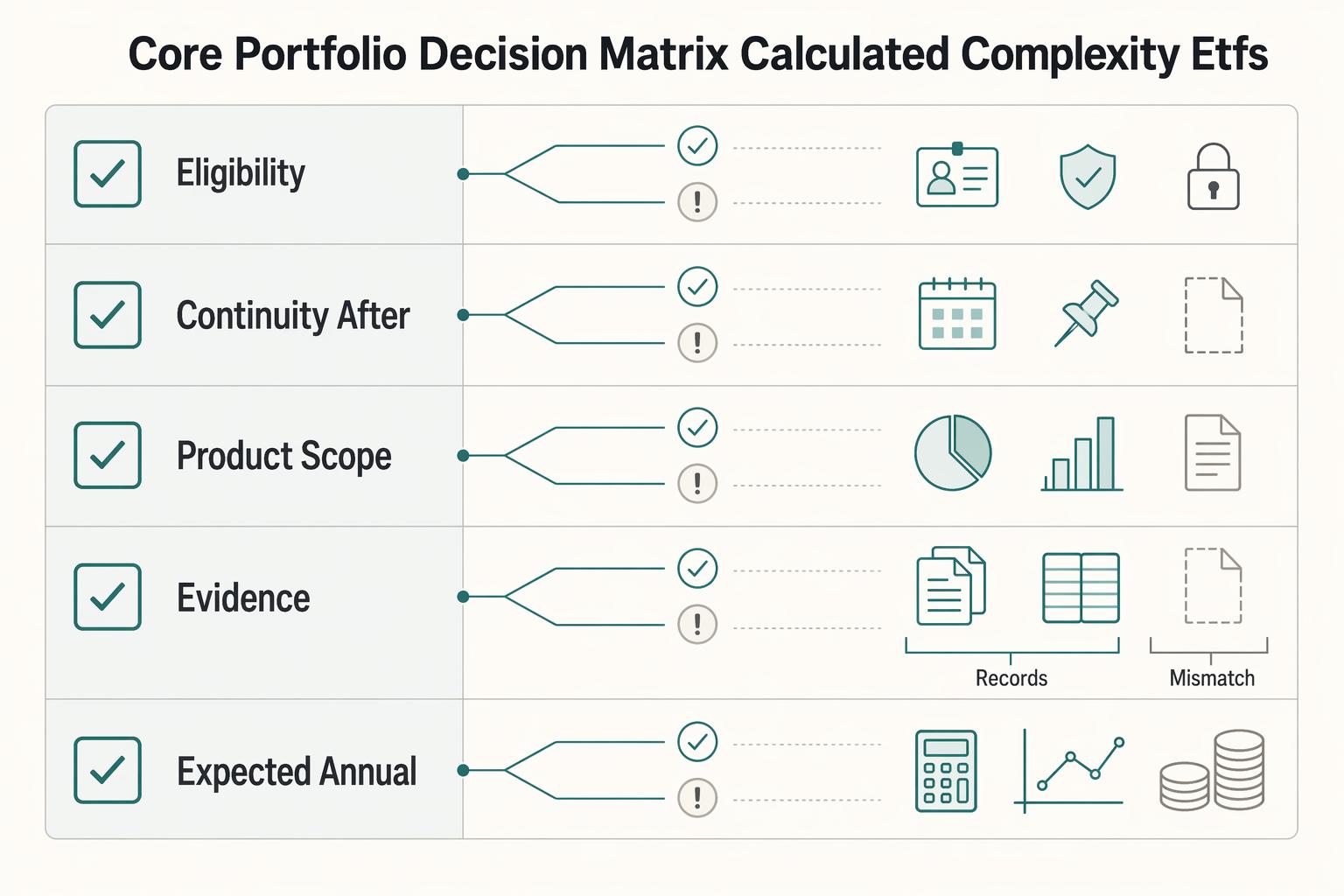
The real problem is a two-system conflict. U.S. tax treatment can punish the wrong fund choice, while local product-access constraints can block the funds you want to buy in the first place. For **us expat ucits etfs**, the practical question is not "Which product is best?" It is "What can I access, report, and keep doing every year without guessing?" Use this four-part filter before any trade: