
Quick Answer
Identify the billing entity and compensation agreement, validate the Medicare rule effective on the service date, and link claims, receipts, and clinician obligations. Use current CMS guidance for 2027 flexibilities and separate claim remediation from compensation already due.
Why this article matters for platform operators now#
Medicare reimbursement and a platform’s payment obligation to a clinician are separate decisions. First identify the enrolled billing entity, any valid reassignment, and the clinician compensation agreement. Then connect claim eligibility, payment receipts, and clinician disbursements without assuming a denied claim automatically cancels compensation for work performed.
Current Medicare telehealth policy includes both permanent and temporary flexibilities, but payout automation is still conditional. Telehealth.HHS.gov says many Medicare telehealth flexibilities extend through December 31, 2027, including home as the patient site for non-behavioral/mental telehealth, no geographic originating-site restrictions for that category, and audio-only delivery through 2027. That can make the lane look launch-ready, but payment reliability still turns on source reconciliation, enrollment evidence, service eligibility, location logic, and supervision conditions.
Start with the real scope#
This guide focuses on Medicare fee-for-service telehealth claim controls and their connection to physician and practitioner compensation. Medicare Advantage, Medicaid, and commercial contracts need independently sourced rules. A shared encounter model can support separate policy configurations.
If your spec just says "telehealth payout logic," treat that as a warning sign. Blended payer logic tends to hide the decision points that block payment later, especially around encounter type, location assumptions, and supervision.
Focus on the controls that move money safely#
Most payout risk sits in four checkpoints:
| Checkpoint | Article detail |
|---|---|
| Enrollment and address evidence | Including PECOS handling |
| Service eligibility | For the applicable Medicare telehealth policy window |
| Location logic | Including originating-site assumptions and home-based care conditions |
| Supervision details | Including cases where direct supervision can occur through real-time audio and visual telecommunications |
CMS guidance on suppressing a practitioner home address in PECOS is a practical signal that enrollment and address handling are part of payout readiness. If you cannot verify which address and site assumptions your payout logic is using, automation is not ready.
Expect source mismatch and plan for it#
Use the later policy update when documents describe different periods. CMS’s February 26, 2026 FAQ explicitly permits RHCs and FQHCs to bill non-behavioral telehealth with G2025 through December 31, 2027. The December 2025 MLN booklet’s 2026 date predates that update. Record the superseding guidance rather than treating this known date difference as an unresolved launch blocker.
Also separate informational summaries from legal authority. The FederalRegister.gov page for the CY 2026 payment policy rule says it is not an official legal edition, so it should not be your only signoff source.
Leave with a go/no-go outcome#
By the end of this guide, you should be able to decide:
- Is a Medicare payout lane launch-ready now, or blocked by unresolved rule or data gaps?
- If it is viable, what rollout sequence lowers exposure, for example a narrower payer or specialty scope first?
- What minimum pre-release checklist must be true before payouts run?
The goal is a clear go or no-go decision and a practical rollout path, not more policy reading.
If you want a deeper dive, read Healthcare and Telehealth Platform Payments: HIPAA-Compliant Provider Payouts.
Define what the platform owes before routing a claim#
Confirm whether an enrolled practice bills Medicare, the practitioner bills directly, or an eligible organization receives payment through a valid reassignment. CMS describes reassignment as allowing an eligible group or organization to submit claims and receive Part B payment for its members. Processing a bank payout does not confer billing privileges.
For a hypothetical agreement paying $100 for an approved completed consultation, a pending or denied $120 claim does not by itself determine whether the $100 is due. Record the agreed service approval and payment date, then handle the claim correction or appeal separately. If compensation depends on collections, define the lawful calculation, timing, and adjustment terms explicitly; never invent a clawback from a status change.
OIG’s telemedicine fraud alert identifies compensation tied to the volume of items or services ordered or prescribed as a suspect characteristic. Paying for documented care is a different question from rewarding orders or referrals. Review the actual compensation arrangement rather than assuming a technically valid claim makes every payment structure permissible.
What to prepare before you design payout logic#
Prepare your source set and provider-routing data first, or your payout logic will hard-code avoidable errors.
Step 1 gather a dated rule register from three sources#
Use Centers for Medicare & Medicaid Services (CMS), Telehealth.HHS.gov, and the CMS Telehealth webpage together, not as substitutes. Telehealth.HHS points readers to CMS coverage updates, and CMS MLN materials point readers back to the CMS Telehealth webpage for current changes.
| Source | Use | Note |
|---|---|---|
| Centers for Medicare & Medicaid Services (CMS) | Use together with the other two sources, not as a substitute | CMS MLN materials point readers back to the CMS Telehealth webpage for current changes |
| Telehealth.HHS.gov | Use together with the other two sources, not as a substitute | Points readers to CMS coverage updates |
| CMS Telehealth webpage | Use together with the other two sources, not as a substitute | Referenced by CMS MLN materials for current changes |
Record source URL, publication or update date, service-date applicability, and owner. A later statutory extension or CMS update can supersede an older annual-rule summary. Resolve the effective period before applying a rule to an encounter.
Step 2 pull provider data that supports location logic#
Before design starts, pull your current provider dataset with PECOS enrollment context and enrolled practice locations. Your model should also test encounter assumptions for Originating site and practitioner location.
The patient’s location is the originating site. A practitioner who has a physical practice can bill from that enrolled location when providing telehealth from home. A virtual-only practitioner whose sole physical practice is the home must enroll that location; public-address suppression is a separate privacy option.
Step 3 split payer inventories before building rules#
If your scope includes multiple payers, separate Medicare inventory from Medicaid and commercial plan inventories before you build anything. This keeps one blended rules engine from hiding payer-specific exceptions and update cycles.
If you cannot version those lanes independently, narrow the launch scope to Medicare first.
Step 4 assign update ownership for Medicare telehealth list changes#
Give explicit ownership to updates for the Medicare telehealth services list. CMS MLN notes that starting in CY 2026, additions to the telehealth services list are permanent-basis only, and it also reports 5 new CPT and HCPCS codes added for CY 2026.
Your release checkpoint should be simple and unambiguous: who updates the rule register, who approves release impact, and which policy version each payout decision used.
Step 1 map the Medicare rule surface that changes payout eligibility#
Map Medicare claim eligibility to the rule effective on the service date, then apply the compensation agreement separately. Review missing facts or genuinely unresolved policy questions; do not hold every clinician payment solely because a claim remains pending.
For CY 2026 Medicare Part B, anchor the timeline on legal-status checkpoints: proposed rule CMS-1832-P (07/16/2025, 90 FR 32352) and final rule CMS-1832-F (11/05/2025, 90 FR 49266). Use those checkpoints to separate what was proposed from what was finalized.
Build the timeline around official artifacts#
Use Federal Register entries as the primary lane, then layer in CMS and Telehealth.HHS.gov materials for interpretation. Track docket ID, publication date, Federal Register citation, and exact PDF page reference for each rule row.
Treat the FederalRegister.gov prototype edition as non-authoritative for legal status. It is not the official legal edition and does not provide legal notice, so verification should run through the "View printed version (PDF)" artifact for both proposed and final entries.
Classify each topic before writing payout logic#
Classify a topic as durable or time-bound only when final-rule or CMS text supports that conclusion. If support is missing, mark it unverified and route it to manual review.
| Rule area | Current operational rule | Record to retain |
|---|---|---|
| Patient location | CMS FAQ permits nationwide telehealth through December 31, 2027; keep applicable service conditions | Patient location and service-date policy |
| Audio-only | Validate the service, home setting, and applicable audio-only conditions | Modality, setting, and any required video-capability or consent evidence |
| RHC/FQHC | CMS FAQ extends non-behavioral G2025 billing through December 31, 2027; behavioral payment uses separate AIR/PPS rules | Provider type, service category, code, and later FAQ version |
| Home-based practitioner | Physical-practice and virtual-only enrollment cases differ | Enrolled practice and home-location determination |
| Direct supervision | Audio-video virtual presence applies to eligible services without a 010 or 090 global-surgery indicator; audio-only is excluded | Service-specific supervision determination and presence evidence |
For unresolved rows, automation should return cannot auto-decide with a required evidence field pointing to the exact CMS or Federal Register document.
Add a manual-review control before engineering starts#
Put the review gate in place before engineering begins:
- Require a final-rule citation before automating eligibility logic.
- Use the official printed PDF as the legal checkpoint.
- Freeze any row with an unresolved source conflict between
Telehealth.HHS.govand CMS or Federal Register artifacts.
The output of this step is a defensible rule timeline: what is finalized, what is still interpretive, and what is too uncertain to automate.
Step 2 separate payer lanes before you write one line of payout code#
Run separate payout lanes from day one. If you cannot keep Medicare, Medicaid, and commercial logic independently versioned, delay broad launch and start with a Medicare-only pilot.
Once you have a dated Medicare timeline, do not run every payer through it. Medicare-specific rules and artifacts apply here, but Medicaid or commercial eligibility, timelines, and code treatment require separate handling. Build side-by-side lanes with separate eligibility checks, exception queues, and policy ownership.
| Payer lane | What you can automate for Medicare | What must stay separate | When to return cannot auto-decide |
|---|---|---|---|
| Medicare | Rules tied to verified CMS and Medicare Part B telehealth materials, including checks that CPT/HCPCS codes align with the Medicare telehealth services list used for the decision period | Medicare-only code mapping, policy dates, and exception reasons | Missing facts, unclear service eligibility, or a genuinely unresolved policy question |
| Medicaid | Lane structure and manual-routing pattern only | State and payer-specific eligibility, code mapping, and timelines | Until the specific policy source is verified |
| Commercial | Lane structure and manual-routing pattern only | Plan-specific eligibility, code mapping, and contract terms | Until the specific payer policy is verified |
For Medicare, keep code logic tight and dated. CMS says payment is for specific Medicare Part B services delivered via 2-way interactive technology, and that starting in CY 2026, additions to the Medicare telehealth services list are permanent-basis only. Your Medicare configuration should therefore use a versioned CPT and HCPCS map tied to the policy period used for adjudication, not a generic "telehealth eligible" flag.
Keep that Medicare map in Medicare configuration only. Do not reuse it for Medicaid or commercial lanes, because Medicaid and commercial eligibility, code mapping, and timelines require their own sourcing and verification.
Use an explicit cannot auto-decide outcome that routes to human operations with required evidence fields. At minimum, capture:
- payer lane and payer name
- service code set used, including whether the decision referenced CPT or HCPCS
- source document title, URL, publication date, and PDF page or section
- policy-effective date used at adjudication
- reason the rule failed, such as source conflict, missing code eligibility, or unresolved location logic
The later CMS FAQ resolves the RHC/FQHC continuation date: non-behavioral services may use G2025 through December 31, 2027. Keep RHC/FQHC billing and behavioral AIR/PPS treatment separate from ordinary physician PFS claims. An older booklet’s 2026 date should not by itself trigger a blanket compensation hold.
Before launch, run one verification checkpoint: sample approved Medicare encounters and confirm that service code, modality, payer lane, and source version all match the exact CMS artifact cited by the rule. If you cannot do that cleanly, hold multi-payer expansion.
Step 3 build provider enrollment and location gates that block bad payouts#
Verify who rendered care, patient location, and the clinician’s authorization for that encounter before submitting a claim. Investigate a missing fact without assuming that a reimbursement defect eliminates compensation already owed under the clinician agreement or applicable employment rules.
1 use evidence gates before disbursement#
Treat location and authorization data as pre-payout controls, not cleanup work. Medicare enrollment-system checks are not established as stand-alone proof of payout eligibility.
At minimum, your payout record should retain:
- patient location at time of service
- documented patient consent obtained before the appointment
- state authorization basis used for that encounter, for example full license, temporary practice pathway, reciprocity, compact, or registration
- verification timestamp for location and authorization checks
Verify patient location and required consent before the visit, then retain the evidence for claims review. Missing or contradictory fields route the claim to remediation. Any clinician-payment restriction must follow the actual agreement and applicable obligations, rather than an automatic claim-status rule.
Because cross-state rules vary by state and pathway, keep routing logic explicit rather than assuming one universal licensing rule. If teams use Federal Register materials during review, treat the site text as informational and verify legal reliance against an official edition.
Step 4 set encounter level eligibility rules your finance team can audit#
Use encounter evidence to decide claim submission and reimbursement handling. Use the compensation agreement to determine the amount and due date owed to the clinician; link both decisions in the record.
1 require a minimum encounter packet before adjudication#
Use an internal minimum packet so finance can audit decisions from the record alone. CMS does not publish this exact bundle as one required field set.
| Packet field | Article wording |
|---|---|
| Payer information | payer type and product lane |
| Service code | service code (CPT/HCPCS) |
| Modality | modality used for the service |
| Clinician context | rendering clinician and supervising context |
| Location | patient location at time of service and service location |
| Decision trace | decision timestamp and rule version used |
Keep the packet tied to the service date. Store modality and required supervision as structured fields. Eligible audio-only care is not the same as virtual direct supervision, which requires real-time audio-video presence under the applicable service rule.
2 bind each decision to the policy version in force that day#
Store the Medicare telehealth services list version and any MPFS policy-period reference you used at adjudication, and persist that with the payout record. This is an audit control, not a CMS-stated formatting requirement.
The policy surface changes over time. CMS states that starting in CY 2026, additions to the Medicare telehealth services list are permanent-only, and CMS notes that five new CPT and HCPCS codes were added. Replaying old encounters against a later ruleset can create false approvals or false failures.
Keep service date, claim processing date, and compensation due date separate. For RHC/FQHC non-behavioral G2025 claims, retain the later CMS FAQ supporting the 2027 extension and the exact provider and service category.
3 build idempotent payout triggers before claim updates go live#
If your claim pipeline receives late or retried events, payout triggers should replay safely. Reprocessing the same approval state should confirm the prior outcome, not create a duplicate disbursement.
Use a stable compensation-obligation identifier to prevent duplicate disbursements. Keep decision versions as audit metadata rather than making every new claim decision a fresh payable. Claim adjustments may alter balances under the agreement; recover the existing payout result before creating another instruction.
4 sample outcomes weekly and test whether reasons travel well#
Do a weekly sample of both approved and failed encounters to test audit readability. This is an internal checkpoint, not a CMS-mandated checkpoint.
Failure and approval reasons should be specific, human-readable, and exportable, for example list or version mismatch for the service date or missing patient originating-site data, not opaque rule IDs. Include edge cases around December 31, 2027 and January 1, 2028 policy boundaries so finance, dispute, and clawback reviews can rely on the same evidence.
Step 5 handle supervision and specialist variance without manual chaos#
Do not auto-decide supervision from narrative notes or specialty labels alone. In the Medicare lane, encode only what your CMS rule artifacts explicitly support, and route anything unclear to exception review.
1 encode supervision as a decision object, not a note field#
Record rendering role, required supervision type, supervisor presence, service code, and setting. For virtual direct supervision, distinguish eligible services from those with 010 or 090 global-surgery indicators and exclude audio-only presence. Teaching-physician rules require their own service-specific check.
Store the source identifiers in the record. If your team validated against the CY 2026 PFS final rule entry, persist CMS-1832-F, 90 FR 49266, 11/05/2025, and the corresponding govinfo PDF reference. This helps avoid a known failure mode: the FederalRegister.gov XML page says it is not legal notice and should be verified against an official edition.
If the supervision allowance for the case is not explicitly documented, return cannot auto-decide and require review.
2 separate cohorts by supervision clarity before launch#
Launch first where supervision evidence is consistently structured, and defer lines where supervision is reconstructed from ambiguous documentation. The point is not to rank specialties, but to separate clear evidence paths from unclear ones.
Use a practical split:
- Lower-risk cohort: rendering role, supervising context, and payable PFS service are captured in discrete fields, with a current policy artifact.
- Higher-complexity cohort: cases with missing supervising-context fields, unclear setting data, or services that may involve professional and technical component separation.
CMS states that for many diagnostic tests and some other PFS services, professional and technical components may be paid separately, so component-sensitive services should stay in the cautious cohort until your logic is explicit.
3 add an exception taxonomy finance can actually measure#
Make supervision holds and denials measurable with a small, consistent reason set.
| Exception reason | Trigger | Evidence to clear |
|---|---|---|
| Missing supervision context | Encounter lacks a structured supervising relationship field | Corrected encounter record tied to encounter ID |
| Unsupported policy source | Decision relied on summary text or unverified XML | Official CMS or Federal Register artifact with govinfo reference |
| Service-component mismatch | Service may require professional or technical component handling | Claim detail showing billed and approved component |
| Site or setting ambiguity | Service setting is unclear in the record | Corrected site field plus policy-version recheck |
Review this weekly by specialty line, owner, and policy version so recurring failure patterns are visible.
4 make the launch tradeoff explicit and reversible#
Wider scope creates more claim-automation edge cases. Start automated claim submission with encounters whose required supervision evidence is complete, then expand as exception patterns stabilize. Keep clinician compensation on its separate agreement-based approval path; an incomplete Medicare billing trail does not automatically suspend an earned payment.
Step 6 pick a launch sequence that minimizes regulatory and payout risk#
Launch the smallest defensible Medicare wedge first, then widen only after reconciliation and exception patterns are stable. Start with limited specialties, clean enrollment evidence, and low location ambiguity so you are not stacking payer variance on top of supervision and eligibility variance.
1 rank launch wedges before revenue upside#
Score launch options by payer mix, specialty complexity, and location variability, including cases where MSA or HPSA geography checks may still apply. For Medicare non-behavioral/mental telehealth services, Telehealth.HHS.gov states there are no geographic originating-site restrictions through December 31, 2027; do not generalize that to every telehealth service category.
| Launch option | Payer mix | Specialty scope | Location variability | Risk read |
|---|---|---|---|---|
| Constrained wedge | Medicare only | Limited specialties with clear supervision evidence | Low, with few cases needing MSA/HPSA geography checks | Lowest launch risk |
| Broad Medicare pilot | Medicare only | Wider specialist mix, including component or teaching complexity | Moderate | Faster coverage, higher exception load |
| Early mixed-payer launch | Medicare, Medicaid, commercial | Mixed specialties | High | Highest payout and reconciliation variance |
Keep RHC/FQHC billing in its own provider-type branch. Apply the February 2026 CMS FAQ’s 2027 G2025 extension and separate behavioral AIR/PPS treatment; this distinction is a supported routing rule, not an unresolved date conflict.
2 start with the cleanest Medicare cohort you can prove#
Start with providers whose enrollment and location evidence is current and easy to verify, and whose encounter packets rarely need manual repair. Here, "clean" means fast, consistent traceability from provider identity to claim to payout, not a fixed threshold.
Anchor policy logic to official artifacts. If you rely on the CY 2026 PFS rule, validate against the official PDF for Federal Register document 2025-19787, not XML alone, because the XML page states it does not provide legal notice.
3 expand only after two checkpoints pass#
Expand only after both operational checkpoints pass for at least one to two full reporting cycles:
- Low exception rate by your internal review standard, without recurring holds from missing enrollment evidence, location ambiguity, or unsupported policy sourcing.
- Clean month-end reconciliation where claim outcomes and payout outcomes align, and each delta is explainable as a hold, reversal, denial, or timing issue.
Before widening scope, confirm that sampled approved and held encounters share one exportable audit trail: service code, payer lane, policy version, enrollment evidence, and final payout disposition.
4 isolate non-Medicare variance if mixed-payer launch is required#
Use separate payer-policy configurations and clearly labeled reconciliation dimensions. Separate physical ledgers are an implementation choice, not a Medicare requirement. Shared accounting can work if claim, payment, adjustment, and compensation records remain attributable to the right payer and obligation.
Before you ship, pressure-test your rollout plan against idempotent retries, payout status visibility, and batch operations in the Gruv docs.
Common mistakes that create payment exposure and how to recover#
Telehealth payment exposure usually shows up when control discipline slips and summary pages or incomplete evidence start standing in for auditable payment logic. That risk is real: telehealth expansion improved access, and HHS OIG also warns those gains should not be compromised by fraud, abuse, or misuse, while reporting dozens of telehealth fraud investigations.
Step 1 Build a rule register instead of relying on summary webpages alone#
Use CMS and OIG telehealth pages as summaries, then anchor implementation to the exact materials your team validated. Keep a rule register with source URL, policy owner, last validation date, and whether the artifact is a summary page or primary source so reviewers can trace what was automated.
Record the publication or update date of oversight material. Use historical fraud findings to inform controls, not as a current measure of every provider’s risk.
Step 2 Separate claims remediation from compensation release#
A failed coverage check can prevent claim submission or trigger correction. Separately determine whether clinician compensation is due, including approved time or completed services. Record the basis for any payment restriction and its permitted release conditions.
Recovery depends on traceability. Record what was missing, what was reviewed, who approved release, and when the hold was lifted.
Step 3 Separate policy interpretation by payer lane#
Do not assume one telehealth interpretation applies across Medicare, Medicaid, and commercial lanes. Federal, state, and private payers introduced telehealth policy flexibilities during the PHE, so keep payer-lane ownership explicit and review lane-to-lane drift before updates affect payout decisions.
In practice, the common break is silent drift across teams, not one obvious bad rule.
Step 4 Release telehealth policy changes through change control#
Treat telehealth policy updates as controlled release events, not one-time setup. Use review, test sampling, approval, and rollback notes so each decision can be traced to a specific rule version.
If you cannot tie a paid or held encounter to the governing version, pause scope expansion until that control is restored.
Build the evidence pack your legal and finance teams will ask for#
Your evidence pack should let legal or finance reconstruct why a payout was approved, held, denied, or reversed without re-running product logic.
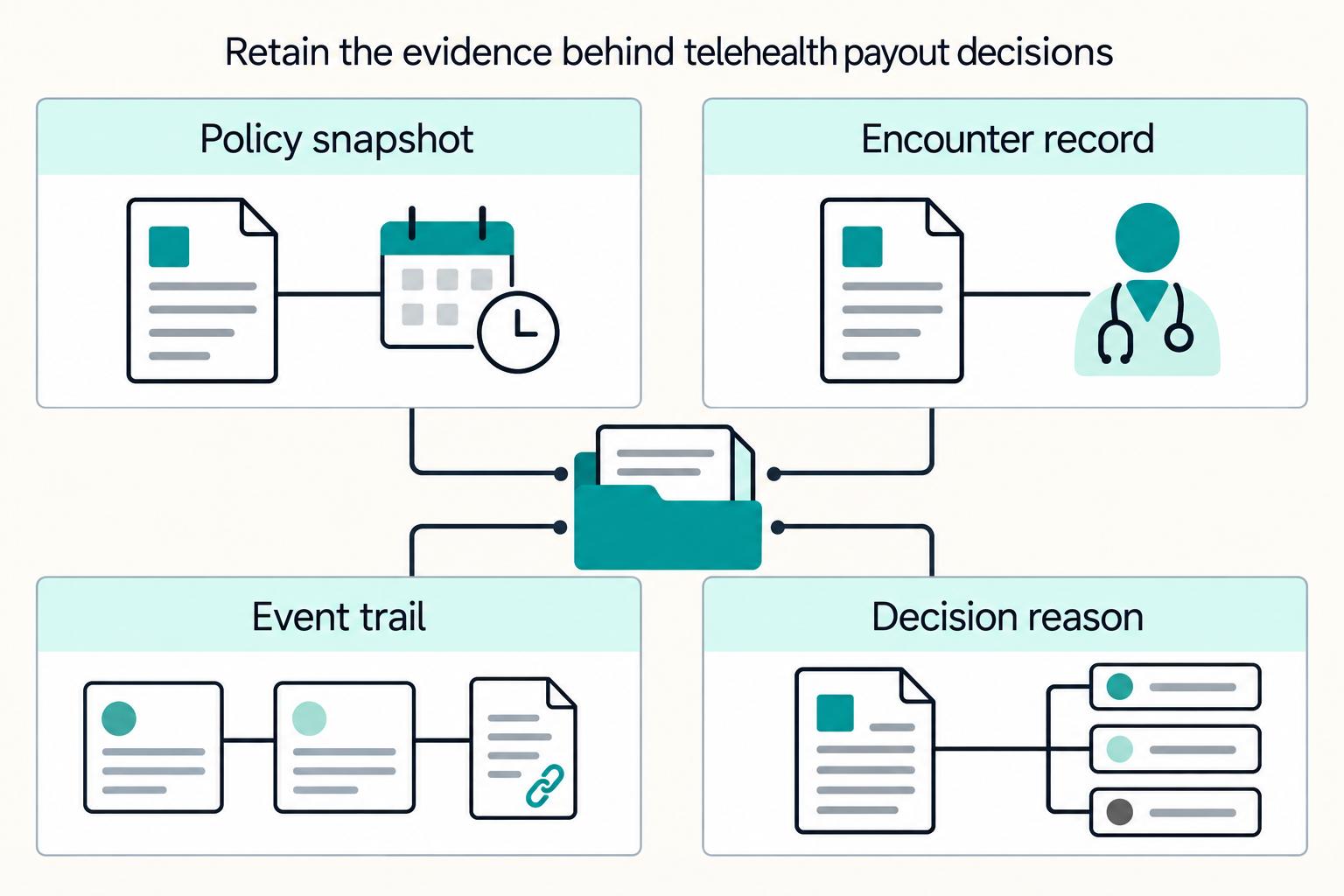
Step 1 Freeze the policy snapshot used for that payout#
For each payout, keep the policy version and rule trace used in the decision. In the Medicare lane, store the source used for the Medicare Part B decision, the payer lane, the encounter fields your logic evaluated, and any supporting reference to CMS, Telehealth.HHS.gov, or the official Federal Register PDF on govinfo.gov.
Treat source quality as a control. FederalRegister.gov states that its XML rendition does not itself provide legal notice, so if your team used a proposed or final rule entry there, retain the linked official PDF record too. A reviewer should be able to see, in plain language, which rule fired, such as audio-only allowed through December 31, 2027, or a distant-site practitioner using an enrolled practice location instead of a home address.
Step 2 Preserve the operational trail finance needs to reconcile#
Keep your internal reconciliation artifacts alongside policy evidence, including the identifiers and event history your platform uses. These are internal controls rather than Medicare-mandated packet fields, but they can be critical when claim outcomes and cash movement do not align.
If your process relied on an enrolled practice location when telehealth was delivered from home, retain what was reviewed and when. It also helps to store the versioned CMS MLN document used at decision time, since CMS marks substantive content changes in dark red.
Step 3 Standardize a dispute packet before you need one#
For denied or clawed-back payouts, use a fixed dispute packet template. Include the original decision trace, policy snapshot, operational event trail, and any documented exception rationale.
For a disputed claim or repayment request, retain the rule effective on the service date, the corrected facts, and the later guidance relied upon. Link any compensation adjustment to its contractual basis. The December 2025 versus February 2026 RHC/FQHC date difference is resolved by the later CMS FAQ; investigate other genuine conflicts individually.
Make the launch decision and copy this checklist#
Launch a narrow workflow once claim rules, compensation terms, provider routing, and claim-to-payment reconciliation are explicit. Expand based on observed exceptions and reconciled obligations, keeping policy updates tied to service dates.
Step 1 Update the rule register before you approve a payout#
Your register should map each decision source to a dated CMS artifact, Medicare Part B material, and the active Medicare telehealth services list. For the CY 2026 payment rule, include 90 FR 49266, 11/05/2025, and the official printed PDF check.
Treat PDF verification as required for legal and compliance confidence. FederalRegister.gov warns that XML-only use should be verified against an official edition. Also track time-bound flexibility windows separately, including the Telehealth.HHS extension through December 31, 2027.
Step 2 Verify payer-lane separation in production#
Keep live, distinct logic and exception routing for Medicare, Medicaid, and commercial payers. Medicare physician payment runs under the Physician Fee Schedule and specific Part B telehealth rules, so ambiguous non-Medicare encounters should not default into Medicare logic.
Use test encounters chosen to exercise known differences between payer policies. Different payers can legitimately reach the same outcome; verify the rule trace rather than demanding different results merely because the payer changed.
Step 3 Enforce claim gates and separate compensation conditions#
Before automated claim submission, validate provider eligibility, location and CPT/HCPCS requirements for that service date and payer. Before clinician payout, apply the compensation agreement’s approval conditions and payment controls. Link the records for reconciliation, but do not make claim coverage a payout prerequisite unless the agreement actually makes compensation contingent on it.
Keep code checks version-aware. CMS MLN notes that 5 new CPT and HCPCS codes were added to the Medicare telehealth services list, so stale mappings create avoidable risk. Where telehealth is used, store the location context used in the decision path.
Step 4 Require audit exports that explain claim-to-payout deltas#
Your team should be able to trace claim outcome to payout outcome without guesswork. Export enough detail to reconcile claim and payout outcomes, including the decision-path inputs your team uses.
Format is secondary. The real test is whether every delta is explainable at reconciliation time.
Step 5 Launch narrow first and route source conflicts to policy review#
Start with a constrained release slice and keep higher-variance branches out of the first launch. If sources conflict, hold automation for that branch and require documented policy resolution.
The later CMS FAQ supports RHC/FQHC non-behavioral billing through December 31, 2027. Record that update and continue to review service-specific billing conditions.
- Rule register is current across CMS, Medicare Part B, and the active Medicare telehealth services list
- CY 2026 register entry includes 90 FR 49266, 11/05/2025, and official PDF verification
- Payer-specific rule traces and exception ownership are verified
- Claim gates validate provider eligibility, location and CPT/HCPCS requirements; compensation approval separately follows the agreement
- Exports can explain every claim-to-payout delta
- Launch starts narrow, and unresolved source conflicts are routed to manual policy review
If your controls and reconciliation checks are passing, map the pilot into a compliance-gated disbursement flow with Gruv Payouts.
Frequently Asked Questions
What Medicare telehealth payment rules matter most for physician and specialist payout workflows in 2026?
Focus first on payable-encounter gates: patient location, modality, telehealth service-list status, and supervision requirements. Many Medicare flexibilities remain in effect through December 31, 2027, including no geographic originating-site restriction and audio-only delivery for non-behavioral/mental telehealth. Treat the annual CMS Physician Fee Schedule cycle as a required checkpoint, since service-list changes are made there and take effect on January 1.
Which telehealth flexibilities extend through 2027, and which requirements still create billing and payout risk?
Many temporary Medicare telehealth flexibilities run through December 31, 2027. The later CMS FAQ confirms RHC/FQHC non-behavioral G2025 billing through that date. Record service eligibility, patient setting, modality, and supervision separately; an extension does not remove every code-specific condition or define the clinician’s compensation.
Can physicians bill from home under Medicare telehealth, and what operational changes affect platform payouts?
Practitioners with a physical practice may use that enrolled location while delivering telehealth from home. Virtual-only practitioners whose sole physical practice is home must enroll that address, with public-address suppression available. Save the applicable enrollment evidence instead of assuming every practitioner can substitute a different address.
How should a platform separate `Medicare`, `Medicaid`, and commercial payer logic without duplicating the whole stack?
Use a shared encounter data model, but keep payer rules independently versioned and independently sourced. For Medicare, anchor logic to CMS and Telehealth.HHS.gov materials and the active telehealth service-list period. If non-Medicare rules are unclear, route to manual review instead of defaulting to Medicare logic.
What minimum controls should exist before paying a physician for a telehealth encounter?
Keep the encounter, service-date policy, provider evidence, and compensation agreement linked. Complete required claim checks before submission, and separately calculate clinician compensation and its due date. Missing coverage evidence does not automatically erase an earned payment obligation.
What key items are still unknown from public summaries before committing product and GTM resources?
Review annual PFS changes and later legislation or CMS updates before applying a policy. Current guidance describes a January 1, 2028 reversion for several temporary flexibilities, including furnishing eligibility for PT, OT, SLP, and audiology practitioners. Treat future boundaries as current-law planning assumptions subject to later change.
Researched and edited by the Gruv editorial team. Gruv builds cross-border billing, payouts, and finance-operations software for global businesses.
Sources
- cms.gov/files/document/mln901705-telehealth-remote-m...trusted
- cms.gov/files/document/telehealth-faq-updated-02-26-...trusted
- federalregister.gov/documents/2025/11/05/2025-19787/medicare-and...trusted
- oig.hhs.gov/reports/featured/telehealthtrusted
- oig.hhs.gov/documents/root/1045/sfa-telefraud.pdftrusted
- telehealth.hhs.gov/providers/billing-and-reimbursement/medicare...trusted
- telehealth.hhs.gov/licensure/licensing-across-state-linestrusted
Educational content only. Not legal, tax, or financial advice.
Related Posts

The Freelance Payment Penalty: A Modeled Audit of Platform Fees, FX Spreads, and Payout Delays
The money rarely disappears through a single, easy-to-spot fee. The real loss is stacked. A marketplace takes its commission, a processor adds a charge for international cards, a bank or payment company converts the currency at a spread, a platform holds the funds before release, and a wire sheds a little to intermediaries on the way in. Each layer looks defensible on its own, but the worker feels the combined result as a smaller deposit and a later payday.

How to Respond to a Subpoena for Business Records
Move fast, but do not produce records on instinct. If you need to **respond to a subpoena for business records**, your immediate job is to control deadlines, preserve records, and make any later production defensible.
A US Expat's Guide to Investing in UCITS ETFs to Avoid PFIC Issues
The real problem is a two-system conflict. U.S. tax treatment can punish the wrong fund choice, while local product-access constraints can block the funds you want to buy in the first place. For **us expat ucits etfs**, the practical question is not "Which product is best?" It is "What can I access, report, and keep doing every year without guessing?" Use this four-part filter before any trade: