
Quick Answer
Route failed renewals using current invoice state and actual decline/advice signals. Recover unknown attempts before another collection, count each invoice once and reconcile refunds and costs. The worked cohort results here are hypothetical, not measured brand performance.
Recover a failed renewal without duplicating collection#
A failed subscription payment can require a later retry, corrected billing details or customer authentication. The right action depends on the actual failure and the invoice’s current state. Sending another charge because a request timed out can collect twice; retrying a lost card repeatedly does not fix the card. Start with the existing invoice and payment attempt before changing the recovery path.
This is a hypothetical worked example for a $50 monthly subscription, not a measured result from an identified brand. The cohort, dates and figures below illustrate an operating and measurement design. They are not a performance benchmark or evidence that a provider produced the improvement. Provider documentation supports the product behavior; the example’s results are assumptions.
Define the renewal and the observation window#
For illustration, take 200 existing subscribers whose September 1, 2026 renewals each fail on the first attempt. Assume each has one $50 invoice and split them into a baseline group and a revised-policy group of 100. Exclude first purchases, trial conversions and voluntary cancellations already effective before renewal. Include all failure families in the overall denominator, even when a particular charge must not be retried.
Observe each invoice for 14 days from the first failure, then reconcile refunds and disputes through September 30. Both groups have the same plan, country/payment-method mix and eligibility rules in this illustration. A real experiment must verify allocation and comparability, retain actual records and assess uncertainty. A dated before/after comparison alone cannot establish that the policy caused a change.
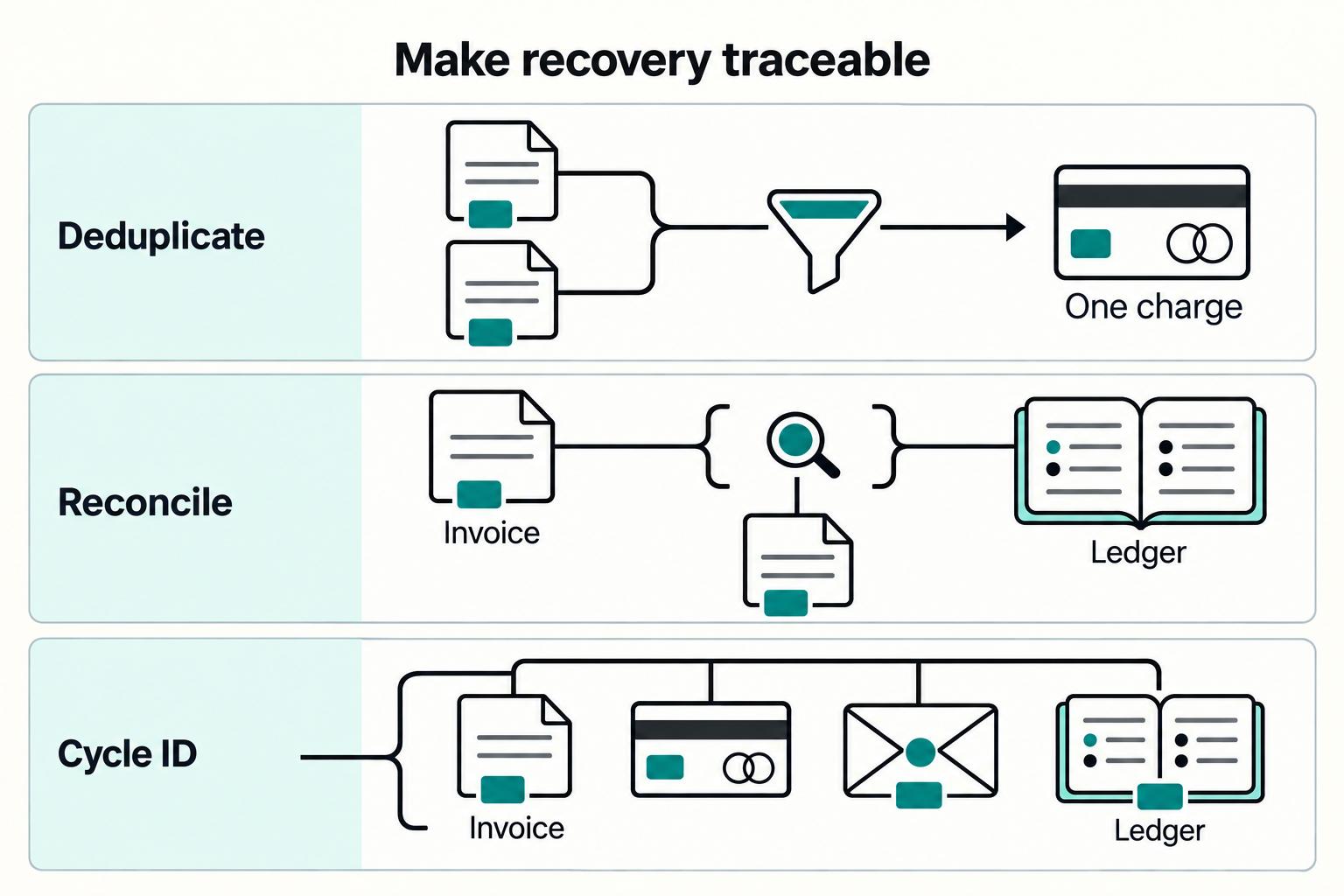
Use one invoice/cycle identifier, subscriber identifier and first-failure timestamp per entry. Payment attempts, messages and method updates link to that entry. A webhook delivered twice is still one event, and five failed attempts on an invoice do not become five failed renewals. Specify how partial collections and adjustments are handled before calculating the result.
Route the decline before scheduling the next action#
Stripe’s card-decline guide exposes decline and advice signals. Interpret network codes with the card brand, since their meaning can differ. Do-not-retry advice stops another attempt on the same transaction/card; temporary retry advice permits a bounded eligible retry. Incorrect data requires correction, and authentication can require the customer to return to a supported payment flow.
| Current evidence | Example action | What must happen before another collection |
|---|---|---|
| Retry-eligible insufficient funds or temporary issuer advice | Keep a bounded eligible retry schedule | Invoice remains unpaid, consent valid and issuer/provider rules permit retry |
| Lost/stolen card or authorization revoked | Stop attempts on that payment method; request an authorized replacement | Valid replacement method and applicable authorization |
| Incorrect card details | Send a secure correction/new-method path | Correct the actual method used for the invoice |
| Authentication required | Request the supported customer authentication flow | Complete the required action and confirm current payment state |
| Request timeout or payment processing | Recover the original attempt’s status | Establish that another collection cannot duplicate a live or successful attempt |
| Invoice already paid or validly canceled/voided | Suppress further recovery collection | Reconcile the terminal outcome and stop stale jobs |
Stripe Billing Smart Retries does not execute another payment on a hard-declined method without a new method, even though scheduled retry counters can increase. Its documentation also identifies non-retry cases such as no method, India-issued cards and disconnected Connect accounts. Configure the actual supported product; a dashboard attempt counter is not a count of executed authorizations.
When using Stripe Billing, update the method field that the subscription actually uses. A subscription-level default can take precedence over a customer default. A customer changing a lower-priority default will not necessarily change the failing method. Confirm the next attempt targets the intended authorized method instead of assuming a successful portal visit solved the invoice.
Change one recovery policy and keep its limits visible#
The revised group in this example changes the recovery workflow: eligible failures get a configured bounded retry policy, customer-action failures get a secure update/authentication path, and messages are suppressed after collection. Keep the original gateway. This bundled intervention would support evaluating the overall workflow, not separately claiming that timing, updater or email copy caused the gain.
If you need to isolate retry timing, hold the messaging and update paths steady between groups. If you need to isolate the message, hold eligible retry settings steady. Use the provider and network constraints as boundaries. Stripe documents a recommended Smart Retry setting; it is not permission to use a fixed count for every decline, method or market. Revocation or do-not-retry advice takes priority over a scheduled job.
Account-updater services, where enabled and supported, can refresh a credential, but they do not guarantee authorization or renewed consent after revocation. Log an updater result as an assisting event, then record the eventual successful attempt. The subscription may still need customer action. Do not count an updater event as collected money.
Send messages that match the current invoice state#
For an eligible temporary failure, a message can say: “Your $50 renewal has not been collected. We will retry under your billing settings. You can review your payment method in your account.” For a customer-action failure: “Your $50 renewal needs a payment-method update or authentication. Open your account to complete the payment.” Use the actual amount, next step and approved service-access policy, rather than promising a universal retry date.
Stripe customer recovery emails supply a configured collection/update path. If your own lifecycle system also sends messages, coordinate the send rules and suppress duplicate or stale reminders. Define an internal contact cap across channels and check current invoice/cancellation state at send time. A queued email should not tell a customer to pay an invoice that has just been collected.
Keep messages free of raw card details and decline information that should remain private. Link to the recognized account or supported hosted payment page. Explain any grace-period or access consequence accurately. Billing status and product access must follow the agreed policy; a failed attempt is not itself a customer choosing to cancel.
Recover unknown outcomes before gateway failover#
Stripe’s PaymentIntent lifecycle distinguishes payment states and tracks attempts for a payment. Retrieve the original operation after an error or timeout and reconcile the current invoice and payment state. While an attempt is processing or its outcome is unknown, stop competing collection jobs and assign an owner to recover it. Do not open another gateway charge merely because the first endpoint did not answer.
If alternate routing is considered later, first establish that the original operation cannot still collect, that any authorization is handled appropriately, and that the new provider can use the customer’s method with valid authorization. Cross-provider tokens and idempotency keys are not automatically portable. A routing switch also needs a shared invoice-level lock so the original retry engine and replacement path cannot collect concurrently.
Use the provider’s documented duplicate protection plus internal invoice-level coordination. Stripe webhook guidance describes duplicate and out-of-order delivery. Persist event references, verify incoming events and reconcile state through the provider API when needed. Replayed payment-success events should neither recognize another receipt nor restore access twice through uncontrolled side effects.
Illustrative results: count invoices once and deduct reversals#
Assume the baseline group collects 40 of its 100 failed invoices within the 14-day window, and the revised group collects 60. All invoices are $50 and fully collected. By September 30, baseline refunds total $100 and revised refunds total $150, with no disputes in this illustrative close. Assume processing costs of $60/$90 and allocated recovery-support costs of $100/$160 respectively. Those costs are hypothetical, not provider tariffs.
| Defined measure | Baseline group | Revised group |
|---|---|---|
| Initially failed renewal invoices | 100 | 100 |
| Initially failed invoice value | $5,000 | $5,000 |
| Invoices collected within 14 days | 40 | 60 |
| Invoice-count recovery rate | 40% | 60% |
| Gross recovered collections | $2,000 | $3,000 |
| Refunds through September 30 | $100 | $150 |
| Collections after refunds | $1,900 | $2,850 |
| Processing costs | $60 | $90 |
| Allocated recovery-support costs | $100 | $160 |
| Net recovered contribution under this definition | $1,740 | $2,600 |
The illustrated recovery difference is 20 percentage points, or a 50% relative increase from the 40% baseline. The contribution difference is $2,600 − $1,740 = $860. Compute contribution as recovered collections minus refunds, processing costs and the stated support costs; add dispute losses and other incremental costs where present. A refund and the same refunded amount’s revenue reversal must not be subtracted twice in the cash calculation.
This contribution is a defined operating comparison, not automatically recognized accounting revenue, recurring revenue retained or profit. Finance must apply the service-delivery and revenue-recognition policy separately. The $860 does not establish future subscriber retention: observe cancellation reasons, next renewal and service status over additional mature windows before making that claim.
Separate successful path classification from causal attribution#
Suppose the revised group’s 60 recovered invoices comprise 35 off-session collections on the unchanged method, 15 off-session collections on a changed method and 10 customer-completed on-session collections. These are mutually exclusive classifications of the successful collection. Apply a predetermined classification rule and store the successful attempt’s evidence, so the categories sum to 60.
A subscriber can also have an updater result, an email click and support outreach before the same success. Retain those as overlapping assisting events. Do not add the three assistance counts to the 60 invoice recoveries or conclude that each event caused a separate save. Compare the assigned experimental policy for the overall result; causal claims for individual features require their own design.
Stripe recovery analytics uses its own recurring-payment scope and method categories, and distinguishes items still in recovery. Reconcile your report definition to the dashboard rather than copying a percentage with a different denominator. Keep newly failed invoices separate from fully observed cohorts; an invoice with only one day of follow-up is not comparable to one with a completed 14-day window.
Decide what to keep after the cohort matures#
Before expanding the revised workflow, inspect unresolved payments, duplicate collections, refunds, support effort and customer complaints alongside contribution. Review the decline mix so an easier revised cohort cannot masquerade as better execution. Investigate a paid invoice whose service access is still suspended and a canceled account with an active retry job before treating the rollout as complete.
The example’s proposed decision is to continue a bounded test if the real records reproduce the contribution gain and payment controls hold. Stop or repair a path that duplicates collection, ignores revocation or sends stale messages, even when gross recovery rises. Extend observation if outcomes are still immature. Publish actual cohort dates, definitions, limitations and reconciled outcomes before calling the result a brand case study.
Frequently Asked Questions
Are the recovery results in this example measured brand outcomes?
No. The dated cohorts and numerical results are hypothetical teaching figures. They demonstrate how to define and reconcile a recovery comparison, not a provider benchmark or identified customer result.
Should hard declines enter blind automated retries?
No. Follow the actual provider and issuer restrictions. Stripe Billing does not execute retries of its listed hard-declined method without a new method; some failures require a supported customer-action or authentication flow.
Can a timed-out renewal charge be sent to another gateway immediately?
No. Recover the original payment and invoice outcome first and ensure it cannot still collect. An alternate path requires valid authorization, supported credentials and shared invoice-level coordination.
How should updater, email and retry recoveries be counted?
Count each recovered invoice once using a defined successful-path category. Preserve overlapping updater, message and support events as assistance evidence without adding them as separate recovered invoices or assuming causality.
Does an invoice recovery rate show retained recurring revenue?
No. Reconcile refunds and disputes, then observe subscription state and later renewals over mature windows. A recovered collection and recognized revenue or future retention are different measures.
What is the illustrated net recovered contribution?
Recovered collections minus refunds, processing costs and allocated recovery-support costs. The example gives $1,740 baseline and $2,600 revised, a hypothetical $860 difference before any additional costs or accounting adjustments.
Researched and edited by the Gruv editorial team. Gruv builds cross-border billing, payouts, and finance-operations software for global businesses.
Sources
Educational content only. Not legal, tax, or financial advice.
Related Posts

The Freelance Payment Penalty: A Modeled Audit of Platform Fees, FX Spreads, and Payout Delays
The money rarely disappears through a single, easy-to-spot fee. The real loss is stacked. A marketplace takes its commission, a processor adds a charge for international cards, a bank or payment company converts the currency at a spread, a platform holds the funds before release, and a wire sheds a little to intermediaries on the way in. Each layer looks defensible on its own, but the worker feels the combined result as a smaller deposit and a later payday.

How to Respond to a Subpoena for Business Records
Move fast, but do not produce records on instinct. If you need to **respond to a subpoena for business records**, your immediate job is to control deadlines, preserve records, and make any later production defensible.

A US Expat's Guide to Investing in UCITS ETFs to Avoid PFIC Issues
The real problem is a two-system conflict. U.S. tax treatment can punish the wrong fund choice, while local product-access constraints can block the funds you want to buy in the first place. For **us expat ucits etfs**, the practical question is not "Which product is best?" It is "What can I access, report, and keep doing every year without guessing?" Use this four-part filter before any trade: