
Quick Answer
Under ASC 340-40, platforms generally capitalize contract acquisition costs only when the cost is incremental to obtaining a customer contract and recovery is expected. Costs that would exist without the contract win are usually expensed as incurred, and teams should assess the cost alongside ASC 606 contract scope. If the amortization period is one year or less, immediate expensing may be allowed.
What ASC 340-40 Covers for Platform Finance Teams#
If you handle commissions or similar deal costs, start with two GAAP tests: is the cost incremental to obtaining a customer contract, and do you expect to recover it? If either answer is no, expense treatment is usually the right starting point.
Before you start#
Treat this as part of your revenue accounting approach, not a side memo. ASC 606 covers revenue from contracts with customers, and ASC 340-40 applies to incremental costs of obtaining contracts within that ASC 606 scope. Make the cost decision with the related contract and revenue facts in view.
Step 1: Anchor the decision in ASC 340-40#
Start with the core recognition rule: recognize an asset for incremental contract acquisition costs only when recovery is expected. At booking, keep three items clear: the customer contract, the terms that triggered the payment, and the basis for expected recovery.
Expected outcome: one clear sentence explaining why the cost belongs on the balance sheet instead of being expensed. If you cannot say that cleanly, pause and document the gap before posting. We recommend making that sentence part of your booking support, not just a review comment.
Step 2: Separate true incrementality from broad selling spend#
The key judgment is not the label "commission." Ask whether you would have incurred the cost if the contract had not been obtained. Costs incurred regardless of a contract win are expensed when incurred, unless they are explicitly chargeable to the customer under the contract terms, and fixed employee salaries are not incremental.
Watch mixed pools that combine win-based payments with fixed pay or general commercial activity. If the cost would exist without the signed contract, default to expense treatment unless your facts support a different conclusion.
Step 3: Build a traceable evidence file#
Keep a compact evidence pack for each capitalized amount: contract record, commission or incentive terms, calculation support, and recovery rationale. Your checkpoint is traceability from contract to trigger to recorded asset without guesswork.
A common failure mode is capitalizing a payment because it is called a commission when the file does not show that the payment was contingent on obtaining the contract.
Step 4: Use this guide as an execution framework#
Use the sections below as an execution framework. They give you decision checkpoints for classifying costs, evidence expectations for booking, and escalation triggers when recoverability, contract terms, or ASC 606 scope are unclear. The goal is consistent, supportable decisions, not just a faster close.
Need the full breakdown? Read ASC 606 Principal vs Agent Decisions for Merchant-of-Record Platforms.
What ASC 340-40 changes for platform finance teams#
ASC 340-40 changes day-one treatment for eligible contract acquisition costs: if a cost is incremental to obtaining a customer contract and you expect to recover it, record it as an asset rather than an immediate expense. Costs that are not incremental are expensed as incurred, unless they are explicitly chargeable to the customer. For platform teams, that means reviewing commission policy and revenue policy together. We recommend documenting that conclusion in the same file your reviewers already use.
Step 1: Anchor the booking rule in ASC 340-40-25-1#
Begin with the recognition rule: recognize an asset for incremental costs of obtaining a contract with a customer when recovery is expected. In practice, if the cost would not exist without obtaining the customer contract and recovery is expected, it is generally not a current-period expense.
Your first checkpoint is journal entry support. The file should show why the amount belongs on the balance sheet instead of the income statement. If support only says "sales commission" and does not show your contract trigger or your recovery logic, pause capitalization until the evidence is complete.
Step 2: Review scope with ASC 606 at the same time#
Apply ASC 340-40 only within the ASC 606 customer contract boundary. If revenue accounting has not established ASC 606 contract scope, do not finalize acquisition cost treatment in a separate lane.
This is where siloed ownership creates errors. If the underlying arrangement is still unresolved under ASC 606, route both decisions together instead of handling them in sequence. If helpful, pair this with your ASC 606 review for Merchant of Record platforms. If you split the decisions across teams, we recommend naming one owner for the final accounting call.
Step 3: Standardize treatment across MoR and payout-led motions#
Use one test across Merchant of Record and payout-led motions: incremental, linked to obtaining a customer contract, and expected to be recovered. The commercial structure can vary, but the accounting conclusion for sales commissions and similar acquisition costs should come from the same documented criteria.
Expected outcome: the same cost type gets the same answer unless the underlying contract facts change. Red flag: identical commission plans are expensed in one channel and capitalized in another only because different teams own the process.
What to prepare before booking the first capitalized cost#
Before you book the first asset, make sure the file can support three points: the cost was incremental to obtaining the contract, the contract is within ASC 606 scope, and recovery is expected. If that support is incomplete, treat the amount as expense until the capitalization evidence is complete. We recommend keeping that three-point check on the same reviewer sheet your accounting team already uses, so your team can see the same conclusion before posting.
Step 1 Build a documentation package that answers the accounting test#
Your documentation package should let a reviewer trace one commission or similar cost from signed contract to accounting conclusion. Include, at minimum:
| File item | What it includes | Why it matters |
|---|---|---|
| Executed customer contract or order form | Contract date and commercial terms | Lets a reviewer trace the cost from signed contract to the accounting conclusion |
| Commission plan or compensation terms | Terms that triggered the payment | Shows why the payment was tied to obtaining the contract |
| Short accounting memo | Why the cost is incremental and why recovery is expected under ASC 340-40 | Ties the fact pattern to the accounting conclusion |
| ASC 606 scope conclusion or revenue memo reference | Scope conclusion for that contract | Keeps the cost decision within ASC 606 scope |
| Practical expedient decision | Decision for costs with an amortization period of one year or less | Documents immediate expensing when that expedient is used |
Checkpoint: can a reviewer see that this cost would not have been incurred if the contract had not been obtained? If the file only shows a payment amount and owner name, it is not ready.
Step 2 Assign approvals before compliance holds create timing disputes#
Set approval ownership before close so Finance is not deciding capitalization while Compliance or Risk is still holding the account. Your role map should state who approves booking when compliance gates delay activation, payout eligibility, or both. We recommend writing that ownership map before your first recurring journal is posted.
If your onboarding runs in a covered banking context, make the map explicit about who confirms Customer Identification Program completion and, for legal entity customers, beneficial owner identification and verification at account opening. If approval logic differs by product or jurisdiction, document those differences in the matrix.
Step 3 Standardize event data before close starts#
Use one authoritative field for contract execution date, one for go live or activation, and one for payout eligibility or payout status. Reconcile those fields across the operational systems used for accounting and compliance. We recommend keeping those dates on one reviewer-facing checklist so your team does not infer them later.
Your control should include a recurring tie-out: the contract in the documentation package must match the operational timing record used for recognition, with exceptions logged when dates or statuses conflict. If you see repeated breaks there, we recommend treating that as a control issue before you debate amortization details, because your reviewers will otherwise spend time fixing evidence instead of validating policy.
Step 4 Define retention and tax-document handling before auditors ask#
Write retention and document handling rules before the first entry. For tax records, define where original W-8 and W-9 forms are stored, who can access full versions, and whether accounting support uses masked copies under your internal process. For W-9s, remember the form is given to the requester or payer, not sent directly to the IRS.
Set minimum retention periods where rules are clear. Keep filed Form 1099 records, or reconstructable data, for at least 3 years, or 4 years for Form 1099-C, from the return due date. In covered bank contexts, CIP identifying information is retained for five years after account closure, and beneficial ownership records also carry five-year retention requirements.
Related: Bad Payouts Are Costing You Supply: How Payout Quality Drives Contractor Retention.
Classify costs with an explicit decision tree for commissions#
Run every commission-related line through one decision tree, and expense by default when the contract link is not supportable. That keeps ASC 340-40 judgments consistent and helps prevent weak items from being capitalized.
Step 1 Ask whether the cost exists without the contract win#
Start with one question: would this cost exist if the contract had not been obtained? If yes, expense it as incurred. If no, treat it as potentially incremental and move to the next gates.
This is where classification usually holds or breaks. Sales commissions are commonly tied to a contract win, while fixed salaries, general marketing, proposal work, and legal pursuit costs are typically incurred regardless. Document the decision for the specific line item, not just the category label.
Use a concrete verification check: can a reviewer trace the amount to a compensation term that pays only because the contract was obtained? For internal control, a support pack, for example contract ID, commission plan version, and payout calculation, is often used. A GL label like "sales incentive" without a contract reference may not be enough on its own.
Before moving on, confirm the contract is in ASC 606 scope so the revenue conclusion and cost conclusion point to the same contract record.
Step 2 Separate commissions from broader acquisition spend#
Do not classify acquisition spend as one blended pool. Split categories and record a yes or no decision for each one so non-incremental costs are not bundled with valid commissions.
| Cost type | Contract linkage | ASC 340-40 treatment | Owner | Example internal documentation |
|---|---|---|---|---|
| Direct sales commission paid only when a customer contract is signed | Explicit, contract-specific | Capitalize if the contract is in ASC 606 scope, recovery is expected, and you are not applying the one-year-or-less practical expedient | Finance with Sales Ops support | Executed contract or order form, commission plan, payout calculation, contract ID, ASC 606 scope memo |
| Fixed salary or base pay for sales staff | Exists regardless of win | Expense as incurred | Finance payroll owner | Compensation terms showing pay is not contingent on obtaining a contract |
| Bid, proposal, marketing, or legal pursuit costs | Usually incurred even if no contract is won | Expense as incurred, unless the cost is separately chargeable to the customer based on your facts | Budget owner with Finance review | Invoice or payroll support and category memo showing non-incremental treatment |
| Renewal, modification, or threshold-based commission | Linkage may be partial or complex | Escalate for judgment and document the conclusion | Controller or technical accounting | Renewal or modification terms, trigger logic, recovery assessment, ASC 606 contract analysis |
Bundling is a common risk. If you cannot reliably separate the incremental portion, expense the line until you can support a defensible split.
Step 3 Apply a hard booking rule and document the outcome#
Use one booking rule for every line: weak evidence means expense now; explicit, repeatable linkage means capitalize under policy.
Even when a cost appears incremental, capitalization still requires expected recovery. If recovery is not documented, the analysis is incomplete.
Before you book to the balance sheet, require both:
- a contract-linked trigger
- a repeatable evidence package another reviewer could use to reach the same result
Also apply the practical expedient consistently: if the amortization period of the would-be asset is one year or less, immediate expensing is allowed.
Treat borderline structures as escalation cases. Renewals, modifications, and threshold-based commission designs can require judgment, so they should not be auto-classified by local convention.
The target outcome is simple: each cost line has a documented yes or no classification, and only lines with explicit contract linkage, ASC 606 alignment, and expected recovery move to a capitalized asset.
For a step-by-step walkthrough, see Platform Economics 101 for Commission Fees, Payout Costs, and Gross Margin.
Set amortization logic that matches real economic benefit#
Once a commission is capitalizable, set amortization to match how the related goods or services transfer to the customer, not a default calendar rule.
Step 1 Define what the asset actually relates to#
For each commission type, write a short memo. ASC 340-40 does not prescribe a single amortization method, so your policy should state what goods or services the asset relates to and why that linkage is reasonable.
Judgment may be required when transfer patterns or renewal expectations are not straightforward. The memo should be traceable to evidence another reviewer can follow: executed contract, commission plan version, expected service period, renewal terms, whether similar renewal commissions are paid, and the ASC 606 view of transfer timing.
Step 2 Choose the period and pattern from the transfer profile#
Choose the amortization period and pattern based on expected transfer, and use straight line only when you do not have evidence of a more specific pattern. Different contract profiles may call for different judgment, but the basis should remain the expected transfer of goods or services.
The period can extend beyond the initial term when renewal is expected and the original commission relates to renewal-period transfers. But if similar renewal commissions are also incurred, do not include anticipated renewals in the original amortization period by default.
If the amortization period is one year or less, ASC 340-40-25-4 allows immediate expensing through the practical expedient. Apply that threshold consistently and document the decision at inception.
Step 3 Tie reassessment to contract reality#
Reassess when expected transfer timing changes significantly. ASC 340-40 requires amortization updates for significant changes in expected timing, accounted for as a change in accounting estimate under Subtopic 250-10.
| Trigger | Why reassess | Accounting note |
|---|---|---|
| Renewal or nonrenewal outcomes | May change expected transfer timing | ASC 340-40 requires amortization updates for significant changes in expected timing |
| Material modifications | May change expected transfer timing | Account for the update as a change in accounting estimate under Subtopic 250-10 |
| Early termination signals | May change expected transfer timing | Keep impairment assessment in the same review |
| Delivery timing or scope changes | May change expected transfer timing | Keep impairment assessment in the same review |
| Evidence that relationship expectations have changed | May change expected transfer timing | Keep impairment assessment in the same review |
Useful internal checkpoints can include renewal or nonrenewal outcomes, material modifications, early termination signals, delivery timing or scope changes, and evidence that relationship expectations have changed. Keep impairment assessment in the same review, since subsequent accounting is not only an amortization schedule question.
Step 4 Reconcile roll-forward to financial statements and escalate when policy drifts#
Reconcile the contract cost asset roll-forward to the balance sheet and amortization expense to the income statement as part of your close control. At minimum, tie opening balance, additions, amortization, impairment, and ending balance to booked amounts, and investigate unexplained differences.
Escalate to controllership or technical accounting when assumptions no longer match observed economics, such as renewal expectations diverging from actual behavior or from commission plan design. When policy and economics diverge, the right response is a documented reassessment, not a mechanical carry-forward.
Build month-end controls from contract event to ledger posting#
After amortization logic is set, control strength comes down to traceability. If you cannot trace each commission from contract event to journal entry, the close control is not reliable.
Step 1 Set a consistent posting order with evidence at each gate#
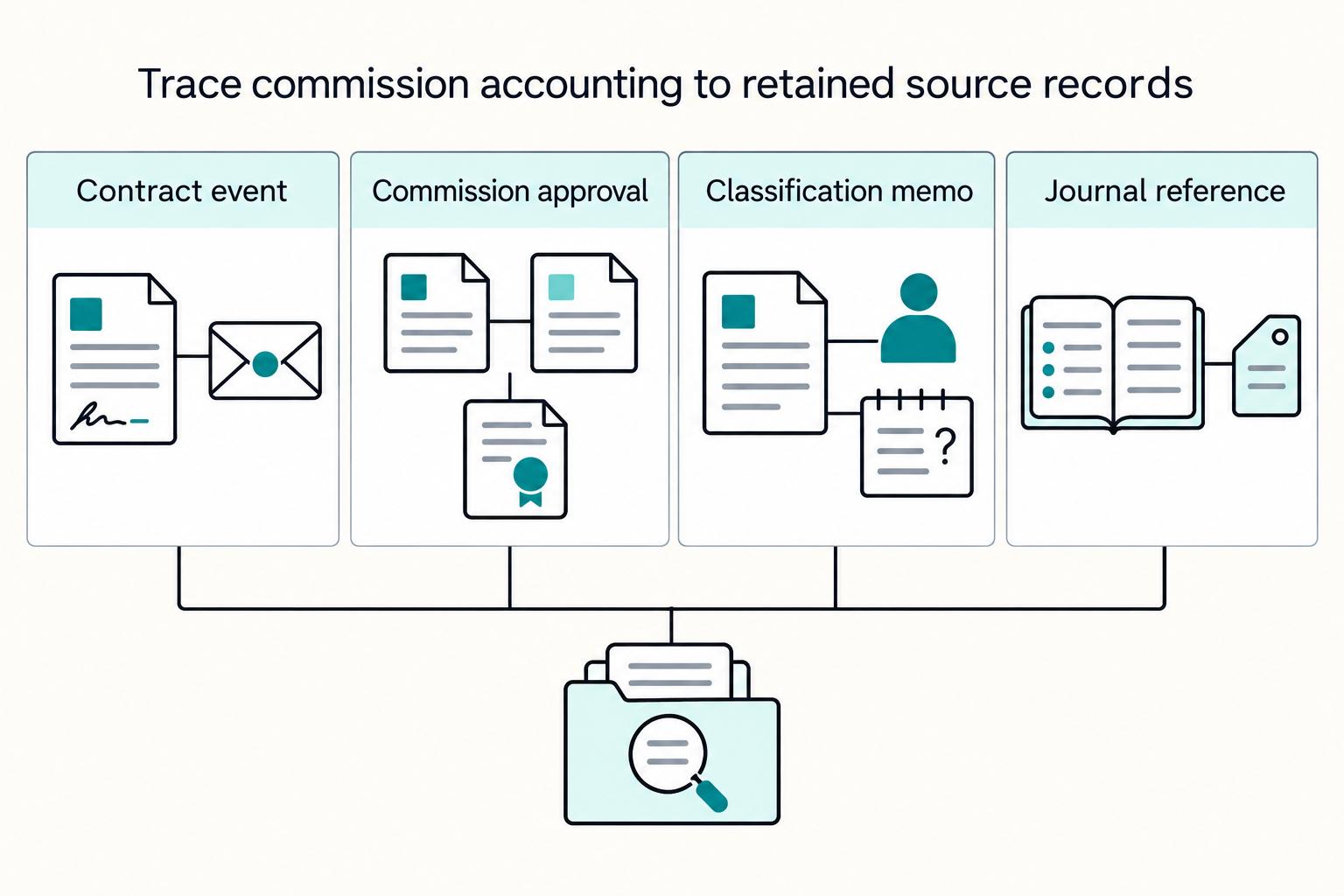
Use one operating sequence and enforce it with documented gates, even though ASC 340-40 does not prescribe a single sequence. One workable flow is: contract executed, commission approved, cost classified, capitalization posted if eligible, amortization run, reviewer sign-off.
Before posting any asset entry, require evidence that the cost is incremental to obtaining the contract and expected to be recovered. If that evidence is missing, or if the amortization period is one year or less under your practical expedient policy, route the item to expense treatment instead of capitalization.
Test the control in both directions: contract to journal and journal back to contract. If either path breaks, your month-end evidence is incomplete.
Step 2 Tie operational events to accounting evidence, not just totals#
Close support should show how source events become ledger entries. In platform environments, operational contract and payment events can be part of that audit trail when they are mapped to accounting decisions.
For each capitalized amount, keep a stable reference set, for example: contract ID, commission approval ID, source event ID, journal ID, amortization schedule ID. That is what makes contract-level reconciliation repeatable and reviewable.
Be explicit about timing roles. One signal may support contract classification, another payable timing, and another may be only corroborating evidence. Batch-level ties alone are not enough if contract-level misclassification or duplicates can still hide inside the total.
Step 3 Add duplicate protection before journal creation#
Duplicate event handling is a core accounting control, not just an engineering concern. Webhook or event retries can repeat, so posting logic should prevent a second capitalization entry for the same approved commission.
Require a pre-posting check on unique source identifiers and retry state, and block duplicate journal creation unless there is a documented reversal-and-repost path. If your idempotency key handling is based on a 24-hour retention window, align replay monitoring and exception review to that window.
Handle asynchronous mismatches through a documented exception-handling process with review, not auto-posting from the latest message alone. A simple reliability test is to replay a previously successful request and confirm the system returns the existing journal reference rather than creating a new one.
Step 4 Keep a compact control matrix and retain close evidence#
Use a small, enforced matrix so each key control has a clear objective, trigger, owner, exception route, and retained evidence.
| Control objective | System signal | Owner | Exception path | Evidence artifact |
|---|---|---|---|---|
| Confirm contract exists before any asset entry | Executed contract record | Finance with sales ops support | Missing or conflicting contract data to manual review | Executed contract, contract ID, approval timestamp |
| Capitalize only eligible incremental and recoverable costs | Commission approval plus classification outcome under ASC 340-40-25-1 | Accounting policy or controllership | Unsupported incrementality or recoverability to expense review | Commission plan version, classification memo, approval record |
| Prevent duplicate capitalization from retries or repeated webhooks | Unique source event ID, idempotency key, posting status | Accounting systems owner | Duplicate or stale event to exception log | Event log, journal reference, retry history |
| Reconcile subsequent accounting each close | Amortization output and ledger movement | Close owner and reviewer | Significant timing changes or unexplained roll-forward differences escalated | Roll-forward, balance sheet tie-out, reviewer sign-off |
This structure helps you demonstrate record accuracy at the transaction level: each entry is supported, posted once, and reviewed before close.
Address contract clauses that can change accounting risk#
Once you can trace entries through close, the next control point is the contract itself. If clauses change enforceability, risk allocation, or dispute path, commission capitalization should not run on autopilot. Treat those clauses as inputs to ASC 340-40-25-1 recoverability and, when timing assumptions change, to ASC 340-40-35-2 reassessment.
Step 1 Review termination language before you lock the benefit period#
Termination language can change the enforceable contract period, and ASC 606 ties contract term to present enforceable rights and obligations. Do not set an amortization period from commercial intent alone if the signed agreement allows broad exit rights or changes the economics through termination penalties.
Use a simple trigger: if termination rights are broad, early, or newly negotiated, reassess the expected benefit period. ASC 606-10-25-3 contemplates contracts with no fixed duration that can be terminated or modified, and the analysis includes whether a penalty is substantive. If that analysis shortens the enforceable period, your amortization view may need to shorten too.
Verification point: retain the signed termination clause, a finance memo on the enforceable period judgment, and the last reassessment date. A control risk is keeping the original amortization schedule after a material amendment or renewal change, even though ASC 340-40-35-2 requires updates when expected transfer timing changes significantly.
Step 2 Flag liability and indemnity clauses for joint Finance and Legal review#
Limitation of liability and indemnification clauses do not automatically change GAAP treatment, but they can change risk allocation and recoverability judgments. A limitation of liability clause generally caps exposure, while an indemnity clause commits one party to compensate the other for specified losses.
That is enough to require review when terms are non-standard, heavily negotiated, or paired with unusual obligations. For capitalized commissions under ASC 340-40, focus on whether revised risk allocation affects expected recovery or creates a fact pattern that needs documented review before close.
Use a compact clause log in the contract file:
| Clause area | What Finance checks | Who must review | Evidence to retain |
|---|---|---|---|
| Termination | Enforceable period and reassessment trigger | Finance, Legal if non-standard | Executed clause, memo, reassessment date |
| Limitation of liability | Whether capped exposure changes recoverability view | Finance, Legal | Redline, clause summary, policy sign-off |
| Indemnification | Whether loss-shifting changes risk allocation assumptions | Finance, Legal | Executed indemnity text, issue memo |
| Governing law and forum | Whether dispute venue or cross-border enforceability raises escalation need | Finance, Legal, Risk | Choice-of-law clause, forum clause, escalation ticket |
Step 3 Map governing law and forum clauses to escalation routing#
Governing law identifies which law applies in a dispute, and a forum selection clause identifies the court and location. These clauses do not determine ASC 340-40 treatment by themselves, but they do affect escalation when recoverability depends on enforceable rights across borders.
If a customer is in one country, service performance runs through another entity, and disputes route to a third forum, send the contract to Legal and Risk before finalizing capitalization. Keep routing explicit: define owner, trigger, and response timing rather than relying on ad hoc escalation.
Verification point: store governing law and forum or jurisdiction as separate contract fields. A control risk is treating cross-border contracts like domestic templates and missing changed enforcement assumptions.
Step 4 Define a dispute-resolution path in the accounting evidence pack#
For contested contracts, define the accounting path before the dispute escalates. ADR language can require mediation first and arbitration for unresolved claims, so your ASC 606 governance file should show how dispute status changes commission accounting decisions, review cadence, and approval requirements for continued capitalization.
At minimum, keep the dispute resolution clause, current dispute status, accounting conclusion, and next review date. If recoverability support is weakening during an active dispute, document whether the asset still meets ASC 340-40-25-1 and whether impairment testing is needed. This keeps legal events from becoming untracked balance sheet risk.
Define escalation triggers before disagreements happen#
Set escalation rules up front: if capitalization is not clearly supportable under ASC 340-40-25-1, or key evidence is missing, pause routine processing and escalate.
Step 1 Escalate when the ASC 340-40-25-1 test is unclear#
Escalate when either recognition gate is uncertain: whether the cost is truly incremental, or whether recovery is expected. If you cannot show the commission would not have been incurred without winning the contract, do not push capitalization through on assumption.
Verification point: keep the signed contract, the commission or compensation terms, and a short memo that ties the cost to contract acquisition. Avoid treating a label like "sales commission" as proof of incrementality by itself.
Step 2 Route legal-enforceability issues and estimate issues to the right owner#
As an internal escalation rule, route indemnification, governing law, jurisdiction, and dispute resolution issues to Legal, especially for cross-border contracts where enforceability can depend on jurisdiction-specific facts. Route amortization period changes and related disclosure judgments to Finance leadership.
Under ASC 340-40-35-2 and Subtopic 250-10, amortization changes are accounting estimate changes, so they should not be handled as routine postings. If contract changes affect expected benefit timing, escalate before the next amortization run.
Step 3 Require documented approval for any manual override#
Treat manual overrides to capitalized contract acquisition costs as a hard stop until documentation is complete. This is a control design choice, but it directly addresses known override risk in journal entry processes.
At minimum, require a traceable rationale, the related journal entry reference, the contract ID, and documented approval before posting. If those elements are missing, the override should not proceed.
Common failure modes and how to recover#
When issues have already slipped through, rebuild the evidence first and then correct the accounting. If you cannot trace a contract event to a posting, support incrementality and expected recoverability under ASC 340-40-25-1, or explain why amortization still matches current facts, treat the asset balance as suspect until review is complete.
Step 1 Replace spreadsheet-only tracking with traceable source records#
The core failure is not using spreadsheets. It is using spreadsheets as the only link between contract execution, commission approval, and journal entry. That creates avoidable books-and-records risk because records should accurately reflect transactions, and audit evidence includes both corroborating and contradictory information.
Recover by moving the control point to a system-supported record, or at least to a controlled log with clear posting references, change history, and attached source documents. Minimum lineage should include contract ID, execution date, compensation terms, approver, journal entry reference, and amortization start logic. A practical check is to sample one capitalized item and confirm you can trace it back to the executed contract and exact commission authorization without relying on memory.
Step 2 Re-test incrementality and reclassify weak items#
A "sales commission" label does not establish capitalization. The test is whether the cost would not have been incurred if the contract had not been obtained; non-incremental costs are expensed as incurred, and fixed salaries are a clear non-incremental example.
Recover with a retrospective review of open balances and recent additions. For each item, pull the signed contract, compensation terms, payee detail, and evidence that payment was triggered by winning that contract. Then classify items as clearly incremental and expected to be recovered, clearly non-incremental, or candidates for the practical expedient when the amortization period is one year or less. If treatment changes, document prior treatment, revised basis, journal entry reference, and why the revision better fits ASC 340-40-25-1.
Step 3 Reassess amortization when contract facts change#
An unchanged amortization schedule despite changing contract facts is a control warning. Capitalized contract costs should be amortized systematically with transfer of related goods or services, and updated when expected transfer timing changes significantly. That update is a change in accounting estimate.
Recover by forcing reassessment when events may significantly change expected benefit timing. Renewal changes, credible termination paths, or active disputes can be review triggers, even though they do not automatically require a new outcome. During close, compare amortization schedules against amendments, renewal notices, termination notices, and dispute logs. If economics changed but the schedule did not, stop and document the rationale.
Step 4 Add compliance-gating checks before you lock timing assumptions#
Signed contracts do not always mean payment flows are operational. KYC, KYB, and AML verification can delay payment or payout capabilities, and missing verification can leave payouts or charges not enabled.
Recover by adding operational status checkpoints before recognition and amortization decisions that depend on go-live timing or expected recovery. Confirm account verification status, payout or charge enablement, and whether any required identity or beneficial-owner steps remain open. These checks do not determine GAAP treatment by themselves, but they do test whether timing assumptions are still credible. If compliance status and accounting timing diverge, route the item to Finance and Compliance before the next posting cycle.
Copy and paste monthly close checklist#
At month end, clear items only when each capitalized cost ties to a documented ASC 340-40 decision, recoverability assessment, source evidence, and ledger movement.
| Close step | Required check | Escalate or stop when |
|---|---|---|
| Confirm classification and sign-off | Each new contract acquisition cost entry has an ASC 340-40 decision record attached | A sales commission is not clearly tied to winning the contract |
| Reconcile the roll-forward | Opening balance plus additions minus amortization minus impairment ties to the closing contract cost asset balance | Closing balance or period amortization cannot support required contract cost disclosures |
| Validate MoR, Virtual Accounts, and Payout batch evidence | Documentation package is complete with contract event, commission approval, and related operational records where used | Duplicate source events, late updates, or open exception queues remain |
| Review tax and compliance artifacts and log escalations | Required payee tax forms are on file; Form W-9 is retained for four years; Form W-8 BEN establishes foreign status when requested by the payer or withholding agent | Form 1099-NEC threshold questions are unresolved and should be escalated to Tax |
Step 1 Confirm classification and sign-off#
Review every new contract acquisition cost entry and confirm an ASC 340-40 decision record is attached. The record should show either that the cost is incremental, meaning it would not have been incurred if the contract had not been obtained and is expected to be recoverable, or that it was expensed, including use of the one-year practical expedient when applicable.
Require Finance owner sign-off with contract ID, commission terms, posting reference, and amortization basis. If a sales commission is not clearly tied to winning the contract, expense it pending review instead of capitalizing first.
Step 2 Reconcile the roll-forward before close is final#
Reconcile opening balance plus additions minus amortization minus impairment to the closing contract cost asset balance sheet amount. Then tie current-period amortization to the income statement so posted expense matches the schedule.
Treat this as a close-stop control if the closing balance or period amortization cannot support required contract cost disclosures.
Step 3 Validate MoR, Virtual Accounts, and Payout batch evidence#
For items booked or amortized in the month, confirm the documentation package is complete: contract event, commission approval, and, where these workflows are used, related operational records from MoR, Virtual Accounts, or Payout batches. This does not prove ASC 340-40 by itself. It shows your internal evidence chain is complete and exceptions are closed.
Check for duplicate source events, late updates, and open exception queues. If a batch was retried or corrected after initial posting, confirm the final journal reflects the final operational state.
Step 4 Review tax and compliance artifacts and log escalations#
Confirm required payee tax forms are on file. Use Form W-9 to collect a correct TIN for information reporting and retain it in your files for four years; use Form W-8 BEN to establish foreign status when requested by the payer or withholding agent.
Do not hardcode the Form 1099-NEC threshold from memory. IRS instructions state Box 1 reports nonemployee compensation of $600 or more, while IRS FAQ content shows a conflicting post-2025 $2,000 statement, so unresolved threshold questions should be escalated to Tax. For foreign account or worker tax issues, log context only: FBAR can apply when aggregate foreign accounts exceed $10,000, with an April 15 due date and automatic extension to October 15, and FEIE depends on individual taxpayer facts.
Related reading: How to Handle Currency Gain and Loss Reporting for a Multi-Currency Platform.
Need an implementation reference for event-to-ledger traceability, payout batches, and reconciliation workflows? Review Gruv docs.
Final takeaway and next step#
Treat ASC 340-40 as an operating discipline, not a one-time memo: define decisions, evidence, ownership, and escalation so conclusions can be reperformed.
- As an implementation choice, pilot one contract lane first. For each cost, decide whether it is incremental, whether it is expected to be recovered, and whether it should be capitalized or expensed. Costs that would be incurred regardless of winning the contract should be expensed when incurred. Keep one consistent evidence pack linking contract terms, commission trigger, accounting identifier, and amortization rationale to ASC 606 transfer timing. If you apply the practical expedient because the amortization period is one year or less, document that election clearly because it must be disclosed.
- Run one full close cycle before scaling. Post, amortize, and reconcile, then test whether another reviewer can trace and reperform the result from source evidence. Use that cycle to catch weak judgments on incrementality, recoverability, and amortization period selection. If expected transfer timing changes significantly, update amortization and treat the update as a change in accounting estimate.
- Escalate edge cases early. When conclusions hinge on complex contract facts or benefit-period judgment, involve specialist advisors before expanding scope. Record the fact pattern, alternatives considered, approval path, and reassessment triggers so Finance and Legal can apply the same decision logic consistently.
Next step: run this approach in one lane for one close cycle, then expand only after exceptions and control gaps are visible.
If you want to validate market coverage and control design before rollout, talk with Gruv.
Frequently Asked Questions
What costs under ASC 340-40 are usually capitalized for platforms?
Platforms usually capitalize costs that are incremental to obtaining a customer contract and expected to be recovered. Sales commissions are a common example when they are triggered by winning the contract. Costs incurred whether or not the contract is obtained are expensed as incurred.
Are sales commissions always capitalized under GAAP?
No. A sales commission is capitalized only if it is incremental and expected to be recoverable. If the amortization period is one year or less, ASC 340-40 allows immediate expensing under the practical expedient. Fixed salaries are not incremental.
How should teams choose an amortization period when contract lives vary?
Choose an amortization basis that matches the transfer of the related goods or services. Use straight line only when you do not have evidence of a more specific pattern. If expected timing changes significantly, update the amortization pattern as a change in accounting estimate.
What is the practical relationship between ASC 340-40 and ASC 606?
ASC 340-40 applies to costs of obtaining contracts that are within ASC 606 scope. In practice, teams should determine contract scope and acquisition cost treatment together so both conclusions point to the same contract record.
What documentation is enough for audit-defensible treatment?
The file should show why the cost is incremental, why recovery is expected, and how amortization was determined. Keep support clear enough that another reviewer can trace the contract, calculation, and conclusion and reperform the result. Period amortization and impairment amounts should also be supportable.
When should Legal review contract clauses before Finance finalizes treatment?
There is no sourced GAAP rule requiring Legal to review every contract cost file. Legal review is still a useful internal control when clauses are non-standard or when recoverability, enforceability, or benefit timing is unclear. That includes cross-border contracts or terms Finance cannot interpret confidently.
How do KYC, KYB, and AML gating events affect timing and controls?
KYC, KYB, and AML gating events do not automatically determine ASC 340-40 recognition. They can affect timing assumptions and controls by showing whether payment or payout capabilities are actually enabled. In covered financial institution contexts, CIP and beneficial-owner procedures may apply, but teams outside that scope should not assume those requirements apply by default.
Researched and edited by the Gruv editorial team. Gruv builds cross-border billing, payouts, and finance-operations software for global businesses.
Sources
- bsaefiling.fincen.gov/resources/FinCENFBARHelp.pdftrusted
- ecfr.gov/current/title-31/subtitle-B/chapter-X/part-1...trusted
- ecfr.gov/current/title-31/subtitle-B/chapter-X/part-1...trusted
- irs.gov/forms-pubs/about-form-w-9trusted
- irs.gov/publications/p1099trusted
- law.cornell.edu/wex/governing_lawtrusted
- law.cornell.edu/wex/forum_selection_clausetrusted
- ncua.gov/newsroom/press-release/2026/fincen-issues-ex...trusted
Educational content only. Not legal, tax, or financial advice.
Related Posts

The Freelance Payment Penalty: A Modeled Audit of Platform Fees, FX Spreads, and Payout Delays
The money rarely disappears through a single, easy-to-spot fee. The real loss is stacked. A marketplace takes its commission, a processor adds a charge for international cards, a bank or payment company converts the currency at a spread, a platform holds the funds before release, and a wire sheds a little to intermediaries on the way in. Each layer looks defensible on its own, but the worker feels the combined result as a smaller deposit and a later payday.

How to Respond to a Subpoena for Business Records
Move fast, but do not produce records on instinct. If you need to **respond to a subpoena for business records**, your immediate job is to control deadlines, preserve records, and make any later production defensible.

A US Expat's Guide to Investing in UCITS ETFs to Avoid PFIC Issues
The real problem is a two-system conflict. U.S. tax treatment can punish the wrong fund choice, while local product-access constraints can block the funds you want to buy in the first place. For **us expat ucits etfs**, the practical question is not "Which product is best?" It is "What can I access, report, and keep doing every year without guessing?" Use this four-part filter before any trade: