
Quick Answer
Treat CPM and CPC as payment units and revenue share as the division of a specified base. They can coexist. Compare effective earnings on the same inventory, reject invalid traffic in every model, and preserve earned-period terms when changing future arrangements.
Separate the payment unit from the publisher’s share#
A publisher agreement needs two answers: which activity or revenue creates earnings, and how much of that amount belongs to the publisher. CPM and CPC describe units used to price activity. Revenue share describes the division of a defined revenue base. They can work together; they are not three mutually exclusive stages of publisher maturity.
Also separate advertiser buying terms from publisher payment terms. An advertiser may buy clicks while the network pays the publisher per impression. The publisher’s contract determines its entitlement. An advertiser-facing CPC field alone does not establish that the publisher earns a fixed fee for every click.
| Term | What to define in the publisher agreement | Illustrative calculation |
|---|---|---|
| Fixed publisher CPM | Rate per 1,000 eligible ad impressions; measurement and validity rules | 500,000 eligible impressions ÷1,000 ×$2 = $1,000 |
| Fixed publisher CPC | Rate per eligible click; click validity and duplicate handling | 4,000 eligible clicks ×$0.25 = $1,000 |
| Revenue share | Publisher percentage and exact revenue base, with permitted deductions | 80% ×$1,250 distributable revenue = $1,000 |
These figures are hypothetical, not market rates. A CPM contract should say whether the count is served, rendered or viewable impressions, and how rejected traffic is removed. A CPC contract needs the valid-click definition. A share contract needs attribution, fees, reversals and any collection condition. None of those labels resolves the other terms automatically.
AdSense shows how impressions and revenue share coexist#
Google’s current AdSense revenue-share page, checked October 3, 2026, says AdSense for Content pays publishers an effective CPM while publishers receive 80% after the advertiser platform’s fee. For Google Ads display purchases, it describes the publisher retaining about 68% of advertiser revenue. Those numbers describe the same fee chain, not alternative publisher tiers.
For illustration, start with $100 of advertiser spend and assume a $15 buy-side fee. The remaining $85 multiplied by an 80% publisher share gives $68; $17 remains on the sell side. The $15 is a simplifying assumption consistent with Google’s published average example, not a fixed fee for every auction. Third-party buy-side fees can differ. An additional platform-partner share, where applicable, also changes what the publisher finally retains.
Google announced the move toward per-impression publisher payments in November 2023 for early 2024. Current publisher economics should not be explained using the older primarily-per-click arrangement. Keep the product and fee base explicit rather than copying the AdSense share percentage into a different network’s contract.
Compare earnings on the same inventory and denominator#
Suppose a hypothetical publisher delivers 500,000 eligible impressions and 4,000 eligible clicks. Fixed $2 CPM and fixed $0.25 CPC each produce $1,000. A 70% share of $1,600 contract-defined distributable revenue produces $1,120. This comparison holds the inventory period constant; the share outcome still depends on monetization and the base definition.
At the assumed rates, the CPC break-even point against the $1,000 CPM amount is 4,000 valid clicks. That is 0.8% of 500,000 impressions. More eligible clicks improve the CPC result; fewer reduce it. This is arithmetic for those hypothetical contracts, not a prediction that changing payment terms will preserve traffic, clicks or advertiser demand.
Ad RPM expresses earnings per 1,000 ad impressions: earnings ÷ ad impressions × 1,000. In this example, $1,120 over 500,000 impressions is $2.24. State whether the numerator is estimated, finalized or after all contractual adjustments. Page views and ad impressions are different denominators; do not compare page RPM with ad RPM as if they were identical.
A hybrid needs an explicit formula. If the contract promises a $1 CPM guaranteed floor plus 50% of monetization above that floor, 500,000 eligible impressions create a $500 floor. Assuming $1,200 distributable revenue, the publisher earns $500 + 50% × ($1,200 − $500) = $850. If the contract instead guarantees the greater of a floor and a share, the calculation differs. Never add a full CPM payment and a full revenue share unless the agreement expressly requires both.
Choose commercial terms after measurement is sound#
A fixed unit price gives the publisher a known rate for eligible activity and leaves the network exposed to monetization below that cost. Revenue share lets earnings move with the specified revenue base, but the publisher needs visibility into how it is constructed. Decide who bears collection and adjustment risk, and whether the arrangement is commercially sustainable for both parties.
Invalid traffic affects impressions as well as clicks. Google’s definition includes artificially inflated clicks or impressions, including automated activity and accidental clicks. Moving a problematic publisher from CPC to CPM does not make its traffic payable. Investigate and apply the contract’s quality controls to the affected activity in every model.
If you cannot establish eligible impression counts, valid clicks or the revenue base required by a contract, resolve that measurement gap before activating the corresponding terms. Segment pilots by comparable inventory and traffic sources. A higher share percentage can still yield less money if the revenue base is lower; review effective earnings, adjustments, margin and support effort together.
Publish terms that make an earned amount reproducible#
Keep one agreement version for each publisher and effective period. State the payment unit, rate or share, revenue-base definition, currency, eligible traffic rules, settlement cadence, threshold, holds, adjustment rights and dispute route. If several components coexist, write the combined formula and the order of deductions.
For example, define whether platform fees are deducted before applying the share or from the publisher amount afterward. Also state whether earnings depend on advertiser collection. A collected-revenue contract and an accrual-based entitlement can produce different timing and risk; your statement must reflect the agreed basis.
Set adjustment policy in the contract before disputes happen. State whether invalid activity can trigger deductions, how long deductions can remain provisional, and when held amounts are released or rolled over.
Make adjustments visible on statements. A dedicated line such as Invalid activity deduction is easier to audit than a silent net change. Define hold behavior up front too: if payment is blocked by a threshold, hold, or review, state whether balance rolls to the next month and when payment is normally issued.
Standardize the payout statement#
Keep one statement structure across CPM, CPC, and revenue share. Standardize at least: gross earnings, deductions, net payable, carryover balance, and a reference for disputes or adjustments.
Separate finalized earnings from other debits and credits so teams can reconcile what remains after invalid activity deductions. For revenue share deals, show the revenue base and applied share in the statement or supporting detail.
Separate a quality review hold from a permanent deduction. Record the amount, reason, owner and expected review point, then release or adjust it according to the agreement. AdSense’s deduction guidance allows adjustments for invalid activity and uncollected advertiser payments under its own terms. That is a product example, not authority to invent the same deduction right in another publisher contract.
Change rates or models prospectively under the contract’s notice and acceptance rules. Preserve the prior version for already earned periods. A new commercial model is not a reason to recalculate old earnings or take back amounts without the applicable contractual basis. Link a correction to the original line rather than silently editing a paid statement.
Reconcile the earnings before sending the payout#
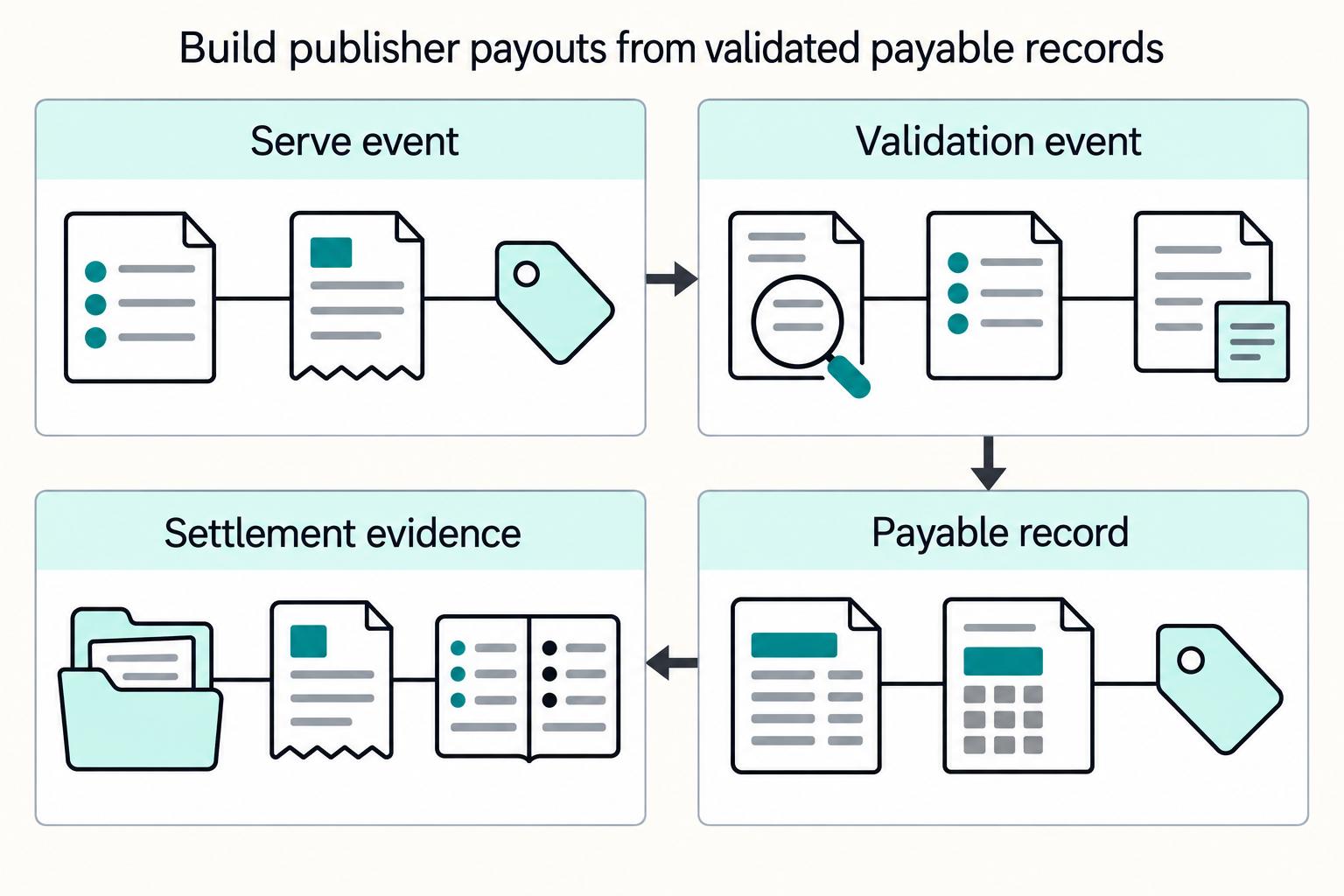
Build payable records from eligible activity and the contract version that governed it. Preserve publisher, inventory period, currency, measurement/report version, base amount, rate/share and adjustment references. Assign a unique calculation or source key so replaying the same imported report cannot accrue the same earnings twice.
The diagram’s sequence separates activity, validation, payable records and settlement evidence. A correction can arrive later, so record it as a linked adjustment with its own unique identifier. Keep estimated earnings separate from finalized entitlement and keep entitlement separate from the external payment attempt.
Illustrative statement: opening unpaid balance $100 + finalized current earnings $1,000 − contractual adjustment $50 = $1,050 eligible balance. Suppose $150 is held under an agreed review rule. The run can release $900 and carry $150 as held. When the $900 payout completes, the remaining unpaid balance is $150. If a new permitted $40 correction then arrives, post it once against the relevant earnings and show $110 remaining, rather than rewriting the completed $900 transfer.
If the same statement has no unpaid balance when a later reversal arrives, show the resulting debit or recovery separately and apply the contract’s offset rules. Do not assume a negative balance gives unrestricted authority to debit the publisher’s bank account. Keep the original payment trace and the reason for the new adjustment available to support.
Before external submission, atomically reserve the amount being paid and persist its operation ID, exact payload, provider request key and destination version. Keep the publisher liability and payment attempts separate. Authenticate and deduplicate callbacks, then reconcile the provider’s outcome and funding movement. A repeated job must neither accrue another earnings liability nor pay the same liability again.
Provider idempotency protects requests within the documented behavior and retention window. Your durable obligation and attempt records must last longer. If submission times out, keep the amount reserved and retrieve the original outcome. Do not send a fallback until conclusive non-payment, funding reconciliation and release approval make a replacement safe.
Reconcile publisher totals, statement lines and completed transfers. Finance should be able to explain the calculation; publisher support should see the contract version and adjustment reason; payment operations should see the attempt status. A request accepted by a payment provider is not proof that the publisher received the funds.
For the broader payment-operation pattern, see automated affiliate publisher payouts.
Run a pilot without changing already earned terms#
Choose comparable publishers or inventory for the proposed arrangement and specify the effective start date. Track eligible activity, earnings per consistent denominator, network margin, hold aging, disputes and reconciliation effort. Set the duration using expected traffic and normal settlement/adjustment cycles rather than assuming four weeks will establish a winner.
Review whether the new commercial terms improve the agreed goal and whether both parties can reproduce the statements. Fix invalid traffic or attribution gaps directly. If a model change is warranted, follow the contract for future activity and retain old-period earnings under their original terms. The useful model is one the network can fund and the publisher can understand.
Frequently Asked Questions
Are CPM, CPC and revenue share mutually exclusive?
No. CPM and CPC describe impression and click pricing units; revenue share divides a defined revenue base. A publisher agreement can combine a payment unit with revenue sharing or a clearly defined guarantee.
Does AdSense pay per click or per impression?
Current AdSense for Content guidance describes effective-CPM publisher payments and an 80% share after the advertiser platform fee. Its Google Ads display example leaves publishers about 68% of advertiser revenue. Advertiser buying terms can differ from publisher payment terms.
Is CPM safer when a publisher has invalid click traffic?
Changing the unit does not resolve invalid traffic. Invalid impressions and clicks can both inflate earnings. Investigate the affected activity and apply the agreement’s validity and adjustment rules in every model.
How should a publisher compare two revenue-share offers?
Compare the defined revenue base, fees, eligible inventory, adjustment rights and effective earnings on the same denominator. A higher share percentage does not guarantee higher take-home earnings.
Can an ad network change payout terms during a cycle?
Follow the agreement’s notice and acceptance requirements and apply changes to their stated effective period. Preserve the original terms for earnings already accrued; a new model is not an automatic basis to recalculate them.
How do retries avoid duplicate publisher payments?
Deduplicate earnings calculations separately from payment attempts. Reserve the payable amount before submission, persist the exact attempt and reconcile unknown outcomes before authorizing any replacement.
Try a related tool
Researched and edited by the Gruv editorial team. Gruv builds cross-border billing, payouts, and finance-operations software for global businesses.
Sources
Includes 3 external sources outside the trusted-domain allowlist.
Educational content only. Not legal, tax, or financial advice.
Related Posts
Affiliate Network Payout Structures for Publisher Commissions
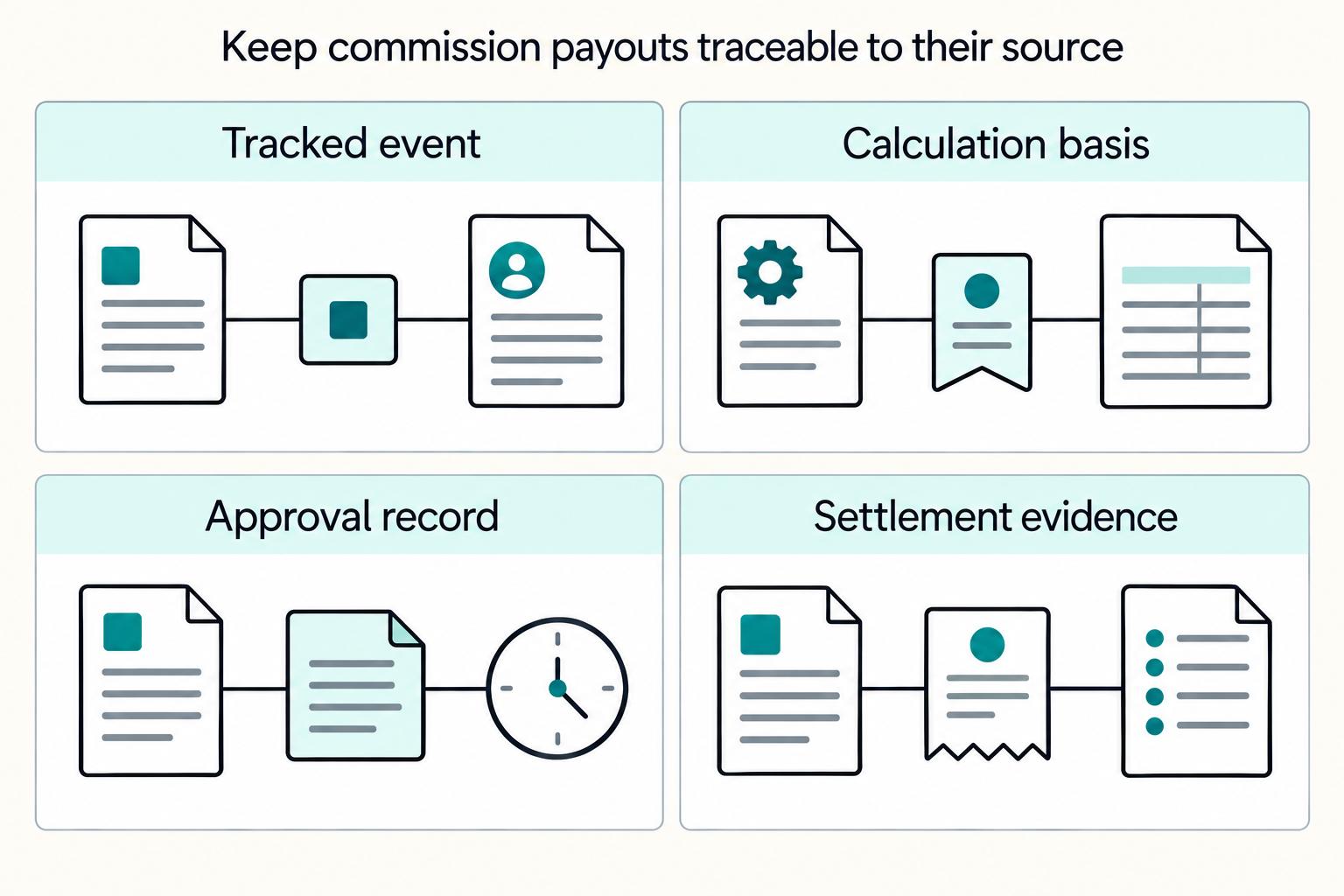
Commission design is an operating decision, not a pricing footnote. The structure you choose affects what behavior you reward and the economics of the program. It is easy to announce rates. It is much harder to define a model that still holds up once reversals, edge cases, and partner questions start showing up.
Automating Affiliate Network Payouts for Publishers and Partners at Scale
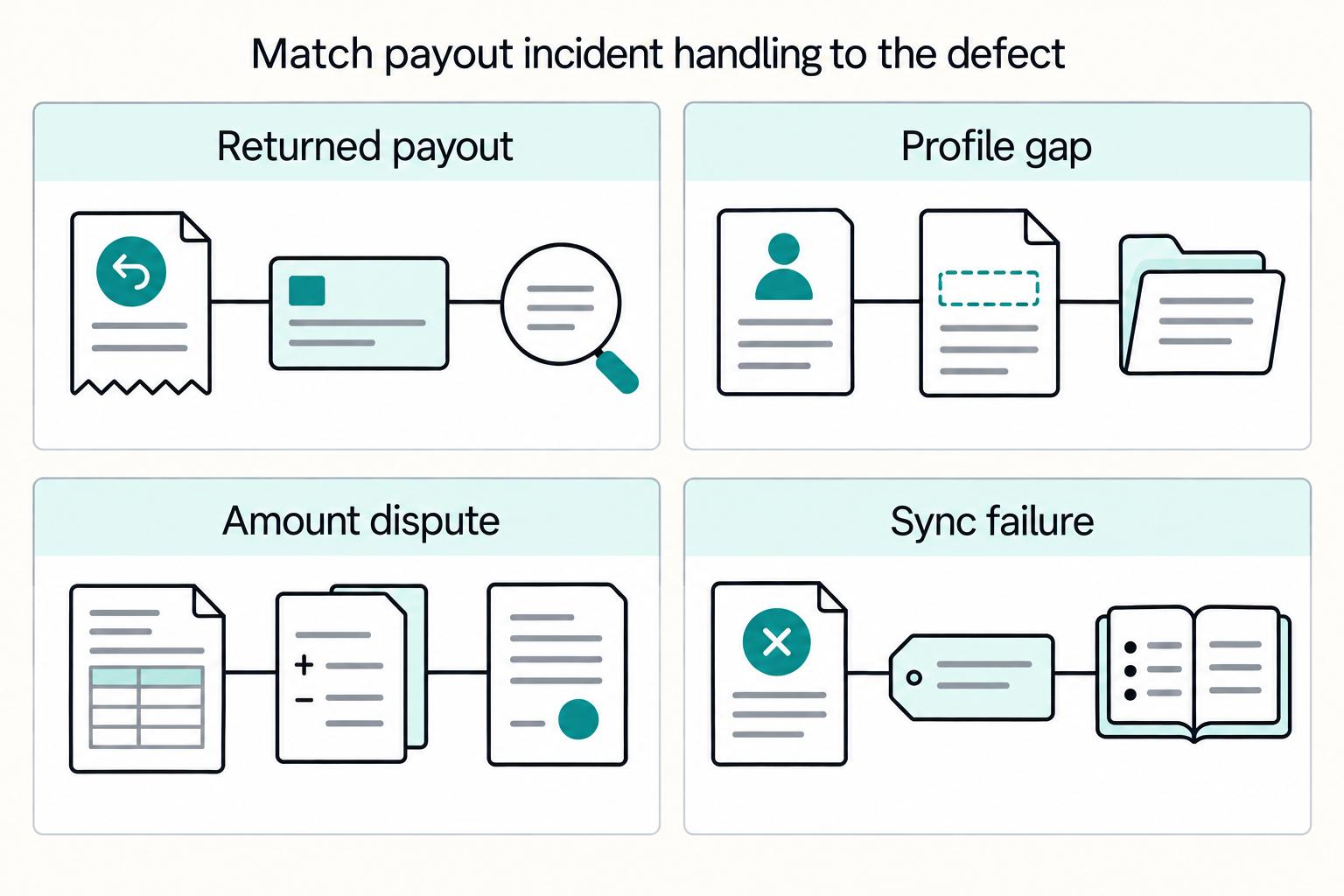
Automating affiliate payouts is worth doing, but only after you decide what has to stay controlled. As programs grow, payouts become a real operational burden, and payout reliability affects whether partners stay engaged. If you automate the payment motion before you clean up approvals, tax data, and reconciliation, you usually do not remove work. You just move it into exceptions that are harder to unwind.
Mass Payouts for Affiliate Networks Paying Publishers, Partners, and Creators at Scale
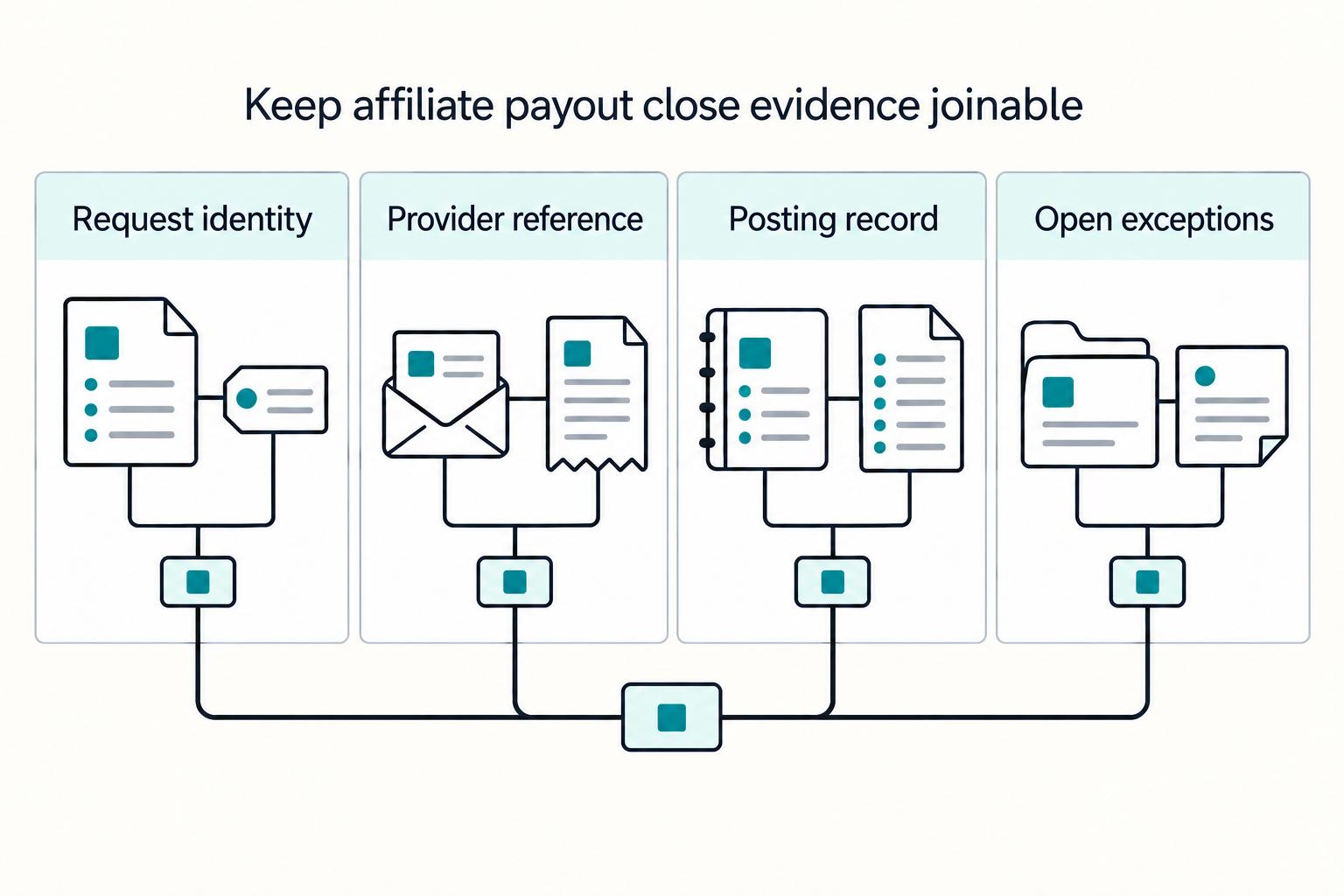
Treat affiliate payouts as infrastructure, not as a payment feature. Once you are paying publishers, partners, and creators in volume, the hard part is often not the send button. It is everything around it: commission calculation, recipient onboarding, approval controls, rail selection, status handling, reconciliation, and close.