
Quick Answer
Measure 3DS as a branching flow: frictionless and challenged attempts each produce authentication outcomes, then connect those outcomes to authorization and capture. Use the relevant branch as each denominator, keep pending or unknown attempts separate from confirmed abandonment, and segment by applicable SCA context, issuer and device.
Measure authentication and payment separately#
A customer can authenticate successfully and still receive a card decline. Another can complete authentication without seeing a challenge at all. If your dashboard treats “challenged” as a required step for every payment, it will report healthy frictionless traffic as missing or lost.
EMVCo describes EMV 3DS as an exchange of transaction, payment and device information between the merchant and issuer to authenticate the customer. It helps prevent card-not-present fraud. Your conversion analysis must then connect that authentication record to the payment that follows.
Keep three questions separate: did authentication succeed, did the issuer authorize the payment, and did the business capture the intended amount? Authorization can be a useful checkout metric, but it is not proof of capture or settlement. Define which outcome your report calls conversion.
Build a branching funnel#
Adyen’s 3DS guide distinguishes a frictionless flow, with no further shopper interaction, from a challenge flow requiring interaction. The issuer determines the authentication path using the information and applicable rules. A challenge that was never requested is not customer abandonment.
| Stage or branch | Record | Useful measurement |
|---|---|---|
| Authentication entry | A distinct attempt entered 3DS | Attempt count, with duplicates of the same event removed. |
| Frictionless branch | Outcome without an interactive challenge | Successful outcomes divided by attempts in this branch. |
| Challenge requested | Issuer requested further interaction | Requested challenges divided by all 3DS attempts. |
| Challenge presented | Challenge actually reached the customer | Presented challenges divided by requested challenges. |
| Challenge completed | Interaction ended with a recorded result | Completed challenges divided by presented challenges. |
| Authentication outcome | Success, failure, other documented result, pending or unknown | Success rate with the denominator and treatment of unresolved attempts stated. |
| Authorization | Request sent and approved, declined or unresolved | Approval rate among submitted authorizations and continuation rate after authentication. |
| Capture | Intended amount captured or still outstanding | Capture completion and amount coverage, distinct from authorization. |
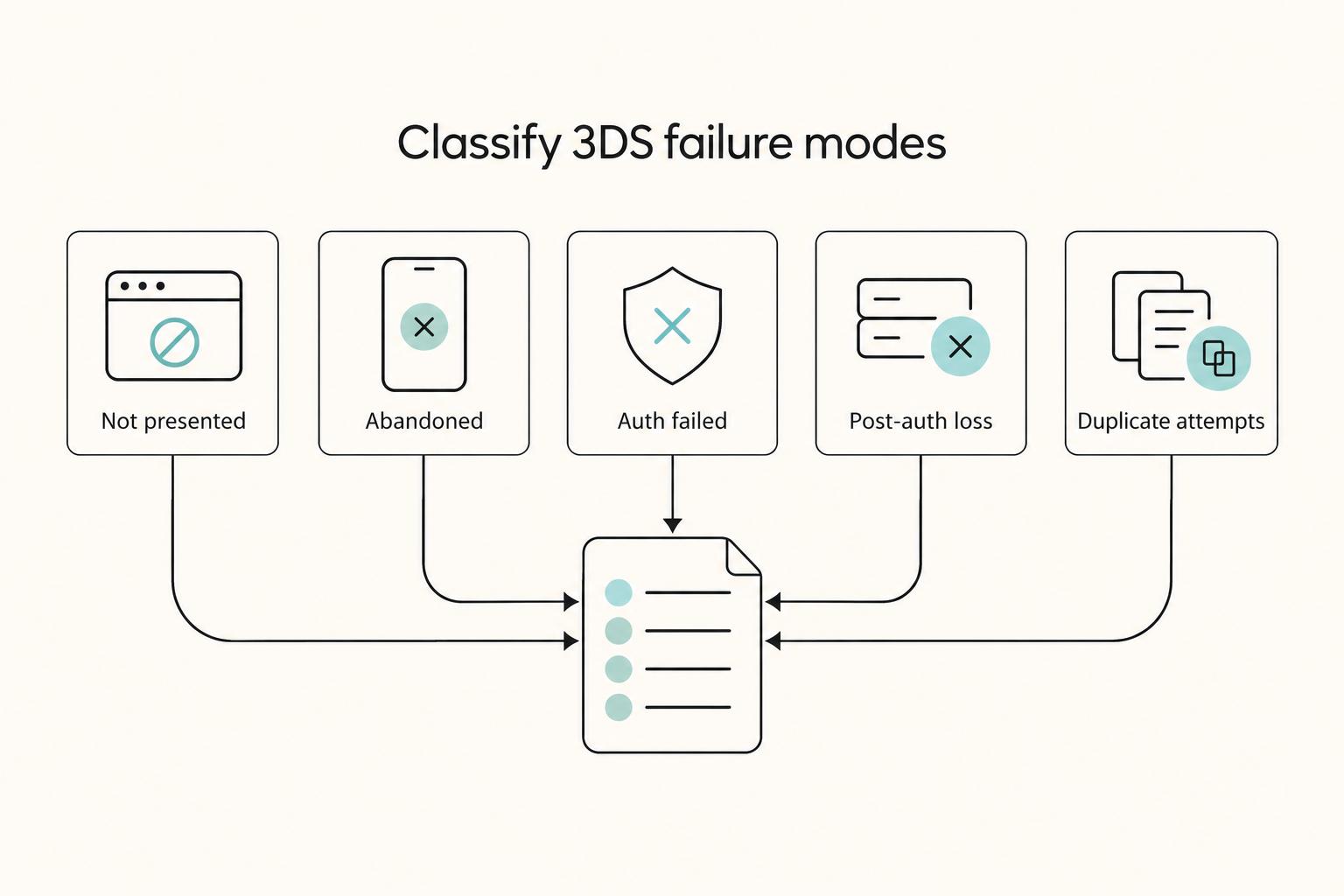
Use the provider’s documented response meanings. “Attempted authentication” is not necessarily authenticated success. Preserve raw codes and map them to explicit business categories. Also separate exempt or out-of-scope payments that did not enter this 3DS funnel from traffic that did.
Worked example: 1,000 attempts#
These numbers illustrate the calculation; they are not industry benchmarks. Suppose 1,000 distinct attempts enter 3DS. Of 700 frictionless attempts, 680 authenticate successfully and 20 fail. The other 300 require a challenge, and all 300 are presented in this example. Of those, 240 authenticate successfully, 20 complete the challenge but fail authentication, and 40 are confirmed abandoned.
| Metric | Calculation | Result |
|---|---|---|
| Challenge-request rate | 300 ÷ 1,000 | 30% |
| Frictionless authentication success | 680 ÷ 700 | 97.1% |
| Challenge completion | (240 + 20) ÷ 300 presented | 86.7% |
| Challenge authentication success | 240 ÷ 300 presented | 80% |
| Overall authentication success | (680 + 240) ÷ 1,000 | 92% |
Now suppose 900 of the 920 authenticated attempts reach authorization, 860 are approved and 40 are declined. The 20 missing authorization submissions need investigation. Authorization approval among submitted requests is 860 ÷ 900, or 95.6%; approved payments per original 3DS attempt are 860 ÷ 1,000, or 86%. Those rates answer different questions.
If 850 of the 860 approved payments have their full intended amount captured by the observation cutoff, full-capture completion per original attempt is 85%. The remaining 10 need their own status. Neither a successful challenge nor a final authorization response should be labelled a completed paid transaction without the relevant payment evidence.
Keep payment identity and observation windows clear#
Store a stable checkout or payment ID and a separate attempt ID. Link the provider payment reference, authentication reference, exposed directory-server reference, authorization and capture records. Multiple webhook deliveries for one attempt are duplicates; a customer’s genuine new attempt is a separate attempt that may belong to the same checkout.
Maintain an attempt-level view for troubleshooting and a checkout-level view for customer conversion. State whether the latter uses first attempts, the latest resolved attempt, or successful payment within a defined window. Do not silently collapse all retries and call the result an attempt rate.
Use the same observation cutoff for compared cohorts. Keep pending and unknown results visible; classify abandonment only after an appropriate inactivity window and checks for later provider outcomes. A customer closing a browser does not prove that a server-side payment failed.
Adyen’s authentication report has its own inclusion rules and outcome fields, including authentication and exemption information. Join it to payment reporting using supported references instead of demanding identical totals from differently scoped datasets.
Diagnose the loss before changing policy#
| Observed loss | First investigation | Likely owner |
|---|---|---|
| Request did not enter authentication | Required data, API response and integration errors | Engineering and payments operations. |
| Challenge requested but not presented | SDK or redirect handoff, device behavior and request state | Engineering and product. |
| Challenge presented then abandoned | Actual exits, timing, display failures and customer interaction | Product, with issuer/provider evidence. |
| Authentication failed | Documented response and reason, request quality and issuer concentration | Payments operations. |
| Authentication succeeded but authorization missing | Continuation handler, lost response and operation record | Engineering. |
| Authorization declined | Issuer response and required authentication data carried into the request | Payments operations and provider. |
| Authorization approved but capture missing | Capture mode, intended amount and capture operation status | Finance and engineering. |
| Outcome still unknown | Provider retrieval, delayed events and recoverable processing | Operations and engineering. |
Collect the evidence your integration exposes; do not make access to every internal issuer or directory-server record a prerequisite to action. Request additional provider investigation when the available records cannot explain the failure. Avoid storing unnecessary sensitive card or authentication data in general analytics logs.
A frictionless result is not a failure merely because the merchant expected a challenge. Likewise, rising abandonment with stable challenge completion does not by itself identify a pre-authentication problem: changing branch proportions and denominators can produce that pattern. Inspect counts, comparable cohorts and the actual stage of loss.
Handle asynchronous results without false losses#
Authenticate and durably store incoming events before acknowledgment. Track receipt separately from processing, and commit the local state change, any accounting effect and outbound work recoverably before marking the event processed. Repeated deliveries must not create another attempt or another capture.
Arrival order and timestamps alone do not establish valid state. Use the provider’s current object, documented version information where available, and allowed transitions. A late result can resolve uncertainty; a later refund or dispute can be a legitimate adverse event rather than stale data.
Persist the original operation identity before authorization or capture dispatch. If the response is lost, retrieve or safely replay that same operation under the provider’s guarantees before creating a new charge or capture. A timeout should create an unknown state, not an automatic duplicate payment.
Use Stripe’s authentication-flow documentation or your provider’s equivalent to implement its actual lifecycle. Report provider-specific statuses as such rather than present one field name as a universal 3DS standard.
Segment by the applicable SCA context#
EEA PSD2/SCA rules and the UK’s SCA framework are distinct legal contexts. Identify the acquiring and issuing processing entities, transaction type, applicable regime and any valid exemption or out-of-scope treatment with the provider and compliance owner. Customer location alone is not a sufficient global scope rule.
The FCA explains the UK SCA framework. Do not describe the UK as an EEA member or automatically treat Monaco and Switzerland as EEA jurisdictions. A provider can route businesses in those markets through an EEA processing entity or apply a wider configuration.
For example, Adyen’s compliance guide describes its processing scope across the EEA, Monaco, Switzerland and UK. That is relevant to an Adyen integration, but should not be copied as the legal geography of PSD2 for every provider.
Inside each applicable context, compare issuer or card-range groups, scheme, device, SDK or redirect flow, amount band, and the authentication path. Keep enough observations to avoid overinterpreting tiny samples. A shift toward issuers that challenge more often can change the blended rate without any checkout regression.
Use current EMV 3DS rather than a legacy fallback plan#
3DS1 belongs in historical comparisons and old data interpretation. Visa’s sunset notice documents discontinuation of 3DS 1.0.2 support. Do not plan a new integration around automatic fallback to that legacy protocol.
Confirm the EMV 3DS versions and flow types supported by your current PSP, SDK and issuer routes. Browser and app behavior can differ, so test the relevant handoffs. A version upgrade does not automatically raise conversion; correct request data and reliable continuation still matter.
Change one cause at a time#
Start with a defined baseline and reliable instrumentation. Fix a confirmed broken redirect or missing continuation directly; there is no universal rule that policy must always change before UX. For policy optimization, isolate a cohort and one variable so the effect can be assessed.
Agree the success criterion before rollout: the intended conversion outcome, compliance, fraud, chargebacks and operational exceptions. If requesting fewer challenges improves authorization but worsens fraud loss, the conversion change alone is not sufficient evidence to retain it. Allow time for delayed risk outcomes.
Keep a control group or matched comparison where feasible, and document changes in issuer mix, traffic and provider configuration. A sandbox can verify integration cases; production outcomes are needed for conversion and risk evaluation.
For implementation detail, see Implement 3D Secure 2 for Platforms Without Losing Checkout Conversion.
Frequently Asked Questions
Must every 3DS payment pass through a challenge?
No. EMV 3DS supports frictionless authentication and challenge flows. Measure those branches separately; absence of a requested challenge is not abandonment.
Is a completed challenge a successful payment?
No. Challenge completion can have an unsuccessful authentication result, and successful authentication can still be followed by an authorization decline or incomplete capture.
What denominator should we use for challenge completion?
Use challenges actually presented for the presentation-to-completion metric. Also measure presentation among requested challenges so a failed handoff cannot disappear from the dashboard.
Should unknown attempts be counted as abandoned?
Keep them separate until the observation window and provider recovery checks support a final classification. A missing event or closed browser is not proof of payment failure.
Is 3DS1 an appropriate fallback for a new integration?
Do not design a new integration around the legacy protocol. Confirm supported current EMV 3DS versions and flows with the provider; old report categories do not prove current support.
Does one Europe filter establish SCA scope?
No. Establish the applicable EEA or UK regime, processing entities and transaction treatment. Provider routing in Monaco or Switzerland can create a particular scope, but those countries are not EEA members.
Researched and edited by the Gruv editorial team. Gruv builds cross-border billing, payouts, and finance-operations software for global businesses.
Sources
Includes 5 external sources outside the trusted-domain allowlist.
- docs.stripe.com/payments/3d-secure/authentication-flowtrusted
- docs.adyen.com/online-payments/3d-secureexternal
- docs.adyen.com/reporting/3d-secure/3ds-authentication-reportexternal
- emvco.com/emv-technologies/3-d-secureexternal
- fca.org.uk/firms/strong-customer-authenticationexternal
- usa.visa.com/content/dam/VCOM/regional/na/us/support-lega...external
Educational content only. Not legal, tax, or financial advice.
Related Posts
Implement 3D Secure 2 for Platforms Without Losing Checkout Conversion
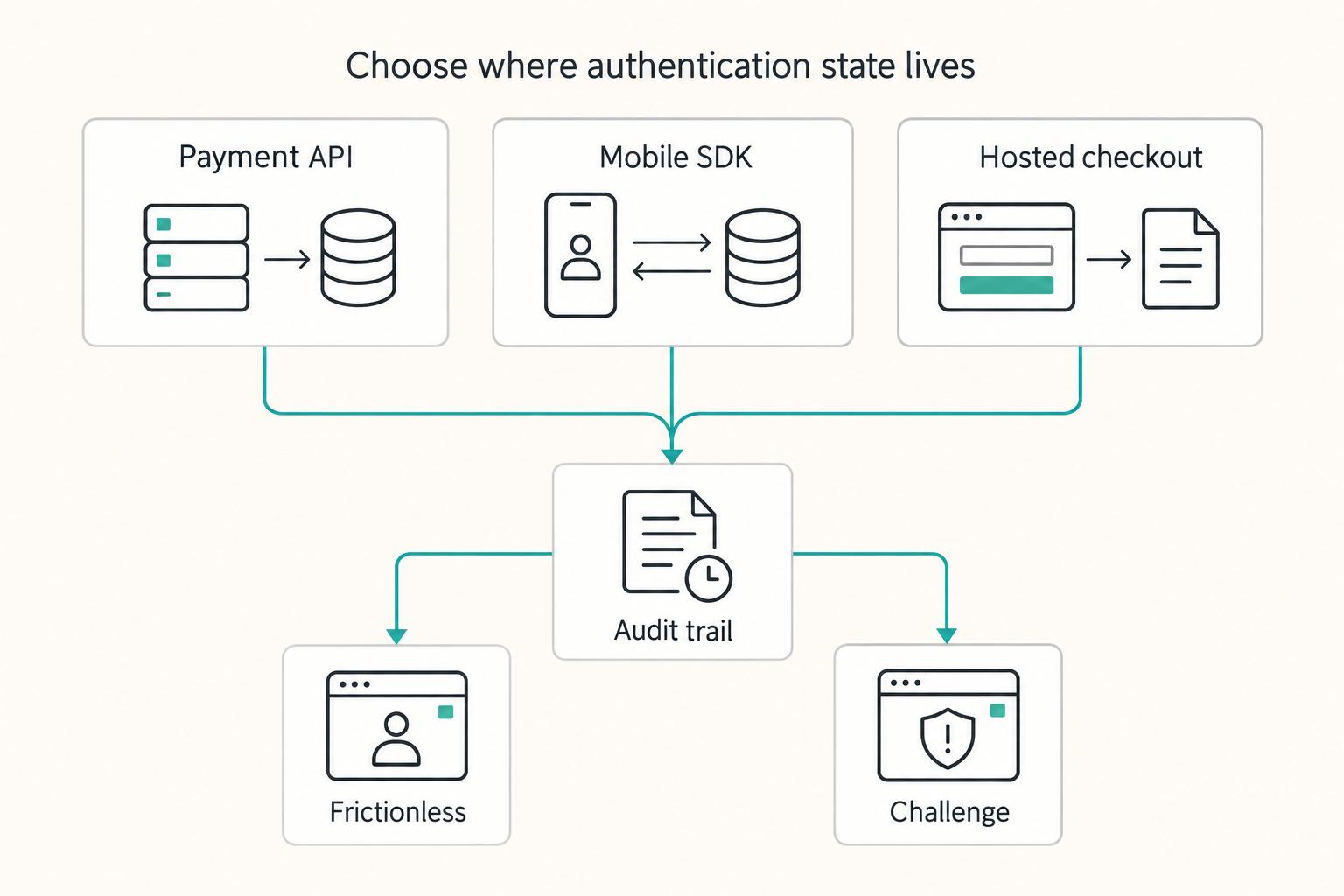
Treat 3D Secure 2 as an architecture choice, not a compliance box to tick. For a platform, the way you introduce 3DS2 changes how you meet Strong Customer Authentication requirements in Europe. It also changes how often customers get interrupted and how much payment logic you tie to a single checkout surface.

The Freelance Payment Penalty: A Modeled Audit of Platform Fees, FX Spreads, and Payout Delays
The money rarely disappears through a single, easy-to-spot fee. The real loss is stacked. A marketplace takes its commission, a processor adds a charge for international cards, a bank or payment company converts the currency at a spread, a platform holds the funds before release, and a wire sheds a little to intermediaries on the way in. Each layer looks defensible on its own, but the worker feels the combined result as a smaller deposit and a later payday.

How to Respond to a Subpoena for Business Records
Move fast, but do not produce records on instinct. If you need to **respond to a subpoena for business records**, your immediate job is to control deadlines, preserve records, and make any later production defensible.