
Quick Answer
Yes: implement 3D Secure 2 in phases, starting with clear PSD2 scope and a single channel you can monitor end to end. Decide early whether hosted checkout, payment APIs, or Mobile SDK should own authentication behavior, then enforce one internal state model for frictionless, challenge, timeout, and failed outcomes. Before broad rollout, verify idempotent retries and duplicate-webhook handling so conversion changes reflect policy decisions, not integration noise.
How to Add 3D Secure 2 Without Hurting Checkout Conversion#
Treat 3D Secure 2 as an architecture choice, not a compliance box to tick. For a platform, the way you introduce 3DS2 changes how you meet Strong Customer Authentication requirements in Europe. It also changes how often customers get interrupted and how much payment logic you tie to a single checkout surface.
The core promise is real. 3D Secure 2 can improve the purchase experience compared with 3D Secure 1 by allowing a frictionless path. But frictionless is not something you simply switch on. A transaction that qualifies for 3DS2 can still end up in either a frictionless flow or a challenge flow, depending on the issuer's requirements. That detail matters more than many launch plans admit, because it means your checkout UX is only partly under your control.
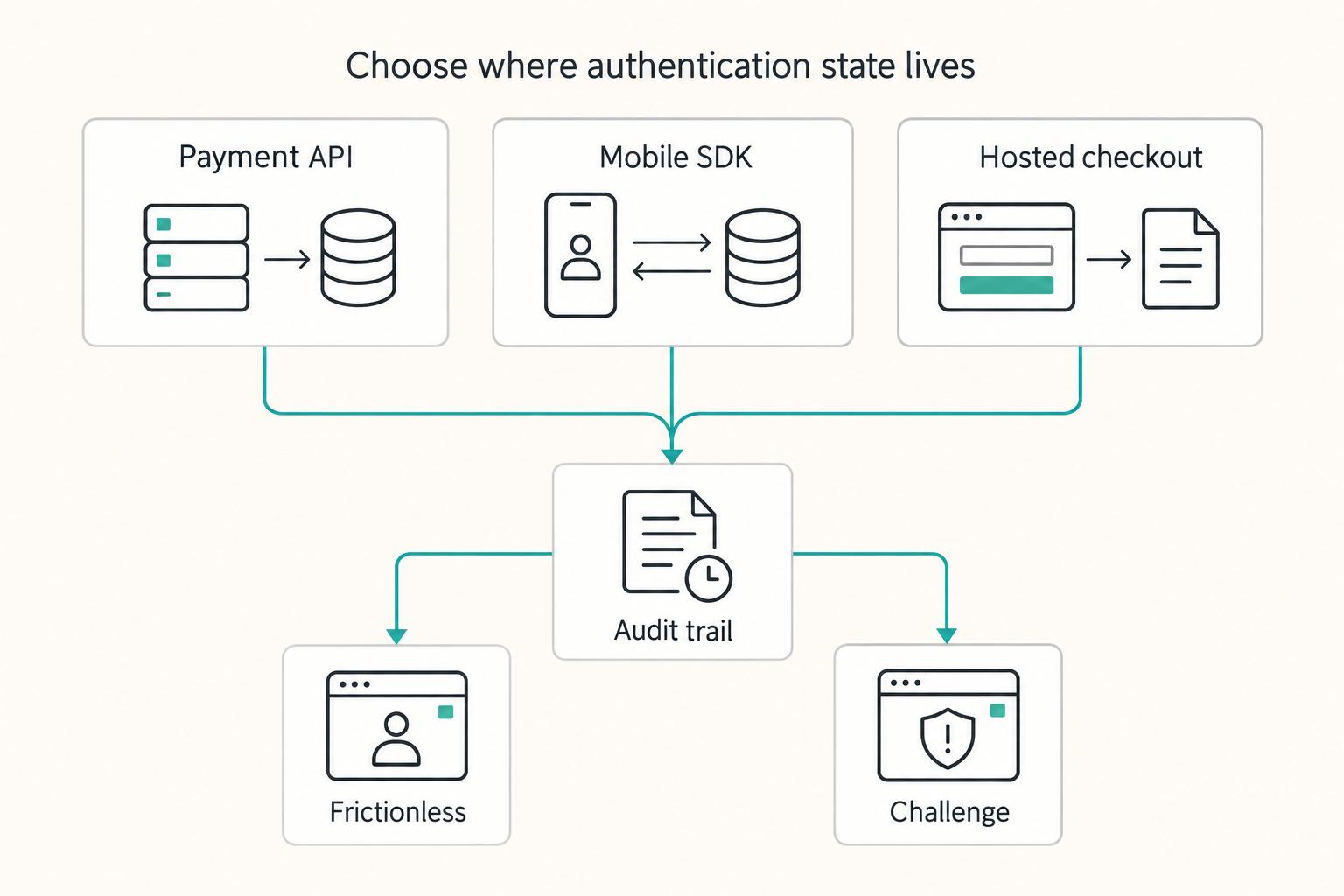
For engineering leads, the first practical decision is where 3DS2 should live. The common surfaces are payment APIs, a Mobile SDK, and hosted checkout. Each shifts ownership in a different direction. Hosted checkout can reduce how much authentication UI you own directly. API-led integration shifts more state handling into your own backend. Mobile SDK support keeps authentication inside the in-app surface, but it also means app and backend flows need to stay aligned. If your web team, app team, and payments backend all model authentication differently, operational debugging gets harder later.
A good early checkpoint is simple: can you trace one payment attempt from checkout start to final authentication result across every channel you operate? If the answer is no, pause before you roll 3DS2 out widely. You want one auditable path that shows whether the attempt was frictionless, challenged, abandoned, or failed. That same state model needs to hold up in both web and mobile.
The conversion risk is also more specific than "3DS hurts checkout." Redirect-based authentication can reduce conversion because technical errors happen during redirection, and some shoppers drop out before completing the authentication step. That is why recreating 3DS1-style interruption inside a newer stack can still hurt conversion. You can meet SCA expectations in Europe and still lose avoidable volume if your integration choice relies on redirects that fail or challenge flows that shoppers do not complete.
This guide stays at that implementation layer. It does not re-explain the basics of PSD2, Visa Secure, Mastercard Identity Check, or similar scheme concepts. It is here to help you sequence decisions across APIs, hosted checkout, and mobile so you can satisfy SCA requirements without dragging old 3DS1 friction into a newer payment stack. Exact behavior can still vary by market, card network, issuer, and provider setup, so the right design starts with those boundaries, not with a generic checkout pattern.
What to prepare before you change checkout#
Before you change checkout, lock scope, ownership, and controls first so your 3DS2 rollout does not create avoidable rework.
| Area | Include | Check |
|---|---|---|
| Scope | Jurisdiction, card mix, scheme, and channel | Produce one matrix by market, card brand, and channel before implementation |
| Ownership | Payment APIs, mobile SDK behavior on Android and iOS, and SCA policy sign-off | If challenge-handling decisions and implementation ownership are unclear, defects will bounce between teams |
| Baseline evidence | Authentication outcomes, challenge rate if available, checkout drop-off points, chargebacks, and support tickets tied to verification or bank-authentication friction | If the baseline is missing, collect a manual sample before rollout |
| Controls | Idempotent retries, a chronological audit trail, and log reviews to confirm sensitive data is not written to operational logs | Force a retried request in test, verify no duplicate operation, and verify one payment attempt can be reconstructed end to end |
- Define scope by jurisdiction and card mix first. Start with where SCA under PSD2 applies to your online card traffic, then map that traffic by scheme and channel. For EEA and UK traffic, the cited SCA effective dates are December 31, 2020 (EEA) and September 14, 2021 (UK). Name the scheme programs you expect in meaningful volume, including Visa Secure and Mastercard Identity Check, and decide whether American Express SafeKey or JCB J/Secure are in scope.
Checkpoint: produce one matrix by market, card brand, and channel before implementation.
- Assign ownership across API, mobile, and policy decisions. Set clear owners for payment APIs, mobile SDK behavior on Android and iOS, and SCA policy sign-off. This prevents gaps when authentication behaves differently across web and mobile.
Red flag: if challenge-handling decisions and implementation ownership are unclear, defects will bounce between teams.
-
Assemble a baseline evidence pack before rollout. Capture current authentication outcomes, challenge rate (if available), checkout drop-off points, chargebacks, and support tickets tied to verification or bank-authentication friction. If that baseline is missing, collect a manual sample before rollout so post-launch performance can be measured against something concrete.
-
Set non-negotiables for retries, auditability, and logging. Require idempotent retries so retried requests do not duplicate side effects. Require a chronological audit trail from request to final result. Require log reviews to confirm sensitive data is not written to operational logs.
Checkpoint: force a retried request in test and verify no duplicate operation is created; verify one payment attempt can be reconstructed end to end.
Choose the right 3DS2 integration surface for your platform#
Choose the thinnest integration surface that solves rollout now without blocking deeper control later. If your immediate problem is fast SCA coverage across many tenants, a hosted or redirect/session-based surface is often the safer starting point; move specific merchants to deeper API control when the need is clear.
Put control at the right boundary#
The core decision is where 3DS complexity lives and which team owns it when issuer behavior varies.
| Surface | Where control lives | 3DS Server responsibility | When it fits |
|---|---|---|---|
| Hosted checkout | Provider-hosted or embedded payment surface | Commonly handled by the provider, including sending AReq through network rails to the issuer | Fast rollout, broad tenant coverage, lower custom front-end effort |
| Direct payment APIs | Your web/app frontend plus backend orchestration | Must still exist, with more auth-state handling around the payment flow on your side | Custom UX, tenant-specific behavior, tighter product control |
| Mixed mode | Hosted for long-tail tenants, API/native for selected segments | Split by segment, normalized into one internal auth model | Multi-tenant platforms with uneven needs |
Hosted does not mean no flexibility. Some stacks let you use hosted pages, embedded forms, or more customized surfaces on the same provider stack. Stripe Checkout, for example, supports more than 100 payment methods, which can matter when rollout breadth is the first priority.
Price operational burden before you commit#
Hosted and redirect paths can reduce initial implementation effort, and some session-style flows include 3DS2 support without extra configuration. The tradeoff is less control over each step of the user journey.
Direct APIs shift more responsibility to your teams: web challenge handling, mobile SDK behavior on iOS/Android, and backend state management around authentication outcomes. That can increase coordination overhead, especially when web and mobile behavior diverge.
A practical checkpoint: test one web, one Android, and one iOS challenge flow, then trace each attempt from start to final payment result. If ownership is unclear at any handoff, treat that as a signal that direct control may be premature.
Design for issuer variance and legacy compatibility#
Do not assume a uniform 3DS UX. The issuer determines whether authentication is required and whether a transaction is frictionless or challenged, and outcomes vary across the broader interoperability domain.
That is why hosted surfaces often work well for broad first rollout, while API-first paths fit segments that need tighter control enough to justify extra ownership.
Also plan migration for tenants with 3DS1-era assumptions. In some setups, you may need to handle both 3DS1 and 3DS2 during transition. Normalize legacy redirect outcomes, 3DS2 frictionless outcomes, and 3DS2 challenge outcomes into the same internal authentication states so downstream payment status and support handling stay consistent. Related: How Platforms Are Reshaping the Market of Foreign Exchange: A 2026 Deep Dive.
Map the authentication architecture end to end#
Before you add more code, define one canonical authentication timeline for each payment attempt. Your target is simple: one attempt, one state history, and no mismatch between what the shopper saw, what the issuer decided, what payment APIs report, and what support or finance can verify later.
Draw the real event path#
Document the path as an explicit sequence, not a single "3DS" box:
| Step | Event |
|---|---|
| 1 | Checkout request creates your internal attempt and payment-tracking object, for example a PaymentIntent lifecycle |
| 2 | If authentication is required, the 3DS Server sends AReq through the payment network to the issuer |
| 3 | The issuer returns ARes through the network back to the 3DS Server |
| 4 | Client and payment APIs receive the next-step outcome |
| 5 | Asynchronous updates land: payment status update, webhook delivery, ledger or audit write, and operator-visible status |
Do not stop at "auth complete." Bank confirmations can arrive asynchronously, so your design must show where late webhook events are applied.
Normalize provider signals into canonical states#
Keep internal states smaller and stricter than provider schemas, and map provider signals into that model consistently across web and mobile.
| Canonical internal state | Typical external signal you might map from | What your platform should do next |
|---|---|---|
frictionless_authenticated | Issuer approves auth with no shopper step | Wait for payment confirmation and mark audit trail as auth satisfied |
challenge_started | Stripe requires_action or Adyen ChallengeShopper | Keep payment open, present challenge on web or mobile SDK, and block duplicate customer prompts |
challenge_completed | Shopper finishes the issuer step | Wait for payment API or webhook confirmation before treating payment as final |
auth_timed_out | Your timeout rule expires before a final auth outcome | Move to controlled recovery: re-prompt, retry, or manual review |
auth_failed | Auth or payment cannot complete and falls back (for example, requires_payment_method) | End the attempt cleanly and allow a new method or fresh try |
Make every boundary duplicate-safe and role-aware#
Treat all boundary events as replayable.
- Outbound POSTs: send an idempotency key and reuse it on timeout retries.
- Inbound webhooks: expect duplicate delivery, persist provider event IDs, and reject invalid state transitions.
- Frontend callback + webhook races: enforce replay rules so one challenge completion cannot create two internal effects.
Define data ownership clearly. PSP/acquirer context is used in issuer authentication, the issuer owns the auth decision, and operators usually need references, timestamps, canonical state, and reason trail, not raw sensitive data. Keep sensitive fields masked, and do not store PII or card details in PaymentIntent metadata or description fields.
For a step-by-step walkthrough, see How to Calculate the Cash Conversion Cycle for a Service Business.
Sequence implementation in phases to avoid rework#
With your state model fixed, roll out in controlled phases so you can validate outcomes before adding complexity. A practical sequence is to prove one narrow 3DS2 path first, then extend to mobile on the same internal states, then introduce tenant-level policy controls.
Ship one narrow path and measure paired outcomes#
Start with one integration surface and one merchant cohort so you can isolate what changed. Stripe supports 3D Secure 2 across payments APIs, mobile SDKs, and Stripe Checkout, while Adyen's 3DS path depends on your server-side integration flow, so begin where your team can observe the full path end to end.
If this cohort includes PSD2 markets, validate that the flow supports SCA instead of only adding friction. Do not measure auth completion alone: review authentication success and authorization outcomes together, and confirm your reporting can separate frictionless outcomes from issuer challenge flows.
If you see higher checkout drop-off without a clear risk or liability reason, pause expansion and retune when you trigger authentication or challenge before adding more merchants.
Extend to Android and iOS without changing the auth contract#
After the first channel is stable, add mobile SDK flows using the same internal auth states you already defined. Stripe supports 3DS on Web, iOS, Android, and React Native, and Adyen guidance is segmented by platform and integration type; treat those as implementation differences, not different meanings of completed or failed.
Run the same test pattern on web, Android, and iOS: one frictionless payment and one issuer challenge. Verify each path lands in the same canonical states and waits for the same final payment confirmation. Also account for issuer fallback to 3DS1 so your UX and state handling do not assume 3DS2-only behavior.
Add tenant policy controls after the base path is stable#
Add tenant overrides only after the shared baseline is working. Keep challenge policy centralized early so you can evaluate core behavior before merchant-specific branching.
Use auditable controls for when to request 3DS and when to challenge, such as Stripe Radar or API controls and Adyen Dynamic 3D Secure rules. For each override, require an owner, rationale, and measurable expectation so conversion changes can be traced to a specific policy decision.
Protect conversion while staying compliant#
Protecting conversion under SCA is a calibration problem, not a blanket "more 3DS" decision. Keep lower-risk traffic on frictionless paths where issuer support is strong, and apply stricter handling only where compliance, fraud outcomes, or liability-shift goals justify added friction.
Score scenarios before you raise challenge rates#
Use a simple scenario matrix so challenge policy is explicit and testable.
| Scenario | Expected frictionless likelihood | SCA posture | Operator note |
|---|---|---|---|
| Lower-risk repeat traffic | Often higher | Prefer frictionless where issuers support it | Review conversion and auth completion together |
| Higher-risk or first-time traffic | Often lower | Expect more challenge when issuer or policy requires it | Confirm extra auth effort improves outcomes |
| Segments with elevated disputes or chargebacks | Mixed | Apply stricter handling with a clear liability-shift objective | Track fraud and dispute outcomes after auth |
For EEA and UK card payments, keep SCA requirements as the boundary condition: the dates in scope are December 31, 2020 (EEA) and September 14, 2021 (UK). Tune for conversion inside that boundary, not outside it.
Measure the counters that explain the tradeoff#
Judge performance as a set, not a single metric. Track conversion, authentication completion, challenge abandonment, fraud outcomes, and liability-shift patterns on the same cohort and time window, split by frictionless versus challenge outcomes.
Use provider reporting with your own payment outcome data to answer one question: did extra authentication improve the business result? Also account for override behavior: with Adyen Dynamic 3D Secure, a "Prefer not" setting can still result in 3DS based on issuer, compliance, or conversion logic.
Calibrate by scheme and market#
Scheme-branded programs such as Visa Secure, Mastercard Identity Check, and American Express SafeKey are all 3DS lanes, but issuer behavior is not uniform across markets. Do reviews by scheme plus market, not only by total 3DS volume.
Stripe's regulated-markets data for H1 2024 reported a 15% increase in 3DS request rates and a 40% increase in frictionless flows. The practical read is that more authentication does not always mean more checkout interruption when issuer support is present. If one scheme-market segment shows higher challenge abandonment without better fraud or dispute results, adjust that segment first.
Handle failure modes before they hit scale#
Design for late and duplicate outcomes from the start, or 3DS2 will create reconciliation debt at volume. Keep one canonical state per authentication attempt, and define a recovery action for every non-final or conflicting state.
Persist the auth facts that explain what actually happened#
Treat checkout responses as provisional. Bank outcomes can arrive asynchronously, and webhook endpoints can receive the same event more than once, so handlers must be replay-safe.
| Field | Why keep it |
|---|---|
| Internal payment ID | Tie each 3DS result back to the internal payment attempt |
| PSP event ID | Support replay-safe handling and resolve cases from one timeline |
| Merchant acquirer reference | Link the attempt to the acquirer reference operators need |
| Timestamps | Reconstruct the order of bank outcomes and webhook events |
| Device platform | Review patterns by platform such as Android versus iOS |
transStatus | Keep the 3DS status and route C as challenge required |
transStatusReason | Keep the reason so denials are diagnosable, not just labeled as failed |
Store enough data to reconcile each attempt across the 3-domain path (issuer, acquirer, interoperability). At minimum: internal payment ID, PSP event ID, merchant acquirer reference, timestamps, device platform, transStatus, and transStatusReason. Keep both status and reason so denials are diagnosable, not just labeled as failed.
Test duplicate delivery explicitly: replay the same callback twice and confirm no duplicate ledger update, customer message, or support case. If transStatus = C, route it as challenge required, not a generic pending state.
Assign a recovery action to every unresolved path#
Do not leave "unknown" states open. Map each failure mode to one action.
| Failure case | What to check | Recovery action |
|---|---|---|
| Late issuer result after UI timeout | Latest payment API state vs stored 3DS status and event time | Reconcile to the canonical final state, then notify the customer from that state only |
| Duplicate callback or webhook | Event ID, payment ID, idempotency key | Suppress duplicate side effects; keep receipt counts for diagnostics |
transStatus = C and challenge not completed | Whether the user abandoned or the return flow failed | Re-prompt if the session is active; otherwise send to manual review or hard fail per policy |
| Payment API final state conflicts with internal record | 3DS event trail, issuer outcome, merchant acquirer reference | Route to reconciliation queue, not directly into success or refund paths |
Assume retries will outlive the checkout session. Some providers retry immediately, then queue redelivery; Adyen documents three immediate retries and queue retries for up to 30 days. Keep idempotency and replay safety in place for that full window.
Build one operator timeline and escalate by pattern#
Give operators one timeline per attempt: 3DS events, issuing-bank outcomes, payment API updates, and merchant acquirer references in one place.
Escalate based on repeated patterns in your own telemetry (issuer, device family, Android vs iOS), not fixed universal thresholds. The operational goal is simple: for any failed authentication, an operator can quickly choose retry, re-prompt, manual review, or hard fail.
Verify launch readiness with a hard checkpoint list#
Do not go live until all four checkpoints pass together: compliance scope, deterministic behavior, operator visibility, and business gates.
- Compliance scope is explicitly validated.
For PSD2 card flows, apply SCA checks only where both the acquiring processing entity and issuer processing entity are in the EEA, Monaco, or the UK. Treat 3D Secure as an accepted SCA method, and confirm scheme coverage for Visa Secure and Mastercard Identity Check in the markets and card mixes you actually support. Run in-session tests on those routes and flag soft declines like 20154 as a launch blocker when auth is missing or exemption handling is wrong. Legal signoff still sits with compliance counsel.
- Auth behavior is deterministic across web and mobile.
Web, iOS, and Android should map to one internal auth contract and the same state model: challenge started, processing, succeeded, timed out, failed. Replay the same request and callback and verify one side effect only. If your PSP supports idempotency keys, validate key handling for the documented window (for example, a minimum of 7 days in Adyen). Keep SCA retry logic constrained to customer-initiated, in-session paths.
- Operator visibility is wired before launch.
Subscribe to webhooks for both payment-lifecycle and 3DS authentication outcomes, and expose challenge/failure states in dashboards tied to ledger records. Support should be able to resolve a case from one timeline using payment ID, PSP event ID, and merchant acquirer reference.
- Business go/no-go gates are written and approved.
Capture pre-launch baselines for conversion and fraud, then set explicit go/no-go thresholds with product, risk, and engineering. If challenge volume rises without fraud improvement, pause rollout and fix policy or UX before wider expansion.
Related reading: Best Platforms for Creator Brand Deals by Model and Fit.
Conclusion#
3D Secure 2 succeeds or fails on execution. EMVCo's EMV 3DS Specifications give providers a common set of requirements, but your launch still comes down to how clearly you define scope, states, retries, and ownership across web, mobile, and backend.
-
Confirm scope before you change checkout. Map where 3DS is in scope for the payment paths and schemes you process, then tie that to the server-side flow each tenant actually uses. Your first verification check is blunt but useful: for any payment path, you should be able to say whether 3DS is expected, optional, or out of scope before engineering starts.
-
Pick the integration surface by tenant and channel. Implementation choices depend on the server-side flow, and channel planning is not the same for Web, iOS, and Android. If you need broad rollout speed, start where you already control behavior consistently. If app volume matters, assign mobile ownership early so your app teams do not end up reverse-engineering web behavior later.
-
Define one shared authentication state model. Keep the same core states across payment APIs and mobile flows, such as frictionless, challenge started, challenge completed, timeout, failed authentication, and final payment result. The practical checkpoint is whether support, finance, and engineering can all trace one payment from checkout request to issuer outcome to internal record without translating channel-specific labels or guessing which event is final.
-
Instrument the whole picture together. Watch conversion, authentication outcomes, chargebacks, and liability shift in the same dashboard or evidence pack. A common mistake is to celebrate more authenticated payments while challenge abandonment rises, or to assume liability shift covers every dispute when it does not apply to recurring transactions.
-
Test failure recovery before broad rollout. Bank responses are asynchronous, and webhook delivery is not exactly once. Build duplicate-event handling, use API idempotency for retried POST requests, keep keys unique within the 64 character limit where that applies, and acknowledge webhook receipt quickly before heavier business logic. That matters because some providers can treat delivery as failed if they do not get a success response within 10 seconds, and some retry undelivered webhook events for up to 30 days. If you do not model that up front, you can end up with duplicate state changes, false support escalations, or ledger mismatches.
-
Expand only on measured results. Start with one cohort and one channel, then read the actual frictionless, challenge, timeout, and failure patterns before widening rollout. If challenge rates climb and you are not seeing a matching fraud or chargeback benefit, pause expansion and tune the policy first. That is the real operating rule here: treat 3DS2 as an iterative payment capability, not a one-time compliance switch.
Frequently Asked Questions
What changed from 3D Secure 1 to 3D Secure 2 that actually affects checkout conversion?
The biggest change is that 3D Secure 2 supports a frictionless flow, so some transactions can complete without extra shopper action. That is a real improvement over 3D Secure 1, which often added a step that increased abandonment risk. But 3DS2 can still move into a challenge flow if the issuer wants more proof, so better conversion is possible, not automatic.
Where should a platform integrate 3DS2 first: hosted checkout, payment APIs, or Mobile SDK?
Start where you can ship with the least operational drag for your tenant mix. Hosted checkout can be a lower-maintenance starting point for regulatory updates, while payment APIs give you more control over when and how SCA is required. Mobile SDK is also a supported integration surface for in-app payments. If you are using Stripe, the supported SCA-compliant paths are the Payment Intents API or the new Stripe Checkout, so verify that decision before you build around older flows.
How does 3DS2 help meet Strong Customer Authentication under PSD2 in practice?
In practice, it gives you a way to authenticate online card payments for PSD2-era SCA while still allowing some transactions to stay frictionless. Scope is not global, though, so you should check whether both the acquiring processing entity and the issuer processing entity are in the EEA, Monaco, or the UK. A good verification point is whether your provider clearly distinguishes frictionless and challenge outcomes on those in-scope routes.
Why can conversion still drop even when 3DS2 supports frictionless authentication?
Because frictionless is only one possible path. The issuer can still require a challenge, and redirect-based authentication can lose shoppers through technical errors or abandonment during the extra step. Monitor challenge volume and conversion outcomes before expanding further.
How do 3DS2, chargebacks, and liability shift relate for platform operators?
When a payment is authenticated with 3D Secure, fraud chargeback liability can shift from your business to the customer’s bank. That matters, but you should not assume it applies to every transaction or every dispute type. In practice, confirm in your PSP records when liability shift applies rather than assuming an authenticated flag always means protection.
What should we treat as unknown before implementation, including vendor complexity and cost model?
Treat issuer behavior, challenge frequency, implementation complexity, and pricing impact as unknowns until you test with your own traffic. There is no grounded basis to assume one cost model or one integration surface will win for every platform. Ask vendors to show the exact surfaces they support and how challenge and frictionless outcomes are exposed when a payment flow stalls.
Try a related tool
Researched and edited by the Gruv editorial team. Gruv builds cross-border billing, payouts, and finance-operations software for global businesses.
Sources
Includes 3 external sources outside the trusted-domain allowlist.
- legislation.gov.uk/eudr/2015/2366/article/97trusted
- support.stripe.com/questions/payment-intents-api-requirement-fo...trusted
- docs.adyen.com/risk-management/dynamic-3d-secureexternal
- docs.adyen.com/development-resources/webhooks/troubleshootexternal
- support.checkout.com/hc/en-us/articles/14327053612562-Strong-Cust...external
Educational content only. Not legal, tax, or financial advice.
Related Posts
How Platform Teams Scale AP Volume Without Adding Headcount
Use this as a decision list for operators scaling Accounts Payable, not a generic AP automation explainer. In these case-study examples, invoice volume can grow faster than AP headcount when the platform fit is right, but vendor claims still need hard validation.
How Platforms Are Reshaping Foreign Exchange in 2026
Treat Foreign Exchange (FX) as an early product and operations decision, not a setting you clean up after launch. Global standard-setters still describe [cross-border payments](https://www.fsb.org/work-of-the-fsb/financial-innovation-and-structural-change/cross-border-payments) through the same four frictions: high costs, low speed, limited access, and insufficient transparency. If your platform pays people or businesses across borders, those frictions show up in user pricing, payout timing, and operational handling.
Airline Delay Compensation Payments for Customer Experience and Control
If you are evaluating an `airline compensation payments customer experience delays platform`, split the work into three lanes first: legally owed refunds, discretionary compensation, and outsourced claims recovery. Vendor pages often blur these together, but they lead to different policy choices, ledger treatment, and customer outcomes.