
Quick Answer
Assign contractual FX ownership, then distinguish rate previews from executable conversion terms. Record quote validity, accepted amount and provider execution references. Apply active legal and program release restrictions, and handle missing tax certificates under the correct withholding rules. Resolve uncertain executions before retrying or switching providers, and expand only after settlement and return reconciliation passes.
Why FX Operations Are Moving Onto Platforms#
Before you start#
Treat Foreign Exchange (FX) as an early product and operations decision, not a setting you clean up after launch. Global standard-setters still describe cross-border payments through the same four frictions: high costs, low speed, limited access, and insufficient transparency. If your platform pays people or businesses across borders, those frictions show up in user pricing, payout timing, and operational handling.
- Reframe FX as architecture.
The BIS measured $9.6 trillion in daily OTC FX turnover in April 2025, up from $7.5 trillion in 2022. That market scale does not determine a platform’s execution quality: quote logic, settlement paths and reconciliation still need explicit owners.
Check: if nobody on your side can clearly answer which team owns rate selection, quote acceptance rules, and payout exception handling, you are still treating FX like back-office cleanup. That is often where launch delays and opaque user outcomes begin.
- Identify whether this guide fits your operating model.
This guide is for founders, product leaders, finance owners, ops teams, and engineering leads running contractor payouts, creator payouts, marketplace disbursements, or embedded cross-border payments. Those teams are already pushing providers for local-currency payment and settlement support. Once you support that model, FX ownership is no longer abstract.
The tradeoff is simple. More control can improve transparency and user experience, but it also raises implementation and control demands. An IMF note published in October 2024 explicitly recognized that platforms can improve efficiency in payments and foreign exchange, including lower transaction costs and better liquidity. That still leaves you responsible for clean operating controls.
- Set decision goals before you compare providers.
Your goal here is practical: decide who should own FX, how quote risk should be controlled, and what you need to implement first so launch is audit-ready and able to scale. If you skip that order and start with vendor demos, you can end up comparing the wrong things. Teams often focus on headline rates while missing who owns stale quotes, how failures are handed off, and what evidence finance will need later.
Check: before you move on, write down three items in plain language: your proposed FX owner, the moment a rate becomes binding for the user or payee, and the minimum evidence you need to prove what happened when a payout is delayed, repriced, or returned. If those three are fuzzy, provider selection will be fuzzy too.
The rest of this guide moves from that first ownership decision into the controls you actually need to operate.
Why market movement changes payout operations#
Exchange-rate movement affects a payout whenever the user’s price promise and the actual conversion occur at different times.
Monitor the currency pair and exposure you actually execute. A broad USD index can provide context, but it does not replace corridor-specific rates, funding deadlines and the interval between quote acceptance and conversion.
Set corridor-specific quote, funding and escalation rules. Different currencies and payout methods have different liquidity, holidays and provider support; use those conditions to set tolerances rather than treating a headline market level as an automatic payout trigger.
Translate those exposures into records: quote ID, acceptance timestamp, execution timestamp, applied rate and any repricing event. If funding is delayed after you promise an amount, follow the contract’s quote-validity and user-reapproval rules before conversion.
Those risks lead straight to the next decision: who actually owns them in your operating model.
Choose your FX ownership model before you choose providers#
Choose the FX ownership model first. It determines liability, retry safety, reconciliation ownership, and margin exposure before provider feature comparisons matter.
Step 1. Ask who owns the outcome when a payout fails#
Start with one question: who owns the outcome when an FX-backed payout fails?
In a bank-led model, control is typically split across treasury, bank processes, and correspondent banking rails, so product teams often have less direct control over rate logic and payout behavior. In a PSP-led model, launch is usually faster and payout tooling is packaged, but customer promises can still sit with your team while quote mechanics and execution sequencing sit with the provider. In an embedded platform-led model, you gain the most control and usually the most exposure.
Merchant of Record concerns who sells to the customer and bears the associated transaction obligations. It does not by itself determine who provides FX, holds funds or absorbs conversion loss. Establish those roles separately in the payment and FX contracts.
| Model | Who owns rate logic | Who owns failures | Who owns reconciliation | Directional fit |
|---|---|---|---|---|
| Bank-led | Bank + internal treasury | Shared across bank execution and your customer commitments | Your finance team across bank records and internal ledger | Often workable for digital banks with established treasury operations |
| PSP-led | PSP-driven quote/conversion behavior | Shared: provider execution + your user-facing commitments and retry policy | Shared provider references + your internal transaction IDs | Often workable for fintech platforms prioritizing speed with thinner treasury capacity |
| Embedded platform-led | Platform chooses routing and user pricing within provider contracts | Allocated by contract, account configuration and customer commitments | Internal ledger first, enriched by provider references and payout-batch reporting | Often workable for multi-entity marketplaces needing unified controls |
Treat this mapping as directional, not universal.
Step 2. Match the model to the risk you cannot absorb#
Match the model to the risk you cannot absorb.
If you need unified routing and one investigation surface, embedded orchestration may help. It does not require becoming Merchant of Record. Choose the execution model against treasury capacity and contracts, and require provider and internal references on each conversion and payout.
Step 3. Resolve liability, idempotency, and handoff questions before you proceed#
Do not move forward if diligence leaves any of these unclear:
- Liability for stale quotes, repricing, or post-acceptance rate movement.
- Explicit API idempotency behavior for repeated POST requests (including idempotency-key handling and retry outcomes).
- An auditable handoff between card-network and closed-loop legs, including whether references persist across each leg.
Split ownership creates investigation risk: the provider shows executed, your ledger shows pending, and no one knows whether a retry would duplicate conversion. Map the authoritative status source, contractually assigned losses and escalation owner before money moves.
Set quote and conversion rules that protect margin#
Protect margin by separating firm-quote promise flows from indicative-rate estimate flows, then enforcing expiry and reprice controls in execution.
Step 1. Separate rate previews from executable conversion terms#
Use indicative rates for estimates and routing previews. At conversion, use the provider’s executable terms and record the acceptance. If you promise a converted amount earlier, establish who absorbs rate movement until execution; confirm that any quote lock covers the relevant usage and period.
If you promise a converted amount, obtain an executable quote or document who absorbs rate movement. Stripe’s preview FX Quotes API offers lock durations that vary by country and payment versus transfer usage; a 24-hour payment quote is not universally available for payout transfers.
For flexible timing, distinguish an indicative rate from the provider’s executable quote. Airwallex Quotes guarantees a rate during its validity period, while quoted buy and sell amounts can be indicative. Preserve the fixed side and final conversion amounts as well as the rate.
- If payout currency is locked at checkout: require firm quote + expiry timestamp + stored quote ID + retry behavior.
- If payout timing is flexible: allow delayed conversion with indicative pricing only until execution is triggered.
- If user reapproval is required after a rate move: define that state in advance.
For each conversion-capable transaction, store quote_type, quote_id, expires_at, and whether the rate was firm or indicative.
Step 2. Block stale quotes and log each repricing event#
Block stale quotes before execution. An expired quote ID should fail hard, trigger recalculation, and follow a clean re-quote decision path.
Stripe states that attaching an expired FX Quote to PaymentIntent or Transfer returns HTTP 400, and it can send fx_quote.expired when a quote becomes invalid due to expiration or significant rate drift. The preview documentation also describes mid-market fallback for some slower non-card payments; confirm method-specific behavior before promising that an initial lock covers final conversion.
Keep controls explicit: reject expired quote IDs, request a fresh quote before execution, and log each repricing event for finance review (old quote ID, new quote ID, reason, and operator/service action).
Step 3. Define corridor-level controls before volatility spikes#
Define corridor-level controls for USD, CHF, and JPY before volatility spikes. They are commonly treated as safe-haven currencies, but you should not run them through identical execution rules.
| Exposure | What to monitor | Illustrative policy |
|---|---|---|
| USD payouts | Your executed currency pair, quote age and funding delay | Escalate repricing outside finance-approved tolerances |
| CHF payouts | Liquidity, quote support and funding/settlement holidays | Apply documented approval rules for large or delayed conversions |
| JPY payouts | Executed pair, zero-decimal amount handling and provider timing | Recheck executable terms before conversion; preserve the approved amount |
Codify these corridor rules before repricing volume rises. When timing pressure and volatility pressure happen together, prefer shorter quote validity and faster escalation.
Build compliance gates into the payout path from day one#
Map required checks to the actual entity, role and transaction. Identity, sanctions, VAT invoicing and tax withholding are distinct workflows; determine which checks constrain a payout and which affect invoicing or reporting.
| Gate | When | Evidence |
|---|---|---|
| Provider onboarding | Before activating the relevant capability | Required identity evidence, decision and restriction status |
| Invoice tax treatment | When issuing a covered invoice | Tax classification and VAT evidence where relevant |
| Payee withholding/reporting | For payments subject to those obligations | Correct document, withholding treatment and reporting owner |
| Release restrictions | Before release | Active legal/provider restriction, approver and decision evidence |
For covered financial institutions, beneficial-owner requirements depend on the account and applicable CDD rules. Ordinary platform operation does not by itself make every payee subject to 31 CFR 1010.230. Implement the onboarding requirements of the regulated partner and actual program, including applicable relief.
Track verification and payout eligibility separately. A saved bank destination is not proof of release approval. Store the required decisions and active capability restrictions without inventing a universal ban on recording payout details before KYC.
Step 2 Run VAT validation before VAT-sensitive invoicing or intra-EU activation. If you support intra-EU trade, validate VAT registration through VIES. Because VIES is a search engine, store the VAT number checked, country, result, and check time, then recheck on your internal cadence.
Do not let cross-border invoice treatment depend on an off-platform email trail.
Step 3 Attach tax-document checkpoints to payout lifecycle events. Use Form W-9 when a payee must provide a correct TIN for IRS information-return workflows. Use Form W-8BEN for foreign beneficial owners when requested by the withholding agent or payer. Use Form 8233 when an eligible nonresident alien individual claims treaty-based withholding exemption on personal-services compensation.
Collect the correct documentation for the applicable withholding or reporting obligation. Missing documentation can require withholding rather than a complete payout ban; apply an actual provider or legal restriction when deciding to hold release.
Assign tax reporting to the responsible payer or withholding agent and keep it separate from FX execution. Personal foreign-asset disclosures such as FBAR and Form 8938 are not ordinary recipient-release gates for a platform.
Record payment type, recipient classification, source of income, required certificate and reporting treatment. W-8BEN applies to individuals; foreign entities commonly use W-8BEN-E, and Form 8233 has a specific nonresident personal-services treaty scope.
For each gate, keep one traceable evidence record with decision timestamp, policy result, reviewer/escalation path when manual handling occurs, and masked artifact references.
Related: IRS Form 8233: When Foreign Contractors Claim Treaty Exemptions and What Platforms Must Verify.
Design your ledger and reconciliation evidence pack for audits and incident response#
Treat your ledger as the primary source of truth, with a traceable chain from quote acceptance to final settlement or return.
Preserve each lifecycle event, but post journal entries only for its financial effects. Quote acceptance, request creation and duplicate webhook delivery do not each imply a new money movement. Tie conversion, settlement, fees, returns and approved adjustments to the same intent and provider references.
From a single payout record, you should be able to see a full status timeline (for example: pending, paid out, held, returned, reversed). Do not collapse asynchronous updates into one mutable status field, or you lose the timeline needed when webhook events arrive late or are delivered more than once.
Step 2 Keep a minimum reconciliation pack that finance and ops can both use. Include internal transaction IDs, provider reference IDs, payout status history, fee detail, applicable exchange-rate fields, internal FX spread attribution, and exception logs. Where available, store ledger-like provider records (such as balance transaction IDs with fee, net, and exchange-rate fields), not just gross payout amounts.
Use both transaction-level and batch-level evidence: transaction-level views support per-transaction cost and reconciliation, while batch-level views validate credits, debits, and counts at the settlement batch level. This prevents "batch looks right" false confidence when an underlying payment attempt is still pending or later returned.
Step 3 Unify Virtual Accounts and Payout Batches into one investigation view. Ops should be able to see the inbound credit, batch assignment, payment attempts in that batch, and latest provider event in one place to resolve credited, held, or returned funds quickly.
Record provider-specific report availability and settlement windows. Avoid a universal report-generation deadline; use documented timing for the actual method and flow.
Step 4 Show that breaks, unmatched items, and retries are controlled. Run a daily break report against provider settlement/reconciliation outputs and route unmatched items to a visible queue. Treat reconciliation exceptions as explicit mismatches where auto-reconciliation cannot match an internal transaction to a provider or statement line.
Keep replay-safe retry evidence for asynchronous flows: processed webhook event IDs, deduplication outcomes, idempotency keys, request fingerprints, first responses, and retry timestamps. If you cannot prove retries are idempotent within the provider reuse window, you have an incident risk.
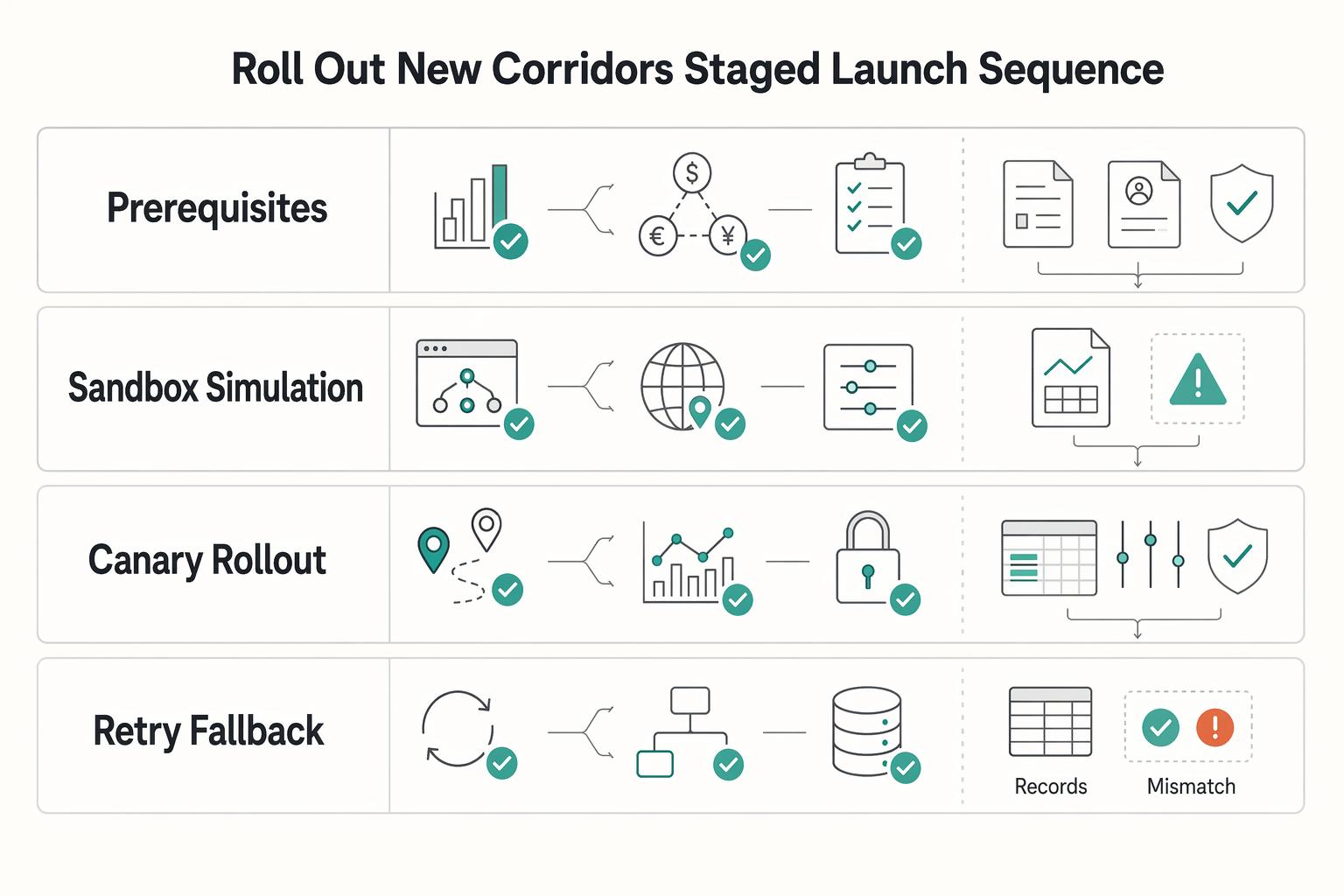
Roll out new corridors with a staged launch sequence#
Launch new corridors in stages, and require each stage to pass clear gates before you widen exposure.
| Stage | When | Checks |
|---|---|---|
| Prerequisites | Before the corridor is marked build-ready | Validate demand, confirm the payment method support matrix, and confirm compliance and tax readiness |
| Sandbox simulation | Before any live traffic | Test quote and payout creation, webhook delivery and retries, reconciliation events, and exception handling; verify event types, payload shape, signature checks, duplicate delivery handling, and ordering assumptions |
| Canary rollout | Internal pilot, then a limited live cohort, then broader release by risk tier | Set go/no-go gates for quote rejection rate, payout success rate, reconciliation lag, and unresolved compliance exceptions |
| Retry and fallback | For multi-PSP or multi-route setups and for each failed payout | Define in-transaction reroute versus later retry, test both behaviors, and record the original route, response code, retry decision, idempotency key, and whether fallback was permitted for that method |
Before marking a corridor build-ready, verify country, currency, recipient type and payout method together. Establish identity, sanctions and provider eligibility requirements for the actual program. Determine applicable withholding and reporting documentation separately; a missing tax certificate can require withholding rather than a release ban.
Step 2 Run end-to-end simulation in sandbox before any live traffic. Use sandbox to test quote and payout creation, webhook delivery and retries, reconciliation events, and exception handling, not just API connectivity. Treat webhook contract testing as a launch gate by verifying event types, payload shape, signature checks, duplicate delivery handling, and ordering assumptions. Include delayed and repeated webhooks in tests, and verify the provider’s retry window (Stripe, for example, automatically retries for up to three days in live mode).
Step 3 Use a canary-style production rollout: internal pilot, then a limited live cohort, then broader release by risk tier. Keep the first live cohort small enough for manual ops review, but real enough to surface corridor-specific failure patterns. Define go/no-go gates in advance for quote rejection rate, payout success rate, reconciliation lag, and unresolved compliance exceptions, and hold expansion if those gates are not met.
Step 4 Make retry and fallback routing explicit and testable. If you run multi-PSP or multi-route setups, define what supports in-transaction reroute versus later retry, and test both behaviors. For each failed payout, record the original route, response code, retry decision, idempotency key, and whether fallback was permitted for that method. If reroute is not explicitly supported and testable for a corridor or method, treat it as single-path and launch with tighter exposure. Resolve the original provider outcome or confirmed cancellation before replacing an attempt on another route; idempotency keys are not shared across providers.
Common failure modes in cross-border FX and how to recover fast#
For an expired unused quote, obtain new terms. For an uncertain execution, investigate the provider outcome. For a compliance exception, apply the actual restriction or withholding treatment rather than assuming every missing artifact freezes funds.
| Failure mode | Action | Evidence |
|---|---|---|
| Expired firm quotes | Block conversion and require explicit re-quote acceptance before proceeding | Quote ID, valid_to_at, server submit time, and re-quote acceptance |
| Async status mismatches | Treat as an investigation state, reconcile by provider reference first, and replay undelivered events chronologically with idempotent handling | Provider payload ID, internal transaction ID, and matched reference |
| Late compliance holds | Apply the actual release restriction or withholding treatment; resolve under the approved policy | The exact missing document attached to the case and rerun policy checks before release |
Check the provider’s actual expiry field and permitted usage before accepting a conversion. If the unused quote has expired, obtain a fresh one and reconfirm material changes where required. Store quote ID, expiry check, execution reference and user or operator approval.
2) Async status mismatches Treat payout status mismatches as an investigation state, not a blind retry signal. Reconcile by provider reference first, then replay undelivered events chronologically with idempotent handling, and return success for already-processed events to stop duplicate retries. Keep the provider payload ID, internal transaction ID, and matched reference in the case file, and plan for Stripe’s automatic retries that can continue for up to three days.
For a verification or documentation exception, record the actual restriction and required recovery step. Missing tax certificates may require withholding, while an active sanctions or provider restriction may prevent release. Collect the correct certificate for the payee and payment scope; do not treat W-8BEN, W-9 and Form 8233 as interchangeable or universal payout blocks.
Related reading: Merchant of Record for Platforms and the Ownership Decisions That Matter.
Conclusion and copy/paste launch checklist#
Before scaling, resolve unclear execution ownership, quote-validity behavior, active release restrictions and withholding treatment. Confirm the event and financial trails support reconciliation.
- Lock the FX ownership and liability map.
Write down who is principal, who is agent, who sets the rate logic, and who absorbs financial risk when a conversion, payout, or settlement step goes wrong. This must cover each PSP, bank, and your own platform services, because role boundaries are contract-specific and a provider can state plainly that it acts as principal and not as your agent or fiduciary. If you run a Merchant of Record structure, confirm which entity actually absorbs transaction risk before you expose a user-facing converted amount. Verification: one signed ownership matrix tied to the live provider contracts, settlement terms, and internal service owners. Red flag: if finance, legal, and engineering give different answers about who owns stale-quote losses or returned funds, stop.
- Enforce quote controls before money moves.
Your production path should reject expired firm quotes, resolve the original conversion outcome before retrying; obtain a fresh quote for a new unexecuted conversion, and log every repricing event with quote ID, acceptance timestamp, and execution reference. Indicative rates can support previews, but final conversion should point to a firm quote and an auditable acceptance event. Silent repricing is the failure mode to avoid, because it turns margin loss into an argument instead of a traceable incident. Verification: finance can trace any executed conversion from internal transaction ID to quote ID, expiry check, provider reference, and any re-quote that happened before payout.
- Apply actual release restrictions and withholding treatment.
Record applicable identity, sanctions and provider decisions before release. Keep VAT invoice treatment and payee withholding/reporting in their proper workflows, using the correct certificate and payment scope. Missing tax documents can change withholding; a release hold should follow an actual restriction or approved policy. Store decision time, masked evidence references and escalation ownership.
- Prove operational readiness with audit trails and retry safety.
The ledger should be immutable and complete enough to reconstruct quote acceptance, conversion, payout attempt, webhook update, and reversal without stitching together guesses from multiple tools. Your reconciliation pack should include provider reference IDs, internal transaction IDs, payout status history, fee attribution, FX spread attribution, and exception logs. Confirm idempotent retries for API calls and async event handling, because some providers can resend undelivered events for up to three days. Verification: run one failed payout and one webhook redelivery test in staging, then confirm no duplicate side effects, no missing journal events, and a named escalation path for unresolved breaks.
Frequently Asked Questions
What does "platforms reshaping Foreign Exchange" actually mean for marketplaces and embedded payments?
It means FX is no longer just a treasury workflow in many platform setups. Your team now decides when rates are shown, when money is converted, how quote risk is handled, and how fees and spread are exposed to users. That matters because newer cross-border platforms compete on speed, fewer fees, and transparency, so FX choices affect both margin and trust.
When should we use indicative rates versus firm FX quotes?
Use indicative rates for estimation, routing, and user previews only. They are non-tradable reference prices, so they should never drive final conversion logic or a guaranteed payout amount. Use a tradable or detailed quote when you are actually converting funds or locking a user-visible amount.
How do we reduce FX slippage in cross-border payments without slowing payouts too much?
Convert as close as possible to the real execution point, not long before it. If payout timing is flexible, show an estimate first and request a firm quote only when the transfer is ready. If the amount is locked at checkout, get the executable quote then and treat expiry as a hard stop. Finance should be able to trace every executed conversion back to a quote ID, acceptance time, and repricing event if one occurred.
What controls prevent stale-quote losses in production systems?
Reject an expired unused quote and check its validity before execution. Obtain a new quote and explicit reapproval when the amount or terms materially change. Record the reason so finance can distinguish market movement from execution errors.
When should we pass FX risk to users versus absorbing it in platform pricing?
There is no universal rule. The choice depends on the promise you make and your product or contract terms. If you advertise or contract around an exact converted amount, many teams treat that as a platform commitment and manage that risk. If users approve a payout at the prevailing rate later in the flow, more risk can be passed through, but only if the rate basis and timing are clearly disclosed.
What should finance teams audit before enabling a new payout corridor?
Audit one full evidence pack before launch, not after the first incident. That pack should include the quote type used, expiry handling, provider reference IDs, internal transaction IDs, fee and FX spread attribution, payout status history, and any exception logs. If a corridor cannot produce that trail on demand, it is not operationally ready.
How should geopolitical volatility change payout policy for USD, CHF, and JPY corridors?
Treat uncertainty as a reason to shorten the gap between quote and execution and to review auto-convert behavior more aggressively. CHF often attracts demand in high uncertainty, JPY can appreciate in risk-off periods, and USD strength can create cross-border spillovers that change corridor economics quickly. In practice, that means more frequent re-quoting, tighter manual review for delayed payouts, and a willingness to pause automatic conversion when repricing starts to repeat.
Try a related tool
Researched and edited by the Gruv editorial team. Gruv builds cross-border billing, payouts, and finance-operations software for global businesses.
Sources
- bis.org/publ/work1094.htmtrusted
- bis.org/publ/qtrpdf/r_qt2212f.htmtrusted
- docs.stripe.com/payments/currencies/localize-prices/fx-quote...trusted
- docs.stripe.com/api/idempotent_requeststrusted
- ecfr.gov/current/title-31/subtitle-B/chapter-X/part-1...trusted
- imf.org/-/media/Files/Research/imf-and-g20/2024/g20-...trusted
- imf.org/-/media/files/publications/gfsr/2025/october...trusted
- irs.gov/forms-pubs/about-form-w-9trusted
Educational content only. Not legal, tax, or financial advice.
Related Posts

FATCA Compliance for Marketplace Platforms: Identifying and Reporting Foreign Account Holders
For marketplace teams handling cross-border payouts, FATCA work is mostly a control-design problem. You need to decide what to implement first, what evidence to keep, and what to escalate before a payout creates avoidable reporting or withholding risk. The practical question is not whether FATCA exists, but which controls actually reduce reporting errors and potential 30% withholding outcomes.
IRS Form 8233: When Foreign Contractors Claim Treaty Exemptions and What Platforms Must Verify
Form 8233 is used by nonresident alien individuals to claim exemption from withholding on compensation for personal services, but for platform operators the key exposure is often operational: scope decisions, review quality, recordkeeping, and escalation. When you pay nonresident individuals for U.S.-source personal services income, the real risk is often not whether a form exists, but whether your team can show why a claim was accepted.
EDI for Platforms Automating Invoice Exchange With Large Buyers
If your platform needs to invoice enterprise buyers through EDI, the real decision is operational: which delivery model will let you exchange the required document set with the fewest surprises in production. Electronic Data Interchange (EDI) is a standards-based way to transmit business documents such as invoices and purchase orders between organizations, and it is primarily used in B2B exchange.