
Quick Answer
Choose the model by scope certainty: use time-based billing for moving requirements, use project-based billing for defined deliverables, and use a hybrid when discovery is unclear but execution can be fixed later. In time-based vs project-based billing pricing, the most reliable rule is evidence readiness, not preference. If your team can prove hours and cap tracking, hourly is defensible; if your team can prove acceptance against scope, fixed fees are cleaner. Add a do-not-exceed limit early when you need control without premature fixed pricing.
How Time-Based and Project-Based Billing Work in Practice#
For finance and ops teams, the real question in time-based vs project-based pricing is not which model looks better in a spreadsheet. It's which model better matches scope certainty and cost expectations. If your scope is uncertain, lean toward time-based billing. If the work is defined and repeatable, project-based billing usually gives clients clearer costs and deliverables upfront.
The two models diverge at the contract level long before they become invoice lines. A time and materials contract prices labor time and materials, with the final cost determined after work is completed. A project-based or fixed-price contract sets one project price, or milestone-based fees, tied to defined deliverables. That distinction matters because it determines what your team has to prove later: hours worked, or completion against an agreed scope.
The practical tradeoff is simple. Fixed pricing works best when scope and likely expenses are well understood early. Time-based billing fits work with less upfront certainty, especially when discovery changes the shape of delivery. Matching the model to the scope early matters because the effects go beyond budget mechanics.
In practice, that makes the decision as much about evidence fit as pricing fit. Before you choose, check whether your team can reliably produce the records the model requires: tracked time and materials, or completion against defined deliverables and scope.
One control deserves early attention: the not-to-exceed clause. In time-based billing, a not-to-exceed limit can set a maximum amount for client spend without forcing a fully fixed fee too early.
So this guide stays grounded in operational reality, not pricing theory. We will look at what each model changes in contracts and cost clarity. Then we will narrow it to a working rule you can use: uncertain scope favors time and materials, while stable scope favors fixed pricing.
Time-based billing vs project-based billing at a glance#
If you need a default: use billable hours when scope is still moving, use fixed pricing when scope is clearly defined, and use a hybrid when discovery is uncertain but execution can be fixed after discovery.
| Decision factor | Time-based billing | Project-based billing | Hybrid model (hourly discovery + fixed execution + change requests) |
|---|---|---|---|
| Scope volatility | Strong fit when requirements are changing or details are fuzzy. | Better fit when scope is stable enough to define upfront. | Use when uncertainty is concentrated early, then reduced after discovery. |
| Forecasting confidence | Lower upfront cost certainty because final cost depends on hours worked. | Higher upfront cost certainty because one fixed project fee is agreed. | Moderate at the start, then higher after discovery is completed and approved. |
| Margin sensitivity | Revenue tracks logged time; faster delivery can reduce billed total. In the cited example, 100 hours at $100/hour gives a $10,000 do-not-exceed, while finishing in 80 hours yields $8,000. | Margin depends on estimation quality and scope control. One source notes fixed pricing can produce better profits. | Splits risk: hourly for unknowns first, then fixed pricing once scope is written. |
| Utilization rate | Time capture is directly tied to billing support. | Capacity still matters operationally, but the invoice is tied to the agreed fee. | Discovery depends on time capture; execution depends on scope discipline. |
| Change-handling overhead | Scope can adjust without fully repricing the whole project each time. | Scope changes generally need explicit change requests to protect the fixed fee. | Keep discovery flexible, then govern execution changes through change requests. |
| Reconciliation effort | No cited source shows an inherent reconciliation advantage by model. | No cited source shows an inherent reconciliation advantage by model. | No cited source shows an inherent reconciliation advantage by model. |
| Operational risk (duplicate events, delayed updates, webhooks, idempotency) | No cited pricing source provides model-specific evidence on these controls. | No cited pricing source provides model-specific evidence on these controls. | No cited pricing source provides model-specific evidence on these controls. |
Before you commit to fixed pricing, confirm three basics in writing: scope baseline, acceptance criteria, and a change-request path. If those are weak, the fee is not truly fixed in practice.
For hybrid deals, a do-not-exceed limit can set a ceiling during discovery without forcing a full fixed fee too early. Watch the escalation trigger as you approach that cap.
Default rule: high uncertainty favors billable hours; stable, repeatable delivery favors fixed pricing. If work starts fuzzy and becomes clear after paid discovery, hybrid is often the cleanest path. For a related model, see A Guide to Usage-Based Pricing for SaaS.
What each model actually changes in your finance operations#
In practice, this choice changes what finance must validate to release and defend an invoice. Time-based billing is paid for time worked, so support centers on time records. Project-based billing is an approved total cost tied to defined work, so support centers on scope and acceptance. Evaluate model fit by payment reliability and exception handling, not margin alone.
| Finance touchpoint | Time-based billing | Project-based billing |
|---|---|---|
| Contract anchor | Hourly rate, estimated hours, and any do-not-exceed budget expectation. | Approved total cost for the project, with scope and acceptance defined up front. |
| Statement detail | Entries must make billed time understandable and approvable. | Entries must show what part of the agreed project fee is being billed. |
| Ledger journals | Postings should trace back to the same approved evidence used for billing (time support). | Postings should trace back to the same approved evidence used for billing (scope/acceptance support). |
| Reconciliation pack | Build the pack around approved time support and any cap tracking. | Build the pack around approved contract terms, scope/acceptance evidence, and change documentation. |
A do-not-exceed limit can reduce billing surprise in hourly work because estimate and rate create a practical ceiling. Using the common example, $100/hour x 100 hours = $10,000, and finishing in 80 hours yields $8,000. Keep an escalation point before the cap so teams do not carry unapproved work while trying to finish.
Use this as your decision test: which model gives your team cleaner approvals, clearer audit support, and more reliable settlement when a payment is questioned? If scope is still moving, time-based billing is usually the more defensible path. If scope is well defined and controlled, project-based billing can be easier to forecast and support. For a related example, see How to Price a Clinical Trial Data Analysis Project.
Hidden costs competitors skip when they say one model earns more#
When someone says one model earns more, the real test is where exception work lands after delivery. Time-based billing often hides administrative overhead and approval friction, while project-based billing often hides unpriced rework and late change pressure.
| Hidden cost bucket | Time-based billing | Project-based billing |
|---|---|---|
| Non-billable coordination | Teams spend extra time defending hours, task codes, and authorization history. | Teams spend extra time clarifying scope, revision limits, and whether a request belongs in the fixed fee or a change request. |
| Review loops | Disputes trigger re-checks of time entries, descriptions, and approver records. | Disputes trigger re-checks of acceptance criteria, revision counts, and deliverable status. |
| Escalation handling | Escalations usually center on budget surprise, trust in billable hours, and work continuing near a do-not-exceed limit. | Escalations usually center on scope creep, late requests, and whether extra work changes price, timeline, or both. |
| Manual Reconciliation fixes | Billing stays clean only if approved time entries, invoice lines, and ledger support match; gaps create manual cleanup. | Billing stays clean only if signed fee, accepted milestone, and approved change records align; missing change evidence creates similar cleanup. |
Use a simple stress test: when the plan breaks, who absorbs the hidden labor? In time-based work, scope creep can expand timesheets and create non-billable back-and-forth to justify the extra effort. If added work was clearly authorized, the client usually absorbs more cost through added hours; if authorization is unclear, your team often absorbs hours or more defense effort.
Project-based billing flips that pressure point. If acceptance criteria are weak or revision limits are unclear, late change requests can arrive as "small tweaks," and margin leakage follows. In practice, the vendor often absorbs that cost unless a written change request resets fee, timing, or both. Before work starts, confirm the contract package includes a scope baseline, acceptance criteria, revision limits, and a named approval path for changes.
Also watch for false profitability. Booked revenue can look strong while cash discipline weakens if settlements, payout status, or invoice clearing lag behind delivery. At month end, tie billed amounts not only to contracts or timesheets, but also to current settlement status and open reconciliation breaks. If revenue rises while manual fixes and unpaid exceptions rise too, the model is booking more, not necessarily earning more.
If your scope is uncertain choose this model and control it this way#
If scope or duration is uncertain, choose time-based billing first, then move to project-based pricing when deliverables and timelines are clearly defined. Time-based models are typically better when work is evolving; fixed pricing improves cost certainty but reduces flexibility.
| Project condition | Time-based billing | Project-based billing |
|---|---|---|
| Requirements are still changing | Better fit because you bill for actual time as scope evolves | Higher risk of locking in assumptions too early |
| Duration is hard to estimate | Better fit when total effort is still unclear | More likely to require early price guesses |
| Deliverables and timeline are already clear | Possible, but often not necessary | Usually the cleaner commercial choice |
Control this model with transparency: track the exact time spent, explain variable costs clearly, and communicate progress regularly. That keeps hourly billing flexible without making costs feel unclear. As soon as scope becomes stable and outcomes are well defined, project-based pricing is usually easier to manage.
If your scope is stable choose this model and protect margin#
If scope is stable, use project-based billing with a fixed-price contract and strict written change-order control. This model is a strong fit for budget control and price transparency when requirements are clear and the scope is well defined.
| Milestone | Payment |
|---|---|
| Deposit | 50% deposit |
| Midpoint | 25% at midpoint |
| Deliverable completion | 25% on deliverable completion (not launch) |
Fixed pricing protects the agreed cost, but your margin is exposed if actual time, staffing, or delivery cost rises. Before locking price, make sure the statement of work clearly defines deliverables, acceptance criteria, and what is out of scope. If new work appears, treat it as a change order with written approval before work begins.
Set contract guardrails early so small revisions do not turn into unpaid work:
- Define how revisions are handled.
- Define how acceptance is handled.
- Define what happens when feedback requests out-of-scope work.
Use milestone-based payments instead of a single final invoice. A practical structure is 50% upfront, 25% at midpoint, and 25% on deliverable completion rather than launch.
Build a hybrid contract that finance and product can both run#
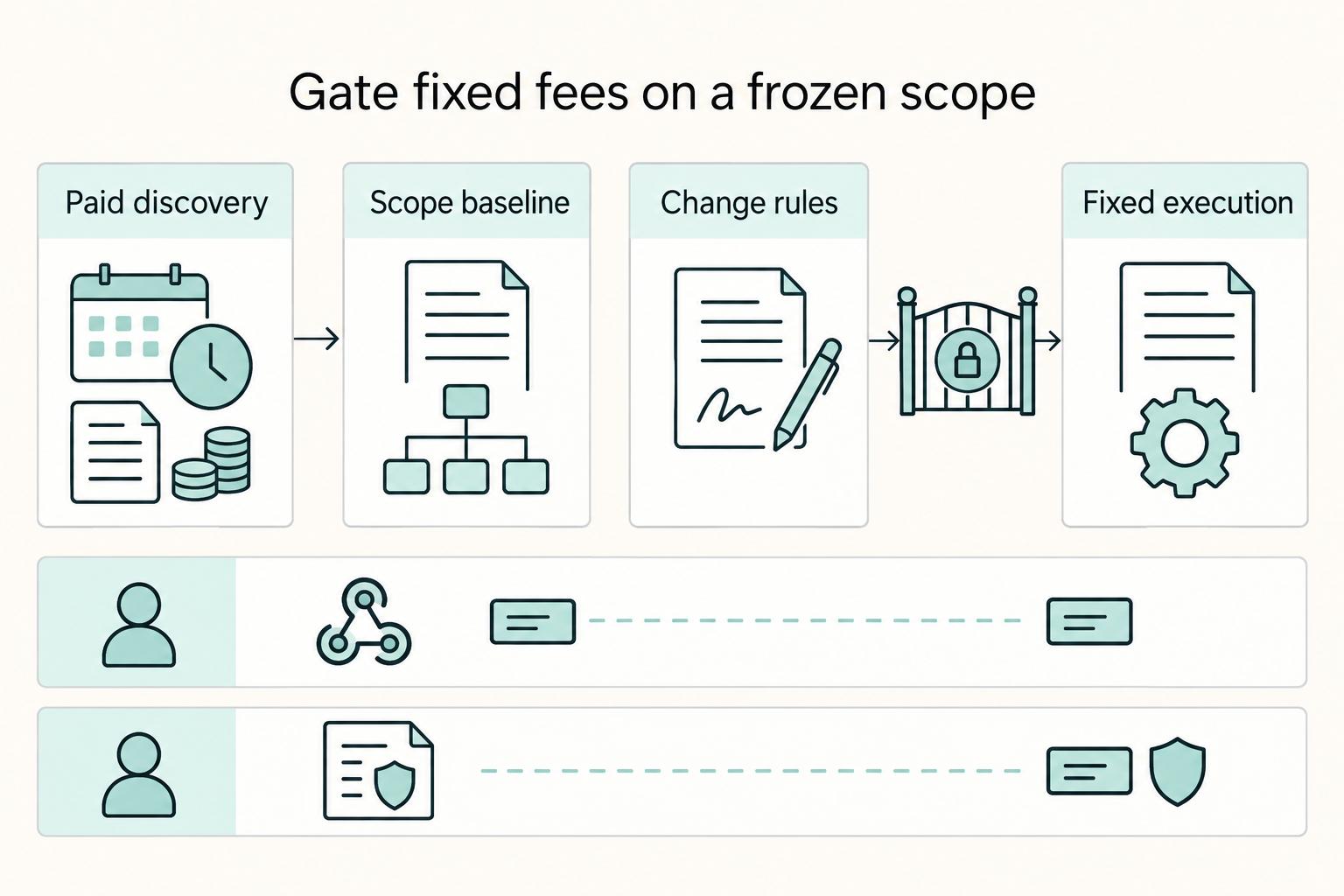
Use a two-phase contract when early scope is uncertain: run discovery on billable hours, then move execution to fixed pricing only after a documented requirements freeze. This keeps discovery flexible while avoiding open-ended cost uncertainty in delivery, and it gives the client clearer cost and timing once scope is stable.
| Contract stage | Commercial model | Required checkpoint | Risk if skipped |
|---|---|---|---|
| Discovery | Billable hours | Goals, time window, and decision owners are explicit | Discovery drifts and final cost stays unclear |
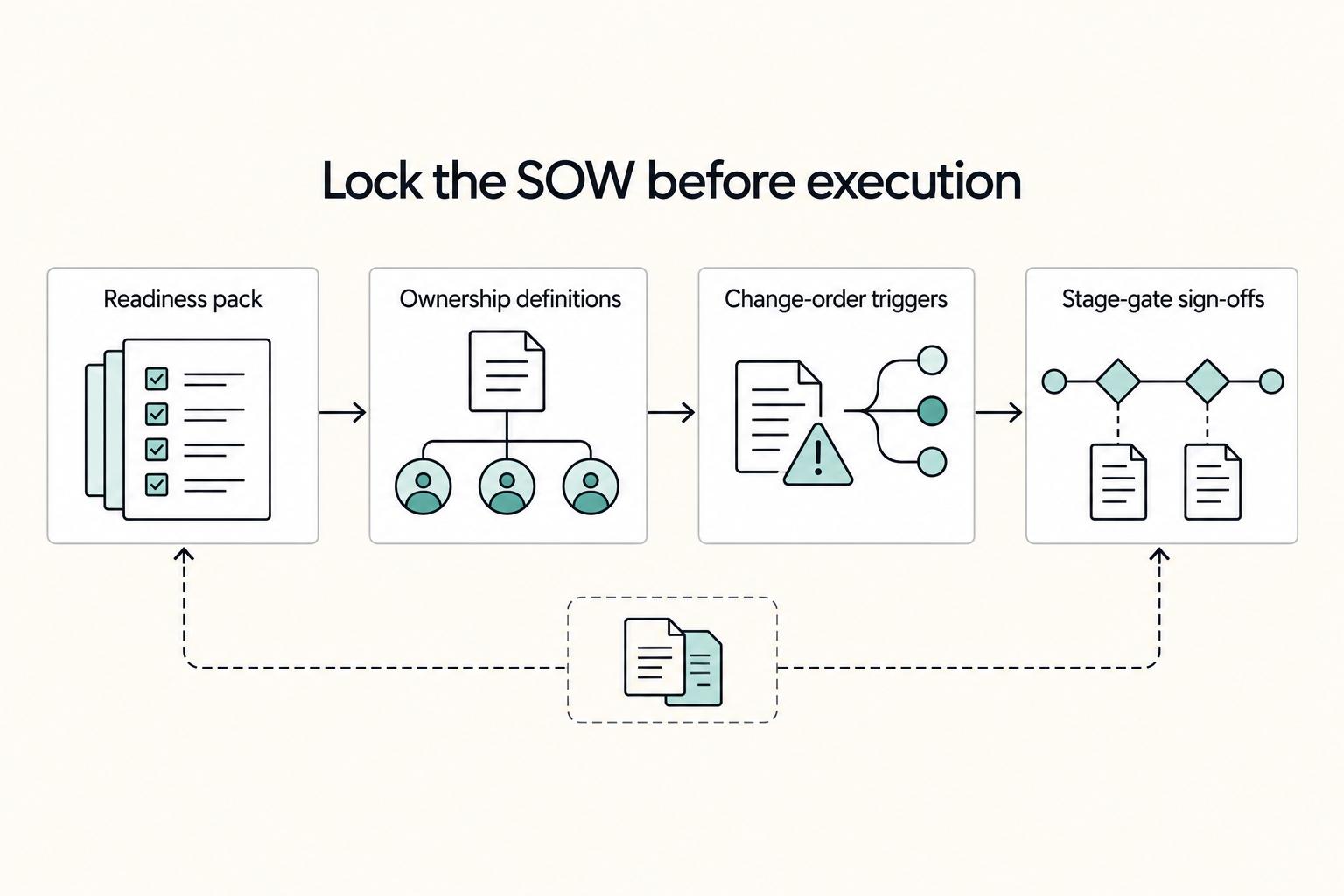
| Phase gate | Approval checkpoint | Approved scope baseline, risk register, signed change-request and exception-routing rules | Fixed pricing starts before scope is actually stable |
| Execution | Fixed pricing | Deliverables, milestones, and acceptance terms match the approved baseline | Unpriced changes and approval friction |
The phase gate is the control point. Before fixed-fee execution starts, require:
- Approved scope baseline
- Live risk register with owners
- Signed rulebook for change requests and exception routing
For platform operations, add controls for status-driven billing and release flows. If Webhooks drive milestone, invoice, or payout status, define the authoritative status, replay-safe (Idempotency) handling expectations, and clear ownership for missing, delayed, or duplicate events.
Where release decisions require compliance checks, keep a separate lane for KYC and related AML/CFT and sanctions-screening obligations under your policy. In cross-border work, route pending or disputed verification through the named exception path rather than ad hoc approvals.
Implementation checklist for cleaner ledgers and fewer payout surprises#
Cleaner ledgers come from rolling out controls in sequence: policy and documents first, then event logic and dashboards. If you start with tooling, you often automate ambiguity and create more exceptions.
| Rollout step | What it must define | What to verify before moving on |
|---|---|---|
| Pricing policy | When you use hourly, fixed, or hybrid terms; who can approve exceptions; how estimate changes are handled | The policy can be applied to real deals without side emails or verbal exceptions |
| Contract templates | Commercial terms, scope references, change-order path, and any hold conditions for billing or payout | Template language matches the approved pricing policy and uses the same terms for status, scope, and approvals |
| Approval matrix | Named owners, backup approvers, and escalation paths for commercial, delivery, finance, and compliance decisions | Roles and responsibilities are explicit, and exception routing is documented under program governance |
| Event schema | Which status changes are informational, which are commercially binding, and which record is authoritative | Billing, milestone, and payout logic all point to the same status definitions |
| Monitoring dashboards | Operating signals that show drift, delays, and exceptions early | Every dashboard metric has a named owner and an auditable source record |
Use dashboards as control signals, not vanity charts. Track estimate variance, utilization rate, change-order cycle time, exception volume, and month-end reconciliation time together so one strong metric does not hide broader process drift.
Before broad rollout, run one closed-project test from proposal through agreement, payment, and reconciliation. The goal is to confirm your workflow actually connects those steps and reduces manual re-entry and admin handling.
For global programs, set a clear internal rule for when W-8, W-9, 1099, and VAT validation (where applicable) are collected and verified, then apply it consistently across onboarding, contracting, payment, and reporting. A practical check before payment or reporting is to confirm the legal entity on the tax form, the counterparty in the ledger, and the party in the contract match.
If you run payouts at scale, tie release logic to documented status transitions and maintain auditable payout batches. You should be able to trace each batch to the approval that released it, the payouts included, and any holds, retries, or reversals.
Treat implementation as a controls sequence, not a dashboard project. For a step-by-step walkthrough, see How to Use Performance-Based Pricing for Your Freelance Services.
Choose the model that survives real operations#
In time-based vs project-based billing, the better model is the one that preserves margin after approval delays, exceptions, and settlement lag, not the one that looks best in a pricing sheet. If it breaks down in your ledger and reconciliation workflow, it is the wrong model for your current operating conditions.
| Operating condition | Model | Controls |
|---|---|---|
| Volatile scope | Controlled time-based billing | Approved time entries, do-not-exceed guardrails, weekly effort checks, and written escalation before work goes past the cap |
| Repeatable delivery | Project-based billing | A clear scope baseline, acceptance criteria, revision limits, and a defined change-request path; milestone completion, acceptance, invoice release, and ledger posting should all map to the same commercial event |
| Mixed environments | Governed hybrid | Time-based discovery, then fixed execution after scope is frozen and approved; approved scope baseline, tagged extra work, approval trail, and links from contract terms to billing records and ledger entries |
For volatile scope, start with controlled time-based billing. When requirements are still moving, charging for actual effort is often cleaner than locking a fixed price too early. Keep strict controls in place: approved time entries, do-not-exceed guardrails, weekly effort checks, and written escalation before work goes past the cap.
For repeatable delivery, project-based billing is easier to standardize when scope is stable. Use a clear scope baseline, acceptance criteria, revision limits, and a defined change-request path. Operationally, milestone completion, acceptance, invoice release, and ledger posting should all map to the same commercial event.
For mixed environments, use a governed hybrid: time-based discovery, then fixed execution after scope is frozen and approved. Make the handoff explicit with an evidence pack: approved scope baseline, tagged extra work, approval trail, and links from contract terms to billing records and ledger entries.
Use one quarter to prove the choice#
Run one quarter with explicit checkpoints, then reprice based on evidence:
| Checkpoint | What to review |
|---|---|
| Ledger accuracy | Sample invoices and confirm contract terms, billed amounts, cash receipts, and accounting entries align. Reconcile contracts, billing, cash, and accounting. |
| Reconciliation effort | Track month-end manual cleanup by model, especially around disputed hours, milestone status, and partial settlements. |
| Change-order behavior | Track late change requests, approval cycle time, and how often unapproved work appears on invoices. |
If hourly work shows rising exceptions and slow approvals, tighten controls or move repeatable work into fixed pricing. If fixed-fee work shows estimate variance and undocumented extras, move uncertain phases back to time-based billing until scope is stable enough to price cleanly.
Related reading: Value-Based Pricing for Strategic Consultants Under Real Payment Risk.
Frequently Asked Questions
Does time-based billing always reduce profitability as teams get faster?
No. Hourly pricing charges based on the time required to complete the job, so faster delivery can reduce billable volume. The real check is whether your effective rate stays healthy and whether time tracking is precise enough to avoid invoice disputes.
When does project-based billing become riskier than hourly pricing?
It gets riskier when scope is not stable enough to define clearly before work starts. Project billing depends on agreeing on scope, price, and a payment plan upfront, and fixed-price work usually needs detailed functional documentation before delivery begins. If requirements are still moving, underestimation, scope creep, cash flow gaps, and admin overhead can wipe out the margin you thought you locked in.
Can we combine billable hours and fixed pricing in one contract without confusing clients?
Yes, if the boundary is explicit. For any project or fixed-price portion, agree on scope, price, and payment plan upfront, and keep hourly tracking precise so billing does not drift into disputes.
Which KPI set should finance track first for each model?
Start with measurable indicators (defined metrics) that show whether pricing is working against business goals, not a long dashboard. For hourly work, include a metric for tracking quality and invoice-dispute frequency, since weak time tracking can trigger disputes. For fixed or project work, include metrics that surface underestimation, scope creep, and cash flow gaps against the payment plan.
How do do-not-exceed limit terms affect client trust and delivery quality?
Confirm the specific impact of do-not-exceed clauses on client trust and delivery quality with a qualified adviser or your contract attorney.
What controls prevent scope creep from eroding margin in fixed-fee work?
Use detailed functional documentation before work starts, then keep scope, price, and payment terms explicit. Some fixed-fee vendors add contingency in estimates (for example, a 30% buffer), but that is not universal and does not replace scope control. Track underestimation, scope creep, cash flow gaps, and admin overhead throughout delivery because those risks can erode margin.
How do Webhooks and Idempotency affect billing accuracy in high-volume operations?
Confirm how webhook and idempotency controls affect billing accuracy in your platform with the relevant payment provider or technical documentation.
Try a related tool
Researched and edited by the Gruv editorial team. Gruv builds cross-border billing, payouts, and finance-operations software for global businesses.
Sources
Includes 3 external sources outside the trusted-domain allowlist.
- federalregister.gov/documents/2023/08/15/2023-17078/additional-g...trusted
- iar.iga.in.gov/latestArticle/50/26trusted
- irs.gov/irm/part2/irm_02-005-004trusted
- leg.colorado.gov/initiative_files/3308/downloadtrusted
- statmodeling.stat.columbia.edu/2020/05/08/so-the-real-scandal-is-why-did-an...trusted
- iteratorshq.com/blog/time-and-materials-vs-fixed-fee-choosin...external
- netsuite.com/portal/resource/articles/accounting/fixed-pr...external
- spp.co/blog/project-based-pricingexternal
Educational content only. Not legal, tax, or financial advice.
Related Posts

SaaS Usage-Based Pricing for Predictable Cashflow and Fewer Disputes
If you are considering **saas usage-based pricing**, treat it as an operations and collections decision first. Pricing works best when the usage unit can be measured, shown on the invoice, and explained by someone outside your product team.
How to Price a Clinical Trial Data Analysis Project
If you choose on fee alone, you are optimizing the smallest visible number, not the full cost of the decision. A better test is simple: **risk adjusted cost = expected project fee + probable rework cost + operational delay impact + the cost of switching vendors midstream**.

Usage-Based Billing for B2B SaaS Platforms That Teams Can Operate
Usage-based billing works best when customer value rises with measurable consumption rather than with a fixed license. It can improve pricing fit, but only if pricing logic, billing data, and finance controls are designed together from the start.