

Quick Answer
Estimate conservative buyer benefit and your delivery floor, then agree a specific fee and scope. A value-based fee can be fixed; only an expressly performance-linked component depends on a later result. Define billing triggers, review periods, change approval and payment dates so delivery evidence reaches the person who pays.
Price the client’s value and define when payment is due#
Value-based consulting fees reflect what solving a problem is worth to the buyer. The fee can still be fixed and paid in advance or by delivery milestones. Separate that pricing decision from a performance-linked bonus: a value-based fee does not automatically make payment conditional on the client achieving a future business result.
Before quoting, establish the problem, a credible value estimate, your delivery cost and the people who approve scope and payment. For a results-dependent component, also agree the baseline, measurement period, data source and attribution rules. When benefits are qualitative, a defined strategy phase can still carry a fixed value-based fee if the buyer understands its value and the deliverables.
Decision controls that prevent fee leakage#
| Control | Trigger | Owner | Evidence artifact |
|---|---|---|---|
| Pricing band | Client asks for one fixed fee before assumptions are stable | You | Proposal showing fee range, assumptions, exclusions, and what would move price up or down |
| Written change authorization | New deliverable, extra stakeholder group, or shifted timeline appears | Client approver and you | Email, signed addendum, or approved change note with revised fee and date |
| Proof-based invoicing | Milestone is claimed complete | You, then client approver or project lead | Acceptance checklist, delivered file links, meeting notes, or before/after snapshot tied to the milestone |
| Fallback floor | Client pushes fee below justified range or value case is weak | You | Floor calculation from your base rate and minimum viable scope |
Keep the proposal’s assumptions and expiry date with the approval record. If approval is delayed, recheck timing and availability before renewing the quote. For extra scope, agree the change before doing that work while continuing unaffected contractual duties. Follow overdue invoices on the agreed dates with delivery evidence, the billing contact and a recorded next action. A good proof file supports a claim; it does not guarantee collection.
Run this sequence before proposal send#
- Set your floor first using your base economics. If you need to calculate that floor, do it before pricing the upside with How to Calculate Your Billable Rate as a Freelancer.
- Use a fee range during discovery, then agree the chosen option and exact fee before signature. Record what changes the price.
- Name the client-side approver for scope and for invoices. If those are different people, note both.
- Define each billing trigger separately: signature or an advance, a delivered or accepted milestone, a recurring date, or a measured performance result. Attach the evidence appropriate to that trigger.
Carry the chosen fee, scope and billing triggers from the proposal into the SOW. For a broader introduction, see Value-Based Pricing for Freelancers Under Real Payment Risk.
What does value-based pricing mean in real operations?#
In practice, value-based pricing means you set the fee from buyer value and willingness to pay, then back it with proof that can survive approvals and invoicing.
| Input | What to confirm |
|---|---|
| Willingness to Pay | What result the client is willing to fund for this specific offering, and who approves that spend |
| ROI | Whether the fee still looks reasonable under a conservative outcome, not just a best case |
| Baseline Conditions | The starting state you will compare against later |
| Success Metrics | The evidence the client will accept as "worked" |
In proposal conversations, use a simple split: value-based pricing starts with the result the client will fund, while cost-plus starts with your delivery cost and margin. Both can work, but they drive different quote-to-cash behavior.
| Lens | Value-based pricing | Cost-plus pricing | Operational consequence |
|---|---|---|---|
| Price anchor | Customer-perceived value and willingness to pay | Your cost plus margin | You defend business impact vs. effort math |
| Scoping behavior | Define outcome, exclusions, Baseline Conditions, and Success Metrics before quoting | Define tasks, time, and resources before quoting | Value pricing forces earlier alignment on what success is |
| Approval flow | Stakeholders align on value and how it will be verified | Stakeholders align on budget and estimate | Value pricing can slow when value is unclear; cost-plus can move faster on estimate approval |
| Payment proof | Milestone evidence tied to agreed results | Evidence of time, activity, or deliverables | Mismatch between price logic and proof increases approval friction |
The agreed billing basis determines what evidence is needed. Pricing from value does not, by itself, require withholding an invoice until business impact is measured.
If the value case is too weak for the buyer to assess, sell a bounded diagnostic phase first. If value is credible but attribution is uncertain, keep the fee fixed for agreed deliverables and avoid making it contingent on a result you cannot isolate.
Use this pre-pricing checklist:
- Outcome statement: one sentence on the business result being funded.
- Pricing band rationale: why your fee range fits value, uncertainty, and execution risk.
- Milestone proof requirements: which artifact unlocks each invoice.
- Baseline record: the agreed before-state.
A fixed project fee can be value-based when the buyer’s expected benefit informs its amount. The problem is promising a business result while defining only activities, or leaving payment contingent on a metric nobody can verify. For another service context, see Value-Based Pricing for Creative Services.
Which pricing model fits this client right now?#
Pick the model you can measure, defend, and collect now, not the one with the highest upside on paper.
Run this pre-proposal flow in order:
- Measurement clarity: Can you define a baseline and success conditions precisely?
- Delivery context: Is this discovery, a bounded phase, or ongoing support?
- Buyer quality and collections behavior: Is there a clear approver, consistent approval behavior, and reliable payment behavior?
- Evidence strength: Can you prove outcome claims with data or testimonials?
If any answer is weak, start with a simpler model and earn the right to upgrade later.
| Model | Use it when | Payment-risk signals | Lock before kickoff |
|---|---|---|---|
| Hourly | Scope is changing, or discovery is the real output | Unclear approver, shifting requests, inconsistent approvals | Time boundaries, approval path, written overage approval |
| Project fee | Deliverables and exclusions are clear for a defined phase | Client wants one number but avoids scope accountability | Fixed scope, acceptance checkpoints, written change-order rule |
| Fixed value-based fee | The buyer’s expected benefit is credible and the engagement boundaries are clear. | Buyer agrees on value but leaves acceptance or invoicing authority unresolved. | Exact fee, defined outputs, review process and billing dates; outcome measurement can inform evaluation without controlling the fixed payment. |
| Performance-linked | Outcomes are measurable, attribution is workable, and trust is strong | Attribution disputes, weak data access, delayed approvals | Bonus formula, baseline, period, data access, attribution, cap/floor, calculation review and payment date. |
Use a diagnostic phase when missing information makes the engagement hard to price. Move directly to a bounded fixed fee when scope and buyer value are clear; there is no mandatory progression from hourly to project to value-based pricing. Add a performance-linked component only when both parties can administer its calculation.
The Consulting Success guide reports a sample split of 37% project, 26% value-based, 21% hourly, 13% monthly retainer and 3% performance-based fees. Its guide does not provide enough sampling detail here to treat those figures as market-wide prevalence or evidence that one model collects better.
Review payment and approval behavior before taking on another phase. When a client misses a date, request the reason, identify the responsible person and use the agreed escalation or notice process. A change of model or suspension requires the contract process; it is not an automatic right triggered by an internal checkpoint.
Choose now:
- If discovery and scope are uncertain, quote hourly with a cap or a bounded diagnostic phase.
- If deliverables are clear, use a fixed project fee; its amount may be informed by buyer value even where future impact cannot be isolated.
- If attribution and measurement are reliable, consider a separately defined performance component, while retaining an affordable base fee.
Record the selected model in the proposal so delivery and finance use the same basis for billing.
How do you calculate a value-based consulting fee without guessing?#
Estimate value and your delivery floor separately, then test a proposed fee against both. A percentage of value can be a negotiation aid, but there is no universal share you are entitled to charge. Agree a specific option and price; an open fee band is not a signed billing amount.
Use this sequence on your next proposal:
| Pricing step | Inputs you gather | Output you produce |
|---|---|---|
| Lock the baseline | Current-state evidence, the metric owner, and explicit success conditions | A baseline record: where the client is now, which metric you will track, and what counts as success |
| Build scenario assumptions | Low/expected/high cases using quantifiable value, annual impact, and material intangibles | A scenario sheet showing the value range and which assumptions need client signoff |
| Set the fee band | Your fallback floor (from hourly/project math), client-stated value from discovery, and the proof burden for upside claims | A conservative-to-strong fee band, often as 2-3 pricing options, with rationale for each option |
| Map invoices to proof | Milestones, acceptance criteria, success metrics, and proof artifacts agreed before work starts | An invoice plan where each fee component has a matching checkpoint and approval trigger |
Run two practical checks before you present pricing. For willingness to pay, ask what the problem is costing, what solving it is worth, and who approves spend. For ROI, test whether client-supplied assumptions, for example savings, lift, or retention effects, still make the fee credible to the approver after uncertainty is considered.
Illustrative example: the client expects a process change to save $120,000 over the next year. After discounting benefits you cannot reasonably attribute and subtracting $20,000 of implementation cost, use $60,000 as the conservative benefit before your fee. Your delivery floor is $8,000. A $12,000 fixed consulting fee leaves an estimated $48,000 net benefit and a fee-based ROI of ($60,000 − $12,000) ÷ $12,000 = 400%. This is a forecast, not a guarantee; do not count the same saved hours and eliminated salary cost twice.
Test the downside too: if the conservative benefit falls to $15,000, the same fee leaves $3,000 and a fee-based ROI of 25%. If that does not justify the buyer’s risk, reduce scope or decline rather than dropping below your $8,000 delivery floor. Offer two or three options with different outputs or support, not an unexplained price range. Use billable-rate economics for the floor and the hourly versus value-based comparison for model choice.
Connect the SOW to billing and collection#
Your pricing only works if contract controls and invoice controls are connected before kickoff. If scope, approvals, and billing live in separate tools or threads, you add friction and increase payment delays.
Set one operating rule: define who approves, what proves completion, and which invoice depends on that proof. Contract systems can simplify workflow, but they do not fully solve billing and collection by themselves, and partial tool coverage usually creates manual follow-up.
| Control | Confirm before kickoff | Owner | Trigger event | Required approval artifact | Invoice dependency |
|---|---|---|---|---|---|
| SOW | Scope, deliverables, timeline, fee structure, and acceptance criteria are clearly stated | You + client buyer | Contract execution | Executed SOW or another recorded approval both sides accept | Bill the approved fee on the agreed trigger, including a signature-stage advance where specified. |
| Change order | Written process exists for scope, timeline, assumption, metric, or fee changes | You draft, client approver confirms | Any requested change to agreed work | Recorded change approval (format agreed in advance) | Update only affected scope, fee and billing terms; do not retrospectively change an invoice already due without agreement. |
| Acceptance criteria + milestone invoicing | Each milestone has a completion test and named proof artifact | Delivery owner + client approver | Milestone completion | Agreed evidence, for example delivered asset, dashboard export, or written signoff | Send the milestone invoice on the agreed delivery or acceptance event; measure future impact separately unless the fee is explicitly contingent. |
| NDA + DPA | Match confidentiality and data terms to actual roles and applicable law. | Legal/privacy owner when available, otherwise deal owner | Data access starts | Agreed confidentiality terms; a processor agreement where the work and applicable law require one. | Resolve required data-access terms before that access begins; missing paperwork does not automatically cancel an otherwise due invoice. |
For a new deliverable, record the request, effect on price and timing, acceptance test and authorized approval before starting the extra work. Covered defect corrections remain within the original obligation. Continue unaffected work unless an agreed notice, suspension or termination provision applies.
Before you send, run a contract-to-invoice validation pass:
- Confirm the named approver has authority for both scope and invoices.
- Confirm the acceptance evidence format for each milestone.
- Confirm the agreement's dispute path matches how issues will be raised and resolved.
- Confirm payment timing is explicit in proposal and invoice terms.
- Complete the actual governing law, dispute forum and notice method before signature; unresolved legal questions stay on the review list, not as placeholders in an executed SOW.
For the $12,000 example, an illustrative schedule is $4,000 due on signature, $4,000 on delivery of the agreed analysis and $4,000 on acceptance of the final recommendations. The payments total $12,000; the advance is part of that total. Define the client’s review period, permitted rejection grounds and response to late feedback. Acceptance of the recommendations is not a promise that the client will implement them or realize $60,000 of benefit.
This pairs well with A Guide to Value Pricing for Accounting and Bookkeeping Services.
How do you reduce cross-border payment risk before kickoff?#
Reduce cross-border payment risk before signature by locking four controls in order: dispute path, payment-route feasibility, evidence standards, and milestone-to-proof mapping. Treat this as collection-risk design, not paperwork.
| Owner | Pre-kickoff actions |
|---|---|
| Contract owner | Complete SOW placeholders, confirm the named approver can accept scope and invoices, and remove generic notice/documentation language |
| Finance or reconciliation owner | Verify the planned payment route is available for this client setup, confirm how each payment maps to a milestone, and flag limits with "where supported" or "when enabled" |
| Delivery owner | Define acceptance proof for every milestone, confirm who provides it, and pause changed milestone work until SOW and invoice terms are updated |
Complete the agreement’s actual law, forum or arbitration details, notice address and method, and the documents each party supplies. A compact SOW may refer to master terms rather than repeat them. For cross-border collection, check where the buyer has assets and whether the chosen dispute route is practical; specifying a forum alone does not guarantee enforcement.
| Control area | What you verify now | What to write into contract/SOW | Failure mode if skipped |
|---|---|---|---|
| Dispute path | Who handles disputes, where they are handled, and how notice is sent | Actual governing law, chosen court or arbitration seat/rules, notice method and addresses, and required records. | Disputes start with process arguments instead of invoice facts |
| Payment-route feasibility | Whether the planned payment method supports this client setup and milestone pattern | Available payment method, invoice currency, due date, responsibility for fees and FX, and how shortfalls or required withholding are documented. | You promise a route or timing your stack cannot support |
| Evidence standards | What counts as completion, review, and acceptance | Named proof artifacts, for example: written signoff, delivered file, dashboard export, approval email | Value-based pricing becomes hard to enforce because success is vague |
| Milestone-to-proof mapping | The exact acceptance event that unlocks each invoice | Milestone, owner, acceptance test, proof artifact, invoice dependency | Tranche billing stalls because work is "done" but not provably accepted |
Weak success definitions are especially costly when fees depend on measured performance. For a fixed value-based fee, define the deliverables and acceptance test instead of making every invoice wait for eventual commercial impact. For a contingent portion, agree how client implementation delays, outside factors and missing data affect the calculation.
Check billing details as well as payment feasibility: legal buyer name, purchase-order requirements, tax treatment, invoice recipient and approval route. A supported payment method cannot fix an invoice addressed to the wrong entity.
For a performance component, a usable schedule states the baseline period, metric definition, exclusions, data owner, measurement date, attribution rule, bonus formula, cap and payment date. For example, a negotiated 10% share of $50,000 in verified eligible savings produces a $5,000 bonus, capped at $6,000. That bonus is separate from the fixed fee and uses realized eligible savings, not the earlier forecast. Specify how disagreements and delayed data are resolved.
Run delivery without scope drift or fee leakage#
Your fee stays defensible only if you control changes as delivery happens. Run one weekly check against the approved baseline and acceptance criteria, and when either changes, record a formal change decision before additional work continues.
Keep one weekly control loop#
Use the same review points each week so drift is visible early and pricing stays tied to outcomes, not extra effort.
- delivered work vs approved scope and baseline assumptions
- progress vs acceptance criteria, not activity volume
- estimated vs actual hours
- change orders by count and value
- delivery margin when revisions or add-ons increase
Track realized yield as an internal diagnostic. For example, $15,000 in fees earned for an engagement divided by 100 delivery hours gives $150 per hour; divided by 158 total engagement hours, including related unpaid administration and revisions, it is about $95. Do not confuse earned fees with cash collected, or treat a 20% gap as a universal failure threshold. Investigate the cause against your own delivery floor and margin.
Classify the change before you do the work#
Before you accept a request, classify it and set the pricing action first.
| Change trigger | Pricing action | Contract or SOW update | Evidence required |
|---|---|---|---|
| Baseline break: a client assumption, dependency, or input changed | Re-price affected work and reset milestones if needed | Update the changed baseline assumption and any affected acceptance criteria | Written request, revised assumption, approval note |
| Uncertainty spike: effort is no longer predictable | Move that workstream to hourly or a time-boxed change order until estimates stabilize | Add a change-order line with scope boundary, owner, and review date | Timebox, budget cap (if used), weekly hours tracking |
| Net-new deliverable: added output, audience, channel, or workflow | Issue a new fee or milestone instead of folding it into current scope | Add a new SOW line item and separate acceptance trigger | Deliverable description, approver confirmation, pricing approval |
A changed assumption can justify a proposed change, but it does not automatically rewrite the agreed fixed fee. Follow the agreed change process and distinguish client-caused extra scope from estimating errors or corrections you already owe. An hourly workstream requires agreed boundaries, rate and any cap before it starts.
Build a proof pack and escalate early#
For each milestone, keep a lightweight proof pack with four items: acceptance evidence, written approver confirmation, current invoice state, and an exception log for disputes or delays.
If acceptance is late, send the delivery record and ask the named reviewer for a specific decision or defect list under the agreed review process. If payment is overdue, follow up with the billing contact and separate undisputed sums from the issue in dispute. Keep the notice and response history. For packaging options, see tiered pricing models.
Run this sequence on every new deal to protect cashflow#
Use these five decisions to check that the proposal, delivery record and billing schedule agree.
| Step | Decision | Output |
|---|---|---|
| Choose the fee basis and payment conditions | Use hourly, fixed or recurring billing informed by the buyer’s value; add a contingent component only when measurable | A written pricing basis, exact fee and fixed or contingent payment terms |
| Set a pricing band with a fallback floor | Select an exact fee and scope, or re-scope | Chosen option, agreed fee and documented delivery floor |
| Lock scope and acceptance in the SOW | Approve scope/acceptance now, or hold signature | An approved SOW with named acceptance checkpoints and triggers |
| Invoice on the agreed trigger | Confirm the contractual date or event and send the correct amount | Invoice with signature, delivery, acceptance or performance-calculation evidence as applicable |
| Review risk at each milestone | Continue unaffected duties, agree a change, or use a contractual notice or suspension right | A recorded milestone decision |
Gate fit before pricing. Confirm you can agree the baseline, define the outcome, verify success, and get timely approvals.
Record whether value can be credibly explained and whether any proposed contingent result can be measured. A fixed fee and a performance component can have different evidence requirements.
Set a pricing band with a fallback floor. Quote a band for the value case, then anchor your minimum with your baseline rate math from How to Calculate Your Billable Rate as a Freelancer.
Choose the exact scope and fee from the options; keep the conservative assumptions and delivery floor with the signed proposal.
Lock scope and acceptance in the SOW. Write scope boundaries, acceptance criteria, and invoice triggers clearly enough that completion is testable.
Name the reviewer and review period, distinguish defects from new scope, and state what happens when client inputs or feedback are late.
Invoice on the agreed trigger. Use the specified date or event and the evidence appropriate to that payment.
Check the advance against the total contract fee and avoid charging it again at settlement. Send accepted milestone evidence to the billing contact along with the invoice, rather than assuming the project reviewer forwards it.
Review risk at each milestone. Resolve disputed scope or acceptance for the affected work. Continue unaffected duties and use the agreed change, notice or suspension process; an internal risk review does not itself authorize stopping delivery.
Record the invoice amount, due date, approval state, payment reference and any unresolved issue. Use the contractual change or notice process for additional work or suspension.
Before taking another phase, compare the original benefit assumptions, delivery margin and actual collection dates. Re-scope when the economics no longer work. Retain a fixed fee where impact is hard to isolate; do not add an unmeasurable bonus to compensate for a weak base price.
Use this implementation block each week:
- Deal owner: fit-gate record and model decision artifact.
- Commercial owner: pricing band/floor record and approved SOW triggers.
- Delivery owner: milestone proof-pack template and acceptance log.
- Milestone reviewer: risk-review log and go/change/pause call owner.
If outcomes are variable and you need a comparison model, use How to Use Performance-Based Pricing for Your Freelance Services. If payment setup depends on country/program support, confirm it directly with Gruv at Talk to Gruv.
Frequently Asked Questions
What is value-based pricing in consulting?
Set the fee using the buyer’s expected value and willingness to pay, while checking that delivery remains profitable. The fee may be fixed, recurring or partly performance-linked. Only an expressly contingent component depends on a measured future result.
How do you calculate a value-based consulting fee?
Estimate conservative benefit, subtract relevant implementation costs, avoid double counting and compare the fee with your delivery floor. In the example, $60,000 of estimated benefit before a $12,000 fee leaves $48,000 and a fee-based ROI of 400%. Test the downside and agree one priced scope before signing.
When should you avoid value pricing?
Avoid a value-based proposal when you cannot make a credible case for the buyer’s benefit or the buyer will not fund it. Avoid performance-linked payment when attribution, data access or measurement is unreliable. A fixed value-based fee for well-defined strategic outputs can still work where longer-term benefits are qualitative.
How should you choose between value-based, hourly, project, and retainer pricing?
Use hourly for uncertain exploration, a project fee for bounded delivery and a retainer for defined ongoing support or reserved capacity. A project fee or retainer can be informed by buyer value. Use performance-linked terms only for a separately measurable result, with an explicit calculation and payment process.
How do you set baseline and success metrics with a client?
You need a before-and-after view that both sides accept before kickoff. Write down the current condition, the target condition, the review date, and what evidence counts for success. Keep the list short and unambiguous so both sides are evaluating the same outcome.
Is value-based pricing safer for cashflow than hourly, project, or retainer pricing?
Cashflow depends on the billing schedule, buyer behavior and collection process as well as price. A fixed value-based fee with an advance can fund delivery; a large contingent bonus paid much later can increase your exposure. Compare dates and funded delivery costs rather than assuming one pricing label is safer.
How can a small consulting team reduce payment risk on value-based deals?
Name scope and billing approvers, agree exact fees and due dates, and specify evidence for each billing trigger. Fund delivery through an agreed advance or staged base fee where appropriate. Keep change requests separate, review outstanding invoices and follow the contract’s notice process before suspending work.
What contract points matter most for preventing disputes and delayed payment?
Define scope, exclusions, client inputs, acceptance criteria and review period; state the exact fee, currency, billing triggers and due dates. Include changes, termination and settlement of amounts already earned, confidentiality, applicable data duties, law/forum and notices. For a performance component, add baseline, attribution, measurement and dispute rules.
Try a related tool
Researched and edited by the Gruv editorial team. Gruv builds cross-border billing, payouts, and finance-operations software for global businesses.
Sources
Includes 3 external sources outside the trusted-domain allowlist.
Educational content only. Not legal, tax, or financial advice.
Related Posts
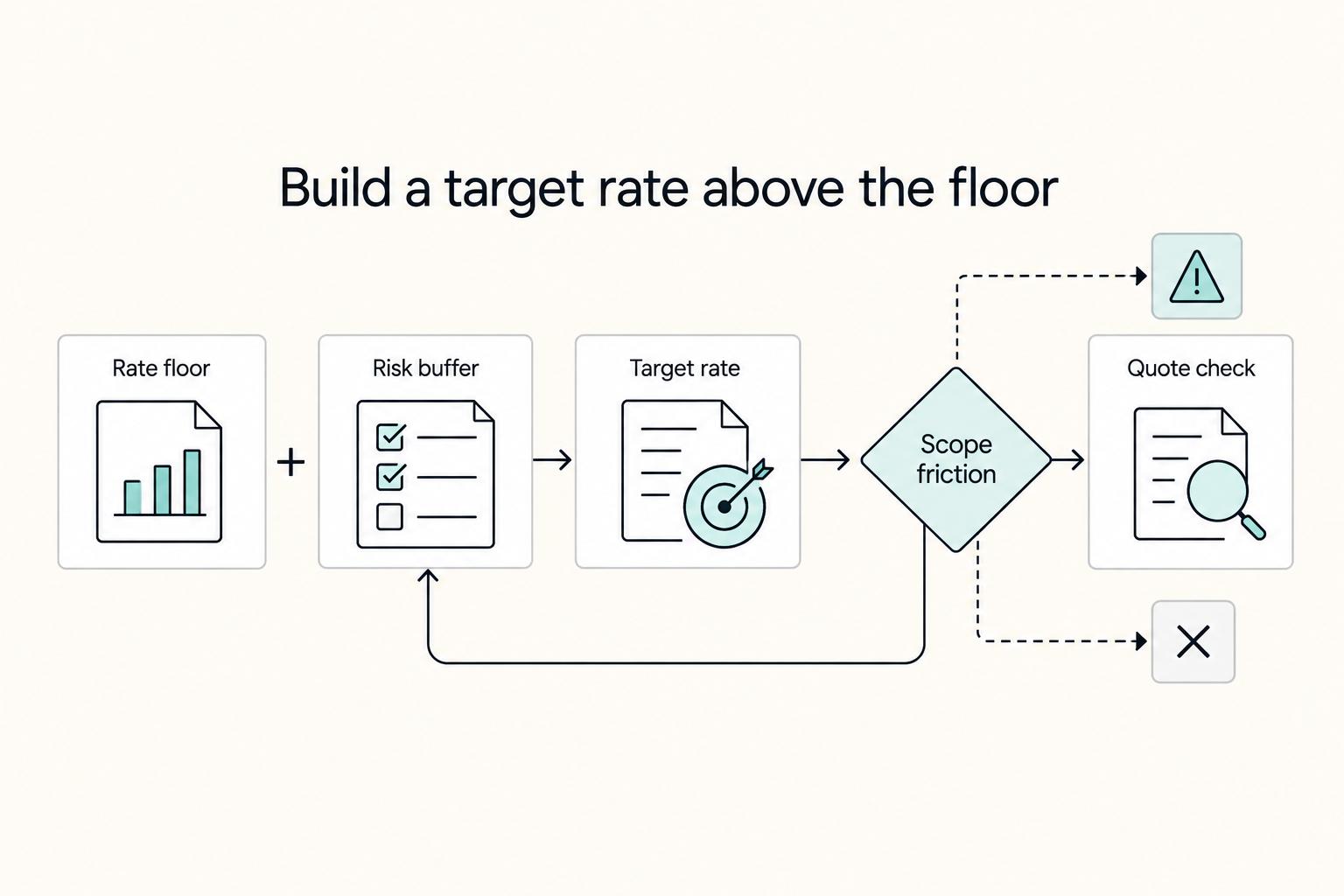
How to Calculate a Freelance Rate You Can Actually Get Paid On
A workable rate is not the neat number a calculator produces. It is the number that still works after you account for real billable capacity, non-client time, scope drift, and the gap between sending an invoice and receiving cleared cash. Start with hourly math even if you do not plan to bill hourly, then turn that number into a quote with clear `payment terms`.

The Freelance Payment Penalty: A Modeled Audit of Platform Fees, FX Spreads, and Payout Delays
The money rarely disappears through a single, easy-to-spot fee. The real loss is stacked. A marketplace takes its commission, a processor adds a charge for international cards, a bank or payment company converts the currency at a spread, a platform holds the funds before release, and a wire sheds a little to intermediaries on the way in. Each layer looks defensible on its own, but the worker feels the combined result as a smaller deposit and a later payday.

How to Respond to a Subpoena for Business Records
Move fast, but do not produce records on instinct. If you need to **respond to a subpoena for business records**, your immediate job is to control deadlines, preserve records, and make any later production defensible.