
Quick Answer
A payment-platform disclosure policy should define exact scope, minimum report evidence, response timers you can meet, safe-harbor limits, and closure evidence before you publish it.
What a Responsible Disclosure Policy Should Cover#
Treat your disclosure policy as an operating document, not a legal page you publish and forget. If you cannot name your in-scope assets, set the minimum evidence required, identify who accepts or rejects a report, and state your response timeline, you do not yet have an executable policy.
Disclosure pages may cover contact channels, good-faith reporting, and coordinated disclosure. This guide focuses on the operating path: how a report moves from intake to triage to remediation to closure.
A Responsible Disclosure Policy works best as a rules-of-engagement document for both your team and the reporter. In practice, that means defining scope, report quality thresholds, response expectations, and communication rules your security, product, legal, and operations teams can follow consistently.
Start with the operating baseline#
Use a Vulnerability Disclosure Policy (VDP) as your baseline. The CISA VDP template gives you a practical starting structure, and BOD 20-01 shows how publication requirements force scope and intake clarity. Even if your organization is not bound by that directive, the discipline is useful. Do not publish process language your team cannot run.
Pressure-test intake first. At minimum, capture where the issue appears, the vulnerability type, and benign, non-destructive reproduction steps. Strong reports often include artifacts such as URLs, timestamps, screenshots, IP addresses, and relevant logs.
Then pressure-test response realism. Example programs commit to responses within 3 working days, or usually within 5 working days, for valid reports. Some also ask reporters to limit status checks to no more than once every 14 days so remediation can stay on track. These are not universal standards, but they are practical benchmarks. If you cannot meet a timeline consistently, say that clearly.
Also separate disclosure from reward design. A bug bounty may include monetary rewards, but some disclosure programs explicitly do not. That is a policy choice, not a defect.
With these rules in place, intake uses clear scope and evidence thresholds, and prioritization considers impact, severity and exploit complexity. Coordinate publication through an agreed timeline and documented updates so reporters and operators can follow the same process.
Choose the policy model before drafting any text#
Choose the model before you write the policy text. Decide whether you will run responsible disclosure only, or disclosure with a bug bounty. Both models are used by vendors, but a bounty adds program terms, submission review decisions, and reward expectations that you need to manage consistently.
A disclosure-only model can keep the focus on intake and coordinated communication. Payment-adjacent programs such as Paddle's vulnerability disclosure policy and Global Payments' disclosure program show how public rules can stay specific even when the reward model differs.
Set one launch checkpoint. If your team cannot reliably handle report intake and review communication yet, disclosure-only may be the more workable starting point. Add paid rewards when that process is stable.
Prepare owners systems and evidence before you write#
Before you draft public language, make sure the operating model is already clear. Define the intake channel, triage checkpoints, what testing is allowed, and how sensitive data is handled.
Set clear triage decision paths#
Define how reports move from intake to first response and triage so a Vulnerability Report does not stall in handoffs. Be explicit about when a report needs more detail before it can proceed.
Set response targets only if your team can run them consistently. In public programs, these targets can be best effort rather than guaranteed SLAs, and they can slip with submission volume, holidays, or resource constraints.
Scope systems and testing rules before publishing#
Build scope around the systems you can actively support and investigate. Be clear about versions in scope, since some programs prioritize recent and current versions.
If you allow scanning, publish limits you can enforce in monitoring. For example, a hypothetical cap of 45 requests per minute needs a defined counting window and a way to detect and respond to excess traffic.
Define your evidence standard up front#
Set the minimum case tracking record before the first report arrives so status checks stay consistent. If you publish timing targets, define how first response and triage checkpoints are logged.
Lock in sensitive-data and intake controls#
Use a strict stop rule. If sensitive data is encountered, testing stops and the issue is reported immediately, with no further disclosure.
Prefer a controlled intake channel to reduce lost reports and uncontrolled copying. Pair it with clear handling rules so report handling stays consistent and contained. Related: How to Write a Payments and Compliance Policy for Your Gig Platform.
Define what is in scope across apps APIs and data flows#
Define scope by exact surface and impact first, or triage can stall on avoidable ambiguity.
Map exact in-scope surfaces#
List in-scope assets explicitly, not as broad product families. Use a consistent affected-systems format with domain, application version, and platform, for example web, iOS, Android, desktop client, or API.
Keep distinct surfaces separate when the risk differs. A production API backend and an auto-update CDN should be scoped as different targets, not one bundle. Verification point: pick three real assets and confirm intake can classify each one unambiguously to a specific surface.
Define what is reportable on each surface#
State what qualifies as a security finding on each surface so researchers and triagers apply the same bar. For client applications, make it explicit that only issues affecting confidentiality, integrity, or availability beyond normal user operation are reportable. That helps keep normal product behavior out of the vulnerability queue.
Separate reportable from critical#
Separate report validity from severity. If you use the CVSS v3.1 qualitative scale, its ratings are:
- None:
0.0 - Low:
0.1–3.9 - Medium:
4.0–6.9 - High:
7.0–8.9 - Critical:
9.0–10.0
Document that some vulnerabilities may not yet have CVSS scores, and some published details may come from external open-source reporting. Final prioritization should reflect the affected surface and available evidence, not the score alone. Verification point: require case records to include both labels, reportable and severity, with a short rationale.
Add one immediate-escalation rule for broad-impact paths#
Write one plain-language escalation trigger for findings that could cause broad downstream impact across shared infrastructure. A practical example is compromise risk in update delivery paths, where malicious updates could be distributed widely. This keeps uncertain but high-impact reports from waiting in the normal triage lane.
Define what is out of scope and what testing is prohibited#
Define out-of-scope and prohibited testing as explicitly as in-scope. If these boundaries are vague, you usually get the same failure pattern: valid research is discouraged, while testing expands into systems you do not own or cannot fix.
Exclude by category and test method#
State the default rule plainly: anything not explicitly listed as in scope is out of scope. Then list excluded categories and methods directly, including the assets and testing approaches you do not want tested, instead of leaving them implied.
For automated testing, publish concrete operating rules, including permitted accounts and an explicit scan-rate limit. Define any cap as your own program rule and explain how researchers can request clarification before testing.
Set an evidence bar for low-signal findings#
Decide which low-signal, standalone findings you accept and which require additional proof of security impact. Be explicit about that acceptance bar so intake and researchers apply the same standard.
Verification point: test your wording with sample reports and confirm triage reviewers reach the same decision from policy text alone.
Draw the third-party boundary clearly#
Use a strict boundary for hosted services: issues in your configuration or usage can be in scope, but flaws in the provider’s service itself are not. This prevents wasted effort on systems your team cannot remediate.
Also state the safe-harbor condition clearly. Protections apply when program guidelines are followed. Out-of-scope testing can increase legal risk and is unlikely to be rewarded.
Publish non-negotiable conduct rules#
Write conduct rules in plain language, including third-party system boundaries and sensitive-data handling. Publish the coordinated disclosure process and explain how reporters can discuss publication dates, delays and extensions with your team.
For more detail, read How to Build a Payment Compliance Training Program for Your Platform Operations Team.
Set report intake requirements and triage timers#
Intake should be explicit, not implied. Once scope is defined, publish a Vulnerability Disclosure Policy (VDP) that states what to submit and how reports are handled. If you publish response timers, commit only to timers you can consistently meet.
Require a minimum submission package#
Set a clear minimum for each Vulnerability Report, even if you use a simple form. CISA provides a basic submission-form example, so the practical goal is a form that is short to complete but structured enough for triage to act.
A practical, program-defined package may include:
- affected asset or endpoint
- reported vulnerability class
- reproduction steps
- proof of impact
- non-destructive test details
Treat this as a program rule you define, not a universal requirement. Before publishing, test a few mock submissions and confirm reviewers can classify them consistently from intake data alone. Also remove drafting artifacts from the published policy. CISA explicitly warns to remove instruction and example text before going live.
Publish timer commitments you can meet#
State these timers only where you can meet them consistently. If a timer is not guaranteed, say that directly instead of implying SLA certainty.
If your VDP sits alongside a bug bounty, keep intake and timing language aligned across both entry points. Bugcrowd describes VDPs as complementary to bug bounties, not replacements.
Map severity to internal action windows#
If you use an internal severity matrix, make it explicit and keep it operational. A simple version can look like this, with routing tied to evidence and business impact rather than to a score alone.
| Severity bucket | Routing expectation | Evidence bar | Owner set |
|---|---|---|---|
| Critical / broad-impact path | Immediate escalation and same-day owner assignment | Credible risk to shared payment infrastructure, authentication, or update paths | Security lead, service owner, operations lead |
| High | Move into active triage in the next working window | Reproducible issue with material confidentiality, integrity, or availability impact | Security triage lead and engineering owner |
| Medium | Queue with a defined remediation target | Valid finding with contained impact and workable reproduction detail | Security triage lead and service owner |
| Needs info | Hold with explicit follow-up questions | Signal is plausible but cannot be validated yet | Intake owner |
Define dispositions and duplicate handling#
You do not need a complex status taxonomy, but you do need one that operators can apply without debate. A practical disposition table looks like this.
| Disposition | Meaning | Evidence required | Owner |
|---|---|---|---|
| Received | Submission arrived and passed basic intake checks | Report ID, timestamp, contact path, enough detail to identify the asset | Intake or security operations |
| Accepted | Issue appears valid and moves into full triage or remediation | Repro steps, affected asset, initial impact note, linked internal ticket | Security triage lead |
| Needs info | Report may be valid but cannot be actioned yet | Explicit list of missing detail needed to proceed | Security triage lead |
| Out of scope | Report falls outside published scope or testing rules | Reference to the relevant policy boundary | Security with policy owner review |
If you add duplicate handling, keep the rule explicit and apply it consistently.
Related reading: How to Build a Payment Health Dashboard for Your Platform. To align triage SLAs and disposition states with operational workflows, review the implementation patterns in Gruv docs.
Write legal protections and researcher conduct rules with counsel#
Once intake and triage are set, make the legal language precise before publication. Your Legal Safe Harbor should be conditional. If a researcher acts in good faith, follows your policy, and stays within legal and program limits, you treat that work as authorized and avoid legal action where your policy allows.
Define authorized research in plain language#
State exactly which behaviors are protected and under what conditions. In practice, authorized research is tied to using your designated reporting channel, following scope and testing rules, avoiding harm, and reporting findings promptly.
Make the rules specific enough for consistent decisions. For example, do not access, download, or modify data in accounts the researcher does not own. Do not conduct disruptive testing such as DoS or DDoS. If sensitive data is encountered, stop testing and notify immediately.
Use a quick calibration check with counsel, security, and intake ownership: can they classify mock cases as protected or not protected without debate?
Limit the promise to law and payment scheme constraints#
Keep the safe-harbor promise explicitly bounded by law and Payment Scheme Rules. A clear pattern is to state that commitments apply unless law or payment scheme rules require otherwise.
If you also run a bug bounty, align the public policy with the program brief line by line. Where they differ, make precedence explicit so operators and researchers are not working from conflicting terms.
Write conduct rules as enforceable operating rules#
Make conduct requirements easy to follow and easy to verify. Require reporting through the designated channel, and publish any program-specific testing limits you enforce, for example scan-rate caps such as 45 requests per minute.
State prohibited actions directly: no unauthorized data access or modification and no disruptive testing. Keep sensitive data private and handle publication through the coordinated disclosure timeline and extension process.
Agree publication dates and handle extensions#
Set a coordinated disclosure process with a target publication date, progress updates and a way to agree extensions. Explain how the researcher and your team will handle missed targets or third-party dependencies.
Keep response targets separate from publication terms. A missed acknowledgment is not the same as an agreed disclosure date. Avoid an indefinite consent requirement that leaves researchers without a clear path when remediation stalls.
If you want a deeper look at the payout side, read Bug Bounty Platforms: How Security Research Platforms Pay Ethical Hackers Globally.
Map remediation steps to payout and ledger operations#
This is where disclosure programs usually break down. The goal is not only to fix the issue, but to prove the fix and document operational impact through closure.
Sequence the case from accepted report to verified closure#
Use one documented sequence for every accepted report, such as triage, containment, fix, retest, production verification, stakeholder communication, and closure. Keeping the order consistent can protect evidence quality and reduce rushed decisions during high-pressure incidents.
Define named checkpoints across security, engineering, and the owner of the affected service. If you also run a bug bounty, align closure logic with bounty decisioning so technically fixed is not treated as operationally resolved.
Require a handoff artifact at each stage, such as report ID, severity rationale, containment owner, remediation ticket, and closure approver. Security should follow the full delivery path, not act only as a final gate.
Add operational-impact checks before and after containment#
Containment can create secondary operational risk, so impact checks should happen both before and after release. Ask one explicit question each time: what could this change do to critical workflows or state transitions?
Avoid false precision. Define the checks your team will run for each high-impact surface, and record the result. If the issue affects state-changing paths, require designated operator verification in test and production. If it affects read-only paths, keep checks lighter but still documented.
Prioritize comparison over opinion. Tie before-and-after validation to the same action so you can confirm expected outputs still appear and no silent drift was introduced.
Define how temporary control changes create and clear exceptions#
Temporary controls are sometimes necessary, but they should create visible, managed exceptions. The risk is not only the temporary change itself. It is also losing track of downstream effects before recovery is complete.
Pair response flexibility with strict validation during recovery. Keep an exception record that captures:
- start time and expected end time
- approver and removal owner
- affected service or workflow
- expected downstream impact
- evidence that the exception was removed and rechecked
If those points are unclear, the team is carrying operational debt without reliable visibility.
Require closure evidence that ties the fix to the operational outcome#
Do not close cases on deployment status alone. Closure evidence should connect the technical change to the operational outcome with before-and-after validation, production verification, and audit-trail references.
A practical minimum closure pack includes:
- original vulnerability report and acceptance decision
- remediation ticket or change record
- retest evidence that the issue no longer reproduces
- production verification notes for the affected path
- references to audit, deployment, or approval logs
- closure note on any remaining temporary exceptions or known downstream impact
Make one rule explicit: if operational verification is incomplete, the case stays open. That keeps disclosure operations, bounty decisions, and stakeholder communication aligned to one definition of done.
For a walkthrough, see How to Build a Payment Reconciliation Dashboard for Your Subscription Platform.
Decide bounty payouts disclosure timing and recognition terms#
Decide the reward model and disclosure timing up front, then apply them consistently to accepted reports. In your Responsible Disclosure Policy or Vulnerability Disclosure Policy, state one model clearly and avoid case-by-case improvisation.
Choose one reward model and name it clearly#
State whether your program is a paid Bug Bounty Program, no-cash, or recognition-only. Paid programs use monetary rewards for responsible reporting, while no-cash models can still acknowledge valid contributions.
If you do not pay, say what researchers receive instead, such as acknowledgment or researcher credit where appropriate. A reader should be able to answer paid, unpaid, or recognition-only? from one short paragraph.
Define award eligibility before launch#
If you pay rewards, set eligibility gates before launch. Require a complete Vulnerability Report with a bug description, potential impact, and reproduction steps or proof of concept. Include relevant technical details, for example affected systems, URLs, or screenshots, without sensitive data.
Do not promise payment for every accepted report. State clearly if award decisions are discretionary, whether decisions are final, and whether severity or impact informs eligibility or payout structure.
Set clear recognition terms if you do not pay cash#
Recognition-only terms should be explicit, not implied. Define what acknowledgment looks like, who approves it, and whether it depends on a valid, responsibly submitted report.
Document the recognition or reward outcome with acceptance, severity rationale, and closure details.
Coordinate publication and remediation timelines#
Agree a coordinated disclosure timeline with the reporter. Aim to remediate before publication, communicate delays promptly and document any agreed extension rather than making completed remediation an indefinite prerequisite.
If you publish timing commitments, present them as your program commitments, not universal standards. Example commitments used in practice include acknowledgment within 5 business days, allowing 3 business days before follow-up, and remediation windows of up to 90 days based on severity.
Fix the mistakes that break disclosure programs#
A common failure mode is policy promises that exceed triage and decision capacity. Use this pre-launch control table to spot the gaps before you widen scope.
| Policy mistake | Operational symptom | What to publish instead | Primary owner |
|---|---|---|---|
| Scope is broader than supportable | Unassigned reports and slow repro decisions | Start with named assets, supported versions, and explicit exclusions | Policy owner plus triage lead |
| Timers are aspirational | Missed acknowledgments and repeated status chasing | Publish timings based on actual staffing and case volume | Security operations lead |
| Safe harbor is broader than internal authorization | Legal review escalations on routine reports | Tie authorization to the designated channel and published rules | Counsel plus policy owner |
| Closure requires only a code change | Issue is marked fixed while operational checks are still open | Require technical validation and operator sign-off before closure | Service owner plus operations |
Narrow scope to what you can triage well#
Start with critical assets and higher-risk vulnerability classes, then widen scope later. Broad language like all apps, all APIs, all findings can create a queue your team cannot route or resolve consistently.
Use a simple checkpoint: can each incoming Vulnerability Report be assigned to an owner with enough evidence to reproduce or reject it? Also define day-one handling for reports without CVSS scores, and validate external open-source inputs before final decisions.
Keep Legal Safe Harbor aligned with operations#
Safe-harbor language should match what your organization can actually support. Keep clear policy limits, and update the policy periodically as your business model evolves.
Avoid broad wording that reads like blanket protection if your operational or legal constraints are narrower. A modular policy structure makes targeted updates easier as threats and security measures change.
Publish timers you can actually meet#
Set acknowledgment, triage, and status-update timing only after validating staffing and case-volume reality.
Publish the CVSS version and rating scale you use. In CVSS v3.1, 0.0 is None, 0.1–3.9 is Low, 4.0–6.9 is Medium, 7.0–8.9 is High and 9.0–10.0 is Critical. Include a documented path for unscored reports and business-impact overrides.
Add control sign-off before closure#
Close reports only after technical validation and required operational validation are complete. Treat this as an internal control so remediation checks cover the teams responsible for affected services.
Document closure evidence in one case file: report ID, severity rationale, fix validation, and required control confirmations. This helps prevent fixed but operationally broken outcomes from slipping through.
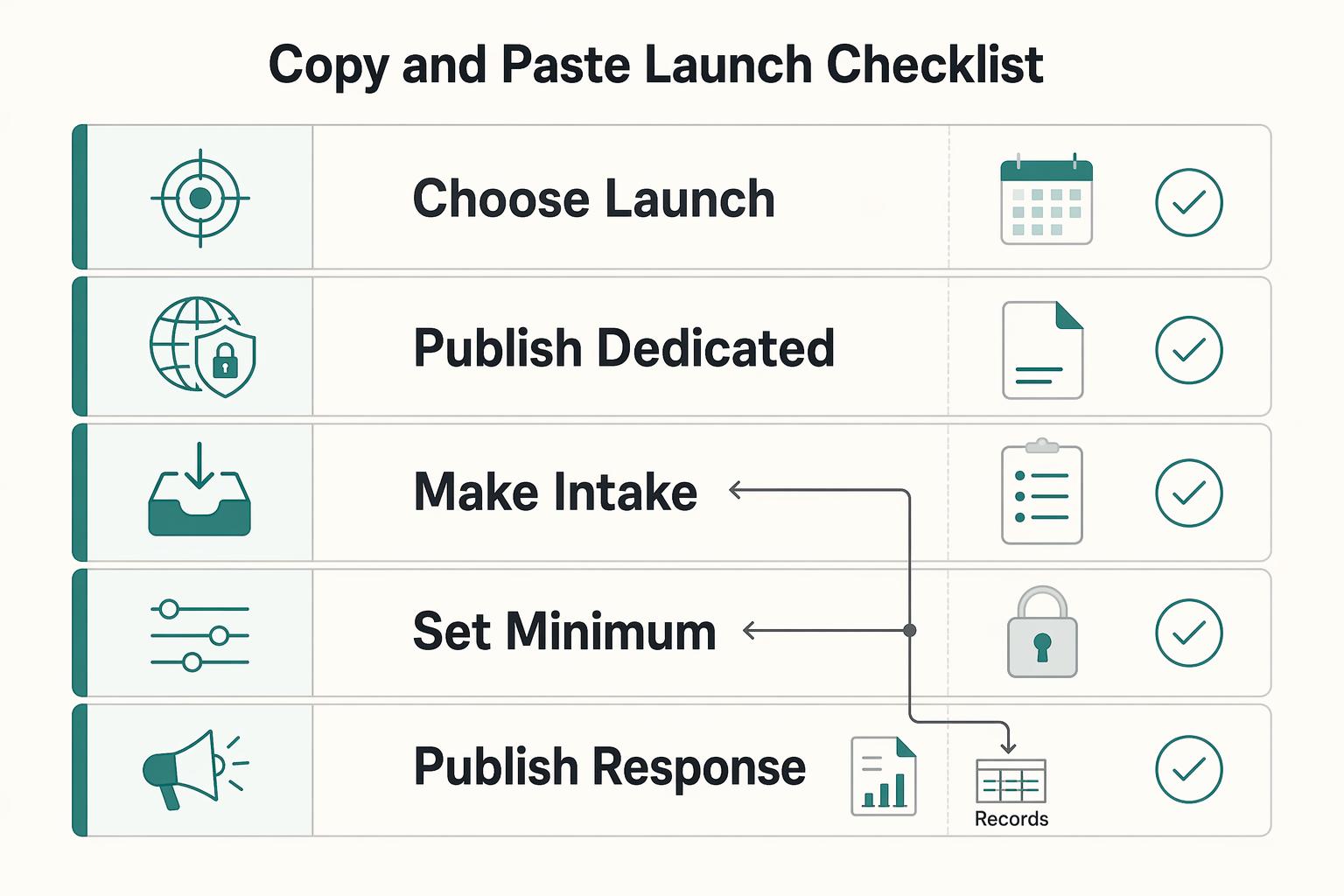
Copy and paste launch checklist#
- Choose your launch model first: start with a disclosure program if you can deliver clear communication and timely fixes, and add paid bounties only when you can sustain payments, consistent triage, and budget.
- Publish a dedicated reporting channel, such as email, a web form, or ticket intake, so reports do not get mixed into general support.
- Make intake ownership explicit: the reporting inbox should be owned, monitored, and separate from general support.
- Set minimum report requirements so submissions are practical, including what was found, why it matters, and enough detail to reproduce.
- Publish response commitments your team can reliably meet: acknowledge receipt, perform basic triage, and keep the reporter updated.
- Document the handling flow end to end: acknowledge receipt, confirm the issue, assess severity, assign an owner, fix, and communicate status.
- If you run a bounty track, define reward governance up front, including who has final payout decision authority.
When you are ready to pressure-test policy gates, payout controls, and rollout scope for your platform, contact Gruv.
Frequently Asked Questions
What is the practical difference between a Responsible Disclosure Policy and a Bug Bounty Program for a payment platform?
A Vulnerability Disclosure Program gives external researchers a formal way to report vulnerabilities in good faith, often as an ongoing channel. A bug bounty adds cash rewards for valid findings, which is the main practical difference. In execution, bounty programs usually launch with defined testable assets and a reward budget, while disclosure programs can run with a wider scope.
Do we need to offer money for reports to run a credible vulnerability disclosure program?
No. CISA states bug bounty capability is optional on its VDP Platform and not required by BOD 20-01. Credibility comes from clear scope, a workable intake path, consistent handling, and safe-harbor language that matches what your legal team will support. If you do not pay cash, state that clearly and set expectations for any non-cash recognition.
Which assets should be in scope first for a platform with web apps, APIs, and mobile clients?
Start with assets you can define clearly and route to an accountable owner without ambiguity. If you run a paid bounty, set exact testable assets and reward budget at launch. If you run disclosure-only, you can keep scope broader but still make it explicit. If reports cannot be mapped to a clearly identified in-scope asset, your scope definition is too loose for consistent triage.
Which findings should usually be out of scope unless there is demonstrated impact?
Define out-of-scope categories explicitly in your program policy, and use clear impact criteria so researchers and triagers apply the same bar. If a submission lacks the severity context, technical details, or impact needed to assess it, treat it as incomplete until the reporter provides more information.
What response timeline should we publish for acknowledgment and triage?
Publish only timing commitments your team can meet with current staffing and report volume. Keep acknowledgment and triage as separate checkpoints, and avoid implying fixed SLA windows you cannot reliably hold. Screening and base-level validation before queue routing can make timelines more defensible operationally.
What minimum fields must every Vulnerability Report include for fast and fair triage?
Ask for the affected asset, a description of the issue, benign reproduction steps and the observed impact. Request a severity estimate if available, but do not reject an otherwise actionable report solely because the researcher has not calculated a score.
Researched and edited by the Gruv editorial team. Gruv builds cross-border billing, payouts, and finance-operations software for global businesses.
Sources
Includes 3 external sources outside the trusted-domain allowlist.
- cisa.gov/vulnerability-disclosure-policy-templatetrusted
- cisa.gov/news-events/directives/bod-20-01-develop-and...trusted
- doit.maryland.gov/policies/ci/FAQ-statewide-vulnerability-disc...trusted
- nasa.gov/vulnerability-disclosure-policytrusted
- uscourts.gov/privacy-security-policy/vulnerability-disclo...trusted
- bugcrowd.com/resources/hacker-resources/standard-disclosu...external
- first.org/cvss/v3.1/specification-documentexternal
- help.globalpay.com/-/media/project/global-payments/corporate/co...external
Educational content only. Not legal, tax, or financial advice.
Related Posts
How Bug Bounty Platforms Pay Ethical Hackers Across Borders
If you are deciding where to launch a bug bounty program next, do not anchor on who advertises the biggest reward. The better question is where you can attract credible researcher attention, meet payout eligibility requirements, and move money with less avoidable payout friction once valid reports start landing.
How to Write a Payments and Compliance Policy for Your Gig Platform
Treat your **payments compliance policy for a gig platform** as an operating document, not a legal memo. If product, finance, and engineering cannot use it to decide whether a payout is released, held, reviewed, or reported, the policy is not finished.

Stale Cheque and Uncashed Payment Policy for US Platforms
A platform can have an old cheque and a current obligation to its owner. The instrument’s bank treatment does not by itself establish whether the underlying amount has been paid, abandoned or legally discharged. This policy focuses on US cheques and state unclaimed-property administration; other countries and special instruments need their own rules.