
Quick Answer
A quarterly tax calculator for freelancers is useful for a first-pass estimate, but it is not enough to approve a payment decision. Lock the inputs, confirm W-2 and 1099 income, withholding, deductions, and credits, then review federal and state treatment separately with records that explain the result.
How to estimate your quarterly tax payment#
A quarterly tax calculator for freelancers is a starting point, not a compliance conclusion. If you own compliance, finance, or risk, your job is to turn that first-pass estimate into a documented federal and state payment decision you can explain later.
The process is broader than what a calculator shows. The IRS says estimated tax is figured and paid with Form 1040-ES, and it also says self-employed individuals generally file annually and pay estimated taxes quarterly. A tool output may suggest an amount, but it does not by itself confirm that the assumptions were right or that federal and state treatment has been fully reviewed.
The risk is concrete. IRS guidance says underpayment can trigger penalties, and estimated payments are generally made in four equal amounts to avoid penalty. It also notes a key threshold: some taxpayers avoid that issue if they owe less than $1,000 after withholding and refundable credits. These details are easy to miss when a calculator estimate is treated as the final answer.
In practice, separate federal and state handling from the start. Estimated-tax prepayments can go to both the IRS and state tax agencies, and states can require their own due-date artifacts. California, for example, requires a separate payment form for each due date, which is why a reasonable federal estimate still needs a distinct state path and records.
This article is about control, not complexity. You will map scope, lock inputs, run and review estimates, and approve federal and state treatment separately, with clear checkpoints before payment. We recommend using that sequence so your team can show exactly how your calculator result moved from draft output to an approved payment decision.
Use one operating rule throughout: every calculator result is proposed until review is complete. If filing status, income inputs, withholding, or state scope is missing or unconfirmed, the estimate is not ready for action. If your intake is incomplete, you should hold the estimate instead of asking a reviewer to guess at the missing facts.
You also need an evidence trail. IRS recordkeeping guidance makes clear that taxpayers must substantiate entries, deductions, and statements on returns. In practice, keep the calculation source, any exports or screenshots, adjustment notes, and payment records together so the decision can be explained quickly and clearly.
What a quarterly tax calculator can and cannot prove#
Treat calculator output as a proposed estimate, not a compliance conclusion. Major tools describe it that way. Keeper describes a ballpark result, Bench calls it approximate, TaxAct positions calculators for planning quarterly payments, and ADP says its federal estimator is informational and does not guarantee accuracy. If you use a calculator in planning, your reviewer should still be able to explain why the output fits the actual filing facts.
These tools are useful for first-pass planning because they organize common inputs, including W-2 and freelance income, into a working estimate across the year's four payment periods. ADP is explicit that mixed W-2 and freelance income can be included.
What they usually cannot do is prove that your assumptions were correct for the filer, that state treatment is complete, or that penalty treatment is settled. Estimated-tax obligations span federal and state agencies, IRS penalty treatment depends on both underpayment amount and timing, and IRS estimated-tax requirements vary for some groups, including farmers, fishermen, and certain higher income taxpayers.
Keep every result in proposed status until inputs, assumptions, and ownership are documented. We would rather see your team delay approval than carry a number forward without a named owner. At minimum, keep:
- the exact inputs and filing assumptions used
- a screenshot or export from the tool used
- the reviewer, review date, and whether the number is federal-only or paired with a separate state decision
If you cannot explain the output in a short paragraph from the captured inputs, do not approve payment.
Confirm who is in scope before you estimate#
Confirm scope first. IRS guidance says self-employed individuals are generally required to file annually and pay estimated taxes quarterly, but that does not mean every filer is handled the same way. If you skip scope, your team can end up approving a clean-looking estimate for the wrong filing profile in your review flow.
Use the IRS self-employed baseline, then run the Form 1040-ES worksheet checkpoint before treating any calculator output as ready for use. The IRS defines self-employed people as sole proprietors or independent contractors, and points to the worksheet to determine whether estimated payments are required. We recommend keeping that worksheet test in your review record so your team can show why your estimate was approved or held.
Start from the IRS baseline, then test for exceptions#
Before estimating, verify two things: whether income is not subject to withholding, and whether existing withholding already covers expected liability. IRS guidance is explicit that estimated tax applies to income not subject to withholding, and that wage earners can sometimes avoid estimated payments by increasing withholding.
So "self-employed" is not the same as "always pay quarterly estimates." IRS rules differ for farmers, fishermen, and certain higher income taxpayers. If the file does not show income mix and withholding position, the estimate is not ready for approval.
Split the file by income profile#
Classify each filer before estimating so you do not bake assumption errors into the run.
| Income profile | What it usually means for scope | What to verify before estimating |
|---|---|---|
| Only W-2 income | May not need separate estimated payments if withholding is sufficient | Current withholding, expected total tax, and whether they still expect to owe $1,000 or more when the return is filed |
| Mixed W-2 income plus 1099 income | Common gray area because some income has withholding and some does not | Annualized W-2 wages, 1099 income, current withholding, and whether withholding can be increased instead of making estimates |
| Primarily 1099 income | May be more likely to require estimated payments when nonemployee compensation is paid without withholding | Year-to-date 1099 income, expected full-year income, prior estimated payments, and whether net self-employment earnings reach the $400 filing trigger |
Use document labels, not informal summaries: Form W-2 for wages and withholding, Form 1099-NEC for nonemployee compensation. If you collapse both into one "annual income" field, you lose the withholding detail needed for a correct scope call.
Route cross-border flags before you lock the number#
If FATCA, FBAR, or Form 8938 exposure appears, route for specialist review before finalizing payment assumptions. Form 8938 and FBAR are separate filing tracks, and one does not replace the other.
IRS guidance states a filer may need both, with separate penalties for failure to file each. FBAR is filed as FinCEN Form 114, not with the IRS, and foreign account status can matter even if the account produced no taxable income.
At intake, ask whether aggregate foreign financial accounts exceeded $10,000 at any point during the year. Also check possible Form 8938 exposure. The IRS comparison table includes this line for unmarried U.S.-resident filers: more than $50,000 on the last day of the tax year or more than $75,000 at any time during the year.
If you want a deeper dive, read A Guide to QuickBooks Self-Employed for Freelancers.
Collect the exact input set before opening any tool#
Do not run a quarterly estimate on partial intake. Form 1040-ES estimates are based on expected income, taxes, deductions, and credits, so those drivers should be captured first.
Use one intake record for every estimate#
Keep everything in one record, not scattered across chat notes and carry-forwards. At minimum, capture filing status, dependents, W-2 income, 1099 income, and current withholding together.
| Field group | Required fields | Why it is required |
|---|---|---|
| Filing profile | Filing status, dependents | These inputs affect withholding and credit treatment |
| Income mix | W-2 income, 1099 income | Preserves the withholding distinction between wage income and typically non-withheld 1099 income |
| Tax already paid | Current federal withholding, plus state withholding if relevant | Helps show whether estimated payments may still be needed |
| Jurisdiction scope | Federal plus each relevant state | Federal and state estimated-tax workflows are separate |
If W-2 and 1099 are merged into one "annual income" field, keep the estimate in draft until they are split back out.
Capture adjustment factors explicitly#
Do not rely only on a generic "other adjustments" box. Capture Traditional IRA, mortgage interest, and education-credit factors (American Opportunity Credit and Lifetime Learning Credit) as distinct inputs.
These are material estimate drivers: traditional IRA contributions may be fully or partially deductible, mortgage interest can affect Schedule A itemization, and education credits are handled through Form 8863. Tools may collect these through direct questions or broader adjustment prompts, but your intake should still store each factor clearly.
Set federal and state scope before first calculation#
Record federal and every relevant state up front, including cases like California and Washington, D.C. D.C. uses a separate estimated-tax voucher process, D-40ES, and state thresholds and rules can differ from federal.
Use an explicit verification checkpoint before approval: flag the estimate for review if any required field is blank or if a prior-quarter value was copied forward without confirmation.
Related: A Guide to VAT MOSS for UK Freelancers Selling Digital Services to the EU.
Compare tool outputs side by side before using them in reporting#
Use comparison, not trust, as your next control. Run the same locked intake through Keeper Tax, Bench, TaxAct, and ADP, then choose a method based on documented scope and assumptions, not a blended average.
| Tool | Federal estimated tax payments | State estimated tax payments | Mixed W-2 + 1099 handled explicitly | Unknowns to log |
|---|---|---|---|---|
| Keeper Tax | Provides a ballpark quarterly estimate; captured text does not confirm a federal-only breakout | State is an input, but separate state payment output is not confirmed in captured text | Yes. Inputs explicitly include W-2 income and freelance/business/1099 income | Formula transparency, penalty logic, exact state treatment |
| Bench | Discloses a quick estimate of quarterly tax payments; federal-only breakout is not confirmed in captured text | Not disclosed in captured text | Not disclosed in captured text | Formula transparency, penalty logic, federal/state breakout, mixed-income handling |
| TaxAct | Strong method signal: ties individual estimated payments to Form 1040-ES | States estimated payments are made to IRS and state tax agencies, but separate state output is not disclosed here | Not disclosed in captured text | Calculator-vs-guidance boundary, state nuance, penalty treatment detail |
| ADP | Federal estimated taxes are explicit, with a stated no-guarantee accuracy disclaimer | Not disclosed in captured text | Yes. ADP explicitly asks whether you also have W-2 income | Formula transparency, penalty logic, state handling |
Read differences for scope, not just amount#
Treat output differences as scope checks first. A precise-looking number can still be incomplete if federal and state handling, mixed-income handling, or method logic is unclear.
TaxAct's guidance is useful as a method anchor because it references Form 1040-ES and the 90% / 100% / 110% comparison framework. That still does not make any single tool result final.
Before accepting any output, confirm all runs used the same filing status, W-2 income, 1099 income, and state/federal scope. If a tool captures fewer inputs than your intake record, log that gap.
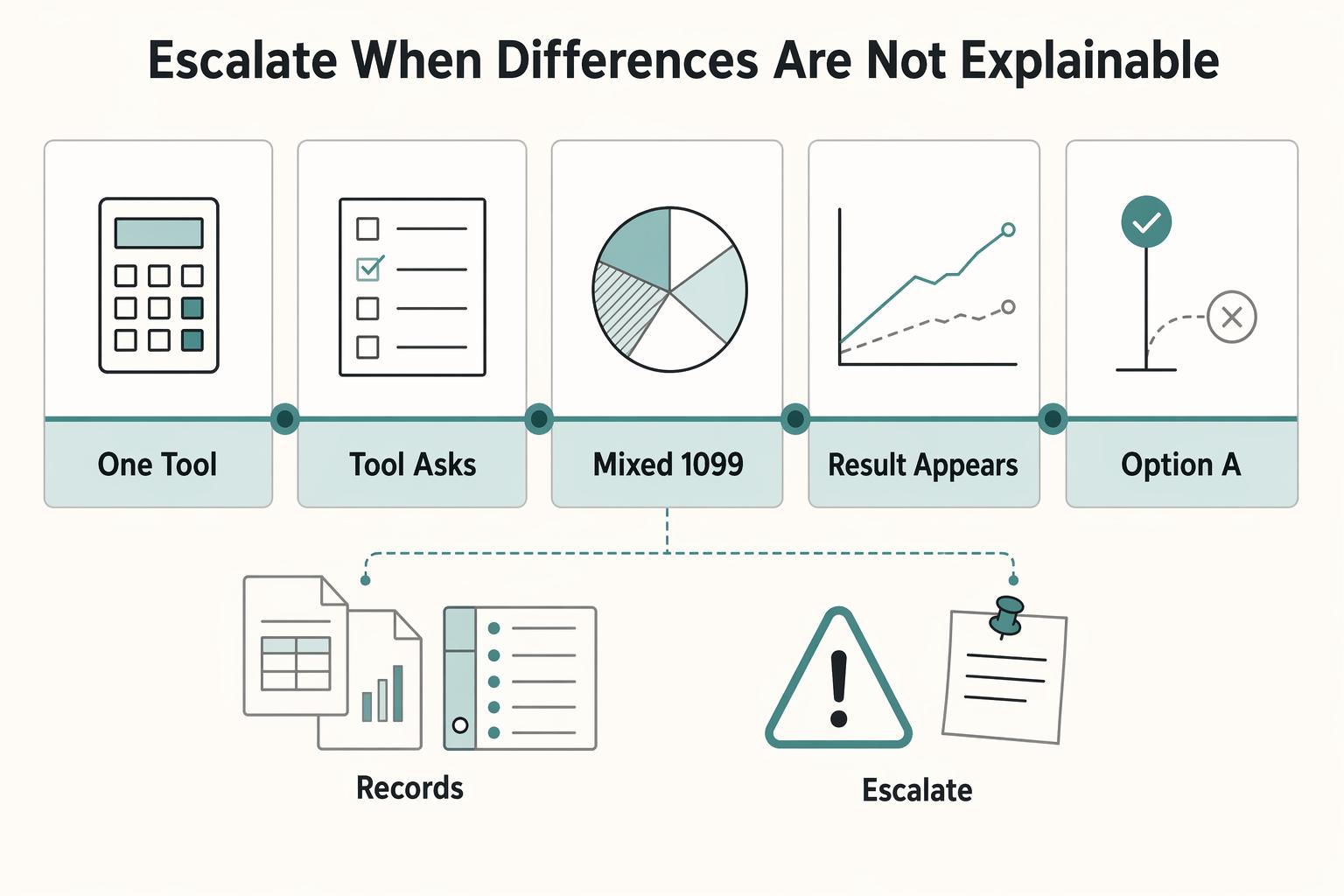
Escalate when differences are not explainable#
If outputs diverge materially, do not average them. Escalate and document why one method was selected, especially when:
- one tool shows a clear federal payment while another suggests little or none, and the input set is the same
- a tool asks for state but does not show a separate state estimated-tax output
- mixed W-2 + 1099 treatment is explicit in one tool and undisclosed in another
- the result appears to depend on 90% / 100% / 110% style prior-year/current-year comparison logic, but the tool does not say so
Calculator outputs are estimates, not compliance proof. Use the comparison record to support an explainable decision path for review.
For related freelancer tax context, see A Deep Dive into the UAE's Corporate Tax for Freelancers and LLCs.
If mixed-income treatment is driving variance, run one normalized input pass with the W-2 vs 1099 calculator before approving assumptions.
Separate federal and state decisions instead of blending them#
Approve federal and state estimated taxes on separate lines, not as one blended number. Federal and state rules can use different forms, thresholds, agencies, and payment instructions.
For the federal line, document the IRS method and Form 1040-ES assumptions. IRS guidance defines estimated tax as tax paid on income not subject to withholding. It also says self-employed individuals generally file annually and pay estimated taxes quarterly, and it uses a general trigger of expected tax due of at least $1,000 at filing.
For the state line, document the specific state method, form, and agency. In California, that means the Franchise Tax Board and Form 540-ES. The 2026 threshold is at least $500, or $250 if married/RDP filing separately, and there is a separate withholding-and-credits comparison. That is a separate decision path, not a federal add-on.
What to approve separately#
Keep two records:
- Federal estimated tax payments: approved against IRS method and Form 1040-ES assumptions
- State estimated tax payments: approved against the relevant state method, form, and agency record
Before approval, the state record should identify the jurisdiction, agency, form or instructions used, and whether the tool produced a state-specific amount. If the tool only gives a ballpark total, or does not show a distinct state payment output, treat the state amount as unvalidated and consider manual state review before quarter close.
Why California should stay on its own track#
For California-heavy cohorts, keep FTB references and notices separate from IRS records. The FTB payment guidance states there is a separate payment form for each due date, so keep the California record path tied to Form 540-ES, FTB payment instructions, and notice history.
Ownership in multi-state populations#
For multi-jurisdiction freelancer populations, assign a named owner to each state decision path as a control. That owner should confirm the applicable state method, validate the threshold test, and document what was used.
Use federal timing as federal timing only: the IRS divides estimated tax into four payment periods with due dates of April 15, June 15, Sept. 15, and Jan. 15. If state logic is unclear in any calculator, consider a manual state-validation step before quarter close.
Apply adjustment factors with explicit rationale#
Treat Traditional IRA, mortgage interest, American Opportunity Credit, and Lifetime Learning Credit as controlled inputs when they apply, backed by current documentation rather than calculator defaults. IRS estimated-tax calculations depend on projected income, deductions, and credits, so errors in these fields can misstate federal payments and may not flow to state treatment the same way.
Why these adjustments need active review#
| Adjustment | Why it needs review now | Common carry-forward risk |
|---|---|---|
| Traditional IRA | A contribution may be deductible, but the deduction can be limited when the taxpayer or spouse is covered by a retirement plan at work | A prior deduction is reused after retirement-plan coverage status changed |
| Mortgage interest | Only qualified mortgage interest counts, and loan proceeds must be used to buy, build, or substantially improve the residence | Interest is carried forward even though proceeds were used for personal debt |
| American Opportunity Credit | For an eligible student in the first 4 years of higher education; up to $2,500 per eligible student, with up to 40% (up to $1,000) refundable | A prior credit is reused without confirming current student status or qualified expenses |
| Lifetime Learning Credit | Can be claimed for unlimited years, but is capped at $2,000 per tax return | A prior credit is reused without current tuition or payment support |
Beginning in 2026, individuals claiming the American Opportunity Credit or Lifetime Learning Credit are required to have a valid Social Security Number, so stale profiles should not pass through unchanged.
What to store for each adjustment#
As an internal control for each adjustment, store:
- Source document such as receipts, canceled checks, statements, or similar support
- Who approved it
- Whether it changed federal, state, or both
Do not assume a federal adjustment changes state estimates the same way. If state treatment is unclear, leave state impact unapproved until the state owner confirms it.
Verification before you finalize#
Reconcile adjustment assumptions to bookkeeping records from systems like QuickBooks before final approval. QuickBooks estimates are useful only when income and expenses are complete and categorized, and the estimate should remain provisional in complex situations.
If an adjustment appears in the calculator but lacks current documentation and a named approver, remove it from the working estimate or escalate it. Prior-quarter entries may still be valid, but they are not valid by default.
Keep supporting records with the tax file for at least the general IRS recordkeeping period of 3 years from the filing date.
Set clear escalation triggers to protect E-E-A-T and compliance#
Escalate the estimate as soon as the tax treatment is no longer clearly explainable from the inputs you captured. Typical triggers include:
- mixed W-2 income and 1099 income cases when current withholding treatment is unclear, or when the team disputes Schedule SE (Form 1040) assumptions. IRS guidance says Schedule SE is used to calculate self-employment tax, and filing is generally required when net self-employment earnings reach $400 or more.
- cross-border signals, including the U.S.-Israel Tax Treaty, offshore assets, foreign accounts, FATCA, Form 8938, FBAR, or FinCEN reporting questions. A foreign-account aggregate over $10,000 can trigger FBAR on FinCEN Form 114, and specified foreign financial assets over the general $50,000 baseline can trigger Form 8938 review. Do not treat these as interchangeable: Form 8938 does not replace FBAR, and FBAR is filed with FinCEN, not the IRS.
- any calculator result that cannot be explained in plain English from saved inputs
Use one internal approval check before sign-off. If the team cannot explain "why this number" clearly from the captured W-2 income, 1099 income, withholding, major adjustments, and Schedule SE treatment, the estimate is not approval-ready.
Build an audit-ready quarterly evidence pack#
A quarterly estimate is easiest to review when you can trace it from inputs to calculator output, approval, and the payment record. Use one standard artifact set every quarter so the chain is reviewable during audits or disputes.
| Artifact | What to keep | How to cross-link |
|---|---|---|
| Intake snapshot | The captured inputs used for that run, plus timestamp and owner | Link to the exact calculator run used for the estimate |
| Calculator output record | Output screenshot or PDF, run date, quarter, jurisdiction, and assumptions used | Name the exact calculator and attach supporting federal or state form context used for the estimate |
| Adjustment evidence | Documents supporting deductions, adjustments, or credits used in that quarter | Link each item to the specific calculator run it affected |
| Approval log | Reviewer, approval decision, escalations, and rationale | Link to the exact output record ID and jurisdiction |
| Final payment record | Amount paid, date, method, and payment confirmation or voucher | Link to the approved estimate and agency record, for example IRS Online Account, Form 1040-ES voucher, FTB Web Pay confirmation, or Form 540-ES voucher |
Store agency context with each output, not in a separate folder. For federal items, keep the IRS support used, including Form 1040-ES when applicable. For California items, keep FTB support with the same record set, including confirmation pages or voucher copies tied to the correct due-date period.
Reconcile estimate records to payment operations before quarter close. At minimum, match quarter, jurisdiction, approved amount, paid amount, payment date, and confirmation evidence. If there is a difference, log it explicitly before sign-off.
Make retention rules explicit by jurisdiction. IRS baseline retention is 3 years in standard cases and 6 years when reportable income was omitted. California FTB's usual review window is 4 years. Do not assume one federal retention rule automatically satisfies state requirements.
Related reading: Quarterly Estimated Taxes for Freelancers Without Guesswork.
Connect tax estimates to payout operations without overbuilding#
Tie quarter-end tax approvals to payout release decisions with a short, auditable control chain. Keep the checkpoints visible: approved estimate, validated payee tax form, and confirmed payment classification before release.
Gate releases with a short approval chain#
If your Gruv setup supports approval gates, audit trails, or reconciliation exports, place them at the quarter-end decision point instead of every payout event. The release record should link to the approved estimate or filing workpaper for the quarter, plus the federal or state owner who approved it.
Before releasing a tax-sensitive payout, confirm three statuses: estimate approved, payee tax form validated, and payment classification confirmed. At quarter close, reconcile approved versus paid results, including payee, quarter, jurisdiction, approved amount, paid amount, release date, and hold reason.
Keep the payee tax profile attached to payout evidence#
Keep a retrievable link from payee tax profile to payout status evidence so reviews do not depend on memory. For U.S. payees, Form W-9 collects the TIN for IRS information-return reporting. The TIN must match the name on line 1, and if no TIN is provided, backup withholding must begin on reportable payments.
For non-U.S. payees, route intake through Form W-8 BEN rather than defaulting to W-9 assumptions. Form W-8 BEN is generally valid through the last day of the third succeeding calendar year unless circumstances change, and updates must be reported within 30 days of that change.
Your linked record should include:
- approved estimate record ID and quarter
- W-9 or W-8 BEN status, collection date, and exception notes
- 1099 tracking status, including whether reporting belongs on Form 1099-NEC or Form 1099-K based on payment rail
- payout status evidence, such as released, held, reversed, or backup withholding applied
For Form 1099-NEC, payee statements and IRS filing are both due by January 31. The aggregate e-file threshold for information returns is 10, calculated across return types, effective for required filings on or after January 1, 2024.
Automate deterministic checks first#
Start automation with deterministic checks, then keep edge cases in human review. Good early candidates are missing-form holds, W-8 BEN validity reminders, name or TIN mismatch flags, and quarter-end reconciliation exports.
If approvals are pending or the payee record does not show a valid W-9 or W-8 BEN path, consider holding the payout and logging the exception before funds move. For retention, keep evidence retrievable across required windows. IRS income-tax records are generally 3 years in standard cases, and employment tax records are kept for at least 4 years after tax is due or paid, whichever is later.
Common failure modes that create regulatory surprises#
Many regulatory surprises come from treating estimates as final decisions instead of controlled inputs. Watch for these failure modes:
- Mistaking calculator speed for compliance assurance: Calculator outputs should be treated as proposed numbers, not approved positions. Keeper frames results as a ballpark estimate, and ADP states its calculators are general guidance rather than exact tax calculations. If your team approves a payout or filing position without documenting inputs, jurisdiction, and approver, errors are more likely.
- Blending federal and state logic into one number: Estimated payments run through separate IRS and state channels. California shows why separation matters: estimated payments are generally required at
$500expected tax due, or$250if married/RDP filing separately, and penalty avoidance compares90%of current-year tax versus100%of prior-year tax. A single blended figure breaks the audit trail. - Letting quarterly assumptions go stale: IRS Publication 505 says changes in income, adjustments, deductions, or credits may require refiguring estimated tax. For freelancer populations, that can mean income, withholding, or deduction assumptions changed while prior-quarter estimates were carried forward without review.
- Missing cross-border overlays: FATCA and FBAR are not interchangeable. Form 8938 can apply to certain U.S. taxpayers with foreign assets, generally above
$50,000, while FBAR is triggered when aggregate foreign financial accounts exceed$10,000at any time during the year. VAT assumptions can also age out: the UK cannot use VAT MOSS for sales from1 January 2021, and the EU expanded MOSS into OSS from1 July 2021.
If your freelancer population spans jurisdictions, escalate these cases to specialist review before approval, not after a notice arrives.
Conclusion#
Use calculator outputs as draft estimates, not approval-ready tax positions. The real decision point is your control process: verify inputs, split federal and state treatment, and escalate when the result is not clearly supportable. We recommend keeping your approval language just as explicit, so your team knows whether it is approving a payment, a hold, or a specialist review for your file.
For federal estimates, use Form 1040-ES to figure and pay estimated tax on income not subject to withholding. For California, follow the FTB's separate estimated-tax process and due-date payment forms. A single blended federal and state number can weaken review and make errors harder to trace.
Keep the process practical and defensible by rechecking current-quarter inputs before each run, approving federal and state estimates separately with clear ownership, and escalating when outputs change materially or the team cannot explain the result from the file. If your team cannot explain the result from your record alone, you should treat the estimate as incomplete.
The core standard is simple: another reviewer should be able to explain each quarterly amount from the record alone. Keep the intake snapshot, saved calculator outputs, support for income, deduction, and credit items, approval history, and payment confirmation. IRS recordkeeping rules require support for reported items, and weak documentation can turn an estimate into avoidable tax risk. We would rather see your reviewer reconstruct your decision from one file than chase missing context across email and spreadsheets.
When you are ready to operationalize approvals and reconciliation in one flow, review Gruv Payouts.
Frequently Asked Questions
Do freelancers always need to pay quarterly estimated taxes?
No. For federal estimates, Form 1040-ES uses a general test of whether you expect to owe at least $1,000 after withholding and refundable credits. That is separate from the filing rule that generally applies when net earnings from self-employment are $400 or more.
How should we estimate when a freelancer has both **W-2 income** and **1099 income**?
Estimate from one combined tax picture, but store W-2 income, 1099 income, and withholding separately. Confirm year-to-date withholding from payroll records before approving the federal amount.
Should federal and state quarterly estimates be approved separately?
Yes. Federal estimates generally use Form 1040-ES, while states can require their own forms, agencies, thresholds, and instructions. Approve them on separate lines rather than as one blended number.
Which deductions and credits most often change calculator outputs?
Start with Traditional IRA contributions, mortgage interest, and the American Opportunity Credit and Lifetime Learning Credit. Require current source documents and record whether each item changes federal only, state only, or both.
What should we do when **Keeper Tax**, **Bench**, **TaxAct**, and **ADP** show different results?
Do not average the outputs. Re-run each tool with the same intake data, then compare differences in withholding, deductions, credits, and state treatment. If the variance is not explainable, escalate and document why one method was chosen.
When should a calculator result be escalated to a tax professional?
Escalate when you cannot explain the result clearly from documented inputs or when small input changes create materially different estimates. Escalation is also important when mixed-income withholding is unclear, cross-border reporting flags appear, or underpayment penalty exposure is in play.
Researched and edited by the Gruv editorial team. Gruv builds cross-border billing, payouts, and finance-operations software for global businesses.
Sources
Educational content only. Not legal, tax, or financial advice.
Related Posts

The Freelance Payment Penalty: A Modeled Audit of Platform Fees, FX Spreads, and Payout Delays
The money rarely disappears through a single, easy-to-spot fee. The real loss is stacked. A marketplace takes its commission, a processor adds a charge for international cards, a bank or payment company converts the currency at a spread, a platform holds the funds before release, and a wire sheds a little to intermediaries on the way in. Each layer looks defensible on its own, but the worker feels the combined result as a smaller deposit and a later payday.

How to Respond to a Subpoena for Business Records
Move fast, but do not produce records on instinct. If you need to **respond to a subpoena for business records**, your immediate job is to control deadlines, preserve records, and make any later production defensible.

A US Expat's Guide to Investing in UCITS ETFs to Avoid PFIC Issues
The real problem is a two-system conflict. U.S. tax treatment can punish the wrong fund choice, while local product-access constraints can block the funds you want to buy in the first place. For **us expat ucits etfs**, the practical question is not "Which product is best?" It is "What can I access, report, and keep doing every year without guessing?" Use this four-part filter before any trade: