
Quick Answer
Yes - if you operate as a Natural Person in the UAE and your annual business turnover passes AED 1,000,000, you generally need Corporate Tax registration through EmaraTax and ongoing filing. The key split is turnover for scope entry and taxable profit for tax due, so low profit does not automatically remove filing duties. Free Zone licensing also does not create automatic 0% treatment, because outcomes depend on qualifying conditions and income mapping. Keep monthly records aligned across invoices, bank activity, and bookkeeping before deadlines arrive.
The UAE's Corporate Tax regime has created understandable uncertainty for freelancers. The problem is not just the rules themselves. It is having to make decisions while deadlines, scope, and penalty risks still feel unclear.
What helps is a clear operating routine: a practical 4-stage system covering Assess, Prepare, Comply, and Optimize. The goal is simple: figure out whether you are in scope, get your records in order, register and file cleanly, and make tax one more managed part of the business instead of a recurring distraction.
Stage 1: Assess - Do You Even Need to Act?#
You only need to act now if you are a Natural Person carrying on a UAE Business or Business Activity and your annual gross business revenue exceeds AED 1,000,000. Verify current rules with FTA/MOF before acting.
1) Confirm your business status first#
Start with the scope question. The practical test is whether you are carrying out activity in the UAE regularly, on an ongoing, independent basis as a business.
A Natural Person is a living human being, whether UAE resident or non-resident. If you do not conduct a UAE business or business activity, you should not register under the natural-person basis test. If you do, move to the income split.
2) Split business income from excluded personal-income streams#
Before you test the threshold, separate business income from excluded personal-income streams. For natural persons, FTA guidance treats the following as non-business streams for this test:
- wages/salary
- personal investment income
- real estate investment income
Use only business or business-activity gross revenue in your threshold calculation. Keep the records that support how you classified each stream, and check the legal definitions when classifying personal investment and real estate activity.
3) Run the turnover test, then verify the registration trigger#
Once your income streams are separated, test whether your gross business revenue exceeds AED 1,000,000 in one calendar year. Use gross revenue before expenses.
Free Zone status does not automatically take you out of scope, and 0% Free Zone treatment is conditional under Qualifying Free Zone Person rules.
If you exceed the threshold, FTA guidance states registration is due by 31 March of the following calendar year, and late registration can trigger an AED 10,000 administrative penalty. Confirm current-year guidance directly with FTA/MOF before filing.
If this, then next step#
| Situation | Next step |
|---|---|
| No UAE business/business activity | Monitor only and reassess if facts change. |
| Business activity exists, but income is only in excluded personal-income streams | Monitor only and keep classification evidence. |
| Business revenue below AED 1,000,000 | Monitor monthly and put basic records in place now. |
| Near AED 1,000,000 or income is irregular | Prepare now so timing errors do not force a rushed response. |
| Business revenue exceeds AED 1,000,000 | Verify the current FTA timeline, then move to registration prep immediately. |
Before you move to registration, keep your residency evidence and decision notes in one place with the Tax Residency Tracker.
Stage 2: Prepare - Build Your "Compliance-Ready" Financial System#
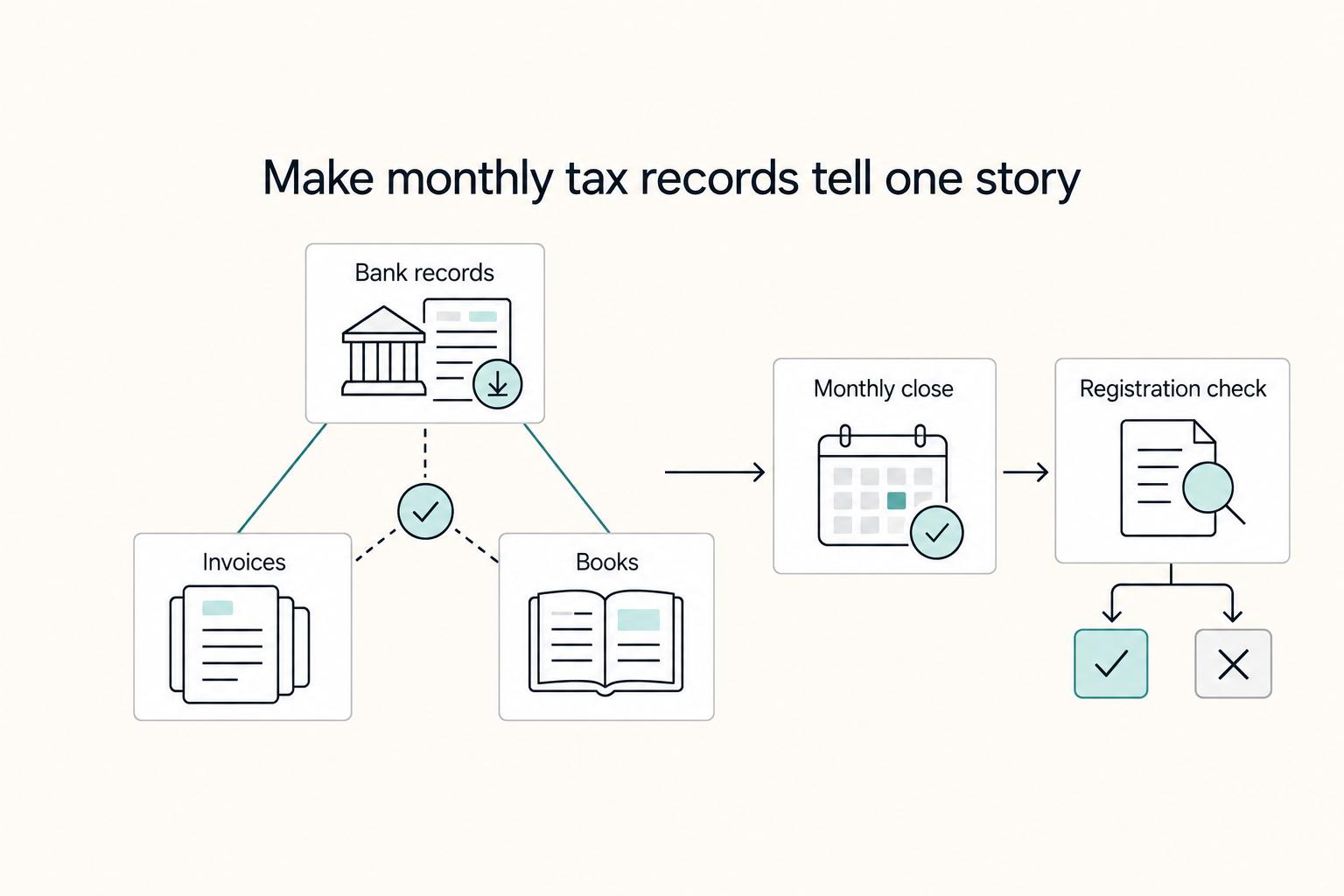
If Stage 1 suggests your compliance obligations may increase, build a repeatable monthly system now. Your bank records, invoices, and books should tell the same story without a year-end reconstruction.
Most compliance stress comes from small inconsistencies. Common problems include vague transaction descriptions and records that do not line up across your bank activity, invoices, and books. This is where clean records start saving time.
Separate money so your records tell one story#
A multi-account setup can be a practical way to keep categories clear during review.
| Account purpose | What goes in | Common mistake to avoid |
|---|---|---|
| Income account | All client receipts and business revenue deposits | Paying personal bills from this account, which makes revenue and owner draws harder to trace |
| Operating account | Planned transfers used for software, contractors, fees, marketing, travel, and other business costs | Letting client payments land here directly, which blurs gross inflows and expenses |
| Tax reserve account | Periodic transfers held for expected tax cash needs | Using it as overflow cash for operating shortfalls |
Use one flow every time. Client money lands in one place first, then moves by deliberate transfer. Bank onboarding in the UAE often includes compliance and background checks on business nature, source of funds, and transaction context. If your application description, invoice samples, website language, and transfer references do not line up, that can trigger a re-evaluation. In more difficult cases, compliance issues can lead to an account hold or freeze.
Before applying, prepare one consistent document pack. Include:
- Trade license and Memorandum of Association, if applicable
- Passport and Emirates ID details for shareholders
- Proof of office tenancy
- Short business plan and invoice samples
Start early if you are in a free zone or working with a newly issued trade license, because longer account-opening waits are common. Check account terms up front as well. Some banks may require minimum balances in the AED 25,000 to 100,000 range, which can reduce operating cash.
Set a conservative reserve-transfer rule based on expected cash obligations, review it with your adviser, and adjust it when your revenue mix or margin changes.
Build a bookkeeping rhythm you can actually keep#
What matters most is not a sophisticated system. It is a monthly routine you will actually follow. Keep your bookkeeping complete, current, and easy to review.
Set a baseline chart of accounts that matches how the business really operates. For example:
- Revenue by service line
- Software and tools
- Subcontractors
- Bank charges
- Marketing
- Travel
- Professional fees
- Owner draws
- Tax reserve transfers
Run a simple document-retention routine for each client engagement. Keep:
- Invoice
- Contract/SOW
- Proof of payment
- Key approval or change notes
- Any credits, refunds, or revised invoices linked to the original
Use a lightweight monthly close checklist. Each month:
- Reconcile each bank account to bookkeeping balances
- Match each client receipt to an invoice or written revenue note
- Clear uncategorized transactions and owner-paid business costs
- Export and store month-end reports with supporting statements
Use a consistent, searchable naming format. For example:
2026-03_ClientName_INV-1045_USD.pdf2026-03_BankStatement_IncomeAccount.pdf
If you want a deeper dive, read the digital nomad tax guide.
Make multi-currency boring and consistent#
For foreign-currency work, consistency matters more than complexity. Pick a rule, document it, and apply it the same way every month.
| Policy area | What to do |
|---|---|
| Source-of-truth exchange rate policy | Pick one rate source for bookkeeping and document it in your finance folder. |
| Conversion timing | Define when you convert amounts for bookkeeping and apply the rule consistently. |
| Reconciliation cadence | Reconcile foreign-currency invoices, receipts, and balances monthly so differences do not compound. |
| Exceptions (corrections/credit notes) | Never overwrite originals. Post corrections as linked follow-on records. |
| Records to keep | Keep the original-currency document and the AED-converted bookkeeping entry. |
Keep both records every time: the original-currency document and the AED-converted bookkeeping entry. That gives you a clean trail when payments arrive late, are short, or include platform deductions.
Stage 3: Comply - Register, Confirm Your TRN, and Set Filing Reminders#
When your books show that your business turnover exceeded AED 1,000,000 in a calendar year, stop treating registration as a later task and schedule it. For a natural person, the published FTA rule has been registration by 31 March of the following calendar year, but verify the current registration deadline and penalty framework before you file. Use EmaraTax for registration, and submit a complete document pack to reduce avoidable delays.
Pre-submission checklist#
Prepare one complete document pack before you start. Include:
- Valid trade license, including branch licenses if applicable
- Identity and authorization documents for the relevant individual and any authorized signatory
- Records supporting how you confirmed the threshold was exceeded
- Attachments in PDF format, with each file under 15 MB
- A consistent internal file naming format so documents are easy to retrieve if clarification is requested
| Step | What you do | Output you should have |
|---|---|---|
| Threshold confirmation | Reconcile invoices, receipts, and bank inflows to confirm turnover exceeded AED 1,000,000 in the calendar year | Dated turnover summary with support files |
| EmaraTax submission | Log in, or create an account, select Corporate Tax registration, complete the form, and upload documents | Submission confirmation/receipt |
| TRN confirmation | Track status and answer any follow-up request promptly | Corporate Tax Registration Number (after approval) |
| Compliance handoff | Set filing reminders, assign ownership, and store evidence in one controlled folder | Live compliance calendar and audit-ready archive |
After registration, keep the routine tight. The general FTA filing cadence is return or declaration submission within nine months from the end of the tax period, but confirm the exact deadline for your case. Set at least two reminders, for example 60 days and 14 days before the due date, and archive each return or declaration, calculation file, submission receipt, and payment proof together.
Talk to a registered corporate tax agent or tax adviser before filing if your case is complex or unclear, especially around classification and scope. Related: How to Manage Your Time Effectively as a Freelancer.
Stage 4: Optimize - Beyond Compliance to Strategic Advantage#
Registration gets you through the door. Optimization is what keeps your positions defensible over time. If you are a freelancer or sole proprietor earning business income in the UAE, focus each cycle on four decisions: expense support, income-stream classification, relief review, and cross-border escalation points.
If you are a Natural Person conducting a business, the biggest upgrade is simple: clean records and a repeatable review.
Tighten expense claims before you try to maximize them#
Treat expense treatment as a documentation exercise first, not a maximization exercise. If you cannot explain the business purpose clearly, tie it to source records, and show how it was paid, flag it for review instead of auto-claiming it.
Use this as a working risk-screen table, not a legal whitelist of deductible items.
| Category | Lower-risk when support is clear | High-risk claim to validate | Evidence to keep |
|---|---|---|---|
| Software and tools | Costs clearly tied to client delivery or business operations | Mixed personal/business subscriptions or unclear bundled plans | Invoice, payment record, short business-purpose note |
| Professional services and licensing | Services and license costs directly connected to the business | Personal costs posted as business costs | License record, adviser invoice, engagement scope, payment proof |
| Marketing and sales | Spend tied to lead generation, visibility, or client acquisition | Spend with no clear business link | Campaign records, invoices, contracts, payment proof |
| Travel and client activity | Costs with a clear business activity link | Trips or expenses with mixed personal use and weak support | Itinerary or agenda, client correspondence, receipts, purpose note |
| Shared or mixed-use costs | Allocations with a documented business-use method | Large allocations with no method or support | Underlying bill or contract, allocation method, working paper |
Two practical controls help immediately: keep a monthly evidence folder that mirrors your bookkeeping categories, and do not rely on card statements alone.
Free Zone decisions depend on income mapping#
Free Zone status is not a shortcut by itself. The quality of the decision depends on whether you can map income streams and support how each stream is treated. Run a two-bucket review each cycle:
- Potentially qualifying income: revenue that appears to fit current Free Zone treatment, subject to verification against current qualifying criteria.
- Potentially non-qualifying income: revenue that does not clearly fit, plus streams relevant to the current de minimis review.
For each stream, retain the contract, invoice trail, customer-location support, and a short delivery description so the treatment is easy to review later.
Small Business Relief is a choice, not a reflex#
Small Business Relief is referenced for small and growing businesses, but the decision should be made only after current guidance is verified. Use this checklist before filing:
| Review point | What to confirm |
|---|---|
| Eligibility | Confirm period revenue against the current eligibility threshold. |
| Election mechanics | Confirm the current filing steps and timing before submission. |
| Tradeoffs | Confirm any continuing calculation, disclosure, or downstream effects. |
| When relief may not be optimal | Pause if you need standard computations for other reporting, financing, or internal decision-making. |
| Decision record | Document the decision either way with a dated note: what you checked, what period data you used, and why you elected or declined. |
Cross-border guardrails#
If another country may also tax the same income, treat this as a cross-border analysis issue, not just a local filing detail. You may need treaty or foreign-credit review when you also file elsewhere, have foreign withholding, or have multi-country income flows.
Keep a cross-border evidence pack: contracts, invoices, payment records, withholding statements if any, UAE registration records, and filing or tax-payment support relevant to your position. Escalate to a cross-border tax adviser when the same income may be taxed in multiple jurisdictions or your residency or treaty position is not straightforward.
You might also find this useful: A Freelancer's Guide to the US-Germany Tax Treaty.
Conclusion: You Are Now in Control#
At this point, you do not need more theory. You need a repeatable compliance cycle. Start each cycle by separating income types, confirming whether you are carrying on a business or business activity, and checking your financial-year start date.
Under UAE Corporate Tax Law (Federal-Decree Law No.47 of 2022), effect is tied to financial years commencing from June 1, 2023. Scope is case-dependent: employment, personal investment, and real-estate investment income are treated differently from income generated by business activity. Threshold monitoring should therefore be part of your review, without treating it as a universal rule.
| Stage | From | To |
|---|---|---|
| Assess | Guessing whether you are in scope | A written determination of income type, business-activity status, and whether you need ongoing threshold monitoring |
| Prepare | Mixed accounts and scattered files | A complete record set for the period: invoices, contracts, payment records, bookkeeping outputs, and notes on unusual items |
| Comply | Reactive admin | A dated compliance checklist for each period, with clear ownership and completion evidence |
| Optimize | Treating tax as one-off work | A scheduled pre-cycle review of structure, expense treatment, and revenue patterns |
Use one default operating routine: review during the year, reconcile figures to source records, and close each period with documentation another person could follow without relying on your memory.
If your facts are unclear, if business-activity and threshold framings point in different directions, or if your legal structure changes, escalate early to a qualified tax adviser. With documented steps and consistent review, you reduce compliance risk and keep your attention on running the business.
For related visa planning context, see UAE Golden Visa for Freelancers and the Green Visa Decision Guide. If you want cleaner invoicing, collections, and payout records in one workflow, review Gruv for freelancers.
Frequently Asked Questions
What counts toward the registration threshold for a freelancer?
If you are a Natural Person, the threshold test uses turnover from your business or business activities during the calendar year, January to December. Wages, personal investment income, and real-estate investment income are not part of that natural-person business test. In practice, separate business receipts from salary and passive income so you do not misread whether you crossed the AED 1,000,000 threshold.
If my profit is low, do I still need to register or file?
Corporate Tax is charged on net income/profit, but the Natural Person registration trigger is based on turnover. If your turnover exceeds AED 1,000,000, you generally still register and file even if taxable profit is at or below the 0% taxable income band. Low profit can reduce tax due, but it does not remove filing duties once you are in scope.
Does a Free Zone licence mean I get 0% tax?
No. Free Zone status is not an automatic exemption. The 0% rate is tied to being a Qualifying Free Zone Person and earning Qualifying Income, and Free Zone LLC/juridical person entities are still within Corporate Tax scope. If you have mixed mainland and Free Zone income, or possible UAE PE activity outside the Free Zone, escalate early to a qualified tax adviser.
What expenses can I deduct?
The rule is principle-based: legitimate business expenses incurred to derive taxable income are generally deductible. If you cannot show business purpose and supporting records, the position is weaker. Keep source documents and clear notes for mixed-use items, and escalate if the personal-versus-business allocation is unclear.
How do I handle invoices in USD or EUR?
Follow the foreign-currency approach in the current FTA guidance for your filing period, and keep complete records (original currency amounts, dates, and conversion workings). If the applicable rule is unclear for your case, confirm it with a qualified tax adviser before filing.
What are the registration deadline and penalty rules?
Registration is completed through the EmaraTax/FTA process. For Natural Persons, the registration deadline is no later than 31 March of the calendar year following the year your turnover first exceeds AED 1,000,000. Missing that deadline can trigger an AED 10,000 administrative penalty. Once you cross the threshold, set the registration deadline immediately rather than waiting for filing season.
Do I need to think about Small Business Relief?
Possibly, but treat it as a separate eligibility test, not an automatic shortcut. Small Business Relief is available only when revenue is at or below AED 3,000,000 in the current and all previous tax periods, and a Qualifying Free Zone Person cannot elect it. Verify your full revenue history before relying on relief, and do not assume it can be combined with Free Zone 0% treatment.
Try a related tool
Researched and edited by the Gruv editorial team. Gruv builds cross-border billing, payouts, and finance-operations software for global businesses.
Sources
Includes 2 external sources outside the trusted-domain allowlist.
- state.gov/reports/2025-investment-climate-statements/u...trusted
- state.gov/reports/2020-investment-climate-statements/u...trusted
- tax.gov.ae/en/taxes/corporate.tax/corporate.tax.topics/...trusted
- tax.gov.ae/en/taxes/corporate.tax/corporate.tax.topics/...trusted
- capstone-books.com/blog/what-are-the-tax-implications-of-hiring...external
- tulpartax.com/do-freelancers-need-to-pay-corporate-tax-in-uaeexternal
Educational content only. Not legal, tax, or financial advice.
Related Posts

Digital Nomad Taxes in 2026 With a Defensible Filing Plan
With digital nomad taxes, the first move is not optimization. It is figuring out where you may be taxable, where filings may be required, and what proof supports that position.
How to Manage Your Time Effectively as a Freelancer
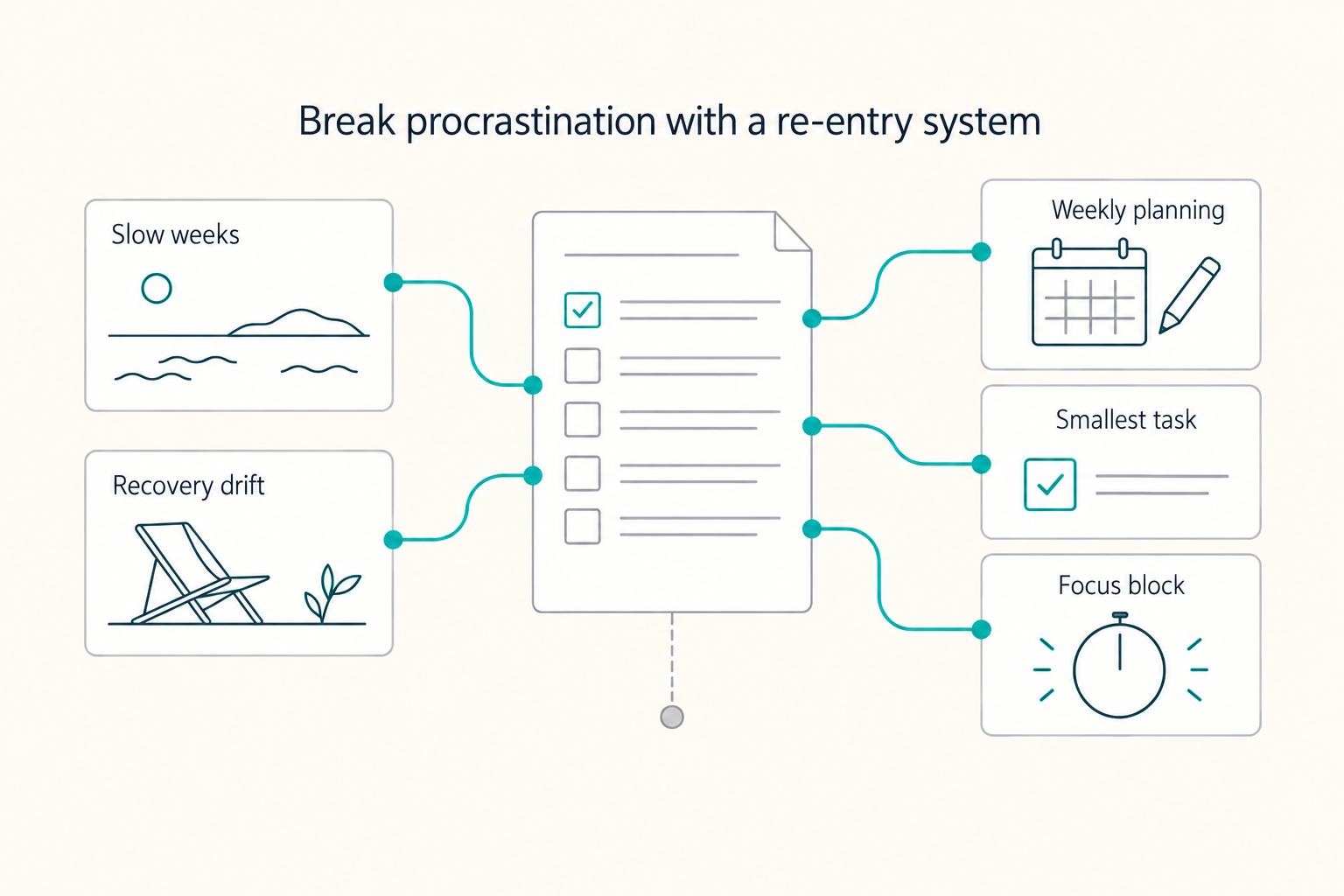
Most freelancers struggle not because they work too few hours, but because they misallocate the hours they have—treating time as an infinite resource rather than a finite business asset with a real cost per unit. The solution is a three-layer operating system: a Time Budget Framework that commits hours to four categories before any client work is booked, a Weekly Operating Template that assigns those categories to specific calendar windows, and a monthly Admin Audit Checklist that reconciles invoicing, bookkeeping, and compliance records. Multi-client orchestration requires a WIP limit, dedicated client windows, and a capacity decision rule run before accepting new engagements. Together, these systems replace reactive decision-making with a repeatable structure that keeps delivery quality consistent, records audit-ready, and the freelance practice operationally durable.
A Freelancer's Guide to the US-Germany Tax Treaty
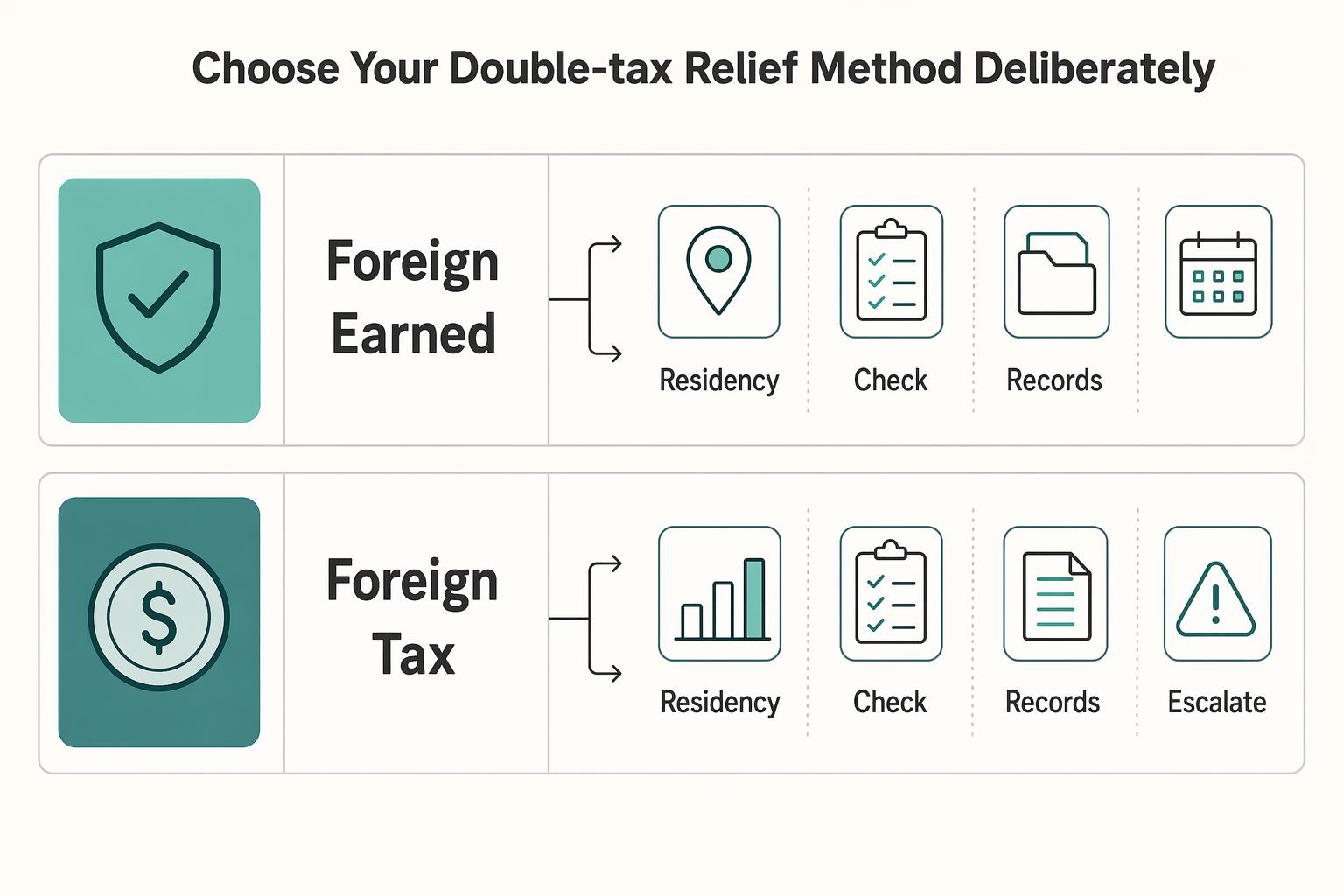
Start with residency facts you can prove, then choose your filing position, then choose structure. That order helps keep filings consistent and reduces avoidable contradictions.