
Quick Answer
Choose gift cards first for most UX research cohorts, then add direct deposit only where bank-linked records are required and your team can support failure handling. The article supports incentive benchmarks by study type, including a reminder that effects can plateau beyond $50 in many consumer surveys. The practical move is to pilot, verify exception handling, and scale only after reconciliation checks pass.
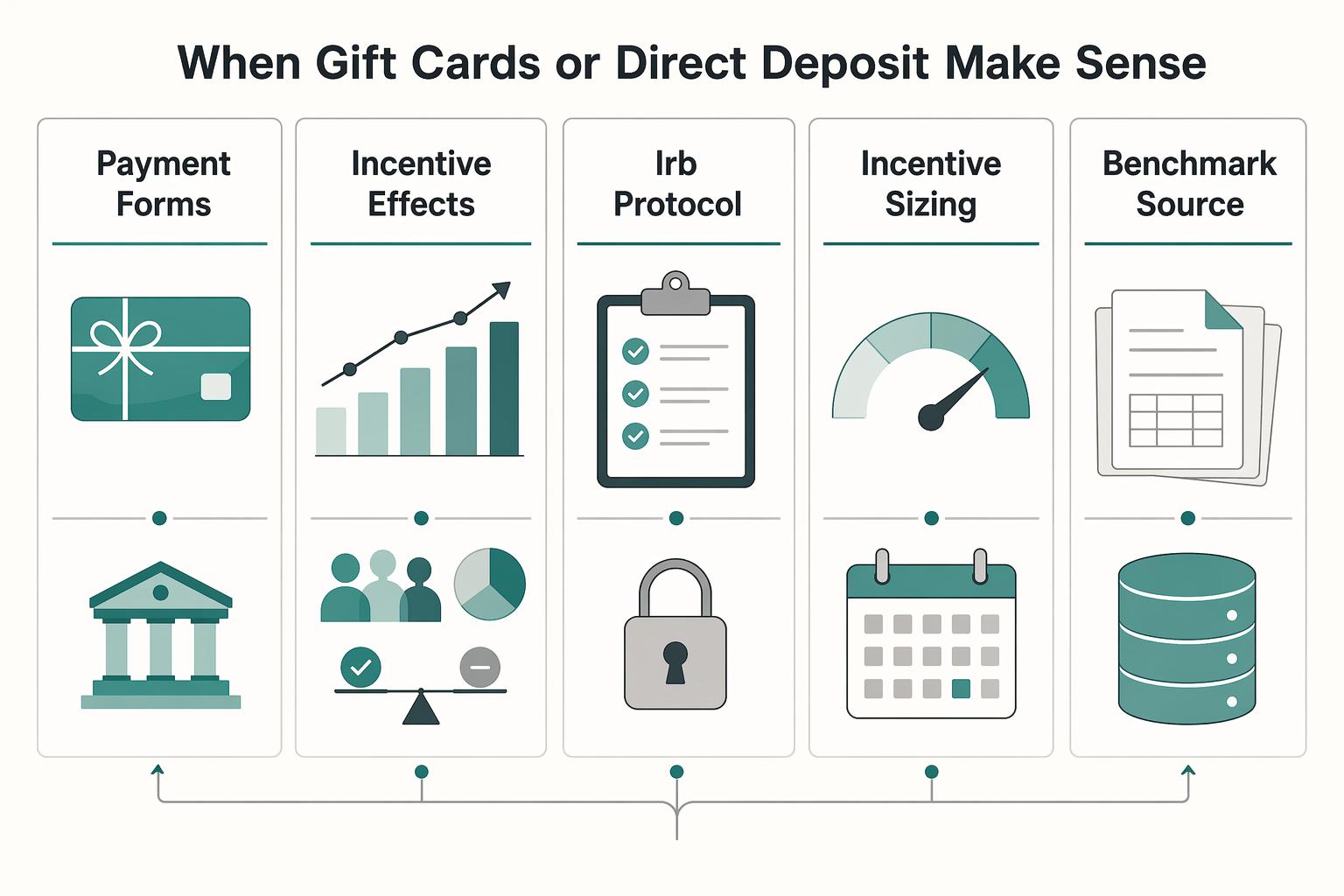
When Gift Cards or Direct Deposit Make Sense#
Research incentives are not just a budget line you approve after recruitment. They can shape who responds and how smoothly your study operations run. If you want to pay participants with gift cards or direct deposit without rollout surprises, you need to set the amount and the payout method together.
| Topic | Supported point | Boundary |
|---|---|---|
| Payment forms | Participant payments can take the form of cash, prepaid cards, digital gift cards, or direct deposits | This guide does not give verified, universal answers on gift card versus direct deposit speed |
| Incentive effects | The evidence points to effects on response rates, sample composition, response bias, and response quality | Do not confuse higher payouts with automatically better outcomes |
| IRB and protocol | If a study goes through IRB approval, the exact payment method may need to be specified there | A common failure mode is choosing a rail for operational reasons, then finding the approved documents point to a different one |
| Incentive sizing | Incentive effectiveness for most consumer surveys generally tends to plateau beyond $50 | That is not a universal rule for every study type |
| Benchmark source | One benchmark source says its guidance draws on data from 20,000+ studies | Method details are not fully visible |
That matters because incentives affect more than response volume. The evidence points to effects on response rates, sample composition, response bias, and response quality. That is a much bigger decision than "what can we afford per respondent." In practice, an incentive or payout setup that is hard for participants can shift who responds while also changing costs. For many studies, the payment rail becomes part of study design.
The method choice also has a governance edge teams often miss. If your study goes through IRB approval, the exact payment method may need to be specified there. That gives you a clean prelaunch checkpoint. Confirm whether the approved protocol names gift cards, direct deposit, or something else before you build fulfillment around it. A common failure mode is choosing a rail for operational reasons, then discovering the approved documents point to a different one.
This article helps platform, finance, and engineering teams make that choice with fewer assumptions. We note what the available information supports and what it does not. The available information supports participant payments in the form of cash, prepaid cards, digital gift cards, or direct deposits. It also supports that many teams pair fair incentives with efficient program design to improve response rates and control costs. It does not give verified, universal answers on gift card versus direct deposit speed, ACH failure rates, or jurisdiction-specific tax handling.
There is one useful boundary on incentive sizing. A cited source says incentive effectiveness for most consumer surveys generally tends to plateau beyond $50. That is not a universal rule for every study type, but it is a good reminder not to confuse higher payouts with automatically better outcomes. Another benchmark source says its guidance draws on data from 20,000+ studies. That is directionally useful even when method details are not fully visible.
By the end, you should be able to choose a payment rail, set payout rules by study type, and identify the evidence pack and approvals you need before launch. If you already know incentives matter, this is the next step. Choose a method participants will actually use and your internal teams can support.
For larger or cross-border research programs, see Clinical Trial Participant Payments: How Research Organizations Can Pay Study Participants Globally.
Gift cards vs direct deposit at a glance for UX teams#
If you need a default today, gift cards are the best-supported option here. If bank-rail traceability is mandatory, treat direct deposit and ACH as unverified until you confirm provider-specific constraints.
| Method | Delivery speed | Participant friction | Ops workload | Reconciliation effort | Support burden | Evidence status |
|---|---|---|---|---|---|---|
| Gift cards | Supported as potentially instant when automated; one platform claims instant delivery by email, SMS, or bulk link export | Supported as flexible: incentive choice can include Visa or Amazon gift cards | Supported directionally: one source says automation reduces manual admin burden | Partially supported: one platform claims tracking/reporting features | Not universally established, but digital delivery and choice suggest a simpler path in many consumer studies | Confirmed by provided excerpts |
| Direct deposit | Not established in provided excerpts | Not established in provided excerpts | Not established in provided excerpts | Not established in provided excerpts | Not established in provided excerpts | Not established in provided excerpts |
| ACH-backed flows | Not established in provided excerpts | Not established in provided excerpts | Not established in provided excerpts | Not established in provided excerpts | Not established in provided excerpts | Not established in provided excerpts |
Gift cards lead this first pass because the excerpts give you usable support: SurveyMonkey includes digital gift cards in direct survey rewards, User Interviews recommends incentive choice, including Visa or Amazon gift cards, and Giftogram positions incentives as a way to boost response rates. One platform also claims instant digital delivery and reporting, plus automatic W-9 collection for recipients at $600+.
If you are considering bank rails, validate required recipient data, payout-status visibility, exception handling, and finance-ready exports before committing.
TruCentive and Giftbit also appear in the results, but here they are still vendor marketing claims. You can treat them as positioning around digital gift cards or prepaid cards and research incentive payments, not independent proof of better outcomes.
Operating rule: if your priority is fast, low-friction payout for broad consumer research, start with gift cards and automate delivery. If bank-linked traceability is required, verify direct deposit constraints first and avoid assuming ACH advantages.
For a step-by-step walkthrough, see Visa Direct vs Mastercard Send Payouts for Platform Teams.
Set incentive amounts by study type before choosing the rail#
Set the incentive amount first, then pick the payout rail. Underpaying can reduce response rates, increase abandonment, and bias your sample toward people willing to participate for minimal compensation.
Use a simple study-type matrix, then adjust by time commitment, cognitive load, and audience scarcity.
| Study type | Burden profile | Grounded benchmark | Practical adjustment rule |
|---|---|---|---|
| Short online survey | Lower time burden, usually lower cognitive load | $5 to $15 for a 10-minute online survey | Stay near the lower end for broad, easy-to-reach samples. Move up when questions are denser, incidence is lower, or the audience is harder to reach. |
| In-depth survey or interview | Higher concentration and more active participation | $25 to $50 for 30-minute interviews or in-depth surveys | For the same stated duration, one benchmark places interviews above surveys: about $57 vs $48 for 30 minutes. If the work is interview-like, price it like one. |
| Longitudinal, diary, or multi-session study | Repeated effort, cumulative burden, higher dropout risk | $75 to $100+ | Use the upper end when retention matters or each session adds meaningful effort. |
The operating rule is simple: choose the amount first, then the rail. If you choose a rail first and compress the incentive to fit ops constraints, sample-quality risk starts before payout delivery.
A $1.76-per-minute baseline can be a reasonableness check, not a universal formula. Keep adjusting for cognitive effort and scarcity, because equal duration does not always mean equal burden.
Record your amount rationale in the study brief before recruitment opens. Capture estimated minutes, expected mental effort, audience type, and chosen band so changes stay deliberate and consistent.
Higher payouts also have limits. A June 2025 NORC brief notes diminishing returns beyond certain thresholds, but a universal cutoff is not established. If completion is weak, test design and consider prepaid incentives rather than assuming larger amounts will always fix outcomes.
If you are scaling a panel or running high-volume studies, see Mass Payments for Research Panels: How to Pay Survey Participants and Clinical Trial Subjects at Scale.
Match the payment method to your research scenario#
Choose the rail by study shape, not habit: for most short-cycle, mixed-demographic research, start with gift cards or digital incentives; use direct deposit or ACH only when you need bank-linked records and can operate the added identity, failure, and reconciliation work.
| Research scenario | If this is your setup | Start with | Why this fits | Scale shift (dozens to thousands) | Main risk to watch |
|---|---|---|---|---|---|
| One-off consumer research sprint | Fast recruiting, mixed participant profiles | Gift cards or digital incentives | One institutional source says gift cards/certificates are preferred for most studies, and one platform says setup and redemption can stay simple from 5 to 500 without account creation | Manual resend and review may work at small volume; at higher volume you need batch controls, duplicate prevention, and clear support ownership | Finance may still require bank-style payout records |
| Recurring market research panel | Repeat payments and confidentiality matter | Reloadable virtual incentive cards, or gift cards if repeat tracking is lighter | One policy page explicitly suggests virtual incentive cards for large-scale, confidentiality-sensitive studies with multiple payments | Repeat-payee tracking becomes core: participant IDs, payment history, and exception handling each wave | Support load can grow quickly when exceptions repeat |
| Ongoing UX research program | Mix of one-off tests and recurring cohorts | Split model: gift cards for broad recruiting, direct deposit only for cases that require bank records | Keeps low-friction payouts for most participants while preserving a bank-rail path where needed | Define rail rules by study type early or finance and ops exceptions will keep recurring | Direct deposit or check can conflict with anonymity requirements, and one university policy allows them only if participants are not anonymous |
Anonymity is usually the first hard decision point. If confidentiality is required, bank-linked methods can be a poor fit unless your process is built for non-anonymous handling.
When to start with gift cards vs validate bank rails#
If you run short recruitment cycles with mixed demographics, start with gift cards or digital incentives. Provider material also markets instant digital delivery, which supports fast completion workflows.
If finance requires bank-linked records, validate ACH readiness before offering it: identity collection, secure bank-data handling, participant-level status tracking, and ACH rejection triage. Without that, you are likely adding exception work rather than reducing it.
Tradeoffs teams miss at scale#
ACH exceptions are operational, not edge cases. Rejections use standardized ACH rejection codes, and returns can arrive after initial payout, including examples of 1-2 days for business accounts and 1-60 days for consumer accounts on one platform knowledge base. That can reopen reconciliation and participant support after a study appears closed.
| Issue | Grounded detail | Operational effect |
|---|---|---|
| ACH returns | Returns can arrive after initial payout, with examples of 1-2 days for business accounts and 1-60 days for consumer accounts on one platform knowledge base | Can reopen reconciliation and participant support after a study appears closed |
| Gift-card delivery | Wrong delivery channel, duplicate sends, and resend handling are named failure modes | At larger volume, even low support rates become material workload |
| Cross-border rollout | Vendor coverage claims do not by themselves confirm legal, tax, or payout feasibility by market | Confirm international and cross-border constraints with the relevant authority |
Gift-card workflows have different failure modes: wrong delivery channel, duplicate sends, and resend handling. At larger volume, even low support rates become material workload.
Confirm international and cross-border constraints with the relevant authority before expanding. Vendor coverage claims, for example large country or reward catalogs, do not by themselves confirm your legal, tax, or payout feasibility by market.
Related: Automating Market Research Incentive Disbursements: How to Pay 10000 Survey Respondents in 24 Hours.
Design payout operations finance and ops can trust#
Set the payout sequence before your first live batch and keep it fixed for every cycle: approval, request creation, idempotent execution, status tracking, then reconciliation closeout. If you cannot prove that order, exception handling usually takes over.
Keep the execution order fixed#
Start with formal incentive approval before anyone sends rewards. In some institutional workflows, disbursement does not proceed until signed Accounts Payable documentation is in place, so your approval record should at least capture the study or campaign, approved amount, recipient count, and approver.
| Step | Capture | Why it matters |
|---|---|---|
| Approval | Study or campaign, approved amount, recipient count, approver | Some institutional workflows do not proceed until signed Accounts Payable documentation is in place |
| Request creation | Unique idempotency key | Safe retries do not duplicate execution |
| Provider reference | payout_batch_id or equivalent provider ID | Track the provider reference against the internal batch record |
| Batch status | batch_status and status history | PENDING means accepted for processing, not fully paid out |
After approval, create the payout request with a unique idempotency key so safe retries do not duplicate execution. API docs explicitly support idempotency for this reason.
Then track the provider reference and status history against your internal batch record. For example, APIs may return a payout_batch_id, and early batch_status can remain PENDING after intake checks, which means accepted for processing, not fully paid out.
Evidence pack by payout cycle#
Keep a complete finance packet for every cycle:
| Evidence item | Why it matters | What to capture |
|---|---|---|
| Approval log | Confirms authorization before funds move | approver, study/campaign ID, approved total, timestamp |
| Provider reference | Makes the exact batch traceable later | payout_batch_id or equivalent provider ID |
| Payout status history | Shows processing outcome and follow-up needs | status changes, timestamps, exception notes |
| Ledger-linked export | Supports reconciliation and closeout | reconciliation/export file mapped to ledger or cost center |
If you use gift cards or cash-like incentives, keep recipient distribution evidence too. Some institutional processes require gift card distribution logs or signed receipt records. You do not need to copy any one institution exactly, but you do need clear proof of intended recipients and actual distribution.
A practical handoff model is: UX Research owns approval and recipient eligibility, Payments Ops owns batch creation, retries, and exception triage, and Finance owns ledger review and closeout. For direct deposit issues, start with Payments Ops because provider status, retry logic, and duplicate prevention usually drive resolution. For gift card issues, start with delivery and resend validation, then escalate to Finance if ledger totals no longer match issued value.
Before each batch, run one checkpoint with three tests: approved total equals batch total, recipient list matches the latest approved export, and each respondent appears once for that wave. Provider intake may catch syntax or duplicated keywords, but duplicate-recipient prevention should happen before submission.
Prevent the failure modes that hurt completion and trust#
Treat payout failures as active incidents, not aging tickets. In research programs, payout mistakes can reduce participant trust, hurt data quality, and make later recruitment harder.
The common failure patterns are predictable: delayed delivery, failed ACH or direct deposit attempts, duplicate sends, wrong channel data, and payouts marked complete that participants still cannot access. For status handling, failed and returned are immediate-action states, and posted still does not guarantee the participant has received funds.
Triage by failure type#
| Failure case | Verify first | Immediate action | Escalate when |
|---|---|---|---|
| Participant says payout not received | Provider reference, payout status, timestamp, intended channel | Confirm whether the payout is processing, posted, failed, returned, or canceled. For bank payouts, check any ACH return code. | Immediately for failed or returned; review again after the normal return window if posted but still missing |
| Payout sent to wrong channel | Approved recipient data vs. actual destination used | Pause resend until destination data is confirmed. If an email was entered incorrectly, troubleshooting may require resending. | Immediately, to prevent compounding errors |
| Payout marked complete but participant cannot redeem | Delivery proof, redemption link or code state, recipient identity match | Reconfirm the exact code or link sent, and verify the participant is using the correct inbox or account. Do not replace until the original is confirmed unusable. | Same day when redemption blocks study completion or follow-up participation |
For ACH or direct deposit, the return reason is often more useful than a generic failure label. ACH return codes identify why the payment was returned; for example, R03 means the destination account could not be located, and one reference lists a 2 Banking Days timeframe. When that pattern appears, move to recipient-data correction and controlled reissue instead of waiting for settlement.
Set timing rules before the first complaint#
Define internal escalation timing before launch. There is no single universal SLA, but your team should at minimum acknowledge participant reports quickly, open an ops case immediately for failed or returned payouts, and recheck unresolved posted payouts after the provider's normal investigation window. Returned payouts are often visible within 2-3 business days, and research payment guidance supports paying as soon as required participant action is completed.
If unresolved payout tickets carry into the next study wave, treat that as an operations-control failure, not routine support noise.
After each campaign, run a short post-mortem and store it with the payout evidence pack:
- Root cause category: bad recipient data, duplicate retry without idempotency, provider delay, redemption issue, or support handoff gap
- Fix owner: UX research, Payments Ops, Finance, or provider support
- Prevention control for next cohort: recipient data revalidation, idempotency-key enforcement, status-based alerting, or resend approval rules
If duplicate sends happen even once, treat them as high severity. Idempotent retries exist to prevent duplicate effects, and duplicate payments create refund work, support burden, and trust damage.
Set compliance and data boundaries before you scale#
Set compliance and data controls before rollout, especially if you are adding direct deposit or ACH. Get participant payment arrangements approved in governance before disbursement, validate requirements country by country, and treat bank-account data handling as a release gate.
| Control area | What to enforce now | What not to assume |
|---|---|---|
| Study governance | Keep approval records for payment method, timing, and amount before disbursement | Ops can change payout terms later without governance review |
| Incentive design | Include an anti-coercion check, not just a budget check | Higher incentives are only a recruiting choice |
| KYC/KYB/AML | Validate requirements per country before enabling a market | One checklist works everywhere, or processor verification alone satisfies your independent legal duties |
| Bank data handling | For applicable ACH use, protect stored account numbers by rendering them unreadable | ACH details can be stored in plain text, or gift cards automatically remove data-handling obligations |
For ACH rails, one concrete threshold in the Nacha rule is 2 million Entries annually for covered entities tied to unreadable-at-rest protection. Even if you are below that volume, use the same operating posture early: keep only what you need and tightly control who can access payout data.
Tax-document rules are not universal in this section. A Duke participant-payment FAQ says a threshold changed from $600 to $2,000 per calendar year effective January 1, 2026; treat that as institution-specific until legal and finance confirm your jurisdictions.
Use this caveat line internally: consumer research payout coverage, verification duties, and tax-document obligations are market-specific, so no rail should be treated as globally ready without local validation.
Use this launch checklist before paying your first large cohort#
Run one small, instrumented pilot before you send a large payout batch. In practice, launch failures usually come from request and retry handling, duplicate creation after connection failures, or weak event and support coverage, not from gift cards vs. direct deposit alone.
| Launch gate | What to verify | Red flag |
|---|---|---|
| Segment setup | Each respondent segment has a confirmed study type, incentive tier, and rail before payout creation | One batch mixes segment rules without clear separation |
| Request safety | Payout file or API payload is validated, create calls use idempotency keys, and retries reuse the same key | Retrying a failed create call with a new key |
| Event handling | Your team processes payout status events and has a runbook for undelivered webhook events | Assuming webhook delivery is one-time and complete |
| Pilot readiness | A small cohort is paid end to end, then reviewed for completion issues and support tickets | Going straight to full volume |
| Release control | Finance signoff, ops monitoring, and participant-support ownership are assigned before launch | No owner for failed transfers or redemption complaints |
The control to enforce is idempotency. If a connection drops after a payout create request, replay the same keyed request instead of generating a new key. Same-key replay should return the same result, including server-error responses, so your retry logic should treat that as a deterministic state, not a reason to create another payout object.
As volume rises, event-driven monitoring becomes more important. Include webhook-failure handling in launch runbooks because documented retry windows can run for up to 3 days. After the pilot, review completion outcomes, ticket categories, and the related request and event logs before a full rollout.
If you are working through participant payments more broadly, try the free invoice generator.
Conclusion#
Choose the rail and the operating controls at the same time. That is the clearest takeaway here. If you separate the incentive decision from the finance and support reality, you will create avoidable cleanup work later.
The evidence you can stand behind is narrower than many teams want, but it is still useful. Incentives increase survey response, and in the cited analysis money outperformed vouchers and lotteries, with reported response-rate effects of RR 1.25 for money versus 1.19 for vouchers and 1.12 for lotteries. So your first decision is not "gift cards or direct deposit?" Ask whether the incentive is meaningful enough for the burden of the study. Do not pretend there is one proven amount that fits every survey, interview, or longitudinal project.
From there, pressure-test the payout method against your actual controls. Before launch, make sure the participant-facing payment language states both the method and the timing. UCSF's guidance is explicit on this point: the consent form should explain how participants will be paid and how long they will have to wait. That sounds minor, but it is a verification step worth making explicit. It can also affect participant trust when payments are delayed or disputed.
Your finance checkpoint matters just as much. Keep payment documentation for each distribution, and do not let reconciliation drift into a vague future task. The grounded policy example here requires reconciling and replenishment not less often than quarterly. If you cannot show who was paid, by which method, and whether the payout actually settled, you do not yet have a scaled incentive process. If participants might receive $600 or more in a calendar year, pull tax handling into the conversation early rather than after the campaign is live.
ACH WEB-debit flows need extra care, but only where the rule applies. If you run a WEB debit flow, the Nacha rule effective March 19, 2021 requires account validation before first use and again after an account number change. Do not overread that into a blanket claim that all payout risk is solved, and do not underread it if you are collecting account details online.
So the practical verdict is straightforward: use evidence to justify the incentive, then use operations readiness to justify the rail. If you are still missing proof on a key point, such as exact payout amounts by study type, cross-border feasibility, or the real support burden of your chosen method, treat that as a pilot question before you scale. Assumptions are cheap at kickoff and expensive in reconciliation.
Related reading: How to Build a Spend Control Policy for Virtual Cards on Your Platform.
Frequently Asked Questions
How much should we pay research participants for different study formats?
Do not assume a fixed federal participant payment amount applies. You should set compensation based on the time, inconvenience, and participation burden involved. Do not assume one verified schedule fits every online survey, interview, diary study, or longitudinal project. One practical check is tax handling: if a participant reaches $600 in a calendar year, the UCSF guidance notes that amount is reportable as taxable income to the IRS.
Are gift cards better than cash for survey incentives?
Not for response outcomes. In a meta-analysis covering 46 RCTs, 109,648 participants, and 14 countries, money outperformed vouchers and lotteries, with RR 1.25 (95% CI 1.16 to 1.35) for response rate. So if your question is strictly about increasing responses, do not assume gift cards beat cash. Gift cards may still be easier to distribute operationally, but that is a separate operational consideration from response rates.
When should a UX team choose direct deposit over gift cards?
This guide does not establish a universal rule for choosing direct deposit over gift cards. A practical screen is operational readiness: if you cannot reliably collect bank details, handle transfer failures, and support participant troubleshooting, direct deposit may add risk. If those controls are in place and you need bank-linked payout records, direct deposit may be reasonable.
Does paying more always improve survey completion quality?
Not necessarily. The current evidence supports a response rate lift from monetary incentives, not a blanket claim that higher payments always improve completion quality or data quality. If you raise incentives, treat it as a measured test and review completion rates, low-effort responses, and cost per complete rather than assuming more spend fixes weak study design.
What can we confidently conclude from current sources and what remains unknown?
We can say three things with confidence. There is no fixed federal payment amount, money improves survey response rates better than vouchers or lotteries, and ACH debit risk programs need active return-rate monitoring. We cannot claim exact incentive amounts by study type, that gift cards outperform cash, that direct deposit is always lower friction, or that cross-border coverage, fees, and failure rates are established here. That is the line between evidence and assumption for teams deciding how to pay participants.
How should we validate ACH and direct deposit risks before a full rollout?
Start by separating what you know applies to WEB debits from what does not automatically apply to ACH credits or direct deposit. The WEB Debit Account Validation Rule, effective March 19, 2021, requires account validation before first use and again after an account number change, so if you ever debit accounts collected online, build that check in. For ACH debit risk monitoring, track unauthorized returns against 0.5%, administrative returns against 3.0%, and overall returns against 15.0%. Then consider a small pilot, inspect return codes and account-change errors, and only scale once support can explain failed transfers.
Try a related tool
Researched and edited by the Gruv editorial team. Gruv builds cross-border billing, payouts, and finance-operations software for global businesses.
Sources
- accounting.uci.edu/support/guides/research-participants.phptrusted
- chass.ncsu.edu/intranet/research-office/award-management/in...trusted
- chibe.upenn.edu/wp-content/uploads/2023/10/Payment-Incentive...trusted
- dartmouth.edu/finance/purchasing/buying_paying/research_pa...trusted
- docs.stripe.com/api/idempotent_requeststrusted
- hrpp.umich.edu/wp-content/uploads/sites/4/2025/04/CSP_Payme...trusted
- irb.duhs.duke.edu/sites/default/files/2025-12/Research%20Parti...trusted
- irb.ucsf.edu/research-participant-paymentstrusted
Educational content only. Not legal, tax, or financial advice.
Related Posts
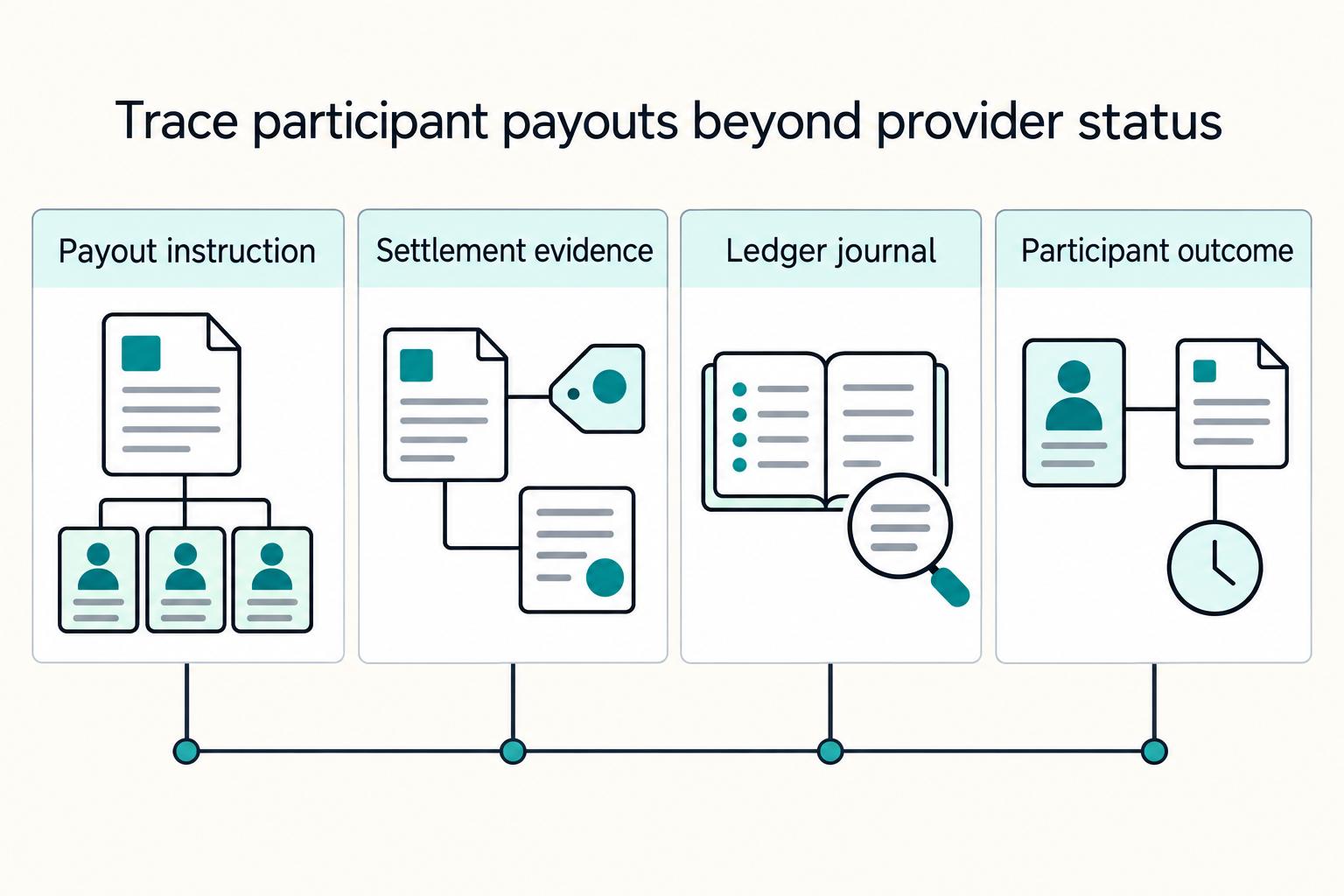
Mass Payments for Research Panels: How to Pay Survey Participants and Clinical Trial Subjects at Scale
You may be able to run a research panel and a clinical trial program on one payout operating model if you keep protocol work separate from payout operations. This guide uses a 30-day planning window to help you choose the model, sequence implementation, and prepare a controlled first launch across both program types.
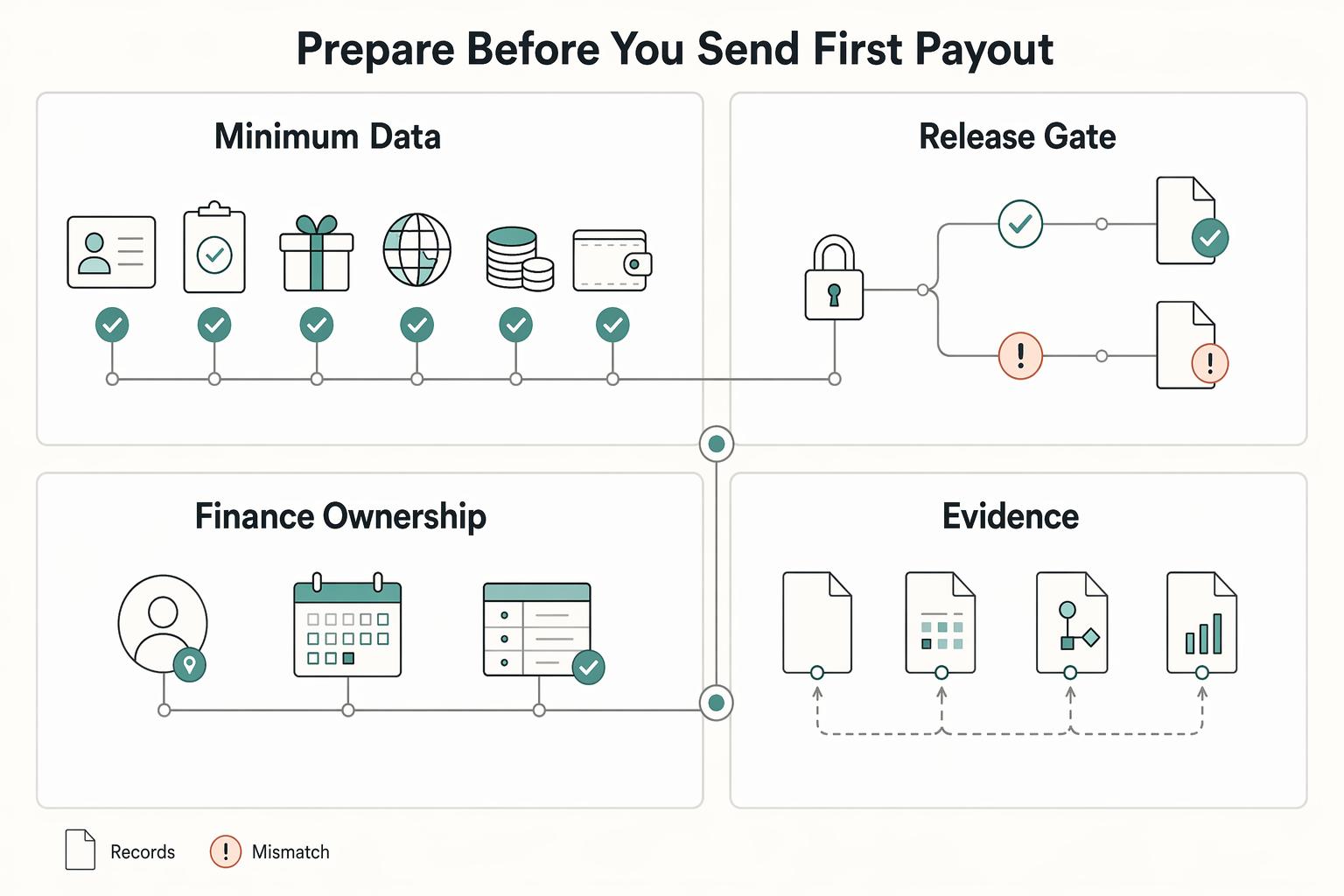
Automating Market Research Incentive Disbursements for 10,000 Respondents in 24 Hours
Many guides fail because they define success as sending messages quickly. At 10,000 respondents in 24 hours, the real job is speed with control. Rewards need to go out fast, but you also need to know which payouts were delivered, which are still pending, and which should never have been released.
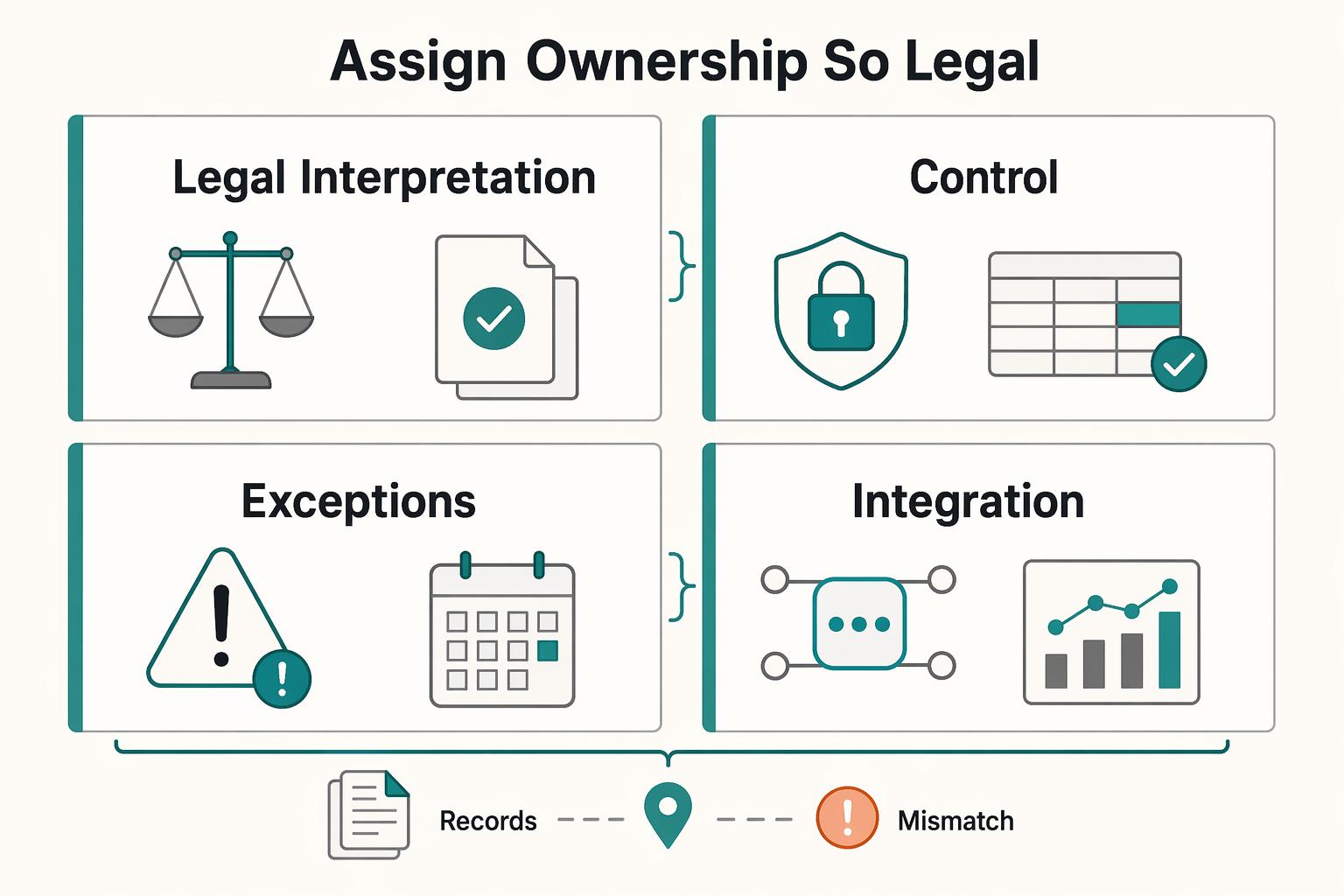
Clinical Trial Participant Payments: How Research Organizations Can Pay Study Participants Globally
Global participant payouts can break when compliance and privacy are treated as late legal reviews after the payment flow is already built. If you need to scale, payout design should start as a product requirement, with clear ownership across product, finance, ops, and engineering.