
Quick Answer
Define a rail-specific completion target, create one entitlement per approved respondent event and persist a stable payout operation key. Test an authorized canary, reuse supported idempotency identifiers for uncertain retries and reconcile provider resource status with internal records. A 24-hour target depends on funding, provider capacity, delivery timing and exception handling.
Plan a 10,000-respondent incentive run with a 24-hour target#
Step 1 Set the right success target#
Treat 10,000 respondents in 24 hours as an operational target, not a delivery guarantee. Define the clock and completion event per rail: a reward issued, an email delivered, a mobile top-up completed or a bank transfer settled. Recipient redemption is a separate event that you cannot promise within the launch window.
Provider acceptance, delivery and redemption are different states. Tremendous processes a single-reward API order synchronously, then delivers email rewards asynchronously. Its delivery-success webhook confirms email delivery, not redemption, and does not apply to LINK rewards. Keep provider-specific states and retrieve current resource status when events are missing or ambiguous.
Step 2 Balance the three pressures that collide at scale#
At this volume, you are managing three competing goals at once: participant experience, fraud risk, and finance-grade reconciliation. On the participant side, the rule is simple: survey incentives work best when the reward feels quick and reliable. Slow or inconsistent delivery can hurt trust.
Fraud controls should reflect your own program: repeated survey submissions, reused destinations and unusual activity can warrant investigation. Shared household details are not conclusive proof of abuse. Preserve the eligibility decision and give uncertain cases a review path.
The third pressure comes from finance and operations. They need visibility while the run is live, not just a total after the fact. Before launch, confirm you can see every payout intent, amount, country, and current state in one place. You should also be able to explain why a payout is marked sent, pending, failed, or held.
Step 3 Build for automation that stays auditable across markets#
This guide is not just about sending faster. It is a practical path to automate disbursements with API calls for payout creation, webhooks for state changes, and records that still hold up when finance asks for proof. In practice, each payout needs an audit-ready trail: who was eligible, what was sent, through which rail, when the provider accepted it, and what final status came back.
Confirm the exact country, product, denomination, currency and account permissions before launch. Catalog coverage and recipient eligibility vary. A supported country does not prove every reward or payout method is available there; test the actual cohort configuration.
If you want a deeper dive, read How to Pay Research Participants: Survey Incentives Gift Cards vs. Direct Deposits for UX Teams.
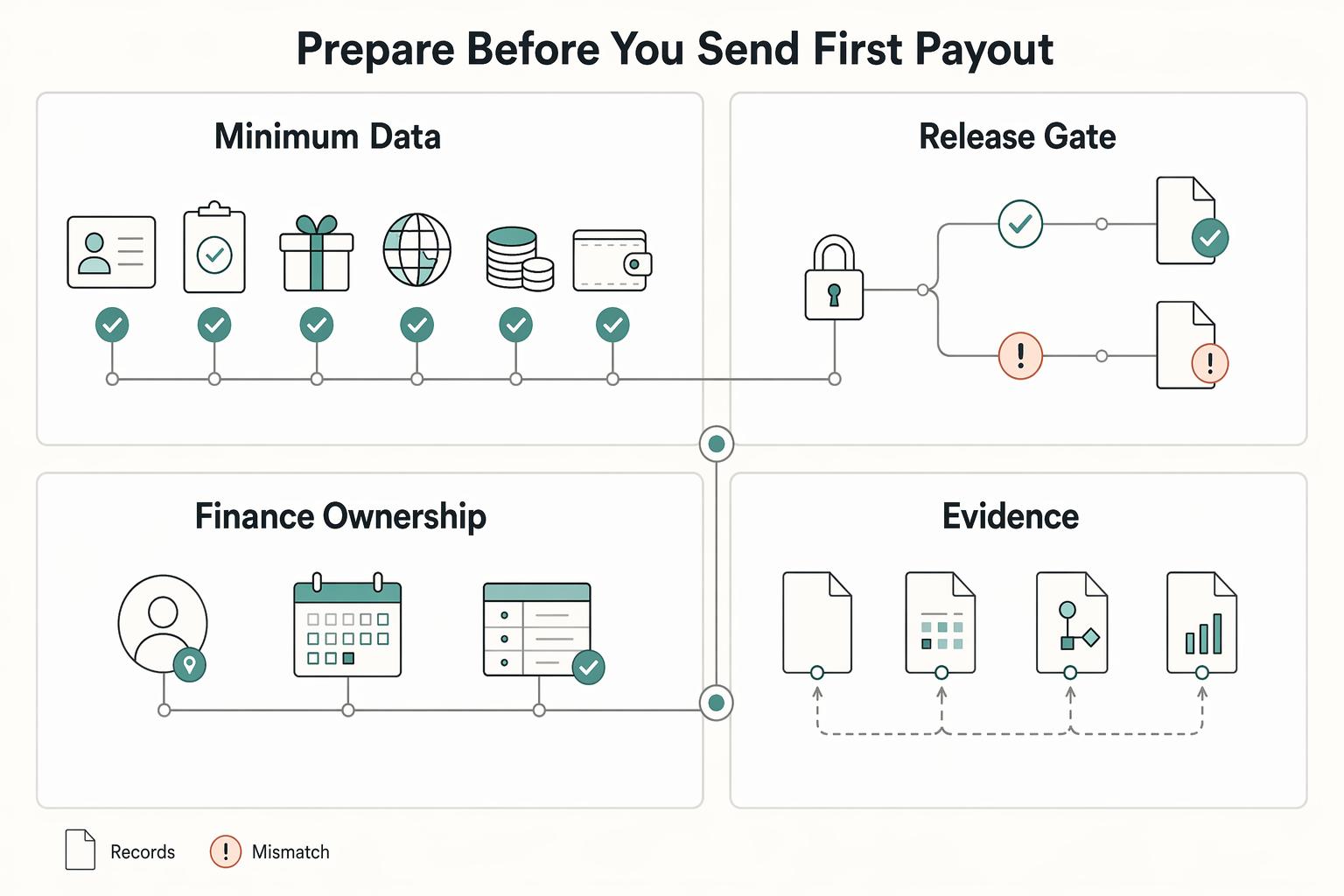
What to prepare before you send the first payout#
Most first-run payout problems come from setup gaps, not sending speed. Before launch, lock the required inputs, decision gates, and owners so the team is not improvising mid-run.
| Prep area | What to define | Article detail |
|---|---|---|
| Minimum data contract | Required record fields | study ID; respondent ID; approved event ID; eligibility; rail; currency; amount; protected destination; stable payout operation key |
| Policy gates by payout lane | Release rules by lane | define the release gate, who clears it, and whether missing data creates a hold or a hard block |
| Finance ownership | Named finance roles | one budget approver; one exception monitor; one owner for reconciliation exports |
| Document path | Document handling | applicable tax forms and reporting obligations; collection channel; reviewer; restricted record references |
- Define the minimum data contract.
Include study ID, respondent ID, approved event ID, eligibility, rail, currency, amount and a protected destination reference. Enforce one payable entitlement per approved event, allowing distinct approved events for the same respondent. Use a stable operation key across retries; changing the key can create a second payment.
- Map policy gates by payout lane.
Incentives may run through bank transfers, digital gift cards, prepaid cards, or wallets, and lanes can differ by compliance path and market coverage. For each lane, define the release gate, who clears it, and whether missing data creates a hold or a hard block.
- Assign finance ownership before launch.
Set one budget approver, one exception monitor, and one owner for reconciliation exports. Lock incentive values by cohort up front so approvals do not stall while payouts are in flight.
- Prepare the document path.
Finance determines which tax documentation and reporting apply to the payment and recipient; W-9/W-8 collection and 1099 reporting are not universal release requirements. Keep forms in restricted systems and link only a status/reference to the operational record.
Choose the right incentive rail for each respondent segment#
At volume, a single rail for every respondent creates avoidable exceptions. Choose by segment, using only constraints you can verify before launch.
| Rail | Delivery speed checkpoint | Geographic fit checkpoint | Failure tolerance checkpoint | Respondent preference checkpoint |
|---|---|---|---|---|
| Digital Gift Cards | Run a live canary and confirm issue-to-redemption works end to end | Verify the exact country, brand, and denomination you plan to offer | Track unclaimed, expired, or reissued rewards in the canary | Confirm the offered catalog is actually useful to that segment |
| Airtime Top-Ups | Test confirmation timing with real recipient numbers | Validate country and carrier mapping before release | Track failed matches and required reroutes | Confirm this segment uses prepaid mobile value |
| Data Bundles | Test bundle activation and recipient confirmation | Validate bundle type at the carrier level in each target market | Track unusable assignments and support contacts | Use only where connectivity value is meaningful to respondents |
| Bank or direct payout | Test initiation and final settlement states | Validate required destination fields for each market | Track rejects, holds, reversals, and manual interventions | Use when cash-equivalent delivery is required |
-
Segment by payout constraints first. Use country, approved amount, incentive type, required destination data, and release-gate requirements to define lanes before you send anything.
-
Validate rails with evidence, not headline claims. A rail is viable only if your canary confirms delivery, reconciliation references, and clear final statuses for your exact cohort.
-
Protect recipient data. Limit access to contact and payout details, retain only necessary fields and define incident handling. Choose the rail for recipient needs and applicable program requirements.
-
Build provider redundancy before scale. Evaluate options such as Reloadly, Giftogram, eGifter Rewards, and Tremendous by lane fit, status artifacts, and fallback readiness for each segment.
A practical rule: document one alternate rail for every high-volume segment before the run starts.
Build the disbursement flow in the right order#
At this stage, optimize for control and traceability, not just speed. For high-volume runs, use payout infrastructure built for scale and keep your own payout record as the operating source of truth.
- Start with a platform that supports the rail mix you already chose.
Confirm that the provider supports your chosen methods, funding source, API volume and market configuration. Ask what limit applies to order creation versus delivery, and test throttling and validation errors. Method choice alone does not establish capacity.
- Keep a clear internal record for each payout.
Persist the approved entitlement and operation key before calling the provider. For example, Tremendous makes orders idempotent through external_id: reuse it for the same order, and a changed payload with that ID conflicts. Webhook UUID deduplication is separate; it prevents repeated event handling, not repeated order creation. Authenticate callbacks using the provider’s documented verification method before applying state changes.
- Build reconciliation into the flow, not after it.
Store requested and provider amounts, currencies, fees, order/reward or transaction IDs, delivery state and refunds. Reconcile those records to the funding debit and ledger. A delivered email is evidence of delivery, not proof of redemption or bank settlement.
- Use vendor claims as directional input, then validate in your own runbook.
Provider materials can surface useful options, but your team should confirm performance in your own environment before broader rollout.
If you want this process to hold up at scale, prioritize repeatable execution with auditable records over one-click sending.
Add fraud and compliance controls without slowing everything down#
Put fraud and compliance checks directly on the release path, with two lanes: immediate block and short hold. That keeps payout speed while preventing expensive cleanup after funds are sent.
| Control | What it covers | Article detail |
|---|---|---|
| Layered checks | Pre-release screening | duplicate respondent detection; velocity caps; country-risk rules; one respondent maps to one payable record per approved event |
| Compliance status gate | Release-time status check | verify the checks required for this program and rail; unresolved mandatory checks hold release |
| Block vs hold | Disposition rules | block clear abuse patterns; hold uncertain cases for analyst review; named owner; response SLA; escalation path |
| Evidence pack | Transaction record evidence | triggered rule; reviewer action; final disposition; timestamped decision trail tied to the same internal transaction ID |
-
Apply layered checks before release. Use duplicate respondent detection, velocity caps, and country-risk rules together. Your baseline check is simple: one respondent maps to one payable record per approved event, and exceptions are visible before submission.
-
Gate release on current compliance status. If your program requires AML checks, sanctions or risk screening, or KYC completion, verify those statuses at release time for the exact payout intent being submitted. No current pass status means no release.
-
Define block vs hold before launch. Block clear abuse patterns. Hold uncertain cases for analyst review, with a named owner, a response SLA, and an escalation path so operators do not bypass controls to keep a batch moving.
-
Store an evidence pack on the same transaction record. For each blocked or held payout, keep the triggered rule, reviewer action, final disposition, and timestamped decision trail tied to the same internal transaction ID. That gives ops, compliance, finance, and support one audit-ready record.
Run the 24-hour launch window with clear checkpoints#
Run the first 24 hours in controlled waves, not one large release, and only expand when your own operational signals stay healthy.
Step 1 Start with a canary batch and scale only on confirmed outcomes#
Send a small authorized canary and confirm its selected completion event before scaling. Test duplicate requests, dropped responses and missing callbacks as well as successful delivery. Use provider IDs and resource retrieval to recover state; do not depend exclusively on webhooks.
Illustrative plan: reserve 100 canary entitlements and 9,900 remaining entitlements. At $10 each, principal budget is $100,000 plus approved fees/FX. A canary with 96 delivered, two failed and two unknown is still 100 submitted—not 96 submissions. Investigate the unknowns before replacement; count failed entitlements against a new attempt only after confirming no reward remains payable. For 10,000 orders over a 20-hour sending window, average submission demand is 500/hour (about 8.3/minute); provider limits, delivery latency and review capacity still determine feasibility.
Step 2 Watch the three dashboards that decide whether you continue#
Keep these dashboards live throughout the launch window:
| Dashboard | What to track | Why it matters |
|---|---|---|
| Payout completion by rail | completion by route | isolate a weak lane without stopping everything |
| Exception queue aging | how long held, failed, or ambiguous records remain unresolved | launch pace does not outrun review capacity |
| Budget burn against the approved cap | committed and completed value against the approved run budget using the same IDs used in ledger and reconciliation views | keeps the live run tied to the approved cap |
Step 3 Define the rollback trigger before the first wave goes out#
Set pause conditions and name who can stop new waves or approve alternatives. Pausing submissions does not cancel rewards or transfers already in flight. Use a fallback only after confirming the original cannot still deliver and obtaining any necessary recipient agreement.
Recover cleanly when payouts fail or partially complete#
When payouts fail or partially complete, use a fixed recovery sequence: classify the case, verify status, choose one controlled action, then close out with documented outcomes.
Step 1 Classify validation failure before creation, confirmed delivery failure, fraud hold, unknown state, confirmed delivery and later reversal. Give each class an owner and an allowed next action; a delivery failure may leave an existing reward available for redelivery.
Step 2 Retrieve the existing order/reward or transfer before acting. Retry an uncertain create request using the same supported idempotency key. Redeliver an existing reward where supported rather than purchasing another. Authorize a new attempt or alternate rail only after confirming the original cannot still pay.
Step 3 Align respondent support replies to the same verified status classes. Give support approved language for each class and require them to check the current status and latest record details before making any payout commitment.
Step 4 Record recovery counts, costs, status age and causes. Update validation, retry and support procedures from the incident evidence before the next run.
Close the loop for finance and audit teams#
Treat a payout run as closed for finance only when disbursement intent, provider outcome, and ledger posting reconcile, and open exceptions are explicitly tracked.
- Build one reconciliation pack per batch that includes intent records, provider final statuses, and ledger postings keyed to the same internal transaction ID and provider reference.
- Separate statuses in your workflow: operationally complete (
paid) is not accounting complete until reversals, rejects, unknowns, and unmatched postings are reviewed and resolved or formally carried forward. - Finance determines applicable tax reporting from payment and recipient facts; retain restricted tax-document references where needed. FEIE and FBAR are not default respondent-payout close checks.
Copy-paste launch checklist for your next incentive disbursement run#
- Record the clock start, eligible population and completion event for each rail.
- Confirm approved principal, fees/FX, funding and provider limits.
- Test country/product/destination validation and recipient delivery with an authorized canary.
- Enforce unique entitlements, stable create-operation keys and separate event deduplication.
- Name pause, review, recovery and fallback owners; never replace an unknown in-flight reward blindly.
- Export entitlement, provider state, fees, funding and ledger records; carry unresolved cases with owners and next actions.
Frequently Asked Questions
How do we pay 10,000 survey respondents in 24 hours without creating duplicate payouts?
Enforce one entitlement per study/respondent/approved event and persist a stable payout operation key before submission. Reuse the provider-supported idempotency identifier for uncertain retries, deduplicate webhook events separately and check existing resources before replacing rewards. Confirm capacity and rail-specific delivery timing against the 24-hour target.
Which is better for global surveys: Digital Gift Cards, Airtime Top-Ups, or direct bank payouts?
Choose a usable option for the respondent’s country and preference. Gift cards need the right brand/denomination; airtime and data require compatible carrier/product details; bank payouts need valid destination fields and settlement time. Compare actual fees, delivery states and failure handling in an authorized canary.
What is the minimum control set before enabling fully automated disbursements?
Before automation, require verified eligibility, a unique entitlement, approved amount/currency, protected destination, funded budget, stable operation key, required program checks and named exception owners. Test duplicate submission and ambiguous-state recovery before releasing volume.
What should we monitor in real time to know the payout run is healthy?
Track completion by rail and completion-event definition, unknown-state age, held/failed cases, delivery latency, duplicates and budget committed against the cap. Track redemption separately where observable; do not report every created order as delivered.
What are the most common failure modes in API and webhook-based incentive payouts?
Common failure classes include invalid destination before creation, accepted orders with delayed delivery, bounced reward emails, missed or duplicate callbacks, request timeouts with unknown creation state and later reversals. Retrieve existing resources before retrying or replacing; delivery failure does not necessarily mean the reward purchase failed.
How should finance verify completion before closing the payout batch?
Finance should close only when intent records, provider final statuses, and ledger postings reconcile to the same internal transaction ID and provider reference. The article also separates operationally complete (paid) from accounting complete, so reversals, rejects, unknowns, and unmatched postings still need review before the batch is treated as closed.
Who should own compliance checks like KYC, AML, and tax-document gating in this process?
The research owner verifies eligibility; operations owns submission and recovery; compliance defines applicable screening and release conditions; finance owns budget, tax reporting and reconciliation. Record the actual owner and delegate for each hold path before launch.
Try a related tool
Researched and edited by the Gruv editorial team. Gruv builds cross-border billing, payouts, and finance-operations software for global businesses.
Sources
Includes 5 external sources outside the trusted-domain allowlist.
Educational content only. Not legal, tax, or financial advice.
Related Posts
How UX Teams Should Pay Research Participants with Gift Cards or Direct Deposit
Research incentives are not just a budget line you approve after recruitment. They can shape who responds and how smoothly your study operations run. If you want to pay participants with gift cards or direct deposit without rollout surprises, you need to set the amount and the payout method together.
How to Automate Client Reporting with Google Data Studio and Supermetrics
If clients rarely engage with your reports, your value story feels fuzzy, and month-end reporting keeps eating into paid work, the fix is usually not more charts. It is tighter operating discipline. The Client Reporting Flywheel is a practical model for turning reporting into three linked outcomes: proof of value, clearer scope control, and better growth planning.
3-Way PO Matching for Marketplaces and Automated Invoice Verification
**Start here: treat three-way PO matching for marketplaces as a control decision, not a software toggle.** If you are still checking invoices only against a purchase order, you can miss cases where the invoice looks right on paper. The delivered item or service may still not match what was ordered.