
Quick Answer
Start with a strict go/no-go decision: launch only after your team can evidence how contractor payouts satisfy SBV expectations and corridor-specific FX obligations. NAPAS, VietQR, and CITAD show useful rail coverage, but they do not confirm that your model is compliant or operationally ready. Build one documented path from funding through disbursement, including KYC-linked release controls, retry behavior, and reconciliation records, then validate it in a constrained pilot before wider rollout.
What to know before paying contractors in Vietnam#
Vietnam can be a conditional go for contractor payouts, not an automatic one. Fast domestic rails exist, but your decision should come down to whether your exact payout flow is workable and compliant.
What is confirmed:
- SBV is the lead financial regulator.
- NAPAS runs the primary instant payment system.
- The commonly cited rail set is NAPAS, VietQR, and CITAD.
- In this context, real-time payments are described as 24/7 instant credit transfers, typically settling in less than 10 seconds, and NAPAS is cited as connecting over 40 banks.
- NAPAS and CITAD have different roles. NAPAS is for retail transactions. CITAD is for high-value interbank payments.
What those rail facts do not confirm:
- The cited scope centers on P2P, e-commerce, and merchant payments. Contractor payouts are not explicitly stated.
- The cited material also notes there is no formal legal definition of real-time payments, so interpretation can depend on functional system practice.
- Availability of NAPAS or VietQR is not proof that your platform can compliantly launch contractor disbursements.
Use this guide as a go/no-go filter, not a market-hype check. Start by mapping your payout path in plain terms: who funds the payment, whether FX conversion occurs, where it occurs, which rail is used, and what records you retain if a payout is questioned.
Follow this sequence:
- Verify rail roles in your design, including where NAPAS, CITAD, and VietQR do or do not fit.
- Validate regulatory and FX unknowns for your specific payout structure before you build.
- Design payout operations so you can handle approvals, exceptions, and traceable records.
- Pilot only the narrow flow you can evidence end to end.
Scope note: this guide is about contractor payout readiness for platforms, not consumer QR checkout expansion or QR initiatives such as VIETQRGlobal. Keep one boundary in view as well. Domestic use of digital currencies as payment instruments is prohibited.
Make a go or no-go call before you scope engineering#
Set a hard gate: if you cannot verify SBV expectations for your exact contractor payout flow and related FX handling, do not proceed to full launch. Fast rails help, but they do not answer the legal and operational questions that determine whether your model works.
Verify the regulatory path for your exact flow. Start by mapping one end-to-end payout path: who funds, where conversion happens, and which entity handles funds at each step. Your real test is not "Vietnam has NAPAS and VietQR." It is "we can document the full flow without assumption gaps."
Use a written review against the APEC fintech report (September 2024), including the Viet Nam case-study section 5.8, as a practical checkpoint. It is not an approval, but it gives your team a concrete way to review Vietnam-specific regulatory context.
Separate rail proof from payout readiness. Treat NAPAS availability as a useful signal, not proof. Techcombank reports transaction bank volume via NAPAS ranked #1 in the industry, and reports 91% of retail transactions conducted digitally. That supports strong domestic digital payment usage, but it does not validate your contractor payout model on its own.
If a partner or vendor flow cannot clearly show contractor onboarding, payout approval, and exception handling on the selected rail, pause before engineering.
Downgrade assumption-heavy launches to conditional go. If launch depends on undocumented assumptions about VND conversion or outbound CNY movement, classify Vietnam as conditional go. Upgrade only after you have an evidence pack: flow diagram, legal Q&A, partner confirmations, and retained payout and reconciliation records.
If critical unknowns remain after discovery, consider a limited pilot instead of a full rollout. That is an operating control, not a legal requirement.
Gather prerequisites and evidence before vendor demos#
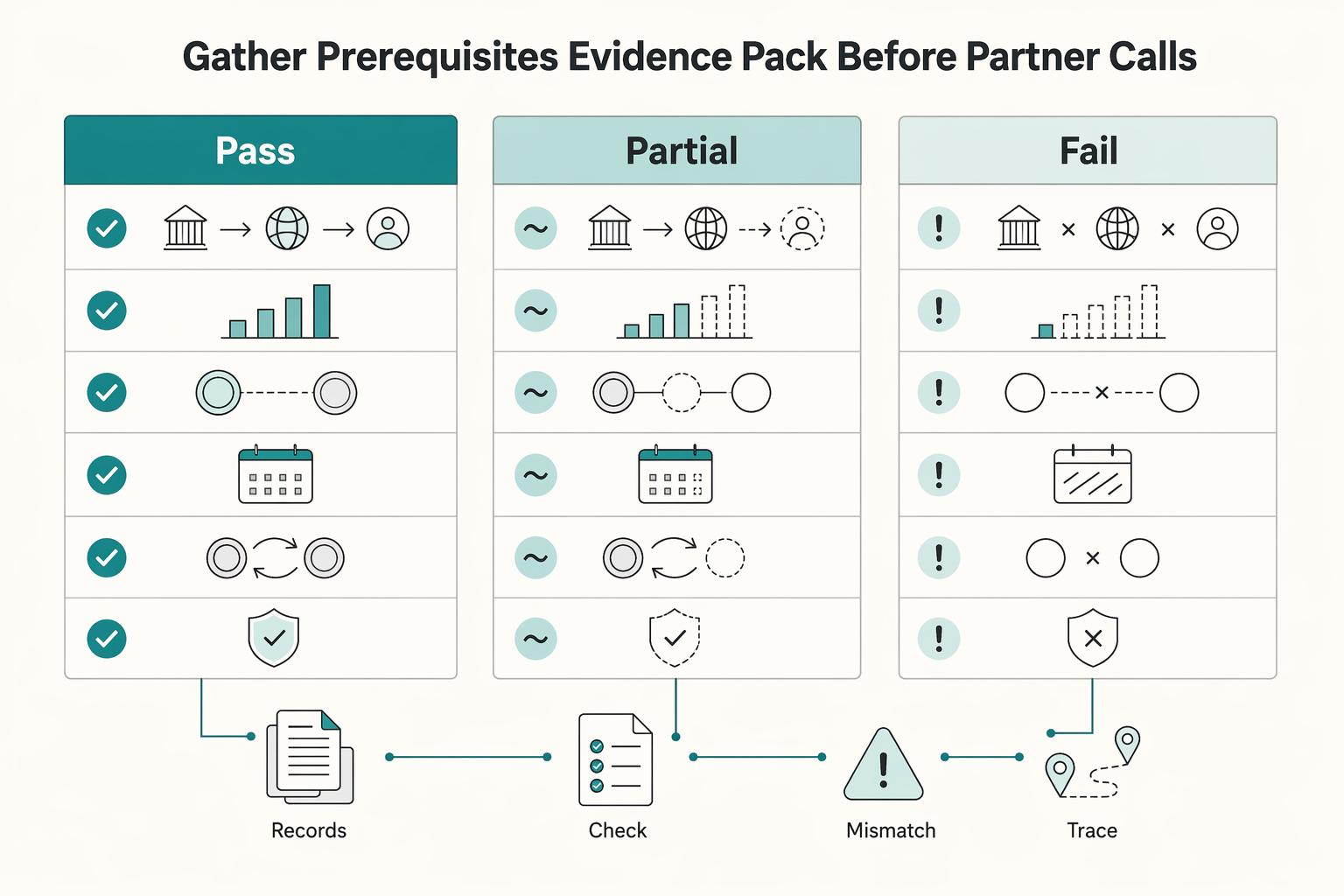
Do not let a polished demo substitute for proof. Before provider calls, build a compact evidence pack so counsel, finance, and vendors are all reviewing the same payout flow and the same open questions.
Build the minimum evidence pack. Start with one page per payout path. Map the funding source, contracting entity, contractor type, destination country, and where VND or CNY conversion is expected to occur. If you still need placeholders like "partner handles FX," treat that as an unresolved dependency.
Include at least:
- target flow diagram from funding to final payout
- contractor categories you expect to onboard
- expected payout corridors
- assumptions list for conversion, settlement timing, and exception ownership
- baseline review artifacts from Vietnam bank disclosures, for context only and not legal approval, such as sections labeled
Risk management report,Independent Auditor's Report, andConsolidated statement of cash flows
Draft counsel questions before the first vendor call. Get a written counsel matrix early, focused on your exact model. Use State Bank of Vietnam (SBV) references, FX scope, and possible licensing or reporting triggers as question areas, and require clear answers tied to each flow variant. Ask direct model-level questions, not broad "is Vietnam possible?" questions.
Log rail dependencies as unverified assumptions. List NAPAS 247, VietQR, and CITAD as items to validate, and require each vendor to state what each rail does and does not solve in its proposed contractor payout flow. Treat rail claims as pending proof until onboarding, approval controls, exception handling, and reconciliation outputs are all demonstrated.
Define retained compliance artifacts up front. Before procurement moves forward, define the records you may need to retain for each payout path, such as KYC outcomes, payout approvals, provider references, and reconciliation exports. If ownership or retention responsibility is unclear, keep the item open and block sign-off.
Predefine stop conditions. Set stop conditions before demos start so procurement does not outrun risk review. If critical SBV, FX, or rail questions remain unresolved for the target flow, pause vendor progression until the evidence pack is complete.
For a step-by-step walkthrough, see Wire Fraud Prevention for Platforms: How to Spot Spoofed Bank Details Before You Pay.
Separate rail facts from contractor payout assumptions#
Use a strict rule here. If the evidence shows retail payments, QR acceptance, partner positioning, or market growth, treat contractor payouts as unvalidated until a provider shows the operational and compliance path.
| Item | Grounded scope | Payout treatment |
|---|---|---|
| NAPAS 247 | Domestic retail instant credit transfers; NAPAS is cited as 24/7, typically less than 10 seconds, and connecting over 40 banks | Treat as unverified for contractor payouts until onboarding, approval controls, exception handling, and reconciliation outputs are demonstrated |
| VietQR | Use only when the payout journey actually depends on a supported QR-based destination experience | Do not treat network prominence or partner positioning as proof of contractor disbursement readiness |
| CITAD | High-value interbank payments | Keep rail mentions in the assumption bucket until the vendor can show transaction type, beneficiary, and settlement path |
| Vietnam-China cross-border QR code payment service / VIETQRGlobal | Cross-border QR narratives tied to merchant checkout, traveler acceptance, or high-level fintech framing | Mark as not yet validated for contractor payouts |
Classify the payment use case before you discuss rails. Classify each proposed flow by transaction type first: Peer-To-Peer or Person To Business. This stops consumer or merchant language from being reused as contractor payout proof. If a vendor cannot clearly state the transaction type, beneficiary, and settlement path, keep any rail mention, including NAPAS 247, VietQR, or CITAD, in the assumption bucket.
For each corridor, keep a one-line label in your evidence pack. If the line still reads like "fast QR payment" instead of a contractor disbursement flow, it is not ready for approval.
Downgrade market and partner signals to context only. Market and partner signals are context, not payout validation. The cited market figures, from USD 52.19 Billion in 2026 to USD 83.02 Billion in 2031, at 9.73% CAGR, are value forecasts. They do not by themselves prove contractor payout operations. Likewise, a corporate annual-report statement describing Zalopay as a leading VietQR partner is network context, not proof of platform-ready contractor disbursements.
Do not let growth charts or partner labels replace evidence of how payouts actually run.
Quarantine cross-border QR narratives until proven otherwise. Apply the same standard to references to Vietnam-China cross-border QR code payment service, VIETQRGlobal, Alipay, and UnionPay International (UPI) narratives. If the material is about merchant checkout, traveler acceptance, or high-level fintech framing, mark it not yet validated for contractor payouts.
Keep that label until contractor-specific operations are documented end to end, including onboarding, authorization, status handling, and reconciliation evidence. Related: How to Pay Contractors in Pakistan: RAAST Local Banks and FX Repatriation Rules.
Define legal and compliance boundaries you must validate#
Once you separate rail facts from payout assumptions, legal ownership becomes the next gate. Do not approve a Vietnam launch until you can name, in writing, who is responsible for each regulated action in your model, especially FX handling and pre-disbursement controls.
Map regulatory roles against your actual payout model. The State Bank of Vietnam (SBV) may be part of the oversight context for your flow, but you still need corridor-specific legal confirmation. Your real operational risk depends on how responsibilities are split across your platform, your partner, and the receiving bank. Do not rely on broad claims like "our partner handles compliance."
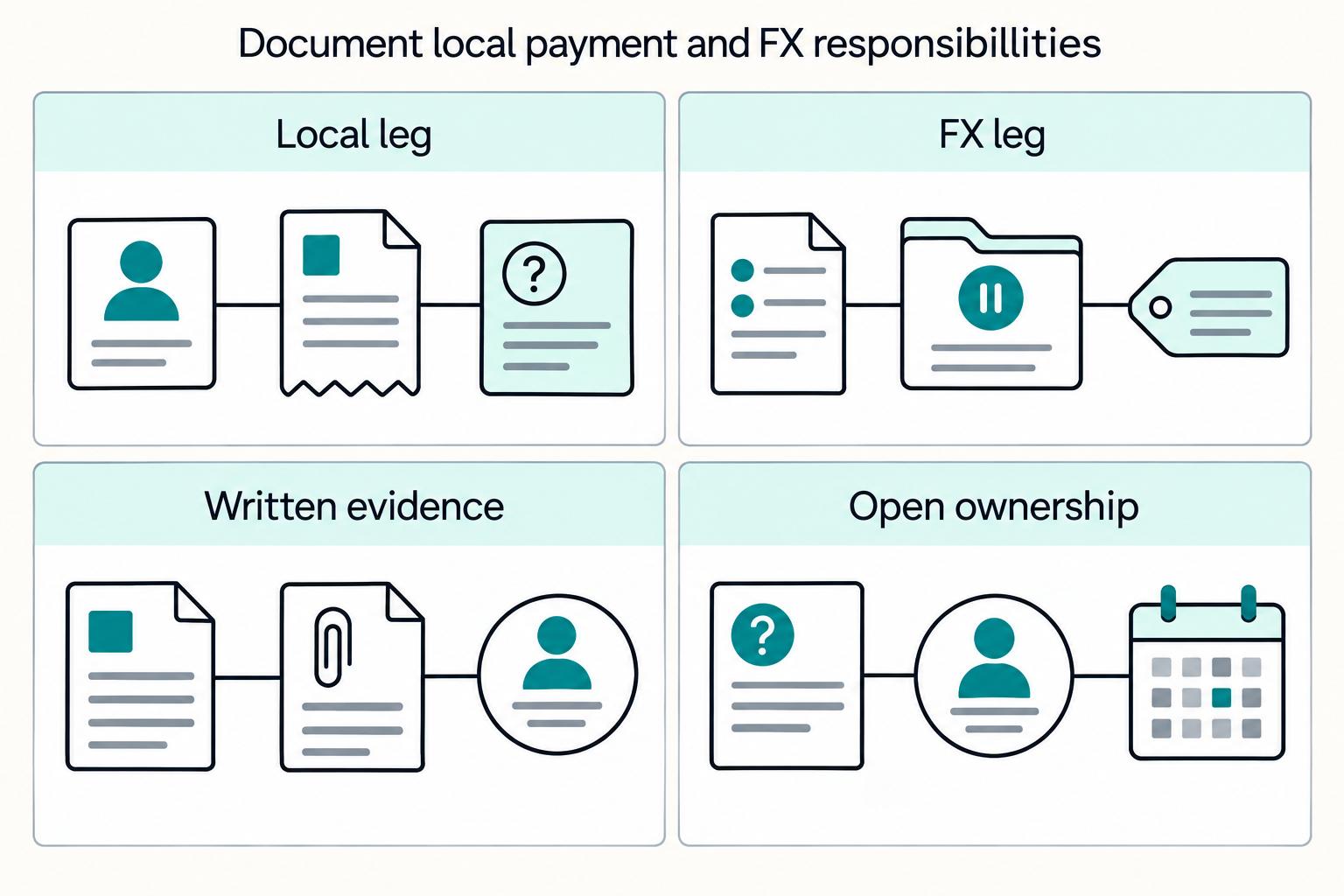
Build a one-page role matrix that states who contracts with the contractor, receives funds, initiates payout instructions, handles conversion, sends final payment, and stores records. Each row should map to an actual source such as contract terms, provider terms, or counsel notes. If responsibility boundaries are unclear, treat that as unresolved risk.
Keep rail evidence in the right bucket. Techcombank reports "Transaction bank volume via NAPAS #1 in the industry," and reports 91% of retail transactions are conducted digitally as at 31 Dec 2024. That supports evidence of active domestic digital-rail usage, not contractor payout legal scope.
Build a counsel-reviewed FX matrix before you discuss scale. Before discussing scale, require an FX matrix that answers, for each corridor, who converts, where conversion occurs, funding currency, payout currency, and required records. Keep it flow-level so operations can execute it.
Use completeness as the test. Every row should tie to a specific provider path and a document owner. If rows still say "bank to confirm" or "handled downstream," the corridor is not launch-ready.
If your model depends on China-linked flows, break that path out explicitly. Treat bilateral retail-payment connectivity narratives as context, not proof that your contractor payout corridor is approved.
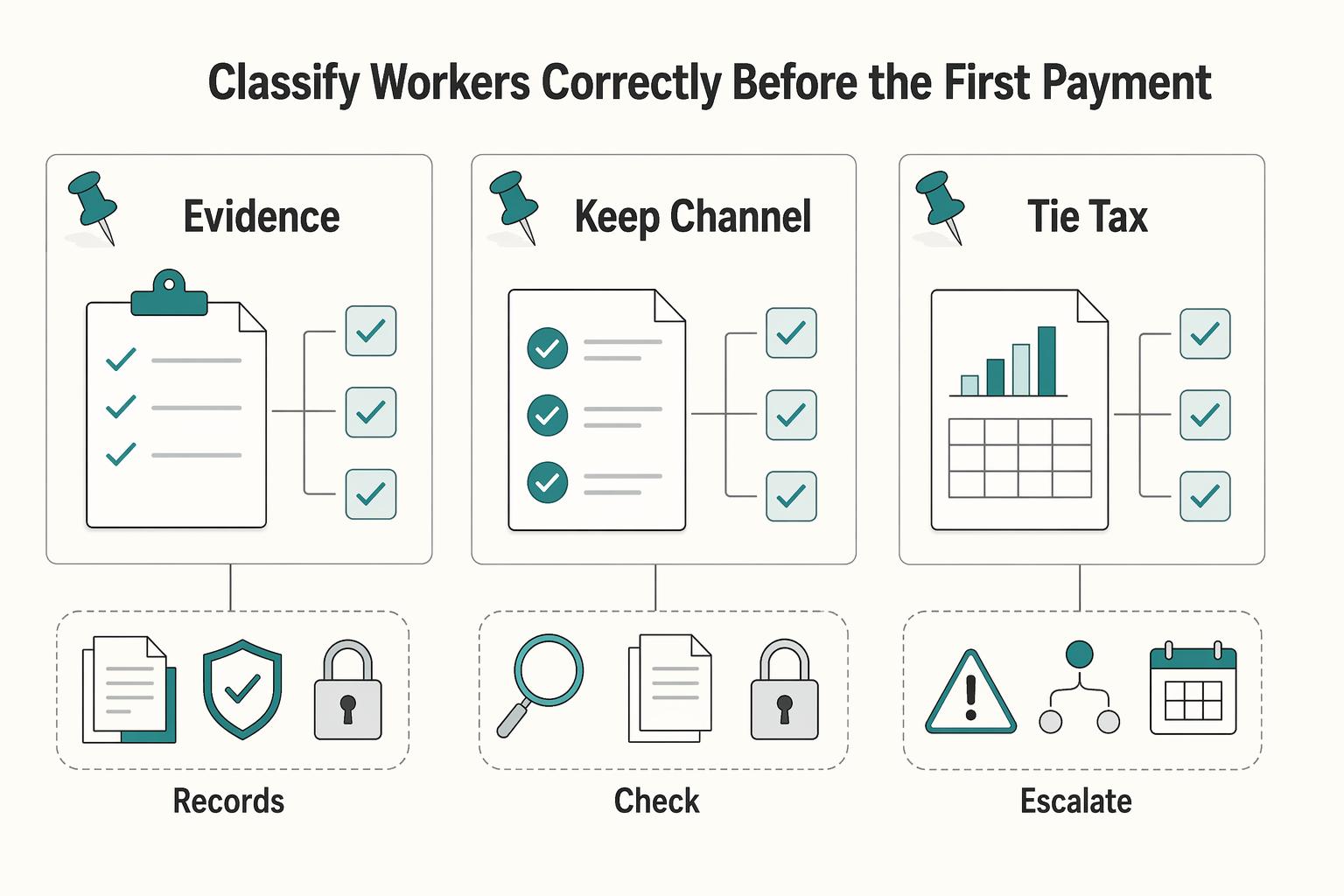
Tie KYC status directly to payout release controls. As an internal control, KYC should drive payout release, not stop at onboarding. Your flow should block release when checks fail, before any external disbursement instruction is created.
Define and test this control before launch. The required outcome is simple: failed checks keep payouts in an internal hold state until resolved, with auditable status history.
Capture jurisdiction interfaces early. If a flow touches Vietnam and China, document each jurisdiction interface in one place: contracting entity country, funding account country, conversion location, beneficiary country, and banking partner country.
Use a strict go or no-go rule. If counsel cannot confirm the legal path for the exact corridor, keep launch conditional. That avoids treating rail labels like VietQR or NAPAS as substitutes for validated cross-border contractor payout readiness.
Design the end-to-end payout flow your ops team can actually run#
Start with one controlled payout path and predefined exceptions before you add more rails. Your team should be able to run onboarding, approval, FX handling, disbursement, failure handling, and reconciliation without improvising during incidents.
Capture payout readiness before money moves. Do not release funds until the contractor record shows payout readiness. At minimum, the record should show KYC status, approved payout destination, payout approver, and whether FX is required for that payment.
Before release, verify one approved beneficiary version, one payout amount, one route choice, and one compliance status. If any item is missing, keep the payout on internal hold.
Separate payout approval, FX quote acceptance, and disbursement. When conversion is involved, treat FX quote acceptance as a separate event. Store the quote reference, funding currency, payout currency, acceptance timestamp, and expiry. Reject the payout if the quote is missing or stale before any external instruction is created.
If your partner supports NAPAS routes, use them, but define fallback behavior in advance. The evidence supports strong digital and NAPAS activity in domestic operations, not universal contractor payout coverage. Route failures should go to an approved direct bank path or manual review.
Use VietQR only when the experience actually needs it. Use VietQR-linked flows only when the payout journey actually depends on a supported QR-based destination experience. Do not treat VietQR network prominence as proof that contractor disbursement is solved for your use case.
VNG's "leading VietQR partner" signal is network context, not launch approval for contractor payouts. For repeat payouts, choose the rail that keeps reconciliation straightforward for your team. If QR is used, require a check that binds the selected destination to the exact contractor profile before release.
Make requests idempotent and statuses deterministic. Assign one internal payout request ID and keep it unchanged across retries. Store provider references alongside it, but make sure retries, duplicate webhooks, or timeout recovery cannot create a second disbursement.
Use a deterministic state model, for example: Held, Approved, Quote Accepted, Submitted, Pending External Confirmation, Completed, Failed, Needs Review. Each provider response should map to one internal state only. If the response is ambiguous, send it to review rather than auto-retrying.
Run one exception queue your finance team can close. Route unresolved payouts into a single queue with tagged causes at intake: document gap, name mismatch, destination-bank issue, or reconciliation mismatch. The cause should determine the next action and any reapproval required before retry.
Close each payout with your internal payout ID, external reference if available, final status, and ledger match. Keep dated evidence for route assumptions. A report as at 31 December 2024 can support domestic digital-rail activity, but partner confirmation is still required for your exact payout path.
Choose your settlement and FX model with explicit tradeoffs#
Choose the settlement model with fewer unresolved State Bank of Vietnam (SBV) and FX rules assumptions, even if the launch fee looks higher. Once your payout flow is fixed, decide where funds settle and when conversion into VND happens.
Compare the three models before you price them. Run this comparison on one page so finance can test traceability from source funds to contractor receipt. One model may stand out as having fewer open regulatory assumptions and fewer handoffs.
| Model | Potential dependency pattern | FX assumption load | Reconciliation and traceability | Main red flag |
|---|---|---|---|---|
| Offshore pre-funding | Offshore treasury account, overseas payout partner, possible domestic handoff into a Vietnam bank | High when local VND handling is still unclear | Harder when conversion, pre-funding, and local delivery sit with different parties | Local delivery for contractor payouts may still be unproven |
| In-country partner settlement | Vietnam banking partner and local settlement rails where supported | Lower when the local partner can clearly show where conversion and payout records sit | Usually cleaner because there are fewer entity handoffs | Depends on the partner's documented scope, not the rail name alone |
Mixed model with staged VND conversion | Offshore funding, then local or regional conversion stage, then domestic payout | Highest because ownership is split across stages | Most complex because one payout can map to multiple timestamps, references, and rate events | Quote slippage and unclear ownership when a payment fails mid-chain |
Validate dependency claims, not just fee claims. Treat named banks, rails, or cross-border partners as possible dependencies, not proof of contractor payout coverage. For each one, confirm whether it sits in your funding leg, FX leg, domestic settlement leg, or only in a different context.
For a sample payout, require one evidence pack that shows source account, conversion point, beneficiary bank path, provider reference, and settlement proof. If that cannot be produced for your exact model, mark the path unproven.
Stress-test spread assumptions on VND and CNY. If your unit economics depend on aggressive spread assumptions, classify that model as high risk until you test executable quotes for your exact path. Spreadsheet margins are not launch evidence.
Use the 2022 banking context as a caution signal. The market narrative included both a "stable exchange rate" and sharply higher market rates in 4Q2022 tied to a "liquidity crunch in the banking system." Choose the model your counsel, finance lead, and payout ops lead can explain end to end without speculative steps.
Build controls that protect auditability at scale#
If finance cannot reconstruct a payout from request to final outcome without raw engineering logs, your controls are not ready. In Vietnam, that risk compounds because retail transfers can typically settle in less than 10 seconds.
Define the audit chain before you automate anything. Set the minimum record chain first, then automate. Every payout, successful or failed, should resolve to one immutable internal payout ID. That ID should link the request ID, contractor ID, approval event, funding source, FX quote reference if used, external provider reference, beneficiary account snapshot, ledger posting ID, payout status, and status evidence.
If one payout touches multiple external legs, for example domestic retail plus a separate funding or FX leg, keep all external references on the same internal record. Do not split traceability across tools.
Treat your ledger as the system of record. The rule should be simple: do not mark a payout released until the ledger contains the approved amount, currency, destination snapshot, and the exact external reference used to send funds.
Reconcile each material response before batch close. Reconcile material state changes before close, not just at end of day. Vietnam infrastructure separates retail and high-value interbank clearing roles across NAPAS and CITAD, so your evidence should map to the actual path used.
Fail batch close if any payout is missing one of these: provider acceptance or rejection, posted ledger state, and final mapped status with evidence. Keep submitted or processing separate from paid.
Sample both fast-success and exception payouts in every batch. Verify that ledger references match provider or bank responses exactly. Where partners provide richer transaction fields, for example ISO 20022-style data, capture them because richer data can improve later traceability.
Do not hardcode one universal transaction limit in control logic. Common limits vary by institution, and the relevant network can include over 40 banks.
Gate release on current compliance status. Do not rely on onboarding status alone for payout release. Before sending to external rails or partners, require a release gate for current compliance checks under your policy.
Persist the evidence that justified release: status outcome, timestamp, ruleset version, reviewer decision, and any override approver plus reason. If status is stale, incomplete, or under review, move to hold instead of release.
Control the failure modes that create duplicate or unprovable payouts. Treat stale FX quotes, webhook replay, duplicate callbacks, and manual hold release as core control points.
Reject stale quotes by policy and store quote creation time, acceptance time, and rejection reason. For asynchronous updates, enforce idempotency at payout creation and callback processing so replayed or duplicate events update the same record rather than create a new disbursement attempt.
Require a documented manual hold-release procedure with reason code, evidence reviewed, approver identity and timestamp, and confirmation that ledger amount and destination still match the intended release.
Finally, be explicit about scope in reporting. Even formal reports can disclose excluded data, for example exclusion of one subsidiary, so your own payout dashboards and exports should state exactly which entities, partners, and payout states are included.
Before pilot scale-up, map your payout states, retry keys, and reconciliation exports against Gruv Payouts so operations and engineering work from the same control model.
Roll out in phases with hard decision checkpoints#
Use phased gates with explicit stop or go decisions before broad launch. The unresolved risk is still interpretation and execution detail, so each phase should close a specific unknown before you increase volume.
| Checkpoint | Required output | Do not advance if |
|---|---|---|
| Verify interpretation and scope before live traffic | Written decision record for the exact contractor flow, plus open SBV and FX interpretation questions and a one-page scope statement | The legal path, conversion point, ownership of checks, or required retained records are still unclear |
| Dry run states and reconciliation before the pilot | Evidence pack with internal payout ID, approval record, destination snapshot, external reference if present, retry history, and final reconciled status | Finance cannot trace a dry run end to end without raw engineering logs |
| Pilot with a small cohort and daily exception review | Small cohort, manual daily review, and exception patterns used as the main signal | Exceptions cluster around one route assumption or one recurring document gap |
| Scale only after repeatable operations and clean close | Repeatable outcomes, clean month-end reconciliation for the limited cohort, and written sign-off from finance, compliance, and ops | Reporting scope is unclear or evidence quality and consistency are not yet sufficient |
These are internal operating gates, not proof of a regulatory requirement by the State Bank of Vietnam (SBV). Use them to document what is confirmed, what is assumed, and what is still open around scope, FX handling, routing, and evidence quality.
Verify interpretation and scope before live traffic. Keep Phase 1 to discovery only, with no production payouts. The required output is a written decision record for your exact contractor flow. It should state who pays, in what currency, where conversion happens if any, who owns checks, and what records must be retained.
Make the checkpoint explicit: list open SBV and FX interpretation questions, plus unresolved dependencies such as partner or bank scope limits. Also lock a one-page scope statement so the pilot does not quietly expand into unvalidated flows.
Dry run states and reconciliation before the pilot. Move to sandbox and dry runs only after discovery outputs are complete. Keep rail assumptions labeled as assumptions. Test your state mapping, retries, ledger updates, and fallback behavior even if a route is described as VietQR-related; that label does not confirm contractor-disbursement suitability.
For each case, save one evidence pack with internal payout ID, approval record, destination snapshot, external reference if present, retry history, and final reconciled status. If finance cannot trace a dry run end to end without raw engineering logs, do not advance.
Pilot with a small cohort and daily exception review. Run a narrow pilot that your team can review manually every day. Use a small cohort, keep strict review on unresolved items, and treat exceptions as the main signal for whether document handling and operational handoffs are ready.
VNG describes expansion as involving "trial and error in allocating people, time, and resources," so plan for learning cycles instead of assuming smooth scale. If exceptions cluster around one route assumption or one recurring document gap, pause expansion and fix the root cause first.
Scale only after repeatable operations and clean close. Scale only when outcomes are repeatable and month-end reconciliation is clean for the limited cohort. Do not use a generic numeric threshold here. Use written sign-off from finance, compliance, and ops based on your own evidence quality and consistency.
Keep reporting scope explicit at this stage. Nam A Bank's disclosures show that formal reporting can include exclusions and staged coverage over time, so your rollout reporting should clearly state included and excluded entities, partners, and payout states. Visible in-market activity, including VietQR partner positioning, is not a readiness signal for your contractor payout operation on its own.
Related reading: How to Pay International Contractors With Fewer Delays and Disputes.
Avoid the mistakes that derail Vietnam launches#
Vietnam launches often fail from category errors, not just coding defects. Use these as stop conditions: if you cannot prove the recovery action, do not scale contractor payout volume.
Mistake 1: Treating rail announcements as contractor-readiness proof. Recovery: Re-scope to your verified contractor flow.
Strong rail activity is not the same as a validated contractor disbursement model. Techcombank's headline NAPAS volume and highly digital retail mix are useful market signals, but they do not prove your exact payout path is ready.
Before you scale, keep a one-page flow record with beneficiary type, destination account details, approval point, payout currency, and where conversion happens if any. If that is missing, you are still operating on assumptions.
Mistake 2: Vague ownership of FX interpretation. Recovery: Assign one accountable owner and close assumptions in writing.
If nobody owns the FX interpretation record, open questions linger and launch risk compounds. Name one accountable owner to maintain the open-issues log until each assumption is confirmed, narrowed, or escalated to a stop decision.
Treat FX as a live risk surface. ABBank reports VND depreciated about 5% against USD in the first nine months of 2022, and reports SBV stabilization efforts including estimated sales of more than US 20 billion. If conversion ownership or partner handling is unclear, keep it marked unresolved.
Mistake 3: Shipping automation without KYC-linked payout gates. Recovery: Enforce pre-disbursement policy holds.
KYC should be enforced at payout release, not only at onboarding. Your payout logic should block disbursement when status is pending, mismatched, or missing required approval events under your internal policy.
Prove this with staged failure cases and retries. If a retry path can bypass a hold, your controls are not production-ready.
Mistake 4: Trusting speed assumptions without exception design. Recovery: Test retries, reversals, and manual intervention.
Fast rails help only when exception handling is explicit. Build for ambiguous states, delayed confirmation, retries, reversals, and manual review instead of assuming clean completion.
This matters under stress conditions. HDBank describes 2022 as volatile and unpredictable, and links sharp 4Q2022 rate increases to a banking-system liquidity crunch. Your readiness check is simple: finance can trace one payout end to end without relying on raw engineering logs.
Mistake 5: No explicit bank and partner dependency map. Recovery: Publish a dependency register and incident routing tree.
If dependency ownership is unclear, incidents stall while funds are in flight. Document each provider and bank dependency, route assumptions, contract owner, ops contact, and escalation path.
If your route depends on specific banks or acquiring partners, make it explicit in the operating record. Operations should be able to route a failed payout incident immediately without asking product to interpret the flow.
Track the right metrics in your first 90 days#
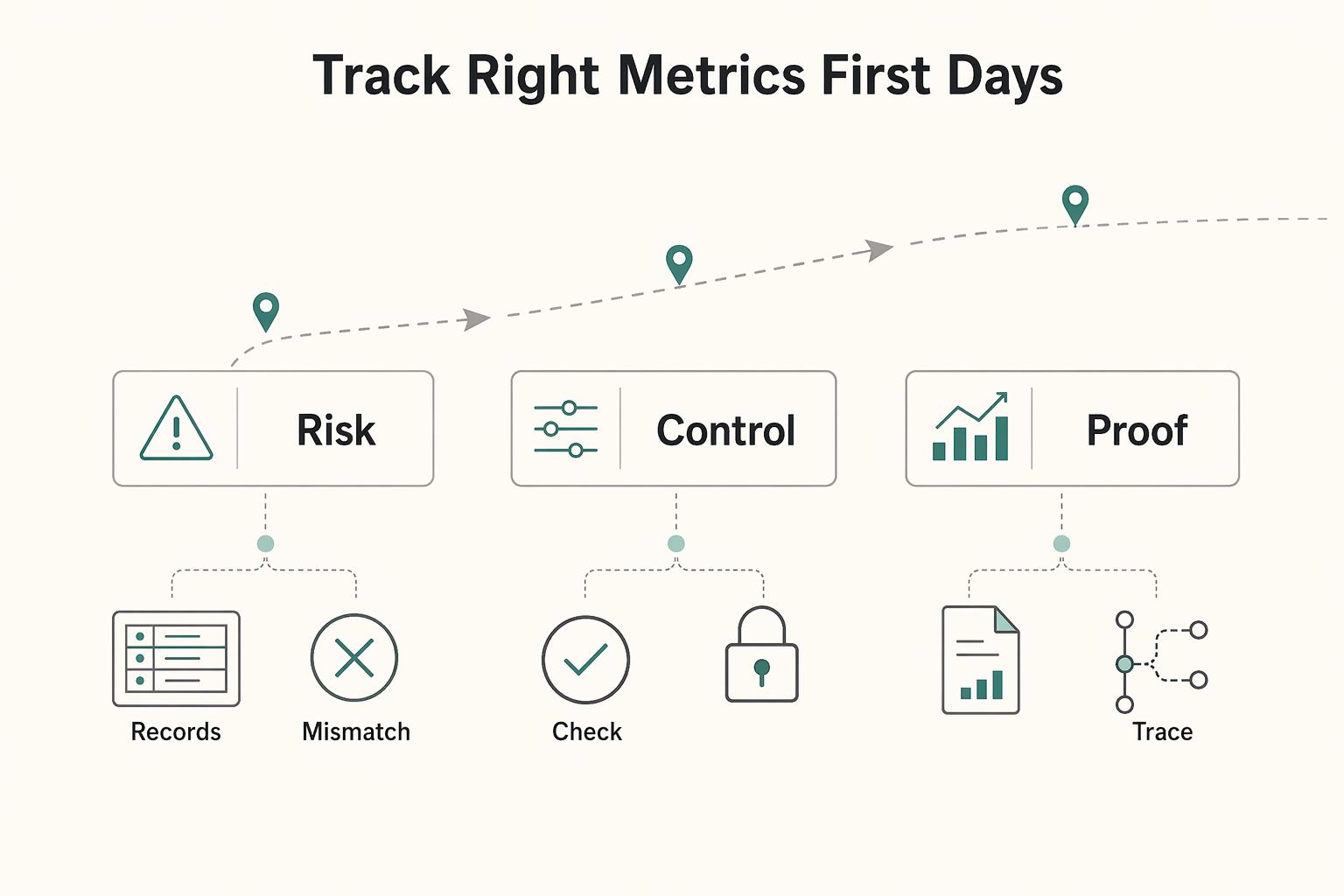
In your first 90 days, treat launch health as a control question, not a volume question. Track where payouts complete, where they stall, and whether key assumptions are being closed. That matters even more in an early-stage fintech environment where execution can involve trial and error.
Split payout performance by path. Track payout outcomes and exception rates separately for your primary route, fallback route, and manual intervention. A single blended metric can hide weakness in your primary route, and path-level targets should be treated as unverified until your own data supports them.
For each payout, record requested path, actual path used, final status, provider or bank reference, and whether manual intervention occurred. Review exception samples weekly and confirm the recorded path against provider evidence before scaling that route.
Measure compliance friction at release. Track KYC pass rate, document defect rate, and average time from hold to release at payout release, not only at onboarding. Treat these as internal baselines to validate, not fixed market benchmarks.
Use specific defect reasons so teams can act: name mismatch, unreadable document, expired ID, or missing approval event. If hold-to-release time trends up, clear queue and approval bottlenecks before adding payout volume.
Watch finance integrity before growth metrics. Track reconciliation completion time, unreconciled payout count, and aging by status. Treat completion-time or aging thresholds as hypotheses until operating data validates them.
Finance should be able to tie request ID, approval event, provider reference, and ledger posting for closed batches without rebuilding the trail from engineering logs.
If aging accumulates in pending, sent, or awaiting-confirmation states, treat it as an operating risk that needs routing and exception-process review.
Keep one board metric for unresolved assumptions. Use one board-level metric: verified assumptions remaining. Count only assumptions that can block safe scale, including unresolved State Bank of Vietnam (SBV) and FX rules interpretation questions.
For each assumption, keep an owner, written question, evidence source, and target close date. If the count is not going down, keep the pilot bounded even when surface-level payout metrics look acceptable.
Conclusion and copy paste launch checklist#
Do not launch because the rails look modern. Launch only when your contractor payout flow is proven end to end and unresolved legal or operating questions have clear owners, dates, and stop conditions.
- Lock the evidence pack before the launch call.
Document the expected role (if any) of NAPAS 247, VietQR, CITAD, and the State Bank of Vietnam (SBV), and mark each item as verified or unverified. The strongest public signal here is narrower: VNG describes Zalopay as a leading VietQR partner, while also describing Vietnam fintech as early-stage with growth potential over the next 10 years. Every launch claim should point to a dated document, not a sales deck or announcement.
- Log unknowns and assign one owner per unknown.
Keep unresolved FX rules, licensing boundaries, and corridor assumptions involving VND and CNY in a tracked list. If ownership is unclear, those unknowns become hidden product assumptions.
- Freeze the payout flow in operational language.
Write the actual sequence: onboarding, identity/compliance checks (where required), approval, disbursement request, retries, exceptions, and reconciliation close. You are ready only if one payout can be traced across all statuses into ledger and export records without ambiguity.
- Choose settlement and conversion model explicitly.
If you use domestic VND, a path tied to CNY, or staged conversion, record that choice and its tradeoff. A specific FX rules interpretation or conversion path is not validated here, so prefer the model with fewer unresolved assumptions and clearer traceability.
- Run a constrained pilot with hard stop conditions.
Keep scope small, review exceptions manually, and define escalation ownership. The pilot should prove document sufficiency, status handling, and reconciliation discipline under real conditions.
- Test the audit chain before go-live.
Dry-run a payout from request to ledger to export and confirm the record pack is complete: identity/compliance check result (if applicable), approval event, provider or bank reference, ledger posting, final status, and reconciliation output.
- Make the launch decision from evidence, not optimism.
This matters more in a market VNG describes as early-stage. The same report also notes newer fintech, cloud, and AI bets had not yet delivered significant financial returns and that expansion involved trial and error in allocating people, time, and resources. If evidence is incomplete, continue constrained pilots. If evidence is complete, scale in controlled cohorts.
If your go/no-go is still conditional on corridor coverage or policy gates, use Contact Gruv to validate market fit before committing full rollout resources.
Frequently Asked Questions
Can we pay contractors in Vietnam through `VietQR` and `NAPAS` today, or do we still need additional validation?
You still need additional validation. The grounded evidence supports broad mobile-payments market context and VNG's statement that Zalopay is a leading VietQR partner, but that does not confirm contractor-payout readiness for your flow. Before go-live, require written scope confirmation plus testable payout, status, and reconciliation evidence from the provider.
What does the `State Bank of Vietnam (SBV)` actually control for contractor payout and `FX rules` decisions?
A precise SBV interpretation for contractor disbursements requires validation against your exact model. Treat SBV scope as material, but validate it against your exact model: who holds funds, who converts currency, where settlement happens, and what records are retained. If those points are not answered in writing, keep Vietnam in conditional-go status.
Is the `Vietnam-China cross-border QR code payment service` relevant to contractor payouts, or mostly to merchant and traveler payments?
Treat relevance to contractor payouts as unconfirmed unless your exact use case is explicitly validated. Do not use broad QR announcements as proof for payout compliance design.
What is live now versus still roadmap for outbound Vietnam-to-China flows tied to `VIETQRGlobal`?
That live-versus-roadmap split is not validated for contractor payout flows. If this corridor is launch-critical, rely on dated, versioned partner documentation rather than sales summaries.
Do `Alipay`, `Ant International`, or `UnionPay International (UPI)` integrations reduce our contractor payout compliance burden?
Those integrations may matter in other payment contexts, but do not infer reduced contractor-payout compliance burden from them. Use written scope coverage for your specific contractor flow, approval chain, and settlement records as the decision test.
When should we route through domestic `VND` settlement versus cross-border conversion paths?
There is no grounded bright-line rule here. Treat routing as a legal and operating design decision that must be validated before build. Prefer the path with fewer unresolved assumptions and clearer source-to-settlement traceability.
What evidence should we keep to prove payout compliance and pass an audit review?
Keep an end-to-end record: contractor identity and KYC outcome, payout request ID, approval event, provider or bank reference, ledger posting, final status evidence, and reconciliation export. Also archive the public materials you relied on with dates and versions, since these documents are broad and time-bound. For example, Vietcombank states its report covers January 1, 2024 to December 31, 2024 and is published electronically in Vietnamese and English.
Try a related tool
Where Gruv fits
Researched and edited by the Gruv editorial team. Gruv builds cross-border billing, payouts, and finance-operations software for global businesses.
Sources
Includes 7 external sources outside the trusted-domain allowlist.
- iife.edu.vn/wp-content/uploads/file-HTKH-21.12.2023.pdftrusted
- abbank.vn/uploads/files/2023/04/28/81e756/phpajmmnl-1-...external
- agribank.com.vn/wcm/connect/592fde6c-f026-43f9-8982-ddbb87cf...external
- apec.org/apecapi/publication/getfileexternal
- cdn.hdbank.com.vn/hdbank-file/investor/editor/RbGBHaoRMNN4AhHO...external
- china-briefing.com/china-outbound-news/vietnams-tourism-growth-...external
- cmsv5.fiingroup.vn/medialib/FG/2025/2025-04/2025-04-22/20250422...external
- erickimphotography.com/page/209external
Educational content only. Not legal, tax, or financial advice.
Related Posts
Paying Contractors in Morocco with CIH, CMI, and Bank Al-Maghrib FX Constraints
Treat Morocco as an operational validation decision, not just a commercial opportunity. The real question is whether you can verify, with current primary evidence, that your contractor payout path works through the institutions you plan to use.
How to Pay Contractors in Pakistan with RAAST and Clear FX Ownership
Treat Pakistan as a two-part payout decision, not a single rail choice. The mistake that burns time is assuming local payout delivery, cross-border funding, and Foreign Exchange (FX) repatriation will all be cleared in the same product conversation. They often are not. If you blur them together too early, you can end up designing features before you know which party actually owns conversion, compliance, and exception handling.
How to Pay Contractors in Bangladesh: BEFTN bKash and Bangladesh Bank FX Rules
Use an operator lens because payout decisions can fail on data quality and control gaps. In the material available, some fields are explicitly unavailable (`..`), and some totals may not reconcile exactly because of rounding. Do not treat every table value as exact or complete. Set a few control checkpoints before you plan rollout: