
Quick Answer
Yes, you can plan contractor payouts in Pakistan around a local rail, but the article’s core answer is to treat RAAST and SBP-linked bank products as only part of the path. You should separate local payout execution from cross-border funding and FX repatriation, then get written operating guidance from partner institutions on eligibility, documents, and exception handling before making launch promises.
How RAAST fits into contractor payouts in Pakistan#
Treat Pakistan as a two-part payout decision, not a single rail choice. The mistake that burns time is assuming local payout delivery, cross-border funding, and Foreign Exchange (FX) repatriation will all be cleared in the same product conversation. They often are not. If you blur them together too early, you can end up designing features before you know which party actually owns conversion, compliance, and exception handling.
The public materials in hand are useful, but narrower than most teams want them to be. The World Bank Pakistan Development Update, published in April 2025, helps with country context because it focuses on Pakistan's economic outlook, development challenges, and structural reforms. That matters for market sizing and risk appetite. But the report does not itself confirm whether a contractor payout route is operationally approved, what documents a specific partner will require, or how outbound movement is handled for a given product path.
Bank materials show the same pattern. For example, Bank AL Habib's Roshan Digital Account (RDA) describes an account that lets eligible users open and manage a Pakistani bank account online. It also states that remittances can be used for investments and "other permissible purposes outlined by the State Bank of Pakistan." That is a useful signal that remittance use is tied to product terms and SBP-permitted purposes. It is not a blanket answer for a contractor payout use case, and it should push you toward written partner confirmation instead of assumptions.
Before you start#
- Split the route into separate legs.
Decide whether you are solving only domestic disbursement inside Pakistan or also inbound funding, conversion, and possible repatriation. The check is straightforward: each leg should have a named institution owner, not a vague statement that "the bank handles it."
- Ask for written operating guidance from the regulated parties.
That may mean your partner commercial bank and, in some models, an exchange company. Ask for the exact product path, permitted use case, compliance ownership, documentary requirements, and what happens when a payout is rejected, returned, or held for review.
- Gate launch claims on evidence, not sales conversations.
If your internal memo cannot attach product terms, compliance requirements, and a clear explanation of who owns FX and outbound movement questions, you do not have a launch-ready route. A common failure mode is letting product copy promise contractor payouts before legal, treasury, and operations have matching written answers.
That is the lens for the rest of this guide. We will separate what you can reasonably design now from what still depends on bank and exchange partner confirmation, so your go or no-go call is based on evidence rather than optimism.
What RAAST can and cannot do for contractor payouts#
For now, treat your contractor payout use case on RAAST, and the boundary between local disbursement, cross-border funding, and Foreign Exchange (FX) repatriation, as unconfirmed until partners document it.
Step 1: Separate confirmed facts from assumptions. The available material on RAAST draws on IMF Pakistan review content and publication metadata, not SBP operating guidance for your payout flow. So you cannot claim your contractor route is supported, that specific payout types are available to you, or that domestic rail choices resolve cross-border and FX questions without direct confirmation from SBP.
Step 2: Get the exact domestic route in writing from a regulated participant. If a bank, PSP, or other partner says your flow will use RAAST, ask for the written product path and the transaction type they will enable for your account model. Before you build, require a documented process for rejects, returns, and held transactions. If they reference Bulk Payments or Credit Transfer, confirm that in writing for your specific setup.
Step 3: Run offshore funding and local delivery as separate workstreams. If funds originate outside Pakistan, keep domestic payout execution separate from funding, conversion, and repatriation handling until partners show otherwise in writing. A fast local payout leg does not, by itself, answer upstream policy or documentary requirements. Hold launch claims until ownership of FX handling, required documents, and return or outbound scenarios is explicitly documented.
If you are deciding between PKR and USD options, read Local Currency Payouts vs USD Payouts: What Contractors Prefer and What Platforms Should Offer.
What to prepare before launch in Pakistan#
Before launch, treat this as an evidence-and-ownership exercise. Do not build around assumed payout paths until each partner gives you written, testable documentation.
| Prep area | Capture in writing | Why it matters |
|---|---|---|
| Evidence pack per institution and product | Exact product name, stated eligibility, and written description of supported use | Use it to scope what a product is explicitly for, not to assume a contractor payout flow is approved |
| Role ownership before API work | Who initiates local payout delivery, who handles funding or conversion, and who owns exception handling | If any participant role is unclear, keep that route in validation |
| Compliance and operations artifacts | Required checks, expected documents, status outputs, and escalation path | Launch bar includes clear failure ownership and records you can audit during rejects, reversals, or investigations |
Step 1: Build an evidence pack per institution and product. For every bank or provider in your planned route, capture the exact product name, stated eligibility, and written description of supported use. For example, Bank AL Habib says its Roshan Digital Account is for Non-Resident Pakistanis and foreign nationals with a Pakistan Origin Card, can be opened online, and is intended to facilitate remittances for investments and other State Bank of Pakistan-permissible purposes. Use details like these to define what a product is explicitly for, not to assume your contractor payout flow is approved.
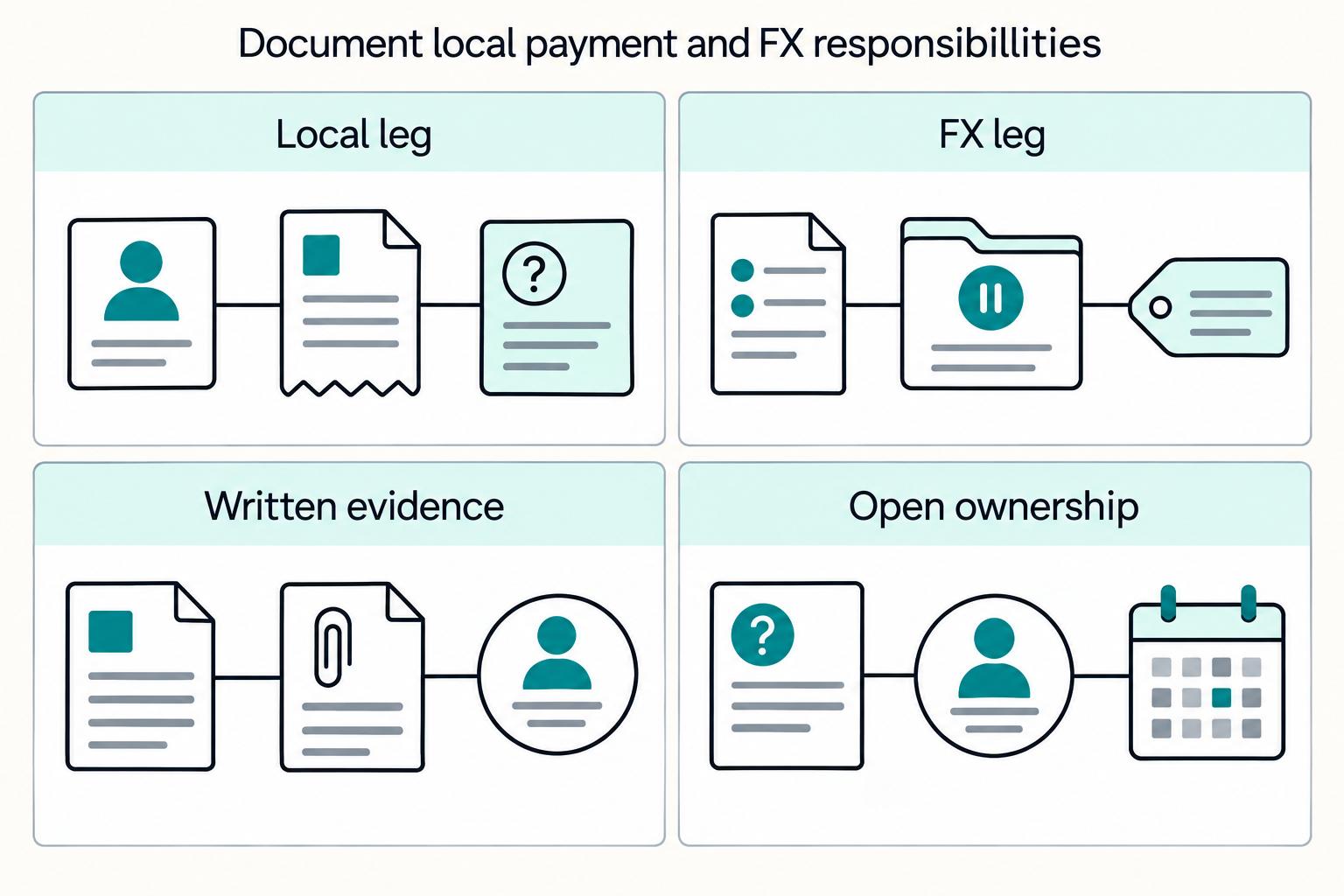
Step 2: Lock role ownership before API work. Document who initiates local payout delivery, who handles funding or conversion, and who owns exception handling. If any participant role is unclear, keep that route in validation instead of treating it as production-ready.
Step 3: Collect compliance and operations artifacts early. Ask each partner to provide their required checks, expected documents, status outputs, and escalation path in writing. Your launch bar should include clear failure ownership and records you can audit during rejects, reversals, or investigations.
Choose your payout architecture for domestic and cross-border legs#
Choose the architecture by your funding origin and evidence quality, not by local payout speed alone. A fast domestic leg can still sit behind slower or uncertain cross-border funding and compliance steps.
| Decision point | Domestic-only via local rails | Cross-border in + domestic out |
|---|---|---|
| Settlement leg | One domestic leg, if funds are already in-country. | At least two legs by design: inbound funding, then domestic payout. |
| Operational owner model | Fewer counterparties and handoffs. | More counterparties and handoffs across funding, compliance, and payout operations. |
| Unresolved dependencies to clear before launch | Beneficiary/account eligibility, status visibility, and exception ownership. | All domestic dependencies, plus inbound-funding handoffs, release conditions, and investigation ownership across legs. |
Treat Electronic Money Institutions, Payment System Providers, and Commercial Banks as separate institution classes in your design and operating model. Do not assume they are interchangeable on routing, controls, onboarding expectations, or exception ownership until each party confirms its role in writing.
If expansion speed matters more than margin, prioritize routes with fewer counterparties and handoffs. If margin matters more, accept the extra integration and governance overhead, but only after ownership is explicit for each leg and each failure state.
Map FX repatriation ownership before you write product requirements#
Do not promise a cross-border contractor flow into Pakistan until ownership is explicit for conversion, document review, and onward movement of funds. Keep the domestic payout leg separate from the FX or repatriation leg in your requirements, because local credit capability does not confirm the full money path.
Step 1. Build a confirmed-versus-unknown matrix#
Use a strict evidence threshold for the confirmed column. The confirmed base is narrow: one bank product example tied to remittance-related use, plus a general statement that transfers can involve banks, money transfer operators, and mobile wallet providers. You do not have contractor-specific FX repatriation rules, documentary standards, or a general policy statement that supports marketing earnings repatriation through local rails.
| Topic | What you can confirm from current evidence | What remains unknown for contractor use cases | Who must answer in writing |
|---|---|---|---|
| Domestic payout leg vs FX leg | Treat these as separate operating questions; a local payout path alone does not confirm how foreign funds enter, convert, or move onward. | Whether your contractor flow is permitted through the exact inbound and outbound path you want to offer. | Platform and partner bank |
| Remittance-related account usage | Bank AL Habib states eligible users can open and manage a Pakistani bank account online through Roshan Digital Account, and that it facilitates remittances for investments and other permissible purposes outlined by SBP. | Whether this product, or a similar one at your partner institution, supports your contractor-earnings flow for your user type. | Partner bank |
| Transfer-provider market | Transfers can involve banks, money transfer operators, and mobile wallet providers. | Which institution converts funds, releases funds, or blocks funds when purpose or documents do not align. | Platform, partner bank, exchange company |
| FX repatriation for contractor earnings | Confirm with SBP or a qualified adviser. | Conversion path, documentary requirements, and outbound movement constraints for earnings or proceeds. | Regulated partners only |
Operationally, every unknown needs both an owner and a due date. If either is missing, product assumptions usually fill the gap.
Step 2. Assign decision ownership before specs become promises#
Assign ownership before requirements become customer-facing claims. The platform should own the commercial promise and evidence pack: what users see in onboarding, which payout options appear in product, and which claims stay blocked pending regulated-partner confirmation.
| Party | Owns or confirms | Article note |
|---|---|---|
| Platform | Commercial promise and evidence pack | Owns what users see in onboarding, which payout options appear in product, and which claims stay blocked pending regulated-partner confirmation |
| Partner bank | Account-product eligibility and bank-side handling guidance | Roshan Digital Account is presented by Bank AL Habib for Non-Resident Pakistanis and Foreign Nationals with a Pakistan Origin Card, not as universal proof for any contractor flow |
| Exchange company | Whether it handles conversion, what triggers holds, and which documents it requires for the exact flow | "We support remittances" is not the same as supporting this contractor-earnings flow |
| Receiving institution | Endpoint behavior and exceptions | Confirm whether payouts are credited, returned, or held for review |
The partner bank should own account-product eligibility and bank-side handling guidance. Product labels matter here: Roshan Digital Account is presented by Bank AL Habib for Non-Resident Pakistanis and Foreign Nationals with a Pakistan Origin Card, not as universal proof that any contractor can receive and repatriate earnings through any bank route in Pakistan.
If exchange companies are part of the route, they should confirm whether they handle conversion, what triggers holds, and which documents they require for the exact flow. "We support remittances" is not the same as "we support this contractor-earnings flow."
The contractor's receiving institution should confirm endpoint behavior and exceptions: credited, returned, or held for review. If status lifecycle language is unclear, support risk rises immediately when payments stall.
Step 3. Set a hard go/no-go rule for product copy#
Use a hard rule: if a bank or exchange-company partner cannot provide written operating guidance for the exact flow, do not ship cross-border payout claims in product copy. Limit external language to the domestic leg you can evidence, and hold FX-handling or repatriation claims until regulated partners confirm them in writing. For more on execution discipline, see How to Pay International Contractors With Fewer Delays and Disputes.
Build compliance and controls into payout operations from day one#
Build controls into the payout design from the start, and treat them as internal operating requirements until your regulated partners confirm the exact Pakistan flow in writing. Do not assume participant-level rules for KYC, AML, retries, or reconciliation are settled, so your product and ops teams should separate what is confirmed from what is still pending confirmation.
Step 1. Place compliance gates on each payout leg#
Use separate decision points for onboarding, payout release, and exception handling rather than one broad "verified user" status. Then document who owns each decision and what evidence is required at that step. If a provider cannot confirm its role for a step in writing, keep that part of the flow out of production claims.
Step 2. Make retries safe before you run real volume#
Define retry behavior before you scale so a resend does not become a second payout. Keep one durable record per payout instruction and preserve status transitions so finance and support can reconstruct what happened without ad hoc evidence. If your team cannot distinguish a true retry from a duplicate, keep traffic in controlled pilots.
Step 3. Reconcile from your ledger, not from provider screenshots#
Treat your internal ledger record as the anchor and attach provider outcomes to that record in a consistent format. Apply the same reconciliation structure to single payouts and batch runs so exceptions stay visible as volume grows. If you cannot show end-to-end traceability for each payout state, postpone rollout beyond pilot scope.
For another local payment rail example, read How Platform Teams Pay Brazil Contractors with Pix.
Execute the payout sequence with verification checkpoints#
Do not treat one successful payout as launch readiness. Keep self-serve closed until you validate route classification, endpoint support, failure handling, reconciliation outputs, and ownership of both domestic payouts and any FX or repatriation dependency.
| Checkpoint | Validate | Evidence or output |
|---|---|---|
| Payout classification | Assign each payout to Bulk Payments, Person-to-Person (P2P) Payments, or a merchant-style flow where relevant | Keep a short route note with the flow type, provider product, and required payout evidence |
| Receiving endpoint support | Confirm receiving support across Commercial Banks or Microfinance Banks in writing; ask what reach means, supported endpoint classes, any exclusions, and required identifier formats | Avoid onboarding users into routes that later fail at initiation |
| Controlled batches | Test small supervised batches and force timeout, duplicate submission, invalid receiving details, manual review holds, and provider rejects | Each tested payout has matching ledger entries, provider references, and support-ready notes |
| Reconciliation and reporting | Trace each payout from request to final state without dashboard-only evidence | Finance needs exportable links between amount, currency, route, internal payout ID, provider reference, and outcome; ops needs a clear exception queue and investigation procedure |
| Dual operational ownership | Go live only when domestic payout reliability and FX/repatriation dependency tracking are both operationally owned | Keep one owner for the local disbursement leg and one for upstream funding or conversion dependencies |
- Step 1: classify the payout type before you build the request shape.
Assign each payout to Bulk Payments, Person-to-Person (P2P) Payments, or a merchant-style flow where relevant. This classification drives request shape, operations assumptions, and support handling. For each live route, keep a short route note with the flow type, provider product, and required payout evidence.
- Step 2: validate the receiving endpoint instead of assuming bank coverage.
Confirm receiving support across Commercial Banks or Microfinance Banks with your provider in writing. Ask what "reach" means for your specific use case, which endpoint classes are supported, any exclusions, and the required identifier formats. This avoids onboarding users into routes that later fail at initiation.
- Step 3: run controlled batches and force failure paths.
Test with small supervised batches before self-serve contractor onboarding. Validate the full lifecycle, including timeout, duplicate submission, invalid receiving details, manual review holds, and provider rejects. The checkpoint is simple: each tested payout has matching ledger entries, provider references, and support-ready notes.
- Step 4: verify reconciliation and reporting outputs before scaling.
Production reporting should let finance and ops trace each payout from request to final state without dashboard-only evidence. Finance needs exportable links between amount, currency, route, internal payout ID, provider reference, and outcome. Ops needs a clear exception queue and an investigation procedure for held, failed, returned, or ambiguous payouts.
- Step 5: gate production on dual operational ownership.
Go live only when domestic payout reliability and FX/repatriation dependency tracking are both operationally owned. Keep one owner for the local disbursement leg and one for upstream funding or conversion dependencies. If operating guidance for the external leg is unclear, avoid public payout timing promises.
Related: Paying the Unbanked: How Platforms Reach Contractors Without Bank Accounts in Developing Markets.
Common failure modes and how to recover without payout chaos#
With the evidence available here, the most reliable recovery pattern is operational: separate flow ownership, add clear pre-release gates, and keep incident records consistent.
Step 1: Separate local payout execution from any upstream funding or conversion dependency. Do not treat one rail or product label as proof of end-to-end coverage. Available guidance does not address all payments policy specifics, so keep your runbook split into distinct legs and require explicit partner confirmation for each leg before promising payout timelines.
Step 2: Remove handoff ambiguity with named owners per step. When multiple partners are involved, vague labels like "provider issue" or "bank issue" slow recovery. Use a simple RACI so funding, initiation, exceptions, and returns each have a clearly accountable owner.
Step 3: Put review gates before release, not after. If your program uses compliance checks, keep block/review/release decisions as explicit states before disbursement. This avoids cases where operations and support see different payout realities at the same time.
Step 4: Standardize incident evidence before scaling retries. Use one record format across teams so each payout has a traceable internal ID, partner reference, state, and next owner. If support cannot answer "what happened, when, and who acts next?" from the record alone, stay in controlled rollout mode.
For a step-by-step walkthrough, see How to Pay Contractors in Nigeria Using Local Rails for Compliance-Safe Operations.
Conclusion and copy-paste launch checklist#
The practical answer: treat these public documents as market context, not operating clearance.
That distinction matters because market context is not the same thing as launch readiness. A WTO Trade Policy Review report dated 23 February 2022, the ADB Pakistan's Digital Network: A Diagnostic Report from JULY 2025, or a Ministry of Finance page listing Federal Budget 2025-26 publications can help frame the environment. They do not, on their own, confirm how any institution will execute payouts, conversions, exceptions, or compliance controls for your specific flow.
Copy-paste launch checklist#
Step 1. Separate context evidence from operating evidence. Use public reports for background only, and maintain a separate list of items that still require partner confirmation. Verification point: your launch file clearly labels what is document-level context vs. what is institution-confirmed.
Step 2. Get written scope confirmation from each institution in your flow. Ask what use cases are supported, what is out of scope, and which party is the operator for each leg of money movement. Verification point: you have dated written responses, not call notes or assumptions.
Step 3. Log unresolved ownership before launch decisions. If responsibilities across institutions are unclear or conflicting, treat that as an open dependency. Red flag: two parties each describe the other as responsible for a critical step.
Step 4. Verify what operational outputs you will receive. Because the public excerpts do not define status models or reconciliation artifacts, request sample outputs and test what your team can actually trace. Verification point: one controlled transaction can be followed end to end in your records.
Step 5. Keep unresolved cross-border and FX items out of external promises. If an institution cannot provide a clear written answer on conversion, remittance handling, or related exceptions, mark it as unresolved and exclude it from launch copy. Failure mode to avoid: promising a complete cross-border flow while key operational ownership is still undefined.
Launch when critical ownership and operating evidence are written, dated, and test-verified. If core items remain interpretive, you are still in discovery, not ready for scale.
Frequently Asked Questions
Can you pay contractors in Pakistan through RAAST today?
That is not confirmed. Treat contractor payouts through RAAST as a partner-verification question, not an assumption, and get written confirmation from the regulated institution that would initiate the local payout leg.
What does RAAST handle directly versus what still depends on banks or Exchange Companies?
A confirmed product boundary for RAAST itself is not established, so do not present it internally as an end-to-end cross-border payout answer. What is explicitly shown is narrower: one bank FAQ mentions account-to-account transfers within the bank and to other local banks, and the Roshan Digital Account excerpt says SBP launched that initiative with designated commercial banks. The practical checkpoint is to ask each partner to state, in writing, whether they own funding, conversion, domestic release, and exception handling.
Does RAAST include foreign exchange conversion and FX repatriation rules?
FX repatriation rules are not covered in available RAAST documentation. The only FX-related signal is that a Pakistan Doing Business Guide includes a section heading for “Foreign Exchange Controls and Repatriation of Profits.” That heading does not show the rules, thresholds, or documents, so you should not infer operational coverage from it.
How should a platform split ownership between domestic payout operations and cross-border funding operations?
Keep them as two separately owned tracks. Your domestic owner should control payout initiation, status tracking, and recipient-side exceptions. Your cross-border owner should control source of funds, conversion path, remittance documentation, and any repatriation or settlement questions with regulated partners. If one partner cannot name its exact responsibility, that is a launch red flag.
Which institution types matter most for launch planning in Pakistan: Commercial Banks, Microfinance Banks, EMIs, or PSPs?
Based on what is documented here alone, Commercial Banks are the clearest starting point because they are explicitly named in the SBP-linked Roshan Digital Account material as "designated commercial banks." This guide does not establish the role of Microfinance Banks, EMIs, or PSPs for this use case. You need direct confirmation before you design routing or coverage assumptions around them.
What is known from SBP and World Bank materials, and what must be confirmed directly with regulated partners?
The grounded points are limited. SBP is referenced as launching the Roshan Digital Account initiative with designated commercial banks, the initiative is described as supporting official inward remittance channels, and one excerpt says account opening can be 100% remote in 2 working days after documents are submitted. None of that confirms contractor payout eligibility, RAAST scope, or FX repatriation handling. Before go-live, ask partners for an evidence pack with supported payout routes, receiving-bank coverage, required documents, and a written answer on who handles FX conversion and any outbound or repatriation questions.
Try a related tool
Where Gruv fits
Researched and edited by the Gruv editorial team. Gruv builds cross-border billing, payouts, and finance-operations software for global businesses.
Sources
Includes 1 external source outside the trusted-domain allowlist.
- documents.worldbank.org/curated/en/099533208082225824/pdf/IDU05ffd64...trusted
- elibrary.imf.org/downloadpdf/view/journals/002/2025/332/002.2...trusted
- elibrary.imf.org/downloadpdf/view/journals/002/2025/332/artic...trusted
- finance.gov.pk/press_releases.htmltrusted
- imf.org/en/-/media/files/publications/cr/2025/englis...trusted
- large.stanford.edu/courses/2024/ph240/zafar1/docs/gop-jun24.pdftrusted
- thedocs.worldbank.org/en/doc/e414b36ae736660edf8f0f3cb597b1e9-0310...trusted
- adb.org/sites/default/files/publication/1067316/paki...external
Educational content only. Not legal, tax, or financial advice.
Related Posts
Local Currency Payouts vs USD Payouts for Contractor Platforms
USD versus local currency is not just a finance setting. For a platform, it changes compliance scope, recipient certainty, reconciliation effort, and how much engineering depth your payout layer needs. In practice, many teams avoid picking one currency forever. A common approach is to set corridor-level rules: use local currency where it is legally and operationally supported, and keep USD as a fallback where legal, coverage, or operational constraints are still real.

Paying Unbanked Contractors in Developing Markets: Best Payout Routes for Platforms
If your team needs to send money to contractors, creators, freelancers, marketplace sellers, or other non-payroll recipients across borders, the payout decision can look deceptively simple at first. On paper, you are choosing a payment rail. In practice, you are choosing an operating model that affects onboarding, compliance, support load, engineering effort, treasury visibility, failure recovery, and the degree of legal risk your company is willing to carry.

Choosing Dynamic Discounting for Contractor Early Payment on Platforms
Dynamic discounting is a buyer-led arrangement on outstanding invoices. Payment happens before the due date, and earlier payment usually means a larger discount. The core question is who funds that acceleration. In the standard model, the buyer uses its own cash, so your early-pay offer sits inside working-capital policy, not just product configuration.