
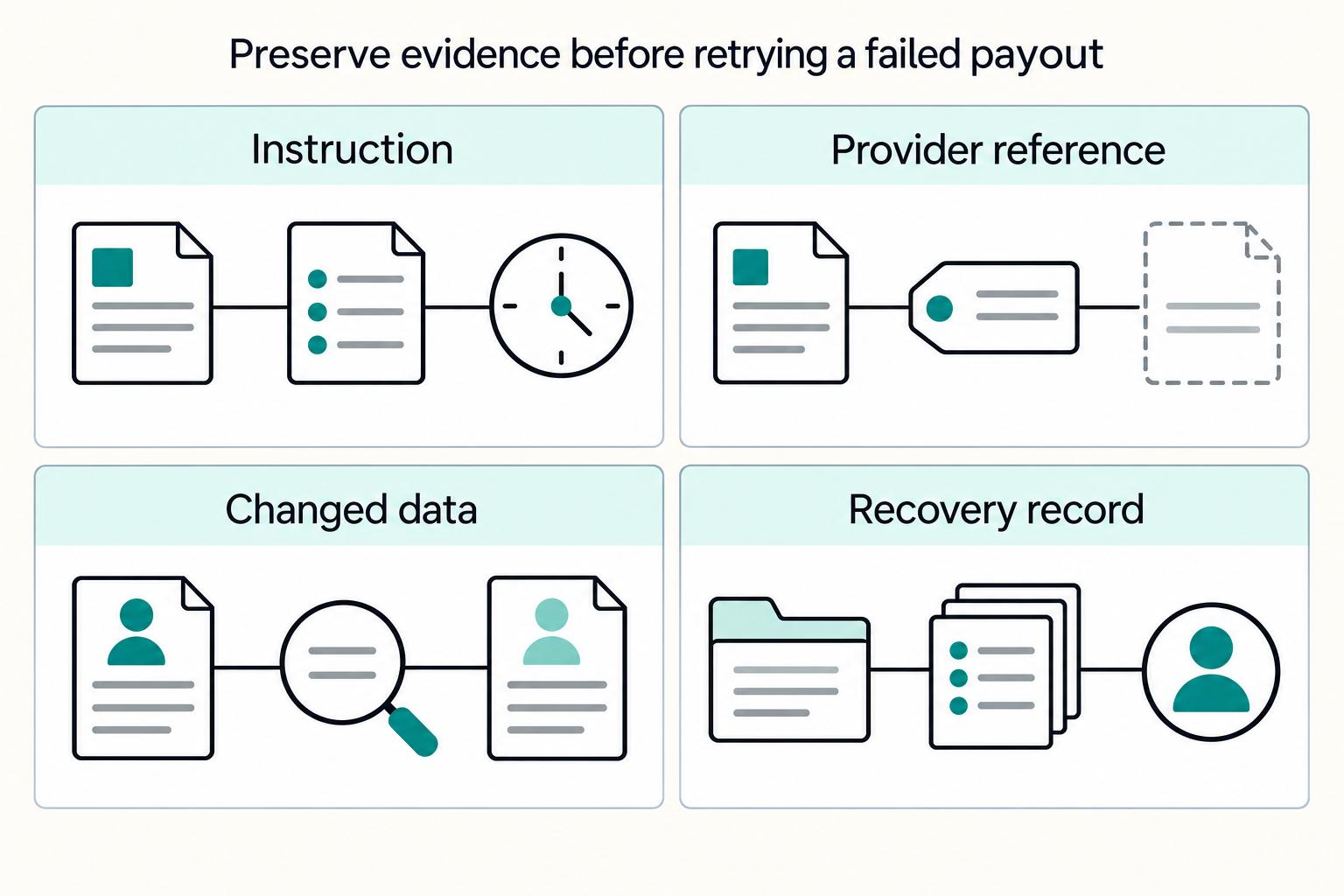
Quick Answer
Separate Czech payouts into two branches: domestic CZK and non-CZK. Use CNB references, partner confirmations, and dated documents like the Rules of the CERTIS Payment System and the List of CERTIS participants before go-live. Then require payout instruction IDs, provider references, status events, and reconciliation records for every pilot case. If any route or ownership item is unresolved, keep it out of the default batch flow.
What matters when paying Czech contractors in CZK#
Before you spend product or compliance effort on the Czech Republic, lock down the few things you can verify. The Czech National Bank, or CNB, supervises the banking sector and payment systems in the local market, and the local currency is the Czech koruna, or CZK. Treat routing, settlement behavior, and partner feasibility as launch questions to prove, not shortcuts to build around.
Before you start#
Step 1. Separate public rail facts from your provider route. CNB’s CERTIS description identifies CERTIS as the Czech interbank CZK system; same-participant transfers are internal to that participant. This establishes currency scope, not your provider’s account access or receipt time. Save the current rules and participant lists with their access dates. A dated CNB reference rate is not an executable FX quote.
Step 2. Confirm standard versus instant CZK service. CNB instant-payment guidance describes one-off CZK transfers within seconds, with voluntary scheme participation and a CZK 2.5 million system limit; banks may set lower outgoing limits. Check both banks, provider access and the actual per-payment limit. Domestic rail speed does not establish an end-to-end cross-border payout promise.
Step 3. Decide early who owns the proof. The hard part is not finding a payment option. It is building an evidence pack that explains why a payout was routed a certain way, who approved the compliance stance, and what source supported the decision at the time. At minimum, keep a dated packet with the CNB reference you relied on, partner confirmations on supported payout paths, and the internal owner for tax, classification, and exceptions. If a payout fails later, that packet lets you separate a routing issue from a policy issue instead of arguing from memory.
Treat this as a go or no-go exercise. It's not just whether contractors in the Czech Republic can be paid. It's whether your bank path, compliance ownership, and operational controls can be explained end to end before the first live batch goes out.
What To Prepare Before You Design Czech Contractor Payouts#
Prepare your payout design inputs before you build routing logic: keep domestic Czech koruna (CZK) payouts separate from cross-currency payouts from the start. Cross-border payments can behave differently, and the CNB notes that in some instances they can take several days and cost up to 10 times more than domestic payments.
Step 1. Define the payout mix you will support first. State clearly whether launch covers only domestic CZK payouts in the Czech Republic or also includes non-CZK and cross-border contractor payouts that may involve correspondent banking. Document each payout type, settlement currency, and intended bank or partner path. If a path is not confirmed, mark it unresolved.
Step 2. Gather the internal documents you already control. Collect your contractor onboarding flow, your independent contractor agreement template, and any internal guidance that references dependent work (závislá práce). Assign a clear owner for classification questions and a clear owner for payout exceptions so decisions stay consistent across onboarding, review, and payout handling.
Step 3. Build a dated evidence packet before launch. Link the current CERTIS rules and participant lists, including the separate instant participant list. Record which version applied to the route approval. Determine payer and recipient tax status, service location and income type before choosing any Czech or US tax artifacts; CNB rail documents do not establish those tax duties.
Related: How to Pay Contractors in Mexico: SPEI CoDi and SAT Compliance for Foreign Platforms.
Map The Czech Rail Constraints Into Product Requirements#
Do not launch a single generic "bank transfer" path for Czech payouts. Split routing early between your planned domestic CZK path and a separate non-CZK path until partner documentation confirms exactly how each flow is processed.
| Path | Required treatment | Key requirement |
|---|---|---|
| Same-bank transfer | Treat it as a different execution path from a different-bank transfer, even if the contractor sees one payout option | Store sending entity, beneficiary bank, payout currency, and expected rail on each payout instruction |
| Different-bank CZK payout | CERTIS is the local CZK interbank system; choose supported standard or instant service | Confirm provider/participant access, bank coverage, outgoing limits, funding and status evidence |
| Non-CZK interbank payout | Put it on a separate branch with its own ETA language, fee handling, exception flow, and ownership for trace/return work | Keep it gated until your provider can document the exact route and status evidence; do not auto-execute it if the path cannot be named clearly |
Step 1. Model interbank payouts as a routed path, not a payment method#
Treat same-bank and different-bank transfers as different execution paths, even if the contractor sees one payout option. Store routing attributes on each payout instruction - sending entity, beneficiary bank, payout currency, and expected rail - so operations can trace failures quickly.
CERTIS handles interbank CZK payments; confirm which participant and provider service executes your local leg. Do not confuse a known public system scope with verified access for your integration. Keep funding, FX conversion and local settlement as separately traceable legs.
Step 2. Create a hard split for non-CZK interbank payouts#
Do not treat non-CZK interbank payouts as just a currency toggle on the same route. Put them on a separate branch with their own ETA language, fee handling, exception flow, and ownership for trace/return work.
Keep this branch gated until your provider can document the exact route and status evidence you will receive. If your team cannot name that path clearly, do not auto-execute it.
Step 3. Use the core documents as launch gates#
Use the Act on payment system and the Rules of the CERTIS Payment System as partner-question checklists, not as assumptions. Require written confirmation of participant setup, supported payout types, status visibility, and reject/return handling before go-live.
If a partner cannot map your intended Czech payout flow back to those references in dated documentation, keep that route out of launch scope.
Compare Bank Transfer, Platform Wallet, And Check Options For Contractors#
Choose the method that preserves end-to-end evidence for your actual product and route. Compare sample exports, receipt evidence and exception handling before choosing a default. A provider may deliver to a bank account while using a wallet or FX service for funding; those categories overlap.
Step 1. Compare methods by evidence quality, not familiarity#
| Method | Control | Traceability | Reconciliation burden | Operational failure visibility | CZK vs non-CZK constraint and extra verification |
|---|---|---|---|---|---|
| Bank transfer | Verify who controls instruction and beneficiary data | Require stable provider references and exportable status history | Test statement-to-ledger matching, including fees and returns | Confirm reject, return and pending events are exposed | For domestic CZK, validate CERTIS participation and the specific route. For non-CZK, verify the actual cross-border route separately. |
| PayPal | Verify account permissions and payout controls for the selected product | Require payout IDs and link withdrawals, fees and reversals | Test whether all related records reconcile to one obligation | Distinguish provider completion from beneficiary receipt | Verify the product’s Czech corridor, export schema and reversal handling; CNB rail documents do not establish wallet behavior. |
| Wise | Verify funding, conversion and bank-delivery controls for this corridor | Require usable transfer references and exportable statuses | Match FX, fees and delivery legs to the payable | Confirm how pending, failed and returned transfers appear | Wise can deliver to bank accounts; test the actual product and route rather than treating it as a separate rail category. |
| Check-like fallback | Document issue, delivery, deposit, void and reissue authority | Link each event to the obligation and instrument ID | Test manual matching and duplicate-payment prevention | Define evidence for loss, non-delivery and stale instruments | If supported and necessary, use a documented exception process with an owner and receipt checks. |
Decision rule: choose a default only after its sample records support your required reconciliation and exception controls. Keep domestic CZK and non-CZK routes as separate operational branches even when the same provider serves both.
Step 2. Validate reference capture before scaling any method#
The gate is not whether money can be sent. It is whether finance can prove what happened using exportable records tied to your internal payout IDs.
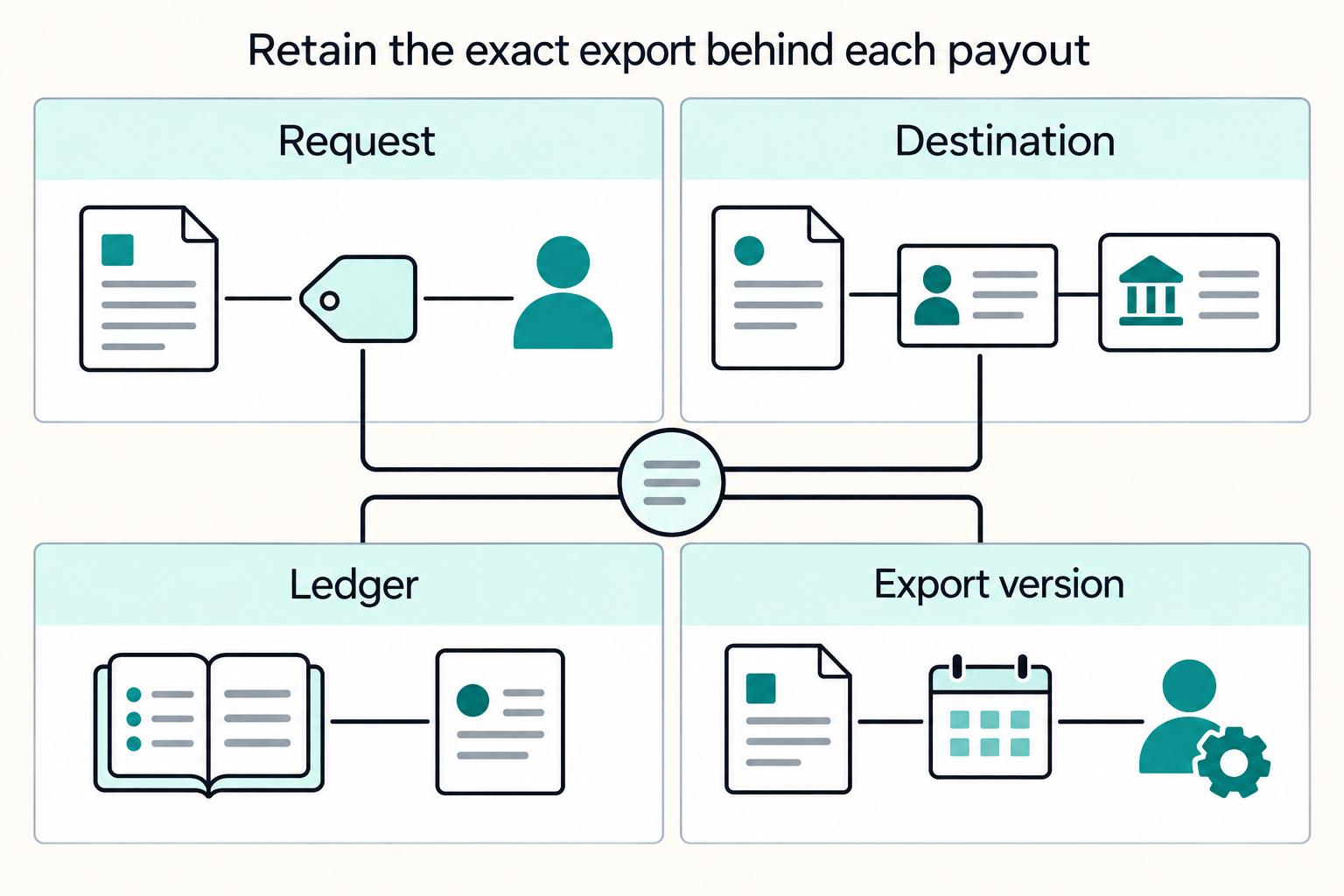
For any primary method, require sample API or export output that includes internal payout ID, provider reference, payout currency, beneficiary identifier, timestamps, and final status or return reason. If those fields are missing or inconsistent, keep the method out of your default batch flow.
For FX-heavy routes, compare an actual corridor quote: funding amount/currency, conversion rate, all fees, delivered amount, quote expiry and expected receipt time. Public US pricing floors or volume thresholds do not establish your Czech program’s terms. Verify exportable payout IDs and fee/FX records separately from price.
Step 3. Exclude methods that break batch reconciliation#
If predictable batch operations matter, test every candidate method for split fee, FX, reversal and withdrawal records. Exclude a configuration that cannot tie those records to one payable; the failure depends on the product and export design, not the provider category alone.
For a wallet route, inspect the actual contractor/business payout product, supported recipient market and currency, fees, exportable references and reversal/withdrawal behavior. A US consumer fee page does not establish Czech contractor payout pricing or settlement.
Practical rule: if you cannot explain a payout from instruction creation through settlement with exportable evidence, keep that method manual.
Assign Compliance Ownership Before You Ship The First Payout#
Assign named owners before launch, or compliance decisions will fragment across teams. Set clear accountability for worker-status review, tax-document handling, record retention, and payment-policy enforcement from day one.
Step 1. Separate payment rail oversight from worker-status judgment#
Put payout controls under one owner: onboarding checks, hold or release rules, and payout-record retention linked to contractor and batch IDs. Contractor-side tax handling does not remove your platform's responsibility for those controls.
Review actual working arrangements as well as the agreement. Czech labour-inspection guidance treats dependent work outside the appropriate labour-law relationship as illegal work: document personal performance, direction, subordination and how work is organized. A contractor label or successful bank payment does not settle classification. Route unresolved employment facts to the responsible reviewer before using the contractor flow.
Step 2. Tie classification boundaries to the agreement you actually use#
Define who validates status boundaries and how that decision appears in your agreement template, onboarding flow, and exception process. If a point is not confirmed, mark it unresolved instead of implying certainty.
Your records should consistently show agreement version, approval date, reviewer, and exception notes. Without that trail, classification and payout decisions can drift out of sync.
Step 3. Assign tax-document collection and storage ownership explicitly#
Assign tax intake and review to an owner who first determines which forms apply. For US-linked payments, service income sourcing generally depends on where services are performed, not the payer’s country. W-8BEN documents foreign individual status where applicable; entities may need a different form. Form 1096 is a payer transmittal for specified paper information returns, not a contractor onboarding form, and is not used for electronic submissions. Document the reporting decision and supporting facts rather than collecting every named form from every Czech contractor.
Use a simple evidence test: for any contractor, can you show whether the document was received, where it is stored, who reviewed it, and which payout batches were allowed before or after that review?
Step 4. Maintain a known-unknowns register for questions CNB materials do not answer#
Use Czech National Bank materials for payment-system oversight questions, because CNB supervises the banking sector and payment systems. Do not treat CNB sources as a complete authority on contractor-classification or foreign tax-operations interpretations.
Track unresolved interpretations in a short register with an owner and deadline. The Ministry of Finance of the Czech Republic co-operates with CNB and has a role in creating and publishing measures and regulations, so some issues may need review beyond payment-system sources before launch.
Build The Payout Sequence With Verification At Every Step#
After ownership is assigned, make the payout flow verifiable end to end. You should be able to show what was checked before submission, what happened during execution, and why a payout was marked complete.
Step 1. Gate onboarding and route eligibility before payout creation#
Decide the payout route before you create an instruction. A contractor should become payout-eligible only after onboarding checks pass and the payment method is mapped to the route you will actually use, including whether it is a domestic CZK transfer or a cross-border/non-CZK path.
Use route-specific timing and fees: a domestic instant CZK leg, standard CZK transfer and cross-border funding/conversion chain have different conditions. Track the timestamp for each leg instead of treating a delayed funding step as proof of local-rail failure.
Your verification checkpoint should capture, for each contractor: approved payment method, currency, route label, review timestamp, and reviewer.
Step 2. Create one payout instruction and keep replay-safe evidence#
Create one durable payout instruction per obligation before money movement starts. That record should tie contractor ID, payout batch ID, amount, currency, destination details, and intended provider or bank path.
Hypothetical cross-currency example: a EUR 1,000 payable is quoted at CZK 25 per EUR with a EUR 10 fee deducted before conversion. If the contractor agreed to bear that fee and receive conversion proceeds at that quote, the delivered amount is EUR 990 × 25 = CZK 24,750. Without that agreement, the deduction leaves part of the EUR 1,000 obligation unpaid: fund the fee separately or obtain a documented contractual adjustment. A promise of CZK 25,000 likewise requires funding enough to deliver that amount. Store the payable currency, agreed fee/FX allocation, funded amount, fee, conversion quote and local delivery reference. Confirm the actual quote rather than using this illustrative rate or a CNB reference rate as execution pricing.
Use a replay-safe execution rule so retries do not create a second payout for the same obligation by accident. Keep exportable artifacts for each submission:
- internal payout instruction ID tied to contractor and batch IDs
- provider or bank submission reference
- ledger posting from approved to submitted
- timestamped status events from create through reconciliation
Step 3. Reconcile to final status and force unresolved cases into exceptions#
A submitted payout is not the same as a completed payout. Mark success only when provider or bank status and your ledger state agree; if status is unresolved, keep it open and move it to an exception queue.
CNB supervision covers payment systems, but your payout-level source of truth is still your provider or banking partner references plus your own ledger trail. Route timing should reflect route reality: domestic CZK cases may resolve faster, while cross-border cases may stay pending longer because they can take several days. If a payout exceeds the expected window, escalate instead of auto-closing.
Handle Failure Modes Operators Actually See In Production#
When a Czech payout fails or stays unresolved, classify the cause first and recover by failure type, not by queue label. That is the fastest way to avoid duplicate sends and keep a defensible record of what happened.
| Failure type | First check | Required action |
|---|---|---|
| Routing issue | Re-check the relevance of the List of CERTIS participants for the banking path you intended | Do not assume the original route is still correct just because a Czech bank account is on file |
| Compliance hold | Route it to document review | Keep execution paused until the profile and required artifacts are cleared |
| Data issue | Correct the contractor profile first | Record who changed what, tied to the same failed instruction history |
| Payout currency diverges from CZK | Treat it as a currency edge case | Stop automation and move the case to the non-CERTIS branch with explicit approval |
Step 1. Classify the break before anyone retries#
Start with one question: is this a routing issue, a compliance hold, or a data issue? A beneficiary mismatch, a missing provider reference, and a delayed status can all appear as "not completed," but they do not share the same fix.
Before any resend, confirm the original instruction still includes contractor ID, payout batch ID, amount, currency, destination details, and any provider or bank reference. If the provider reference is missing, pause retries and establish submission truth first.
Use route-aware timing for delayed outcomes. Real-time payments are understood as moving funds within seconds rather than days, so unexpected lag on a path you expected to be fast is a review trigger, not an automatic retry signal.
Step 2. Recover by failure type, not by support queue label#
If the failure looks like rail or routing, re-check the relevance of the List of CERTIS participants for the banking path you intended. Do not assume the original route is still correct just because a Czech bank account is on file.
If the failure is a compliance hold, route it to document review and keep execution paused until the profile and required artifacts are cleared. If it is a data issue, correct the contractor profile first and record who changed what, tied to the same failed instruction history.
Apply one explicit product rule for currency edge cases: if payout currency diverges from Czech koruna (CZK), stop automation and move the case to the non-CERTIS branch with explicit approval.
Step 3. Keep an incident evidence pack that can survive audit review#
For every failed or returned payout, keep one incident packet with timestamped events, decision logs, reconciliation notes, and final resolution. It should show what was submitted, what status came back, what was re-validated, what changed, and why the case was retried, canceled, or rerouted.
Because the Czech National Bank supervises payment systems, keep these records audit-ready and easy to follow outside the immediate ops team. Related reading: How to Write a Payments and Compliance Policy for Your Gig Platform.
Make The Launch Decision With A Go Or No-Go Scorecard#
Make this a pass-or-fail decision, not a vibes-based launch call. If a core ownership gap is still open, especially around compliance or exception handling, treat the Czech Republic rollout as no-go even if the payout code works.
Step 1. Build a scorecard that forces evidence, not assumptions#
Use a short scorecard and require a proof link for every pass item. The point is to stop teams from marking work "done" based on a positive call or a single sandbox result.
| Check | Pass condition | Proof you should attach |
|---|---|---|
| Rail and currency path clarity | Your payout route and currency path are explicitly documented for this launch scope | Internal routing decision note |
| Operational feasibility | The provider or bank path you plan to use is confirmed and current in your internal launch records | Internal partner or route validation record |
| Compliance ownership | Named owner exists for worker classification, tax artifacts, and payout exceptions | Internal compliance SOPs |
| Reconciliation readiness | Ops can trace instruction, provider reference, ledger entry, and final status for a payout | Sample audit log or pilot case file |
Step 2. Apply one hard no-go rule#
Do not launch if legal or compliance ownership is unresolved for classification, tax documents, or exception review. That is the failure mode that creates the worst incident class: a technically successful payout that your team cannot later defend, explain, or remediate cleanly.
A practical checkpoint is simple: ask one person to name the owner, decision document, and storage location for each of those three areas. If any answer is vague, you are not ready.
Step 3. Approve only a phased rollout with explainable pilots#
Green-light a pilot only when a small set of real payouts can be explained end to end. For each pilot case, you should be able to show the contractor record, payout instruction, references, status changes, reconciliation result, and any manual decision taken.
If the pilot completes but its evidence cannot be assembled, hold expansion and repair the missing records. Test standard, eligible instant, cross-currency and reject/unknown-status cases that fall within your actual launch scope. Global transaction projections do not prove a Czech provider integration.
For a step-by-step walkthrough, see Gig Worker Tax Compliance at Scale: How Platforms Handle 1099s W-8s and DAC7 for 50000+ Contractors.
Conclusion#
Treat Czech contractor payouts as a sequence of funding, conversion and delivery decisions. Public CNB documents establish the CZK system; partner evidence establishes your access, fees and final-status data. Use the following launch checklist to keep both kinds of evidence tied to the actual payout.
- Confirm your Czech koruna scope and routing assumptions.
Decide exactly which payouts are in Czech koruna (CZK) and which are not. Your verification point is a written routing note from your payments team or banking partner that states which path applies to each payout type, because a common failure mode is treating every Czech payout as if it follows the same domestic-bank logic.
- Validate partner feasibility with current counterparty confirmation.
Do not rely on a sales conversation or an old integration memo. Your checkpoint is a dated record showing who confirmed route feasibility, which legal entities and payout paths were checked, and what open questions still need confirmation from the bank or PSP.
- Document compliance ownership before the first live transfer.
Name the team and person who own contractor onboarding checks, tax-document workflow, and evidence retention. The red flag here is split ownership with no final approver, because that is how required reviews and records fall into gaps.
- Implement payout execution so retries cannot create duplicate payments.
You do not need fancy architecture to do this, but you do need clear idempotency keys, payout batch IDs, provider reference capture, and a rule for unresolved statuses. The failure mode to avoid is replaying a request after a timeout and discovering later that the ledger, provider status, and contractor history disagree.
- Require reconciliation and exception handling before scale.
Every payout should be explainable from instruction creation through final status, return, or hold. If a provider reference is missing, the beneficiary data changes mid-process, or a status remains pending too long, route it into an exception queue with notes instead of auto-closing it as successful.
- Run a pilot and demand audit-ready traceability.
Start with a narrow contractor cohort, limited payout volume, and manual review of each result. Approval to scale should depend on whether you can produce the evidence pack quickly: timestamps, contractor identifier, batch identifier, payment method record, provider reference, reconciliation result, and the decision log for any exception.
That is the practical standard for this work. If your team cannot prove those six points with documents and test results, you are not ready to broaden rollout.
This pairs well with our guide on How to Launch a Legal Compliance Platform for Freelancers and Handle Their Payments.
Frequently Asked Questions
Can I offer one generic bank transfer option for Czech contractors?
Not if you cannot show which route you are actually using. The safer approach is to split domestic CZK payouts from non-CZK interbank payouts until your bank or payout partner confirms the exact path, status model, and reject or return handling in writing.
What is the first proof I should ask a bank or payout partner for?
Ask for written confirmation of the exact route and the status evidence you will receive. At minimum, you want supported payout types, participant setup, status visibility, reject or return handling, and sample output that includes your internal payout ID, provider reference, payout currency, beneficiary identifier, timestamps, and final status or return reason.
Who should own classification and tax-document handling?
Assign classification review separately from payout execution and tax-document custody. Select documents from payer/recipient status, income type and service location. W-8BEN may be relevant to a foreign individual in a US tax workflow; Form 1096 is a payer’s paper-return transmittal, not a Czech contractor intake form. Record which documents apply, who reviewed them and which exceptions remain.
When is a Czech payout route ready for self-serve launch?
Only when the route and currency path are documented, partner feasibility is confirmed, ownership is assigned for classification, tax documents, and exceptions, and a pilot payout can be explained end to end with references, status changes, and reconciliation evidence. If you still cannot name the path clearly or assemble the evidence pack without digging through chats or dashboards, it is not ready.
Try a related tool
Where Gruv fits
Plan and approve payout batches
See how payee status, approval rules, route review, and exception handling sit in one payout workflow.
See reconciliation and mismatch review
Compare ledger entries, provider payment records, and statement rows to see what matches and what finance needs to review.
Researched and edited by the Gruv editorial team. Gruv builds cross-border billing, payouts, and finance-operations software for global businesses.
Sources
Includes 2 external sources outside the trusted-domain allowlist.
Educational content only. Not legal, tax, or financial advice.
Related Posts
Pay Contractors in Peru with Yape, PLIN, and SBS Checks
Treat Peru as a posture decision, not just a rail decision. If you choose a local wallet-style method first, then sort out contractor status, tax data, and evidence later, you may get a smoother payout experience. You also raise launch risk in areas that are much harder to fix once money starts moving.

Pay Contractors in Mexico: SPEI, CoDi and SAT Records
Paying a contractor in Mexico involves an accepted service obligation, the supplier’s tax documents and a money movement. A SPEI transfer does not classify a worker, and a CFDI invoice does not prove that a bank account was credited. Link these records while keeping their different meanings visible.

How to Pay Contractors in Kenya with M-Pesa, PesaLink, and KRA Controls
Kenya is worth serious consideration for contractor payouts, but you should not greenlight a launch just because M-Pesa is familiar and PesaLink is on the shortlist. The real decision is practical. Confirm which rail fits your contractor base, put local compliance and tax controls in place before money moves, and keep enough evidence to explain each payout later.