Start by defining success as contractor funds usability, then compare rails corridor by corridor instead of trusting headline speed claims. Use a 30-day pilot with explicit fallback between instant routes like SEPA Instant or FedNow and slower paths such as ACH or SWIFT. Scale only the corridors that show better settlement timing, lower operating drag, and cleaner finance tie-outs.
The appeal of open banking for contractor payouts is faster settlement at lower cost. But that upside is conditional, not automatic. You get it only when you choose rails corridor by corridor, separate provider acceptance from actual funds availability, and verify outcomes with your own data.
Start with the outcome, not the rail. For contractor payouts, the key question is not "Did the API accept the request?" It is "When were funds actually available to the contractor?" Treating those as the same event is how "fast payouts" look better in reporting than in reality.
That distinction matters because faster-payment value comes from less float and lower operating friction. Evidence on faster payments shows efficiency gains, but it also shows those gains depend on adoption. In Canada, projected five-year benefits ranged from $1.65 billion in a weaker-adoption case to $7.01 billion in a stronger-adoption case. The practical takeaway is simple: capability alone does not create savings. Actual usage and settlement outcomes do.
Your first checkpoint is alignment on what "completed" means. If product means "submitted" while finance or ops means "funds available," reporting and contractor communication will drift immediately.
Account-to-account payments are attractive because they move money through bank accounts rather than card networks, and on some rails they can settle instantly. Grounded examples are Faster Payments (UK) and SEPA Instant (EU). That is an opportunity, not a universal promise across every route.
The rail decision should not stop at "use open banking" or "use card push." In practice, evaluate A2A, card-push, and batch rails based on corridor coverage, participant access, and fallback behavior.
The settlement model matters early because it affects who can access the rail. Two providers can both claim access to a fast rail, so verify reach, exception handling, and confirmation quality with corridor-level data. If corridor-level availability and funds-available evidence are missing, treat speed claims as unproven.
That sets the operating plan. The guide that follows gives platform, finance, and engineering teams a practical 30-day path to choose cleanly. The objective is straightforward: reduce payout delay and operating cost without creating compliance, reconciliation, or trust issues that cost more later.
A practical starting rule is to require two signals before expanding any new payout route: an event that confirms initiation, and a method to confirm funds available, not just provider acceptance. Without both, you still do not know if the route is better.
One risk is marketing instant outcomes while fallback paths remain batch-based or instant-rail access is partial. Real-time settlement readiness, participant access, and adoption shape what contractors actually experience. Teams that execute well prove settlement truth corridor by corridor, then scale what holds up under measurement.
For the account validation side of contractor payouts, see Bank Account Verification for Contractor Payouts: Microdeposits Open Banking and Instant Match Compared.
Define "completed payout" before rail selection, or different teams will report different outcomes and overstate speed.
Set two internal states and keep them fixed across product, ops, and finance:
This is an operating control, not wordplay. Every non-cash payout runs on a payment rail, so treat acceptance and completed movement as separate checkpoints. Use one shared test question across teams: "Is this payout completed?"
Do not publish one global payout promise. Define corridor-level promise tiers, for example instant, same-day, next-day, or batch, then map each corridor to rails you can access and verify.
Treat rail choice as corridor-specific. ACH, SWIFT, SEPA, and Faster Payments can behave differently across routes. If you cannot prove corridor coverage and reliable post-payment status, downgrade the promise for that corridor.
Lock down what pending, sent, and completed mean before support macros, payout messages, and finance reporting diverge. Keep the labels simple, but tie each one to an event or evidence point your team can produce quickly in an audit.
Use this checkpoint: support should be able to answer contractor status questions without engineering log dives. If status handling starts to raise cost to serve over time, treat that as integration debt early.
For a step-by-step walkthrough, see How to Lock In FX Rates for Contractor Payouts Using Forward Contracts.
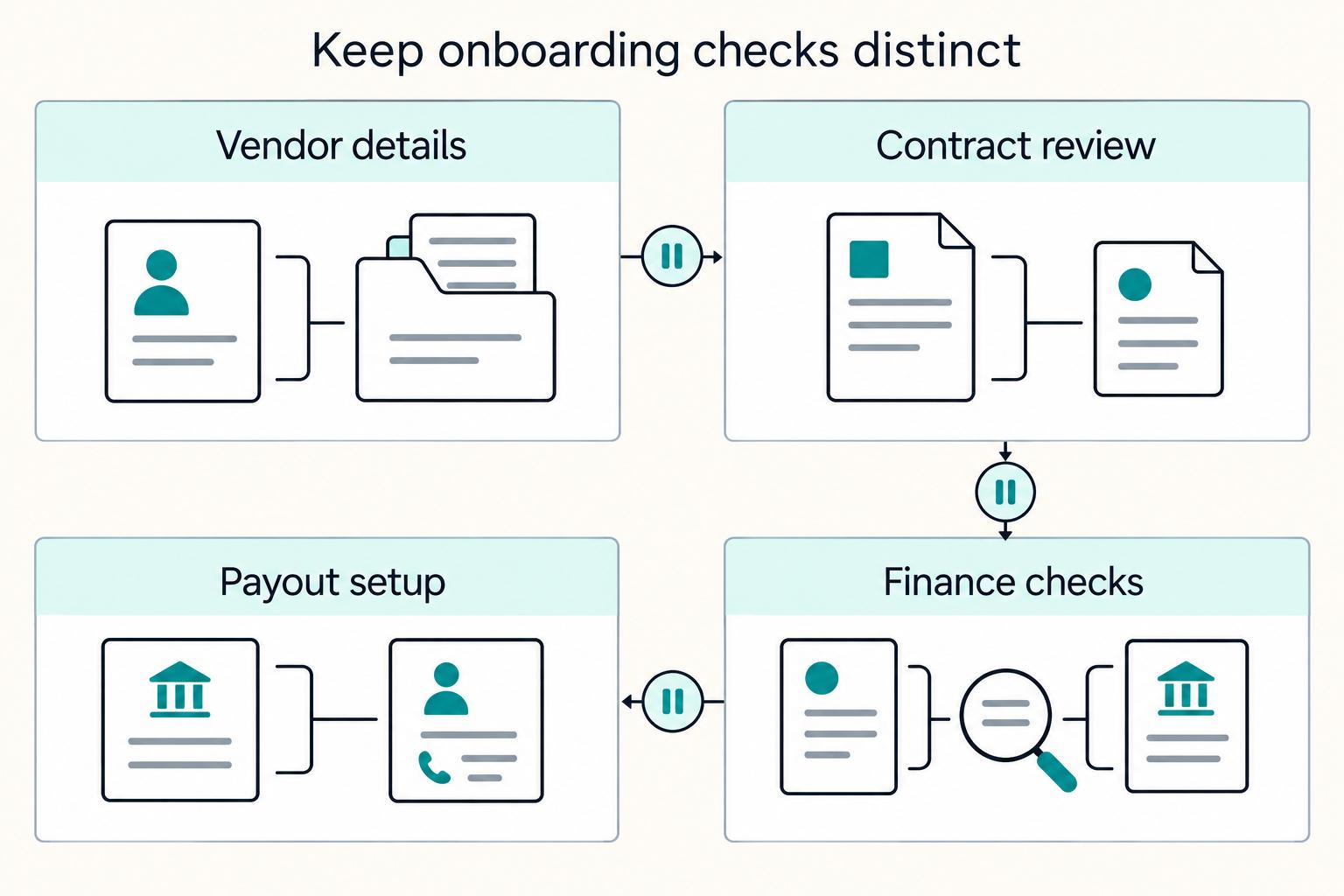
Once you define settlement completion, build the evidence pack before choosing any new rail. Do not switch rails until you can show how each corridor behaves today, which compliance gates apply, and which tax artifacts you can actually retrieve.
Start with a corridor-level map of where funds go, how much moves, and which rail is used now, including ACH, SWIFT, and any current Visa Direct usage. Keep this corridor-specific, not provider-label specific.
For each corridor, capture:
Use a simple baseline check: pick five recent payouts and confirm ops can trace from request accepted to your "funds available" point without engineering log dives.
Treat broad rail claims as unproven until your telemetry confirms them in your corridors. For example, bank-to-bank A2A positioning is only a hypothesis until your data validates it. Likewise, Open Banking was mandated in the UK by the CMA's Retail Banking Market Investigation Order 2017, not a universal shortcut to instant outcomes everywhere.
Build baseline timing from your own records. The goal is not a perfect model. It is a defensible before-and-after comparison.
For each corridor, create a sample pack with payout IDs, event trails, and finance-relevant records used to verify movement. You should be able to answer:
If event trails break across teams, flag that before pilot launch. That is basic risk control. Even the Open Banking review noted that early outcomes can be hard to assess.
Document the compliance gates your team applies by market, rather than copying assumptions across corridors.
For each market, record:
Your checkpoint is simple: a reviewer should be able to answer "what must be true before release?" for a corridor from one clear reference.
If tax collection or reporting is enabled, document what you collect, what you generate, and where artifacts are stored for audit retrieval, including gaps.
One concrete control is preserving submitted tax-document detail, not just derived status flags. A payer may rely on a properly completed Form W-8BEN. The IRS instructions (Rev. October 2021) added line 6b, "FTIN not legally required," so your process should retain the submitted document detail and form version.
Run a practical check: retrieve one completed W-8BEN and confirm you can view the submitted fields and form version.
Related: Bad Payouts Are Costing You Supply: How Payout Quality Drives Contractor Retention.
Build one scorecard per corridor, not one opinion per provider. If a rail has unknown true time-to-funds or unknown recovery effort in that corridor, treat it as not rollout-ready even if the quoted fee looks attractive.
Turn the evidence pack into a decision sheet that product, ops, and finance can challenge. Many cross-border payments are still slow and expensive, and intermediary-heavy paths often add delay and cost. The ECB reports that only 40% of international B2B transactions settle within one working day on average. For nearly one-third of cross-border payments, costs exceed 3% of the amount sent. A corridor scorecard keeps you from treating either your baseline or a vendor promise as decision-grade by default.
Score one sending country, receiving country, currency, and recipient type combination at a time. Do not mix domestic and cross-border behavior, and do not merge bank-account payouts with card or wallet routes just because one provider offers both.
| Rail option | True time to funds | Fallback path | Failure recovery effort | Reconciliation burden | Confidence |
|---|---|---|---|---|---|
| ACH | Your measured median and P95 from request accepted to funds available | Documented corridor fallback or none | Low / medium / high, backed by your exception history | Low / medium / high after journal tie-out test | Measured / pilot-only / unknown |
| SWIFT | Your measured median and P95 | Documented fallback or none | Low / medium / high | Low / medium / high | Measured / pilot-only / unknown |
| PIX | Your measured median and P95 | Documented fallback or none | Low / medium / high | Low / medium / high | Measured / pilot-only / unknown |
| SEPA Instant | Your measured median and P95 | Documented fallback or none | Low / medium / high | Low / medium / high | Measured / pilot-only / unknown |
| UPI | Your measured median and P95 | Documented fallback or none | Low / medium / high | Low / medium / high | Measured / pilot-only / unknown |
| FedNow | Your measured median and P95 | Documented fallback or none | Low / medium / high | Low / medium / high | Measured / pilot-only / unknown |
| Lightning Network | Your measured median and P95 | Documented fallback or none | Low / medium / high | Low / medium / high | Measured / pilot-only / unknown |
| Visa Direct | Your measured median and P95 | Documented fallback or none | Low / medium / high | Low / medium / high | Measured / pilot-only / unknown |
Scoring rules:
True time to funds uses your settlement definition, not API acceptance time.Fallback path means a production route you can actually invoke in that corridor, with trigger and owner documented.Failure recovery effort reflects real human work when payouts stall, return, or need investigation.Reconciliation burden reflects whether finance can tie provider events to Ledger Journals at close.Checkpoint: sample five to ten recent payouts in a corridor and have one reviewer trace each payout from request accepted to funds available, then back to the ledger without engineering help. If that trace breaks, do not rate the rail low-burden.
Do not compare rails on transaction fee alone. A lower fee can still produce a higher operating cost once retries, investigations, and finance cleanup are included.
| Cost component | What to include |
|---|---|
| quoted transaction fee | any intermediary or provider charges present in settlement records |
| manual exception handling time | for returns, holds, investigations, and reroutes |
| support tickets | caused by delayed or unclear payout states |
| payout retries | related duplicate-review effort |
| month-end close effort | when finance must reconcile weak event trails against Ledger Journals |
For each rail option, total the cost components you can observe:
Corridor behavior can matter more than rail labels. Intermediary-heavy paths can increase delay and cost pressure. Use the same sample window as your timing evidence so speed and cost stay comparable.
Practical check: ask finance to explain one month of payouts for a corridor using only scorecard inputs and ledger evidence. If they need extra spreadsheets, inbox searches, or portal screenshots, you may be undercounting operating cost.
Every scorecard claim needs a confidence label:
| Confidence | Definition |
|---|---|
| Measured | backed by your own production or pilot event data plus reconciliation checks |
| Pilot-only | based on limited controlled traffic |
| Unknown | based on sales material, generic SLA language, or assumptions from another corridor |
Unknown claims should block rollout promises. If time-to-funds is unknown, do not promise faster settlement for that corridor. If failure recovery effort is unknown, do not claim lower operating cost.
Capture one more risk note: access constraints. BIS notes that broader access can improve speed and cost, but legal and regulatory frameworks may limit eligibility for direct access to payment systems. If a route depends on a specific access model, overlay service, or partner arrangement, document that dependency before rollout decisions. If a corridor still shows mostly pilot-only or unknown, that is a valid result. Run a controlled pilot before scale launch.
Before you lock vendor assumptions, run corridor-level economics with the payment fee comparison tool and pair it with your exception-handling costs.
Turn the scorecard into explicit if/then routing rules per corridor, or you are still operating on instinct.
If your corridor data shows consistent fast settlement, low exception effort, and clean reconciliation, set Account-to-Account Payments as the primary route, but only where your own time-to-funds evidence is strong.
Choose for speed and cost-effectiveness together, not headline speed alone. Rail availability or market momentum is not enough. FedNow launched in July 2023 and reached more than 900 financial institutions in its first year, but that does not prove readiness for your contractor mix or operating model.
Before setting a default, re-check recent median and tail time to funds and confirm finance can trace those payouts to the ledger without manual cleanup. If either check fails, keep the route as optional, not default.
If fast-rail performance is inconsistent, define the fallback order upfront. A specific fallback pattern can be valid in some corridors, but it is not a universal rule.
| Fallback element | Include |
|---|---|
| primary rail | trigger for fallback |
| fallback order | reroute owner |
| contractor-facing expectation | by route |
| last validation date | for the rule |
Document each corridor with:
Run a failure drill before go-live: force a primary-route failure, reroute, and verify your internal statuses and support responses match the slower path.
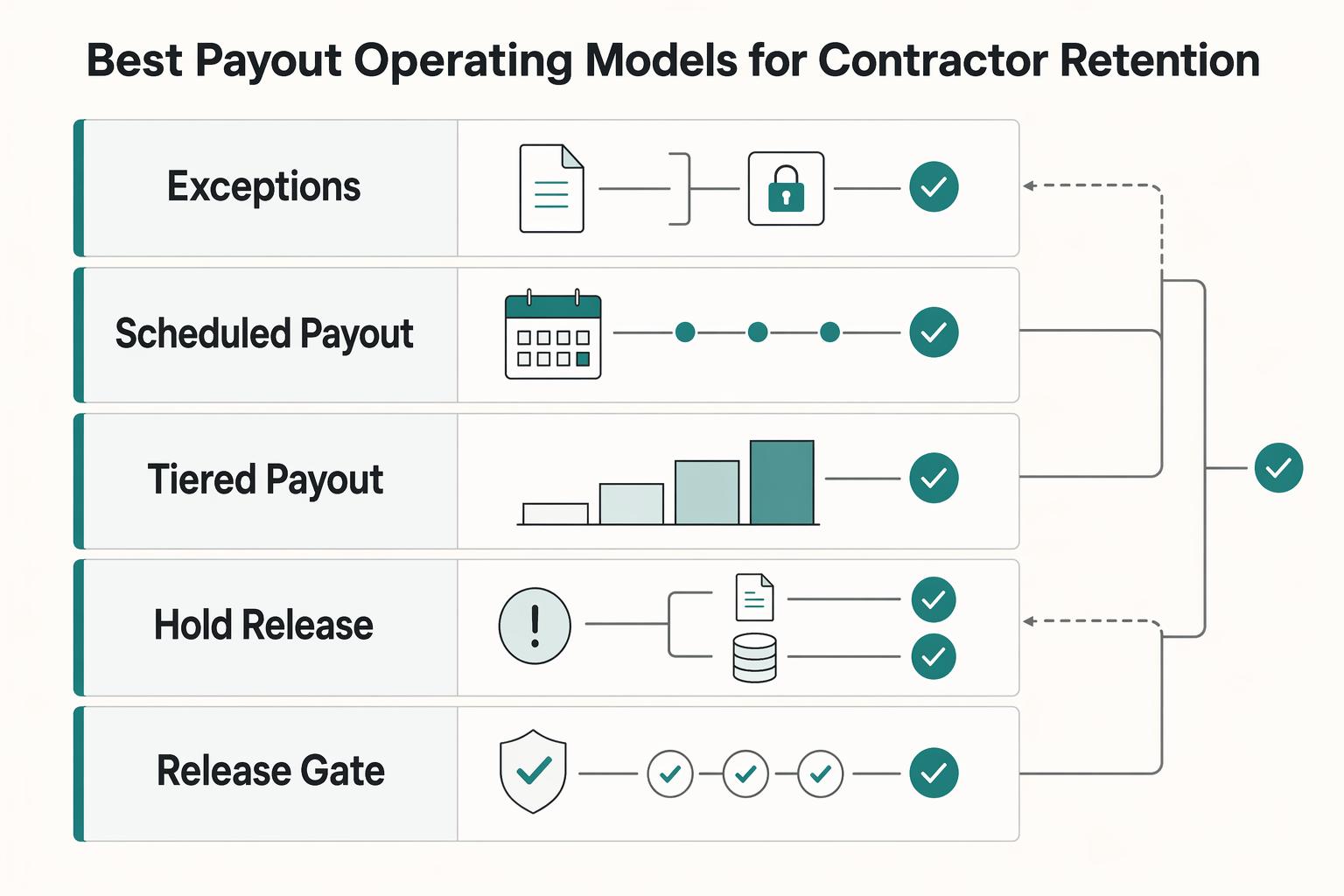
When payout risk is elevated, route for control first. Define hold and review rules in advance, with clear ownership and auditable decisions, instead of relying on ad hoc overrides under pressure.
Assess network-level risk and confirm your organization has the capacity to operate the chosen technology before scaling it in higher-risk flows.
For these payouts, keep a complete internal trail: selected route, approval decision, fallback reason if any, and final disposition, funded, returned, or held. If reviewers cannot reconstruct one flagged payout end to end from internal records, the process is not ready for that risk tier.
Do not market payouts as instant unless that promise still holds when primary routes fail. If fallback can move a payout onto a slower rail, your public expectation should reflect that outcome, or be set by route eligibility before send time.
A practical rule is to promise to the slowest route you may actually use in that corridor, unless you can reliably segment promises at send time. Instant-payment rails can improve speed and experience, but only when routing, operations, and customer-visible status all tell the same story.
Make the full money path explicit before launch. When collection, ledgering, payout creation, and provider events live in separate mental models, teams lose a shared source of truth.
Write the sequence exactly as operators and engineers run it. Document your own handoffs from collection through ledger posting and payout execution; do not assume a canonical end-to-end implementation. If you use labels like Virtual Accounts, Ledger Journals, or Payout Batches, treat them as internal terms and version their definitions.
Use one checkpoint: can one payout be reconstructed from collection to final disposition without tribal knowledge? If finance cannot tie collected amount, journal entry, and outbound payout record together, the path is still incomplete.
Keep operational status and accounting truth separate in your model. For example, a payout can be created while funds are still pending final disposition.
Ownership should be explicit before disputes and exceptions test it. Decide Merchant of Record vs direct platform payout responsibility with legal, finance, and operations, and document the reconciliation owner. Leaving this implicit creates gaps when something goes wrong.
Payabli's terms, last updated January 15, 2025, describe both a direct-agreement path and a tri-party path for merchants whose transaction volume requires an agreement among the merchant, Payabli, and Payabli's acquirer. The same terms state that accepting or continuing to use the service creates a legally binding contract. These points do not establish when MoR is required, but they do show why responsibility should be explicit in signed agreements.
Keep an evidence pack with the signed agreement path, named reconciliation owner, and exception RACI. If product messaging says "we only facilitate" but finance books and resolves payouts as owner, resolve that mismatch before go-live.
Set a clear internal replay policy for payout creation and webhook ingestion so retries do not create duplicate payouts or duplicate customer-facing outcomes. Treat this as a defined control in your architecture, not ad hoc behavior.
Run a retry drill: replay the same create intent and the same webhook payload, then confirm the resulting payout record, ledger impact, and contractor-visible status are still coherent. If you cannot prove that behavior in test and production logs, retry handling is not yet reliable.
There is no standard provider event taxonomy you can rely on, so map every provider-specific state to a clear action and owner.
For each state, document the internal meaning, next owner, and contractor-visible message. Support should be able to answer "where is the money?" from the event trail alone.
For exception flows, predefine where funds land next and when automation must pause for manual ownership. Blind spots usually show up in these edge states, not in the happy path.
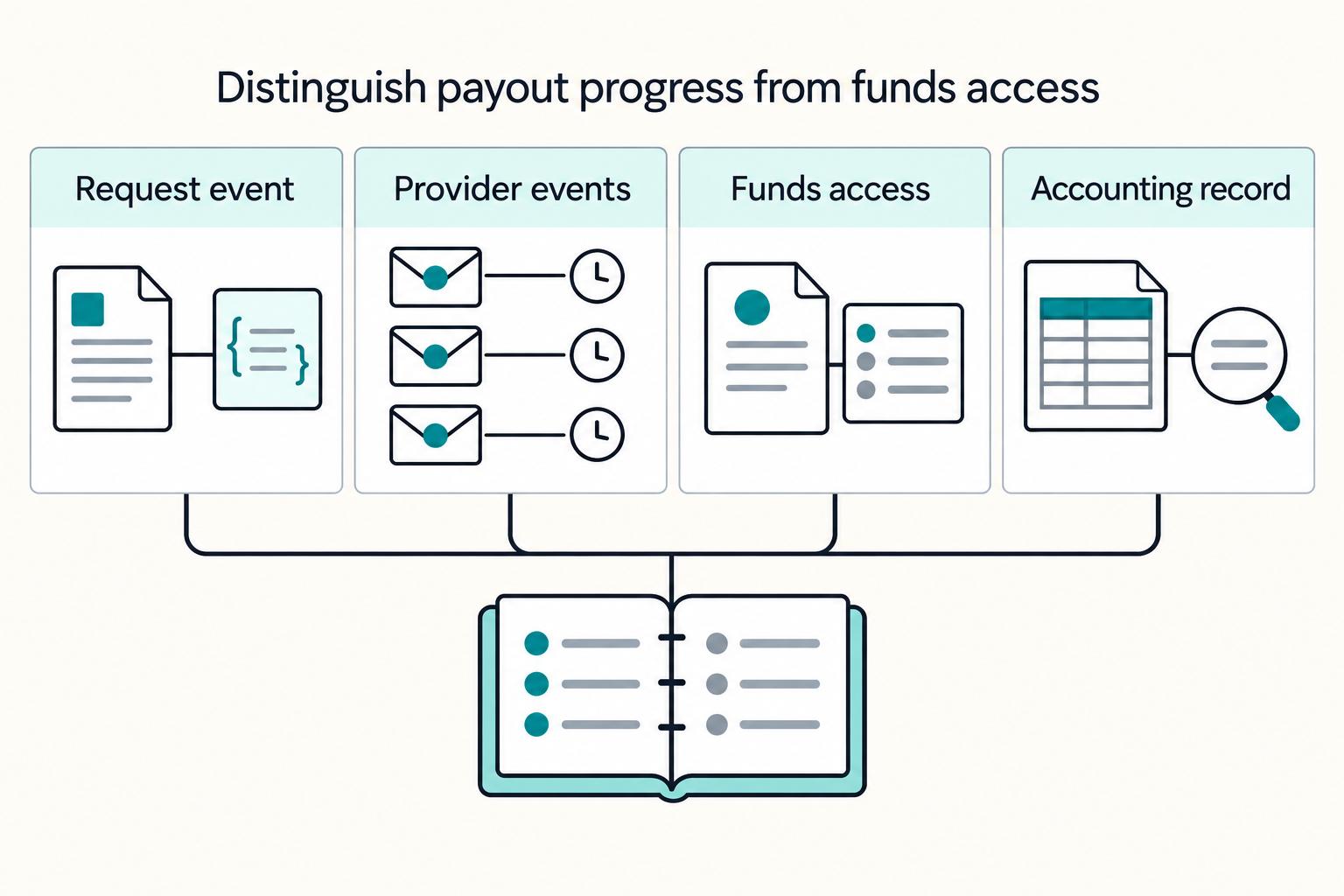
Treat settlement as a measured evidence trail, not a single success status. A payment request moving forward is not the same as funds access, so your instrumentation should show the path from request through funds availability, including exceptions.
Create one internal timeline per payout across API and webhook events so operations, support, and finance all read the same history. Keep immutable event records instead of relying on one mutable status field.
For each event, capture the minimum fields you need to reconstruct what happened and when:
Use a simple checkpoint: can your team reconstruct a payout end to end without provider dashboards or raw-log forensics? If not, the instrumentation is not complete.
Reconcile event history to accounting records on a cadence your close process can enforce. This helps keep accounting truth and operational truth aligned when events arrive out of order or settle later than expected.
Your tie-out should compare counts and amounts across requested payouts, provider-progressed payouts, and booked payouts, then bucket breaks into practical exception types. The goal is one shared exception list that finance, ops, and engineering can all use.
Keep settlement-model differences explicit in reporting. Real-Time Settlement and Deferred Net Settlement can produce different participant access patterns, so provider progress should not be treated as equivalent to funds availability.
Track decision metrics around actual access to funds, not just initiation speed. These are operational control metrics, not just observability outputs.
Use those metrics to decide expansion or rollback by route. Expand when the full trail, tie-out process, and exception handling consistently support your customer-facing promise.
Faster-payment gains are linked to reducing delay-related float, but they can be offset by provider connection and system-adjustment costs, so keep those tradeoffs visible in your reporting.
Prevent rework by failing payout eligibility before batching, and by making tax exceptions explicit in the same ops flow your team uses to release funds. The IRS excerpts do not prescribe payout-gate sequencing, so treat that sequencing as an internal control decision.
Do not let a payout enter a batch until required tax-reporting checks for that program are in a resolved state. The practical rule is simple: block early with a visible reason instead of discovering issues during batch review.
Your checkpoint is whether ops can see a blocked payout before any batch ID exists. If exceptions only appear at batch time, the gate is too late and cleanup cost is already rising.
Keep exception handling in one shared operating flow across product, ops, and finance. Each blocked payout should show current status, what is missing, and who owns resolution so teams do not fall back to side channels.
Use a spot check: from one screen, can an operator explain why the payout is blocked and what must happen next? If not, your control exists on paper but not in operations.
If U.S. foreign-asset reporting questions can affect your program, assign clear internal ownership for triage, evidence handling, and escalation. IRS guidance covers filing obligations, but it does not assign platform-team ownership boundaries. A common failure mode is treating Form 8938 and FBAR as interchangeable. They are not.
| Checkpoint | What to keep explicit in your gate notes |
|---|---|
| Form 8938 filing point | Form 8938 is attached to the annual return and filed by that return due date, including extensions. |
| FBAR relationship | Filing Form 8938 does not remove any separate FinCEN Form 114 (FBAR) obligation. |
| Threshold handling | Thresholds are not one-size-fits-all; higher thresholds can apply for joint filers and taxpayers residing abroad. |
| Specified domestic entities | IRS instructions include a $50,000 last-day-of-tax-year threshold and a $75,000 anytime-during-tax-year threshold. |
| Scope edge cases | Some accounts are excluded, including accounts maintained by a U.S. payer, and if no income tax return is required, Form 8938 is not required. |
If your team cannot quickly identify owner, status, and evidence for these cases, the gate is not ready for scale.
Scale only the corridors that prove better outcomes under real traffic. If a route looks faster or cheaper in planning but creates unclear settlement states, unstable fallback, or rising unresolved exceptions, treat it as a no-go.
With pre-settlement verification and risk controls already upstream, the pilot question is simple: does this route improve payout outcomes without shifting hidden work into finance, ops, or support?
Choose a small set of corridors that reflects your real payout mix, including easier and messier operating contexts. Keep decisions corridor-specific, because risk and control performance are context-dependent.
Define the scorecard before the first pilot payout:
| Criterion | What to review during the pilot | Evidence needed before scale | Freeze signal |
|---|---|---|---|
| Speed | Time from payout request to funds availability | Measured event trail, not provider claims | Meaningful share of payouts in ambiguous status |
| Cost | Direct fees plus retries, manual handling, and support load | Ops and finance agree total operating effort improves | Lower direct fees but higher exception workload |
| Failure recovery | Behavior when the primary path delays or fails | Clear fallback behavior and operator actions | Frequent or undocumented manual repair |
| Contractor satisfaction | Ticket volume and complaint patterns by corridor | Support impact is stable or improved | Increased "where is my money?" contacts |
Treat provider claims as unproven until your own pilot data confirms them.
Use the same production flow you intend to scale, but with bounded traffic. Side workflows hide the async and exception behavior you need to evaluate.
Traceability is the checkpoint: each pilot payout should be reconstructable from request through status updates to a recorded final state. Keep pre-settlement controls active during the pilot. If controls are relaxed to improve pilot optics, the result is not scale-ready.
Review daily, not only at pilot close. Confirm operational events, reconciliation records, and support outcomes tell the same story for each payout.
Do not evaluate only direct transaction cost. In high-volume, low-margin payment operations, hidden operating drag often decides the real economics. Keep a consistent corridor worksheet so reviewers can reconstruct any payout without tribal knowledge.
Approve scale only where measured settlement outcomes improve, total operating cost improves, compliance gates remain stable, and fallback behavior stays clear for operators and contractors.
Freeze corridors with unresolved unknowns: unclear timing, recurring reconciliation mismatches, rising unresolved exceptions, or worsening support patterns. Final rule: scale routes that improve settlement and operating cost without increasing unresolved exceptions. Freeze unstable or unproven routes.
For a closer look at the cost tradeoffs behind payout timing, see Same-Day vs. Next-Day vs. T+2 Payouts: What Settlement Speed Actually Costs Your Platform.
Trust breaks when contractor messaging moves faster than what your team can prove operationally. Before broader launch, separate marketing claims from measured outcomes, require fast payment-state evidence for support and audits, and monitor early warning signals.
Treat launch claims and operational proof as separate checkpoints across product, ops, and support. Send contractor-facing confirmations only when your team can trace them to verifiable payment-state evidence. If you cannot prove state quickly in an audit or support case, the rollout controls are still too loose.
Keep a full event trail so operators can investigate quickly when failures happen. Use objective-question-signal tracking so teams can spot scaling issues early instead of relying on assumptions. Watch early warning signals closely, especially support workload rising with volume and incident root cause taking days.
Document what changes operationally when the primary path fails and what support should communicate next. Keep escalation ownership explicit so unresolved issues do not drift between teams. If support cannot explain the current state and next step clearly, the rollout is not launch-ready.
Early rollout data is useful, but it is still early. Scale only when launch speed, cost-to-serve, and conversion continue to hold up in real operations. If one of those trends worsens, pause expansion and tighten controls before trust, compliance, or unit economics erode.
Related reading: ACH vs Wire Transfer for Contractor Payouts When Platform Teams Should Use Each.
Your advantage is not a "fastest rail" headline. It is a payout design you can prove, reconcile, and explain corridor by corridor.
Treat this checklist as an operating control, not a launch slide. A practical benchmark is the OCC Payment Systems booklet, Version 1.0, October 2021. It explicitly covers policies and procedures, internal controls, risk assessment, and includes an Internal Control Questionnaire.
Define API success and settlement completion in one shared language across product, ops, and finance. Run a quick alignment check: have each team describe one recent payout status. If answers differ, your definition is not operational yet.
Build a corridor scorecard that makes tradeoffs explicit: measured speed, total cost, fallback behavior, and reconciliation burden. Mark each corridor claim as proven, pilot-only, or unknown, and avoid contractor-facing promises on unknown rows.
Implement idempotent API and webhook handling, then reconcile against ledger journals as an internal control choice. Use a replay test: resend the same payout request and webhook event, and confirm one intended payout and one clean accounting result.
Enforce eligibility gates before payout release where your program requires them (for example KYC, KYB, AML, and tax-document checks). Keep an evidence pack that shows eligibility checks, document location, and override authority, and review it regularly. The FDIC Consumer Compliance Examination Manual is updated on an ongoing basis, with section-level recency shown on-page.
Run a time-boxed pilot as a decision gate, not just a launch step. Scale only corridors that pass your go or no-go checks for measured outcomes, exception handling, and reconciliation quality. If open-source payment components are in scope, apply the same standard: long-term ownership capacity and network-risk review, consistent with the World Bank's February 2025 guidance.
For the broader A2A cost case, see Open Banking for Platforms: How to Use Account-to-Account Payments to Bypass Card Fees.
If you are finalizing status flows, retries, and payout batch operations after your pilot, use the Gruv docs as your implementation checklist.
No. Instant outcomes depend on the underlying rail. Corridors on real-time rails like PIX, SEPA Instant, UPI, or FedNow can settle in seconds and run 24/7/365. If the route uses ACH or SWIFT, timing follows batch behavior and banking-hour constraints, so funds availability is slower.
Payout success usually means the API request was accepted and processing started. Settlement completion means the recipient account is credited and funds are available to use. Keep those states separate, because clearing happens before final posting.
Optimize total payout cost, not just per-transaction fee. Clearing and settlement mechanics drive speed, cost, and predictability, so a cheaper rail can become more expensive if delays and exceptions increase. Make corridor-level decisions based on measured time-to-funds and operational disruption, then scale what performs.
Track measured time-to-funds for your top 10 contractor corridors, with P50 and P95, instead of vendor headline claims. Also track corridor-level delays, exceptions, and outages so you can see reliability, not just nominal speed. That gives you decision-grade evidence before you change rails or providers.
Use instant rails when corridor coverage is reliable and payout speed is part of your contractor promise. ACH is typically 1-3 business days, and SWIFT is often 2-5 days cross-border, so they are usually weaker for time-sensitive payouts. Batch rails still fit where instant coverage is limited, but set expectations clearly because bank-hour processing can delay starts.
A common mistake is treating API acceptance as completed payment. Another is promising "instant" without corridor-level proof of when funds are actually usable. Recover quickly by separating processing and funds-available states in product and support, and by resetting promises to measured corridor outcomes.
Require measured time-to-funds for your top 10 corridors, including P50 and P95, not just marketing claims. Ask for evidence of how delays, exceptions, and outages are handled in business-critical flows. If they claim very fast card push payouts, for example via Visa Direct, have them prove recipient eligibility boundaries and what happens when instant routing is unavailable.
A former product manager at a major fintech company, Samuel has deep expertise in the global payments landscape. He analyzes financial tools and strategies to help freelancers maximize their earnings and minimize fees.
With a Ph.D. in Economics and over 15 years of experience in cross-border tax advisory, Alistair specializes in demystifying cross-border tax law for independent professionals. He focuses on risk mitigation and long-term financial planning.
Educational content only. Not legal, tax, or financial advice.

For compliance, legal, and finance owners, choosing between Microdeposits, Open Banking, and Instant Match is a control decision first, not just a feature choice. This guide helps you make that call for **bank account verification contractor payouts** with a process your team can actually run.

Payout issues are not just an accounts payable cleanup task if you run a two-sided marketplace. They shape supply-side trust, repeat participation, and fill reliability. They can also blur the revenue and margin signals teams rely on.

Payout speed is not a vanity metric. For embedded payments teams, it can affect unit economics, working capital, support load, and the level of trust sellers, creators, contractors, or suppliers place in your platform. The useful question is not "how fast can we move money?" but "which settlement tier is worth its cost once real operating friction is included?"