
Quick Answer
Choose verification by the evidence required: valid identifiers, account access, ownership comparison and payout-route eligibility are different checks. Bind approval to the exact account version and preserve the contractor payable while resolving destination issues.
Verify the destination, then approve the actual payout route#
Bank-account verification helps a contractor platform establish whether payout instructions belong to the intended recipient and can be used by its payment provider. Several checks contribute to that decision: valid account details, evidence of access, account-holder matching and payment-route eligibility. A single “verified” flag hides those differences. A valid account number can still point to the wrong person, and a contractor who can see a deposit can still be using an account your provider does not permit.
Choose methods by the evidence you need. Bank-connected account data can reduce typing and support an ownership comparison where available. A microdeposit challenge can provide evidence of access when a connection is unavailable. A local payee-name check can compare the intended recipient with bank records before payment. Keep identity, business classification and any applicable due-diligence requirements separate from these account results.
Microdeposits, bank connections and Instant Match compared#
| Method | What happens | Useful evidence | Limitation and operating cost |
|---|---|---|---|
| Microdeposit challenge | User confirms an amount or statement code from a small deposit | Access to the destination’s transaction information | Completion can require waiting and a second visit; does not alone prove legal ownership |
| Bank-connected account retrieval | User consents and selects an account through the provider/bank flow | Account identifiers; ownership data if a separate supported product supplies it | Institution/product coverage and consent can fail; selected account must match the approved beneficiary |
| Plaid Instant Match | After bank login, user supplies account/routing details; last four account digits match the bank mask | A specific additional Auth flow at supported US institutions | Not the same product as Identity Match; not a full-name ownership decision |
| Local payee-name service | Provider compares account identifier and beneficiary name | Name/account consistency result for the supported scheme | Close match, no match and unavailable results need distinct handling; not identity-document verification |
Plaid Auth retrieves supported bank-account details and requires a payment processor to move funds. It does not by itself execute your payout. Where the integration supplies a processor token, keep its permitted use tied to the intended processor rather than assuming it is portable to every rail or provider.
Plaid’s Instant Match documentation describes a bank-login flow with an account-mask comparison. The same page describes Instant Micro-deposits over eligible US RTP/FedNow routes, with a code supplied from the deposit description. Thus “microdeposit” does not always mean a multi-day wait. Those named products have specific US coverage; do not translate their labels into global availability promises.
Same-Day Micro-deposits provides a separate supported flow for users entering bank details without the normal bank-login connection. Plaid documents posting within one to two business days, followed by manual code confirmation. Build a visible pending state and follow the documented verification outcome, attempt limits and expiry for your configured product. A deposit request being accepted is not the contractor completing the challenge.
Plaid Identity retrieves ownership information, while Identity Match compares supplied information with bank-held information using separate scores. A business account may identify the business, and joint accounts may identify several owners. Availability for microdeposit-created records is limited; do not assume every Auth result can also produce ownership data. Missing data needs an approved alternative, rather than a fabricated match.
Choose checks for the actual country and payment method#
Start with your provider’s recipient country, currency, account type and supported payment method. Establish which identifiers it requires and which checks it can perform. ACH account/routing data, a UK sort code/account number and a European IBAN are different instructions. A checksum or format check is useful for typing errors but cannot establish who owns an account.
| Proposed route | Account evidence to obtain | Additional question before release |
|---|---|---|
| US ACH credit | Correct ACH account/routing details plus approved access/ownership evidence | Does this exact processor accept the data or token and account type? |
| UK bank payment | Sort code/account number and beneficiary identity; Confirmation of Payee where available | What result was returned for this beneficiary, and how was any discrepancy resolved? |
| Supported SEPA payment | IBAN and beneficiary details; Verification of Payee through the actual provider | What is the name-check outcome, and are currency and receiving account supported? |
| International bank transfer | Provider-required beneficiary details, account identifier and bank routing | Are intermediary instructions, currency and receiving-bank requirements correct? |
| Card or wallet payout | Recipient credentials and eligibility required by that product | Is this a supported card/wallet recipient rather than a bank account assumed compatible? |
Pay.UK’s Confirmation of Payee is an account-name checking service for UK payments. The European Payments Council’s Verification of Payee scheme supports name/IBAN checks between participating payment service providers. Treat a match, a close match, a no-match and a check that could not be performed as different evidence states. Neither is a universal guarantee that a payment is legitimate.
Do not turn a US authentication method into proof of SWIFT, card or wallet eligibility. Even when an institution can receive an instant verification deposit, the commercial payout product may have different limits and availability. Confirm the actual payment service separately; use the verified bank details only within the approved route.
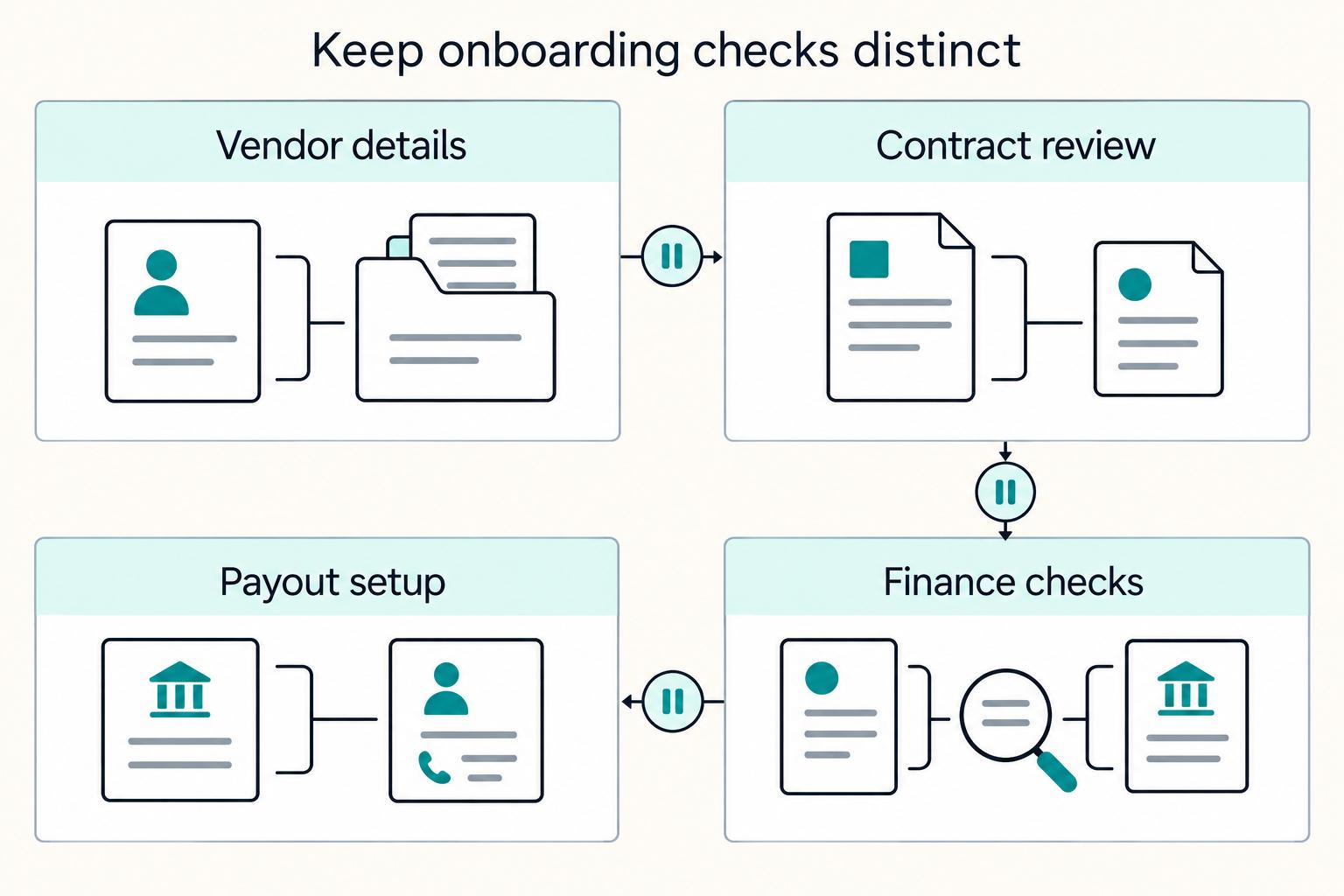
Keep onboarding checks distinct#
Establish the contracting payee and approved service obligation, then collect the account through a controlled portal. Record whether the beneficiary is an individual, their business or another authorized recipient. Third-party and joint accounts require the actual provider’s permission and your documented review; being a business owner does not automatically make every personal or company account acceptable.
The diagram’s vendor, contract, finance and payout stages illustrate an internal workflow. It is not a universal legal sequence. Run independent reviews in parallel where appropriate, but require the necessary results before activating a destination. A missing bank result should remain visible as a bank issue rather than being reported as a failure of the contractor’s identity.
Collect only relevant data, restrict sensitive account details and provider tokens, and use masked identifiers in routine operations. Your operators do not need a contractor’s bank password. Use the provider’s supported bank connection and consent flow; keep credentials out of your own intake forms, support tickets and logs.
A worked bank-change decision for a $2,000 invoice#
Assume an approved $2,000 invoice is due tomorrow and the contractor has a previously approved destination ending 4821. A portal request replaces it with an account ending 7310. The new account’s format is valid and a microdeposit challenge completes, but available ownership data identifies a different business. The completed challenge provides access evidence; it does not resolve the beneficiary discrepancy.
Keep the $2,000 payable intact. Mark the new account version pending review, authenticate the change through an established contact channel and ask for evidence of the actual account relationship. Do not use contact details supplied only in the suspicious change request. If the contractor’s verified company is the new beneficiary and both your provider and policy permit that destination, record the supported relationship and a separate approval. If the discrepancy remains unresolved, do not send to the new account.
Paying the former account is not an automatic fallback: confirm it remains authorized and usable. If it does, obtain an approved instruction for that route; otherwise resolve an approved alternative with the contractor and payment owner. A destination review must not silently erase earned compensation or leave the contractor without an owner and next update. Any specific legal restriction remains a separate decision.
Bind the release to invoice ID, $2,000 amount, currency, payee ID, approved account version and current evidence. If another account change occurs between approval and submission, stop that stale instruction and review the new version. This prevents an account checked yesterday from authorizing different details today.
Define fallback by the missing evidence#
| Problem | Useful next step | What should remain unresolved |
|---|---|---|
| Bank connection unavailable | Offer a supported microdeposit challenge or reviewed provider-approved document path | Ownership remains unresolved if the substitute supplies access evidence only |
| Microdeposit pending or expired | Explain the next action and restart only under the product’s documented rules | Do not treat deposit initiation as completed verification |
| Close name match | Review a supported legal/trading-name or joint-account explanation | Do not silently normalize an unexplained different beneficiary |
| No match or suspicious recent change | Authenticate through an established channel and escalate the affected destination | Do not override solely to meet payout urgency |
| Name check unavailable | Use the route’s approved alternative evidence or payment-owner review | Unavailability is not a positive match |
A fallback should answer the original evidence question. Asking someone to complete another access challenge does not solve a name mismatch. Conversely, a bank statement with the correct name may support ownership but does not establish that the account remains open and compatible with the chosen route. Record which part each piece of evidence supports.
Define who can approve exceptions, which evidence is required and how the contractor receives a status update. Use separation between the person editing a destination and the person approving an exceptional release as an internal control choice. Avoid universal score thresholds or mandatory cooldown lengths: set and test these for the actual fraud exposure, provider and operational requirements.
Account verification and payment retry safety are separate#
Successful verification cannot stop duplicate disbursements. Preserve a stable payable identifier, separate payment-attempt records and a release decision that allows only one live attempt for the obligation. Use atomic internal reservation/approval controls so concurrent requests cannot both claim the same unpaid amount. Use the provider’s documented duplicate-prevention mechanism in addition to those internal controls.
If submission times out, recover the original transaction using its provider reference before creating a replacement. Do not conclude that no funds moved merely because the verification record still says approved. A confirmed return can reopen the payable, with actual returned principal and fees recorded; an unknown outcome remains a recovery case. Late events and repeated callbacks should update the original attempt without generating another obligation or payout.
Reverify when beneficiary details change, when permission or account data becomes invalid, or when a return or fraud signal undermines the previous decision. Plaid Auth’s update guidance identifies consent and account-number changes that need remediation. Freeze the affected destination version while recovering what happened, rather than blanket-resetting every unrelated contractor or assuming yesterday’s token will always work.
Keep evidence that reconstructs the release decision#
For each account version, retain the payee and destination identifiers, method, provider reference, timestamps, precise check results, ownership comparison, exception reason and approver. Link the approved version to the actual payout attempt, amount, currency and final outcome. Keep sensitive raw evidence in controlled storage and place masked references in the operational history.
At review, reconstruct one normal release, one name discrepancy, one bank change and one unknown payment outcome. Ask whether the evidence proves the destination that was actually used and whether the decision was current at submission. A tax filing record does not answer these questions. FBAR and Form 8938 are separate tax/reporting matters when applicable; they are not generic contractor bank-verification release evidence.
Measure completion time and abandonment by method and institution, plus mismatches, confirmed returns, stale-version releases and unresolved exceptions. State denominators and observation windows. Compare both user effort and evidence quality: a fast challenge with no ownership result can require more manual review than a slower method that resolves the actual issue.
Frequently Asked Questions
Do microdeposits prove that a contractor legally owns the account?
A completed challenge supports access to transaction information. It does not alone prove legal ownership or the account’s suitability for your provider. Resolve the approved payee/account relationship separately.
Is Plaid Instant Match the same as Identity Match?
No. Instant Match is an Auth account-mask comparison flow after bank login at supported US institutions. Identity Match separately compares supplied identity information with bank-held ownership information.
Does open banking automatically execute the payout?
An account-data connection and payment execution are distinct capabilities. Confirm the actual payment provider, route and data/token compatibility rather than treating account retrieval as money movement.
What should happen when a payee-name check is unavailable?
Record unavailability as its own result and use the route’s approved alternative evidence or review path. It is not a positive match, and switching methods must resolve the missing evidence.
Should a bank-detail change trigger fresh review?
Yes. Bind evidence and approval to the new account version before release. Authenticate sensitive changes through established channels and preserve the prior version and payment history.
Can a payout timeout be retried because the account is verified?
No. Verification does not establish the original payment outcome. Recover that attempt first, and keep the payable and payment-attempt records separate to avoid duplicate payment.
Researched and edited by the Gruv editorial team. Gruv builds cross-border billing, payouts, and finance-operations software for global businesses.
Sources
Includes 4 external sources outside the trusted-domain allowlist.
Educational content only. Not legal, tax, or financial advice.
Related Posts

The Freelance Payment Penalty: A Modeled Audit of Platform Fees, FX Spreads, and Payout Delays
The money rarely disappears through a single, easy-to-spot fee. The real loss is stacked. A marketplace takes its commission, a processor adds a charge for international cards, a bank or payment company converts the currency at a spread, a platform holds the funds before release, and a wire sheds a little to intermediaries on the way in. Each layer looks defensible on its own, but the worker feels the combined result as a smaller deposit and a later payday.

How to Respond to a Subpoena for Business Records
Move fast, but do not produce records on instinct. If you need to **respond to a subpoena for business records**, your immediate job is to control deadlines, preserve records, and make any later production defensible.

A US Expat's Guide to Investing in UCITS ETFs to Avoid PFIC Issues
The real problem is a two-system conflict. U.S. tax treatment can punish the wrong fund choice, while local product-access constraints can block the funds you want to buy in the first place. For **us expat ucits etfs**, the practical question is not "Which product is best?" It is "What can I access, report, and keep doing every year without guessing?" Use this four-part filter before any trade: