
Quick Answer
Treat mena contractor payments uae saudi egypt as three separate operating lanes, then launch only after you lock scope metrics, enforce KYC/AML/KYB gates, and prove ledger-to-provider traceability in pilot runs. Choose rails by return handling and audit evidence when speed is similar, and keep fallback ownership explicit before scaling. If worker status, tax intake, or corridor behavior is unclear, pause automation until counsel and controls are in place.
Why this guide exists for UAE Saudi Egypt contractor payouts#
This guide is for platform teams building repeatable contractor payouts across the United Arab Emirates, Saudi Arabia, and Egypt, not for one-off freelancer invoices. The hard part is not sending a payment once. It is sending payments repeatedly with controls that still hold up when volume grows, exceptions pile up, and audit questions start coming in.
At that point, the standard is simple: your payout operation needs to be traceable, defensible, and recoverable. Payment risk is practical, not theoretical. Funds can arrive late, arrive short, or fail to arrive at all. Even a small failure rate can turn into a finance, support, and reconciliation problem.
You also need to plan around tradeoffs. When two options are close, judge them on record quality and failure recovery, not just settlement claims. In these markets, it is safer to design for uncertainty than to assume clean, stable operating conditions.
Use this guide for decision checkpoints and implementation order, not as legal or tax advice. That matters most for worker classification and in-country work status. One cited Saudi guidance says foreign nationals working inside Saudi Arabia should not be treated as contractors, and misclassification can trigger fines, retroactive benefits, and GOSI contributions. If worker status or the underlying arrangement is unclear, pause rollout and get local counsel before you automate payouts.
By the end, you should have:
- A launch-ready payout setup with clear onboarding, approval, release, and reconciliation gates
- A failure-recovery path for payment failures and returns
- An audit trail finance can defend
A strong baseline starts with a complete evidence pack: detailed invoices, FX conversion records, service descriptions aligned to business activity, and contractor business registration documentation where required. Informal payment channels may feel faster, but they weaken your documentation trail and raise audit risk.
Start with scope and success metrics#
Do not start vendor demos until you have a written payout perimeter and a small shared metric set. Treat each country as its own operating lane, not one corridor.
Define the payout perimeter#
Define the payout perimeter on one page, split by contractor type, expected monthly payout count, and destination mix across the UAE, Saudi Arabia, and Egypt.
Make sure finance and ops point to the same scope and can name who is in and out for phase one. That matters because payment methods, transaction speeds, and currency availability vary by market. The UAE and Saudi Arabia are generally described as having more developed digital payment infrastructure, while Egypt still has a larger traditional banking role as digital adoption increases.
Lock success metrics before demos#
Lock success metrics before demos. At minimum, track required payment methods per market, how transaction speeds perform in each corridor, and which payout currencies are actually available.
For each metric, define how it is measured, who owns it, and what counts as success or failure. If your team cannot calculate these from current exports, vendor evaluation will drift toward marketing claims instead of operating reality.
Set compliance constraints before release design#
Set compliance and classification constraints before you build release logic. Document three things: required onboarding checks, missing-data conditions that block release, and exception paths with named approvers.
In these corridors, international transactions can still run into compliance or banking restrictions, so incomplete contractor or business profiles should route to review, not pass through silently.
Choose the decision rule early#
Choose the decision rule now. If reconciliation is already a board-level pain point, prioritize traceability and ledger evidence over headline settlement claims.
Ask each vendor to show how a payout is tracked from approval to release to final status, and what records remain when a payment stalls or returns. Speed matters, but without defensible records it usually creates more downstream cost than it saves.
Gather the documents and systems before first live payout#
Before the first live payout, lock a documentation baseline and a traceable system flow so issues can be resolved as operating facts, not internal debates.
Build the minimum evidence pack#
Build a minimum evidence pack for each contractor record, not just a template library: Independent contractor agreement, documented contractor classification rationale, and clear ownership for contractor reporting practices.
Keep this practical. Payment execution alone is not enough for compliance readiness. Payment, classification, and contractor reporting need to line up. Spot-check a small sample to confirm each artifact is present, dated, and owned.
Set tax-document intake boundaries#
Set tax-document intake boundaries before onboarding opens. Define which tax-related documents your program collects, where they are stored, who can review them, and which downstream reporting workflows they can affect.
The goal is consistency, not ad hoc intake. If ownership of reporting dependencies is unclear now, month-end reporting risk grows later. Specific form requirements and filing triggers are jurisdiction-specific and should be confirmed separately. For a deeper reporting walkthrough, use IRS Form 1042-S for Platform Operators: How to Report and Withhold on Foreign Contractor Payments.
Confirm entity and counterparty data before rail testing#
Confirm entity and counterparty data before rail testing: legal name capture, beneficiary-name mapping, and required counterparty data checks in your program.
Matching logic deserves extra attention. Cross-border payouts in these corridors can still hit compliance or banking friction, so unresolved name mismatches can turn into avoidable reviews or delays.
Define integration controls before the first payout request#
Define integration controls before engineering sends the first payout request: duplicate-submission handling, inbound event verification, and payout-state event records.
Run a controlled test before launch. Retry the same payout request, replay an inbound event, and confirm your audit trail shows exactly what happened with no silent overwrites. If traceability is weak here, treat it as a launch risk.
Related: How to Use Gusto for Payroll for a Small US-Based Agency.
Build a country decision table for UAE KSA and Egypt#
Build this table before launch. For the UAE, Saudi Arabia, and Egypt, when two options are close on speed, choose the one with clearer return handling and stronger audit evidence.
Separate verified support from market context#
Separate verified payout support from general market context. Regional momentum is useful background, but country-level contractor payout details are often missing, so mark unknowns explicitly.
Across MENA, digital payment adoption is being pushed by real-time rails, cashless policy pressure, and cross-border e-commerce. Mode mix and growth signals are regional, not country-level: POS led in 2025, while online and remote payments are forecast to grow faster through 2031.
| Country | Rails to verify | Expected settlement behavior | Compliance friction | Likely failure modes | Investigation steps | Known unknowns |
|---|---|---|---|---|---|---|
| UAE | Confirm bank payout support first; include Aani only where supported for your contractor flow | Country-level timing is unknown from current evidence; validate with pilots | Country-specific review triggers are unknown; verify with provider documentation and pilot outcomes | Unknown until tested; explicitly track name mismatch, manual review holds, and unclear transitions from submitted to credited or returned | Collect provider reference, submitted beneficiary data, status timestamps, and return reason before retry | Aani coverage for contractor payouts, fee transparency, and return handling detail |
| KSA | Confirm bank payout support first; treat mada as market context only where supported | Country-level timing is unknown from current evidence; validate with pilots and written status definitions | Country-specific review or data requirements are unknown; confirm directly with providers | Unknown until tested; track manual review holds, incomplete beneficiary data, inconsistent status events, and returns after provisional success | Compare API payload, webhook sequence, dashboard status, and final outcome. Treat mismatches as audit issues | mada coverage for contractor flows, pricing clarity, legal edge cases |
| Egypt | Confirm bank payout support and any local method support separately | Country-level timing is unknown from current evidence; test speed claims with real-value pilots | Fraud and risk handling are a known regional concern; Egypt-specific operational thresholds are still unknown | Unknown until tested; track fraud or risk holds, beneficiary mismatch, delayed final status, and returns after intermediate success | Request risk-review reason, final bank outcome, payout reference, and exact submitted beneficiary data | Screening thresholds, fee visibility, country-specific return-rate data |
Growth signals are useful context, but they are not proof that a corridor is ready for scale.
Fill rows only with evidence you can defend#
Only fill rows with evidence you can defend later: pilot observation, written provider confirmation, or durable artifacts such as API or webhook docs and reconciliation exports.
For each country, run a controlled pilot and keep one evidence pack with the request payload, provider reference, event log, status timestamps, and any hold or return reason. If held, failed, credited, and returned states are not clearly distinct, treat that as operational risk.
Apply the routing decision rule before volume#
When speed is close, choose cleaner return handling and cleaner audit evidence.
Here, "cleaner" means you can quickly answer what was sent, when status changed, why it was held or returned, whether the reference stayed consistent, and how finance ties it back to the ledger. If fee detail, screening logic, or support coverage remains vague, keep that row marked as a known unknown and do not route early volume there.
Related reading: How to Launch a Legal Compliance Platform for Freelancers and Handle Their Payments.
Choose your rail strategy for scale#
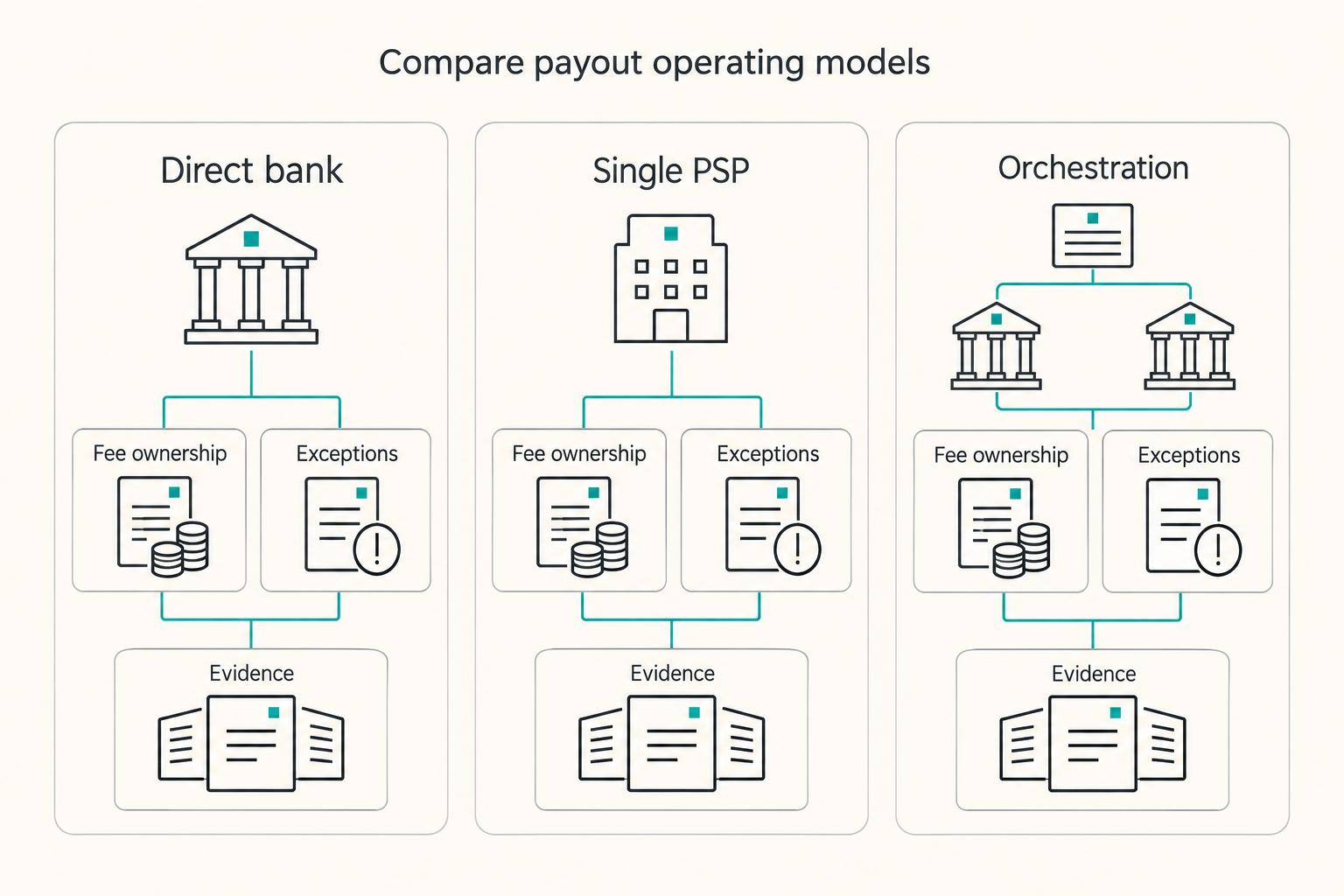
Start with the fewest payout paths that give you acceptable failure handling, then add routing complexity only when failed-payout cost is higher than the cost of operating another provider. Use pilot evidence from your target corridors to make that call, not sales-level similarity. If you already have a country decision table, the next step is choosing the operating shape behind it.
Compare the common operating patterns#
Compare these operating patterns before signing anything. The practical question is who owns fee complexity, routing logic, and operational evidence when payouts fail.
| Pattern | Best fit | What you gain | What you take on | Provider examples to assess |
|---|---|---|---|---|
| Direct bank routing | Stable corridors, low provider count, strong internal treasury or banking relationships | Fewer intermediaries and tighter control over payout creation and reconciliation design | More internal build work and more direct ownership of returns, exceptions, and bank-data gaps | Your bank rails and internal payout stack |
| Single PSP | Lower volume, faster launch, one operational surface for support and reporting | Simpler integration, one contract, fewer dashboards and webhook models | Concentration risk if one provider has corridor issues, less routing flexibility | Tap Payments, Amazon Payment Services (APS), Telr, Stripe, Checkout.com |
| Payment orchestration across providers | Higher failure cost, multi-country scale, need to route by corridor or fallback rule | More resilience, routing control, and optionality when one path degrades | More integration and monitoring complexity, harder reconciliation, more fee-model comparison work | Two or more of Tap Payments, APS, Telr, Stripe, Checkout.com, plus your routing layer |
A single PSP is often the starting point when failure cost is still manageable. Move earlier to orchestration when payout failures create operating cost you cannot absorb, but do it with explicit fallback rules rather than broad automatic rerouting.
Use pricing ownership as a core filter#
Use pricing ownership as a core filter. Provider choice changes your cost structure, and that impact can compound with transaction volume.
Stripe Connect makes the tradeoff clear. In one model, Stripe sets and collects processing fees from your users, and the platform does not incur additional account, payout volume, tax-reporting, or per-payout fees. In the model where you handle pricing for users, Stripe lists $2 per monthly active account and 0.25% + 25¢ per payout sent. Stripe defines an active account as one in any month when payouts are sent to that user's bank account or debit card.
Use the same lens across Tap Payments, APS, Telr, Stripe, and Checkout.com. Ask:
- Who owns pricing shown to users or connected accounts?
- Are there per-account, per-payout, payout-volume, or tax-reporting charges?
- Which fees sit at platform level versus recipient level?
- Are instant or accelerated payout options priced separately?
Get the fee schedule version and effective date in writing. Costs can change, so old decks or proposals are not enough for sign-off.
Pick the model that matches operating pain#
Choose based on operational pain, not architecture preference. If corridors are stable and volume is modest, one provider is often easier to control.
If you use a single-provider setup, run controlled pilots in your target corridors and confirm that submitted, held, credited, failed, and returned states are clearly distinguishable in both dashboard and event data. If payout references, return reasons, or status timestamps cannot be tied back to your ledger, the simplicity is only apparent.
Direct bank routing can fit teams that already have strong internal payments engineering and treasury support. You gain control, but you also take on more exception handling when return flows or bank messages are inconsistent.
Orchestration can improve resilience and routing control, but keep version one narrow: one primary route, one fallback route, and explicit switch conditions. Keep routing decision records with the provider-selection reason, fallback trigger, and final outcome so ops and finance can reconstruct what happened later.
If volume is low and pilots are stable, start with fewer providers. If failed-payout cost is high or corridor divergence is likely, move earlier to orchestration with controlled fallback rules, explicit monitoring, and recently revalidated fee assumptions.
If your shortlist is close on settlement speed, run a side-by-side landed-cost check before committing routing logic with the Payment Fee Comparison.
Put compliance gates before payout execution#
Set compliance gates before you scale payouts. If onboarding, monitoring, and release checks are not machine-enforced and logged, your control model may not hold up as volume grows.
| Step | Purpose | Evidence |
|---|---|---|
| Onboarding checks | Whether the counterparty can be in your program | Dated pass, fail, or review result with the evidence bundle used |
| Transaction monitoring | Whether this payout should proceed, pause, or escalate under your AML policy | Hard stops and soft reviews with required disposition codes and notes |
| Payout release | Whether the payout is cleared or not cleared at execution time | Payee ID, payout ID, timestamp, rule version, decision result, reviewer or approver, and links to underlying records |
| Tax and reporting mapping | Whether foreign asset or account reporting may apply | Keep Form 8938 and FinCEN Form 114 (FBAR) separate, and keep thresholds and penalty exposure explicit in policy logic where relevant |
Run onboarding checks before money movement#
Run onboarding checks before any money movement. Keep this layer focused on who the counterparty is, which entity is involved, and whether required documents under your KYC, KYB, and AML policy are complete enough for a payable-state account.
Keep account creation separate from payout approval. A payee can be onboarded and still blocked from release until required tax or identity records are complete. Each payee record should show a dated pass, fail, or review result, along with the evidence bundle used.
Treat transaction monitoring as its own gate#
Treat transaction monitoring as its own gate. Onboarding answers whether a counterparty can be in your program. Monitoring answers whether this payout should proceed, pause, or escalate under your AML policy.
Split outcomes into hard stops and soft reviews. Hard stops should block release automatically until resolved. Soft reviews should route to an analyst queue with required disposition codes and notes so the decision can be reconstructed later.
Make payout release depend on both gates#
Make payout release depend on the first two gates. At execution time, the decision should be binary: cleared or not cleared.
Store that release decision as structured evidence, not just a status label. At minimum, keep payee ID, payout ID, timestamp, rule version, decision result, reviewer or approver where applicable, and links to underlying records.
Map tax and reporting steps early#
Map tax and reporting steps early when foreign asset or account reporting may apply. Under FATCA, certain U.S. taxpayers generally report specified foreign financial assets using Form 8938. The IRS says Form 8938 must be attached to the annual return and filed by that return's due date, including extensions. If a U.S. taxpayer is not required to file an income tax return for the year, Form 8938 is not required.
Do not collapse Form 8938 and FinCEN Form 114 (FBAR) into one check. They are separate requirements, some filers may need both, and separate penalties may apply. The IRS also directs filers to use its comparison table and Form 8938 instructions to determine whether exceptions apply.
Keep thresholds and penalty exposure explicit in policy logic where relevant. IRS materials describe a general Form 8938 baseline of $50,000 in some cases. They also include $50,000 at year-end or $75,000 at any time during the tax year for certain specified domestic entities, and potential penalties of $10,000, plus up to $50,000 for continued failure after IRS notification, plus a 40 percent substantial understatement penalty in some cases.
For contractor payouts across the UAE, Saudi Arabia, and Egypt, keep the rollout rule strict: if a control depends on memory, chat, or spreadsheets, treat it as a control gap and block scale until enforcement, logging, and auditability are in place.
We covered this in detail in How MoR Platforms Split Payments Between Platform and Contractor.
Wire the money flow inside Gruv#
Once your release gate is binary, money movement needs to be deterministic too. Every intake, balance change, FX conversion, and payout release in Gruv should create a reconstructable state change, or reconciliation risk rises as volume grows across the UAE, Saudi Arabia, and Egypt.
Reconcile intake to a reference#
Reconcile intake to a reference, not just a bank account. If your Gruv setup uses Virtual Accounts, treat them as intake identifiers linked to the real receiving account and your internal ledger, not as fund-holding accounts.
Set one hard checkpoint: inbound transfers should carry a payer-facing reference you can match to the intended receivable or funding event, where the provider supports it. If your PSP issues a transfer reference number, store it on the funding record and require a match before balances become spendable. Do not treat "money received at bank" as "money attributed to the right funding pool," and do not release payouts from unattributed funds.
Post to the ledger before wallet views#
Post balance movements to the ledger first, then project them into wallet views. In Gruv, the ledger is the source of truth and wallet balances are derived from it.
Keep the lifecycle explicit: funds collected, funds attributed, balance available, FX pending or complete, payout submitted, payout released or held. If conversion happens before payout, record the conversion as its own event. For any payout, you should be able to reconstruct the chain from raw records alone: intake reference, ledger postings, conversion record, provider submission reference, and, where used, payout batch ID.
Enforce FX quote discipline#
Enforce FX quote discipline before you create payout obligations. Authenticated quotes are time-bounded, include quote IDs, and may be withdrawn, so stale quotes should be rejected and refreshed.
For each conversion tied to a payout, persist the source currency, target currency, quoted rate, quote ID, quote expiry or retrieval timestamp, provider name, and payout ID, plus batch ID when batching is enabled. A payout executed on a different rate without a linked quote record is an avoidable control gap.
Release payouts in controlled windows#
Release payouts in controlled windows and keep logs PII-minimal. If payout batches are enabled in your Gruv implementation, use them as release containers so finance can approve a bounded set with one evidence package and pause cleanly when exceptions appear.
Keep logs and webhook events narrow but reconstructable. Do not log unnecessary sensitive data. Keep masked artifacts that support review, such as masked beneficiary account details, masked beneficiary name or identifier, payout amount, currency, quote ID, provider reference, compliance decision ID, batch ID, and timestamps. Audit logs should let you reconstruct sequence independently, but they still need underlying evidence artifacts behind them.
Use idempotency keys for payout creation and updates, and retain replay protection long enough for your retry window. If an API may remove keys after at least 24 hours, keep your own request fingerprint and final object reference to prevent duplicate releases after transient failures.
For a step-by-step walkthrough, see A Deep Dive into the UAE's Corporate Tax for Freelancers and LLCs.
Build payout lifecycle controls engineers can trust#
Once money movement is ledger-backed, ambiguity in state and ownership creates failures. Use an internal payout state model, duplicate-safe retries, and observability that helps distinguish provider delay, processing lag, and terminal failures.
Define a canonical state machine#
Define a canonical state machine and map every provider event into it. Use internal control states that fit your system, for example: pending, submitted, credited, returned, held, and failed.
| State | Operator meaning |
|---|---|
| Pending | Created internally, not handed off |
| Submitted | Sent to provider, awaiting outcome |
| Credited | Provider reports completion |
| Returned | Funds come back after an apparent success path |
| Held | Stopped for review, compliance, or missing data |
| Failed | Terminal non-credit outcome before beneficiary receipt |
Keep provider status and your canonical status side by side. Some providers expose intermediate states such as pending or in_transit before terminal outcomes like paid, failed, or canceled, so treating submitted as done is a control gap.
Set a reconstruction check. For any payout, you should be able to retrieve current state, previous state, transition timestamp, event source, provider reference, and reason or error code.
Make retries safe by design#
Make retries safe by design. For payout create and update calls, always send an idempotency key so retries do not create duplicate operations.
In production, two rules matter most:
- Retry the same logical request with the same idempotency key
- Store your own request fingerprint and final object reference, because keys may be pruned after they are at least 24 hours old
If your provider follows Stripe-style constraints, idempotency keys can be up to 255 characters, which is enough for an internal request ID plus operation type.
Apply the same discipline to webhooks. Delivery retries can continue for up to three days, and duplicate events can occur. Verify signatures before processing, persist event IDs, and no-op already processed events before side effects.
Instrument the async path#
Instrument the async path so product and ops can see reliability degrade early. Start with queue depth and oldest-message age. If backlog grows and oldest age rises, processing is falling behind even when provider APIs look healthy.
Then segment failures by provider, operation, and outcome. Track timeout patterns across payout creation, status polling, and webhook ingestion, and persist provider error metadata, such as codes, with each payout record instead of collapsing everything into a generic "provider error."
A practical operator view includes canonical state counts, age buckets for submitted and held payouts, webhook duplicate rate, queue backlog, and provider error-code distribution. That baseline helps teams trust what the payout lifecycle is actually doing.
Plan failure handling before you launch#
Treat failure handling as a launch requirement, not cleanup work. Before the first live batch, define how payouts fail, who acts next, and what evidence confirms funds movement.
Document first-class failure paths#
Document first-class failure paths such as beneficiary or account-detail errors, provider timeout, review holds, and return after provisional success.
Keep these paths separate instead of collapsing everything into "failed payout." A beneficiary or account-detail error, a timeout, and a post-credit return can trigger different operating and finance actions. Stripe payout outcomes include terminal states such as paid, failed, or canceled, and payouts sent to non-existent bank accounts can be returned to your balance, so a "credited" state should stay reversible until reconciliation clears.
For timeout readiness, test whether your webhook endpoint can return 2XX within 10 seconds under load. Checkout treats slower acknowledgment as delivery failure and can retry for 30 hours, so you need to distinguish webhook retry noise from real payout failure.
Assign recovery ownership and response clocks#
Assign recovery ownership and response clocks before incidents happen. For each failure type, define who investigates, who approves re-release, and when contractor communication starts.
| Market | Boundary | Article detail |
|---|---|---|
| KSA | Acknowledgment within 48 hours; full response within 10 calendar days | KSA PSP complaint rules |
| Egypt | Complaint reference number within 2 working days | CBE consumer process |
| UAE | In-country Consumer Complaint Management function independent from retail operations | Licensed financial institutions |
A practical split is:
- Payments ops: beneficiary or account-detail errors and return cases
- Compliance or risk: release from held state
- Engineering: timeout and event-delivery incidents until provider status is confirmed
- Finance: re-release decisions that change ledger position after returns
If you operate through a regulated PSP, align internal timelines to the strictest applicable boundary. In KSA PSP complaint rules, acknowledgment is required within 48 hours and full response within 10 calendar days. In Egypt, the CBE consumer process expects a complaint reference number within 2 working days. In the UAE, complaint handling for licensed financial institutions must sit in an in-country Consumer Complaint Management function independent from retail operations.
Build reconciliation checkpoints#
Build reconciliation checkpoints that hold up in audit and close. Each payout should map internal ledger postings to the provider reference that proves external movement.
Your evidence pack should include provider payout ID, internal payout ID, ledger entry IDs, event timestamps, and the settlement artifact tying payout totals to transaction-level detail. Stripe provides payout reconciliation reports and API retrieval paths. Checkout provides settlement statements and the Financial Actions by Payout ID Report for underlying payments and fees.
Run a daily unresolved-delta queue, not just month-end cleanup. If a posted payout does not have a matching provider reference and supporting settlement artifact, keep it open with an owner, reason, and expected resolution date.
Pause auto-routing on recurring return patterns#
When a corridor shows recurring returns with the same pattern, consider pausing auto-routing and requiring manual approval until the root cause is contained.
Watch for repeated signatures: the same bank-format issue, the same provider, the same return reason, or the same timeout pattern. Use a minimum re-release packet with corrected beneficiary details, the prior provider reference, the return reason code when available, and confirmation that reversal or hold entries are already posted.
Split ownership across finance ops and engineering#
Treat ownership as a control. When finance, payments ops, and engineering all "own payouts" without explicit decision rights, escalation can slow when UAE, Saudi Arabia, or Egypt batches break.
Document decision rights by function#
Document decision rights by function, not just task lists. One workable model is this: finance sets reconciliation acceptance criteria, engineering owns state enforcement and event integrity, and payments ops handles daily exceptions and trend tracking by provider, country, and failure type.
Use one simple check for every payout issue: who can pause releases, who can approve re-release, and who can declare recovery complete. If that answer changes by shift or person, ownership is still unclear.
Keep country-level analysis inside the ops queue#
Run country-level analysis inside the ops queue. Do not collapse all MENA payout traffic into one metric when the underlying rails differ. UAE has Aani, Saudi Arabia has SARIE, and Egypt's IPN includes a maximum monthly transaction value of 400,000 Egyptian pounds per bank registered in the app.
Keep exception reporting split by provider and country so trend analysis and escalation stay useful over time.
Separate escalation ladders#
Use distinct escalation paths for risk, outages, and data quality, each with named authority boundaries. Outages need technical recovery ownership and severity handling, risk cases need clear hold and release authority, and data-quality defects need a defined path for ledger-impacting corrections.
Mixed escalation can become a failure mode. Engineering may treat it as an incident, finance as unreconciled cash, and ops as queue work. Clear authority boundaries reduce that stall.
Publish one shared dashboard#
Publish one shared dashboard with internal definitions for success, failed, and recovered. Keep those definitions consistent across finance, ops, and engineering so performance measures and escalation are based on the same signals.
Validate each metric against underlying payout evidence, not labels alone. If a recovered payout cannot be tied back to the original failed attempt and correcting entries, treat it as unresolved in success-rate reporting.
Common mistakes teams make in MENA contractor payouts#
A common mistake is treating the UAE, Saudi Arabia, and Egypt as one payout market. Cross-border flows still depend on domestic first-mile and last-mile rails, so a single regional rule set creates avoidable risk.
Split country rules before launch#
Split country rules before launch. UAE has Aani, Saudi Arabia has mada/SPAN, and Egypt runs the Instant Payment Network. Published rail constraints include a 400,000 EGP monthly maximum transaction value per bank registered in the app.
For each corridor, confirm four things before go-live: supported rail, cutoff behavior, return path, and the evidence artifact you receive when a payout is credited or returned. If a provider can only say "MENA coverage" and cannot answer those questions by corridor, pause launch.
Price the full payout flow#
Do not optimize on quoted FX alone. Price the full payout flow instead. Total cost can include transfer fees and FX margin, and low transparency is a known warning sign.
Require payout-linked reporting that ties payout IDs to fees and settlement outcomes, not just daily summaries. If you cannot trace a contractor payout from provider reference to settlement record and ledger entry, the "cheaper" route is not ready for decision.
Finish classification and agreement hygiene first#
Complete classification and agreement hygiene before the first live payout. Document classification rationale across behavioral control, financial control, and relationship factors, and make sure the contractor agreement matches that position.
Do not defer tax-document collection indefinitely. For foreign payees, Form W-8BEN is submitted when requested by the withholding agent or payer.
Treat provider claims as pilot hypotheses#
Treat provider claims as hypotheses until pilot evidence confirms them. Settlement timing can vary by country, industry, region, currency, and business-day calendar, and some account types may carry higher payout-failure risk.
In pilot runs, verify submitted-to-credited timing, exception handling, and audit-pack quality. If payout reports, fee detail, and references are not clean and usable, do not scale that corridor yet.
Copy and use this launch checklist#
Treat this as a go-live gate. If any item lacks a named owner, documented rule, and verification check, do not scale across the UAE, Saudi Arabia, and Egypt.
- Confirm corridor scope before choosing providers.
Define your first 90 days by payout volume, average ticket, and destination split across the UAE, Saudi Arabia, and Egypt, then map the rail you expect to use per corridor. In the UAE, Aani is an instant-payments platform launched by Al Etihad Payments, a CBUAE subsidiary. In Saudi Arabia, mada/SPAN is a national ATM and POS network connecting Saudi banks. In Egypt, the Instant Payment Network links operating banks and shows limits of 70,000 EGP per transaction, 120,000 EGP daily, and 400,000 EGP monthly. If expected Egypt payouts can breach those limits, do not rely on that rail alone for your first pilot.
- Approve compliance and tax-document boundaries before coding release logic.
Separate hard stops from soft reviews in your payout release policy. Hard stops can include unresolved entity checks or missing beneficial-owner information where your AML procedures require it. Because AML controls are risk-based, tier checks by risk and keep the tiering written and enforceable. For tax intake, define when you collect Form W-8BEN or Form W-9, who reviews completeness, and which reporting paths may apply, including IRS Form 1042-S for Platform Operators: How to Report and Withhold on Foreign Contractor Payments or Form 1099-NEC where applicable.
- Finalize provider strategy with explicit fallback rules.
Use a single PSP when corridor coverage is narrow and reconciliation is straightforward. Use payment orchestration when you need centralized routing across multiple providers and redundancy across coverage or outage risk. Then define fallback triggers, switch authority, and when a corridor moves from auto-routing to manual approval. If returns or compliance holds repeat in one corridor during pilot, pause automatic retries there until the root cause is identified.
- Validate controls that prevent duplicate or untrusted payout events.
Use idempotency keys for payout create and update retries, and verify webhook signatures before processing events. Keep a payout state machine with explicit transitions, for example pending, submitted, credited, returned, held, and failed, and require provider reference plus timestamp on each transition. Test by sending the same payout request twice with the same idempotency key and confirm one economic outcome, not two ledger movements.
- Run a controlled pilot, then expand corridor by corridor.
Start with a small pre-approved contractor group and keep manual review available for exceptions. After each cycle, review credited-versus-submitted counts, provider-reference-to-ledger matches, and unresolved deltas. Expand only after finance signs off on reconciliation completeness and engineering signs off on event-history integrity, with acceptance criteria defined per corridor.
This pairs well with our guide on How to Write a Payments and Compliance Policy for Your Gig Platform.
Frequently Asked Questions
What is the best way to pay contractors in UAE, Saudi Arabia, and Egypt if we are a platform, not an employer?
There is no single best method across all three countries, so treat each corridor separately. Payment-system oversight is led by CBUAE in the UAE and SAMA in Saudi Arabia, and InstaPay in Egypt is described as CBE-licensed over the Instant Payment Network. In practice, choose the path that gives you country-level evidence you can reconcile: supported rail, return path, provider reference, and credited-or-returned records.
When should we choose direct bank payouts instead of payment orchestration?
Direct bank payouts or a single PSP can be a fit when your corridor mix is narrow and your immediate priority is simpler operations and reconciliation. Use orchestration when you need multi-processor routing and retry on an alternative processor. Keep the tradeoff explicit: orchestration can improve routing flexibility, but it also adds integration and operating complexity.
What are the minimum KYC AML and KYB checks to enforce before payout release?
Do not assume one fixed checklist is legally identical across the UAE, Saudi Arabia, and Egypt. AML/CFT expectations are risk-based by jurisdiction and context. A practical baseline is customer due diligence that verifies the counterparty, validates legal-entity details where relevant, identifies and verifies beneficial owners for legal-entity customers, and supports ongoing monitoring. If counterparty records and beneficiary details do not match review status, hold release.
Which metrics should we track weekly to control payout speed cost and failure risk?
Track submitted-to-credited time by country and provider, total landed cost (fees plus FX), return rate, manual-touch rate, and reconciliation latency from provider reference to ledger close. Also track request-for-information cases and post-submission holds or reversals, since these are documented delay and reversal drivers in cross-border flows. For external benchmarks, the G20 end-2027 targets include 75% of retail cross-border payments available within one hour and an average cost of no more than 1%, with no corridor above 3%.
What usually causes payout delays in MENA corridors and how do we reduce them fast?
Common delay patterns include compliance information requests and failed downstream compliance checks. Cross-border payments can also have limited transparency, and correspondent-bank involvement can add parties to trace. A practical near-term response is operational: tighten pre-submit controls, keep review evidence ready, and pause auto-routing on corridors showing repeated returns or holds.
How should finance and engineering divide ownership of payout operations without gaps?
A workable split is for finance to own release policy, exception approvals, and the definition of reconciliation complete, while engineering owns enforcement in the payout system, including state controls, audit-trail integrity, and reliable provider-reference capture. If a payout can advance without a named owner, provider reference, and traceable history, your ownership split still has a control gap.
Try a related tool
Researched and edited by the Gruv editorial team. Gruv builds cross-border billing, payouts, and finance-operations software for global businesses.
Sources
- congress.gov/event/118th-congress/senate-event/LC74137/texttrusted
- fdic.gov/risk-management-manual-examination-policies/...trusted
- fincen.gov/report-foreign-bank-and-financial-accountstrusted
- irs.gov/businesses/corporations/fatca-information-fo...trusted
- irs.gov/forms-pubs/about-form-8938trusted
- mei.edu/publication/putting-diplomacy-first-middle-e...trusted
- nvlpubs.nist.gov/nistpubs/SpecialPublications/NIST.SP.800-61r...trusted
- rules.house.gov/bill/119/hr-3838trusted
Educational content only. Not legal, tax, or financial advice.
Related Posts

The Best Way to Pay a Team of Contractors in Latin America
If you need to pay contractors in Latin America without cashflow surprises, start with risk, not convenience. Cross-border payouts can break on delays, hidden FX loss, or compliance friction, so the cheapest-looking option is not always the safest one to run.
How to Use Gusto for Payroll for a Small US-Based Agency
Gusto is a strong primary payroll system when your agency mostly runs U.S. payroll. Once you start paying people outside the U.S., it becomes one part of a broader stack, because sending money and carrying compliance responsibility are different jobs.
IRS Form 1042-S for Platform Operators: How to Report and Withhold on Foreign Contractor Payments
If you own compliance, legal, finance, or risk for a platform paying foreign contractors, sellers, or creators, you may need to make **Form 1042-S** operational. That means clear decisions, reliable checks, and escalation points your team can apply and defend.