
Quick Answer
Stop off-contract contractor payments by treating them as a pre-payment controls problem. Map every payout path, require approval and contract checks before payout authorization, enforce idempotency on write paths, verify webhook authenticity, and send incomplete records to hold-and-review. Keep reconciliation and anomaly review as backstops so duplicate, unauthorized, or weakly documented payouts are caught quickly.
Why Off-Contract Contractor Payments Happen#
Off-contract contractor payments become dangerous when they repeat. Small off-policy spend adds up, fragments data, and weakens compliance. Teams usually discover it later during invoice review, audit, or reconciliation.
That is the core problem in maverick spend: money moving outside approved suppliers, processes, or policies. For platform payouts, treat it as a pre-payment controls problem first. Reconciliation still matters, but it should be the backstop, not the main defense.
Follow a stop-before-funds-move sequence#
This guide is for operators. Put controls where unauthorized or duplicate payouts can still be stopped without slowing approved payouts more than necessary.
- Map the payment path
Trace the full route from payout request to API call, status event, and ledger posting. Confirm where contract status, approval status, and requester identity are checked before payout authorization.
- Block bad requests early
Apply hard controls before payout creation. Use an idempotency key on payout-create requests so retries are treated as the same request, not a second payment.
- Keep a recovery path for misses
Webhooks are HTTP endpoints for asynchronous payment events and need their own controls. Verify event authenticity before processing, and design for missed deliveries because Stripe can retry undelivered events for up to 3 days. For backfill workflows, Stripe event-list APIs can provide history for up to 30 days.
Stay focused on operations, not theory#
The scope here is practical: approval workflow design, contract controls, API and event-delivery enforcement, and recovery when controls fail. In practice, payment reconciliation is matching transaction records for accuracy in your books. As off-policy behavior spreads and data fragments, compliance becomes harder to enforce.
Do not dismiss exceptions because each one looks small. Benchmarks use different metrics, but they point in the same direction: off-policy behavior accumulates and gets harder to control as it spreads. The goal is simple: keep payout speed for approved contractors while making unapproved routes fail before funding.
Define maverick spend in platform payouts#
In platform payouts, maverick spend is contractor payment activity that runs outside your documented procurement procedures, supplier agreement, or approval workflow.
Treat a payout as in policy only when it is traceable through your approved control record: the required purchase order (PO), contract or supplier agreement linkage where required, and approval evidence. In procurement terms, this lines up with out-of-system purchasing and off-contract spend patterns.
In practice, it usually shows up in a few ways:
- routing through a non-approved supplier path
- creating payments without a PO where your policy requires one
- initiating payout API requests before required contract and approval checks are completed
- processing manual batches outside the same control checks
The payout rail itself is not the issue. API-based payouts are normal. The control question is whether approval and contract checks happen before final payment.
Do not label every non-PO invoice as maverick spend. If your policy allows an exception, document it and keep it tied to the same evidence path. A simple hold rule works well: if a payout cannot show required supplier status, contract or PO linkage, and approval evidence, stop it until validated.
For a deeper look at controlling long-tail contractor payouts, read Tail-End Spend Management: How Platforms Can Automate Long-Tail Contractor Payments.
What to prepare before you change controls#
Before you tighten payout rules, lock down ownership and evidence first. If exception approvals and payout batch releases are not traceable, stronger rules can create confusion at the edges.
- Assign named owners and put authority in writing.
Split responsibility across the relevant teams, then document who can approve purchase order exceptions, who can release a batch, and who can override a hold. Controls should prevent execution until required clearances and approvals are in place, so authority limits need to be explicit. If your record still says "finance" or "ops" instead of a named role and backup, fix that before rollout. Your check: one current document that shows each owner, their approval rights, and the limits of those rights.
- Assemble the evidence pack you need to test every gate.
Pull current approval workflow logic and journal export samples from real payouts, plus the compliance artifacts tied to the gates in scope. If identity/AML-style gates are in scope, include risk-based identity verification procedures, beneficial-owner identification and verification materials (for legal entities), and named day-to-day compliance ownership with independent testing coverage. If sanctions checks are in scope, include how suspect, blocked, and rejected transactions are identified and recorded. Keep audit evidence tied end to end: approvals, verifications, and reconciliations linked to final journal records, not only API logs.
- Define success checkpoints before you change anything.
Set measures that show whether controls reduced off-contract activity without simply shifting the burden into manual work. Use operating measures such as invoice-to-payment cycle time, error-free disbursement rate, and cost-per-invoice so tradeoffs show up early. If exceptions fall but reconciliation slows, revise the controls before full rollout.
With those pieces in place, you can map where off-contract payments enter the stack without losing time to ownership gaps or missing evidence.
Map where off-contract payments enter your stack#
Start by finding every point where a payout can move forward without contract, supplier, or approval checks. If you cannot trace one payment from request intake to API request, status event, and final ledger transaction record, you do not yet know where spend is escaping.
Step 1: Trace one real payout end to end#
Use a real contractor payment, not a whiteboard flow. Follow it from request intake through PO or non-PO invoice handling, payout submission, processor response, status updates, and final ledger transaction posting.
At each step, capture who initiated or changed it, when it happened, and the identifier that links to the next step.
For API-originated actions, include the processor request ID. Stripe logs API requests and assigns a request identifier, which is the link you need for end-to-end tracing. Your checkpoint is simple: can you connect requester identity, approver identity, processor request ID, event record, and ledger transaction reference for the same payout without guesswork? If the ledger transaction cannot be tied back to the originating request and approval record, your audit trail has a control gap.
Step 2: Separate entry points by channel#
Do not treat all intake paths as one flow. Manual upload, direct API use, and non-PO handling are different lanes with different bypass risks, so each needs its own controls.
| Channel | What to capture | Likely bypass point |
|---|---|---|
| Manual upload into a payout batch | uploader, file name, batch ID, supplier IDs, approval reference | file accepted before supplier or contract checks |
| Direct API endpoint use | requester service, request ID, idempotency key, contract or PO reference in payload | engineering path skips approval workflow |
| Non-PO payment path | approver, reason code, evidence pack, later reconciliation owner | payout approved without supplier agreement or preferred-supplier review |
This split matters. Manual batch-file payout intake exists as a distinct channel, and direct API submission is a different one. If you control only one path, the other becomes the bypass.
Step 3: Flag records most likely to be off-contract#
The fastest way to narrow the problem is to flag records that already show weak control signals. Prioritize:
- missing preferred supplier match
- missing supplier agreement reference, or an agreement that appears expired in your record
- payout initiated before required approval workflow completion
- non-PO invoices not based on a purchase order
Use structured supplier controls, not free-text vendor names. Approved supplier list and supplier selection policy controls are designed to narrow supplier choices, and ASL models can carry references to agreement records. If a payout record cannot point to that supplier record or agreement reference, mark it high risk.
Also check timestamp order. If payout submission predates final approval completion, treat it as a control failure even if reconciliation later looks clean.
Step 4: Produce a one-page control map and mark missing audit evidence#
Once you know the channels and high-risk records, make the gaps visible. Create a one-page map with one row per stage: request intake, supplier check, approval, payout submission, event status handling, and ledger transaction posting. For each row, show the control, system of record, evidence created, owner, and any missing evidence.
Be explicit about where audit-trail data exists and where it does not. Transaction audit trails can show who changed a transaction and when. Delivery controls are separate because webhook events occur outside the synchronous payment flow. Signatures should be verified, and raw request bodies must be preserved for verification. Undelivered events can be retried for up to three days, so handling must be replay-safe.
If any row is missing an actor, timestamp, or link field to the next row, treat it as a control gap, not documentation debt.
For a step-by-step walkthrough, see How MoR Platforms Split Payments Between Platform and Contractor.
Set pre-payment gates that block bad payouts without blocking good ones#
Good payment controls are strict about facts and light on friction. Block early when the failure is clear, and pause only when human judgment is actually needed. If payout authorization happens before verification, contract checks, and duplicate protection, you have moved control from prevention to cleanup.
Step 1. Verify payout eligibility before you check contract linkage#
Make contractor status the first gate. For platform payouts, user verification can be a precondition before payments and payouts are enabled, and unresolved issues can move capabilities into a disallowed state.
Use a clear rule: no first payout unless the account is payout-enabled. If you use staggered verification for faster signup, make that tradeoff explicit. Faster onboarding can still lead to payout interruption later when additional checks are triggered.
Test this in the production flow, not just in diagrams. Run one passing contractor and one failing contractor through the same path, and confirm payout authorization reads the same verification state finance relies on.
Step 2. Validate supplier agreement and PO controls (if required) before payout authorization#
After eligibility is confirmed, validate the payment basis before money moves. If your process uses supplier agreement controls, confirm the supplier agreement reference exists, matches the contractor record, and is the agreement your approval flow expects. If your process uses PO controls, validate PO linkage here as well.
Set explicit rules in policy and code. If a required supplier agreement reference is missing, deny or route for review based on policy. If a PO is required by your policy and the amount is above your documented internal threshold, block the API payout and require finance approval before retry.
Document threshold ownership and rationale. A federal-award control reference uses a documented micro-purchase threshold approach, with self-certification up to $50,000 in that context. The point is threshold governance, not copying that number into your own policy.
Step 3. Split hard denies from hold-for-review cases#
This is where many teams lose speed, so separate definitive failures from fixable ambiguity and keep approved cases moving.
Hard deny:
- verification failed or payout capability is disallowed
- required supplier agreement reference missing
- required idempotency header missing on payout-create
- required PO missing and amount above documented threshold
Hold for review:
- agreement reference exists but does not cleanly match contractor entity
- PO mismatch below threshold
- verification still in progress rather than failed
For review cases, require a complete evidence pack up front: contractor ID, supplier agreement ID, PO ID if applicable, approval reference, and current verification status.
Step 4. Place the gates where recovery is still cheap#
Most of the decisioning belongs before money moves. Use preventive controls as the primary barrier, and keep detective controls as backstops. Run all three layers, but put most decisions at request time and payout time.
| Gate placement | What it catches well | Speed impact | Leakage risk | Recovery cost |
|---|---|---|---|---|
| Request-time checks | Missing verification state, missing required supplier agreement or PO reference, obvious policy failures | Usually lowest on clean traffic when automated | Usually lowest | Usually lowest |
| Payout-time checks | Last-minute capability changes, stale approvals, agreement or PO drift since request creation | Usually moderate | Usually lower than post-payment and often higher than request-time | Usually moderate |
| Post-payment checks | Reconciliation mismatches, late data updates, missed controls | No upfront delay | Usually highest | Usually highest |
Step 5. Require an idempotency key on every payout-create call#
Treat retries as replays, not new spend. Require an idempotency key on every payout-create request and store it with your internal payout intent ID.
Processor behavior supports this control directly: Stripe returns the same result for repeated requests with the same key, including 500 responses, and PayPal can duplicate requests when the idempotency header is omitted.
Verification is straightforward: submit the same payout-create request twice with the same key and confirm one processor outcome or object, not two payouts.
Add contract clauses that directly reduce payment leakage#
Payment gates work better when the contract tells you what happens if someone tries to bypass them. Draft clauses that let you suspend, cap, recover, and enforce, then expose those clause fields in your approval workflow and audit trail. If terms live only in a PDF, off-contract payouts can still slip through.
Step 1. Draft termination around payment-control breaches#
Name payment-control failures directly in the termination language, not just generic breach. If repeated off-contract requests, false approval references, or missing required documentation are material to payout risk, say so. Also state whether payouts can be suspended during review. Do not assume suspension rights exist unless you draft them.
Operationally, termination ends future executory obligations, while rights based on prior breach or performance can survive. That lets you stop new payouts while preserving claims tied to earlier bad requests. For covered federal-assistance contracts, agreements above $10,000 must address termination for cause and convenience. More broadly, termination terms should be deliberate, not boilerplate.
Verification point: confirm a terminated or suspended contractor record is read the same way by legal, finance, and the payout service. A common failure is valid clause language with no structured status field.
Step 2. Set liability limits that match payment failure modes#
A limitation-of-liability clause should cover payout-specific failure modes, not just broad service failures. Liability-limiting language can cap exposure for certain damages, so define what sits inside the cap and what does not. For payout operations, that usually includes unauthorized requests, duplicate instructions, inaccurate payout details provided by the contractor, and delayed compliance documents.
The main risk is a generic cap that leaves payout errors and unauthorized requests in a gray area after money moves. The goal is not to erase every claim. It is to allocate losses in advance and route anything outside scope to separate approval or insurance treatment. Local enforceability still needs review across operating markets.
Step 3. Add indemnification for misrepresentation and compliance-triggering failures#
Use indemnification to allocate contractor-side misrepresentation risk that causes downstream loss. Cover failures such as false identity information, withheld sanctions-relevant facts, or missing required documentation that creates compliance exposure.
Be explicit about limits. OFAC civil penalties can be strict liability, and indemnity language does not automatically recover every fine, penalty, or regulatory cost. If your business is subject to AML program obligations, documentation and customer-identification controls matter even more. Indemnity gives you an allocation position, subject to drafting and enforceability.
Step 4. Lock enforceability with governing law, forum, and dispute terms#
Keep governing law, forum, and dispute method separate and clear. Governing law selects which law applies. Forum selection sets where litigation may be brought. Dispute-resolution language sets how conflicts are handled.
If you choose arbitration, written agreements covered by 9 U.S.C. § 2 are enforceable in the U.S., and cross-border award enforcement may be available when New York Convention coverage fits your counterparties and markets. For litigation, exclusive choice-of-court terms can matter in international civil or commercial matters. Keep signed acceptance evidence, contract version, and dispute-clause text in the audit trail, because enforceability weakens quickly if assent to the specific version is unclear.
Step 5. Put clause metadata into the payout decision#
Legal language only helps if the payout path can read it. Do not release a payout unless the approval workflow includes supplier agreement ID, contract version, effective date, termination status, governing law, forum or dispute method, and approval reference, with acceptance evidence stored alongside.
Run a recurring reconciliation check so the approval record, legal repository, and payout service point to the same agreement version and status. The usual leakage pattern is not missing legal language. It is valid language with missing metadata.
For more on approval controls, see What Is a Requisition Order? How Platforms Use Internal Purchase Requests to Control Spend.
Decide when to use MoR, direct payouts, or hold-and-review#
You need three routes, and each serves a different purpose. Use MoR when you want key transaction-compliance operations handled by the payment provider. Use direct payouts only when verification controls are enforced end to end. Send incomplete records to hold-and-review.
Step 1. Choose MoR when you want transaction-compliance work handled outside your team#
A Merchant of Record (MoR) is the entity legally responsible for processing customer payments. In managed-payment models, that can shift core work such as indirect tax handling, fraud prevention, dispute response, and transaction-level support away from your platform team.
This route is often strongest when the bottleneck is operating compliance workflows, not calling payout APIs. It can be a practical fit for multi-market operations where you do not want finance ops and engineering owning every tax, fraud, and dispute process internally.
Checkpoint: confirm exactly which obligations move to the provider and which stay with you. Keep internal approval controls and reconciliation intact so settlements still map to the approved contractor, agreement version, and payout reason.
Step 2. Use direct payouts only when verification gates are already enforced#
Direct payouts are workable only if verification is a hard gate. Before connected accounts can accept payments and send payouts, KYC requirements must be fulfilled, and in some onboarding setups your platform must collect and submit required KYC or KYB data.
This is ongoing operational work, not a one-time setup. Verification expectations evolve, and unresolved issues can leave payout or payment capabilities disallowed.
The decision rule is simple: if you can prove no payout is released while KYC or KYB requirements are outstanding, direct payouts can work. If you cannot prove that, hold the flow until the controls are reliable. Provider reach does not remove verification prerequisites.
Use a pre-release checkpoint for each batch or API path: payout capability enabled, no unresolved verification requirements, and approval records still matched to the current agreement ID and version.
Step 3. Route incomplete or contradictory records to hold-and-review#
Hold-and-review is the right state when required evidence is missing or inconsistent. Put payouts on hold when KYC or KYB artifacts are incomplete, verification requirements are unresolved, VAT validation is invalid, or required contract metadata is missing from your approval record.
For EU VAT checks, treat results precisely. VIES is a search engine that checks national VAT databases. An invalid result means the VAT number is not registered in the relevant national database. That is a verification failure to resolve, not an automatic fraud conclusion.
Capture a complete review packet for each hold: VIES result and timestamp, submitted tax ID, current KYC or KYB status, agreement ID and version, and the review reason code. "Payment pending" can be a normal status while review is in progress.
| Route | Compliance burden on your team | Engineering effort | Operational latency | Reconciliation complexity |
|---|---|---|---|---|
| MoR | Can be lower for transaction compliance where provider-managed functions apply | Medium upfront integration; often less ongoing compliance buildout | Can be lower after launch, subject to provider process rules | Medium: still need settlement-to-approval mapping |
| Direct payout | Higher: you own or coordinate verification-state handling | High: eligibility and approval gates must be enforced in product | Can be lower for clean traffic with complete verification | High: you own approval-to-payout evidence continuity |
| Hold-and-review | Focused manual burden on exception cases | Low to medium: queueing, statusing, evidence capture | Highest by design | Medium to high, based on reason-code and outcome discipline |
If payout urgency conflicts with control quality, delay the payout and document the reason code. A visible hold is usually easier to audit than releasing funds without completed verification, valid tax checks, or required approval metadata.
If your decision table points to higher compliance overhead across your payout flows, use it to test whether a managed model fits your operating constraints. See Compare Merchant of Record workflows.
Implement API and webhook controls engineering can trust#
Once you choose a payout control model, enforce that policy in code so bypasses are hard. Write-path retries should be deterministic, and incoming events should affect final ledger state only after authenticity checks pass.
Step 1. Make approval context mandatory on payout writes#
If your payout policy depends on approvals, do not leave approval context as optional metadata. A payout create or update request can include the approval reference and requester context needed to reconstruct who approved what and why.
That preserves audit continuity when a payout is disputed, reversed, or reviewed later. If a payout can be created from only amount and recipient data, teams with approval requirements may have a control gap.
Step 2. Enforce idempotency on every write path#
Require an idempotency key on create and update operations, and keep duplicate handling deterministic. Stripe supports this pattern, and the same key returns the original result, including 500 responses, so a timeout is not a reason to generate a new key.
Stripe keys can be up to 255 characters and may be pruned after at least 24 hours. If your duplicate-risk window is longer, keep your own dedupe record tied to the business action as well.
Step 3. Verify webhooks first, then process asynchronously#
A practical pattern is to acknowledge deliveries quickly and process them in the background. GitHub recommends returning a 2XX within 10 seconds, which makes queue-first processing a safer choice.
Before any policy-state change, verify authenticity. For Stripe, signature verification depends on the exact raw UTF-8 request body plus the Stripe-Signature header and endpoint secret, so body mutation before verification can break validation.
Step 4. Test ordering and redelivery edge cases#
Assume event order can differ from event occurrence order and that retries or redeliveries can happen. GitHub documents that delivery order can differ from event occurrence order, so stale events must not reopen closed payout decisions.
Cover at least: out-of-order status events, duplicate deliveries using unique delivery IDs such as X-GitHub-Delivery, and provider-specific redelivery behavior. Stripe automatically retries undelivered events for up to three days, while GitHub does not auto-redeliver failed deliveries and supports manual redelivery for deliveries from the past 3 days.
Build an exception lane for urgent contractor payments#
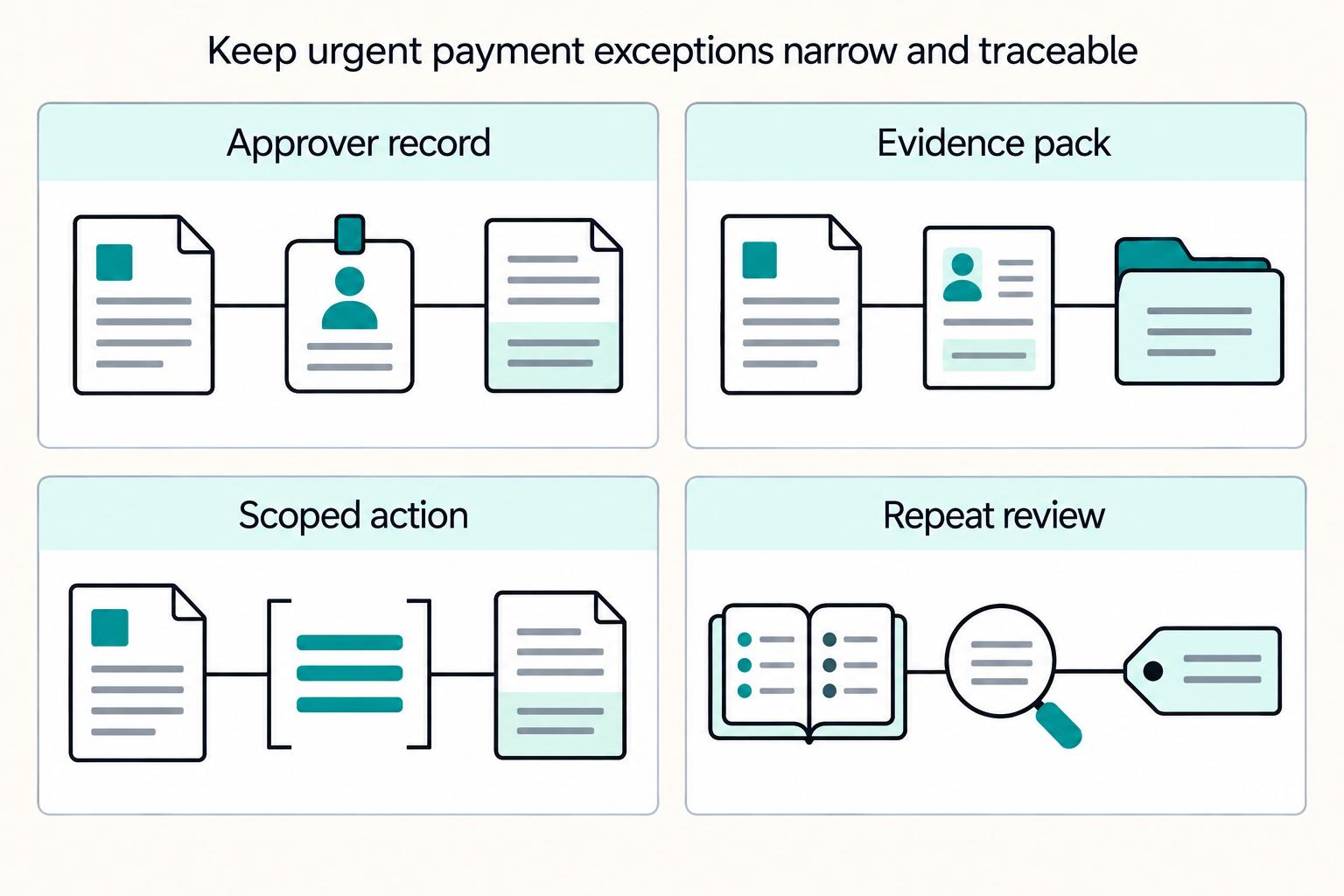
Urgent payments need a path, but that path should stay narrow, named, and auditable. Otherwise it becomes a standing bypass for normal controls.
Step 1. Name the approvers and separate duties#
Keep the exception lane inside your existing approval workflow with designated approvers and clear segregation of duties. The requester should not approve, and the person releasing payment should not be the same person who created the exception.
Require each exception record to state the exact action being approved and include enough facts and rationale to justify the exception. Ensure approval is documented in writing by the designated authority.
Step 2. Require a minimum evidence pack before release#
Urgency can shorten the clock, but it should not waive the evidence. Require a minimum pack for each exception: documented analysis, current AML/KYC identity status, and current due-diligence status.
That pack should make three points clear: commercial rationale, accepted risk, and current identity and due-diligence state. For legal entities, exception reviewers should verify beneficial-owner information under written AML procedures and confirm ongoing due-diligence updates on a risk basis. If the justification is only lack of planning, route it to hold-and-review instead of release.
Step 3. Keep exception approvals tightly scoped#
Treat urgent approval as scoped to a specific payout action with clear documented parameters and ownership. Prevention controls matter most on faster rails where processed transfers can be immediate, final, and irrevocable.
If a team starts reusing the same vendor, reason, and path for routine payments, the exception lane has become policy.
Step 4. Review exception drift and keep records retrievable#
Exceptions should teach you where the base process is failing. Run internal reviews at a risk-based cadence to catch drift early. Look for repeat vendors, repeat approvers, and vague reason codes, then fix intake or onboarding gaps instead of widening exceptions.
Keep exception files, approvals, and payout links retrievable without log reconstruction. If you align to common AML recordkeeping practice, retain these records for at least five years.
Related: Contractor Advance Payments: How Platforms Can Offer Pay-Before-Delivery Without Taking Credit Risk.
Detect and recover when money has already moved#
Even with strong prevention, some misses will get through. Once you allow tightly controlled exceptions, you need a post-payment backstop: run a regular anomaly review, pause related payouts quickly, and keep evidence complete enough for clean reconciliation.
Step 1. Trigger a business-day anomaly review#
Do not wait for month-end close to find bad payouts. Set an anomaly review cadence that fits your risk profile; for many teams, that means each business day. Focus on indicators that often surface off-contract issues after release, such as missing PO records, missing supplier-agreement evidence, failed invoice-review matches, or ledger mismatches between payout events and finance postings.
Use settlement and payout outputs, not only app logs. Stripe's payout reconciliation report helps reconcile transactions in each payout as a settlement batch and groups them by reporting category for faster triage. Adyen's settlement details report supports transaction-level reconciliation for paid-out payments when you need to confirm what settled and how it was classified.
Checkpoint: sample yesterday's anomaly queue and confirm each item links to a payout ID, contractor, amount, policy-failure reason, and current status. If a reviewer cannot reconstruct the sequence of events, the audit trail is not complete.
Step 2. Freeze related payouts before debating root cause#
Contain the issue before you argue about why it happened. If the signal looks real, stop more money from leaving through the same path. On Stripe Connect, pausing payouts blocks both automatic and manual payouts, and can stop in-flight payouts that remain pending for up to 10 days.
Then investigate with a clear sequence. One practical order is to identify the affected payment set, confirm whether the contractor should have been payable, correct missing or wrong contract or approval data, and then clean up accounting classification for budget reconciliation. If you reclassify ledger entries before fixing the commercial record, you can end up with a clean ledger tied to bad source data.
If the anomaly indicates possible suspicious activity, route it through your AML procedures. FinCEN requires ongoing monitoring to identify suspicious transactions, and MSBs have SAR obligations when facts meet the rule.
Step 3. Document reversals, returns, and webhook evidence completely#
When funds are returned or reversed, keep the provider references with the case file: payout ID, reversal or return reference, event ID, settlement reference, and delivery evidence showing notification timing and delivery outcomes. Stripe includes prior delivery attempts with HTTP status codes, retries undelivered events for up to 3 days, and listable events are limited to the last 30 days.
For ACH corrections, treat reversals as a specific mechanism, not a generic undo. Nacha requires the Company ID, SEC Code, and Amount in the reversal to match the original entry. The reversal must be made available to the RDFI within 5 banking days after the erroneous-entry settlement date.
Checkpoint: every closed case should include the provider reference set, relevant delivery evidence, final ledger adjustment, and a short note tying the corrected entry to budget reconciliation.
Common mistakes that recreate maverick spend#
If the same exceptions keep coming back, the design is the problem, not the policy language. Maverick spend returns when finance approvals get tighter but technical controls, accounting controls, or contract enforcement stay loose.
Step 1. Close the API path, not just the approval ticket#
Approval tickets do not matter if engineering leaves a direct payout path open without the same checks. Control design should pair business-process approvals with information-technology controls, and segregation of duties should stop one team from both requesting and executing payment actions.
Apply least privilege in practice: non-privileged users or service accounts should not be able to execute privileged payout functions. Emergency access should be temporary, not persistent. Red flag: one channel blocks required payout data, but another channel still accepts the request.
Step 2. Put a hard expiry on emergency overrides#
Emergency overrides should be temporary, not a standing route. If override access does not auto-expire, it can become routine for exception payout flows.
Use overrides with a predefined expiry instead of persistent access. Then review override activity for repeat patterns across requesters, vendors, or teams. If you cannot quickly tell which overrides are still active, the exception path is already functioning like normal operations.
Step 3. Require books and records, not logs alone#
Logs help, but they are not a complete accounting-control record. The standard is accurate and fair transaction records paired with internal accounting controls.
For operations, keep each payout tied to complete accounting records, not just request and API traces. A common gap is clean event logging with no reliable link to finance postings.
Step 4. Keep AML checks separate from contract enforcement#
AML and CDD checks tell you who you are paying. They do not replace contract enforcement terms. For U.S. legal entity customers, procedures must identify and verify beneficial owners, but that requirement does not answer post-dispute enforcement.
If agreements are missing termination or dispute-resolution language, you can pass compliance checks and still have weak remedies when a relationship breaks down. Require those clauses in the contract record for repeat exception payouts.
Conclusion and copy-paste checklist#
Make the approved path easy, block the unapproved path before funds move, and keep recovery evidence tight enough that you can unwind mistakes without rebuilding the story from logs.
- Confirm ownership and release authority.
Assign named owners across finance ops, engineering, and payments ops, and define who can approve payout batches, approve contract exceptions, and reopen failed payments. Off-contract spend is harder to contain when final authority is unclear. Checkpoint: Keep one current doc or admin view showing approvers, escalation contacts, and each role's release actions.
- Map every payout entry point and mark bypasses.
Trace intake through API request, event receipt, and ledger journal posting, including manual uploads, direct API calls, retries, and emergency paths. Maverick purchasing is bypassing accepted procedure, so focus on where procedure can be skipped. Checkpoint: For each path, record yes or no for contract reference, approval state, and audit trail. Any "no" is a live bypass.
- Enforce pre-payment gates in order.
Validate contractor status first, including KYB or KYC where your model requires it, then contract status and PO linkage, then payout authorization. Use hard denials for missing contract records or failed risk checks, and route incomplete but not clearly prohibited cases to review. Checkpoint: Test missing PO, expired agreement, and incomplete verification states. Each should block or route to review before authorization.
- Implement idempotent API writes and verified event handling.
Require idempotency keys on payout-create requests. Stripe's model is a useful benchmark: the same key returns the same result, including errors, keys can be up to 255 characters, and stored keys may be removed after 24 hours. Verify signatures with your endpoint secret and preserve the raw request body exactly so checks remain valid. Checkpoint: Replay the same payout request with the same key and confirm no second payout. Send an altered-body event delivery and confirm rejection before ledger posting. Red flag: Posting journals from unverified deliveries can create a ledger-corruption path.
- Include contract clauses for control failures.
Cover termination, limitation of liability, indemnification, governing law, jurisdiction or forum selection, and dispute resolution. These clauses address different risks when payment controls fail, and enforceability depends on jurisdiction and drafting. Checkpoint: Store contract metadata in the approval record, not only a file link, before payout release.
- Stand up a narrow exception lane.
Allow urgent payments only with tight guardrails: one-time use, time bounds, and evidence. Minimum evidence should include a contract snapshot, reason code, current KYB or KYC or AML state, named approver, and planned reconciliation path. Review drift on a fixed cadence. Red flag: Repeated exceptions for the same vendor or team mean the exception lane is becoming the default lane.
- Run post-payment anomaly checks and close recovery before month-end.
Use a consistent operating cadence to catch missing PO references, missing agreement IDs, failed approval matches, duplicate retries, and ledger mismatches. Then freeze follow-on payouts where needed, investigate, correct source data, and document reversals or returns with provider and delivery evidence. In P2P terms, compliance and reconciliation are part of the control design, not after-the-fact cleanup. Checkpoint: By month-end, every flagged item should be cleared, reversed, reclassified, or escalated with an owner and evidence.
Related reading: Contractor Onboarding Optimization: How to Reduce KYC Drop-Off and Get to First Payout Faster.
When you convert the checklist into rollout tickets, keep approval fields, idempotency handling, and webhook-to-ledger behavior aligned in one implementation source: Read the docs.
Frequently Asked Questions
What is maverick spend in contractor payment platforms?
It is payout activity that runs outside your documented procurement procedures, supplier agreement, or approval workflow. In practice, that includes off-contract buying, payments without required PO linkage, direct API requests made before required checks, or manual batches outside the same controls.
Why does off-contract spend keep happening even with policies?
Because policy language does not remove the operating and behavioral causes. Gaps in education, tools, and culture let teams bypass approved channels, so small exceptions repeat and spread.
What are the first controls to implement?
Start with pre-payment controls that stop release before funds move. Require approved channels, approval status, and contract references before payout authorization, validate any PO linkage your policy requires, and test both UI and API paths with missing data to confirm they are blocked.
How is this different from classic procurement maverick spend?
Classic maverick spend is often many small, low-visibility indirect or tail-spend transactions. In contractor payouts, risk also sits in payment execution flows such as API requests, retries, webhook delivery status, and ledger posting, which is why idempotency and replay-safe event handling matter.
Should we prioritize prevention or post-payment detection?
Prioritize prevention at request time and payout authorization time. Keep post-payment detection as a backstop for misses, duplicate retries, failed event deliveries, and ledger mismatches, with routine anomaly review to catch what slipped through.
What evidence should we keep for audits and disputes?
Keep the full chain: approvals, contract metadata, any required PO or obligation references, API request and response logs, delivery history, and final journal or ledger entries. Pair system logs with accounting books and underlying documents so investigations, reconciliations, and disputes are traceable end to end.
Researched and edited by the Gruv editorial team. Gruv builds cross-border billing, payouts, and finance-operations software for global businesses.
Sources
- acquisition.gov/far/1.602-1trusted
- acquisition.gov/far/1.602-3trusted
- bsaaml.ffiec.gov/manual/AssessingComplianceWithBSARegulatoryR...trusted
- bsaaml.ffiec.gov/docs/manual/04_AssessingTheBSAAMLComplianceP...trusted
- congress.gov/crs_external_products/IF/PDF/IF12936/IF12936...trusted
- ecfr.gov/current/title-2/subtitle-A/chapter-II/part-2...trusted
- ecfr.gov/current/title-2/subtitle-A/chapter-II/part-2...trusted
- federalregister.gov/documents/2016/05/11/2016-10567/customer-due...trusted
Educational content only. Not legal, tax, or financial advice.
Related Posts

The Freelance Payment Penalty: A Modeled Audit of Platform Fees, FX Spreads, and Payout Delays
The money rarely disappears through a single, easy-to-spot fee. The real loss is stacked. A marketplace takes its commission, a processor adds a charge for international cards, a bank or payment company converts the currency at a spread, a platform holds the funds before release, and a wire sheds a little to intermediaries on the way in. Each layer looks defensible on its own, but the worker feels the combined result as a smaller deposit and a later payday.

How to Respond to a Subpoena for Business Records
Move fast, but do not produce records on instinct. If you need to **respond to a subpoena for business records**, your immediate job is to control deadlines, preserve records, and make any later production defensible.

A US Expat's Guide to Investing in UCITS ETFs to Avoid PFIC Issues
The real problem is a two-system conflict. U.S. tax treatment can punish the wrong fund choice, while local product-access constraints can block the funds you want to buy in the first place. For **us expat ucits etfs**, the practical question is not "Which product is best?" It is "What can I access, report, and keep doing every year without guessing?" Use this four-part filter before any trade: