
Quick Answer
Instant bank payments via open banking can work for recurring charges when your team can prove consent, reconcile to an internal ledger, and assign return liability before launch. The article argues pay by bank beats cards only when total collection cost stays lower after fees, failed payments, recovery work, and support, and it warns that instant authorization is not the same as final settlement or exception handling.
Why platform teams are moving recurring charges to bank rails now#
Platform teams are revisiting recurring charges on bank rails because instant payment infrastructure is no longer a niche option. The opportunity is real, but the outcome still depends more on operating discipline than on the rail itself.
Capgemini describes instant rails as real-time payer-to-payee infrastructure and says more than 80 jurisdictions, representing 95% of global GDP, now support instant payment schemes. That makes this a live product and finance decision for many platforms, not a theoretical alternative.
In SEPA-linked markets, timing matters too. The EU Instant Payments Regulation is described as having come into force in October 2025, requiring euro-area banks to offer instant payments at the same cost as standard SEPA transfers. That is a strong market signal that instant movement is becoming baseline infrastructure.
The real decision is operational: can your team run recurring bank charges with clear ownership, reliable reconciliation, and controls your support and finance teams can defend? The OCC payment-systems handbook treats ACH, payment cards, and real-time payments as distinct payment types, so card-era assumptions should not carry over by default. If your team still needs a shared baseline for the rail map itself, start with What Are Payment Rails? ACH Wire SEPA and Real-Time Networks Compared.
Before you roll anything out, check whether you already have:
- written policies and procedures for recurring bank collections
- internal controls and a current risk assessment for failures and exceptions
- named owners for management reporting, internal audit, and third-party risk management
This is where programs usually break. Capgemini also notes that real-time models require real-time monitoring and stress testing, with higher liquidity buffers in some banking contexts. This guide stays focused on the United States, United Kingdom, and SEPA-linked contexts, where implementation details and operating expectations differ in ways that matter day to day. If you need a simpler operator baseline for where A2A should stay limited to specific journeys, start with Where A2A Beats Cards for Platform Operators in Open Banking.
Define instant clearly before you choose a rail#
For recurring charges, treat "instant" as three separate states: authorization, settlement, and post-initiation failure handling. If your service activates immediately, authorization certainty should come first. Then you need to know how long settlement and exceptions actually take.
| State | What to confirm | Grounded note |
|---|---|---|
| Authorization | Whether authorization certainty is strong enough if service activates immediately | Do not collapse payer authorization and clearinghouse handoff into one "paid" status. |
| Settlement | How long settlement actually takes | ACH is not a real-time method; typical processing is reported as one to three business days or two to three days, with same-day transactions available in some setups. |
| Post-initiation failure handling | How long exceptions actually take | ACH returns are linked to the settlement gap and are often tied to insufficient funds or fraud. |
ACH is the clearest example of why this matters. It is commonly used for recurring, preauthorized payments, but it is not a real-time method. Typical processing takes one to three business days, sometimes quoted as two to three days, with same-day transactions available in some setups.
In practice, payer authorization and clearinghouse handoff are separate checkpoints before settlement. Do not collapse them into one "paid" status. Before launch, trace one recurring debit end to end and confirm each event lands in your internal ledger or payment event log, not just in a provider dashboard.
The main risk sits in the settlement gap. ACH returns are linked to that gap and are often tied to insufficient funds or fraud. So a debit that looks successful at initiation can still create recovery work later. If you are comparing ACH with other bank debit schemes for recurring collections, verify scheme-specific and provider-specific behavior directly instead of importing assumptions from another rail.
When recurring pay by bank beats cards and when it does not#
Use a simple rule: pay by bank beats cards only when your total collection cost is lower after fees, failures, and recovery work. If fee savings are narrow or account continuity is weak, cards are usually the safer default.
Headline pricing is only the starting point. On Stripe's pricing page, domestic cards are 2.9% + 30¢ per successful transaction, Instant Bank Payments are 2.6% + 30¢, and ACH Direct Debit is 0.8% with a $5.00 cap. That means "pay by bank" is not one cost outcome. The rail changes the math.
| Method | Stripe-listed headline price | Where it can make sense | What to verify before using it in your model |
|---|---|---|---|
| Domestic cards | 2.9% + 30¢ | Recurring billing where card continuity is already strong | Whether effective cost is rising with volume and failed payments |
| Instant Bank Payments | 2.6% + 30¢ | Flows where bank authorization UX fits and fee reduction still matters | Whether country-specific pricing changes the number |
| ACH Direct Debit | 0.8%, capped at $5.00 | Higher-ticket recurring charges where percentage card fees are expensive | Failure handling, support effort, and whether the cap improves blended cost |
When you compare providers, normalize to the same cost basket: transaction fees, failed-payment handling, retry effort, support workload, and reconciliation time. Any estimate is provisional until you verify your country-specific pricing, because provider pages can change and country-level payment-method pricing can override generic tables.
Your finance model should include more than base processing fees:
- Processing: card vs bank fees using your exact country and plan.
- Program add-ons: Stripe Managed Payments adds 3.5% per successful transaction on top of standard processing fees, and Stripe notes additional charges for subscription payments.
- Cross-border extras: Managed Payments examples include 1.5% for international transactions and 1% to 2% for currency conversion.
- Failure and recovery: NSF-related costs, collections effort, and support contacts.
- Operations: reconciliation labor when internal ledgers and provider statuses diverge.
Do not force a full migration. Keep a clear stay-on-cards lane for segments where bank-link onboarding is harder or operational uncertainty is still high. Bank rails tend to work best for recurring cohorts with larger ticket sizes, stronger account continuity, and an all-in cost profile that still holds up after recovery and ops work are included.
Assign liability before launch or pay for it later#
If liability is vague at launch, it comes back as write-offs, support volume, and finance cleanup. Put a named owner on each failure type now, and document that ownership in contracts, internal SOPs, and customer communication triggers.
Pay by bank is a direct bank-to-bank transfer. In recurring collections, one team may own authorization conversion while another owns post-debit recovery and loss exposure.
| Failure type | Primary owner | Decision to lock before launch |
|---|---|---|
| Authorization drop-off during bank linking or mandate setup | Product | Retry path, fallback method, and handoff to recovery flow |
| Failed Automatic Debit (including insufficient funds) | Operations | Customer notification trigger, retry cadence, and service-pause rules |
| Late Bank-Initiated Returns or unauthorized claims | Finance | Reserve and write-off treatment, ledger handling, and escalation path |
Be precise with language. Do not use Chargebacks as a catch-all term for every post-payment issue. Keep card-dispute language separate from bank-return language in contracts, vendor reviews, and internal docs so teams do not misread the exposure.
That distinction matters in recurring rail design. In the cited subscription example, iDeal is used for initial mandate capture, while later recurring collections run on SEPA Direct Debit. Risk ownership should follow the recurring rail, not the setup step. The same example also describes ongoing SEPA Direct Debit exposure windows of 8 weeks and 13 months, which is enough to show why "no chargebacks" is not a complete risk statement for recurring bank debits.
Customer messaging is part of loss control too. Trigger a clear notification on each failed Automatic Debit, and route repeat failures into a stronger recovery path instead of sending the same reminder again.
Set up mandates and customer permissions so disputes stay low#
Low dispute rates usually come from clear initiation and strong records, not from better wording after the fact. Make payment permission explicit up front, then make the evidence easy to retrieve later.
Push and pull are different customer promises#
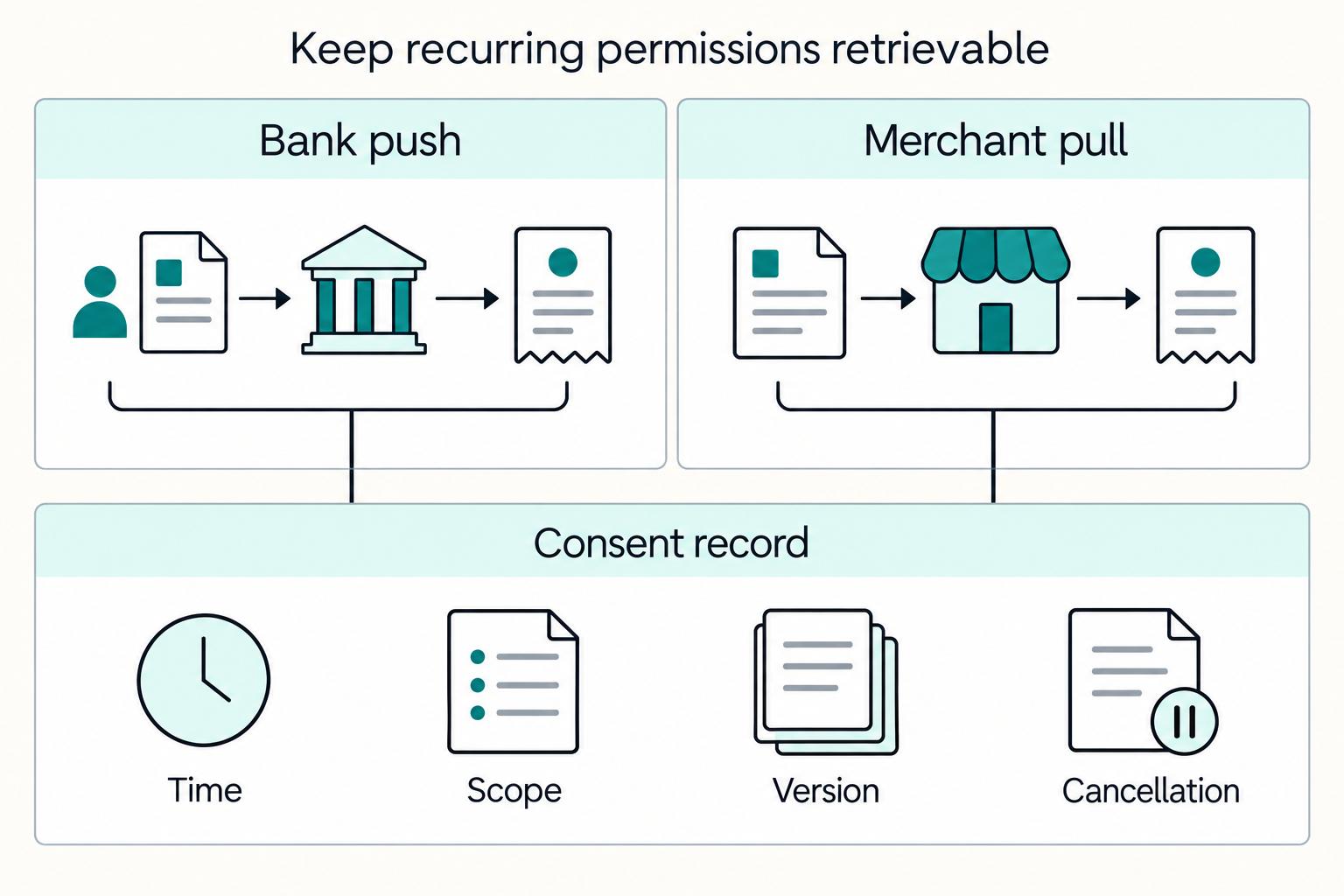
Keep these models separate in your product language: Recurring Bill Pay means the customer asks their bank to send funds, while Automatic Debit means the customer authorizes you to pull funds.
For third-party payer or preauthorized bill-payment arrangements, CFPB Regulation Z commentary says payment is received when the creditor gets the transfer medium. That is different from when a customer may think the process started.
Make that distinction visible in your UX and support scripts:
- If it is bank push, tell customers changes and cancellation happen through their bank.
- If it is merchant pull, state that they are authorizing recurring debits and show the cancellation path in-product.
Reflect CFPB timing logic in copy and notification behavior#
Timing language needs to be concrete, especially for variable charges.
| Moment | Article note | Copy focus |
|---|---|---|
| Authorization time | Regulation Z commentary states that a payment made on the creditor website is received when the consumer authorizes it. | Show authorization time separately from later timing. |
| Receipt timing | If authorization is after 5 p.m. or your stated later cutoff, receipt is deemed the next business day. | Include cutoff handling in customer language. |
| Crediting treatment | Payments must be credited as of receipt, except when a delay causes no finance or other charge. | Keep crediting treatment distinct from authorization wording. |
Regulation Z commentary states that a payment made on the creditor website is received when the consumer authorizes it. If authorization is after 5 p.m. or your stated later cutoff, receipt is deemed the next business day. Regulation Z also states payments must be credited as of receipt, except when a delay causes no finance or other charge.
Your copy should separate three moments clearly:
- authorization time
- receipt timing, including cutoff handling
- crediting treatment
Do not claim a specific CFPB advance-notice deadline unless your legal team has mapped it for your rule set.
Keep mandate records fixed and retrievable#
Your dispute process is only as strong as your records. Keep one searchable, non-editable record for each consent event with:
- consent timestamp
- payment scope
- cancellation path shown to the customer
- exact acceptance text/version
- channel used
If support cannot retrieve that record quickly from a customer ID or reference, the dispute workflow stays fragile.
Use terms your partners and scheme guidance can verify#
Keep customer-facing and internal labels aligned with the terms used by your processor, bank partner, and relevant scheme guidance, including Nacha materials where applicable.
Do not hide the mechanics behind vague labels. Customers should be able to tell whether they set up bank push or authorized merchant pull, and exactly how to cancel.
Build the integration around ledger truth not gateway dashboards#
Once customer permission is in place, make your ledger the source of record and treat gateway dashboards as secondary views. That one design choice prevents a lot of downstream confusion.
For recurring bank-payment flows, use a strict processing sequence so product state does not outrun accounting state:
- authorization event
- provider reference
- ledger journal posting
- invoice state update
- wallet projection update
This sequence keeps each step auditable. Provider events are inputs, while journal postings are internal accounting facts. Integrated payments can auto-update books and invoices, but you still need the ledger layer to decide what is true before customer-visible balances move.
Make webhook handling idempotent#
Across ACH, Direct Debit, and Open Banking, asynchronous events can retry or arrive out of order. If your handler is not idempotent, one payment event can create duplicate journal postings.
Use a stable deduplication key:
- provider event ID when available
- otherwise provider reference + normalized event type + amount
Direct gateway-to-accounting syncs can add noise to the general ledger. Ingest provider events into your ledger logic first, then push clean journal outcomes into accounting.
Reconcile with references, not dashboard totals#
Daily reconciliation should key off both:
- provider reference
- internal ledger ID
Use dashboard totals to spot problems, not as booking truth. Keep a compact reconciliation record with provider reference, ledger ID, amount, state, and resolution note. Also document who reviewed it and how unmatched items were resolved.
Give finance and ops states they can act on#
Operational states need to help teams act without waiting on engineering.
| State | Meaning | Typical next action |
|---|---|---|
| Pending | Initiation exists, posting/review not complete | Wait for next event or scheduled review |
| Credited | Journal posted; invoice can advance | Close normally and confirm |
| Held | Missing/mismatched reference, amount, or review | Resolve before posting |
| Returned | Prior payment needs reversal/recovery | Reverse accounting impact and start recovery workflow |
Keep the states action-oriented, not cosmetic. External providers report activity, but your ledger determines internal truth.
Handle country and rail differences without stalling rollout#
Treat each country-and-rail rollout as its own program, not as one global recurring setup with translated labels. Before you call a market ready, run a separate review across operational, technology, governance, consumer-protection, and legal or policy domains. Use our payment rails comparison to keep ACH, wire, SEPA, and instant-network assumptions in separate design lanes.
This is a rollout problem, not just an integration task. The practical rule is simple: scope support where customers actually feel it, at the market, rail, and program level.
Scope support by market and by program#
Define support as a specific program with distinct customer copy, support handling, and internal state mapping. Do not assume wording, notices, or return handling will transfer cleanly from one market to another.
A common failure mode is grouping multiple rails under one internal label, then discovering that customer notices and support macros describe the wrong flow.
Publish a country matrix that operators can use#
Keep a live matrix in-product and in internal docs. It should answer real support, finance, and compliance questions without forcing teams to interpret dashboards on the fly.
| Matrix item | What to include |
|---|---|
| Market and rail naming | Both internal and customer-facing |
| Mandate or permission model | The model used for the program |
| Settlement wording | Only wording you are prepared to promise |
| Return behavior and status mapping | Return behavior wording and internal status mapping |
| Notice obligations | Customer notice obligations and accountable owner |
| Cancellation or revocation path | Path shown to users |
| Coverage checkpoint | Mark a program as supported only when it has live transactions and working functionality, not when sandbox tests pass or contracts are signed. |
Those are the minimum fields. Do not mark a program as supported until it has live transactions and working functionality, not just sandbox tests or signed contracts.
Precision in naming prevents support debt#
Naming looks minor until it creates support debt. Use rail terms exactly where they belong, and keep customer-facing language specific to the program in market. If naming, notices, and internal statuses are not aligned for a given market, treat that as a readiness gap, not a copy edit.
Compare providers with operator criteria not marketing claims#
Do not assume providers are equivalent. For recurring bank charges, if a provider cannot clearly document return risk, retry behavior, and reconciliation outputs, that is launch risk.
There is not enough support here for a feature-by-feature ranking of Stripe Link, Plaid, and GoCardless. Your scorecard should make that uncertainty visible instead of pretending the products are interchangeable.
| Provider | Recurring authorization UX | Return-risk model | Retry controls | Public documentation status |
|---|---|---|---|---|
| Stripe Link | Unknown from current evidence | Unknown from current evidence | Unknown from current evidence | No authoritative provider detail here to score confidently |
| Plaid | Unknown from current evidence | Unknown from current evidence | Unknown from current evidence | No authoritative provider detail here to score confidently |
| GoCardless | Unknown from current evidence | Unknown from current evidence | Unknown from current evidence | No authoritative provider detail here to score confidently |
Score the consent experience against the actual rail#
Start with how recurring consent is created and explained, not just with checkout conversion. In U.K. open banking, VRPs are described as customer-authorized recurring collections with customer-controlled limits and parameters. If a provider supports a VRP-style flow, confirm those limits are visible to customers, stored in retrievable records, and available to support when a debit is disputed. If you are still deciding where A2A actually beats cards for your operator model, pair this section with Where A2A Beats Cards for Platform Operators in Open Banking.
Do not treat "instant" as a complete risk answer. The Federal Reserve's 2025 Pay-by-Bank note frames both benefits and risks, so one-sided cost messaging is incomplete. If service activates immediately after authorization, define what happens when a later return or revocation appears and who owns the loss.
Verify the integration depth with evidence, not screenshots#
Hidden finance and support debt usually shows up in the integration layer. Ask each provider for the same evidence pack before you score it:
- sample webhook payloads for success, pending, failed, returned, and authorization-revoked events
- event delivery and replay behavior, including unique event IDs or other idempotency controls
- failure reason granularity beyond a generic "failed" status
- reconciliation export samples with provider reference, payout or settlement reference, and enough detail to match your ledger
Run a duplicate-delivery test in sandbox or pilot and confirm your integration can process the same event twice without double posting. Then compare one failed collection across the dashboard, webhook payload, and export file. If reason codes or references do not line up, retry logic and support handling will drift.
Do not overtrust dashboard labels. If insufficient funds, revoked consent, and bank-side rejects all collapse into one broad status, dunning decisions and customer messaging will break.
Put governance terms on the same scorecard#
Contract clarity on Bank-Initiated Returns is a core operating requirement. "No chargebacks" language is not enough if your MSA, order form, or service schedule does not clearly state who absorbs return losses, how long exposure stays open, and what return notice you receive.
Score incident operations the same way: named escalation path, response targets for payment incidents, and handling for high-value failed collections. If escalation ownership is unclear across support, risk, and account management, your team will carry that coordination burden during incidents.
The practical choice is not the biggest brand. It is the provider that can document rail-specific consent behavior, expose machine-usable failure states, and clearly define Bank-Initiated Returns ownership. Unknowns are acceptable during evaluation, not at launch.
Roll out in phases with hard go and no-go checkpoints#
Roll this out in phases, and treat unresolved return liability as a no-go. Start with one stable recurring segment, confirm collections improve, and confirm reconciliation and close work do not get worse.
| Stage | Scope | Go checkpoint | No-go signal |
|---|---|---|---|
| Phase 1 | One stable recurring cohort | Collection reliability improves and finance can reconcile without extra manual work | Unmatched events, rising manual exceptions, or close-time drag |
| Phase 2 | Variable-amount recurring charges | Notification flow, consent/mandate evidence retrieval, and retry behavior are working in live operations | Support cannot retrieve consent evidence or explain amount-change notices and outcomes |
| Expansion | Additional segments or markets | Failure trend, recovery trend, support volume, and finance close impact remain acceptable through the pilot period | NSF Fees or Bank-Initiated Returns ownership is still unclear |
Start where variability is low#
Begin with a cohort that has predictable billing behavior so failures are easier to diagnose across product, support, and finance views. The checkpoint is not just authorization success. It is whether failed, recovered, and returned states line up across operational outputs and finance records. If a failed collection cannot be traced cleanly end to end without hand correction, do not expand.
Add variable amounts only when dispute readiness is real#
Move to variable amounts only after notification, consent evidence retrieval, and retry outcomes are proven in production workflows. This matters in flows aligned to Variable Recurring Payments, where customers authorize payments within agreed limits. If support cannot retrieve and explain the consent scope during a dispute, rollout risk is still too high.
In the UK context, VRPs have been described as not yet broadly established, with active debate on liability and who pays when fast VRP payments are returned. Treat that as a maturity signal. If your provider or legal path cannot show a clear dispute-resolution mechanism, keep the scope narrow.
Gate expansion with a repeatable evidence pack#
Before each expansion step, review the same evidence pack, then compare the U.S. branch against your FedNow vs RTP vs ACH payout routing guide so same-day language does not outrun actual rail behavior:
- failure-rate trend, recovery-rate trend, support ticket volume, and finance close-time impact for the pilot window
- contract language that clearly allocates Bank-Initiated Returns and NSF Fees ownership
- operational proof that support and finance can retrieve consent evidence and explain notices for failed or variable collections
Do not respond to uncertainty by adding so many controls that the flow becomes slow or expensive. Protections and dispute procedures can add cost, and over-engineering can erase the value of the model. Where legal or policy interpretation matters, verify against official Federal Register editions or PDFs rather than relying only on prototype web rendering.
Mistakes that create hidden risk in recurring bank debits#
Most hidden risk comes from operating shortcuts, not from the rail itself. Teams treat speed as certainty, migrate too broadly, and lose control of mandate evidence and status language.
- Treating "instant" as final settlement. In the EU material, instant payment means an instant credit transfer, and the Commission workshop Q&A is clarificatory rather than binding law. Do not design irreversible fulfillment or customer messaging off a single success signal without a clear exception-handling path.
- Migrating all recurring traffic at once. Fixed-amount cycles, variable debits, and different market rules fail in different ways. Segment by billing pattern, market, and mandate readiness, and keep any cohort out if consent records, unique mandate identifiers, or pause or cancel controls are not working.
- Ignoring consent and notice controls in live operations. If your flow requires pre-debit notice, verify the notice timestamp and customer control path, not just debit attempts. Missed consent notifications can lead to blocked or held service, which quickly turns into support load and churn risk.
- Mixing the wrong payment vocabulary and status definitions. Keep wire terms like SWIFT MT103 and Correspondent Banking out of recurring debit triage, and standardize state names across finance, support, and engineering. This is cost control as much as clarity: one cited Direct Debit study estimates up to £50 repair cost per failed DD, and 78% of finance teams reported spending more than 10 minutes rectifying each failure.
What to do next if you want lower cost without hidden payment risk#
Start small, and block launch on unresolved risk ownership rather than headline processing price.
- Pilot one narrow recurring cohort first, and confirm you can prove customer consent for each charge and the cancellation path before scaling.
- Use a provider scorecard that includes total operating cost, not just advertised rates, and include failure-handling overhead such as dispute or chargeback response work.
- Treat liability ownership and payment-state handling as explicit go or no-go checks, then expand market by market only after your records and customer communications are consistently clear.
Frequently Asked Questions
What is the difference between Automatic Debit and Recurring Bill Pay, and why does it matter for platform risk?
Automatic Debit means the customer authorizes you to pull funds. Recurring Bill Pay means the customer asks their bank to send funds. It matters because initiation, timing control, and cancellation handling change the platform's risk and support burden.
Do instant bank payments settle instantly, or only authorize instantly?
Instant does not always mean final, irreversible settlement. The article separates authorization, settlement, and post-initiation failure handling, and says timing depends on the rail and setup. Keep pending, credited, held, and returned states instead of treating one success signal as fully paid.
When should a platform prioritize ACH or Direct Debit over cards for recurring charges?
Prioritize ACH or Direct Debit when the all-in collection cost is lower than cards after fees, failures, recovery work, and reconciliation. They also need strong consent control, retry handling, and operational support. If onboarding or coverage is weak, keep a card lane instead of forcing migration.
How are Bank-Initiated Returns different from Chargebacks in day-to-day operations?
Do not treat Bank-Initiated Returns and Chargebacks as interchangeable terms. The article says your provider contract and internal taxonomy should define the difference for your program. Run separate queues, reason labels, and owners for customer communication and ledger correction.
What should product, finance, and engineering validate before launching recurring pay by bank?
Validate consent timestamp, payment scope, and the cancellation path for every recurring charge. Validate setup and charge execution as separate checkpoints, because setup does not guarantee future payment success. Also confirm failed, recovered, and returned states can be traced end to end and that support can retrieve consent evidence quickly.
Is coverage and behavior the same across the United States, United Kingdom, and SEPA markets?
No. Coverage and behavior are market-specific and rail-specific across the United States, United Kingdom, and SEPA-linked markets. The article recommends a market-by-market operating matrix for naming, permission model, settlement wording, return behavior, notice obligations, and cancellation paths. Do not reuse one-country assumptions across all programs.
Researched and edited by the Gruv editorial team. Gruv builds cross-border billing, payouts, and finance-operations software for global businesses.
Sources
Includes 1 external source outside the trusted-domain allowlist.
Educational content only. Not legal, tax, or financial advice.
Related Posts

The Freelance Payment Penalty: A Modeled Audit of Platform Fees, FX Spreads, and Payout Delays
The money rarely disappears through a single, easy-to-spot fee. The real loss is stacked. A marketplace takes its commission, a processor adds a charge for international cards, a bank or payment company converts the currency at a spread, a platform holds the funds before release, and a wire sheds a little to intermediaries on the way in. Each layer looks defensible on its own, but the worker feels the combined result as a smaller deposit and a later payday.

How to Respond to a Subpoena for Business Records
Move fast, but do not produce records on instinct. If you need to **respond to a subpoena for business records**, your immediate job is to control deadlines, preserve records, and make any later production defensible.
A US Expat's Guide to Investing in UCITS ETFs to Avoid PFIC Issues
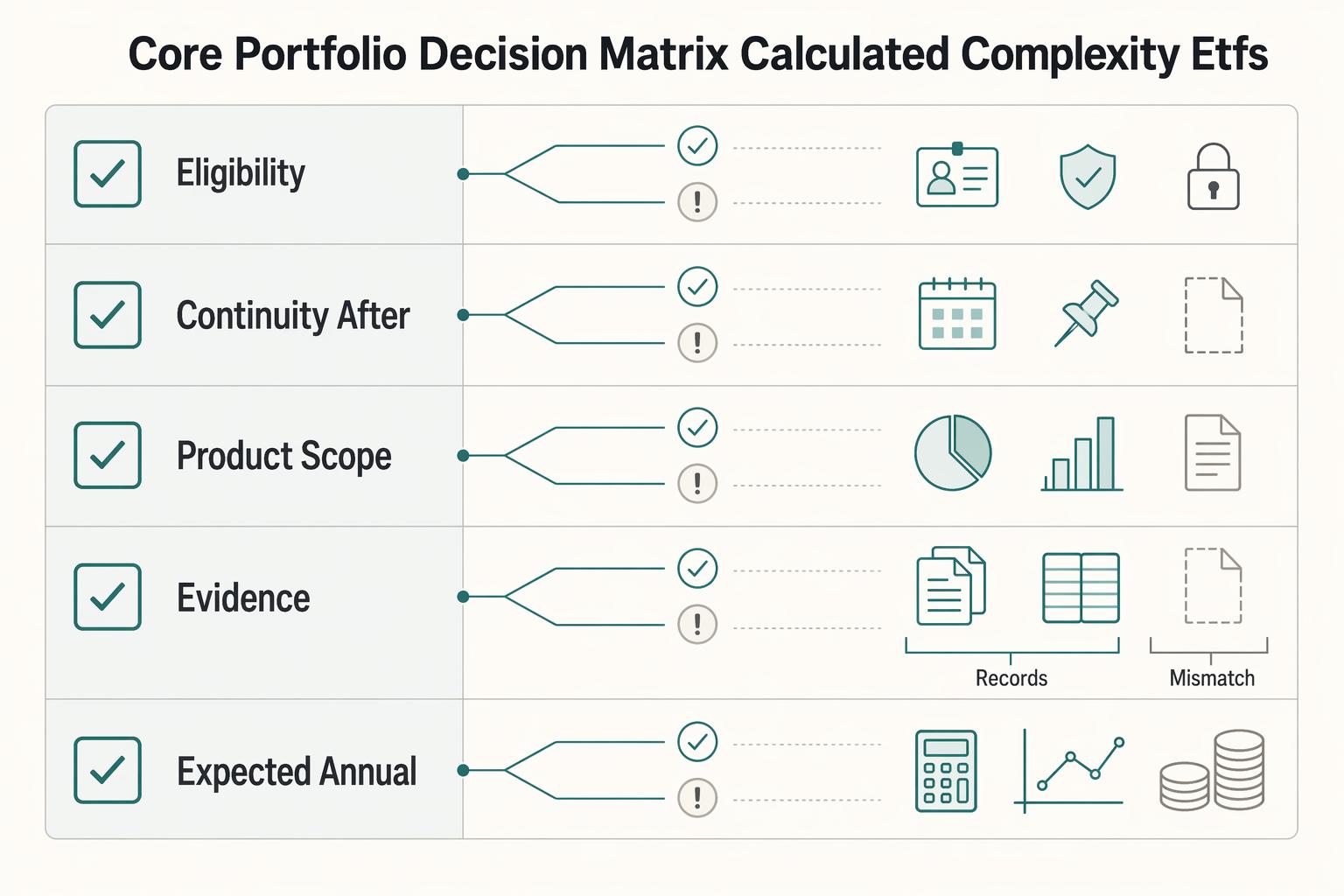
The real problem is a two-system conflict. U.S. tax treatment can punish the wrong fund choice, while local product-access constraints can block the funds you want to buy in the first place. For **us expat ucits etfs**, the practical question is not "Which product is best?" It is "What can I access, report, and keep doing every year without guessing?" Use this four-part filter before any trade: