
Quick Answer
Keep one durable payout obligation with authorized attempt records. Atomically claim execution before dispatch and bind request keys to tenant, operation and input. Reuse the original provider key only within its documented replay coverage. Hold uncertain or expired-key attempts for reconciliation; do not rotate keys or providers to escape a timeout. Guard event processing and ledger effects separately.
Why Reliable Retries Depend on Idempotency Keys#
Payout retries are normal in payout-style REST APIs. Duplicate payouts are the real problem, because one bad retry can turn a transient timeout into duplicate money movement, a messy reconciliation gap, and a support issue that takes time to unwind.
With idempotency keys in a payout API, generating a token is the easy part. The hard part is deciding what a retry means and when the server should replay a prior result instead of creating a new payout. This article focuses on three things: clear decision rules for Idempotency-Key use, an implementation order that does not paint you into a corner, and verification checkpoints you should pass before you ship a Payout API.
An idempotency key identifies a request within a defined account and operation scope. Persist the accepted request and its state before allowing an external payout call. Completed equivalent requests replay the stored response; an in-flight duplicate receives the documented status or conflict response rather than starting another execution.
The operating stance throughout is simple: design retries as replay behavior and treat request success as different from payout finality. A successful HTTP response only tells you what happened at the API boundary. It does not, by itself, prove that the payout is final. In practice, you want one payout intent, one client-generated key, and one auditable record that lets you verify what happened when delivery outcome is uncertain.
Build the mental model before writing code#
Use a durable internal payout obligation ID, with separate attempt records for provider submissions. The request key identifies a command within that design. A batch needs item-level obligation identities because a partly completed batch cannot safely be retried as an entirely new set of payouts.
An Idempotency-Key is the request identity for that intent. The transport field name is secondary; the contract is what matters: the same command with the same input should return the same outcome, or a deterministic replay of the first outcome. POST alone does not guarantee this behavior, so your backend has to enforce it.
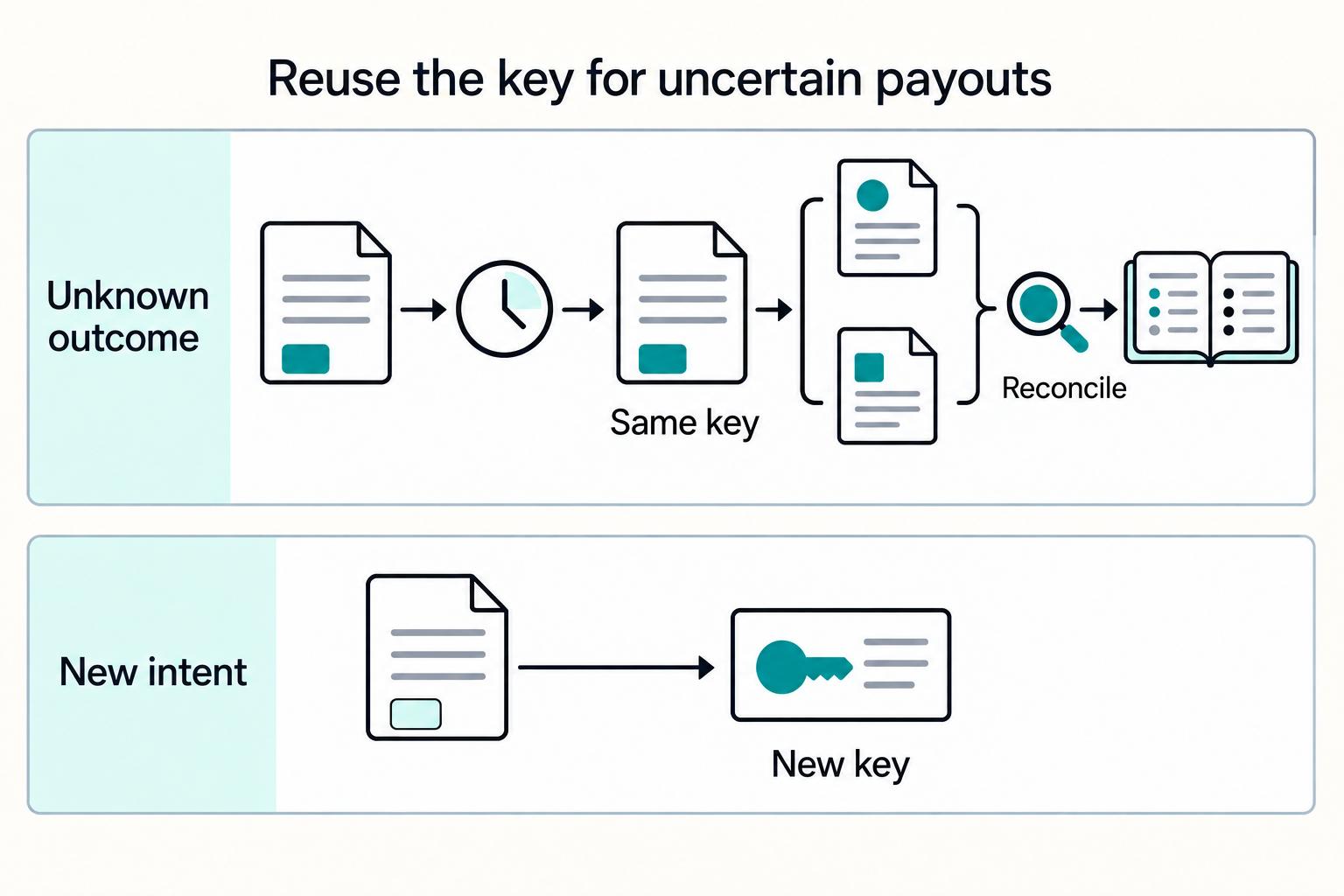
Define your replay states before you write handlers or storage logic. Your labels can vary, but you need clear equivalents for in-progress, completed, failed, and unknown-delivery outcomes after timeouts or dropped connections. That unknown-delivery case is the high-risk path, and retries there should be treated as replay, not a fresh create.
When should you reuse a key and when should you rotate it#
Keep the original internal payout and attempt identities while an outcome is unknown. A provider retry may reuse its original key only when the endpoint’s documented replay protection still covers it. If the key has expired, the endpoint is unclear, or a different provider/region would be used, stop outbound creates and reconcile first. A fresh key is not a way to resolve uncertainty.
The practical rule set#
| Payout state in your system | Action | Owner |
|---|---|---|
| processing | Return internal current state; retry provider only under documented in-flight rules | app |
| unknown | Hold new creates; reconcile, using same-key provider replay only within valid coverage | app + ops |
| confirmed failed/cancelled attempt | Check it cannot still pay and approve any replacement attempt for the same obligation | app + ops |
| completed payout | Replay status; do not pay the same obligation again | app |
| unresolved or expired provider key | Investigate with provider references/support; do not blindly resend | ops |
Keep the boundary strict: retries reuse the same key for the same intent; new intents get new keys. Related reading: API Authentication and Security: OAuth2 JWT and API Keys.
Design the idempotency data contract and storage boundary#
Design this as a contract first: define what counts as the same payout request, then make storage enforce that rule. In at-least-once delivery systems, retries and duplicate delivery are normal, so the contract should handle ambiguous outcomes without turning retries into new payout creates.
For your own API, scope the key by authenticated tenant/account and operation, and bind it to a durable payout obligation and attempt. Two different client keys for the same obligation must not bypass the obligation-level duplicate guard.
Define sameness in the contract#
Be explicit about same-key behavior. For the same key and the same normalized request, return the original result or current known state. For the same key with a materially different request, reject it with a documented error response.
| Scenario | Key/payload relation | Handling |
|---|---|---|
| Replay of the same request | Same key and the same normalized request | Return the original result or current known state |
| Formatting-only replay | Semantically identical requests with harmless formatting differences | Normalize your internal hash according to the documented contract, but preserve the accepted provider payload for retries |
| Changed request with same key | Same key with a materially different request | Reject with a documented error response before downstream execution |
Store only what you need to replay safely#
Store the scoped key, payout obligation ID, attempt ID, normalized request hash, processing state, provider route/key and references, timestamps, and replayable response. Atomically claim the record using a unique constraint or conditional write before enqueueing or calling the provider. A separate “check then insert” lets concurrent workers both pass. Persist dispatch through a transactional outbox or equivalent durable handoff.
Set retention by payout risk, then validate against real behavior#
A provider’s replay cache can expire before your business obligation or investigation ends. Retain the durable obligation and attempt journal beyond the short request-response cache, under your retention policy. After cache expiry, consult the journal and provider status instead of sending the same key as if its old protection still existed.
Compare provider behaviors before finalizing defaults#
These primary documentation examples show why one default cannot be copied across products. Verify the exact payout endpoint and account/region before implementing a provider retry; Adyen’s general payment-API page does not establish every transfer-product rule.
| Documentation | Published replay rule | Boundary to retain |
|---|---|---|
| Stripe API | Caches first executed status/body including 500; keys up to 255 characters; can prune after at least24 hours | Same key after pruning can create anew; pre-execution validation or concurrency conflicts are not cached |
| Adyen general payment API | Keys up to64 characters, company-account scope, valid7–14days | No cross-region duplicate checking; in-flight duplicate can return409/422 error704; follow transient-error guidance |
| Razorpay payout API | Use same key until processed or failed; keys mandatory sinceMarch15,2025 | Do not use a fresh key while processing; verify exact product/endpoint retention and failure semantics |
Stripe can replay a cached failure as well as a success, so a repeated 500 response is not evidence of a new attempt. Adyen warns that duplicate checking does not span regional endpoints. Razorpay’s payout guidance permits a new key after a confirmed failed state, but not while processing. Keep those endpoint-specific rules separate from your durable internal obligation guard.
What to record before trusting a provider rule#
| Record | Details |
|---|---|
| Provider and endpoint | provider, product, and endpoint path |
| Reference | doc URL or contract reference |
| Review date | last reviewed date |
| Evidence source | whether behavior was documented, observed in sandbox, or confirmed by support |
| Coverage | whether coverage varies by market/program |
| Fallback | your internal fallback when semantics are unclear |
Keep your controls stricter than unknown external semantics#
When a provider rule is unclear or its replay window has elapsed, hold outbound creates and reconcile. Never fail over to a different provider or region, omit the key, or generate a new key solely to escape an uncertain response.
Prevent the failure modes most teams discover too late#
Most duplicate payouts are not one bug. They happen when your API gateway, retry worker, and manual ops paths act on the same payout intent without consistently reusing the same Idempotency-Key.
Race conditions split one intent into several attempts#
Treat this as a hard rule: one payout intent gets one operation identity, and every retry path reuses it until outcome is clear. If any path generates a new key after a timeout, one business action can become multiple create requests.
For a hypothetical USD 100 obligation, two concurrent workers must contend for one atomic execution claim. The winner may dispatch the payout; the other reads the durable state. Also enforce that a second client key cannot pay the same obligation again. A read-only lookup before both workers send is insufficient.
Trace the internal obligation, each authorized attempt and its fixed provider key. A confirmed failed or cancelled attempt may lead to an approved replacement attempt, but a completed payout is not permission to pay the same obligation twice. Check the provider’s failure or cancellation semantics and any required return of funds before replacement.
Unknown outcome after the side effect#
A crash after provider submission but before local success persistence leaves an uncertain attempt. The durable dispatch record must survive the crash. Reconcile using the provider reference or documented same-key replay within its valid window; without that protection, investigate before another outbound call.
Operational red lines#
Most idempotency breaks come from unofficial paths added during incidents. Watch for:
- manual replay scripts that bypass your dedup checks
- retry jobs that regenerate keys by default
- admin "resend" or "retry" actions that create before prior-attempt reconciliation
If these paths exist, your flow is not reliably idempotent yet.
If you want a deeper dive, read Idempotency in Payment APIs: How to Prevent Duplicate Payouts and Double Charges.
Implement in the right order so teams do not create platform debt#
- Define tenant/operation scope, normalized input rules, current-state responses and mismatch errors in the API contract.
- Persist one durable obligation and authorized attempt, with a fixed provider key and route.
- Atomically claim execution and use a durable dispatch handoff; return in-flight state to duplicates.
- Implement provider-status reconciliation, authenticated event handling and guarded ledger posting before production traffic.
- Test uncertain outcomes, key expiry, concurrent workers and partial batch completion before expanding volume.
Put auth first, but keep side effects behind the replay gate#
A defensive request path is: authenticate (OAuth2/JWT or API keys), then run idempotency and payload-consistency checks, then allow side effects. This keeps unauthenticated traffic out of dedup logic while still blocking authenticated duplicates before provider calls.
Include reconciliation and observability in the initial design#
Authenticate and authorize status events, deduplicate repeated deliveries, and apply transitions against the payout’s current state. Event delivery may be duplicated or reordered. Request replay, event deduplication and ledger posting need separate identities and guards; a webhook alone is not an instruction to create another payout.
| Test | Setup | Expected result |
|---|---|---|
| Timeout then retry | timeout after outbound payout call, then retry with the same key | return the stored result instead of creating a second payout |
| Duplicate submit | duplicate submit of the same payload and key | return the recorded result instead of creating again |
| Payload mismatch | mismatched payload with the same key | rejected before side effects |
| Different keys, same obligation | Two creates with different client keys but one obligation ID | One authorized payout; second request resolves to existing obligation state |
| Expired provider cache | Unresolved attempt older than documented replay coverage | No blind outbound retry; journal and provider investigation retained |
| Crash after provider call | Provider processes but local response save fails | Reconcile surviving attempt; do not open another uncertain create |
| Duplicate/reordered events | Deliver status events twice and out of order | No duplicate ledger effect or invalid state regression |
Define the evidence pack for audit and incident response#
Make each payout decision reconstructible from one exportable evidence pack, created at write time. If you cannot tell from one packet whether a retry produced one payout or two, the replay design is not complete.
Your minimum trace bundle should stay with the payout record:
- internal payout obligation and attempt IDs
- request ID
Idempotency-Key- provider payout ID
- webhook event IDs tied to status changes
ledgerjournal references for the money movement or reservation- provider account/region, fixed outbound key, accepted payload hash and dispatch timestamps
| Team | Uses in practice |
|---|---|
| Engineering | Verify whether the same key and payload produced one side effect or two, including timeout-after-provider-processing cases. |
| Payments ops | Use provider payout ID plus webhook IDs for exception handling and manual follow-up. |
| Finance | Use ledger references so reconciliation exports match the operational record. |
Conclusion#
Treat idempotency as a reliability control, not just a header on a POST request. It works when retry behavior is explicit and duplicate requests are handled predictably. The key makes retries safer. It does not, by itself, confirm final money movement or replace reconciliation controls.
Verify concurrent same-key requests, different keys for the same obligation, a crash after submission but before local persistence, expired provider keys, and duplicate or reordered events. Confirm each case preserves one authorized obligation and prevents an uncertain prior attempt from being paid again.
Frequently Asked Questions
Can idempotency keys prevent duplicate payouts in every failure scenario?
No. They make duplicate requests safer and more predictable, especially around retries and network failures, but they do not make every payout path risk-free by themselves. You still need concurrent-request handling and request-consistency checks, because POST is not idempotent by default.
Should I retry a payout with a new key after a timeout?
Do not rotate the key to escape a timeout. Keep the same internal attempt and use the original provider key only within confirmed endpoint replay coverage. If coverage has expired or the outcome remains unclear, reconcile and hold new creates. A replacement attempt needs evidence the prior attempt cannot still pay the obligation and an explicit approval.
What should my service do if the first payout attempt is still processing?
Treat that payout intent as in flight and prevent a second side effect. If the same Idempotency-Key arrives again with the same payload, return the prior result or current status instead of reprocessing. A good checkpoint is to send two concurrent requests with the same key and verify you get one payout action, not two.
How long should an idempotency key remain valid in a payout system?
Provider replay caches and your durable payout journal have different lifetimes. Stripe may prune keys once they are at least 24 hours old; a pruned key can create a new request. Keep obligation and attempt records long enough to block late duplicate submissions and investigate unresolved outcomes. Cache expiry must not erase business-level duplicate protection.
What is the difference between idempotency at API request level and final payout confirmation via webhooks?
Request idempotency controls repeated commands. Webhooks update the known payout state and must be authenticated, deduplicated and handled despite reordering. Reconcile provider state and ledger postings separately; API acceptance or a repeated response does not itself prove final bank receipt.
How do I document idempotency behavior clearly in an OpenAPI spec for integrators?
Document the Idempotency-Key header as client-generated, and state clearly which endpoints accept it. Then specify the scope of the key, any expiration period you enforce, what happens when the same key is replayed, and how you handle the same key with a different payload via request-consistency checks. If you want one reference point for the structure, this guide on the OpenAPI Specification for Payment Platforms is the right companion piece.
Try a related tool
Researched and edited by the Gruv editorial team. Gruv builds cross-border billing, payouts, and finance-operations software for global businesses.
Sources
Includes 3 external sources outside the trusted-domain allowlist.
Educational content only. Not legal, tax, or financial advice.
Related Posts
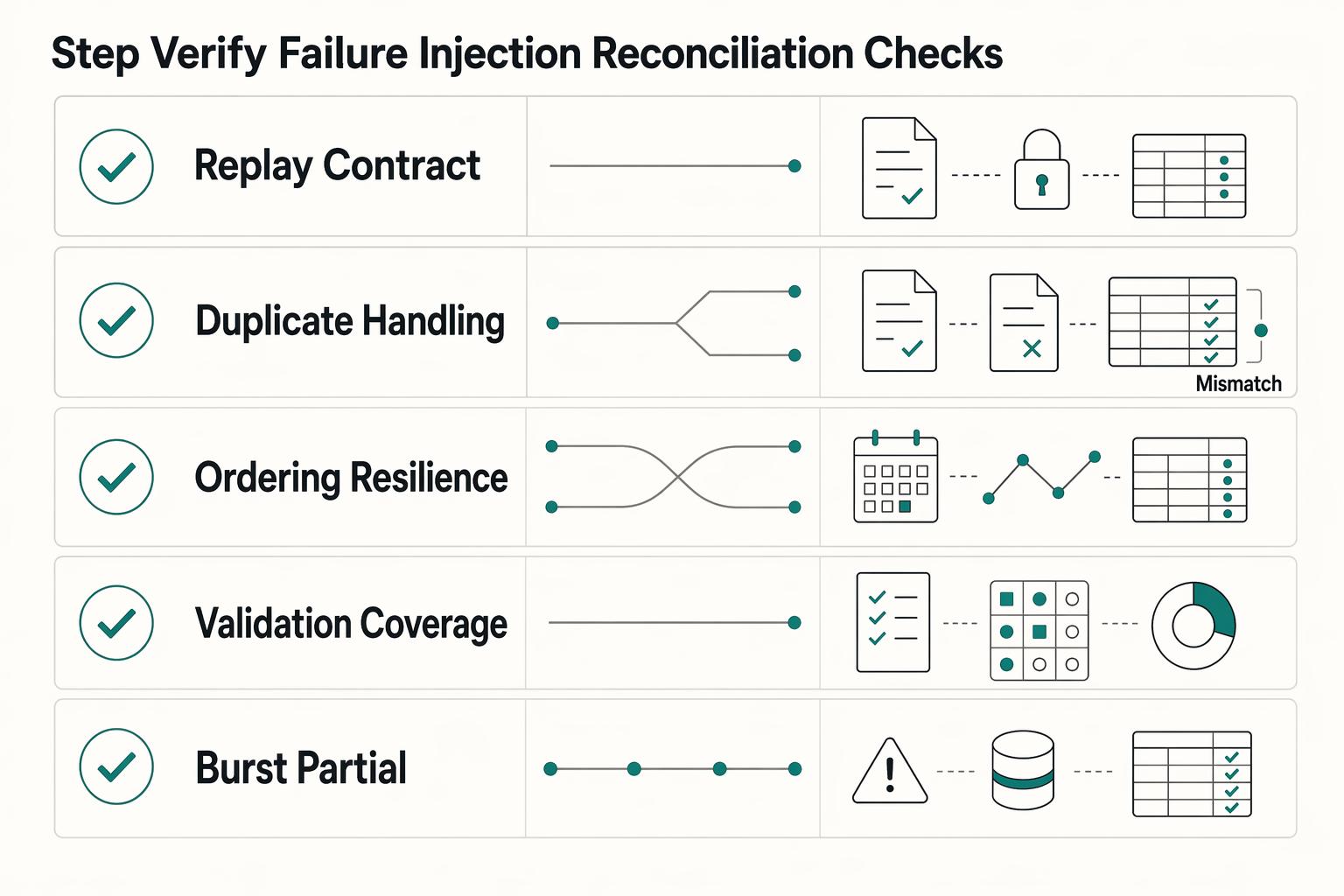
Prevent Duplicate Payouts and Double Charges with Idempotent Payment APIs
Treat duplicate money movement as a distributed retry problem, not a single HTTP bug. The goal is simple: the same customer intent should produce one financial result.
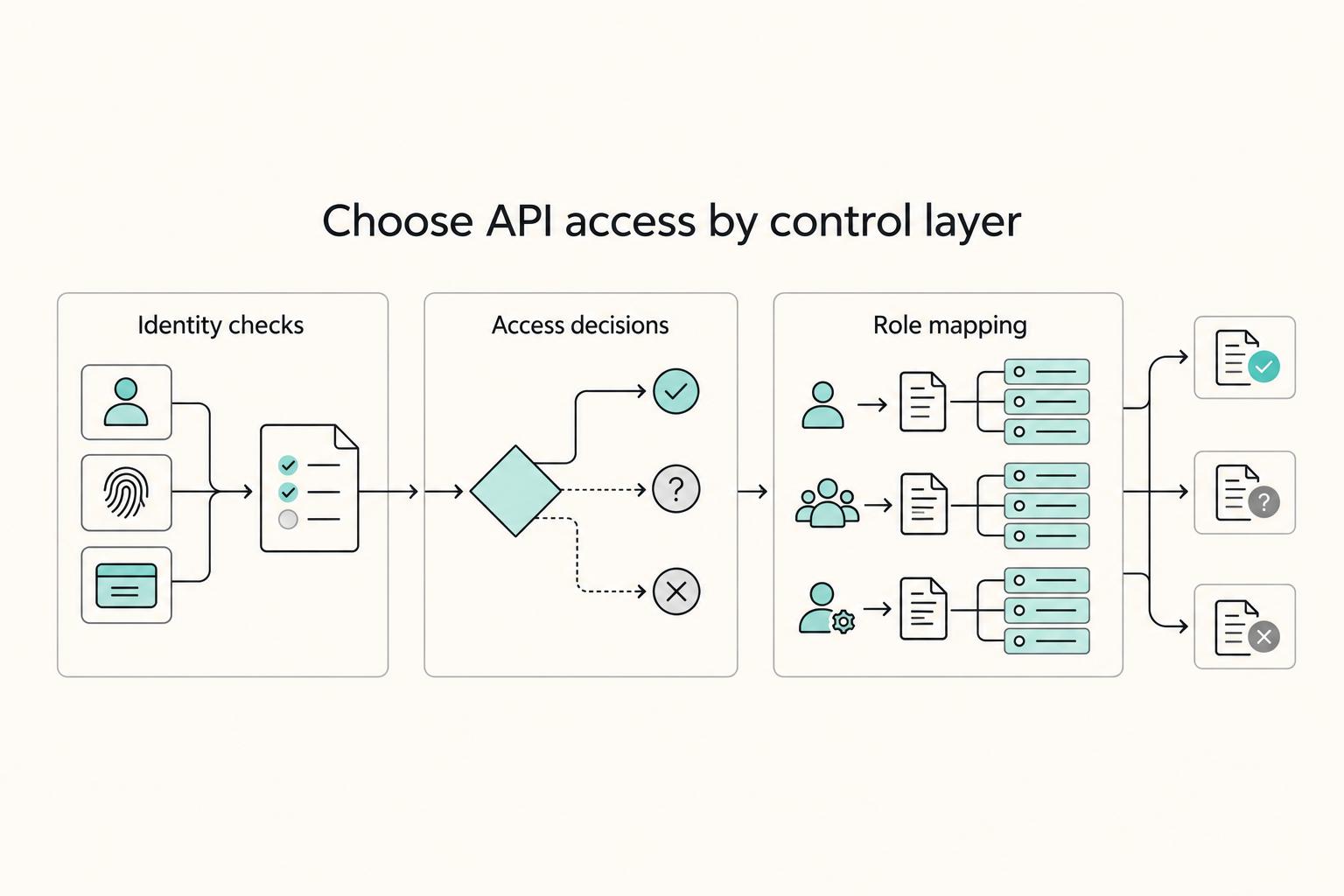
Choosing OAuth 2.0, JWT, or API Keys for Production APIs
Your first authentication choice is not just a security decision. It shapes how quickly you can launch payments, onboarding, reporting, and payouts, and how expensive cleanup becomes once partner access, credential rotation, or incident response starts to matter.
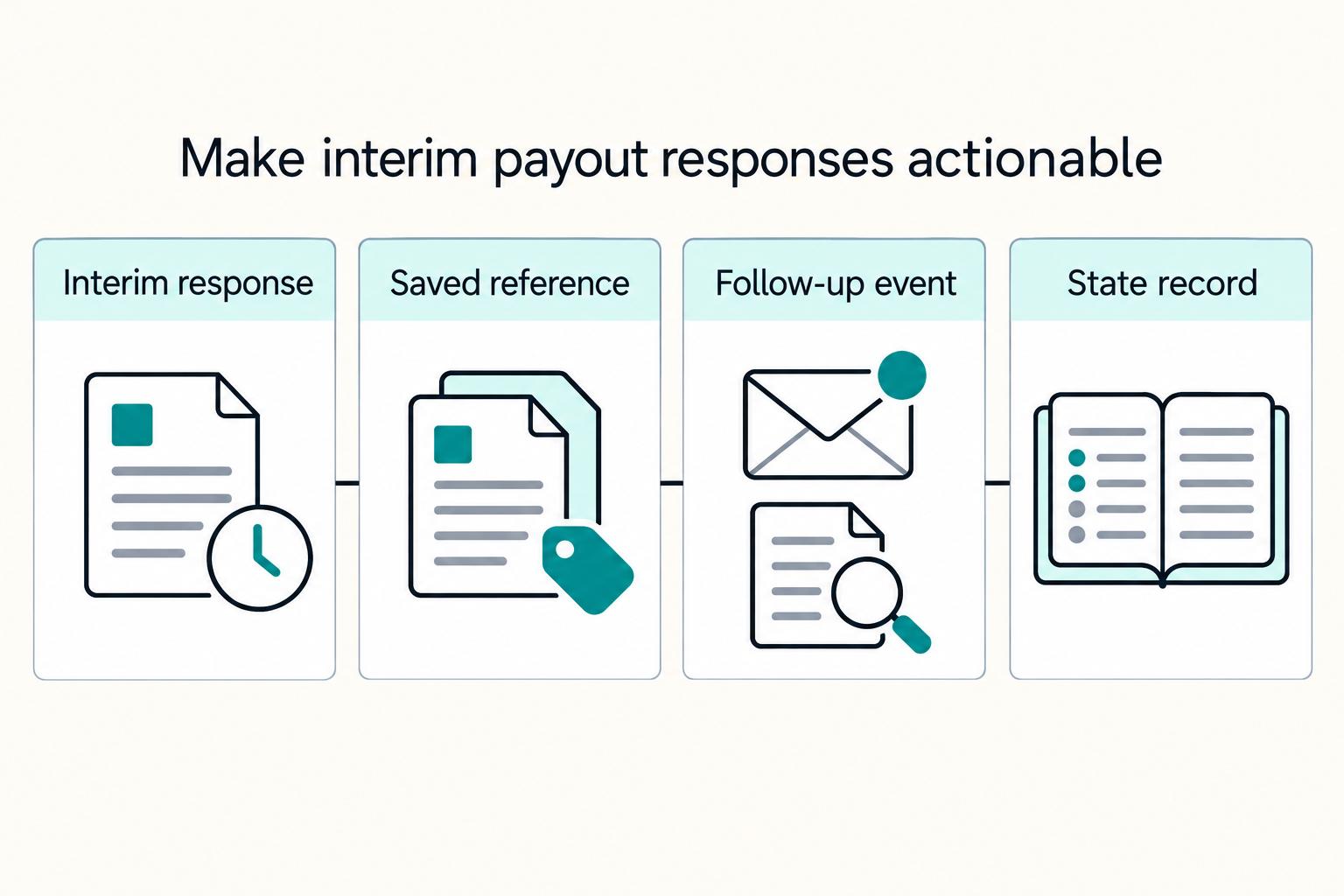
OpenAPI Specification for Payment Platforms: How to Document Your Payout API
Payout API docs often fail in production when they describe endpoints, not obligations. If you want teams to integrate and operate a payout API with confidence, treat the OpenAPI specification as the production contract from day one, not a side artifact generated after code ships.