
Quick Answer
Start with one master draft that states who you help, what you deliver, and proof a client can verify, then adapt it by channel without changing those core facts. If you are learning how to write a freelance bio, focus on fit first, not autobiography. Use a single CTA per version, set clear scope boundaries, and remove any claim you cannot defend with samples, published work, or role history.
Write a Client-Winning Freelance Bio in 30 Minutes#
If you want to know how to write a freelance bio that is client-focused, write for scan speed, not autobiography. Clients often read your headline before they open your portfolio, and first impressions can form in less than seven seconds. Your opening should show fit, proof, and a clear next step fast.
Step 1 Write one master bio that answers the client's first question#
Start by assuming nobody is reading for your full story. They want to know who you help, what you do, why they should believe you, and what they should do next. That is very different from a short professional bio that reads like a career summary.
Your master version should open with a headline and first paragraph that make you easy to place. A role-only headline like "Writer" or "Graphic Designer" is weak because it does not tell the client why you are the right fit. A stronger headline follows a simple structure: niche or role, specific result or industry, and a clear value add. Keep it plain enough that a client could repeat it back after one read.
Use this quick self-check for common style problems that can hurt outcomes:
| If your draft sounds like this | It reads as | What to replace it with |
|---|---|---|
| "I am a passionate freelancer with years of experience." | Personal-summary style | Name the client, service, and proof source |
| "My journey started when I discovered my love for design." | Backstory first | Lead with the client problem you solve now |
| "Writer / Designer / Consultant" | Generic headline | Use role + industry or result + value add |
| "I help brands grow with strategic solutions." | Vague promise | State what you deliver and for whom |
| "Available for exciting opportunities." | Weak next step | Ask for a call, brief, or portfolio review |
A good draft usually feels narrower than your full experience. That is a feature, not a flaw. Broad service lists can make you look flexible, but they can also make you harder to trust because the client cannot tell what you are actually known for.
Step 2 Keep only claims you can prove#
A strong bio gets its credibility from proof, not tone. Before a sentence stays in the draft, tie it to evidence you can show. A simple rule: every claim should map to a portfolio piece, a published sample, or relevant role history. If you describe yourself as experienced, specialist, conversion-focused, or trusted, be ready to point to the exact work that earns that wording.
One practical check is to mark each sentence in your draft and ask, "What proves this?" Keep your portfolio links, bylined articles, case examples, and past job titles beside the draft while you write. If a line has no proof behind it, narrow it until it does. "I write email campaigns for SaaS teams" is much easier to defend than "I help all businesses scale through world-class messaging."
A common failure mode here is writing a chronological resume instead of client-relevant value. Your old roles matter only when they support the offer in front of the buyer today. If they do not strengthen fit, trim them.
Step 3 Adapt by channel without changing the core message#
Once the core version is solid, adapt it for each placement instead of rewriting it from scratch. Social profiles and personal websites are often where people first see you, so keep your headline and opening lines easy to scan. Then adjust length and detail for each channel.
What should stay consistent across channels is the center of your positioning: who you help, what you deliver, and the proof you can defend. If your social profile says you help fintech founders with launch copy, but your website says you are a general content writer for any industry, that mismatch creates doubt before the client even reaches your samples.
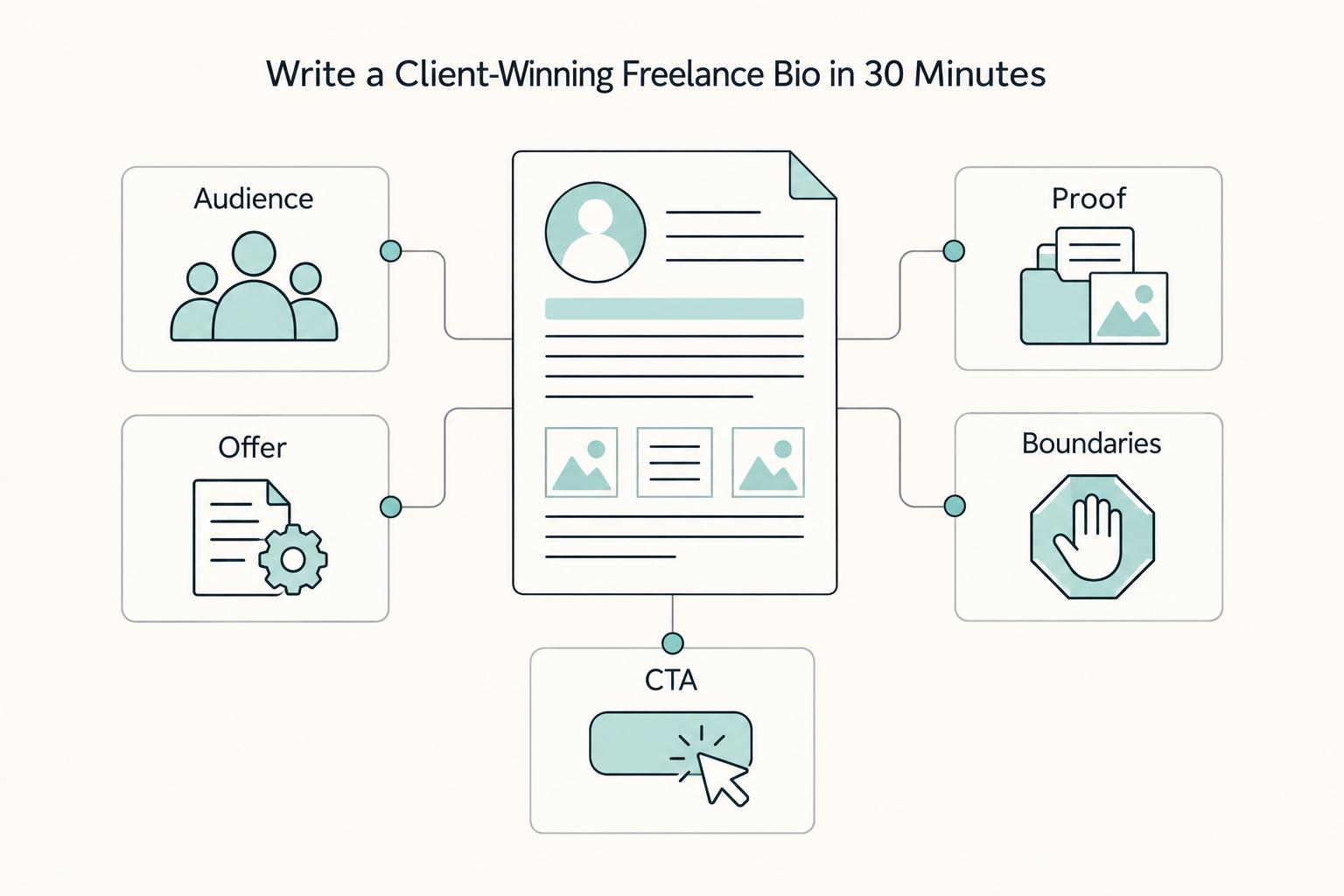
Before you draft, do this quick checkpoint pass:
- Audience: Name the client type you want this bio to attract.
- Offer: Decide the main service or result this version should sell.
- Proof: Pull 2 to 3 portfolio links, published samples, or past roles that support the claims.
- Boundaries: Note what you do not want this bio to imply or invite.
- CTA: Pick the one next step you want the reader to take.
That five-part check is what makes the writing faster later. Without it, you are not drafting a bio. You are improvising one. You might also find this useful: How to Manage Multiple Freelance Projects Without Losing Your Mind.
Prepare Your Inputs Before You Write#
Start with prep, not prose. Put your bio inputs in one working document so your draft stays consistent, client-focused, and easy to verify.
Step 1: Build one working doc with four inputs#
Use one page or note and capture these four areas before you write:
| Input | What to capture |
|---|---|
| Target client | Name who this bio is for in specific terms. |
| Service scope | State the main service this version is selling. |
| Best proof assets | List the strongest support you already have, such as portfolio pieces, published work, or relevant role history. |
| Niche statement | Write one identity line with your name, role, and differentiator. |
Then turn the table into one working line for each input:
- Target client
Name who this bio is for in specific terms.
- Service scope
State the main service this version is selling.
- Best proof assets
List the strongest support you already have, such as portfolio pieces, published work, or relevant role history. A resume or cover letter alone usually will not give decision-makers a clear picture.
- Niche statement
Write one identity line with your name, role, and differentiator.
If a sentence in your future bio cannot be traced back to this doc, treat it as unproven until you can support it.
Step 2: Compare channel versions side by side#
Bio copy is often reused across channels, but each channel needs the right length, tone, and next step. Review current versions in one table first:
| Channel | Current positioning | Proof used | Primary CTA |
|---|---|---|---|
| Website About page | What you say you do, for whom, and your angle | Portfolio links, case examples, relevant roles | Explore work, contact, or book a call |
| LinkedIn profile | Headline and intro fit with current niche | Job titles, featured work, published posts | Message, connect, or view work |
| Proposal materials | Intro aligned to the client's stated need | Similar sample, related project, role history | Reply, schedule a call, or review sample |
This makes inconsistencies obvious fast, especially on your About page.
Step 3: Assign one primary intent per channel#
Give each channel one primary intent and use it as an editing constraint. Secondary actions can exist, but one should lead.
If a sentence tries to do everything at once (career story, full services list, proof, and CTA), split or trim it. Keep each line tied to the channel's main job.
Step 4: Verify, soften, or cut major claims#
Before you draft new copy, run this claim pass:
| Claim status | Definition |
|---|---|
| Keep | Clearly supported by your existing proof. |
| Soften | Partially supported. |
| Cut | Unsupported. |
In your working doc, add a proof link or source note next to each major claim you plan to keep. This keeps the final draft credible and makes it easier to avoid overclaiming.
Step 5: Run a pre-draft quality gate#
Check these quickly before you move on:
- Audience is clear.
- Niche is consistent across channels.
- Each channel has one primary CTA.
- Vague hype words are removed or supported.
- Outdated titles, industries, or services are removed.
If this pass is clean, move to positioning. Related: How to Manage Your Personal Brand as a Freelancer.
Set Your Positioning So Clients Know You Are for Them#
Start with one positioning line the right buyer can recognize fast: audience, service, outcome.
Step 1 Draft your opening line in buyer order#
Use this prompt and fill in the blanks:
- Who do you help most often right now?
- What specific service do you deliver for them?
- What practical outcome does that work support?
Draft template: [Full name] is a [job title] who helps [primary audience] with [service] so they can [outcome].
Keep this line checkable, not inflated. Include your full name and an appropriate job title in the first sentence, then choose voice by channel: third person for formal placements, first person for more personal ones.
Step 2 Pick one primary audience using your current proof#
Choose one primary audience for the opener, then place secondary audiences later in the bio.
Use this prioritization rule:
- Review your 2 to 3 strongest proof assets.
- Identify which audience appears most consistently.
- Make that audience your primary one.
| Aspect | Broad positioning | Niche-led positioning |
|---|---|---|
| Clarity | Usually needs more context before fit is clear | Fit is easier to scan in the first line |
| Trust | Relies more on proof later in the bio | Often reads as more credible because scope is tighter |
| Lead quality | Can attract a wider but more mixed set of inquiries | Can attract inquiries closer to your core offer |
Broad copy can feel flexible. Niche-led copy usually reduces interpretation work for the reader.
Step 3 Define fit boundaries with verifiable language#
After your opener, add a quick fit framework:
- What you do
- What you do not do
- What projects are best fit
Write these as concrete, supportable statements, not self-descriptors.
Then match claim strength to evidence:
- If you are early-stage with limited relevant samples, lead with clear scope and avoid big outcome claims.
- If you have stronger proof (published work, repeat project patterns, relevant role history), add specialization or a significant achievement later in the bio.
Final check: if a line cannot be tied to a sample, published piece, or role history, soften it or cut it. Also keep backups of published proof, including screenshots, so your evidence stays usable if links disappear.
Build a Proof Stack That Sounds Credible Without Overselling#
Your proof stack should do one job clearly: make a claim, attach the strongest verifiable evidence, then trim any wording that evidence cannot support.
Step 1 Match every claim to one checkable proof#
Start with the strongest signal you can verify quickly. For most freelancers, that is a work sample, published piece, or role history directly tied to the service you offer. Credentials help when they show real authority, but they should support your evidence, not replace it.
| High-trust proof signal | Weak or decorative signal |
|---|---|
| Linked sample, published piece, or portfolio item | "Experienced," "passionate," "results-driven" |
| Role-based evidence tied to the service | Broad title with no context |
| Specific detail such as "nine years," "three attached samples," or a dated project scope | Big claims with no date, link, or artifact |
If a client cannot easily validate the line, simplify it or cut it.
Step 2 Use narrower proof if you are early-stage#
If you do not have major logos or standout achievements yet, do not invent authority. Use the concrete artifacts you do have: a scoped project, a guest post, a before-and-after sample, or relevant work from a prior role. Specifics are more credible than self-praise.
Keep the claim size matched to the evidence size. If your proof is limited, keep your wording limited too.
Step 3 Keep personal details only when they improve fit or trust#
Some bio advice allows interesting personal details even when they are loosely relevant, but client-facing bios work better when each detail helps someone decide if you are the right fit. Keep details that strengthen domain trust, audience understanding, or practical working fit. Cut details that do not change a buyer decision.
Final verification check before you adapt this for each channel: every proof line should be easy to validate, stay consistent across platforms, and remain accurate after compression.
If you need the next step, see How to Write a Freelance Proposal That Wins Clients.
Draft the Core Bio Using a Repeatable Structure#
Draft your core bio in five lines, with one decision task per line. Keep proof and scope separate so a client can quickly judge relevance, credibility, fit, and next step.
- Fit line: Say who you are, what you do, and who you help in plain language. This should answer, "Is this relevant to my problem?"
- Value line: State what you deliver or improve for that client type, and make your point of difference clear. Avoid turning this into a broad service list.
- Proof line: Add one relevant achievement, experience detail, or work-sample signal that supports your value claim. Keep promises at the same level as your evidence.
- Scope line: Define the work you take on (or do not take on) so poor-fit inquiries filter out early. This should answer, "Is this the engagement they actually want?"
- Single CTA: Ask for one action only, such as reviewing samples or reaching out about a specific project type.
| Part | Strong line | Weak line |
|---|---|---|
| Fit | "I write case studies for B2B SaaS teams selling to technical buyers." | "I am a versatile freelance writer with many skills." |
| Value | "I turn product wins into sales-ready proof for demand gen and sales teams." | "I help brands tell their story." |
| Proof | "Recent work includes three published case studies and prior in-house content experience." | "Highly experienced and results-driven." |
| Scope | "Best fit: case studies, customer stories, and interview-led content, not daily social posting." | "Open to all writing projects." |
| CTA | "Review my samples and message me if you need interview-led customer content." | "Let's connect sometime." |
Cleanup pass: remove vague adjectives, keep only verifiable claims, and check role and offer consistency across all five lines. If your fit line says strategist but your scope only offers execution, fix that before adapting for LinkedIn, your website, or pitch copy.
This core draft is your master source. Finalize it first, then adapt length and tone for LinkedIn, your website, and outreach without changing core facts.
For a step-by-step walkthrough, see How to Write a Freelance Instagram Bio That Filters for Fit.
Adapt the Same Bio for Each Channel Without Losing Consistency#
Change emphasis by channel, not your identity. Keep one master bio with three fixed points: who you help, what you deliver, and your strongest proof. If those shift across your LinkedIn profile, website, and pitches, the message starts to feel inconsistent.
Step 1. Lock non-negotiables in one master version. Before you publish anywhere, keep your core bio in one working document and lock the parts that should not move: niche, service focus, and best evidence. Use details you can verify quickly, such as relevant sample links, role history, published work, or a clear service boundary. For example: "case studies and customer stories, not daily social content." If a claim is not backed by a sample, title, or past role, cut it.
Run a side-by-side check on two channel drafts before you publish. If one version names a specific audience and another sounds broad, update the master first, then rebuild the shorter version from it.
Step 2. Adapt order and tone for each channel. You do not need to reinvent the bio for every channel. You do need to match length and tone to the placement.
| Channel | Purpose | Prioritize first | Trim | CTA |
|---|---|---|---|---|
| Fast first impression and profile scan | Fit line, strongest proof, current offer | Long backstory, broad service lists | "Message me if you need [service] for [client type]." | |
| Personal website About page | Clarify offer and qualify leads | Service boundaries, fit criteria, proof links | Generic personality filler | "Review samples and get in touch about [project type]." |
| Platform profile | Match platform opportunities quickly | Relevant samples, scoped services, role history | Off-topic services, weak claims | "Invite me for [specific engagement]." |
| Pitch email or cover letter | Show match for one opportunity | Most relevant proof and direct fit | Full bio paragraph, unrelated achievements | "Happy to send clips or discuss this assignment." |
Step 3. Swap in proof that fits the channel. Keep the same core facts, but surface the most relevant proof for that context. Use your strongest proof early in short-profile formats. Use extra space on your About page for boundaries and best-fit criteria. On platform profiles, lead with samples that match posted opportunities. In pitches or cover letters, keep it concise and mirror the opportunity. Some submission contexts may require a short bio in the cover letter, so keep a short version ready.
Watch for inflation when you compress. Replace labels like "expert" or "industry leader" with proof you can verify.
Step 4. Run a consistency QA pass before publishing. Use this mini-checklist each time you update a version. If you publish across multiple channels, review it once a week:
- Same niche named everywhere
- Same claim strength everywhere
- Same offer boundaries everywhere
- Same tone and level of seniority everywhere
If one version sounds broader, more senior, or more results-heavy than the others, fix it before it goes live. This catches drift early and keeps your bio credible across touchpoints.
We covered this in detail in How to Write a Compelling 'About Me' Page for Your Freelance Website.
Add Conversion Mechanics So the Bio Brings In Better Leads#
Use each bio version to do two jobs at once: move qualified prospects forward and help poor-fit inquiries self-select out early.
Step 1: Use one CTA with one action. Start with a command verb and ask for a single next step. "Message me if you need case studies for B2B SaaS" is stronger than "Let's connect" because it names both service and fit. Quick check: read your CTA alone. If someone could reply without showing fit, tighten it.
Step 2: Build your CTA around three fit filters. Keep these in or near the ask:
- Ideal client profile: who you serve
- Service boundary: what you do and do not do
- Project-type match: the kind of work you want
If your boundary is "customer stories, not daily social content," say that directly. Specific wording gives good-fit prospects a clear yes and gives poor-fit prospects a clear no. If your bio sounds interchangeable, people tend to compare on price.
| Channel | Best single ask | What the prospect should send | Expectation to set next |
|---|---|---|---|
| LinkedIn profile | Message you about a specific need | A short note confirming they need your named service and fit your named client type | Say you will reply with relevant samples or fit questions |
| Website About page | Get in touch about one project type | A message tied to the project type named on the page | Say what happens after contact (for example, a follow-up reply) |
| Platform profile or pitch | Invite or reply for the relevant engagement | Opportunity details or assignment context | Say you can share relevant clips or discuss the assignment |
Step 3: Run a pre-publish check.
- One verifiable proof signal (sample link, published work, or past role)
- One clear next step written as a command
- One expectation-setting line about what happens after contact
- One final ambiguity scrub for vague claims, mixed services, or overly broad wording
If you want the full breakdown, read How to Write a Book to Establish Your Freelance Expertise.
Fix Common Bio Mistakes Before You Publish#
Run a QA pass before you publish, not just a style polish. Treat this bio like client-facing work, because every word is a writing sample. If a line sounds inflated, unclear, or hard to defend in a follow-up question, revise it now.
Step 1. Verify every claim with proof. Read line by line. For each service or credibility claim, pair it with one concrete outcome and one verifiable proof source (for example, a linked sample, published work, a past role, or a portfolio item). If you cannot defend the claim quickly, cut it or narrow it.
| Mistake | What it sounds like | Fix standard |
|---|---|---|
| Unsupported claim | "Expert copywriter for every industry" | Name the real service, one relevant outcome, and one proof source you can show |
| Vague service language | "I help brands grow" | State the buyer, deliverable, and scope boundary in plain language |
| Promise-proof mismatch | "I write high-converting SaaS case studies" with only unrelated samples | Replace the proof with a matching sample, or reduce the claim to what your proof supports |
| Expectation-conflict wording | "Available for ongoing content support" when you only do project work | Rewrite to match your actual availability and engagement type |
Step 2. Remove credibility-risk wording. Do not use titles or positioning you cannot substantiate. If you have not earned a label yet, do not claim it. Overstated wording loses trust fast.
Step 3. Check clarity against your real scope. Make sure your bio clearly says what you do, who you help, and what you do not do. If wording can attract the wrong inquiry, tighten it. Read your promise and proof side by side; they should point to the same service, buyer, and experience level.
Step 4. Confirm readiness before publish or submission. Do not publish the rushed version. If this bio is for an application, pitch, or platform profile, recheck required fields and submission guidelines before sending. If you catch an error after sending, correct it directly, send the right version, and give a clear ETA for follow-up.
Use this final publish gate:
- Every service claim has one outcome and one proof source.
- Your CTA matches your real scope and availability.
- Titles and experience claims are fully supportable.
- Buyer, deliverable, and boundary wording are specific.
- Any unresolved doubt sends this draft back to revision, not to publish.
Related reading: How to Write a Compelling Case Study.
Wrap Up and Use This Copy Paste Checklist#
Treat your professional bio as an operating tool, not a polishing project. Run this final pass/fail review before you publish.
| Check | Pass if | Fail if |
|---|---|---|
| Fit check | Your opening states who you help, what you do, and your unique offering. | A reader still cannot tell what kind of work you take. |
| Proof check | Each credibility claim is tied to support you can show right now, for example relevant work examples or role history. | Someone could ask for proof and you cannot provide it. |
| Scope check | Your services are clear and you set at least one boundary for poor-fit work. | The bio reads like you do everything for everyone. |
| Master-to-channel sync check | Core facts match and only length, tone, and CTA are tailored to the platform. | Niche, services, or availability conflict across versions. |
| Next-step check | Each version ends with one clear call to action. | The reader has to guess what to do next. |
| Language-risk check | Every claim is verifiable and wording is specific. | You rely on vague or inflated terms without support. |
If you prefer a line-by-line review, use the same checklist in this order:
- Fit check. Pass if your opening states who you help, what you do, and your unique offering. Fail if a reader still cannot tell what kind of work you take.
- Proof check. Pass if each credibility claim is tied to support you can show right now, for example relevant work examples or role history. Fail if someone could ask for proof and you cannot provide it.
- Scope check. Pass if your services are clear and you set at least one boundary for poor-fit work. Fail if the bio reads like you do everything for everyone.
- Master-to-channel sync check. Compare your master version with your LinkedIn profile, About page, and pitch version. Pass if core facts match and only length, tone, and CTA are tailored to the platform. Fail if niche, services, or availability conflict across versions.
- Next-step check. Pass if each version ends with one clear call to action. Fail if the reader has to guess what to do next.
- Language-risk check. Pass if every claim is verifiable and wording is specific. Fail if you rely on vague or inflated terms without support.
After this self-review, get help only for the gap you found. If proof is the weak point, start with How to Build a Freelance Portfolio Clients Trust, then return and publish.
Frequently Asked Questions
What should a freelance bio include?
A freelance bio should quickly show what kind of freelancer you are, who you help, and what you specialize in. Then add concise details that help a client judge fit and know the next step. If your opening sentence does not make your offer clear, rewrite it before you publish.
How long should a professional bio be?
Let the channel decide the length. A longer version can hold more qualifications and context, but a profile or pitch version should get to fit faster. If you need extra space just to explain what you do, clarify your positioning first.
Can beginners write a strong writer's bio without major clients?
Yes, if the claims are narrow and verifiable. Use proof you can stand behind and show when asked. If a client could ask “where can I see that?” and you have no answer, cut the line or narrow it.
Should I use the same bio on a LinkedIn profile and an About page?
Use the same core business facts everywhere, but adapt the depth, emphasis, and CTA to the channel. Update the master draft first, then adapt from that source instead of rewriting from memory. If one version promises broader services, different availability, or a different niche, you have a channel mismatch. | Channel | Depth | Emphasis | CTA style | |---|---|---|---| | LinkedIn profile | Shorter and easy to scan | Fit and core details in the first lines | Invite a message, connection, or brief inquiry about a specific service | | About page | Longer when space allows | Services, niches, qualifications, boundaries, and best-fit clients | Point to a contact page, portfolio, or inquiry step | | Pitch or cover letter | More compressed and opportunity-specific | Match the client need or assignment first | Ask for the next decision tied to that opportunity | If you use a professional headshot, keep the same one across profiles for consistency.
What should I avoid in a freelance bio?
Avoid generic descriptors, irrelevant life story, and any line you cannot verify. Keep only details that help a client judge fit. If a line sounds polished but could describe many freelancers, it is too vague.
How often should I update my freelance writing profile and website bio?
Update it whenever your niche, services, proof, availability, contact path, or current offer changes. Even when nothing major has shifted, do a periodic cross-channel review against your master draft. If one published version still reflects retired services or older proof, it is out of date.
Try a related tool
Researched and edited by the Gruv editorial team. Gruv builds cross-border billing, payouts, and finance-operations software for global businesses.
Sources
Includes 6 external sources outside the trusted-domain allowlist.
- franklinpierce.edu/academics/Academic-Catalog-2020-2021.pdftrusted
- luzerne.edu/academics/catalogs/2017-18.pdftrusted
- askamanager.org/2025/01/open-thread-january-17-2025.htmlexternal
- beafreelanceblogger.com/emergency-prepareexternal
- blog.annabyang.com/manage-your-content-across-multiple-platformsexternal
- blog.hubspot.com/marketing/professional-bio-examplesexternal
- ca.indeed.com/career-advice/career-development/how-to-writ...external
- elnacain.com/blog/write-an-about-page-freelance-writerexternal
Educational content only. Not legal, tax, or financial advice.
Related Posts

Georgia 1% Tax for Entrepreneurs Without Filing Surprises
Treat Georgia's 1% tax path as a compliance question first and a rate discussion second. The goal is a setup you can defend under review, not a shortcut that fails at filing time.

How to Manage Your Personal Brand as a Freelancer
Your brand is not a mood board. Think of it as the experience people have of your work: the promise you make, the proof you can show, and the way you present yourself across client touchpoints. Get that clear first, and your fit is easier to read from profile to proposal.

How to Manage Multiple Freelance Projects Without Losing Your Mind
If this feels hard, the issue is often not your craft. It is a lack of operating control: too many open commitments, a calendar filled with delivery blocks, an inbox setting priorities, and tasks that feel urgent because no clear next action exists.